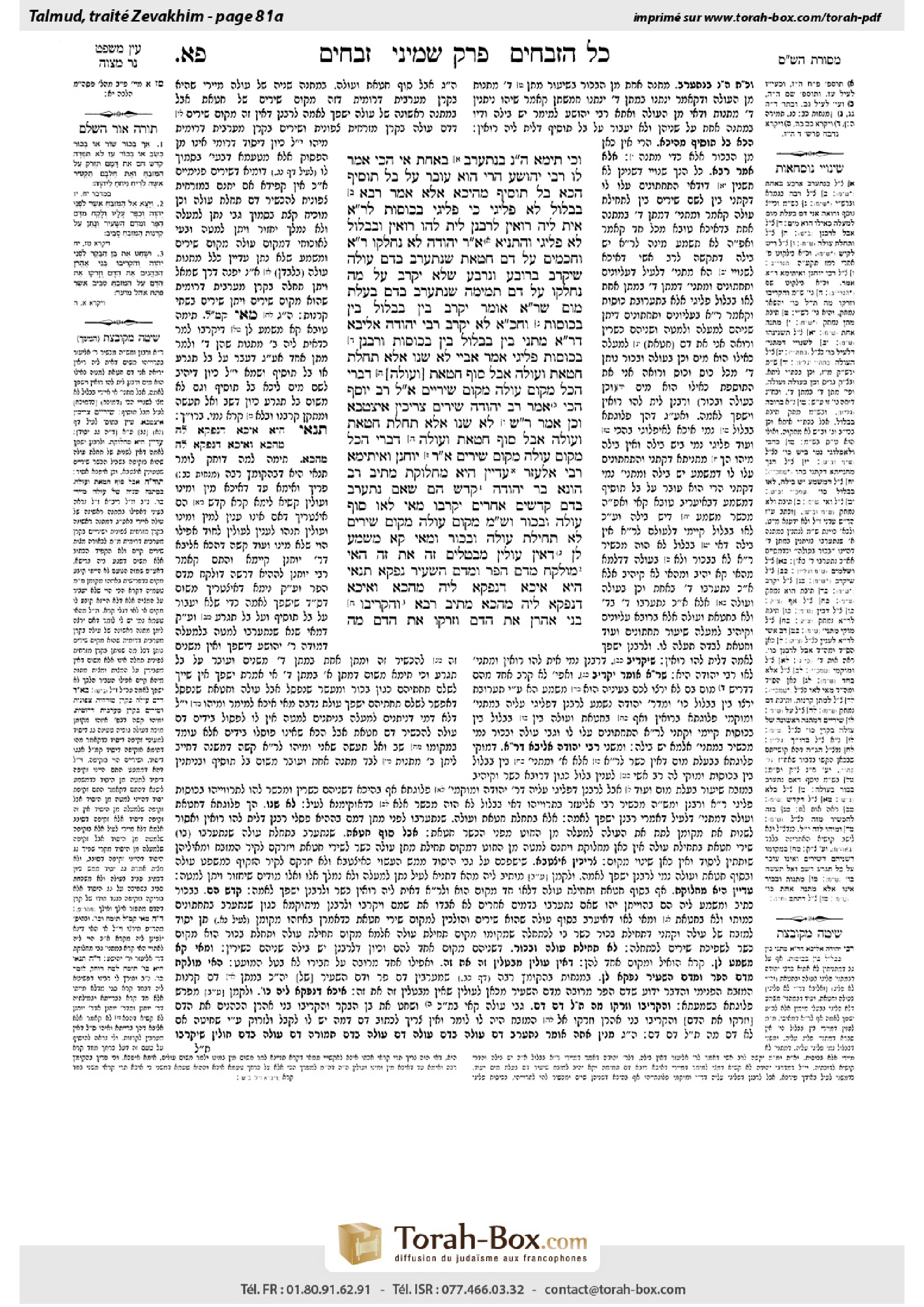
Zevachim 81a: Talmud study for Daf Yomi
Daf Yomi is the daily study of one Talmud folio. Explore 37 tractates with scans, Hebrew text, Sefaria English and AI-generated French translations where annotated.
Passage selection and English or AI-generated French translation are available where the scan has annotations. Daf Study is independent of Torah-Box and Sefaria.
Browse Zevachim · זבחים · All tractatesZevachim 81a text and translations
This page of Zevachim includes the Aramaic text, an English translation and an AI-generated French translation, alongside the scan above.
זבחים פ״א א · Aramaic and Hebrew text
וְכִי תֵּימָא הָכָא נָמֵי בְּנִתְעָרֵב בְּאַחַת; אִי הָכִי, אָמַר לוֹ רַבִּי יְהוֹשֻׁעַ: הֲרֵי הוּא עוֹבֵר עַל בַּל תּוֹסִיף – הָכָא בַּל תּוֹסִיף מֵהֵיכָא?
אֶלָּא אָמַר רָבָא: בְּבָלוּל לָא פְּלִיגִי, כִּי פְּלִיגִי – בְּכוֹסוֹת; לְרַבִּי אֱלִיעֶזֶר אִית לֵיהּ רוֹאִין, לְרַבָּנַן לֵית לְהוּ רוֹאִין.
וּבְבָלוּל לָא פְּלִיגִי?! וְהָתַנְיָא, אָמַר רַבִּי יְהוּדָה: לֹא נֶחְלְקוּ רַבִּי אֱלִיעֶזֶר וַחֲכָמִים עַל דַּם חַטָּאת שֶׁנִּתְעָרֵב בְּדַם עוֹלָה – שֶׁיִּקְרַב, בְּרוֹבֵעַ וְנִרְבָּע – שֶׁלֹּא יִקְרַב. עַל מָה נֶחְלְקוּ? עַל דַּם תְּמִימָה שֶׁנִּתְעָרֵב בְּדַם בַּעֲלַת מוּם – שֶׁרַבִּי אֱלִיעֶזֶר אוֹמֵר: יִקְרַב, בֵּין בְּבָלוּל בֵּין בְּכוֹסוֹת; וַחֲכָמִים אוֹמְרִים: לֹא יִקְרַב.
רַבִּי יְהוּדָה אַלִּיבָּא דְּרַבִּי אֱלִיעֶזֶר מַתְנֵי בֵּין בְּבָלוּל בֵּין בְּכוֹסוֹת, וְרַבָּנַן בְּכוֹסוֹת פְּלִיגִי.
אָמַר אַבָּיֵי: לֹא שָׁנוּ אֶלָּא תְּחִלַּת חַטָּאת וְעוֹלָה,
אֲבָל סוֹף חַטָּאת [וְעוֹלָה] – דִּבְרֵי הַכֹּל מְקוֹם עוֹלָה מְקוֹם שִׁירַיִים. אֲמַר לֵיהּ רַב יוֹסֵף, הָכִי אָמַר רַב יְהוּדָה: שִׁירַיִם צְרִיכִין אִיצְטְבָא.
וְכֵן אָמַר רַבִּי שִׁמְעוֹן: לֹא שָׁנוּ אֶלָּא תְּחִלַּת חַטָּאת וְעוֹלָה, אֲבָל סוֹף חַטָּאת וְעוֹלָה – דִּבְרֵי הַכֹּל מְקוֹם עוֹלָה מְקוֹם שִׁירַיִם. אָמַר רַבִּי יוֹחָנָן, וְאִיתֵּימָא רַבִּי אֶלְעָזָר: עֲדַיִין הִיא מַחְלוֹקֶת.
מֵתִיב רַב הוּנָא בַּר יְהוּדָה: ״קֹדֶשׁ הֵם״ – שֶׁאִם נִתְעָרֵב בְּדַם קָדָשִׁים אֲחֵרִים, יִקְרְבוּ. מַאי, לָאו סוֹף עוֹלָה וּבְכוֹר – וּשְׁמַע מִינַּהּ מְקוֹם עוֹלָה מְקוֹם שִׁירַיִם? לָא; תְּחִילַּת עוֹלָה וּבְכוֹר.
וּמַאי קָא מַשְׁמַע לַן, דְּאֵין עוֹלִין מְבַטְּלִים זֶה אֶת זֶה? הַאי מִ״וְּלָקַח מִדַּם הַפָּר וּמִדַּם הַשָּׂעִיר״ נָפְקָא! תַּנָּאֵי הִיא; אִיכָּא דְּנָפְקָא לֵיהּ מֵהָכָא, וְאִיכָּא דְּנָפְקָא לֵיהּ מֵהָכָא.
מֵתִיב רָבָא: ״וְהִקְרִיבוּ בְּנֵי אַהֲרֹן אֶת הַדָּם וְזָרְקוּ אֶת הַדָּם״ – מָה
Zevachim 81a · English translation
And if you would say that here too, the mishna is discussing a case where the measure of four placements was mixed with precisely the amount of one placement, and therefore the priest certainly placed some blood of both offerings, if so, how would one explain the clause in the mishna that states: Rabbi Yehoshua said to Rabbi Eliezer: According to your opinion, doesn’t the priest violate the prohibition of: Do not add? From where is the violation of: Do not add, here? After all, the priest places only the measure of one placement from the offering that requires one placement.
Rather, Rava says: Rabbi Eliezer and the Rabbis do not disagree with regard to a case of actual blood mixed together. When they disagree it is with regard to a case of cups of blood that were intermingled, and it is unknown which blood is in which cup. The explanation according to Rabbi Eliezer is that he is of the opinion that one views the blood that was not placed properly as though it were water, and therefore it is permitted to present the blood; whereas the explanation according to the Rabbis is that they are not of the opinion that one views the blood that was not placed properly as though it were water, and consequently all of it must be poured into the Temple courtyard drain.
The Gemara asks: And do they not disagree with regard to blood mixed together? But isn’t it taught in a baraita: Rabbi Yehuda said: Rabbi Eliezer and the Rabbis did not disagree in a case of blood of a sin offering that was mixed with blood of a burnt offering that the mixture shall be sacrificed, or in a case of blood that was fit for presentation that was mixed with the blood of an animal that copulated with a person, or an animal that was the object of bestiality, that it shall not be sacrificed. The baraita continues: With regard to what case did they disagree? With regard to blood of an unblemished animal that was mixed with blood of a blemished animal, as Rabbi Eliezer says that it shall be sacrificed, whether in a case of blood mixed together or in a case of cups intermingled, and the Rabbis say it shall not be sacrificed.
The Gemara answers: Rabbi Yehuda, in accordance with the opinion of Rabbi Eliezer, i.e., when Rabbi Yehuda teaches the opinion of Rabbi Eliezer, teaches that the dispute applies both in a case of blood mixed together and in a case of intermingled cups, but the Rabbis who taught the mishna maintain that Rabbi Eliezer and the Rabbis disagree only in a case of intermingled cups.
§ The mishna teaches that if the blood of a sin offering, which is to be placed above the red line, was mixed with blood of a burnt offering, which is to be placed below the line, Rabbi Eliezer holds that it shall all be placed above the red line, and one views the blood of the burnt offering placed there as though it is water, and subsequently the priest shall place the blood below the red line. By contrast, the Rabbis rule that all the blood shall be poured into the Temple courtyard drain. Concerning this, Abaye says: The mishna taught that according to the opinion of the Rabbis the blood shall be poured into the drain only if the first portion of the blood of a sin offering, i.e., that blood which is to be placed above the red line, and the blood of a burnt offering were mixed.
But if the final portion of the blood of a sin offering, i.e., the remainder of the blood that is poured onto the base of the altar (see Leviticus 4:25), and the blood of a burnt offering were mixed, everyone agrees that since the place of the blood of a burnt offering, below the red line, is the same as the place of the remainder of the blood of a sin offering, as the remainder of the blood of a sin offering is poured on the base of the altar, the priest shall place all the blood on the side of the altar below the red line. Rav Yosef said to Abaye: This is what Rav Yehuda says: The places are not the same, as the remainder of blood needs to be placed on the bench, i.e., on the upper horizontal surface of the base itself, and not on the side of the altar as is the case with the blood of a burnt offering.
The Gemara notes that amora’im of Eretz Yisrael disagreed in the same manner as Abaye and Rav Yosef: And likewise Rabbi Shimon ben Lakish says: The mishna taught that according to the opinion of the Rabbis the blood shall be poured into the drain only if the first portion of the blood of a sin offering and the blood of a burnt offering were mixed. But if the final portion of the blood of a sin offering and the blood of a burnt offering were mixed, everyone agrees that since the place of the blood of a burnt offering is the same as the place of the remainder of the blood of a sin offering, the priest shall place all the blood on the side of the altar below the red line. Rabbi Yoḥanan says, and some say it was Rabbi Elazar who says: This case of the remainder of blood of a sin offering that was mixed with the blood of a burnt offering is still included in the dispute between Rabbi Eliezer and the Rabbis.
Rav Huna bar Yehuda raises an objection from a baraita: The verse states with regard to firstborn animals: “They are holy” (Numbers 18:17). The emphasis of the term “they” serves to teach that even if the blood of a firstborn offering was mixed with blood of other sacrificial animals, the blood shall be sacrificed, as the blood of firstborn offerings is not nullified. What, is it not referring even to a case of the final portion of the blood of a burnt offering and the blood of a firstborn offering that were mixed, indicating that the priest places the mixture below the red line? And if so, one can learn from this baraita that the place of the blood of a burnt offering, which is also the place of the blood of a firstborn offering, is the same as the place of the remainder of blood of a sin offering. The Gemara answers: No, the baraita is referring to the first part of the blood of a burnt offering and the blood of a firstborn offering.
The Gemara raises a difficulty: But if so, what is this baraita teaching us? Is it teaching that the blood of offerings that ascend to the altar do not nullify one another? This halakha is already derived from the verse: “And he shall take of the blood of the bull and of the blood of the goat” (Leviticus 16:18), from which it is understood that although the blood of the two animals is in the same vessel, they each retain their distinct identity. The Gemara answers: This is a dispute between tanna’im, as there is a tanna who derives this halakha from here, and there is a tanna who derives it from there.
Rava raises an objection from a baraita that discusses a verse describing a burnt offering: “And Aaron’s sons, the priests, shall present the blood and sprinkle the blood” (Leviticus 1:5). The superfluous second mention of the blood teaches that it is still called the blood of a burnt offering even after it was mixed with other blood, and therefore it should be sprinkled in its proper manner. What does it mean when
Zevachim 81a · Traduction française (IA)
Et si tu dis qu’ici aussi, la Michna traite d’un cas où la quantité correspondant à quatre aspersions a été mélangée à exactement la quantité correspondant à une aspersion, de sorte que le prêtre a certainement aspergé du sang des deux offrandes, comment expliquer alors la clause de la Michna où Rabbi Yehoshua dit à Rabbi Eliezer : « Selon ton opinion, le prêtre ne transgresse-t-il pas l’interdit de ne pas ajouter ? » D’où vient ici la transgression de l’interdit de ne pas ajouter ? Après tout, le prêtre n’asperge que la quantité correspondant à une aspersion de l’offrande qui ne requiert qu’une aspersion.
Rava dit plutôt : Rabbi Eliezer et les Sages ne sont pas en désaccord dans le cas où du sang a réellement été mélangé. Leur désaccord porte sur des coupes de sang interverties, de sorte qu’on ignore quel sang se trouve dans chaque coupe. Selon Rabbi Eliezer, il faut comprendre qu’il estime que l’on considère le sang qui n’a pas été appliqué correctement comme de l’eau ; il est donc permis de présenter le sang. Selon les Sages, il faut comprendre qu’ils n’estiment pas que l’on considère le sang qui n’a pas été appliqué correctement comme de l’eau ; par conséquent, tout le sang doit être versé dans le conduit d’évacuation de la cour du Temple.
La Guemara demande : Ne sont-ils donc pas en désaccord dans le cas où du sang a été mélangé ? N’est-il pas enseigné dans une baraïta : Rabbi Yehuda a dit : Rabbi Eliezer et les Sages n’étaient pas en désaccord dans le cas où le sang d’un sacrifice expiatoire avait été mélangé au sang d’un holocauste, et où le mélange devait être sacrifié ; ni dans le cas où du sang propre à être présenté avait été mélangé au sang d’un animal qui s’était accouplé avec une personne, ou au sang d’un animal qui avait été l’objet d’une relation sexuelle avec un homme, et où le mélange ne devait pas être sacrifié. La baraïta poursuit : Sur quel cas étaient-ils en désaccord ? Sur celui du sang d’un animal sans défaut mélangé au sang d’un animal présentant un défaut. Rabbi Eliezer dit que le mélange doit être sacrifié, qu’il s’agisse de sang mélangé ou de coupes interverties, tandis que les Sages disent qu’il ne doit pas être sacrifié.
La Guemara répond : Rabbi Yehuda, lorsqu’il rapporte l’opinion de Rabbi Eliezer, enseigne que le désaccord s’applique aussi bien au cas où du sang a été mélangé qu’à celui de coupes interverties. Mais les Sages qui ont enseigné la Michna soutiennent que Rabbi Eliezer et les Sages ne sont en désaccord que dans le cas de coupes interverties.
§ La Michna enseigne que si le sang d’un sacrifice expiatoire, qui doit être appliqué au-dessus de la ligne rouge, a été mélangé au sang d’un holocauste, qui doit être appliqué au-dessous de la ligne, Rabbi Eliezer estime que tout le sang doit être appliqué au-dessus de la ligne rouge ; on considère alors le sang de l’holocauste ainsi appliqué comme de l’eau, puis le prêtre applique le sang au-dessous de la ligne rouge. En revanche, les Sages statuent que tout le sang doit être versé dans le conduit d’évacuation de la cour du Temple. À ce sujet, Abaye dit : la Michna enseigne que, selon les Sages, le sang doit être versé dans le conduit uniquement si le sang de la première partie d’un sacrifice expiatoire, c’est-à-dire le sang qui doit être appliqué au-dessus de la ligne rouge, a été mélangé au sang d’un holocauste.
Mais si le sang de la dernière partie d’un sacrifice expiatoire, c’est-à-dire le reste du sang, qui est versé sur la base de l’autel (voir Lévitique 4,25), a été mélangé au sang d’un holocauste, tous sont d’accord : puisque le sang d’un holocauste doit être appliqué au-dessous de la ligne rouge, au même endroit que le reste du sang d’un sacrifice expiatoire, car ce reste est versé sur la base de l’autel, le prêtre doit appliquer tout le sang sur le côté de l’autel, au-dessous de la ligne rouge. Rav Yosef dit à Abaye : Rav Yehuda dit ceci : les emplacements ne sont pas les mêmes, car le reste du sang doit être appliqué sur le rebord, c’est-à-dire sur la surface horizontale supérieure de la base elle-même, et non sur le côté de l’autel, contrairement au sang d’un holocauste.
La Guemara relève que des amoraïm d’Eretz Israël sont en désaccord de la même manière qu’Abaye et Rav Yosef. Rabbi Shimon ben Lakish dit lui aussi : la Michna enseigne que, selon les Sages, le sang doit être versé dans le conduit uniquement si le sang de la première partie d’un sacrifice expiatoire a été mélangé au sang d’un holocauste. Mais si le sang de la dernière partie d’un sacrifice expiatoire a été mélangé au sang d’un holocauste, tous sont d’accord : puisque le sang d’un holocauste doit être appliqué au même endroit que le reste du sang d’un sacrifice expiatoire, le prêtre doit appliquer tout le sang sur le côté de l’autel, au-dessous de la ligne rouge. Rabbi Yoḥanan dit — et certains disent que c’est Rabbi Elazar qui le dit : ce cas, où le reste du sang d’un sacrifice expiatoire a été mélangé au sang d’un holocauste, est lui aussi inclus dans le désaccord entre Rabbi Eliezer et les Sages.
Rav Huna bar Yehuda soulève une objection à partir d’une baraïta : au sujet des animaux premiers-nés, le verset dit : « Ils sont saints » (Nombres 18,17). L’accent mis sur le terme « ils » enseigne que même si le sang d’une offrande de premier-né a été mélangé au sang d’autres animaux sacrificiels, le sang doit être sacrifié, car celui des offrandes de premier-né n’est pas annulé. N’est-ce pas là une référence au cas où le sang de la dernière partie d’un holocauste a été mélangé au sang d’une offrande de premier-né, ce qui indique que le prêtre applique le mélange au-dessous de la ligne rouge ? Si tel est le cas, on peut déduire de cette baraïta que le sang d’un holocauste — qui doit être appliqué au même endroit que le sang d’une offrande de premier-né — se trouve au même endroit que le reste du sang d’un sacrifice expiatoire. La Guemara répond : non, la baraïta fait référence au sang de la première partie d’un holocauste mélangé au sang d’une offrande de premier-né.
La Guemara soulève une difficulté : si tel est le cas, que nous enseigne cette baraïta ? Enseigne-t-elle que le sang des offrandes destinées à être offertes sur l’autel ne s’annule pas mutuellement ? Cette halakha est déjà déduite du verset : « Il prendra du sang du taureau et du sang du bouc » (Lévitique 16,18), dont on comprend que, bien que le sang des deux animaux se trouve dans le même récipient, chacun conserve son identité propre. La Guemara répond : c’est un désaccord entre tannaïm ; un tanna déduit cette halakha d’ici, et un autre la déduit de là.
Rava soulève une objection à partir d’une baraïta qui traite d’un verset décrivant un holocauste : « Les fils d’Aaron, les prêtres, présenteront le sang et aspergeront le sang » (Lévitique 1,5). La seconde mention du sang, qui est superflue, enseigne qu’il est toujours appelé le sang d’un holocauste, même après avoir été mélangé à un autre sang, et qu’il doit donc être aspergé selon la procédure qui lui est propre. Que signifie
Traduction française générée par IA à partir de l’édition anglaise de Sefaria. Vérifie toujours un passage avec le texte source.
Text from Sefaria: William Davidson Edition - Vocalized Aramaic (CC BY NC); William Davidson Edition - English (CC BY NC).