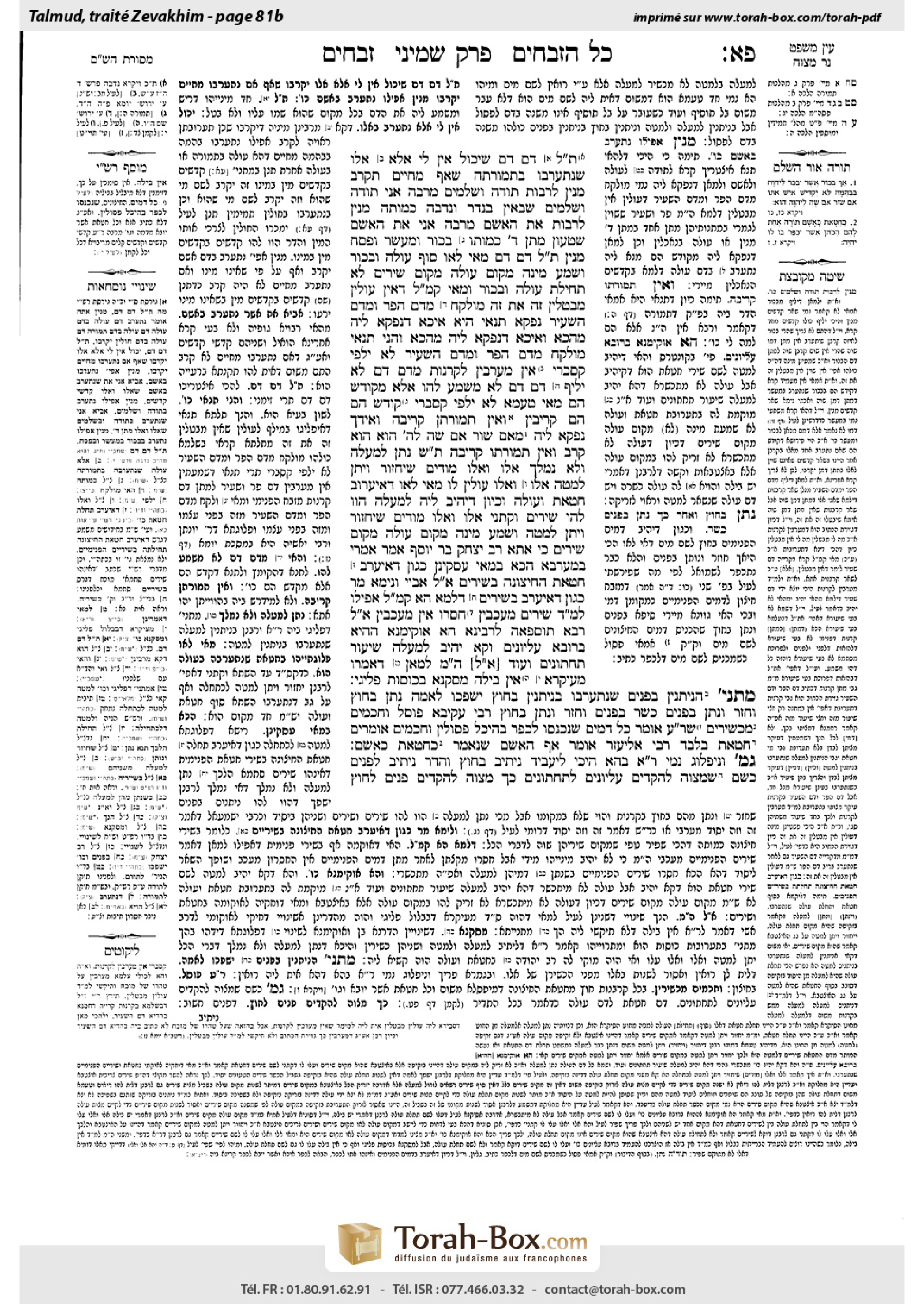
Zevachim 81b: Talmud study for Daf Yomi
Daf Yomi is the daily study of one Talmud folio. Explore 37 tractates with scans, Hebrew text, Sefaria English and AI-generated French translations where annotated.
Passage selection and English or AI-generated French translation are available where the scan has annotations. Daf Study is independent of Torah-Box and Sefaria.
Browse Zevachim · זבחים · All tractatesZevachim 81b text and translations
This page of Zevachim includes the Aramaic text, an English translation and an AI-generated French translation, alongside the scan above.
זבחים פ״א ב · Aramaic and Hebrew text
תַּלְמוּד לוֹמַר ״דָּם״ ״דָּם״? שֶׁיָּכוֹל אֵין לִי אֶלָּא אֵלּוּ שֶׁנִּתְעָרְבוּ בִּתְמוּרָתָהּ, שֶׁאַף מֵחַיִּים תִּקְרַב; מִנַּיִן לְרַבּוֹת תּוֹדָה וּשְׁלָמִים?
מְרַבֶּה אֲנִי תּוֹדָה וּשְׁלָמִים, שֶׁבָּאִין בְּנֶדֶר וּנְדָבָה כְּמוֹתָהּ. מִנַּיִן לְרַבּוֹת אֶת הָאָשָׁם?
מְרַבֶּה אֲנִי אֶת הָאָשָׁם, שֶׁטָּעוּן מַתַּן אַרְבַּע כְּמוֹתוֹ. בְּכוֹר וּמַעֲשֵׂר וָפֶסַח מִנַּיִן? תַּלְמוּד לוֹמַר ״דָּם״ ״דָּם״.
מַאי, לָאו סוֹף עוֹלָה וּבְכוֹר – וּשְׁמַע מִינַּהּ: מְקוֹם עוֹלָה מְקוֹם שִׁירַיִם?
לָא; תְּחִילַּת עוֹלָה וּבְכוֹר. וּמַאי קָא מַשְׁמַע לַן – אֵין עוֹלִין מְבַטְּלִין זֶה אֶת זֶה? מִ״וְּלָקַח מִדַּם הַפָּר וּמִדַּם הַשָּׂעִיר״ נָפְקָא! תַּנָּאֵי הִיא; אִיכָּא דְּנָפְקָא לֵיהּ מֵהָכָא, וְאִיכָּא דְּנָפְקָא לֵיהּ מֵהָכָא.
וְהָנֵי תַּנָּאֵי, מִ״וְּלָקַח מִדַּם הַפָּר וּמִדַּם הַשָּׂעִיר״ לָא יָלְפִי – קָסָבְרִי אֵין מְעָרְבִין לִקְרָנוֹת; מִ״דָּם״ ״דָּם״ לָא יָלֵיף – ״דָּם״ ״דָּם״ לָא מַשְׁמַע לְהוּ;
אֶלָּא מִ״קֹּדֶשׁ הֵם״ – מַאי טַעְמָא לָא יָלְפִי? קָסָבְרִי: ״קֹדֶשׁ הֵם״ – הֵם קְרֵיבִין, וְאֵין תְּמוּרָתָן קְרֵיבָה.
וְאִידַּךְ, נָפְקָא לֵיהּ מֵ״אִם שׁוֹר אִם שֶׂה לַה׳ הוּא״ – הוּא קָרֵב, וְאֵין תְּמוּרָתוֹ קְרֵיבָה.
תָּא שְׁמַע: נָתַן לְמַעְלָה וְלֹא נִמְלַךְ – אֵלּוּ וְאֵלּוּ מוֹדִים שֶׁיַּחֲזוֹר וְיִתֵּן לְמַטָּה, אֵלּוּ וָאֵלּוּ עוֹלִין לוֹ.
מַאי, לָאו דְּאִיעָרוּב חַטָּאת וְעוֹלָה? וְכֵיוָן דְּיָהֵיב לֵיהּ לְמַעְלָה, הָווּ לְהוּ שִׁירַיִם; וְקָתָנֵי: אֵלּוּ וְאֵלּוּ מוֹדִים שֶׁיַּחֲזוֹר וְיִתֵּן לְמַטָּה, וּשְׁמַע מִינַּהּ: מְקוֹם עוֹלָה מְקוֹם שִׁירַיִם!
כִּי אֲתָא רַב יִצְחָק בַּר יוֹסֵף, אֲמַר: אָמְרִי בְּמַעְרְבָא, הָכָא בְּמַאי עָסְקִינַן – כְּגוֹן דְּאִיעָרַב חַטָּאת הַחִיצוֹנָה בְּשִׁירַיִם.
אֲמַר לֵיהּ אַבָּיֵי, וְנֵימָא מָר: כְּגוֹן דְּאִיעָרַב בְּשִׁירַיִם! דִּלְמָא הָא קָא מַשְׁמַע לַן – אֲפִילּוּ לְמַאן דְּאָמַר שִׁירַיִם מְעַכְּבִין, חָסְרוּ אֵין מְעַכְּבִין.
אֲמַר לֵיהּ רָבָא תּוֹסְפָאָה לְרָבִינָא: הָא אוֹקֵימְנָא הָהִיא בְּרוּבָּא עֶלְיוֹנִים, וְקָא יָהֵיב לְמַעְלָה שִׁיעוּר תַּחְתּוֹנִים וְעוֹד! אֲמַר לֵיהּ: הָנֵי מִילֵּי לְמַאן דְּאָמְרוּ מֵעִיקָּרָא אֵין בִּילָּה; מַסְּקָנָא – בְּכוֹסוֹת פְּלִיגִי.
מַתְנִי׳ הַנִּיתָּנִין בִּפְנִים שֶׁנִּתְעָרְבוּ בְּנִיתָּנִין בַּחוּץ – יִשָּׁפְכוּ לָאַמָּה. נָתַן בַּחוּץ וְחָזַר וְנָתַן בִּפְנִים – כָּשֵׁר.
בִּפְנִים, וְחָזַר וְנָתַן בַּחוּץ – רַבִּי עֲקִיבָא פּוֹסֵל, וַחֲכָמִים מַכְשִׁירִים. שֶׁרַבִּי עֲקִיבָא אוֹמֵר: כׇּל דָּמִים שֶׁנִּכְנְסוּ לְכַפֵּר בַּהֵיכָל – פְּסוּלִין, וַחֲכָמִים אוֹמְרִים: חַטָּאת בִּלְבַד. רַבִּי אֱלִיעֶזֶר אוֹמֵר: אַף הָאָשָׁם, שֶׁנֶּאֱמַר: ״כַּחַטָּאת כָּאָשָׁם״.
גְּמָ׳ וְנִיפְלוֹג נָמֵי רַבִּי אֱלִיעֶזֶר בְּהָא!
הֵיכִי לֶיעְבֵּיד? נִיתֵּיב בַּחוּץ וַהֲדַר נִיתֵּיב לִפְנִים? כְּשֵׁם שֶׁמִּצְוָה לְהַקְדִּים עֶלְיוֹנִים לַתַּחְתּוֹנִים, כָּךְ מִצְוָה לְהַקְדִּים פְּנִים לַחוּץ.
Zevachim 81b · English translation
the verse states twice: “Blood,” “blood”? The baraita explains: If “blood” were written only once, one might have thought: I have derived only that this halakha was stated with regard to a case where this, i.e., the blood of a burnt offering, was mixed with the blood of its substitute, as even if these offerings were intermingled when the animals were alive, the burnt offering and its substitute shall be sacrificed. From where is it derived to include even a case of the blood of a thanks offering or a peace offering that was mixed with the blood of a burnt offering, as these offerings are not sacrificed if they became intermingled with a burnt offering while alive?
The baraita continues: And even if one says: I include in this first mention of blood the case of the blood of a thanks offering or a peace offering that was mixed with the blood of a burnt offering, as they are similar in that they both come as a vow offering and a gift offering, like a burnt offering, from where is it derived to include even a case of the blood of the guilt offering that was mixed with the blood of a burnt offering, as a guilt offering cannot be brought as a vow offering or a gift offering?
The baraita continues: And even if one says: I include in this first mention of blood even a case of the blood of the guilt offering that was mixed with the blood of a burnt offering, as they are similar in that a guilt offering requires the placement of two placements that are four, like a burnt offering, from where is it derived that the same applies to the blood of a firstborn offering, and the animal tithe offering, and the Paschal offering, whose blood is placed once on the altar? Therefore, the verse states twice: “Blood,” “blood.” This repetition serves to teach that in any case where the blood of a burnt offering became mixed with the blood of another offering that is placed below the red line, this blood is presented.
The Gemara analyzes this baraita: What, is it not referring even to a case of the final portion of the blood of a burnt offering and the blood of a firstborn offering that were mixed? And if so, one can learn from this baraita that the place of the blood of a burnt offering is the same as the place of the remainder of the blood of a firstborn offering.
The Gemara answers: No, the baraita is referring to the first part of the blood of a burnt offering and the blood of a firstborn offering. But if so, what is this baraita teaching us? Is it teaching that the blood of offerings that ascend to the altar do not nullify one another? This halakha is already derived from the verse: “And he shall take of the blood of the bull and of the blood of the goat” (Leviticus 16:18). The Gemara explains: This is a dispute between tanna’im, as there is a tanna who derives this halakha from here, and there is a tanna who derives it from there.
§ The Gemara has cited three different verses as the source for the halakha that the blood of offerings that ascend to the altar do not nullify one another: “They are holy” (Numbers 18:17); “And he shall take of the blood of the bull and of the blood of the goat” (Leviticus 16:18); “And Aaron’s sons, the priests, shall present the blood and sprinkle the blood” (Leviticus 1:5). The Gemara notes: And these other tanna’im do not derive this principle from the verse: “And he shall take of the blood of the bull and of the blood of the goat,” as they maintain that the High Priest does not mix the blood of the bull with the blood of the goat in order to place the blood on the corners of the golden altar; rather, each type of blood is placed separately. Additionally, these other tanna’im do not derive this halakha from the repeated mention of: “Blood,” “blood,” as they do not learn anything from this repetition.
The Gemara asks: But what is the reason that those other tanna’im do not derive this halakha from the verse: “They are holy” (Numbers 18:17)? The Gemara explains: They hold that the verse should be understood as follows: “They are holy,” i.e., they, the firstborn offerings themselves, are sacrificed, but their substitutes are not sacrificed.
The Gemara asks: And the other tanna, i.e., the tanna who derives the halakha that the blood of offerings that ascend to the altar do not nullify one another from the verse: “They are holy” (Numbers 18:17), from where does he learn that the substitute of a firstborn is not sacrificed? The Gemara explains: He derives it from the verse: “Whether it be ox or sheep, it is the Lord’s” (Leviticus 27:26). The emphasis of “it is” teaches that it is sacrificed but its substitute is not sacrificed.
§ The Gemara resumes its discussion of whether the place of the blood of a burnt offering is the same as the place for the remainder of the blood of offerings. Come and hear a baraita: With regard to blood that is to be placed above the red line that was mixed with blood that is to be placed below the line, which according to the Rabbis must be poured into the Temple courtyard drain, if the priest placed the mixed blood above and did not consult the authorities, both these Sages and those Sages, i.e., the Rabbis and Rabbi Eliezer, concede that he shall again place the blood below the red line, and these placements and those placements count for him.
The Gemara analyzes this baraita: What, is it not referring to a case where the blood of a sin offering and a burnt offering were mixed? And once the priest placed blood of the sin offering above the red line, that which is left from the blood of the sin offering is considered the remainder of the blood. And yet the baraita teaches: Both these Sages and those Sages concede that he shall again place the blood below the red line. And if so, one can learn from the baraita that the place of the blood of a burnt offering is the same as the place of the remainder of the blood of a sin offering.
The Gemara relates: When Rav Yitzḥak bar Yosef came from Eretz Yisrael to Babylonia, he said that they say in the West, Eretz Yisrael: What are we dealing with here? We are dealing not with a mixture of blood of a sin offering and blood of a burnt offering, but with a case where the blood of a sin offering sacrificed on the external altar, which is placed above the red line, was mixed with the remainder of the blood of a sin offering whose blood is presented inside the Sanctuary. This remainder is poured on the base of the external altar. Consequently, once the priest has placed blood from the mixture above the red line, all that remains is a mixture of remainders, which are placed in the same location.
Abaye said to Rav Yitzḥak bar Yosef: Why is it necessary to cite the case of the remainder of the blood of a sin offering whose blood is presented inside the Sanctuary? But let the Master say that it is referring to a case where the blood of a sin offering sacrificed on the external altar was mixed with the remainder of the blood of a sin offering sacrificed on the external altar. Perhaps you chose that case to indicate that this is what the baraita teaches us: Even according to the one who says that failure to pour the remainder of the blood of a sin offering whose blood is presented inside the Sanctuary disqualifies the offering, nevertheless, if the remainder was merely lacking, as in this case, as some of the blood had been placed above the red line, this does not disqualify the offering.
Rava Tosfa’a said to Ravina: How can that baraita be cited as proof for the issue at hand? We already interpreted it (80b) with regard to a mixture of blood that is to be placed above the red line with blood that is to be placed below the red line, which contains a majority of blood that is to be placed above the line, and the priest places above the red line a measure of blood that is to be placed below the line and slightly more. Ravina said to him: That statement applies according to those who said initially that Rabbi Eliezer and the Rabbis disagree with regard to a mixture of blood, and that Rabbi Eliezer holds that there is no mixing. But according to the conclusion, Rabbi Eliezer and the Rabbis disagree with regard to cups of blood that were intermingled, and therefore the above interpretation of the baraita was rejected.
MISHNA: Blood that is to be placed on three locations inside the Sanctuary, i.e., between the staves, on the Curtain, and on the golden altar, that was mixed with blood that is to be placed outside the Sanctuary on the external altar in the Temple courtyard, has no remedy, as one may not change the location of the placement of the blood of one to fulfill his obligation with the other type of blood. Therefore, all the blood shall be poured into the Temple courtyard drain. If the priest, on his own initiative, placed the mixture of blood outside the Sanctuary and again placed the mixture of blood inside the Sanctuary, the offering is fit.
If the priest, on his own initiative, placed the mixture of blood inside the Sanctuary and again placed the mixture of blood outside the Sanctuary, Rabbi Akiva deems the blood placed outside disqualified, and the Rabbis deem it fit. As Rabbi Akiva says: Any blood that is to be presented outside that entered to atone in the Sanctuary is disqualified; but the Rabbis say: That is the halakha with regard to the blood of an external sin offering alone, as it is written: “And any sin offering, whereof any of the blood is brought into the Tent of Meeting to atone in the Sanctuary, shall not be eaten” (Leviticus 6:23). Rabbi Eliezer says: The status of a guilt offering is like that of a sin offering as well, as it is stated: “As is the sin offering, so is the guilt offering” (Leviticus 7:7), i.e., there is one halakha for them. That is not the case with regard to the blood of other offerings.
GEMARA: The mishna teaches that if blood that is to be placed inside the Sanctuary was mixed with blood that is to be placed outside the Sanctuary, all the blood should be poured into the Temple courtyard drain, and there is no opposing opinion recorded in the mishna. The Gemara asks: And let Rabbi Eliezer disagree even with regard to this case, just as he disagrees with regard to a mixture of blood that is to be placed above the red line that was mixed with blood that is to be placed below the red line, where he holds that the improperly placed blood is considered as though it were water.
The Gemara explains that Rabbi Eliezer does not disagree in this case, as how should the priest act? If one says that he should first place blood from the mixture on the altar outside the Sanctuary, and again place blood from the mixture inside the Sanctuary, this is not allowed. Just as it is a mitzva to give precedence to the blood that is to be placed above the red line over the blood that is to be placed below the line, e.g., the presentation of the blood of a sin offering precedes the presentation of the blood of a burnt offering, since a sin offering serves to effect atonement, so too is it a mitzva to give precedence to the blood that is to be placed inside the Sanctuary over blood that is to be placed outside the Sanctuary.
Zevachim 81b · Traduction française (IA)
Le verset mentionne-t-il donc deux fois « sang », « sang » ? La baraïta explique : si le mot « sang » n’était écrit qu’une seule fois, on aurait pu penser que cette halakha ne concerne que le cas où ce sang, c’est-à-dire celui d’un holocauste, s’est mélangé au sang de son substitut, car même si ces sacrifices se sont trouvés mêlés alors que les animaux étaient encore vivants, l’holocauste et son substitut doivent être sacrifiés. D’où apprend-on que cela concerne aussi le cas où le sang d’un sacrifice de reconnaissance ou d’un sacrifice de paix s’est mélangé au sang d’un holocauste, alors que ces sacrifices ne sont pas sacrifiés s’ils se sont trouvés mêlés à un holocauste du vivant des animaux ?
La baraïta poursuit : même si l’on dit que cette première mention du sang inclut le cas où le sang d’un sacrifice de reconnaissance ou d’un sacrifice de paix s’est mélangé au sang d’un holocauste, puisque ces sacrifices lui ressemblent en ce qu’ils peuvent, comme l’holocauste, être apportés en offrande votive ou en offrande volontaire, d’où apprend-on que cela inclut aussi le cas où le sang d’un sacrifice de culpabilité s’est mélangé au sang d’un holocauste, alors qu’un sacrifice de culpabilité ne peut être apporté en offrande votive ni en offrande volontaire ?
La baraïta poursuit : même si l’on dit que cette première mention du sang inclut aussi le cas où le sang d’un sacrifice de culpabilité s’est mélangé au sang d’un holocauste, puisque ces deux sacrifices se ressemblent en ce qu’un sacrifice de culpabilité requiert deux aspersions qui en valent quatre, comme l’holocauste, d’où apprend-on que la même règle s’applique au sang d’un sacrifice de premier-né, d’un sacrifice de la dîme du bétail et du sacrifice pascal, dont le sang est appliqué une fois sur l’autel ? Le verset mentionne donc deux fois « sang », « sang ». Cette répétition enseigne que, dans tous les cas où le sang d’un holocauste s’est mélangé au sang d’un autre sacrifice dont le sang est appliqué sous la ligne rouge, ce sang est appliqué.
La Guemara examine cette baraïta : ne s’agit-il pas même du cas où la dernière partie du sang d’un holocauste s’est mélangée au sang d’un sacrifice de premier-né ? Si tel est le cas, on peut en déduire que l’emplacement où l’on applique le sang d’un holocauste est le même que celui où l’on applique le reste du sang d’un sacrifice de premier-né.
La Guemara répond : non, la baraïta parle de la première partie du sang d’un holocauste et du sang d’un sacrifice de premier-né. Mais alors, que nous enseigne cette baraïta ? Enseigne-t-elle que les sangs des sacrifices qui montent à l’autel ne s’annulent pas mutuellement ? Cette halakha est déjà déduite du verset : « Il prendra du sang du taureau et du sang du bouc » (Lévitique 16:18). La Guemara explique qu’il s’agit d’une controverse entre tannaïm : un tanna déduit cette halakha de ce verset, et un autre tanna la déduit de l’autre verset.
§ La Guemara a cité trois versets différents comme sources de la halakha selon laquelle les sangs des sacrifices qui montent à l’autel ne s’annulent pas mutuellement : « Ils sont saints » (Nombres 18:17) ; « Il prendra du sang du taureau et du sang du bouc » (Lévitique 16:18) ; « Les fils d’Aaron, les prêtres, présenteront le sang et aspergeront le sang » (Lévitique 1:5). La Guemara fait remarquer que ces autres tannaïm ne déduisent pas ce principe du verset « Il prendra du sang du taureau et du sang du bouc », car ils estiment que le Grand Prêtre ne mélange pas le sang du taureau avec celui du bouc pour appliquer le sang sur les angles de l’autel d’or ; chaque type de sang est appliqué séparément. En outre, ces autres tannaïm ne déduisent pas cette halakha de la répétition « sang », « sang », car ils ne tirent aucun enseignement de cette répétition.
La Guemara demande : mais pourquoi ces autres tannaïm ne déduisent-ils pas cette halakha du verset « Ils sont saints » (Nombres 18:17) ? La Guemara explique qu’ils comprennent le verset ainsi : « Ils sont saints », c’est-à-dire que les premiers-nés eux-mêmes sont sacrifiés, mais pas leurs substituts.
La Guemara demande : et l’autre tanna, c’est-à-dire celui qui déduit du verset « Ils sont saints » (Nombres 18:17) la halakha selon laquelle les sangs des sacrifices qui montent à l’autel ne s’annulent pas mutuellement, d’où apprend-il que le substitut d’un premier-né n’est pas sacrifié ? La Guemara explique qu’il le déduit du verset : « Qu’il s’agisse d’un bœuf ou d’un mouton, il appartient à l’Éternel » (Lévitique 27:26). L’accent mis sur « il » enseigne que l’animal lui-même est sacrifié, mais pas son substitut.
§ La Guemara reprend l’examen de la question de savoir si l’emplacement du sang d’un holocauste est le même que celui où l’on applique le reste du sang des sacrifices. Viens et entends une baraïta : le sang qui doit être appliqué au-dessus de la ligne rouge s’est mélangé au sang qui doit être appliqué sous la ligne ; selon les Rabbins, ce mélange doit être versé dans le canal d’évacuation de la cour du Temple. Si le prêtre a appliqué le sang mélangé au-dessus de la ligne sans consulter les autorités, les uns comme les autres, c’est-à-dire les Rabbins et Rabbi Eliezer, conviennent qu’il doit ensuite appliquer le sang sous la ligne rouge ; les applications faites à ces deux endroits sont prises en compte pour lui.
La Guemara examine cette baraïta : ne s’agit-il pas du cas où le sang d’un sacrifice expiatoire s’est mélangé à celui d’un holocauste ? Une fois que le prêtre a appliqué au-dessus de la ligne rouge une partie du sang du sacrifice expiatoire, ce qui reste de son sang est considéré comme le reste du sang. Pourtant, la baraïta enseigne que les uns comme les autres conviennent qu’il doit ensuite appliquer le sang sous la ligne rouge. On peut donc en déduire que l’emplacement où l’on applique le sang d’un holocauste est le même que celui où l’on applique le reste du sang d’un sacrifice expiatoire.
La Guemara rapporte : lorsque Rav Yitzḥak bar Yosef arriva de la Terre d’Israël en Babylonie, il dit qu’en Occident, c’est-à-dire en Terre d’Israël, on expliquait : de quoi s’agit-il ici ? Non pas d’un mélange de sang d’un sacrifice expiatoire et de sang d’un holocauste, mais du cas où le sang d’un sacrifice expiatoire offert sur l’autel extérieur, qui est appliqué au-dessus de la ligne rouge, s’est mélangé au reste du sang d’un sacrifice expiatoire dont le sang est présenté à l’intérieur du Sanctuaire. Ce reste est versé sur la base de l’autel extérieur. Par conséquent, une fois que le prêtre a appliqué au-dessus de la ligne rouge du sang provenant du mélange, il ne reste qu’un mélange de restes, qui sont appliqués au même endroit.
Abaye dit à Rav Yitzḥak bar Yosef : pourquoi est-il nécessaire de citer le cas du reste du sang d’un sacrifice expiatoire dont le sang est présenté à l’intérieur du Sanctuaire ? Le Maître aurait pu dire qu’il s’agit du cas où le sang d’un sacrifice expiatoire offert sur l’autel extérieur s’est mélangé au reste du sang d’un sacrifice expiatoire offert sur l’autel extérieur. Peut-être as-tu choisi ce cas pour nous enseigner ce que nous apprend la baraïta : même selon celui qui affirme que le fait de ne pas verser le reste du sang d’un sacrifice expiatoire dont le sang est présenté à l’intérieur du Sanctuaire invalide le sacrifice, si seul le reste fait défaut, comme dans ce cas où une partie du sang a été appliquée au-dessus de la ligne rouge, cela n’invalide pas le sacrifice.
Rava Tosfa’a dit à Ravina : comment peut-on citer cette baraïta comme preuve pour la question dont nous traitons ? Nous l’avons déjà interprétée (80b) comme portant sur un mélange de sang destiné à être appliqué au-dessus de la ligne rouge et de sang destiné à être appliqué sous la ligne, dans lequel le sang destiné à être appliqué au-dessus de la ligne est majoritaire ; le prêtre applique au-dessus de la ligne rouge une quantité de sang destinée à être appliquée sous la ligne, augmentée d’un peu. Ravina lui répondit : cette explication s’applique selon ceux qui ont d’abord affirmé que Rabbi Eliezer et les Rabbins sont en désaccord au sujet d’un mélange de sang et que Rabbi Eliezer estime qu’il n’y a pas de mélange. Mais, selon la conclusion, Rabbi Eliezer et les Rabbins sont en désaccord au sujet de coupes de sang qui se sont mélangées ; l’interprétation précédente de la baraïta a donc été écartée.
MICHNA : Le sang qui doit être appliqué en trois endroits à l’intérieur du Sanctuaire, c’est-à-dire entre les barres, sur le rideau et sur l’autel d’or, s’il s’est mélangé au sang qui doit être appliqué à l’extérieur du Sanctuaire, sur l’autel extérieur dans la cour du Temple, ne peut faire l’objet d’aucune solution, car on ne peut pas changer l’emplacement prévu pour le sang d’un sacrifice afin de s’acquitter de son obligation avec l’autre type de sang. Tout le sang doit donc être versé dans le canal d’évacuation de la cour du Temple. Si le prêtre, de sa propre initiative, a appliqué le mélange de sang à l’extérieur du Sanctuaire, puis l’a de nouveau appliqué à l’intérieur du Sanctuaire, le sacrifice est valide.
Si le prêtre, de sa propre initiative, a appliqué le mélange à l’intérieur du Sanctuaire, puis l’a de nouveau appliqué à l’extérieur du Sanctuaire, Rabbi Akiva déclare invalide le sang appliqué à l’extérieur, tandis que les Rabbins le déclarent valide. Rabbi Akiva dit en effet : tout sang qui doit être présenté à l’extérieur et qui est entré dans le Sanctuaire pour y obtenir l’expiation est invalide. Mais les Rabbins disent que cette halakha ne concerne que le sang d’un sacrifice expiatoire extérieur, ainsi qu’il est écrit : « Tout sacrifice expiatoire dont une partie du sang est apportée dans la Tente d’assignation pour faire l’expiation dans le Sanctuaire ne sera pas mangé » (Lévitique 6:23). Rabbi Eliezer dit que le statut d’un sacrifice de culpabilité est également identique à celui d’un sacrifice expiatoire, comme il est dit : « Comme le sacrifice expiatoire, ainsi le sacrifice de culpabilité » (Lévitique 7:7), c’est-à-dire qu’une même halakha s’applique aux deux. Il n’en va pas ainsi du sang des autres sacrifices.
GUEMARA : La Michna enseigne que si du sang destiné à être appliqué à l’intérieur du Sanctuaire s’est mélangé à du sang destiné à être appliqué à l’extérieur du Sanctuaire, tout le sang doit être versé dans le canal d’évacuation de la cour du Temple ; la Michna ne rapporte aucune opinion contraire. La Guemara demande : Rabbi Eliezer ne devrait-il pas également être en désaccord dans ce cas, comme il l’est au sujet d’un mélange de sang destiné à être appliqué au-dessus de la ligne rouge et de sang destiné à être appliqué sous la ligne, puisqu’il estime que le sang appliqué au mauvais endroit est considéré comme de l’eau ?
La Guemara explique que Rabbi Eliezer n’est pas en désaccord dans ce cas. En effet, comment le prêtre devrait-il agir ? Dire qu’il doit d’abord appliquer sur l’autel, à l’extérieur du Sanctuaire, du sang provenant du mélange, puis appliquer de nouveau à l’intérieur du Sanctuaire du sang provenant du mélange, cela n’est pas permis. De même qu’il est une mitsva de donner la priorité au sang destiné à être appliqué au-dessus de la ligne rouge sur celui destiné à être appliqué sous la ligne — par exemple, la présentation du sang d’un sacrifice expiatoire précède celle du sang d’un holocauste, puisque le sacrifice expiatoire sert à obtenir l’expiation —, de même est-il une mitsva de donner la priorité au sang destiné à être appliqué à l’intérieur du Sanctuaire sur celui qui doit être appliqué à l’extérieur.
Traduction française générée par IA à partir de l’édition anglaise de Sefaria. Vérifie toujours un passage avec le texte source.
Text from Sefaria: William Davidson Edition - Vocalized Aramaic (CC BY NC); William Davidson Edition - English (CC BY NC).