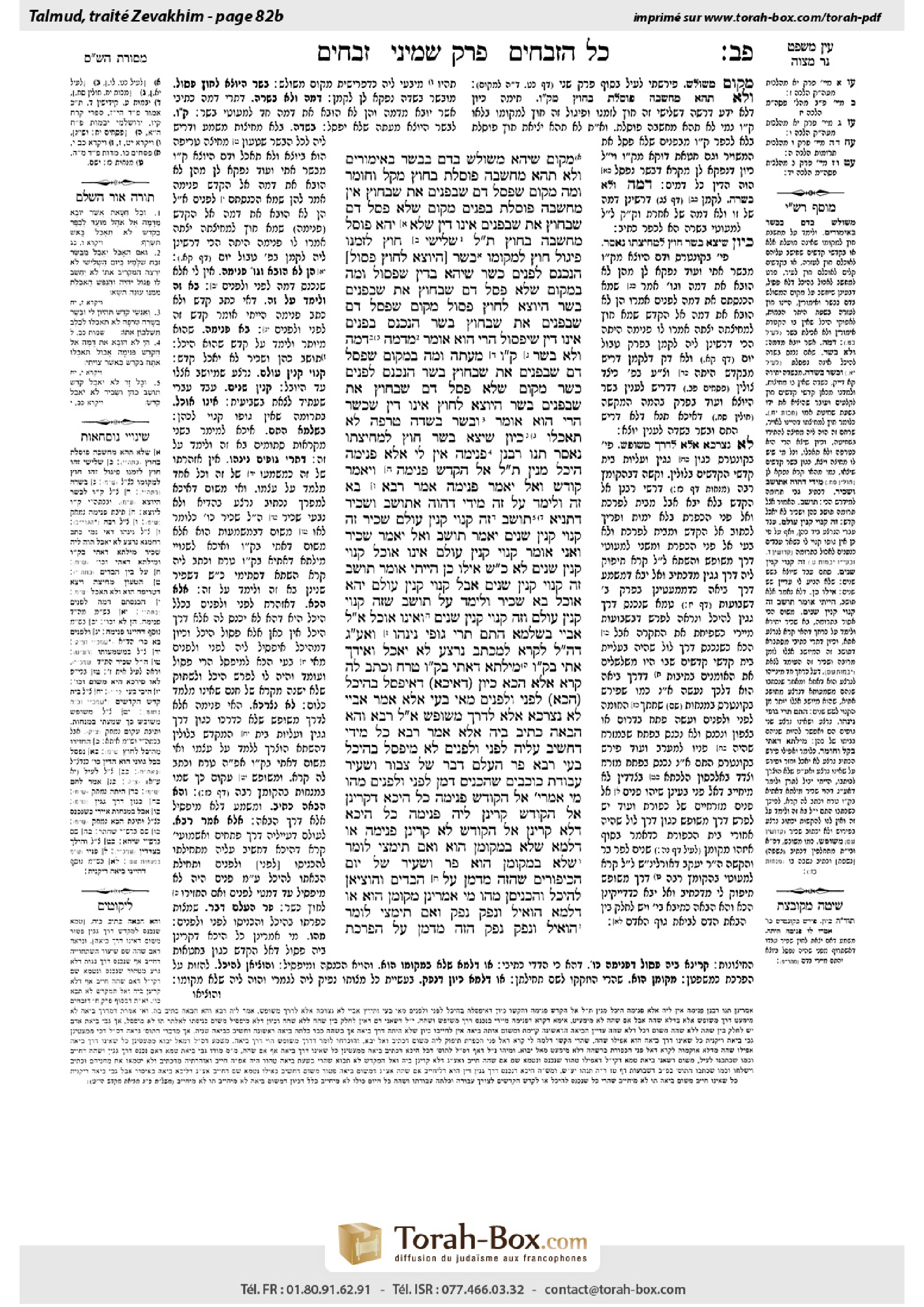
Zevachim 82b: Talmud study for Daf Yomi
Daf Yomi is the daily study of one Talmud folio. Explore 37 tractates with scans, Hebrew text, Sefaria English and AI-generated French translations where annotated.
Passage selection and English or AI-generated French translation are available where the scan has annotations. Daf Study is independent of Torah-Box and Sefaria.
Browse Zevachim · זבחים · All tractatesZevachim 82b text and translations
This page of Zevachim includes the Aramaic text, an English translation and an AI-generated French translation, alongside the scan above.
זבחים פ״ב ב · Aramaic and Hebrew text
מָקוֹם שֶׁיְּהֵא מְשׁוּלָּשׁ בְּדָם, בְּבָשָׂר, בְּאֵימוּרִים.
וְלֹא תְּהֵא מַחְשָׁבָה פּוֹסֶלֶת בַּחוּץ מִקַּל וָחוֹמֶר: וּמָה מְקוֹם שֶׁפָּסַל דָּם שֶׁבִּפְנִים אֶת שֶׁבַּחוּץ – אֵין מַחְשָׁבָה פּוֹסֶלֶת בִּפְנִים, מְקוֹם שֶׁלֹּא פָּסַל דָּם שֶׁבַּחוּץ אֶת שֶׁבְּפָנִים – אֵינוֹ דִּין שֶׁלֹּא יְהֵא פּוֹסֵל מַחְשָׁבָה בַּחוּץ?
תַּלְמוּד לוֹמַר: ״שְׁלִישִׁי״ – חוּץ לִזְמַנּוֹ, ״פִּגּוּל״ – חוּץ לִמְקוֹמוֹ.
בָּשָׂר [הַיּוֹצֵא לַחוּץ – פָּסוּל], הַנִּכְנָס לִפְנִים – כָּשֵׁר.
שֶׁיְּהֵא בַּדִּין שֶׁפָּסוּל: וּמָה בִּמְקוֹם שֶׁלֹּא פָּסַל דָּם שֶׁבַּחוּץ אֶת שֶׁבִּפְנִים – בָּשָׂר הַיּוֹצֵא לַחוּץ פָּסוּל, מְקוֹם שֶׁפָּסַל דָּם שֶׁבִּפְנִים אֶת שֶׁבַּחוּץ – בָּשָׂר הַנִּכְנָס בִּפְנִים אֵינוֹ דִּין שֶׁיִּפְסוֹל?
הֲרֵי הוּא אוֹמֵר: ״מִדָּמָהּ״ – דָּמָהּ וְלֹא (בשר) [בְּשָׂרָהּ].
קַל וָחוֹמֶר מֵעַתָּה: וּמָה בִּמְקוֹם שֶׁפָּסַל דָּם שֶׁבִּפְנִים אֶת שֶׁבַּחוּץ – בָּשָׂר הַנִּכְנָס לְפָנִים כָּשֵׁר; מָקוֹם שֶׁלֹּא פָּסַל דָּם שֶׁבַּחוּץ אֶת שֶׁבִּפְנִים – בָּשָׂר הַיּוֹצֵא לַחוּץ אֵינוֹ דִּין שֶׁכָּשֵׁר?!
הֲרֵי הוּא אוֹמֵר: ״וּבָשָׂר בַּשָּׂדֶה טְרֵפָה לֹא תֹאכֵלוּ״ – כֵּיוָן שֶׁיָּצָא בָּשָׂר חוּץ לִמְחִיצָתוֹ, נֶאֱסָר.
תָּנוּ רַבָּנַן: ״פְּנִימָה״ – אֵין לִי אֶלָּא פְּנִימָה, הֵיכָל מִנַּיִן? תַּלְמוּד לוֹמַר: ״אֶל הַקֹּדֶשׁ פְּנִימָה״.
וְיֹאמַר ״קֹדֶשׁ״, וְאַל וְיֹאמַר ״פְּנִימָה״! אָמַר רָבָא: בָּא זֶה וְלִימֵּד עַל זֶה; מִידֵּי דְּהָוֵה אַ״תּוֹשָׁב וְשָׂכִיר״.
דְּתַנְיָא: ״תּוֹשָׁב״ – זֶה קָנוּי קִנְיַן עוֹלָם, ״שָׂכִיר״ – זֶה קָנוּי קִנְיַן שָׁנִים.
יֹאמַר ״תּוֹשָׁב״ וְאַל יֹאמַר ״שָׂכִיר״, וַאֲנִי אוֹמֵר: קָנוּי קִנְיַן עוֹלָם אֵינוֹ אוֹכֵל, קָנוּי קִנְיַן שָׁנִים לֹא כׇּל שֶׁכֵּן?
אִילּוּ כֵּן, הָיִיתִי אוֹמֵר: ״תּוֹשָׁב״ – זֶה קָנוּי קִנְיַן שָׁנִים, אֲבָל קְנוּי קִנְיַן עוֹלָם יְהֵא אוֹכֵל; בָּא ״שָׂכִיר״ וְלִימֵּד עַל ״תּוֹשָׁב״, שֶׁזֶּה קָנוּי קִנְיַן עוֹלָם וְזֶה קָנוּי קִנְיַן שָׁנִים – וְאֵינוֹ אוֹכֵל.
אֲמַר לֵיהּ אַבָּיֵי: בִּשְׁלָמָא הָתָם – תְּרֵי גוּפֵי נִינְהוּ; וְאַף עַל גַּב דַּהֲוָה לֵיהּ לִקְרָא לְמִכְתַּב ״נִרְצָע לֹא יֹאכַל״, וְאִידַּךְ אָתֵי בְּקַל וָחוֹמֶר – מִילְּתָא דְּאָתְיָא בְּקַל וָחוֹמֶר טָרַח וְכָתַב לַהּ קְרָא. אֶלָּא הָכָא, כֵּיוָן (דְּאִיכָּא) דְּאִיפְּסֵל בְּהֵיכָל, (הָכָא) לִפְנַי וְלִפְנִים מַאי בָּעֵי?
אֶלָּא אָמַר אַבָּיֵי: לֹא נִצְרְכָא אֶלָּא לְדֶרֶךְ מְשׁוּפָּשׁ. אֲמַר לֵיהּ רָבָא: וְהָא הֲבָאָה כְּתִיב בֵּיהּ! אֶלָּא אָמַר רָבָא: כֹּל מִידֵּי דְּחַשֵּׁיב עֲלֵיהּ לִפְנַי וְלִפְנִים – לָא מִיפְּסֵל בְּהֵיכָל.
בָּעֵי רָבָא: פַּר הֶעְלֵם דָּבָר שֶׁל צִבּוּר וּשְׂעִיר עֲבוֹדָה זָרָה, שֶׁהִכְנִיס דָּמָן לִפְנַי וְלִפְנִים – מַהוּ?
מִי אָמְרִינַן: ״אֶל הַקֹּדֶשׁ פְּנִימָה״ – כֹּל הֵיכָא דְּקָרֵינַן ״אֶל הַקֹּדֶשׁ״ קָרֵינַן לֵיהּ ״פְּנִימָה״, כֹּל הֵיכָא דְּלָא קָרֵינַן ״אֶל הַקֹּדֶשׁ״ לָא קָרֵינַן ״פְּנִימָה״; אוֹ דִלְמָא שֶׁלֹּא בִּמְקוֹמָן הוּא?
וְאִם תִּימְצֵי לוֹמַר שֶׁלֹּא בִּמְקוֹמָן הוּא – פַּר וְשָׂעִיר שֶׁל יוֹם הַכִּיפּוּרִים שֶׁהִזָּה מִדָּמָן עַל הַבַּדִּים, וְהוֹצִיאָן לַהֵיכָל וְהִכְנִיסָן, מַהוּ?
מִי אָמְרִינַן מְקוֹמָן הוּא, אוֹ דִלְמָא הוֹאִיל וּנְפַק נְפַק?
וְאִם תִּימְצֵי לוֹמַר הוֹאִיל וּנְפַק נְפַק – הִזָּה מִדָּמָן עַל הַפָּרֹכֶת,
Zevachim 82b · English translation
This verse teaches that the place where improper intent disqualifies the offering must be triply functional: For the presenting of the blood, for the eating of the meat, and for the burning of the sacrificial portions of the offering that are consumed on the altar. In other words, it must be outside its designated place with regard to all three of these issues. Consequently, intent to present the blood in the Sanctuary does not disqualify the blood.
The Gemara suggests the opposite: And if so, let intent to present the blood outside the Sanctuary not disqualify the offering based on an a fortiori inference: And just as in a place where the part of the blood that went inside the Sanctuary disqualifies the rest of the blood that is outside in the courtyard, and yet intent to present the blood inside the Sanctuary does not disqualify the offering, so too, in a place where the part of the blood that went outside the courtyard does not disqualify the rest of the blood that is inside the courtyard, is it not logical that intent to present the blood outside the courtyard does not disqualify the offering?
The Gemara answers that the verse states: “And if it be eaten at all on the third day, it is piggul; it shall not be accepted,” and the Sages interpreted this verse as follows: “On the third day” is referring to intent to perform its rites beyond its designated time; “it is piggul” is referring to intent to perform its rites outside its designated area.
A baraita teaches: The meat of offerings that left its designated area and was taken to a place that is outside its designated area for consumption, which is outside the wall of Jerusalem in the case of offerings of lesser sanctity and outside the wall of the Temple courtyard in the case of offerings of the most sacred order, is disqualified from being eaten. By contrast, meat of offerings that entered inside the Sanctuary is not disqualified and remains fit to be eaten.
One might have thought that it should be derived based on a logical inference that this meat is disqualified, as follows: And just as in a place where the part of the blood that went outside the courtyard does not disqualify the rest of the blood that remained inside the courtyard, yet meat that leaves and is taken outside the courtyard is disqualified, so too, in a place where the part of the blood that went inside the Sanctuary disqualifies the rest of the blood that is outside the Sanctuary, is it not right that meat that enters the Sanctuary should be disqualified?
The baraita explains that one does not derive this inference, as the verse states: “And any sin offering, whereof any of the blood is brought into the Tent of Meeting to atone in the Sanctuary, shall not be eaten” (Leviticus 6:23), which indicates that the blood of an offering that is brought inside is disqualified, but not meat that enters the Sanctuary.
The baraita continues: From now, as it has been established that the meat of offerings that is brought inside the Sanctuary is not disqualified, one can suggest an a fortiori inference: And just as in a place where blood that went inside the Sanctuary disqualifies the blood that remained outside in the courtyard, and yet meat that enters the Sanctuary is fit, therefore, in a place where the blood that went outside the courtyard does not disqualify the blood that is inside the courtyard, is it not logical that meat that left and was taken outside the courtyard should be fit?
The Gemara explains that one does not derive this a fortiori inference, as the verse states: “And you shall not eat any flesh that is torn of beasts in the field” (Exodus 22:30). The apparently superfluous term “in the field” teaches a general halakha: Once meat has left and been removed outside of its boundary, i.e., the area in which it is permitted to consume it, it has become prohibited.
§ The Gemara returns to its discussion of the blood of a sin offering that entered the Sanctuary. The Sages taught: It is stated that when Moses questioned Aaron as to why a sin offering was not consumed, he said: “Behold, its blood was not brought into the sacred place within” (Leviticus 10:18). This indicates that had the blood been brought within, Moses would have understood that the offering would have been disqualified and rendered prohibited for consumption. The baraita comments: I have derived only that the offering is disqualified if the blood is brought within, i.e., into the Holy of Holies; from where is it derived that the same applies if it was merely brought into the Sanctuary? The verse states: “Into the sacred place within,” and this sacred place is the Sanctuary.
The Gemara questions this derivation: And let the verse state only “sacred place,” and it need not state “within.” If blood that entered the Sanctuary is already disqualified, this halakha certainly applies if it was brought farther inside, to the Holy of Holies. Rava says: This verse comes and teaches about that verse. In other words, had the verse stated only “sacred place,” it would have been interpreted as referring to the Holy of Holies. The addition of “within” indicates that this sacred place is the Sanctuary, while the term “within” is referring to the Holy of Holies. The Gemara cites a similar example: This is just as it is with regard to a tenant and a hired worker.
As it is taught in a baraita concerning teruma: The verse states: “A tenant of a priest or a hired worker shall not eat of the consecrated” (Leviticus 22:10). “A tenant”; this is referring to a Hebrew slave who has been acquired as a permanent acquisition, i.e., one who said he wishes to stay with his master. This slave has his ear pierced and he remains with his master until the Jubilee Year. “A hired worker”; this is referring to a Hebrew slave who has been acquired for an acquisition of six years, the standard period of servitude for a Hebrew slave.
The baraita asks: Let the verse say “tenant” and let it not say “hired worker,” and I would say: If one who is acquired as a permanent acquisition does not partake of his master’s, i.e., the priest’s, teruma, as despite his status as a slave he is not considered his master’s property, is it not all the more so logical that one who is acquired for an acquisition of six years should not be permitted to partake of teruma?
The baraita answers: If so, that the verse were stated in this manner, I would say: “A tenant”; this is one who was acquired for an acquisition of six years, as the term itself is ambiguous, but one who was acquired as a permanent acquisition may partake of teruma. Therefore, the term “hired worker,” which is certainly referring to one who is less permanent than a tenant, comes and teaches about the meaning of the term “tenant,” that this one was acquired as a permanent acquisition and that one was acquired for an acquisition of six years, and both this one and that one may not partake of teruma. Similar reasoning applies in the above case concerning the terms “sacred place” and “within.”
Abaye said to Rava: Are these cases comparable? Granted, there, the tenant and the hired worker are two bodies. And this is significant, as even though the verse could have written explicitly that a pierced tenant may not partake of teruma, from which the halakha of a Hebrew slave for six years could have been inferred, and the other case, that of a slave for six years, is therefore a matter that can be derived through an a fortiori inference, it need not be stated explicitly. Nevertheless, there is a principle: At times, with regard to a matter that can be derived through an a fortiori inference, the verse nevertheless takes the trouble and writes it explicitly. But here, the same blood enters the Holy of Holies via the Sanctuary, and once it is disqualified in the Sanctuary, why is it necessary for the verse to teach that this blood is disqualified when it enters the innermost sanctum, the Holy of Holies?
Rather, Abaye says: This mention of “within” is necessary only for a case where the blood entered the Holy of Holies not via the Sanctuary but in a roundabout manner, e.g., from the roof or the loft of the Holy of Holies, without having entered the Sanctuary. Rava said to Abaye: But an expression of bringing is written in the verse: “Behold, its blood was not brought into the sacred place within,” which indicates a standard manner of bringing it into the Holy of Holies. Rather, Rava says: In any circumstance where the priest intended to bring the blood inside the innermost sanctum, it is not disqualified when it is only in the Sanctuary, and therefore it was necessary for the verse to teach both disqualifications.
§ Rava raises a dilemma: With regard to the bull for an unwitting communal sin and the goat for a sin of idol worship, whose blood should be presented in the Sanctuary, if it occurred that the priest brought their blood into the innermost sanctum, what is the halakha?
Rava explains the sides of the dilemma: Do we say that since the verse states: “Into the sacred place within” (Leviticus 10:18) as a single phrase, and therefore anywhere that we read a prohibition against bringing the blood “into the sacred place,” i.e., that the blood is disqualified by being brought into the Sanctuary, we also read a prohibition against bringing the blood “within,” i.e., that it is likewise disqualified when it is brought into the Holy of Holies; but anywhere that we do not read a prohibition against bringing the blood “into the sacred place,” such as with regard to these offerings, whose blood is supposed to be brought into the Sanctuary, we do not read a prohibition against bringing the blood “within” the Holy of Holies? Or perhaps, since in any event the Holy of Holies is not the proper place for the blood of these offerings, it is disqualified.
And if you say that the Holy of Holies is not the proper place for the blood of these offerings and they are therefore disqualified, one can raise another dilemma: In the case of the bull and goat of Yom Kippur, where the High Priest sprinkled from their blood on the staves of the Ark, as required (see Leviticus 16:14), and he brought their remaining blood out to the Sanctuary and subsequently brought it in again to the Holy of Holies, what is the halakha? Is the blood disqualified by this improper second entrance into the Holy of Holies?
Rava explains the sides of the question: Do we say that it is its place, as the High Priest is supposed to bring this blood into the Holy of Holies on Yom Kippur at some point? Or perhaps one should say that since the High Priest has performed the mitzva and the blood has been brought out, it has been brought out, and the Holy of Holies is no longer considered its place.
And if you say that since the blood has been brought out, it has been brought out, one can raise another dilemma: If the High Priest sprinkled from their blood on the Sanctuary Curtain
Zevachim 82b · Traduction française (IA)
Ce verset enseigne que le lieu où une intention impropre disqualifie l’offrande doit remplir trois fonctions : permettre la présentation du sang, la consommation de la viande et la combustion sur l’autel des parties de l’offrande qui y sont consumées. Autrement dit, pour chacun de ces trois aspects, il doit s’agir d’un lieu situé hors de l’endroit qui lui est assigné. Par conséquent, l’intention de présenter le sang dans le Sanctuaire ne disqualifie pas le sang.
La Guemara suggère le raisonnement inverse : si tel est le cas, l’intention de présenter le sang hors du Sanctuaire ne devrait pas disqualifier l’offrande, selon un raisonnement a fortiori. En effet, dans un cas où une partie du sang entrée dans le Sanctuaire disqualifie le reste du sang qui se trouve à l’extérieur, dans la cour, l’intention de présenter le sang dans le Sanctuaire ne disqualifie pourtant pas l’offrande. À plus forte raison, dans un cas où une partie du sang sortie de la cour ne disqualifie pas le reste du sang qui se trouve dans la cour, n’est-il pas logique que l’intention de présenter le sang hors de la cour ne disqualifie pas l’offrande ?
La Guemara répond que le verset dit : « Si elle est mangée le troisième jour, c’est du piggoul ; elle ne sera pas agréée », et les Sages interprètent ainsi ce verset : « Le troisième jour » fait référence à l’intention d’accomplir les rites après le délai qui leur est assigné ; « c’est du piggoul » fait référence à l’intention d’accomplir les rites hors de l’endroit qui leur est assigné.
Une baraïta enseigne : La viande des offrandes qui a quitté l’endroit qui lui est assigné et a été emportée dans un lieu situé hors de son périmètre de consommation — hors des murailles de Jérusalem pour les offrandes de moindre sainteté, et hors des murailles de la cour du Temple pour les offrandes de très haute sainteté — est disqualifiée et ne peut être consommée. En revanche, la viande des offrandes entrée dans le Sanctuaire n’est pas disqualifiée et reste propre à la consommation.
On aurait pu penser qu’il fallait déduire par raisonnement que cette viande est disqualifiée, comme suit : dans un cas où une partie du sang sortie de la cour ne disqualifie pas le reste du sang demeuré dans la cour, la viande qui quitte son emplacement et est emportée hors de la cour est néanmoins disqualifiée. À plus forte raison, dans un cas où une partie du sang entrée dans le Sanctuaire disqualifie le reste du sang qui se trouve à l’extérieur du Sanctuaire, n’est-il pas juste que la viande entrée dans le Sanctuaire soit disqualifiée ?
La baraïta explique qu’on ne déduit pas cela, car le verset dit : « Toute offrande pour le péché dont une partie du sang a été portée dans la Tente d’assignation pour faire l’expiation dans le Sanctuaire ne sera pas mangée » (Lévitique 6:23). Cela indique que le sang d’une offrande porté à l’intérieur est disqualifié, mais non la viande entrée dans le Sanctuaire.
La baraïta poursuit : Dès lors qu’il a été établi que la viande des offrandes portée dans le Sanctuaire n’est pas disqualifiée, on peut proposer un raisonnement a fortiori : dans un cas où le sang entré dans le Sanctuaire disqualifie le sang demeuré à l’extérieur, dans la cour, la viande entrée dans le Sanctuaire reste propre à la consommation. Par conséquent, dans un cas où le sang sorti de la cour ne disqualifie pas le sang qui se trouve dans la cour, n’est-il pas logique que la viande qui a quitté son emplacement et a été emportée hors de la cour reste propre à la consommation ?
La Guemara explique qu’on ne déduit pas cela par raisonnement a fortiori, car le verset dit : « Vous ne mangerez aucune chair déchirée par les bêtes dans le champ » (Exode 22:30). L’expression apparemment superflue « dans le champ » enseigne une halakha générale : dès que la viande a quitté son périmètre, c’est-à-dire la zone où sa consommation est permise, elle est interdite.
§ La Guemara revient à son étude du sang d’un sacrifice expiatoire entré dans le Sanctuaire. Les Sages ont enseigné : Lorsque Moïse demanda à Aaron pourquoi un sacrifice expiatoire n’avait pas été consommé, il lui dit : « Voici, son sang n’a pas été porté à l’intérieur du lieu sacré » (Lévitique 10:18). Cela indique que si le sang avait été porté à l’intérieur, Moïse aurait compris que l’offrande aurait été disqualifiée et interdite à la consommation. La baraïta commente : J’ai seulement déduit que l’offrande est disqualifiée si le sang est porté à l’intérieur, c’est-à-dire dans le Saint des saints. D’où déduit-on qu’il en va de même s’il a simplement été porté dans le Sanctuaire ? Le verset dit : « à l’intérieur du lieu sacré » ; ce lieu sacré, c’est le Sanctuaire.
La Guemara conteste cette déduction : Que le verset dise seulement « lieu sacré », sans préciser « à l’intérieur ». Si le sang entré dans le Sanctuaire est déjà disqualifié, cette halakha s’applique à plus forte raison s’il a été porté plus loin, dans le Saint des saints. Rava dit : Ce verset vient éclairer cet autre verset. Autrement dit, si le verset avait seulement dit « lieu sacré », on aurait interprété ces mots comme faisant référence au Saint des saints. L’ajout de « à l’intérieur » indique que le lieu sacré est le Sanctuaire, tandis que le terme « à l’intérieur » fait référence au Saint des saints. La Guemara cite un exemple comparable : il en va de même pour le résident et le salarié.
Car une baraïta enseigne, au sujet de la terouma : Le verset dit : « Un résident d’un prêtre ou un salarié ne mangera pas des choses consacrées » (Lévitique 22:10). « Un résident » désigne un esclave hébreu acquis à titre permanent, c’est-à-dire celui qui a dit vouloir rester auprès de son maître. On lui perce l’oreille et il demeure auprès de son maître jusqu’à l’année du Jubilé. « Un salarié » désigne un esclave hébreu acquis pour une période de six ans, durée normale de servitude d’un esclave hébreu.
La baraïta demande : Que le verset dise « résident » sans dire « salarié », et j’en déduirais ceci : si celui qui a été acquis à titre permanent ne mange pas de la terouma de son maître, c’est-à-dire du prêtre — car, malgré son statut d’esclave, il n’est pas considéré comme appartenant à son maître —, n’est-il pas d’autant plus logique que celui qui a été acquis pour une période de six ans ne soit pas autorisé à manger de la terouma ?
La baraïta répond : Si le verset était formulé ainsi, je dirais : « Un résident » désigne celui qui a été acquis pour une période de six ans, car le terme lui-même est ambigu ; mais celui qui a été acquis à titre permanent pourrait manger de la terouma. C’est pourquoi le terme « salarié », qui désigne certainement quelqu’un de moins permanent qu’un résident, vient éclairer le sens du terme « résident » : l’un a été acquis à titre permanent, l’autre pour une période de six ans, et ni l’un ni l’autre ne peuvent manger de la terouma. Le même raisonnement s’applique au cas précédent, concernant les termes « lieu sacré » et « à l’intérieur ».
Abayé dit à Rava : Ces cas sont-ils comparables ? Certes, dans ce cas, le résident et le salarié sont deux personnes distinctes. Cela a son importance : même si le verset avait pu dire explicitement qu’un résident dont l’oreille a été percée ne peut manger de la terouma, ce qui aurait permis de déduire par raisonnement a fortiori la halakha concernant l’esclave hébreu engagé pour six ans, il n’aurait pas été nécessaire de mentionner explicitement ce second cas. Il existe néanmoins un principe : parfois, le verset prend la peine d’énoncer explicitement une règle qui pourrait être déduite par raisonnement a fortiori. Mais ici, c’est le même sang qui entre dans le Saint des saints en passant par le Sanctuaire ; or, dès lors qu’il est disqualifié dans le Sanctuaire, pourquoi le verset doit-il enseigner que ce sang est disqualifié lorsqu’il entre dans le lieu le plus intérieur, le Saint des saints ?
Abayé dit plutôt : La mention de « à l’intérieur » n’est nécessaire que dans le cas où le sang est entré dans le Saint des saints non pas en passant par le Sanctuaire, mais par un chemin détourné, par exemple depuis le toit ou le grenier du Saint des saints, sans être passé par le Sanctuaire. Rava dit à Abayé : Mais le verset emploie une expression qui signifie « apporter » : « Voici, son sang n’a pas été porté à l’intérieur du lieu sacré » ; cela indique qu’il y a été porté de manière ordinaire, dans le Saint des saints. Rava dit plutôt : Dans toutes les circonstances où le prêtre avait l’intention de porter le sang dans le lieu le plus intérieur, celui-ci n’est pas disqualifié tant qu’il se trouve seulement dans le Sanctuaire ; le verset devait donc enseigner les deux disqualifications.
§ Rava soulève une question : Concernant le taureau offert pour une faute involontaire de la communauté et le bouc offert pour le péché d’idolâtrie, dont le sang doit être présenté dans le Sanctuaire, quelle est la halakha si le prêtre a porté leur sang dans le lieu le plus intérieur ?
Rava expose les deux côtés de la question : Faut-il dire que, puisque le verset dit « à l’intérieur du lieu sacré » (Lévitique 10:18) comme une seule expression, partout où l’on interprète l’interdiction de porter le sang « dans le lieu sacré » — c’est-à-dire que le sang est disqualifié lorsqu’il est porté dans le Sanctuaire —, on interprète aussi l’interdiction de le porter « à l’intérieur », c’est-à-dire qu’il est également disqualifié lorsqu’il est porté dans le Saint des saints ; mais partout où l’on n’interprète pas l’interdiction de porter le sang « dans le lieu sacré », comme pour ces offrandes dont le sang doit être porté dans le Sanctuaire, on n’interprète pas non plus l’interdiction de le porter « à l’intérieur », dans le Saint des saints ? Ou bien faut-il peut-être dire que, de toute façon, le Saint des saints n’étant pas l’endroit où le sang de ces offrandes doit se trouver, il est disqualifié ?
Et si tu dis que le Saint des saints n’est pas l’endroit où le sang de ces offrandes doit se trouver et qu’elles sont donc disqualifiées, on peut soulever une autre question : Dans le cas du taureau et du bouc de Yom Kippour, dont le grand prêtre a aspergé le sang sur les barres de l’Arche, comme cela est prescrit (voir Lévitique 16:14), puis a porté le sang restant hors du Saint des saints jusque dans le Sanctuaire, avant de le rapporter dans le Saint des saints, quelle est la halakha ? Le sang est-il disqualifié par cette seconde entrée impropre dans le Saint des saints ?
Rava expose les deux côtés de la question : Faut-il dire que le Saint des saints est son emplacement, puisque le grand prêtre doit y porter ce sang à un moment donné, le jour de Yom Kippour ? Ou bien faut-il peut-être dire que, puisque le grand prêtre a accompli la mitsva et que le sang a été porté à l’extérieur, il est sorti, et le Saint des saints n’est donc plus considéré comme son emplacement ?
Et si tu dis que, puisque le sang a été porté à l’extérieur, il est sorti, on peut soulever une autre question : si le grand prêtre a aspergé le sang sur le rideau du Sanctuaire
Traduction française générée par IA à partir de l’édition anglaise de Sefaria. Vérifie toujours un passage avec le texte source.
Text from Sefaria: William Davidson Edition - Vocalized Aramaic (CC BY NC); William Davidson Edition - English (CC BY NC).