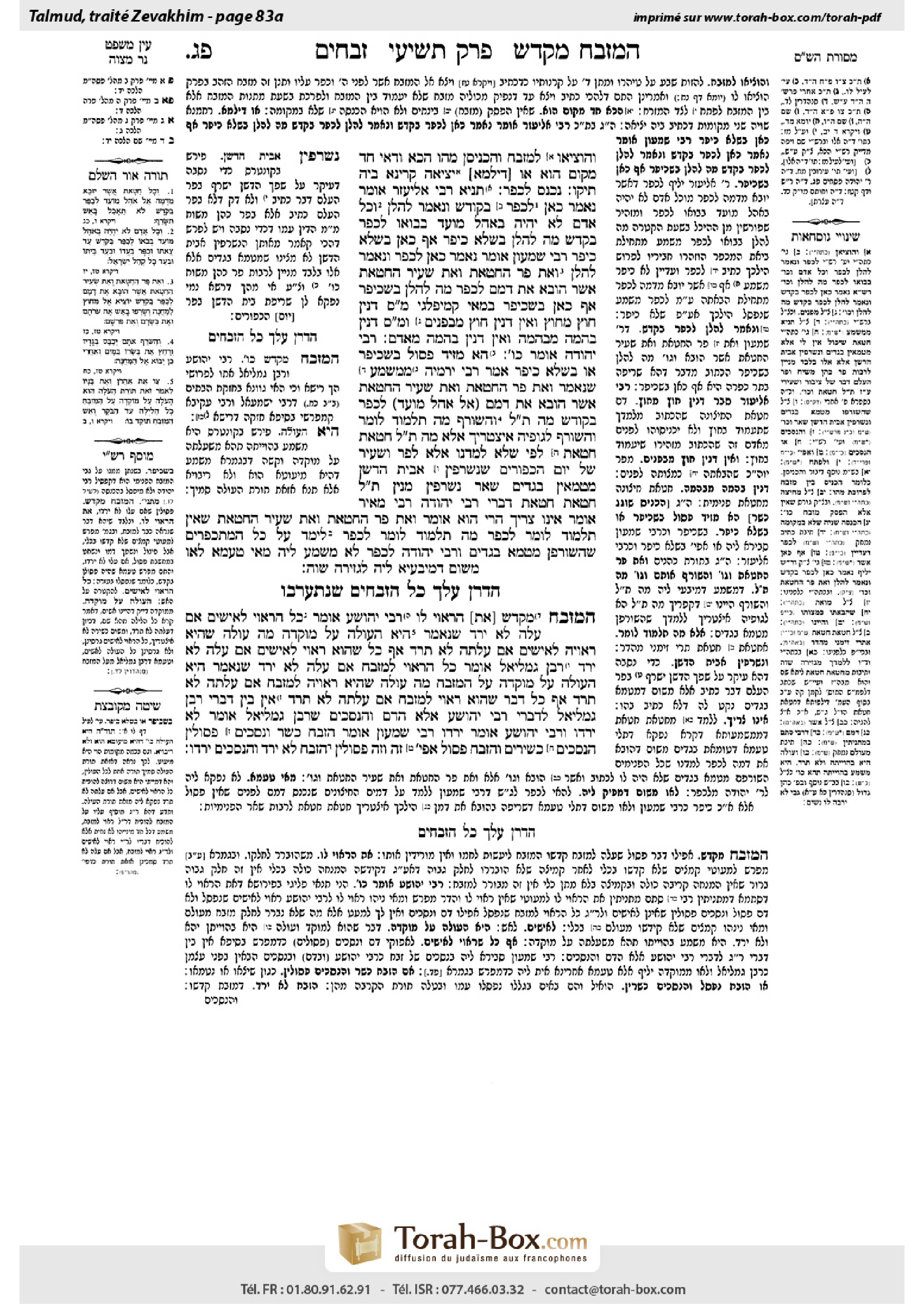
Zevachim 83a: Talmud study for Daf Yomi
Daf Yomi is the daily study of one Talmud folio. Explore 37 tractates with scans, Hebrew text, Sefaria English and AI-generated French translations where annotated.
Passage selection and English or AI-generated French translation are available where the scan has annotations. Daf Study is independent of Torah-Box and Sefaria.
Browse Zevachim · זבחים · All tractatesZevachim 83a text and translations
This page of Zevachim includes the Aramaic text, an English translation and an AI-generated French translation, alongside the scan above.
זבחים פ״ג א · Aramaic and Hebrew text
וְהוֹצִיאוֹ לַמִּזְבֵּחַ וְהִכְנִיסָן, מַהוּ?
הָכָא וַדַּאי חַד מָקוֹם הוּא, אוֹ [דִילְמָא] יְצִיאָה קָרֵינָא בֵּיהּ? תֵּיקוּ.
נִכְנַס לְכַפֵּר. תַּנְיָא, רַבִּי אֱלִיעֶזֶר אוֹמֵר: נֶאֱמַר כָּאן ״לְכַפֵּר בַּקֹּדֶשׁ״, וְנֶאֱמַר לְהַלָּן ״וְכׇל אָדָם לֹא יִהְיֶה בְּאֹהֶל מוֹעֵד בְּבֹאוֹ לְכַפֵּר בַּקֹּדֶשׁ״;
מָה לְהַלָּן בְּשֶׁלֹּא כִּיפֵּר, אַף כָּאן בְּשֶׁלֹּא כִּיפֵּר.
רַבִּי שִׁמְעוֹן אוֹמֵר: נֶאֱמַר כָּאן ״לְכַפֵּר״, וְנֶאֱמַר לְהַלָּן ״וְאֵת פַּר הַחַטָּאת וְאֶת שְׂעִיר הַחַטָּאת אֲשֶׁר הוּבָא אֶת דָּמָם לְכַפֵּר״; מָה לְהַלָּן בְּשֶׁכִּיפֵּר, אַף כָּאן בְּשֶׁכִּיפֵּר.
בְּמַאי קָמִיפַּלְגִי? מָר סָבַר: דָּנִין חוּץ מִחוּץ, וְאֵין דָּנִין חוּץ מִבִּפְנִים;
וּמָר סָבַר: דָּנִין בְּהֵמָה מִבְּהֵמָה, וְאֵין דָּנִין בְּהֵמָה מֵאָדָם.
רַבִּי יְהוּדָה אוֹמֵר כּוּ׳. הָא מֵזִיד – פָּסוּל; בְּשֶׁכִּיפֵּר אוֹ בְּשֶׁלֹּא כִּיפֵּר?
אָמַר רַבִּי יִרְמְיָה: מִמַּשְׁמָע שֶׁנֶּאֱמַר ״וְאֵת פַּר הַחַטָּאת וְאֶת שְׂעִיר הַחַטָּאת אֲשֶׁר הוּבָא אֶת דָּמָם (אֶל אֹהֶל מוֹעֵד) לְכַפֵּר בַּקֹּדֶשׁ״ – מָה תַּלְמוּד לוֹמַר ״וְהַשֹּׂרֵף״?
מָה תַּלְמוּד לוֹמַר ״וְהַשֹּׂרֵף״?! לְגוּפֵיהּ אִיצְטְרִיךְ! אֶלָּא מָה תַּלְמוּד לוֹמַר ״חַטָּאת״ ״חַטָּאת״?
לְפִי שֶׁלֹּא לָמַדְנוּ אֶלָּא לְפַר וְשָׂעִיר שֶׁל יוֹם הַכִּפּוּרִים שֶׁנִּשְׂרָפִין אַבֵּית הַדֶּשֶׁן – מְטַמְּאִין בְּגָדִים; שְׁאָר נִשְׂרָפִין מִנַּיִן? תַּלְמוּד לוֹמַר ״חַטָּאת״ ״חַטָּאת״. דִּבְרֵי רַבִּי יְהוּדָה.
רַבִּי מֵאִיר אוֹמֵר: אֵינוֹ צָרִיךְ; הֲרֵי הוּא אוֹמֵר: ״וְאֵת פַּר הַחַטָּאת וְאֵת שְׂעִיר הַחַטָּאת״ – שֶׁאֵין תַּלְמוּד לוֹמַר ״לְכַפֵּר״, מָה תַּלְמוּד לוֹמַר ״לְכַפֵּר״? לִימֵּד עַל כׇּל הַמִּתְכַּפְּרִים שֶׁהַשּׂוֹרְפָן מְטַמֵּא בְּגָדִים.
וְרַבִּי יְהוּדָה – ״לְכַפֵּר״ לָא מַשְׁמַע לֵיהּ; מַאי טַעְמָא? לָאו מִשּׁוּם דְּמִיבַּעְיָא לֵיהּ לִגְזֵירָה שָׁוָה?
הֲדַרַן עֲלָךְ כׇּל הַזְּבָחִים שֶׁנִּתְעָרְבוּ
מַתְנִי׳ הַמִּזְבֵּחַ מְקַדֵּשׁ [אֶת] הָרָאוּי לוֹ.
רַבִּי יְהוֹשֻׁעַ אוֹמֵר: כׇּל הָרָאוּי לָאִישִּׁים – אִם עָלָה לֹא יֵרֵד, שֶׁנֶּאֱמַר: ״הִיא הָעֹלָה עַל מוֹקְדָה״; מָה עוֹלָה, שֶׁהִיא רְאוּיָה לָאִישִּׁים – אִם עָלְתָה לֹא תֵּרֵד; אַף כֹּל שֶׁהוּא רָאוּי לָאִישִּׁים – אִם עָלָה לֹא יֵרֵד.
רַבָּן גַּמְלִיאֵל אוֹמֵר: כׇּל הָרָאוּי לַמִּזְבֵּחַ – אִם עָלָה לֹא יֵרֵד, שֶׁנֶּאֱמַר: ״הִיא הָעֹלָה עַל מוֹקְדָה עַל הַמִּזְבֵּחַ״; מָה עוֹלָה, שֶׁהִיא רְאוּיָה לַמִּזְבֵּחַ – אִם עָלְתָה לֹא תֵּרֵד; אַף כׇּל דָּבָר שֶׁהוּא רָאוּי לַמִּזְבֵּחַ – אִם עָלְתָה לֹא תֵּרֵד.
אֵין בֵּין דִּבְרֵי רַבָּן גַּמְלִיאֵל לְדִבְרֵי רַבִּי יְהוֹשֻׁעַ אֶלָּא הַדָּם וְהַנְּסָכִים – שֶׁרַבָּן גַּמְלִיאֵל אוֹמֵר לֹא יֵרְדוּ, וְרַבִּי יְהוֹשֻׁעַ אוֹמֵר יֵרְדוּ.
רַבִּי שִׁמְעוֹן אוֹמֵר: הַזֶּבַח כָּשֵׁר וּנְסָכִים פְּסוּלִין, הַנְּסָכִים כְּשֵׁירִים וְהַזֶּבַח פָּסוּל, אֲפִילּוּ זֶה וָזֶה פְּסוּלִין – הַזֶּבַח לֹא יֵרֵד וְהַנְּסָכִים יֵרְדוּ.
Zevachim 83a · English translation
and then brought out the blood to the golden altar in the Sanctuary and sprinkled the blood there, as required (see Leviticus 16:18), but subsequently brought the remainder of the blood in toward the Curtain dividing the Sanctuary from the Holy of Holies, what is the halakha?
Rava explains the sides of the dilemma: Do we say that here the area of the Curtain and the golden altar is certainly one place, as they are both in the Sanctuary, and therefore the blood should not be disqualified by being brought back toward the Curtain? Or perhaps, since we call the taking of the blood to the golden altar: Going out, in the verse: “And he shall go out unto the altar” (Leviticus 16:18), its return to the Curtain should be considered bringing in, and therefore the blood should be disqualified? No answers were found, and therefore the Gemara states that these dilemmas shall stand unresolved.
§ The mishna teaches that the Sages disagree as to the halakha in a case where the priest carrying the blood of a sin offering whose blood placement is on the external altar entered the Sanctuary to atone through sprinkling, but in practice the priest did not actually sprinkle the blood. According to Rabbi Eliezer the blood is disqualified, whereas Rabbi Shimon maintains that the blood is disqualified only if the priest sprinkles it in the Sanctuary. Concerning this, it is taught in a baraita that Rabbi Eliezer says: It is stated here: “And any sin offering, whereof any of the blood is brought into the Tent of Meeting to atone in the Sanctuary, shall not be eaten” (Leviticus 6:23), and it is stated there, with regard to the service of the High Priest on Yom Kippur: “And there shall be no man in the Tent of Meeting when he goes in to atone in the Sanctuary, until he comes out” (Leviticus 16:17).
Rabbi Eliezer explains: Just as there, with regard to Yom Kippur, the phrase “when he goes in to atone” is referring to the stage when he has not yet atoned, so too here, with regard to the disqualification of blood brought inside the Sanctuary, the phrase “to atone in the Sanctuary” is referring to a situation where the blood enters the Sanctuary at a time when the priest has not yet atoned.
Conversely, Rabbi Shimon says: It is stated here: “To atone” (Leviticus 6:23), and it is stated there, with regard to the conclusion of the service on Yom Kippur: “And the bull of the sin offering and the goat of the sin offering, whose blood was brought in to atone in the Sanctuary, shall be taken outside the camp, and they shall burn in the fire” (Leviticus 16:27). Just as there, the phrase “to atone” is referring to the stage when he has already atoned, as the bull and goat of Yom Kippur are burned after their blood has been sprinkled, so too here, the phrase “to atone” is referring to a situation where he has already atoned, whereas merely bringing the blood into the Sanctuary does not disqualify it.
The Gemara inquires: With regard to what principle do Rabbi Eliezer and Rabbi Shimon disagree? The Gemara explains that one Sage, Rabbi Eliezer, holds that one derives a case of outside, i.e., the blood of a sin offering whose blood placement is on the external altar, which may not be brought inside the Sanctuary, from another prohibition of outside, the prohibition against entering the Sanctuary; but one does not derive a case of outside from the bull and goat of Yom Kippur, whose blood is brought inside the Sanctuary.
And one Sage, Rabbi Shimon, holds that one derives a halakha involving an animal, i.e., a sin offering whose blood placement is on the external altar, from another halakha involving an animal, the bull and goat of Yom Kippur; but one does not derive a case of an animal from a prohibition involving a person.
§ The mishna teaches that Rabbi Yehuda says: If the priest took the blood into the Sanctuary unwittingly, the blood remains fit for presentation. The Gemara infers: But if his taking of the blood into the Sanctuary was intentional, it is disqualified. The Gemara analyzes this halakha: Is the blood disqualified only in a case where he took the blood into the Sanctuary and atoned, by sprinkling it inside the Sanctuary, as claimed by Rabbi Shimon in the mishna; or even in a case where he took the blood in and did not yet atone, in accordance with the opinion of Rabbi Eliezer?
Rabbi Yirmeya said that one can cite a proof from a baraita: From the fact that it is stated with regard to the Yom Kippur service: “And the bull of the sin offering and the goat of the sin offering, whose blood was brought in to atone in the Sanctuary, shall be taken outside the camp, and they shall burn in the fire their skins, and their flesh, and their dung; and he who burns them shall wash his clothes” (Leviticus 16:27–28), one can ask the following question: Why must the verse state: “And he who burns”?
The Gemara interrupts its citation of the baraita to question its line of inquiry. Why must the verse state: “And he who burns”? One can answer that this term was necessary for itself, to teach that the one who burns the bull and goat of Yom Kippur is thereby rendered ritually impure. Rather, this is what the baraita is saying: Why must the verse state twice: “Sin offering,” “sin offering,” with regard to the bull and the goat? It could have stated merely: And the bull and the goat of the sin offering.
The baraita answers that if the term “sin offering” had appeared only once, we would have learned only with regard to the bull and the goat of Yom Kippur that are burned in the place of the ashes that they render ritually impure the garments of the one who carries them. From where is it derived that the same applies to other sin offerings that are burned? The verse states: “Sin offering,” “sin offering,” twice, to include all sin offerings that are burned. This is the statement of Rabbi Yehuda.
Rabbi Meir says: This derivation from the repeated mention of sin offering is not necessary. Now consider, the verse states: “And the bull of the sin offering and the goat of the sin offering…shall be taken outside the camp.” As there is no need for the verse to state with regard to these offerings: “Whose blood was brought in to atone in the Sanctuary,” why must the verse nevertheless state: “To atone”? This teaches with regard to all offerings that atone inside the Sanctuary that one who burns them renders his garments impure.
The Gemara notes: And Rabbi Yehuda does not learn anything from the term “to atone.” What is the reason for this? Is it not because he requires this phrase for a verbal analogy, to derive that the blood of an external sin offering that was taken inside the Sanctuary is disqualified only if the priest sprinkled it, in accordance with the opinion of Rabbi Shimon? This answers the Gemara’s question, as Rabbi Yehuda evidently follows the opinion of Rabbi Shimon.
MISHNA: Certain unfit items, once they have been placed on the altar, are nevertheless sacrificed. The mishna teaches: The altar sanctifies only items that are suited to it. The tanna’im disagree as to the definition of suited for the altar.
Rabbi Yehoshua says: Any item that is suited to be consumed by the fire on the altar, e.g., burnt offerings and the sacrificial portions of other offerings, which are burned on the altar, if it ascended upon the altar, even if it is disqualified from being sacrificed ab initio, it shall not descend. Since it was sanctified by its ascent upon the altar, it is sacrificed upon it, as it is stated: “It is the burnt offering on the pyre upon the altar” (Leviticus 6:2), from which it is derived: Just as with regard to a burnt offering, which is suited to be consumed by the fire on the altar, if it ascended it shall not descend, so too, with regard to any item that is suited to be consumed by the fire on the altar, if it ascended it shall not descend.
Rabban Gamliel says: With regard to any item that is suited to ascend upon the altar, even if it is not typically consumed, if it ascended, it shall not descend, even if it is disqualified from being sacrificed ab initio, as it is stated: “It is the burnt offering on the pyre upon the altar,” from which it is derived: Just as with regard to a burnt offering, which is fit for the altar, if it ascended it shall not descend, so too, any item that is fit for the altar, if it ascended it shall not descend.
The mishna comments: The difference between the statement of Rabban Gamliel and the statement of Rabbi Yehoshua is only with regard to disqualified blood and disqualified libations, which are not consumed by the fire but do ascend upon the altar, as Rabban Gamliel says: They shall not descend, as they are fit to ascend upon the altar, and Rabbi Yehoshua says: They shall descend, as they are not burned on the altar.
Rabbi Shimon says: Whether the offering was fit and the accompanying libations were unfit, e.g., if they became ritually impure or they were brought outside their designated area, or whether the libations were fit and the offering was unfit, rendering the accompanying libations unfit as well, and even if both this and that were unfit, the offering shall not descend, as it was sanctified by the altar, but the libations shall descend.
Zevachim 83a · Traduction française (IA)
puis fit sortir le sang vers l’autel d’or, dans le Sanctuaire, et y aspergea le sang, comme il le fallait (voir Lévitique 16:18), mais fit ensuite entrer le reste du sang vers le rideau qui séparait le Sanctuaire du Saint des Saints : quelle est la halakha ?
Rava expose les termes de la question : faut-il dire qu’ici, l’espace du rideau et celui de l’autel d’or constituent assurément un seul et même lieu, puisqu’ils se trouvent tous deux dans le Sanctuaire, et que le sang ne devrait donc pas être invalidé parce qu’on l’a ramené vers le rideau ? Ou peut-être que, puisque le fait de porter le sang jusqu’à l’autel d’or est désigné comme une sortie dans le verset : « Et il sortira vers l’autel » (Lévitique 16:18), son retour vers le rideau doit être considéré comme une entrée, et le sang serait donc invalidé ? Aucune réponse n’ayant été trouvée, la Guemara conclut que ces questions restent sans solution.
§ La Michna enseigne que les Sages sont en désaccord sur la halakha dans le cas où le prêtre qui porte le sang d’un sacrifice expiatoire dont le sang doit être appliqué sur l’autel extérieur entre dans le Sanctuaire pour faire expiation par aspersion, mais n’asperge finalement pas le sang. Selon Rabbi Eliezer, le sang est invalidé, tandis que Rabbi Shimon maintient qu’il ne l’est que si le prêtre l’asperge dans le Sanctuaire. À ce sujet, une baraïta enseigne que Rabbi Eliezer dit : Il est dit ici : « Tout sacrifice expiatoire dont une partie du sang est portée dans la Tente d’assignation pour faire expiation dans le Sanctuaire ne sera pas mangé » (Lévitique 6:23), et il est dit là, au sujet du service du Grand Prêtre à Yom Kippour : « Qu’aucun homme ne se trouve dans la Tente d’assignation lorsqu’il entrera pour faire expiation dans le Sanctuaire, jusqu’à ce qu’il en sorte » (Lévitique 16:17).
Rabbi Eliezer explique : de même que là, au sujet de Yom Kippour, l’expression « lorsqu’il entrera pour faire expiation » désigne le moment où il n’a pas encore fait expiation, de même ici, au sujet de l’invalidation du sang porté à l’intérieur du Sanctuaire, l’expression « pour faire expiation dans le Sanctuaire » désigne le cas où le sang entre dans le Sanctuaire alors que le prêtre n’a pas encore fait expiation.
À l’inverse, Rabbi Shimon dit : Il est dit ici : « pour faire expiation » (Lévitique 6:23), et il est dit là, au sujet de la conclusion du service de Yom Kippour : « Le taureau du sacrifice expiatoire et le bouc du sacrifice expiatoire, dont le sang a été porté à l’intérieur pour faire expiation dans le Sanctuaire, seront emportés hors du camp, et ils seront brûlés au feu » (Lévitique 16:27). De même que là, l’expression « pour faire expiation » désigne le moment où il a déjà fait expiation, puisque le taureau et le bouc de Yom Kippour sont brûlés après que leur sang a été aspergé, de même ici, l’expression « pour faire expiation » désigne une situation où il a déjà fait expiation ; le simple fait de porter le sang dans le Sanctuaire ne l’invalide donc pas.
La Guemara demande : Sur quel principe Rabbi Eliezer et Rabbi Shimon sont-ils en désaccord ? La Guemara explique que l’un des Sages, Rabbi Eliezer, considère qu’on déduit le cas d’un élément extérieur — c’est-à-dire le sang d’un sacrifice expiatoire dont l’application est destinée à l’autel extérieur et qui ne peut être porté dans le Sanctuaire — d’une autre interdiction concernant l’extérieur, celle d’entrer dans le Sanctuaire ; mais qu’on ne déduit pas le cas d’un élément extérieur du taureau et du bouc de Yom Kippour, dont le sang est porté dans le Sanctuaire.
Et l’autre Sage, Rabbi Shimon, considère qu’on déduit une halakha concernant un animal — c’est-à-dire un sacrifice expiatoire dont l’application du sang est destinée à l’autel extérieur — d’une autre halakha concernant un animal, le taureau et le bouc de Yom Kippour ; mais qu’on ne déduit pas le cas d’un animal d’une interdiction concernant une personne.
§ La Michna enseigne que Rabbi Yehouda dit : Si le prêtre a porté le sang dans le Sanctuaire par inadvertance, le sang reste apte à être présenté. La Guemara en déduit que si, en revanche, il a porté le sang dans le Sanctuaire intentionnellement, il est invalidé. La Guemara examine cette halakha : le sang est-il invalidé uniquement dans le cas où il l’a porté dans le Sanctuaire et a fait expiation en l’aspergeant à l’intérieur, comme l’affirme Rabbi Shimon dans la Michna, ou bien même dans le cas où il l’a porté à l’intérieur sans encore faire expiation, conformément à l’opinion de Rabbi Eliezer ?
Rabbi Yirmeya dit qu’on peut apporter une preuve à partir d’une baraïta : puisque, à propos du service de Yom Kippour, il est dit : « Le taureau du sacrifice expiatoire et le bouc du sacrifice expiatoire, dont le sang a été porté à l’intérieur pour faire expiation dans le Sanctuaire, seront emportés hors du camp, et l’on brûlera au feu leurs peaux, leur chair et leurs excréments ; celui qui les brûlera lavera ses vêtements » (Lévitique 16:27-28), on peut poser la question suivante : pourquoi le verset doit-il préciser : « celui qui les brûlera » ?
La Guemara interrompt la citation de la baraïta pour contester son raisonnement. Pourquoi le verset doit-il préciser : « celui qui les brûlera » ? On peut répondre que cette expression est nécessaire en elle-même, pour enseigner que celui qui brûle le taureau et le bouc de Yom Kippour devient rituellement impur. La baraïta dit plutôt ceci : pourquoi le verset mentionne-t-il deux fois « sacrifice expiatoire », au sujet du taureau et du bouc ? Il aurait pu dire simplement : « le taureau et le bouc du sacrifice expiatoire ».
La baraïta répond que si l’expression « sacrifice expiatoire » n’apparaissait qu’une seule fois, nous aurions appris uniquement au sujet du taureau et du bouc de Yom Kippour, qui sont brûlés à l’emplacement des cendres, qu’ils rendent impurs les vêtements de celui qui les porte. D’où déduit-on qu’il en va de même pour les autres sacrifices expiatoires qui sont brûlés ? Le verset répète deux fois « sacrifice expiatoire » afin d’inclure tous les sacrifices expiatoires qui sont brûlés. Telle est la déclaration de Rabbi Yehouda.
Rabbi Meïr dit : Cette déduction à partir de la répétition de l’expression « sacrifice expiatoire » n’est pas nécessaire. Considérons maintenant : le verset dit : « Le taureau du sacrifice expiatoire et le bouc du sacrifice expiatoire… seront emportés hors du camp. » Puisqu’il n’était pas nécessaire que le verset précise à propos de ces offrandes : « dont le sang a été porté à l’intérieur pour faire expiation dans le Sanctuaire », pourquoi le verset précise-t-il néanmoins : « pour faire expiation » ? Cela enseigne que, pour toutes les offrandes dont l’expiation s’accomplit à l’intérieur du Sanctuaire, celui qui les brûle rend ses vêtements impurs.
La Guemara remarque : Rabbi Yehouda ne déduit rien de l’expression « pour faire expiation ». Pour quelle raison ? N’est-ce pas parce qu’il a besoin de cette expression pour une analogie verbale, afin d’établir que le sang d’un sacrifice expiatoire destiné à l’autel extérieur, porté à l’intérieur du Sanctuaire, n’est invalidé que si le prêtre l’a aspergé, conformément à l’opinion de Rabbi Shimon ? Cela répond à la question de la Guemara, puisque Rabbi Yehouda suit manifestement l’opinion de Rabbi Shimon.
MICHNA : Certains éléments impropres, une fois placés sur l’autel, sont néanmoins offerts. La Michna enseigne : L’autel ne sanctifie que les éléments qui lui conviennent. Les tannaïm sont en désaccord sur ce qui convient à l’autel.
Rabbi Yehoshoua dit : Tout élément destiné à être consumé par le feu sur l’autel, par exemple les holocaustes et les parties sacrificielles des autres offrandes, qui sont brûlées sur l’autel, s’il est monté sur l’autel, ne doit pas en redescendre, même s’il est impropre à être offert a priori. Puisqu’il a été sanctifié en montant sur l’autel, il y est offert, comme il est dit : « C’est l’holocauste sur le bûcher, sur l’autel » (Lévitique 6:2). On en déduit que, de même que pour un holocauste, destiné à être consumé par le feu sur l’autel, s’il est monté, il ne doit pas redescendre, de même, pour tout élément destiné à être consumé par le feu sur l’autel, s’il est monté, il ne doit pas redescendre.
Rabban Gamliel dit : Tout élément destiné à monter sur l’autel, même s’il n’est pas habituellement consumé, s’il est monté, ne doit pas redescendre, même s’il est impropre à être offert a priori, comme il est dit : « C’est l’holocauste sur le bûcher, sur l’autel ». On en déduit que, de même que pour un holocauste, qui convient à l’autel, s’il est monté, il ne doit pas redescendre, de même, tout élément qui convient à l’autel, s’il est monté, ne doit pas redescendre.
La Michna commente : La différence entre les propos de Rabban Gamliel et ceux de Rabbi Yehoshoua concerne uniquement le sang invalidé et les libations invalidées, qui ne sont pas consumés par le feu mais montent sur l’autel. Rabban Gamliel dit qu’ils ne doivent pas redescendre, puisqu’ils peuvent monter sur l’autel ; Rabbi Yehoshoua dit qu’ils doivent redescendre, puisqu’ils ne sont pas brûlés sur l’autel.
Rabbi Shimon dit : Que l’offrande ait été apte et les libations qui l’accompagnent impropres — par exemple parce qu’elles sont devenues rituellement impures ou qu’elles ont été portées hors de la zone qui leur est assignée —, ou que les libations aient été aptes et l’offrande impropre, ce qui rend également impropres les libations qui l’accompagnent, et même si les deux, l’offrande et les libations, étaient impropres, l’offrande ne doit pas redescendre, car elle a été sanctifiée par l’autel, mais les libations doivent redescendre.
Traduction française générée par IA à partir de l’édition anglaise de Sefaria. Vérifie toujours un passage avec le texte source.
Text from Sefaria: William Davidson Edition - Vocalized Aramaic (CC BY NC); William Davidson Edition - English (CC BY NC).