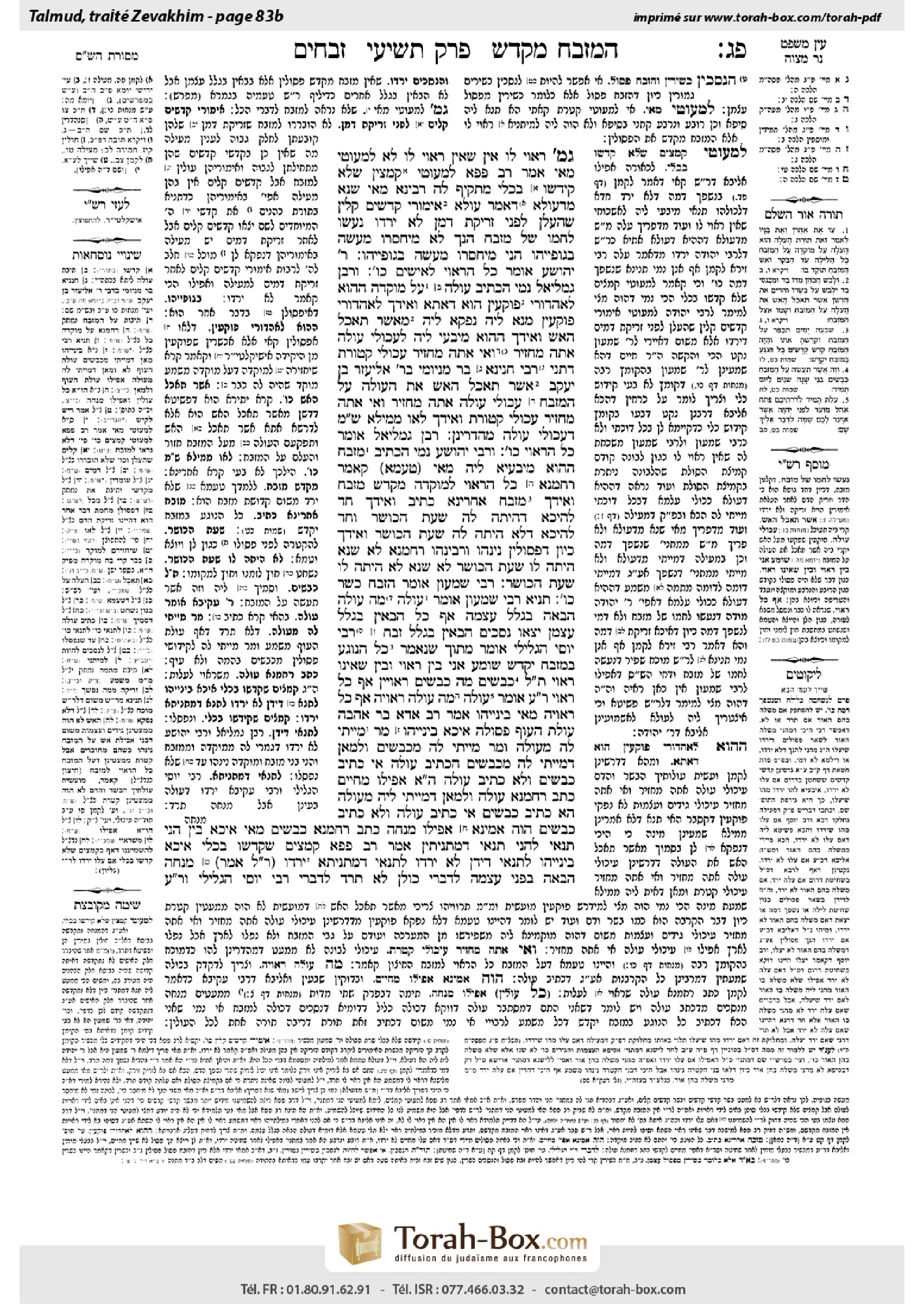
Zevachim 83b: Talmud study for Daf Yomi
Daf Yomi is the daily study of one Talmud folio. Explore 37 tractates with scans, Hebrew text, Sefaria English and AI-generated French translations where annotated.
Passage selection and English or AI-generated French translation are available where the scan has annotations. Daf Study is independent of Torah-Box and Sefaria.
Browse Zevachim · זבחים · All tractatesZevachim 83b text and translations
This page of Zevachim includes the Aramaic text, an English translation and an AI-generated French translation, alongside the scan above.
זבחים פ״ג ב · Aramaic and Hebrew text
גְּמָ׳ רָאוּי לוֹ אִין, שֶׁאֵין רָאוּי לוֹ לָא; לְמַעוֹטֵי מַאי? אָמַר רַב פָּפָּא: לְמַעוֹטֵי קְמָצִין שֶׁלֹּא קִידְּשׁוּ בִּכְלִי.
מַתְקֵיף לַהּ רָבִינָא: מַאי שְׁנָא מִדְּעוּלָּא? דְּאָמַר עוּלָּא: אֵימוּרֵי קָדָשִׁים קַלִּין שֶׁהֶעֱלָן לִפְנֵי זְרִיקַת דָּמָן – לֹא יֵרְדוּ, נַעֲשׂוּ לַחְמוֹ שֶׁל מִזְבֵּחַ.
הָנָךְ לָא מִיחַסְּרוּ מַעֲשֶׂה בְּגוּפַיְיהוּ, הָנֵי מִיחַסְּרוּ מַעֲשֶׂה בְּגוּפַיְיהוּ.
רַבִּי יְהוֹשֻׁעַ אוֹמֵר: כׇּל הָרָאוּי לָאִישִּׁים כּוּ׳. וְרַבָּן גַּמְלִיאֵל נָמֵי – הָכְתִיב: ״עֹלָה עַל מוֹקְדָה״! הָהוּא לְאַהְדּוֹרֵי פּוֹקְעִין הוּא דַּאֲתָא.
וְאִידַּךְ – לְאַהְדּוֹרֵי פּוֹקְעִין מְנָא לֵיהּ? נָפְקָא לֵיהּ מֵ״אֲשֶׁר תֹּאכַל הָאֵשׁ״.
וְאִידַּךְ – הַהוּא מִיבְּעֵי לֵיהּ: לְעִכּוּלֵי עוֹלָה אַתָּה מַחֲזִיר, וְאִי אַתָּה מַחֲזִיר עִכּוּלֵי קְטוֹרֶת. דְּתָנֵי רַבִּי חֲנִינָא בַּר מִנְיוֹמֵי בְּרַבִּי אֱלִיעֶזֶר בֶּן יַעֲקֹב: ״אֲשֶׁר תֹּאכַל הָאֵשׁ אֶת הָעֹלָה עַל הַמִּזְבֵּחַ״ – עִכּוּלֵי עוֹלָה אַתָּה מַחֲזִיר, וְאִי אַתָּה מַחֲזִיר עִכּוּלֵי קְטוֹרֶת.
וְאִידָּךְ – לָאו מִמֵּילָא שָׁמְעַתְּ מִינַּהּ דְּעִכּוּלֵי עוֹלָה מְהַדְּרִינַן?
רַבָּן גַּמְלִיאֵל אוֹמֵר: כׇּל הָרָאוּי כּוּ׳. וְרַבִּי יְהוֹשֻׁעַ נָמֵי, הָכְתִיב ״מִזְבֵּחַ״! הָהוּא מִיבַּעְיָא לֵיהּ: מַאי (טַעְמָא) קָאָמַר רַחֲמָנָא כׇּל הָרָאוּי לְמוֹקְדָה? מְקַדֵּשׁ מִזְבֵּחַ.
וְאִידַּךְ – מִזְבֵּחַ אַחֲרִינָא כְּתִיב. וְאִידַּךְ – חַד לְהֵיכָא דְּהָיְתָה לָהּ שְׁעַת הַכּוֹשֶׁר, וְחַד לְהֵיכָא דְּלֹא הָיְתָה לָהּ שְׁעַת הַכּוֹשֶׁר.
וְאִידַּךְ – כֵּיוָן דִּפְסוּלִין נִינְהוּ וְרַבִּינְהוּ רַחֲמָנָא, לָא שְׁנָא הָיְתָה לוֹ שְׁעַת הַכּוֹשֶׁר לָא שְׁנָא לֹא הָיְתָה לוֹ שְׁעַת הַכּוֹשֶׁר.
רַבִּי שִׁמְעוֹן אוֹמֵר: הַזֶּבַח כָּשֵׁר כּוּ׳. תַּנְיָא, רַבִּי שִׁמְעוֹן אוֹמֵר: ״עֹלָה״ – מָה עוֹלָה הַבָּאָה בִּגְלַל עַצְמָהּ, אַף כֹּל הַבָּאִין בִּגְלַל עַצְמָן; יָצְאוּ נְסָכִים הַבָּאִין בִּגְלַל זֶבַח.
רַבִּי יוֹסֵי הַגְּלִילִי אוֹמֵר: מִתּוֹךְ שֶׁנֶּאֱמַר ״כׇּל הַנֹּגֵעַ בַּמִּזְבֵּחַ יִקְדָּשׁ״ – שׁוֹמֵעַ אֲנִי בֵּין רָאוּי וּבֵין שֶׁאֵינוֹ רָאוּי; תַּלְמוּד לוֹמַר ״כְּבָשִׂים״ – מָה כְּבָשִׂים רְאוּיִין, אַף כֹּל רָאוּי. רַבִּי עֲקִיבָא אוֹמֵר: ״עֹלָה״ – מָה עוֹלָה רְאוּיָה, אַף כֹּל רְאוּיָה.
מַאי בֵּינַיְיהוּ? אָמַר רַב אַדָּא בַּר אַהֲבָה: עוֹלַת הָעוֹף פְּסוּלָה אִיכָּא בֵּינַיְיהוּ; מָר מַיְיתֵי לַהּ מֵ״עֹלָה״, וּמָר מַיְיתֵי לַהּ מִ״כְּבָשִׂים״.
וּלְמַאן דְּמַיְיתֵי לַהּ מִ״כְּבָשִׂים״ – הָכְתִיב ״עֹלָה״! אִי כְּתִיב ״כְּבָשִׂים״ וְלָא כְּתִיב ״עֹלָה״, הֲוָה אָמֵינָא אֲפִילּוּ מֵחַיִּים; כְּתַב רַחֲמָנָא ״עֹלָה״.
וּלְמַאן דְּמַיְיתֵי לֵיהּ מֵ״עֹלָה״, הָא כְּתִיב ״כְּבָשִׂים״! אִי כְּתִיב ״עֹלָה״ וְלָא כְּתִיב ״כְּבָשִׂים״, הֲוָה אָמֵינָא אֲפִילּוּ מִנְחָה; כְּתַב רַחֲמָנָא ״כְּבָשִׂים״.
מַאי אִיכָּא בֵּין הָנֵי תַּנָּאֵי לְהָנֵי תַּנָּאֵי דְּמַתְנִיתִין? אָמַר רַב פָּפָּא: קְמָצִים שֶׁקָּדְשׁוּ בִּכְלִי אִיכָּא בֵּינַיְיהוּ – לְתַנָּאֵי דִּידַן לֹא יֵרְדוּ, לְתַנָּאֵי דְּמַתְנִיתָא יֵרְדוּ.
רֵישׁ לָקִישׁ אָמַר: מִנְחָה הַבָּאָה בִּפְנֵי עַצְמָהּ – לְדִבְרֵי כּוּלָּן לֹא תֵּרֵד, לְדִבְרֵי רַבִּי יוֹסֵי הַגְּלִילִי וְרַבִּי עֲקִיבָא
Zevachim 83b · English translation
GEMARA: The mishna teaches that the altar sanctifies items that are suited to it, from which the Gemara infers: Items suited to the altar, yes, they are sanctified by it, but items that are not suited to the altar, no, they are not sanctified by it and descend from it even after ascending. The Gemara asks: This inference serves to exclude what? Rav Pappa said: It serves to exclude handfuls of flour that were removed from meal offerings by a priest in order to be burned on the altar, and that were not sanctified by being placed in a service vessel before they ascended upon the altar. Those handfuls did not yet become suited for the altar and therefore shall descend.
Ravina objects to Rav Pappa’s assertion: In what way is this case different from that of Ulla? As Ulla says: Sacrificial portions of offerings of lesser sanctity that one offered up on the altar before the sprinkling of the offering’s blood, and are therefore not yet suited for the altar, shall not descend, as they have become the bread of the altar, i.e., they have been sanctified such that they must be burned.
The Gemara responds that there is a difference between the cases: These sacrificial portions described by Ulla do not lack the performance of an action with regard to themselves that will render them fit for the altar; they lack only the sprinkling of the blood, an independent action. By contrast, these handfuls mentioned by Rav Pappa lack the performance of an action with regard to themselves, as they have yet to be sanctified through placement in a service vessel and never became fit for the altar.
§ The mishna teaches that Rabbi Yehoshua says: Any item that is suited to be consumed by the fire on the altar, if it ascended upon the altar it shall not descend, as it is stated: “It is the burnt offering on the pyre upon the altar” (Leviticus 6:2), from which it is derived that any item suited for burning on the altar shall not descend. The Gemara asks: And as for Rabban Gamliel also, who holds that any item suited for the altar, whether it is to be burned or not, shall not descend, isn’t it written in the verse: “Burnt offering on the pyre”? The Gemara responds: That verse comes to teach the mitzva to restore to the pyre any parts of the offering that were dislodged from the pyre, and is not discussing unfit items at all.
The Gemara asks: And the other tanna, Rabbi Yehoshua, from where does he derive the requirement to restore to the fire sacrificial portions that were dislodged from it? The Gemara responds: He derives it from the verse: “That the fire has consumed of the burnt offering on the altar” (Leviticus 6:3), indicating that items already partially consumed by the fire are restored to it even if they were dislodged from the pyre.
The Gemara asks: And the other tanna, Rabban Gamliel, what does he derive from that verse? The Gemara responds: Rabban Gamliel requires that verse to derive that you return partially consumed parts of a burnt offering to the altar, but you do not return partially consumed parts of an incense offering that fell from the golden altar. As Rabbi Ḥanina bar Minyumi, son of Rabbi Eliezer ben Yaakov, teaches that the verse “that the fire has consumed of the burnt offering on the altar” teaches that you return partially consumed parts of a burnt offering that fell from the pyre, but you do not return partially consumed parts of an incense offering that fell from the pyre.
The Gemara asks: And the other tanna, Rabbi Yehoshua, from where does he derive this distinction? The Gemara responds: Can it not be learned by itself from the straightforward meaning of the verse that we restore partially consumed parts of a burnt offering to the altar? Therefore, there is no need for an additional verse, as both halakhot can be derived from the same verse.
§ The mishna teaches that Rabban Gamliel says: With regard to any item that is suited to ascend upon the altar, even if it is not typically consumed, if it ascended, it shall not descend, even if it is disqualified from being sacrificed ab initio, as it is stated: “It is the burnt offering on the pyre upon the altar” (Leviticus 6:2). The Gemara asks: And according to Rabbi Yehoshua as well, isn’t it written: “Upon the altar,” and not merely: “On the pyre”? The Gemara responds: That term is required by Rabbi Yehoshua to teach: What is the reason the Merciful One states that any item that is suited for the pyre does not descend from the altar? It is because the altar sanctifies it.
The Gemara asks: And the other tanna, Rabban Gamliel, from where does he derive that the altar sanctifies the items that ascend upon it? The Gemara responds: It is from the fact that the term “altar” is written another time, in the verse: “Whatever touches the altar shall be sacred” (Exodus 29:37). The Gemara asks: And the other tanna, Rabbi Yehoshua, why does he require two verses to teach the same halakha, i.e., that the altar sanctifies items that ascend upon it? The Gemara answers: One verse is necessary for a case where an item had a time of fitness for consumption by the fire and was then disqualified, e.g., it became ritually impure; and one verse is necessary for a case where an item did not have a time of fitness, e.g., an offering that became disqualified at the moment of its slaughter.
The Gemara asks: And the other tanna, Rabban Gamliel, why does he not require another verse to teach that even items that had no time of fitness shall not descend from the altar? The Gemara responds: Once there are disqualified items that the Merciful One included in the halakha that they shall not descend from the altar, it is no different if the item had a time of fitness and it is no different if the item did not have a time of fitness.
§ The mishna teaches that Rabbi Shimon says: Whether the offering was fit and the accompanying libations were unfit, or whether the libations were fit and the offering was unfit, and even if both this and that were unfit, the offering shall not descend, but the libations shall descend. The Gemara elaborates: It is taught in a baraita that Rabbi Shimon says: The verse that teaches that fit items shall not descend from the altar states: “This is the law of the burnt offering: It is the burnt offering on the pyre upon the altar” (Leviticus 6:2). From there it is derived: Just as a burnt offering, which is an item that comes upon the altar for its own sake, shall not descend, so too, all items that come upon the altar for their own sake shall not descend. Excluded are libations, which come upon the altar for the sake of the offering, not for their own sake; these shall descend.
§ The Gemara cites another baraita relating to the mishna. Rabbi Yosei HaGelili says: From that which is stated: “Whatever touches the altar shall be sacred” (Exodus 29:37), I would derive that the altar sanctifies any item that ascends upon it, whether it is fit for the altar or whether it is unfit. Therefore, the verse states: “Now this is that which you shall offer upon the altar: Two lambs” (Exodus 29:38), to teach: Just as lambs are fit for the altar and are sanctified by it, so too, all items fit for the altar are sanctified by it. Rabbi Akiva says that the verse states: “Burnt offering,” to teach: Just as a burnt offering is fit for the altar and is sanctified by it, so too, all items fit for the altar are sanctified by it.
The Gemara asks: What is the practical difference between these opinions? Rav Adda bar Ahava said: The case of a disqualified bird burnt offering is the practical difference between them. One Sage, Rabbi Akiva, who cites the halakha from the term “burnt offering,” includes a disqualified bird burnt offering in the halakha that the offering shall not descend, as it is a burnt offering. And the other Sage, Rabbi Yosei HaGelili, who cites the halakha from the term “lambs,” does not include a disqualified bird burnt offering in the halakha, as it is not similar to a lamb.
The Gemara asks: And according to the one who cites the halakha from the term “lambs,” isn’t it written: “Burnt offering”? The Gemara answers: According to Rabbi Yosei HaGelili, if “lambs” had been written and “burnt offering” had not been written, I would say that even an animal that became disqualified and ascended upon the altar while alive shall not descend. Therefore, the Merciful One writes: “Burnt offering,” indicating that this halakha applies only to animals once they are fit to ascend the altar. Live animals are not fit to ascend the altar.
The Gemara continues: And according to the one who derives the halakha from “burnt offering,” isn’t it written: “Lambs”? The Gemara explains: According to Rabbi Akiva, if “burnt offering” had been written and “lambs” had not been written, I would say that any item fit to ascend the altar is included in the halakha, even a meal offering. Therefore, the Merciful One writes: “Lambs,” indicating that this halakha applies only to animal offerings and bird offerings, not to meal offerings.
The Gemara asks: What difference is there between the opinions of these tanna’im, Rabbi Yosei HaGelili and Rabbi Akiva, and the opinions of these tanna’im of the mishna? Rav Pappa said: The difference between them is with regard to handfuls of flour, removed from meal offerings, that were sanctified in a service vessel and were then disqualified. According to our tanna’im, i.e., those in the mishna here, those handfuls shall not descend, as they are fit for the altar and for consumption by the fire as well. According to the tanna’im of the baraita, those handfuls shall descend, as those tanna’im hold that the halakha applies only to animal offerings and bird offerings.
Reish Lakish says in summary: With regard to a meal offering that comes by itself and does not accompany another offering, according to the statements of all of the tanna’im in the mishna, it shall not descend once it ascended, either because it is fit to be consumed by the fire, or because it comes by itself. According to the statements of Rabbi Yosei HaGelili and Rabbi Akiva,
Zevachim 83b · Traduction française (IA)
GUEMARA : La Michna enseigne que l’autel sanctifie les éléments qui lui conviennent. La Guemara en déduit que les éléments qui conviennent à l’autel sont bien sanctifiés par lui, mais que ceux qui ne lui conviennent pas ne le sont pas et en descendent, même après y être montés. La Guemara demande : Qu’est-ce que cette déduction vient exclure ? Rav Pappa dit : Elle vient exclure les poignées de farine prélevées par un prêtre sur des offrandes de farine afin d’être brûlées sur l’autel, mais qui n’ont pas été sanctifiées par leur placement dans un ustensile de service avant de monter sur l’autel. Ces poignées ne sont pas encore devenues aptes à l’autel et doivent donc en descendre.
Ravina objecte à l’affirmation de Rav Pappa : En quoi ce cas diffère-t-il de celui d’Oulla ? Car Oulla dit : Les portions sacrificielles d’offrandes de moindre sainteté qu’on a fait monter sur l’autel avant l’aspersion du sang de l’offrande, et qui ne sont donc pas encore aptes à l’autel, n’en descendent pas, puisqu’elles sont devenues le pain de l’autel, c’est-à-dire qu’elles ont été sanctifiées de sorte qu’elles doivent être brûlées.
La Guemara répond qu’il y a une différence entre les deux cas : les portions sacrificielles décrites par Oulla ne nécessitent pas qu’une action soit accomplie sur elles-mêmes pour les rendre aptes à l’autel ; seule leur manque l’aspersion du sang, qui est une action distincte. En revanche, les poignées mentionnées par Rav Pappa nécessitent qu’une action soit accomplie sur elles-mêmes, puisqu’elles n’ont pas encore été sanctifiées par leur placement dans un ustensile de service et ne sont jamais devenues aptes à l’autel.
§ La Michna enseigne que Rabbi Yehoshua dit : Tout élément apte à être consumé par le feu sur l’autel, s’il y est monté, n’en descendra pas, comme il est dit : « C’est l’holocauste sur le brasier, sur l’autel » (Lévitique 6:2). On en déduit que tout élément apte à être brûlé sur l’autel n’en descendra pas. La Guemara demande : Et Rabban Gamliel aussi, qui considère que tout élément apte à l’autel, qu’il soit destiné à être brûlé ou non, n’en descend pas, ne trouve-t-il pas dans le verset les mots « holocauste sur le brasier » ? La Guemara répond : Ce verset vient enseigner la mitsva de remettre sur le brasier les parties de l’offrande qui en ont été écartées ; il ne traite pas du tout des éléments inaptes.
La Guemara demande : Et l’autre tanna, Rabbi Yehoshua, d’où tire-t-il l’obligation de remettre sur le feu les portions sacrificielles qui en ont été écartées ? La Guemara répond : Il la tire du verset : « Ce que le feu a consumé de l’holocauste sur l’autel » (Lévitique 6:3), qui indique que les éléments déjà partiellement consumés par le feu sont remis sur celui-ci, même s’ils ont été écartés du brasier.
La Guemara demande : Et l’autre tanna, Rabban Gamliel, que déduit-il de ce verset ? La Guemara répond : Rabban Gamliel a besoin de ce verset pour déduire qu’on remet sur l’autel les parties partiellement consumées d’un holocauste, mais qu’on ne remet pas les parties partiellement consumées d’une offrande d’encens tombées de l’autel d’or. En effet, Rabbi Ḥanina bar Minyumi, fils de Rabbi Eliezer ben Yaakov, enseigne que le verset « ce que le feu a consumé de l’holocauste sur l’autel » enseigne qu’on remet sur le brasier les parties partiellement consumées d’un holocauste qui en sont tombées, mais qu’on ne remet pas les parties partiellement consumées d’une offrande d’encens qui en sont tombées.
La Guemara demande : Et l’autre tanna, Rabbi Yehoshua, d’où tire-t-il cette distinction ? La Guemara répond : Ne peut-on pas déduire du sens littéral du verset qu’on remet sur l’autel les parties partiellement consumées d’un holocauste ? Il n’est donc pas nécessaire d’avoir un verset supplémentaire, puisque les deux halakhot peuvent être déduites du même verset.
§ La Michna enseigne que Rabban Gamliel dit : Tout élément apte à monter sur l’autel, même s’il n’est pas habituellement consumé, n’en descendra pas s’il y est monté, même s’il est disqualifié pour être offert a priori, comme il est dit : « C’est l’holocauste sur le brasier, sur l’autel » (Lévitique 6:2). La Guemara demande : Et Rabbi Yehoshua aussi ne trouve-t-il pas dans le verset les mots « sur l’autel », et pas seulement « sur le brasier » ? La Guemara répond : Rabbi Yehoshua a besoin de cette expression pour enseigner ceci : Pourquoi le Miséricordieux dit-il que tout élément apte à être placé sur le brasier ne descend pas de l’autel ? Parce que l’autel le sanctifie.
La Guemara demande : Et l’autre tanna, Rabban Gamliel, d’où déduit-il que l’autel sanctifie les éléments qui y montent ? La Guemara répond : Il le déduit du fait que le terme « autel » apparaît une autre fois, dans le verset : « Tout ce qui touchera l’autel sera sacré » (Exode 29:37). La Guemara demande : Et l’autre tanna, Rabbi Yehoshua, pourquoi a-t-il besoin de deux versets pour enseigner la même halakha, à savoir que l’autel sanctifie les éléments qui y montent ? La Guemara répond : Un verset est nécessaire pour le cas où un élément a été apte à être consumé par le feu pendant un certain temps, puis a été disqualifié, par exemple parce qu’il est devenu rituellement impur ; l’autre est nécessaire pour le cas où un élément n’a jamais été apte, par exemple une offrande disqualifiée au moment de son abattage rituel.
La Guemara demande : Et l’autre tanna, Rabban Gamliel, pourquoi n’a-t-il pas besoin d’un autre verset pour enseigner que même les éléments qui n’ont jamais été aptes ne descendent pas de l’autel ? La Guemara répond : Dès lors que le Miséricordieux a inclus des éléments disqualifiés dans la halakha selon laquelle ils ne descendent pas de l’autel, il n’y a pas de différence entre un élément qui a été apte pendant un certain temps et un élément qui ne l’a jamais été.
§ La Michna enseigne que Rabbi Shimon dit : Que l’offrande ait été apte et que les libations qui l’accompagnent aient été inaptes, que les libations aient été aptes et l’offrande inapte, ou même que les deux, l’offrande et les libations, aient été inaptes, l’offrande ne descendra pas, mais les libations descendront. La Guemara développe : Une baraïta enseigne que Rabbi Shimon dit : Le verset qui enseigne que les éléments aptes ne descendent pas de l’autel dit : « Telle est la loi de l’holocauste : c’est l’holocauste sur le brasier, sur l’autel » (Lévitique 6:2). On en déduit que, de même qu’un holocauste, élément qui vient sur l’autel pour lui-même, ne descend pas, de même tous les éléments qui viennent sur l’autel pour eux-mêmes ne descendent pas. Les libations sont exclues : elles viennent sur l’autel pour l’offrande, et non pour elles-mêmes ; elles descendront donc.
§ La Guemara cite une autre baraïta liée à la Michna. Rabbi Yosei HaGelili dit : De ce qui est dit — « Tout ce qui touchera l’autel sera sacré » (Exode 29:37) —, je déduirais que l’autel sanctifie tout élément qui y monte, qu’il soit apte à l’autel ou inapte. Le verset dit donc : « Voici ce que tu offriras sur l’autel : deux agneaux » (Exode 29:38), pour enseigner que, de même que les agneaux sont aptes à l’autel et sont sanctifiés par lui, de même tous les éléments aptes à l’autel sont sanctifiés par lui. Rabbi Akiva dit que le verset emploie le terme « holocauste » pour enseigner que, de même qu’un holocauste est apte à l’autel et est sanctifié par lui, de même tous les éléments aptes à l’autel sont sanctifiés par lui.
La Guemara demande : Quelle est la différence pratique entre ces opinions ? Rav Adda bar Ahava dit : Le cas d’un holocauste d’oiseau disqualifié constitue la différence pratique. Rabbi Akiva, qui tire la halakha du terme « holocauste », inclut un holocauste d’oiseau disqualifié dans la halakha selon laquelle l’offrande ne descend pas, puisqu’il s’agit d’un holocauste. En revanche, Rabbi Yosei HaGelili, qui tire la halakha du terme « agneaux », n’inclut pas un holocauste d’oiseau disqualifié dans cette halakha, car il ne ressemble pas à un agneau.
La Guemara demande : Et selon celui qui tire la halakha du terme « agneaux », le verset ne dit-il pas aussi « holocauste » ? La Guemara répond : Selon Rabbi Yosei HaGelili, si le terme « agneaux » avait été écrit sans que le terme « holocauste » le soit, j’aurais dit que même un animal devenu disqualifié et monté vivant sur l’autel n’en descend pas. Le Miséricordieux écrit donc « holocauste », indiquant que cette halakha ne s’applique qu’aux animaux aptes à monter sur l’autel. Les animaux vivants ne sont pas aptes à monter sur l’autel.
La Guemara poursuit : Et selon celui qui déduit la halakha du terme « holocauste », le verset ne dit-il pas aussi « agneaux » ? La Guemara explique : Selon Rabbi Akiva, si le terme « holocauste » avait été écrit sans que le terme « agneaux » le soit, j’aurais dit que tout élément apte à monter sur l’autel est inclus dans cette halakha, même une offrande de farine. Le Miséricordieux écrit donc « agneaux », indiquant que cette halakha ne s’applique qu’aux offrandes animales et aux offrandes d’oiseaux, et non aux offrandes de farine.
La Guemara demande : Quelle différence y a-t-il entre les opinions de ces tannaïm, Rabbi Yosei HaGelili et Rabbi Akiva, et celles des tannaïm de la Michna ? Rav Pappa dit : La différence entre eux concerne les poignées de farine prélevées sur des offrandes de farine, sanctifiées dans un ustensile de service puis disqualifiées. Selon nos tannaïm, c’est-à-dire ceux de la Michna ici, ces poignées ne descendront pas, puisqu’elles sont aptes à l’autel et également à être consumées par le feu. Selon les tannaïm de la baraïta, ces poignées descendront, car ils considèrent que la halakha ne s’applique qu’aux offrandes animales et aux offrandes d’oiseaux.
Reish Lakish résume : Pour une offrande de farine présentée seule et n’accompagnant pas une autre offrande, selon les propos de tous les tannaïm de la Michna, elle ne descendra pas une fois montée, soit parce qu’elle est apte à être consumée par le feu, soit parce qu’elle est présentée seule. Selon les propos de Rabbi Yosei HaGelili et de Rabbi Akiva,
Traduction française générée par IA à partir de l’édition anglaise de Sefaria. Vérifie toujours un passage avec le texte source.
Text from Sefaria: William Davidson Edition - Vocalized Aramaic (CC BY NC); William Davidson Edition - English (CC BY NC).