Zevachim 84a: Talmud study for Daf Yomi
Daf Yomi is the daily study of one Talmud folio. Explore 37 tractates with scans, Hebrew text, Sefaria English and AI-generated French translations where annotated.
Passage selection and English or AI-generated French translation are available where the scan has annotations. Daf Study is independent of Torah-Box and Sefaria.
Browse Zevachim · זבחים · All tractatesZevachim 84a text and translations
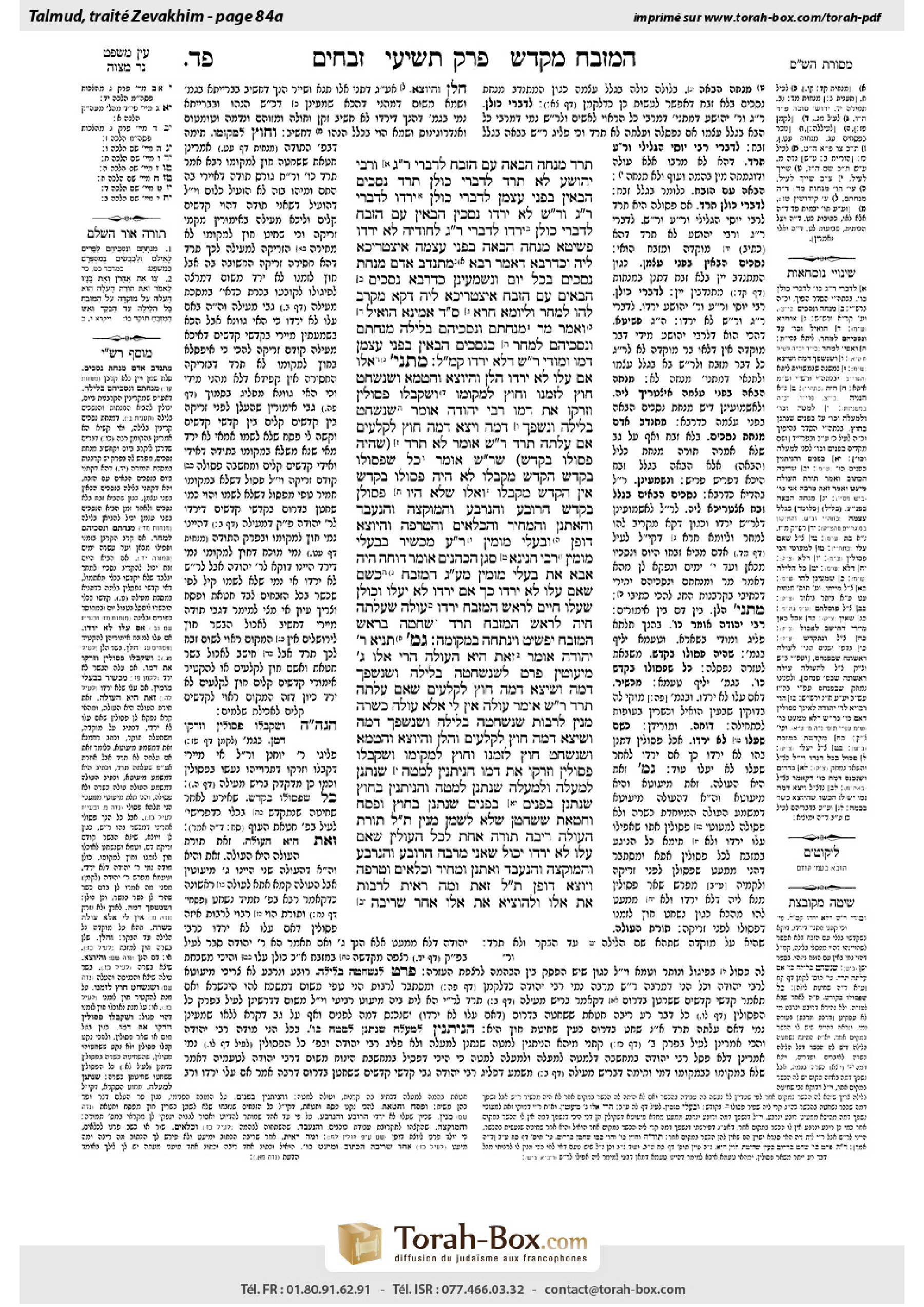
This page of Zevachim includes the Aramaic text, an English translation and an AI-generated French translation, alongside the scan above.
זבחים פ״ד א · Aramaic and Hebrew text
תֵּרֵד. מִנְחָה הַבָּאָה עִם הַזֶּבַח – לְדִבְרֵי רַבָּן גַּמְלִיאֵל וְרַבִּי יְהוֹשֻׁעַ לֹא תֵּרֵד, לְדִבְרֵי כּוּלָּן תֵּרֵד.
נְסָכִים הַבָּאִין בִּפְנֵי עַצְמָן – לְדִבְרֵי כּוּלָּן יֵרְדוּ, לְדִבְרֵי רַבָּן גַּמְלִיאֵל וְרַבִּי שִׁמְעוֹן לֹא יֵרְדוּ. נְסָכִין הַבָּאִין עִם הַזֶּבַח – לְדִבְרֵי כּוּלָּן יֵרְדוּ, לְדִבְרֵי רַבָּן גַּמְלִיאֵל לְחוֹדֵיהּ לֹא יֵרְדוּ.
פְּשִׁיטָא! מִנְחָה הַבָּאָה בִּפְנֵי עַצְמָהּ אִיצְטְרִיכָא לֵיהּ – וְכִדְרָבָא, דְּאָמַר רָבָא: מִתְנַדֵּב אָדָם מִנְחַת נְסָכִים בְּכׇל יוֹם.
וְנַשְׁמְעִינַן כִּדְרָבָא! נְסָכִים הַבָּאִים עִם הַזֶּבַח אִיצְטְרִיכָא לֵיהּ – דְּקָא מַקְרֵב לְהוּ לִמְחַר וּלְיוֹמָא חָרָא.
סָלְקָא דַּעְתָּךְ אָמֵינָא, הוֹאִיל וְאָמַר מָר: ״מִנְחָתָם וְנִסְכֵּיהֶם״ בַּלַּיְלָה, ״מִנְחָתָם וְנִסְכֵּיהֶם״ לְמָחָר – כִּנְסָכִים הַבָּאִין בִּפְנֵי עַצְמָן דָּמוּ, וּמוֹדֵי רַבִּי שִׁמְעוֹן דְּלֹא יֵרְדוּ; קָא מַשְׁמַע לַן.
מַתְנִי׳ אֵלּוּ אִם עָלוּ לֹא יֵרְדוּ: הַלָּן, וְהַיּוֹצֵא, וְהַטָּמֵא, וְשֶׁנִּשְׁחַט חוּץ לִזְמַנּוֹ וְחוּץ לִמְקוֹמוֹ, וְשֶׁקִּבְּלוּ פְּסוּלִין וְזָרְקוּ אֶת דָּמוֹ.
רַבִּי יְהוּדָה אוֹמֵר: שֶׁנִּשְׁחַט בַּלַּיְלָה וְנִשְׁפַּךְ דָּמָהּ וְיָצָא דָּמָהּ חוּץ לַקְּלָעִים – אִם עָלְתָה תֵּרֵד. רַבִּי שִׁמְעוֹן אוֹמֵר: לֹא תֵּרֵד, שֶׁהָיָה פְּסוּלוֹ בַּקֹּדֶשׁ. שֶׁרַבִּי שִׁמְעוֹן אוֹמֵר: כֹּל שֶׁפְּסוּלוֹ בַּקֹּדֶשׁ – הַקֹּדֶשׁ מְקַבְּלוֹ, לֹא הָיָה פְּסוּלוֹ בַּקֹּדֶשׁ – אֵין הַקֹּדֶשׁ מְקַבְּלוֹ.
וְאֵלּוּ שֶׁלֹּא הָיָה פְּסוּלָן בַּקֹּדֶשׁ: הָרוֹבֵעַ, וְהַנִּרְבָּע, וְהַמּוּקְצֶה, וְהַנֶּעֱבָד, וְהָאֶתְנַן, וְהַמְּחִיר, וְהַכִּלְאַיִם, וְהַטְּרֵפָה, וְהַיּוֹצֵא דּוֹפֶן, וּבַעֲלֵי מוּמִין. רַבִּי עֲקִיבָא מַכְשִׁיר בְּבַעֲלֵי מוּמִין. רַבִּי חֲנִינָא סְגַן הַכֹּהֲנִים אוֹמֵר: דּוֹחֶה הָיָה אַבָּא אֶת בַּעֲלֵי מוּמִין מֵעַל גַּבֵּי הַמִּזְבֵּחַ.
כְּשֵׁם שֶׁאִם עָלוּ לֹא יֵרְדוּ, כָּךְ אִם יֵרְדוּ לֹא יַעֲלוּ. וְכוּלָּן שֶׁעָלוּ חַיִּים לְרֹאשׁ הַמִּזְבֵּחַ – יֵרְדוּ. עוֹלָה שֶׁעָלְתָה חַיָּה לְרֹאשׁ הַמִּזְבֵּחַ – תֵּרֵד. שְׁחָטָהּ בְּרֹאשׁ הַמִּזְבֵּחַ – יַפְשִׁיט וִינַתְּחֶהָ בִּמְקוֹמָהּ.
גְּמָ׳ תַּנְיָא, רַבִּי יְהוּדָה אוֹמֵר: ״זֹאת״, ״הִיא״, ״הָעֹלָה״ – הֲרֵי אֵלּוּ שְׁלֹשָׁה מִיעוּטִין; פְּרָט לְשֶׁנִּשְׁחֲטָה בַּלַּיְלָה, וְשֶׁנִּשְׁפַּךְ דָּמָהּ, וְשֶׁיָּצָא דָּמָהּ חוּץ לַקְּלָעִים – שֶׁאִם עָלְתָה, תֵּרֵד.
רַבִּי שִׁמְעוֹן אוֹמֵר: ״עֹלָה״ – אֵין לִי אֶלָּא עוֹלָה כְּשֵׁרָה; מִנַּיִן לְרַבּוֹת שֶׁנִּשְׁחֲטָה בַּלַּיְלָה, וְשֶׁנִּשְׁפַּךְ דָּמָהּ, וְשֶׁיָּצָא דָּמָהּ חוּץ לַקְּלָעִים, וְהַלָּן, וְהַיּוֹצֵא, וְהַטָּמֵא, וְשֶׁנִּשְׁחַט חוּץ לִזְמַנּוֹ וְחוּץ לִמְקוֹמוֹ, וְשֶׁקִּבְּלוּ פְּסוּלִין וְזָרְקוּ אֶת דָּמוֹ,
הַנִּיתָּנִין לְמַטָּה שֶׁנְּתָנָן לְמַעְלָה, וּלְמַעְלָה שֶׁנְּתָנָן לְמַטָּה, וְהַנִּיתָּנִין בַּחוּץ שֶׁנְּתָנָן בִּפְנִים, בִּפְנִים שֶׁנְּתָנָן בַּחוּץ,
וּפֶסַח וְחַטָּאת שֶׁשְּׁחָטָן שֶׁלֹּא לִשְׁמָן – מִנַּיִן? תַּלְמוּד לוֹמַר: ״תּוֹרַת הָעֹלָה״ – רִיבָּה תּוֹרָה אַחַת לְכׇל הָעוֹלִין, שֶׁאִם עָלוּ לֹא יֵרְדוּ.
יָכוֹל שֶׁאֲנִי מְרַבֶּה הָרוֹבֵעַ וְהַנִּרְבָּע, וְהַמּוּקְצֶה וְהַנֶּעֱבָד, וְאֶתְנַן וּמְחִיר, וְכִלְאַיִם וּטְרֵפָה וְיוֹצֵא דּוֹפֶן? תַּלְמוּד לוֹמַר: ״זֹאת״.
וּמָה רָאִיתָ לְרַבּוֹת אֶת אֵלּוּ וּלְהוֹצִיא אֶת אֵלּוּ? אַחַר שֶׁרִיבָּה
Zevachim 84a · English translation
even that meal offering shall descend, as it is not similar to lambs. With regard to a meal offering that comes with an animal offering, either a burnt offering or peace offering, according to the statements of Rabban Gamliel and Rabbi Yehoshua, it shall not descend, as it is meant for consumpion by the fire. According to the statements of everyone else, i.e., Rabbi Shimon and the tannai’im of the baraita, it shall descend, as it is neither offered by itself nor is it an animal.
Reish Lakish continues: With regard to libations that come by themselves, according to the statements of everyone, i.e., Rabbi Yosei HaGelili, Rabbi Akiva, and Rabbi Yehoshua, they shall descend, but according to the statements of Rabban Gamliel and Rabbi Shimon, they shall not descend. With regard to libations that come with an animal offering, according to the statements of everyone, they shall descend, while according to the statement of Rabban Gamliel alone, they shall not descend.
The Gemara questions the need for such a summary: Isn’t it obvious? The Gemara answers: It was necessary for him to state the halakha in the case of a meal offering that comes by itself, and this is in accordance with the statement of Rava. As Rava says: A person can volunteer to bring a meal offering that normally accompanies libations, on any day, even without offering the libations and animal offering that it normally accompanies. Although the summary is itself obvious, it is nevertheless stated to indicate that it is possible to offer such a meal offering.
The Gemara asks: If the intent of his summary is to express his agreement with the statement of Rava, then let Reish Lakish teach us explicitly that the halakha is in accordance with the statement of Rava. The Gemara answers: It was necessary for the case of libations that come with an animal offering, as the halakha in such a case is that he may sacrifice the libations the next day and on a later [ḥara] day sometime after sacrificing the animal offering that they accompany.
Accordingly, it may enter your mind to say that since the Master says that the verse: “And their meal offering and their libations” (Numbers 29:18), indicates that libations may be offered at night, and the phrase “and their meal offering and their libations” indicates that libations may be offered the next day and on a later day, perhaps libations offered on a later date than the animal itself are to be considered as libations which come by themselves, and Rabbi Shimon would concede that they shall not descend. Reish Lakish therefore teaches us the case of libations that accompany an animal offering, to indicate that such libations are still considered as those that accompany an animal offering and that they shall descend from the altar.
MISHNA: These are the items that even if they were disqualified, if they ascended the altar they shall not descend: Blood, sacrificial portions, or limbs of a burnt offering, any of which were left overnight off the altar, or that emerge from the Temple courtyard, or that become ritually impure, or that came from an animal that was slaughtered with the intent to sacrifice it beyond its designated time or outside its designated area, or an offering that people unfit to perform the Temple service collected and then sprinkled its blood.
Rabbi Yehuda says: In the case of a sacrificial animal that was slaughtered at night, or one whose blood was spilled on the floor of the Temple without its being collected in a vessel, or one whose blood emerged outside the curtains, i.e., outside the Temple courtyard: Even if it ascended upon the altar it shall descend. Rabbi Shimon says: In all these cases, if it ascended it shall not descend, because its disqualification occurred in sanctity. As Rabbi Shimon says: With regard to any unfit offering whose disqualification occurred in sanctity, i.e., in the course of the Temple service, the sacred area renders the offering acceptable, and if it ascended onto the altar it shall not descend. But with regard to any offering whose disqualification did not occur in sanctity but rather was unfit initially, the sacred area does not render the offering acceptable.
And these are the offerings whose disqualification did not occur in sanctity: An animal that copulated with a person, and an animal that was the object of bestiality, and an animal that was set aside for idol worship, and an animal that was worshipped as a deity, and an animal that was given as payment to a prostitute or as the price of a dog, and an animal born of a mixture of diverse kinds, and an animal with a wound that will cause it to die within twelve months [tereifa], and an animal born by caesarean section, and blemished animals. Rabbi Akiva deems blemished animals fit in the sense that if they ascended they shall not descend. Rabbi Ḥanina, the deputy High Priest, says: My father would reject blemished animals from upon the altar.
Concerning those animals that, if they ascended, do not descend, just as if they ascended the altar they shall not descend, so too, if they descended they shall not then ascend. And all of them that if they ascend they do not descend, if they ascended to the top of the altar alive they descend, as an animal is fit for the altar only after it is slaughtered. A burnt offering that ascended to the top of the altar alive shall descend, as one does not slaughter an animal atop the altar ab initio. But if one slaughtered the animal at the top of the altar, he should flay it and cut it into pieces in its place, and it is not removed from the altar.
GEMARA: It is taught in a baraita that Rabbi Yehuda says: The verse from which is derived the halakha that items that ascended upon the altar shall not descend, states: “This is the law of the burnt offering: It is the burnt offering on the pyre upon the altar” (Leviticus 6:2). These are three terms of exclusion used in the verse: “This,” “it,” and “the,” from which it is derived that three instances are excluded from this halakha: A sacrificial animal that was slaughtered at night, and one whose blood was spilled, and one whose blood emerged outside the curtains, i.e., outside the Temple courtyard. With regard to these cases, the halakha is that if one of them ascended upon the altar it shall descend.
Rabbi Shimon says: From the usage of the term “burnt offering” I have derived only with regard to a fit burnt offering that it shall not descend. From where is it derived that the verse also includes a sacrificial animal that was disqualified, such as one that was slaughtered at night; or whose blood was spilled; or whose blood emerged outside the curtains, i.e., outside the Temple courtyard; or that was left overnight; or that emerged from the Temple courtyard, or that became ritually impure; or that came from an animal that was slaughtered with the intent to sacrifice it beyond its designated time or outside its designated area; or an offering that people unfit to perform the Temple service collected and then sprinkled its blood?
In addition, from where is it derived that the following are also included in this halakha: Those offerings whose blood is to be placed below the red line that divided between the upper and lower halves of the external altar, i.e., a burnt offering, a guilt offering, or a peace offering, but it was placed above the red line; and a sin offering, whose blood is to be placed above the red line, that had its blood placed below the red line; and those offerings whose blood is to be placed outside, on the external altar, that had their blood placed inside, in the Sanctuary; and those offerings whose blood is to be placed inside that had their blood placed outside?
And in addition, with regard to a Paschal offering or sin offering that were slaughtered not for their sake, from where is it derived that if they ascended upon the altar they shall not descend? The verse states: “The law of the burnt offering,” which included in one law all items that ascend upon the altar, establishing the principle that if they ascended the altar they shall not descend.
One might have thought that I should also include an animal that copulated with a person, and an animal that was the object of bestiality, and an animal that was set aside for idol worship, and an animal that was worshipped as a deity, and an animal that was given as payment to a prostitute or as the price of a dog, and an animal born of a mixture of diverse kinds, and an animal that is a tereifa, and an animal born by caesarean section. Therefore, the verse states: “This,” to exclude these types of disqualifications, which descend even after they have ascended the altar.
The Gemara asks: And what did you see as reason to include those and exclude these? The Gemara answers: After noting that the verse included
Zevachim 84a · Traduction française (IA)
Même cette offrande de farine devra descendre, car elle n’est pas comparable aux agneaux. Quant à une offrande de farine qui accompagne une offrande animale, qu’il s’agisse d’un holocauste ou d’un sacrifice de paix, selon Rabban Gamliel et Rabbi Yehoshua, elle ne devra pas descendre, car elle est destinée à être consumée par le feu. Selon tous les autres, c’est-à-dire Rabbi Shimon et les tanaïm de la baraïta, elle devra descendre, car elle n’est offerte ni seule ni comme offrande animale.
Reish Lakish poursuit : Quant aux libations offertes seules, selon tous, c’est-à-dire Rabbi Yosei HaGelili, Rabbi Akiva et Rabbi Yehoshua, elles devront descendre ; mais selon Rabban Gamliel et Rabbi Shimon, elles ne devront pas descendre. Quant aux libations qui accompagnent une offrande animale, selon tous, elles devront descendre, tandis que, selon Rabban Gamliel seul, elles ne devront pas descendre.
La Guemara s’interroge sur la nécessité d’un tel résumé : cela n’est-il pas évident ? La Guemara répond : Il était nécessaire de préciser le cas d’une offrande de farine offerte seule, conformément à l’avis de Rava. En effet, Rava dit : Une personne peut s’engager à apporter une offrande de farine qui accompagne habituellement des libations, n’importe quel jour, même sans offrir les libations et l’offrande animale qu’elle accompagne habituellement. Bien que le résumé lui-même soit évident, il est néanmoins énoncé pour indiquer qu’il est possible d’offrir une telle offrande de farine.
La Guemara demande : Si son résumé vise à exprimer son accord avec l’avis de Rava, que Reish Lakish nous enseigne explicitement que la halakha est conforme à l’avis de Rava ! La Guemara répond : Il était nécessaire de mentionner le cas des libations qui accompagnent une offrande animale, car la halakha est qu’on peut offrir ces libations le lendemain ou un autre jour ultérieur [ḥara], après avoir offert l’offrande animale qu’elles accompagnent.
Dès lors, on pourrait penser que, puisque le Maître dit que le verset « et leur offrande de farine et leurs libations » (Nombres 29:18) indique que les libations peuvent être offertes la nuit, et que l’expression « et leur offrande de farine et leurs libations » indique qu’elles peuvent être offertes le lendemain ou un autre jour ultérieur, peut-être les libations offertes à une date ultérieure à celle de l’offrande animale elle-même doivent-elles être considérées comme des libations offertes seules, auquel cas Rabbi Shimon conviendrait qu’elles ne doivent pas descendre. Reish Lakish nous enseigne donc le cas des libations qui accompagnent une offrande animale, pour indiquer que ces libations sont toujours considérées comme accompagnant une offrande animale et qu’elles doivent descendre de l’autel.
MICHNA : Voici les éléments qui, même s’ils ont été invalidés, ne doivent pas descendre s’ils sont montés sur l’autel : le sang, les parties sacrificielles ou les membres d’un holocauste qui ont passé la nuit hors de l’autel, qui sont sortis de la cour du Temple, qui sont devenus rituellement impurs, qui proviennent d’un animal abattu avec l’intention de l’offrir après le délai prescrit ou hors du lieu prescrit, ou qui appartiennent à une offrande dont le sang a été recueilli puis aspergé par des personnes inaptes au service du Temple.
Rabbi Yehouda dit : Dans le cas d’un animal sacrificiel abattu la nuit, ou dont le sang a été répandu sur le sol du Temple sans être recueilli dans un récipient, ou dont le sang est sorti au-delà des tentures, c’est-à-dire hors de la cour du Temple, même s’il est monté sur l’autel, il devra en descendre. Rabbi Shimon dit : Dans tous ces cas, s’il est monté, il ne devra pas descendre, car son invalidation s’est produite dans la sainteté. En effet, Rabbi Shimon dit : Pour toute offrande impropre dont l’invalidation s’est produite dans la sainteté, c’est-à-dire au cours du service du Temple, le lieu sacré rend l’offrande recevable ; si elle est montée sur l’autel, elle ne devra pas en descendre. Mais pour toute offrande dont l’invalidation ne s’est pas produite dans la sainteté, mais qui était impropre dès le départ, le lieu sacré ne la rend pas recevable.
Et voici les offrandes dont l’invalidation ne s’est pas produite dans la sainteté : un animal qui s’est accouplé avec une personne, un animal qui a fait l’objet d’un acte de bestialité, un animal mis à part pour l’idolâtrie, un animal adoré comme une divinité, un animal donné en paiement à une prostituée ou comme prix d’un chien, un animal issu d’un croisement d’espèces, un animal atteint d’une blessure qui le fera mourir dans les douze mois [tereifa], un animal né par césarienne et les animaux présentant un défaut. Rabbi Akiva considère que les animaux présentant un défaut sont aptes, en ce sens que, s’ils sont montés sur l’autel, ils ne devront pas en descendre. Rabbi Ḥanina, le substitut du grand prêtre, dit : Mon père faisait retirer de l’autel les animaux présentant un défaut.
Concernant ces animaux qui, s’ils sont montés sur l’autel, n’en descendent pas, de même qu’ils ne doivent pas descendre s’ils y sont montés, de même, s’ils en sont descendus, ils ne doivent pas ensuite y remonter. Tous ceux qui, s’ils montent sur l’autel, n’en descendent pas doivent toutefois en descendre s’ils sont montés vivants jusqu’à son sommet, car un animal n’est apte à être offert sur l’autel qu’après avoir été abattu. Un holocauste monté vivant jusqu’au sommet de l’autel doit en descendre, car on n’abat pas un animal au sommet de l’autel a priori. Mais si l’on a abattu l’animal au sommet de l’autel, on doit le dépouiller et le découper sur place, sans le retirer de l’autel.
GUEMARA : Une baraïta enseigne que Rabbi Yehouda dit : Le verset dont on déduit la halakha selon laquelle les éléments montés sur l’autel ne doivent pas en descendre dit : « Telle est la loi de l’holocauste : c’est l’holocauste sur le foyer, sur l’autel » (Lévitique 6:2). Le verset comporte trois termes d’exclusion : « telle », « c’est » et « l’holocauste ». On en déduit que trois cas sont exclus de cette halakha : un animal sacrificiel abattu la nuit, un animal dont le sang a été répandu et un animal dont le sang est sorti au-delà des tentures, c’est-à-dire hors de la cour du Temple. Dans ces cas, si l’un d’eux est monté sur l’autel, il devra en descendre.
Rabbi Shimon dit : Du terme « holocauste », je n’ai déduit que le cas d’un holocauste apte, qui ne doit pas descendre. D’où déduit-on que le verset inclut également un animal sacrificiel invalidé, par exemple parce qu’il a été abattu la nuit, ou que son sang a été répandu, ou que son sang est sorti au-delà des tentures, c’est-à-dire hors de la cour du Temple, ou qu’il a passé la nuit dehors, ou qu’il est sorti de la cour du Temple, ou qu’il est devenu rituellement impur, ou qu’il provient d’un animal abattu avec l’intention de l’offrir après le délai prescrit ou hors du lieu prescrit, ou encore une offrande dont le sang a été recueilli puis aspergé par des personnes inaptes au service du Temple ?
En outre, d’où déduit-on que les offrandes suivantes sont également incluses dans cette halakha : celles dont le sang doit être placé sous la ligne rouge qui séparait les moitiés supérieure et inférieure de l’autel extérieur, c’est-à-dire un holocauste, un sacrifice de culpabilité ou un sacrifice de paix, mais dont le sang a été placé au-dessus de la ligne rouge ; un sacrifice expiatoire, dont le sang doit être placé au-dessus de la ligne rouge, mais dont le sang a été placé sous cette ligne ; les offrandes dont le sang doit être placé à l’extérieur, sur l’autel extérieur, mais dont le sang a été placé à l’intérieur, dans le Sanctuaire ; et les offrandes dont le sang doit être placé à l’intérieur, mais dont le sang a été placé à l’extérieur ?
En outre, concernant un sacrifice pascal ou un sacrifice expiatoire abattu sans que ce soit pour leur propre compte, d’où déduit-on que, s’ils sont montés sur l’autel, ils ne doivent pas en descendre ? Le verset dit : « La loi de l’holocauste », réunissant sous une même loi tous les éléments qui montent sur l’autel et établissant le principe que, s’ils y sont montés, ils ne doivent pas en descendre.
On aurait pu penser qu’il fallait également inclure un animal qui s’est accouplé avec une personne, un animal qui a fait l’objet d’un acte de bestialité, un animal mis à part pour l’idolâtrie, un animal adoré comme une divinité, un animal donné en paiement à une prostituée ou comme prix d’un chien, un animal issu d’un croisement d’espèces, un animal qui est une tereifa et un animal né par césarienne. Le verset dit donc : « Telle », pour exclure ces types d’invalidations, qui doivent descendre même après être montés sur l’autel.
La Guemara demande : Et qu’as-tu vu pour inclure ceux-là et exclure ceux-ci ? La Guemara répond : Après avoir remarqué que le verset a inclus
Traduction française générée par IA à partir de l’édition anglaise de Sefaria. Vérifie toujours un passage avec le texte source.
Text from Sefaria: William Davidson Edition - Vocalized Aramaic (CC BY NC); William Davidson Edition - English (CC BY NC).