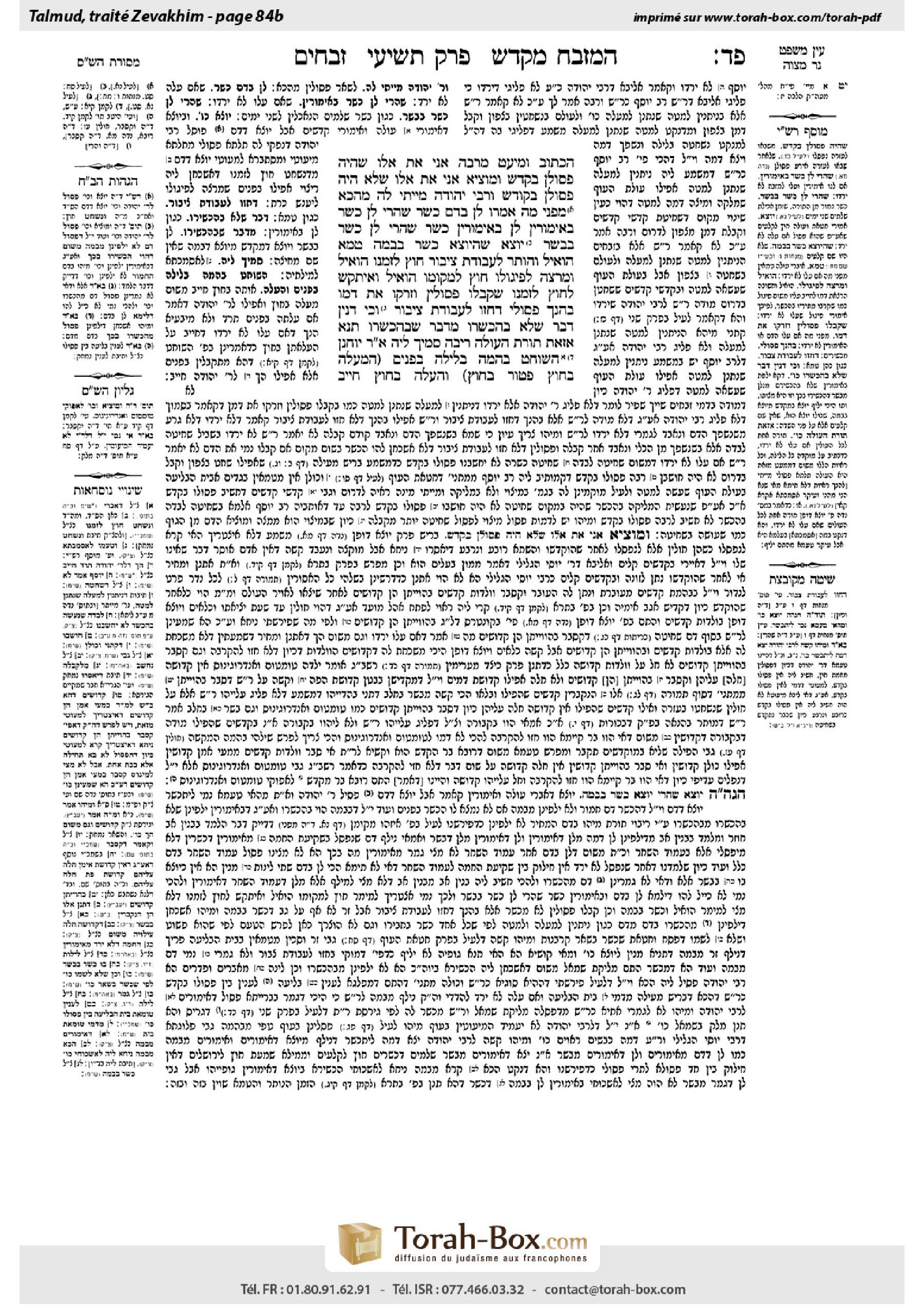
Zevachim 84b: Talmud study for Daf Yomi
Daf Yomi is the daily study of one Talmud folio. Explore 37 tractates with scans, Hebrew text, Sefaria English and AI-generated French translations where annotated.
Passage selection and English or AI-generated French translation are available where the scan has annotations. Daf Study is independent of Torah-Box and Sefaria.
Browse Zevachim · זבחים · All tractatesZevachim 84b text and translations
This page of Zevachim includes the Aramaic text, an English translation and an AI-generated French translation, alongside the scan above.
זבחים פ״ד ב · Aramaic and Hebrew text
הַכָּתוּב וּמִיעֵט, מְרַבֶּה אֲנִי אֶת אֵלּוּ שֶׁהָיָה פְּסוּלָן בַּקֹּדֶשׁ, וּמוֹצִיא אֲנִי אֶת אֵלּוּ שֶׁלֹּא הָיָה פְּסוּלָן בַּקּוֹדֶשׁ.
וְרַבִּי יְהוּדָה מַיְיתֵי לַהּ מֵהָכָא: מִפְּנֵי מָה אָמְרוּ לָן בַּדָּם כָּשֵׁר –
שֶׁהֲרֵי לָן כָּשֵׁר בָּאֵימוּרִין. לָן בָּאֵימוּרִין כָּשֵׁר – שֶׁהֲרֵי לָן כָּשֵׁר בַּבָּשָׂר.
יוֹצֵא – שֶׁהַיּוֹצֵא כָּשֵׁר בְּבָמָה.
טָמֵא – הוֹאִיל וְהוּתַּר לַעֲבוֹדַת צִיבּוּר.
חוּץ לִזְמַנּוֹ – הוֹאִיל וּמְרַצֶּה לְפִיגּוּלוֹ.
חוּץ לִמְקוֹמוֹ – הוֹאִיל וְאִיתַּקַּשׁ לְחוּץ לִזְמַנּוֹ.
שֶׁקִּבְּלוּ פְּסוּלִין וְזָרְקוּ אֶת דָּמוֹ – בְּהָנָךְ פְּסוּלֵי דַּחֲזוֹ לַעֲבוֹדַת צִיבּוּר.
וְכִי דָּנִין דָּבָר שֶׁלֹּא בְּהֶכְשֵׁרוֹ, מִדָּבָר שֶׁבְּהֶכְשֵׁרוֹ?!
תָּנָּא אַ״זֹּאת תּוֹרַת הָעֹלָה״ רִיבָּה סְמִיךְ לֵיהּ.
אָמַר רַבִּי יוֹחָנָן: הַשּׁוֹחֵט בְּהֵמָה בַּלַּיְלָה בִּפְנִים וְהֶעֱלָה בַּחוּץ – חַיָּיב,
Zevachim 84b · English translation
and subsequently the verse excluded, I say the following claim with regard to what to include and what to exclude: I will include those whose disqualification was in sanctity, i.e., in the course of Temple service, and rule that if they ascended they shall not descend, and I will exclude these whose disqualification was not in sanctity, and rule that if they ascended they shall descend.
And as for Rabbi Yehuda, who disagrees with Rabbi Shimon and does not deem it permitted for items whose disqualification occurred in sanctity to remain on the altar, yet agrees that those items listed in the beginning of the mishna, such as sacrificial portions left overnight, shall not descend, he derives it from here, as it is taught in a baraita: For what reason did the Sages say to us that in the case of blood left overnight it is fit, i.e., if blood of an offering had been left overnight and was then placed on the altar it is not removed?
This is as the halakha is in the case of sacrificial portions, which if they are left overnight are fit. From where is it derived that in the case of sacrificial portions that are left overnight, they are fit? This is as the halakha is in the case of meat, which if it is left overnight is fit, because the meat of a peace offering may be eaten for two days and one night.
From where is it derived that if an offering that emerges from the Temple courtyard is then placed on the altar it is not removed? This is derived by comparison, since an offering that leaves its area is fit in the case of an offering brought on a private altar, as the entire notion of sacrifice on such an altar is that it may be performed anywhere.
From where is it derived that if an offering that has become ritually impure is placed on the altar it is not removed? This is derived by comparison, since it is permitted to offer an impure offering in the case of communal rites, i.e., communal offerings. In cases of necessity, the communal offerings may be sacrificed even if they are ritually impure.
From where is it derived that if an offering that was disqualified due to the intention of the priest who slaughtered it to consume it beyond its designated time [piggul] was placed on the altar, it is not removed? This is derived by comparison, since the sprinkling of its blood effects acceptance with regard to its status as piggul. The status of piggul takes effect only if the sacrificial rites involving that offering were otherwise performed properly. This indicates that it still has the status of an offering, so it is not removed from the altar.
From where is it derived that if an offering that was disqualified due to the intention of the priest who slaughtered it to consume it outside its designated area was placed on the altar, it is not removed? This is derived by comparison, since it is juxtaposed to an offering that was slaughtered with intent to consume it beyond its designated time.
From where is it derived that if an offering that people unfit for performing the Temple service collected and then sprinkled its blood was placed on the altar, it is not removed? This is derived from the halakha of these priests who are generally disqualified because they are impure, yet who are fit to perform the communal rites, i.e., to sacrifice communal offerings, in a case when all the priests or the majority of the Jewish people are impure.
The Gemara questions the derivations of the baraita: But can one deduce the halakha of a matter that is not fit, i.e., sacrificial portions that are disqualified due to having been left overnight, from the halakha of a matter that is fit, i.e., the peace offering, which is permitted for eating for two days and one night? Similarly, how can the baraita derive the halakha of flesh that was removed from the Temple courtyard from the halakha of a private altar, which has no halakhic area surrounding it?
The Gemara answers: The tanna relied on the verse: “Command Aaron and his sons, saying: This is the law of the burnt offering: It is the burnt offering on the pyre upon the altar all night until the morning; and the fire of the altar shall be kept burning there” (Leviticus 6:2), which amplified the application of the halakha stated in the verse, teaching that many types of disqualified offerings may be left upon the altar. The derivations written in the baraita are mere supports for those two halakhot. The explanations cited in the baraita for including these disqualifications are mentioned only to clarify why Rabbi Yehuda does not exclude them based on the terms “this,” “it,” and “that.”
§ With regard to an offering that was slaughtered at night, which Rabbi Yehuda holds shall descend from the altar even if it ascended, Rabbi Yoḥanan says: One who slaughters a sacrificial animal at night inside the Temple courtyard, and then offers it up on an altar outside the Temple courtyard, is liable to receive karet, which is the punishment for one who sacrifices an offering outside the Temple courtyard. Although one is normally liable for sacrificing an offering outside the Temple courtyard only if it was fit to be offered on the altar within the Temple, and an animal slaughtered at night is disqualified and shall descend from the altar according to Rabbi Yehuda,
Zevachim 84b · Traduction française (IA)
et ensuite le verset exclut. Je formule l’argument suivant pour déterminer ce qu’il faut inclure et ce qu’il faut exclure : j’inclurai les cas où l’invalidation est survenue dans le domaine de la sainteté, c’est-à-dire au cours du service du Temple, et je statuerai que, s’ils sont montés sur l’autel, ils n’en descendront pas ; j’exclurai les cas où l’invalidation n’est pas survenue dans le domaine de la sainteté, et je statuerai que, s’ils sont montés sur l’autel, ils en descendront.
Quant à Rabbi Yehouda, qui est en désaccord avec Rabbi Shimon et ne considère pas que les éléments invalidés dans le domaine de la sainteté puissent rester sur l’autel, mais convient néanmoins que les éléments énumérés au début de la Michna, tels que les portions sacrificielles laissées toute la nuit, n’en descendent pas, il le déduit de ce qui suit, comme l’enseigne une baraïta : Pour quelle raison les Sages nous ont-ils dit que, dans le cas du sang laissé toute la nuit, il reste apte — c’est-à-dire que si le sang d’une offrande est resté toute la nuit puis a été placé sur l’autel, il n’en est pas retiré ?
C’est que la halakha est la même pour les portions sacrificielles : si elles sont laissées toute la nuit, elles restent aptes. D’où déduit-on que les portions sacrificielles laissées toute la nuit restent aptes ? De la halakha concernant la viande : si elle est laissée toute la nuit, elle reste apte, car la viande d’une offrande de paix peut être consommée pendant deux jours et une nuit.
D’où déduit-on que si une offrande qui a quitté la cour du Temple est ensuite placée sur l’autel, elle n’en est pas retirée ? On le déduit par comparaison, puisqu’une offrande qui quitte son aire reste apte dans le cas d’une offrande apportée sur un autel privé, car le principe même du sacrifice sur un tel autel est qu’il peut être accompli n’importe où.
D’où déduit-on que si une offrande devenue rituellement impure est placée sur l’autel, elle n’en est pas retirée ? On le déduit par comparaison, puisqu’il est permis d’offrir une offrande impure dans le cadre des rites communautaires, c’est-à-dire des offrandes communautaires. En cas de nécessité, les offrandes communautaires peuvent être sacrifiées même si elles sont rituellement impures.
D’où déduit-on que si une offrande invalidée parce que le prêtre qui l’a égorgée avait l’intention de la consommer après le délai prévu [piggul] est placée sur l’autel, elle n’en est pas retirée ? On le déduit par comparaison, puisque l’aspersion de son sang produit l’acceptation à son égard quant à son statut de piggul. Le statut de piggul ne prend effet que si les autres rites sacrificiels de cette offrande ont été accomplis correctement. Cela indique qu’elle conserve son statut d’offrande et qu’elle n’est donc pas retirée de l’autel.
D’où déduit-on que si une offrande invalidée parce que le prêtre qui l’a égorgée avait l’intention de la consommer hors de l’aire prévue est placée sur l’autel, elle n’en est pas retirée ? On le déduit par comparaison, puisqu’elle est rapprochée d’une offrande égorgée avec l’intention d’être consommée après le délai prévu.
D’où déduit-on que si une offrande dont des personnes inaptes au service du Temple ont recueilli le sang puis aspergé l’autel est placée sur celui-ci, elle n’en est pas retirée ? On le déduit de la halakha concernant ces prêtres qui sont généralement inaptes parce qu’ils sont impurs, mais qui sont aptes à accomplir les rites communautaires, c’est-à-dire à sacrifier les offrandes communautaires, lorsque tous les prêtres ou la majorité du peuple juif sont impurs.
La Guemara met en question les déductions de la baraïta : peut-on déduire la halakha d’un cas inapte, celui des portions sacrificielles invalidées parce qu’elles ont été laissées toute la nuit, de la halakha d’un cas apte, à savoir l’offrande de paix, dont la viande peut être consommée pendant deux jours et une nuit ? De même, comment la baraïta peut-elle déduire la halakha de la viande qui a quitté la cour du Temple de celle d’un autel privé, qui n’est soumis à aucune limite territoriale selon la halakha ?
La Guemara répond : le tanna s’est appuyé sur le verset : « Ordonne à Aaron et à ses fils, en disant : Voici la loi de l’holocauste : c’est l’holocauste qui brûle sur le bûcher de l’autel toute la nuit jusqu’au matin ; le feu de l’autel y restera allumé » (Lévitique 6:2), qui a élargi la portée de la halakha énoncée dans le verset et enseigne que de nombreux types d’offrandes invalidées peuvent rester sur l’autel. Les déductions consignées dans la baraïta ne sont que des appuis à ces deux halakhot. Les explications données dans la baraïta pour inclure ces motifs d’invalidation ne sont mentionnées que pour préciser pourquoi Rabbi Yehouda ne les exclut pas en s’appuyant sur les termes « ceci », « elle » et « cela ».
§ Au sujet d’une offrande égorgée la nuit, dont Rabbi Yehouda estime qu’elle doit descendre de l’autel même si elle y est montée, Rabbi Yoḥanan dit : Celui qui égorge un animal destiné au sacrifice la nuit, dans la cour du Temple, puis le fait brûler sur un autel situé à l’extérieur de la cour du Temple, est passible de karet, peine encourue par celui qui sacrifie une offrande à l’extérieur de la cour du Temple. En effet, normalement, on n’est passible d’avoir sacrifié une offrande à l’extérieur de la cour du Temple que si celle-ci était apte à être offerte sur l’autel à l’intérieur du Temple ; or, selon Rabbi Yehouda, un animal égorgé la nuit est invalidé et doit descendre de l’autel,
Traduction française générée par IA à partir de l’édition anglaise de Sefaria. Vérifie toujours un passage avec le texte source.
Text from Sefaria: William Davidson Edition - Vocalized Aramaic (CC BY NC); William Davidson Edition - English (CC BY NC).