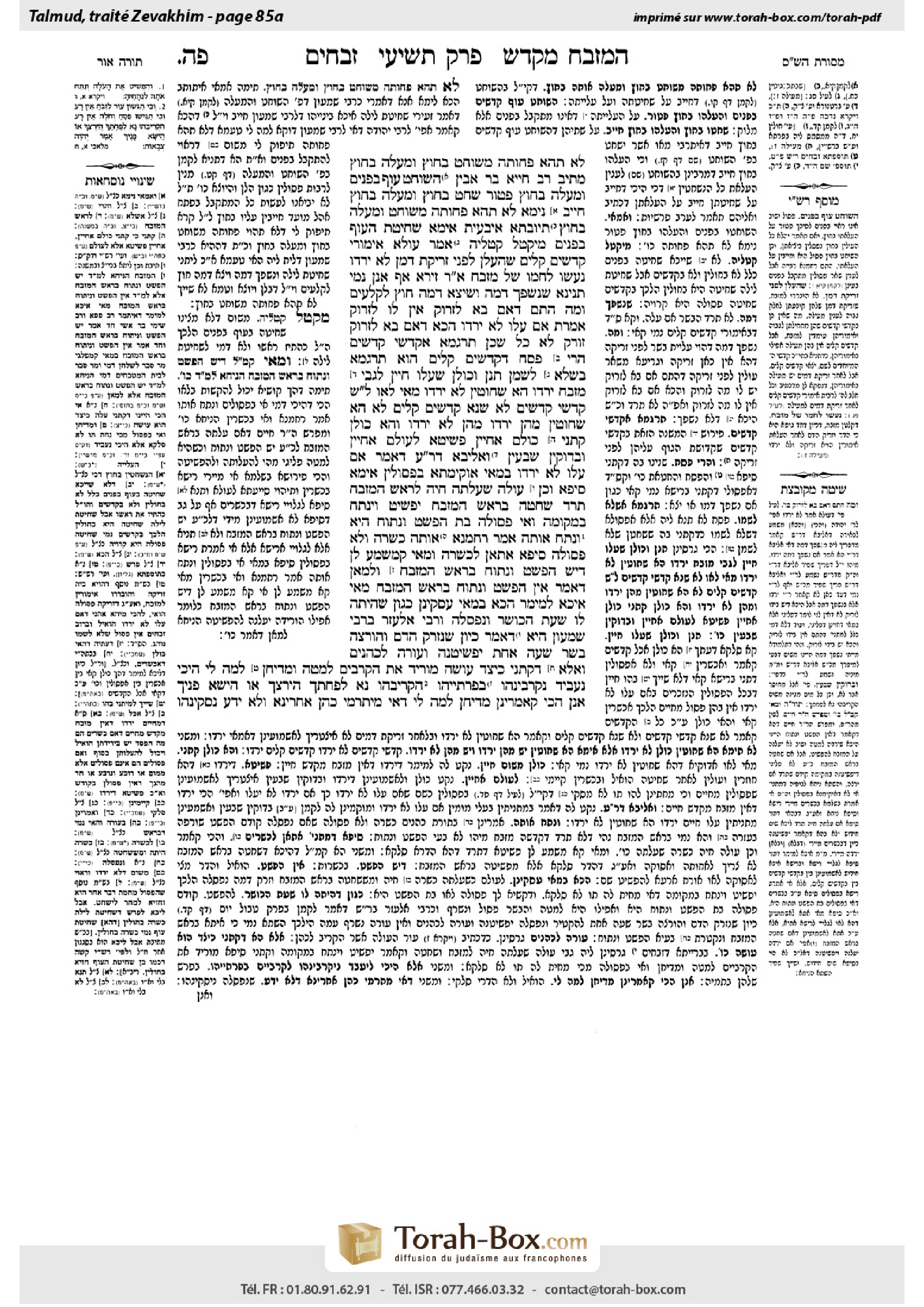
Zevachim 85a: Talmud study for Daf Yomi
Daf Yomi is the daily study of one Talmud folio. Explore 37 tractates with scans, Hebrew text, Sefaria English and AI-generated French translations where annotated.
Passage selection and English or AI-generated French translation are available where the scan has annotations. Daf Study is independent of Torah-Box and Sefaria.
Browse Zevachim · זבחים · All tractatesZevachim 85a text and translations
This page of Zevachim includes the Aramaic text, an English translation and an AI-generated French translation, alongside the scan above.
זבחים פ״ה א · Aramaic and Hebrew text
לֹא תְּהֵא פְּחוּתָה מִשּׁוֹחֵט בַּחוּץ וּמַעֲלֶה בַּחוּץ.
מֵתִיב רַב חִיָּיא בַּר אָבִין: הַשּׁוֹחֵט עוֹף בִּפְנִים וּמַעֲלֶה בַּחוּץ – פָּטוּר. שֹׁחֵט בַּחוּץ וּמַעֲלֶה בַּחוּץ – חַיָּיב. נֵימָא: לֹא תְּהֵא פְּחוּתָה מִשּׁוֹחֵט וּמַעֲלֶה בַּחוּץ!
תְּיוּבְתָּא. אִיבָּעֵית אֵימָא: שְׁחִיטַת הָעוֹף בִּפְנִים – מִיקְטָל קַטְלֵיהּ.
אָמַר עוּלָּא: אֵימוּרֵי קָדָשִׁים קַלִּים שֶׁהֶעֱלָן לִפְנֵי זְרִיקַת דָּמָן – לֹא יֵרְדוּ, נַעֲשׂוּ לַחְמוֹ שֶׁל מִזְבֵּחַ.
אָמַר רַבִּי זֵירָא, אַף אֲנַן נָמֵי תְּנֵינָא: שֶׁנִּשְׁפַּךְ דָּמָהּ, וְשֶׁיָּצָא דָּמָהּ חוּץ לַקְּלָעִים. וּמָה הָתָם – דְּאִם בָּא לִזְרוֹק אֵין לוֹ לִזְרוֹק, אָמַרְתָּ: אִם עָלוּ לֹא יֵרְדוּ; הָכָא דְּאִם בָּא לִזְרוֹק זוֹרֵק – לֹא כׇּל שֶׁכֵּן?!
תַּרְגְּמַהּ אַקׇּדְשֵׁי קָדָשִׁים.
הֲרֵי פֶּסַח – דְּקָדָשִׁים קַלִּים הוּא! תַּרְגְּמַהּ בְּשֶׁלֹּא לִשְׁמָן.
תְּנַן: וְכוּלָּן שֶׁעָלוּ חַיִּין לְגַבֵּי מִזְבֵּחַ – יֵרְדוּ. הָא שְׁחוּטִין – לֹא יֵרְדוּ; מַאי, לָאו לָא שְׁנָא קׇדְשֵׁי קָדָשִׁים לָא שְׁנָא קָדָשִׁים קַלִּים?
לָא; הָא שְׁחוּטִין – מֵהֶן יֵרְדוּ מֵהֶן לֹא יֵרְדוּ. וְהָא ״כּוּלָּן״ קָתָנֵי! ״כּוּלָּם״ אַחַיִּין.
פְּשִׁיטָא! לְעוֹלָם אַחַיִּין – וּבְדוּקִּין שֶׁבָּעַיִן; וְאַלִּיבָּא דְּרַבִּי עֲקִיבָא, דְּאָמַר: אִם עָלוּ לֹא יֵרְדוּ.
בְּמַאי אוֹקֵימְתַּהּ – בִּפְסוּלִין? אֵימָא סֵיפָא: וְכֵן עוֹלָה שֶׁעָלְתָה חַיָּה לְרֹאשׁ הַמִּזְבֵּחַ – תֵּרֵד, שְׁחָטָהּ בְּרֹאשׁ הַמִּזְבֵּחַ – יַפְשִׁיט וִינַתֵּחַ בִּמְקוֹמָהּ. וְאִי פְּסוּלָה – בַּת הֶפְשֵׁט וְנִתּוּחַ הִיא?! ״וְנִתַּח אוֹתָהּ״ אָמַר רַחֲמָנָא, ״אוֹתָהּ״ – כְּשֵׁרָה וְלָא פְּסוּלָה!
סֵיפָא אֲתָאן לִכְשֵׁרָה. וּמַאי קָמַשְׁמַע לַן? דְּיֵשׁ הֶפְשֵׁט וְנִתּוּחַ בְּרֹאשׁ הַמִּזְבֵּחַ.
וּלְמַאן דְּאָמַר אֵין הֶפְשֵׁט וְנִתּוּחַ בְּרֹאשׁ הַמִּזְבֵּחַ, מַאי אִיכָּא לְמֵימַר? הָכָא בְּמַאי עָסְקִינַן – כְּגוֹן שֶׁהָיְתָה לוֹ שְׁעַת הַכּוֹשֶׁר וְנִפְסְלָה; וְרַבִּי אֶלְעָזָר בְּרַבִּי שִׁמְעוֹן הִיא, דְּאָמַר: כֵּיוָן שֶׁנִּזְרַק הַדָּם וְהוּרְצָה בָּשָׂר שָׁעָה אַחַת – יַפְשִׁיטֶנָּה, וְעוֹרָהּ לַכֹּהֲנִים.
וְאֶלָּא דְּקָתָנֵי: כֵּיצַד עוֹשֶׂה – מוֹרִיד אֶת הַקְּרָבַיִם לְמַטָּה וּמַדִּיחָן; לְמָה לִי?
הֵיכִי נַעֲבֵיד? נַקְרְבִינְהוּ בְּפִרְתַּיְיהוּ?! ״הַקְרִיבֵהוּ נָא לְפֶחָתֶךָ הֲיִרְצְךָ אוֹ הֲיִשָּׂא פָנֶיךָ״!
אֲנַן הָכִי קָאָמְרִינַן: מַדִּיחָן לְמָה לִי? דְּאִי מִיתְרְמֵי כֹּהֵן אַחֲרִינָא וְלָא יָדַע – נַסְּקִינְהוּ.
Zevachim 85a · English translation
nevertheless, the halakha with regard to one who slaughters an animal at night should not be less stringent than that of one who slaughters an animal outside the Temple and offers it up outside. With regard to that case, the mishna (106a) states that such a person is liable, even though an animal slaughtered outside the Temple is not fit to be offered on the altar inside the Temple and shall descend from the altar even if it has ascended.
Rav Ḥiyya bar Avin raises an objection to the statement of Rabbi Yoḥanan from a mishna (111a): One who slaughters a bird inside the Temple courtyard and then offers it up on an altar outside the Temple is exempt, as a bird offering is supposed to be pinched at the nape of the neck and not slaughtered with a knife. But if he slaughtered the bird outside the Temple courtyard and offered it up outside the Temple courtyard, he is liable to receive karet. According to Rabbi Yoḥanan, let us say that the halakha with regard to one who slaughters an animal inside the Temple should not be less stringent than that of one who slaughters an animal and offers it up outside the Temple. Why, then, is such a person exempt?
The Gemara responds: This is indeed a conclusive refutation, and the statement of Rabbi Yoḥanan is rejected. The Gemara adds a possible explanation: If you wish, say that one cannot derive the halakha of a bird slaughtered inside the Temple from that of a bird slaughtered outside of it, because in the case of the slaughter of a bird inside the Temple, it is considered as if he killed it. By contrast, in the case of an animal slaughtered at night within the Temple, although it is disqualified, it is still considered a slaughtered animal, and its status may therefore be derived from that of an animal that is slaughtered outside the Temple.
§ Concerning items that were inappropriately placed on the altar, Ulla says: Sacrificial portions of offerings of lesser sanctity that one offered up upon the altar before the sprinkling of their blood, which is the act that sanctifies such portions for the altar, shall not descend, as they have become the bread of the altar.
Rabbi Zeira said in support of Ulla: We learn in the mishna as well: The sacrificial portions of an offering whose blood was spilled, or whose blood emerged outside the curtains, shall not descend if they ascended. From this one can infer: And if there, where the blood was spilled, if he comes to sprinkle it he cannot sprinkle it, as there is no blood with which to do so, and you said that if they ascended the altar they shall not descend, then here, where the blood is intact such that if he comes to sprinkle it he sprinkles it, which renders the sacrificial portions permitted for sacrifice upon the altar, is it not all the more so that if they ascended they shall not descend?
The Gemara rejects the inference of Rabbi Zeira: Interpret the mishna as referring specifically to offerings of the most sacred order, whose sacrificial portions are sanctified for the sake of the altar before their blood is presented. Therefore, such sacrificial portions are considered fit for the altar and shall not descend if they ascended. It may be that the sacrificial portions of offerings of lesser sanctity are entirely unfit for the altar before the presentation of their blood.
The Gemara challenges: But there is a Paschal offering, which is an offering of lesser sanctity, and it is mentioned in the same list of items that shall not descend if they ascended. The Gemara explains: Interpret the case of a Paschal offering as referring to where it was slaughtered not for its sake, but not to where its blood was spilled or emerged outside the curtains.
We learned in the mishna: And all of them that if they ascend they do not descend, if they ascended to the top of the altar alive, they descend. But it may be inferred from here that slaughtered animals shall not descend, even if their blood was not presented. What, is it not that this inference applies to all offerings, and the halakha is not different with regard to offerings of the most sacred order, and it is not different with regard to offerings of lesser sanctity?
The Gemara responds: No, it is possible to infer as follows: But with regard to slaughtered animals, some of them shall descend and some of them shall not descend. The Gemara challenges: But the mishna teaches that all of them shall descend if they ascended alive, in which case it must be inferred with regard to all of them that if they were slaughtered they shall not descend. The Gemara explains: When the mishna states: All of them shall descend, it is referring only to animals that ascended upon the altar while still alive, in order to emphasize that all fit animals that ascended while still alive shall descend and are not slaughtered atop the altar. The mishna did not intend to teach the halakha with regard to all slaughtered animals.
The Gemara asks: Isn’t it obvious that live animals that ascended upon the altar shall descend? The Gemara answers: Actually, the mishna intends to teach the halakha with regard to living animals but is referring specifically to animals blemished on the cornea of the eye, and it is in accordance with the opinion of Rabbi Akiva, who says that in the case of such a small blemish, if they ascended the altar they shall not descend. The phrase: All of them shall descend, teaches that even Rabbi Akiva agrees that such animals that ascended while still alive shall descend.
The Gemara asks: To what case did you interpret this halakha in the mishna to be referring? You interpreted it as referring to disqualified offerings. Say the latter clause: And likewise, a burnt offering that ascended to the top of the altar alive shall descend. But if one slaughtered the animal at the top of the altar, he should flay it and cut it into pieces in its place, and it is not removed from the altar. And if the mishna is referring to a disqualified offering one must ask: Is a disqualified offering fit for flaying and cutting? The Merciful One states: “And he shall flay the burnt offering, and cut it into its pieces” (Leviticus 1:6), and the word “it” indicates an exclusion: Only fit offerings are flayed and cut, and not those that are disqualified.
The Gemara answers: In the latter clause we come to refer to a fit offering. The Gemara asks: And what does this teach us? The Gemara answers: It teaches that there is flaying and cutting at the top of the altar, and it is not considered degrading to the altar.
The Gemara asks: But according to the one who says that there is no flaying and cutting at the top of the altar, what can be said? The Gemara answers: According to that opinion, what are we dealing with here? We are dealing with a case where the animal that ascended while still alive had a time of fitness, during which it was slaughtered atop the altar and its blood was presented, and thereafter it became disqualified. And the last clause of the mishna is in accordance with the opinion of Rabbi Elazar, son of Rabbi Shimon, who says: Since the blood was sprinkled, thereby effecting acceptance of the flesh of the offering for a moment, even if the offering then became disqualified, he shall flay it and its hide is given to the priests, and its flesh is burned.
The Gemara asks: But if the mishna is referring to an offering that became disqualified, then with regard to that which is taught in a baraita concerning the mishna: What shall he do with such an offering? He takes the innards down from the altar, placing them below it, and thereafter rinses them, why do I need to do so? Since the innards of a disqualified offering may not be returned to the altar once they have been removed from it, why should they be removed from the altar?
The Gemara responds: Rather, what should we do? Should we offer them with their dung? Doesn’t the verse state: “Present it now to your governor; will he be pleased with you? Or will he accept your person?” (Malachi 1:8), and isn’t it derived from this verse that items considered repulsive to people are not fit for use as an offering for the Most High?
The Gemara clarifies: This is what we are saying: Since one removes the innards of a disqualified offering from atop the altar and they may not be returned, why do I need to rinse them? The Gemara answers: The concern is that if another priest chances upon these innards and does not know that they are disqualified for the altar, he will sacrifice them upon the altar with their dung.
Zevachim 85a · Traduction française (IA)
Néanmoins, la halakha concernant celui qui égorge un animal la nuit ne doit pas être moins rigoureuse que celle concernant celui qui égorge un animal hors du Temple et l’offre sur un autel à l’extérieur. À propos de ce cas, la Michna (106a) enseigne que cette personne est passible, bien qu’un animal égorgé hors du Temple ne soit pas apte à être offert sur l’autel à l’intérieur du Temple et doive en être retiré, même s’il y a été placé.
Rav Ḥiyya bar Avin soulève une objection à l’énoncé de Rabbi Yoḥanan à partir d’une Michna (111a) : Celui qui égorge un oiseau dans la cour du Temple, puis l’offre sur un autel à l’extérieur du Temple, est exempt, car un sacrifice d’oiseau doit être pincé à la nuque et non égorgé au couteau. Mais s’il égorge l’oiseau à l’extérieur de la cour du Temple et l’offre à l’extérieur de cette cour, il est passible de karet. Selon Rabbi Yoḥanan, ne faut-il pas dire que la halakha concernant celui qui égorge un animal à l’intérieur du Temple ne doit pas être moins rigoureuse que celle concernant celui qui égorge un animal et l’offre à l’extérieur du Temple ? Pourquoi, alors, une telle personne est-elle exemptée ?
La Guemara répond : Il s’agit effectivement d’une réfutation décisive, et l’énoncé de Rabbi Yoḥanan est rejeté. La Guemara ajoute une explication possible : Si tu le souhaites, dis que l’on ne peut pas déduire la halakha concernant un oiseau égorgé à l’intérieur du Temple de celle concernant un oiseau égorgé à l’extérieur, car, dans le cas d’un oiseau égorgé à l’intérieur du Temple, c’est comme s’il l’avait tué. En revanche, dans le cas d’un animal égorgé la nuit dans le Temple, bien qu’il soit disqualifié, il est néanmoins considéré comme un animal égorgé, et son statut peut donc être déduit de celui d’un animal égorgé hors du Temple.
§ Au sujet des éléments placés à tort sur l’autel, Ulla dit : Les portions sacrificielles des sacrifices de sainteté moindre qu’on a offertes sur l’autel avant l’aspersion de leur sang, acte qui sanctifie ces portions pour l’autel, ne doivent pas en être retirées, car elles sont devenues la nourriture de l’autel.
Rabbi Zeira apporte un appui à Ulla : Nous l’apprenons également dans la Michna : Les portions sacrificielles d’un sacrifice dont le sang a été répandu ou dont le sang est sorti au-delà des tentures ne doivent pas être retirées si elles ont été placées sur l’autel. On peut en déduire : Dans ce cas, où le sang a été répandu, s’il voulait l’asperger, il ne le pourrait pas, puisqu’il n’y a pas de sang à cet effet ; pourtant, tu as dit que si ces portions ont été placées sur l’autel, elles ne doivent pas en être retirées. Alors ici, où le sang est intact, de sorte que s’il voulait l’asperger, il le pourrait, ce qui rend les portions sacrificielles aptes à être offertes sur l’autel, n’est-il pas d’autant plus évident que, si elles y ont été placées, elles ne doivent pas en être retirées ?
La Guemara rejette la déduction de Rabbi Zeira : Interprète la Michna comme se rapportant précisément aux sacrifices de sainteté supérieure, dont les portions sacrificielles sont sanctifiées pour l’autel avant que leur sang soit présenté. Ces portions sacrificielles sont donc considérées comme aptes à l’autel et ne doivent pas en être retirées si elles y ont été placées. Il se peut que les portions sacrificielles des sacrifices de sainteté moindre soient entièrement inaptes à l’autel avant la présentation de leur sang.
La Guemara objecte : Mais il y a le sacrifice pascal, qui est un sacrifice de sainteté moindre, et qui figure dans la même liste d’éléments ne devant pas être retirés s’ils ont été placés sur l’autel. La Guemara explique : Interprète le cas du sacrifice pascal comme se rapportant à un sacrifice égorgé sans l’intention requise, et non à un cas où son sang a été répandu ou est sorti au-delà des tentures.
Nous avons appris dans la Michna : Tous ceux qui, une fois placés sur l’autel, ne doivent pas en être retirés, doivent en être retirés s’ils y ont été placés vivants. Mais ne peut-on pas en déduire que les animaux égorgés ne doivent pas être retirés, même si leur sang n’a pas été présenté ? Cela ne signifie-t-il pas que cette déduction s’applique à tous les sacrifices, sans distinction entre les sacrifices de sainteté supérieure et ceux de sainteté moindre ?
La Guemara répond : Non, on peut en déduire ce qui suit : parmi les animaux égorgés, certains doivent être retirés et d’autres non. La Guemara objecte : Mais la Michna enseigne que tous doivent être retirés s’ils ont été placés vivants sur l’autel ; il faut donc en déduire, pour tous, que s’ils ont été égorgés, ils ne doivent pas en être retirés. La Guemara explique : Quand la Michna dit « tous doivent être retirés », elle se réfère uniquement aux animaux placés sur l’autel alors qu’ils étaient encore vivants, afin de souligner que tous les animaux aptes qui y ont été placés vivants doivent en être retirés et ne sont pas égorgés sur l’autel. La Michna n’entendait pas enseigner la halakha concernant tous les animaux égorgés.
La Guemara demande : N’est-il pas évident que les animaux vivants placés sur l’autel doivent en être retirés ? La Guemara répond : En réalité, la Michna entend enseigner la halakha concernant des animaux vivants, mais elle se réfère précisément à des animaux présentant une petite tare à la cornée de l’œil, conformément à l’opinion de Rabbi Akiva, qui dit que, dans le cas d’une telle petite tare, si ces animaux ont été placés sur l’autel, ils ne doivent pas en être retirés. L’expression « tous doivent être retirés » enseigne que même Rabbi Akiva convient que de tels animaux placés vivants sur l’autel doivent en être retirés.
La Guemara demande : À quel cas as-tu dit que cette halakha de la Michna se rapporte ? Tu as dit qu’elle concerne des sacrifices disqualifiés. Considère la clause suivante : De même, un holocauste placé vivant sur le haut de l’autel doit en être retiré. Mais si l’on égorge l’animal au sommet de l’autel, il faut l’écorcher et le découper sur place, sans le retirer de l’autel. Or, si la Michna parle d’un sacrifice disqualifié, il faut demander : Un sacrifice disqualifié peut-il être écorché et découpé ? Le Miséricordieux dit : « Il écorchera l’holocauste et le découpera en morceaux » (Lévitique 1:6), et le mot « le » indique une exclusion : seuls les sacrifices aptes sont écorchés et découpés, et non ceux qui sont disqualifiés.
La Guemara répond : Dans la clause suivante, il s’agit d’un sacrifice apte. La Guemara demande : Et qu’est-ce que cela nous apprend ? La Guemara répond : Cela enseigne qu’on peut écorcher et découper au sommet de l’autel, et que cela n’est pas considéré comme une profanation de l’autel.
La Guemara demande : Mais, selon celui qui dit qu’on ne peut pas écorcher et découper au sommet de l’autel, que peut-on répondre ? La Guemara répond : Selon cette opinion, de quel cas s’agit-il ici ? Il s’agit d’un animal placé vivant sur l’autel qui a connu une période où il était apte : il a été égorgé sur l’autel et son sang a été présenté, puis il est devenu disqualifié. Et la dernière clause de la Michna est conforme à l’opinion de Rabbi Elazar, fils de Rabbi Shimon, qui dit : Puisque le sang a été aspergé, ce qui a rendu la chair du sacrifice acceptable pendant un instant, même si le sacrifice est ensuite devenu disqualifié, on l’écorchera ; sa peau sera donnée aux prêtres et sa chair sera brûlée.
La Guemara demande : Mais si la Michna se rapporte à un sacrifice devenu disqualifié, pourquoi la baraïta enseigne-t-elle à propos de la Michna : « Que doit-on faire d’un tel sacrifice ? On retire les entrailles de l’autel, on les dépose en dessous, puis on les rince » ? Pourquoi faut-il procéder ainsi ? Puisque les entrailles d’un sacrifice disqualifié ne peuvent pas être remises sur l’autel une fois qu’elles en ont été retirées, pourquoi les retirer de l’autel ?
La Guemara répond : Alors, que faudrait-il faire ? Les offrir avec leurs excréments ? Le verset ne dit-il pas : « Présente-le donc à ton gouverneur : t’agréera-t-il ? Te sera-t-il favorable ? » (Malachie 1:8), et ne déduit-on pas de ce verset que les éléments considérés comme répugnants par les gens ne sont pas aptes à être offerts au Très-Haut ?
La Guemara précise : Voici ce que nous disons : Puisqu’on retire de l’autel les entrailles d’un sacrifice disqualifié et qu’elles ne peuvent pas y être remises, pourquoi faut-il les rincer ? La Guemara répond : On craint qu’un autre prêtre ne tombe sur ces entrailles et, ignorant qu’elles sont disqualifiées pour l’autel, ne les offre sur l’autel avec leurs excréments.
Traduction française générée par IA à partir de l’édition anglaise de Sefaria. Vérifie toujours un passage avec le texte source.
Text from Sefaria: William Davidson Edition - Vocalized Aramaic (CC BY NC); William Davidson Edition - English (CC BY NC).