Zevachim 85b: Talmud study for Daf Yomi
Daf Yomi is the daily study of one Talmud folio. Explore 37 tractates with scans, Hebrew text, Sefaria English and AI-generated French translations where annotated.
Passage selection and English or AI-generated French translation are available where the scan has annotations. Daf Study is independent of Torah-Box and Sefaria.
Browse Zevachim · זבחים · All tractatesZevachim 85b text and translations
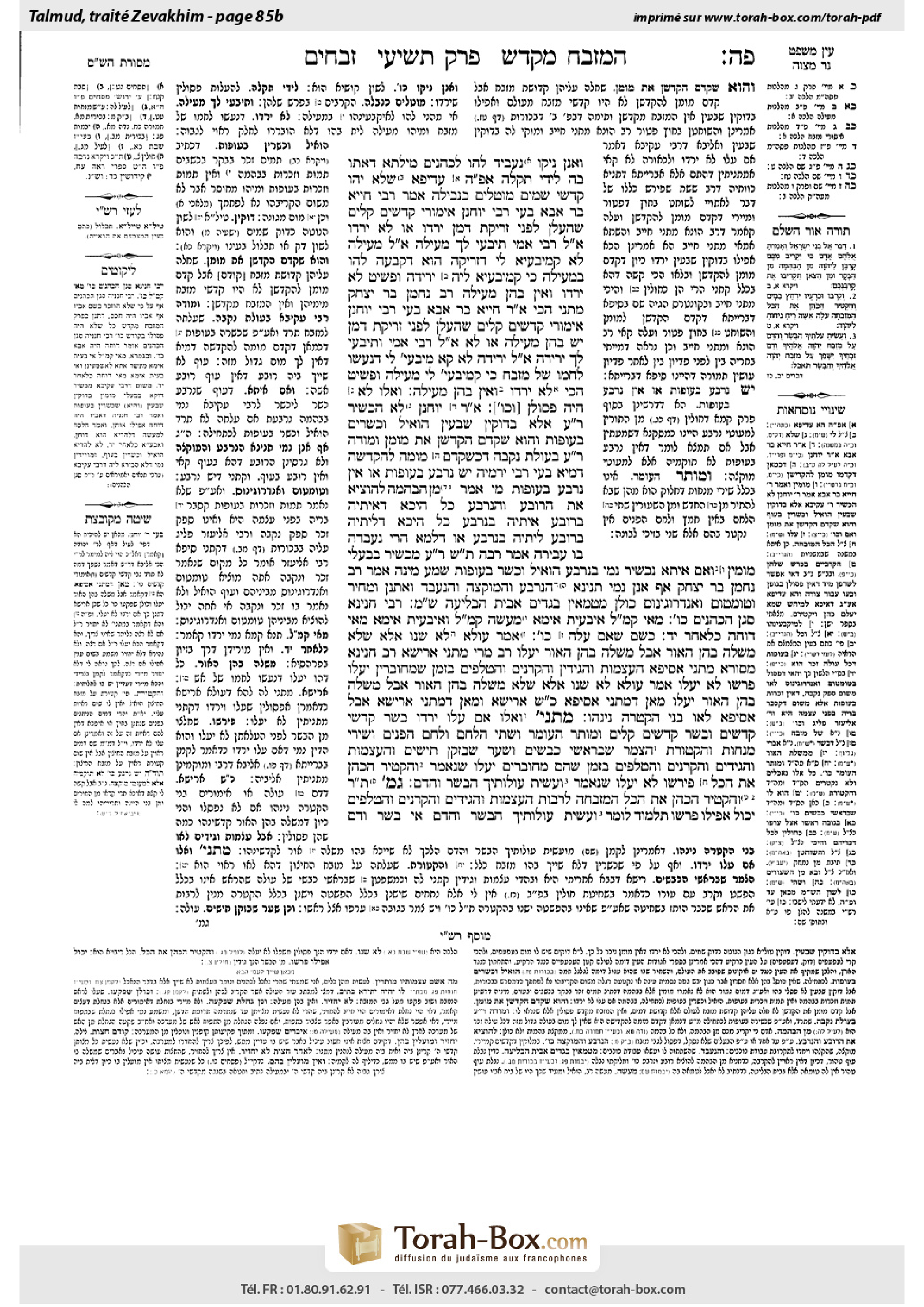
This page of Zevachim includes the Aramaic text, an English translation and an AI-generated French translation, alongside the scan above.
זבחים פ״ה ב · Aramaic and Hebrew text
וַאֲנַן נֵיקוּ נֶעְבֵּיד לְהוּ לְכֹהֲנִים מִילְּתָא דְּאָתוּ בַּהּ לִידֵי תַקָּלָה?! אֲפִילּוּ הָכִי עֲדִיפָא, שֶׁלֹּא יְהוּ קׇדְשֵׁי שָׁמַיִם מוּטָלִים כִּנְבֵילָה.
אָמַר רַבִּי חִיָּיא בַּר אַבָּא, בָּעֵי רַבִּי יוֹחָנָן: אֵימוּרֵי קָדָשִׁים קַלִּים שֶׁהֶעֱלָן לִפְנֵי זְרִיקַת דָּמָן, יֵרְדוּ אוֹ לֹא יֵרְדוּ?
אֲמַר לֵיהּ רַבִּי אַמֵּי: וְתִיבְּעֵי לָךְ מְעִילָה! אֲמַר לֵיהּ: מְעִילָה לָא קָמִיבַּעְיָא לִי – דִּזְרִיקָה הוּא דְּקָבְעָה לְהוּ בִּמְעִילָה; כִּי קָמִיבַּעְיָא לֵיהּ – יְרִידָה. וּפָשֵׁיט: לֹא יֵרְדוּ, וְאֵין בָּהֶן מְעִילָה.
רַב נַחְמָן בַּר יִצְחָק מַתְנֵי הָכִי: אָמַר רַבִּי חִיָּיא בַּר אַבָּא, בָּעֵי רַבִּי יוֹחָנָן: אֵימוּרֵי קָדָשִׁים קַלִּים שֶׁהֶעֱלָן לִפְנֵי זְרִיקַת דָּמָן, יֵשׁ בָּהֶן מְעִילָה אוֹ לָא? אֲמַר לֵיהּ רַבִּי אַמֵּי: וְתִיבְּעֵי לָךְ יְרִידָה! אֲמַר לֵיהּ: יְרִידָה לָא קָא מִיבַּעְיָא לִי – דְּנַעֲשׂוּ לַחְמוֹ שֶׁל מִזְבֵּחַ; כִּי קָמִיבַּעְיָא לִי – מְעִילָה. וּפָשֵׁיט הָכִי: לֹא יֵרְדוּ, וְאֵין בָּהֶן מְעִילָה.
וְאֵלּוּ לֹא הָיָה פְּסוּלָן [וְכוּ׳].
אָמַר רַבִּי יוֹחָנָן: לֹא הִכְשִׁיר רַבִּי עֲקִיבָא אֶלָּא בְּדוּקִּין שֶׁבָּעַיִן, הוֹאִיל וּכְשֵׁרִים בָּעוֹפוֹת. וְהוּא שֶׁקָּדַם הֶקְדֵּשָׁן אֶת מוּמָן. וּמוֹדֶה רַבִּי עֲקִיבָא בְּעוֹלַת נְקֵבָה, דִּכְשֶׁקָּדַם מוּמָהּ לְהֶקְדֵּשָׁהּ דָּמְיָא.
בָּעֵי רַבִּי יִרְמְיָה: יֵשׁ נִרְבָּע בָּעוֹפוֹת, אוֹ אֵין נִרְבָּע בָּעוֹפוֹת? מִי אָמַר: ״מִן הַבְּהֵמָה״ – לְהוֹצִיא אֶת הָרוֹבֵעַ וְהַנִּרְבָּע;
כֹּל הֵיכָא דְּאִיתֵיהּ בְּרוֹבֵעַ אִיתֵיהּ בְּנִרְבָּע, כֹּל הֵיכָא דְּלֵיתֵיהּ בְּרוֹבֵעַ לֵיתֵיהּ בְּנִרְבָּע; אוֹ דִלְמָא, הֲרֵי נֶעֶבְדָה בּוֹ עֲבֵירָה?
אָמַר רַבָּה, תָּא שְׁמַע: רַבִּי עֲקִיבָא מַכְשִׁיר בְּבַעֲלֵי מוּמִין. וְאִם אִיתָא, נַכְשֵׁיר נָמֵי בְּנִרְבָּע – הוֹאִיל וְכָשֵׁר בָּעוֹפוֹת! שְׁמַע מִינַּהּ.
אָמַר רַב נַחְמָן בַּר יִצְחָק, אַף אֲנַן נָמֵי תְּנֵינָא: הַנִּרְבָּע, וְהַמּוּקְצֶה, וְהַנֶּעֱבָד, וְאֶתְנַן, וּמְחִיר, וְטוּמְטוּם, וְאַנְדְּרוֹגִינוֹס – כּוּלָּן מְטַמְּאִין בְּגָדִים אַבֵּית הַבְּלִיעָה! שְׁמַע מִינַּהּ.
רַבִּי חֲנִינָא סְגַן הַכֹּהֲנִים כּוּ׳. מַאי קָא מַשְׁמַע לַן? אִיבָּעֵית אֵימָא: מַעֲשֶׂה קָא מַשְׁמַע לַן, וְאִיבָּעֵית אֵימָא: מַאי דּוֹחֶה – כִּלְאַחַר יָד.
כְּשֵׁם שֶׁאִם עָלָה כּוּ׳. אָמַר עוּלָּא: לֹא שָׁנוּ אֶלָּא שֶׁלֹּא מָשְׁלָה בָּהֶן הָאוּר, אֲבָל מָשְׁלָה בָּהֶן הָאוּר – יַעֲלוּ.
רַב מָרִי מַתְנֵי אַרֵישָׁא; רַב חֲנִינָא מִסּוּרָא מַתְנֵי אַסֵּיפָא: הַעֲצָמוֹת וְהַגִּידִין וְהַקְּרָנַיִם וְהַטְּלָפַיִם, בִּזְמַן שֶׁמְּחוּבָּרִין – יַעֲלוּ, פֵּרְשׁוּ – לֹא יַעֲלוּ. אָמַר עוּלָּא: לֹא שָׁנוּ אֶלָּא שֶׁלֹּא מָשְׁלָה בָּהֶן הָאוּר, אֲבָל מָשְׁלָה בָּהֶן הָאוּר – יַעֲלוּ.
מַאן דְּמַתְנֵי אַסֵּיפָא – כׇּל שֶׁכֵּן אַרֵישָׁא; וּמַאן דְּמַתְנֵי אַרֵישָׁא – אֲבָל אַסֵּיפָא, לָאו בְּנֵי הַקְטָרָה נִינְהוּ.
מַתְנִי׳ וְאֵלּוּ אִם עָלוּ יֵרְדוּ: בְּשַׂר קׇדְשֵׁי קָדָשִׁים, וּבְשַׂר קָדָשִׁים קַלִּים, וּמוֹתַר הָעוֹמֶר, וּשְׁתֵּי הַלֶּחֶם, וְלֶחֶם הַפָּנִים, וּשְׁיָרֵי מְנָחוֹת, וְהַקְּטוֹרֶת.
הַצֶּמֶר שֶׁבְּרָאשֵׁי כְבָשִׂים, וְשֵׂעָר שֶׁבִּזְקַן תְּיָשִׁים, וְהָעֲצָמוֹת וְהַגִּידִים וְהַקַּרְנַיִם וְהַטְּלָפַיִם; בִּזְמַן שֶׁהֵם מְחוּבָּרִים – יַעֲלוּ, שֶׁנֶּאֱמַר: ״וְהִקְטִיר הַכֹּהֵן אֶת הַכֹּל״. פֵּירְשׁוּ – לֹא יַעֲלוּ, שֶׁנֶּאֱמַר: ״וְעָשִׂיתָ עֹלֹתֶיךָ הַבָּשָׂר וְהַדָּם״.
גְּמָ׳ תָּנוּ רַבָּנַן: ״וְהִקְטִיר הַכֹּהֵן אֶת הַכֹּל הַמִּזְבֵּחָה״ – לְרַבּוֹת הַעֲצָמוֹת וְהַגִּידִים וְהַקְּרָנַיִם וְהַטְּלָפַיִם. יָכוֹל אֲפִילּוּ פֵּרְשׁוּ? תַּלְמוּד לוֹמַר: ״וְעָשִׂיתָ עֹלֹתֶיךָ הַבָּשָׂר וְהַדָּם״.
אִי בָּשָׂר וָדָם,
Zevachim 85b · English translation
The Gemara asks: And shall we stand and do something for the priests through which they shall come to encounter a stumbling block? Were these innards to remain unwashed, no priest would mistakenly sacrifice them upon the altar. The Gemara answers: Even so, rinsing disqualified innards is preferable, so that the sanctified offerings of Heaven shall not be lying as a carcass.
With regard to the matter discussed by Ulla (85a), Rabbi Ḥiyya bar Abba said that Rabbi Yoḥanan raises a dilemma: In the case of sacrificial portions of offerings of lesser sanctity that one offered up before the sprinkling of their blood, which is the act which sanctifies such portions for the altar, shall they descend or shall they not descend?
Rabbi Ami said to Rabbi Yoḥanan: Instead of raising the dilemma of whether or not such portions shall descend, you should raise the dilemma of whether their ascension upon the altar sanctifies them with regard to the halakhot of misuse of consecrated property. Rabbi Yoḥanan said to him: With regard to the misuse of consecrated property I do not raise the dilemma, as certainly the rite of sprinkling and not their ascension to the altar determines their status with regard to the misuse of consecrated property. When Rabbi Yoḥanan raised the dilemma it was with regard to their descent from the altar. And Rabbi Yoḥanan resolved his dilemma and ruled: If they ascended they shall not descend, and they are not subject to the prohibition of misuse of consecrated property.
Rav Naḥman bar Yitzḥak teaches the discussion in this manner: Rabbi Ḥiyya bar Abba said that Rabbi Yoḥanan raises a dilemma: In the case of sacrificial portions of offerings of lesser sanctity that one offered up on the altar before the sprinkling of their blood, are they subject to the halakhot of misuse or not? Rabbi Ami said to him: And you should raise the dilemma with regard to their descent from upon the altar. Rabbi Yoḥanan said to him: With regard to their descent I do not raise the dilemma, because after these sacrificial portions ascend the altar they become the bread of the altar and shall not descend. When I raise the dilemma it is with regard to the misuse of consecrated property. And Rabbi Yoḥanan resolved his dilemma in this manner: They shall not descend, and they are not subject to the prohibition of misuse of consecrated property.
§ The mishna teaches: And these are the offerings whose disqualification did not occur in sanctity: An animal that copulated with a person, or an animal that was the object of bestiality…or blemished animals. Such offerings shall descend from the altar if they ascended. Rabbi Akiva deems blemished animals fit in the sense that if they ascended upon the altar they shall not descend.
Rabbi Yoḥanan says: Rabbi Akiva deemed fit only those animals with small blemishes, such as on the cornea of the eye, as such blemishes are fit with regard to bird offerings ab initio. And this is the halakha only when their consecration preceded their blemish, since such an animal was fit for the altar at the time of its consecration. But if their blemish preceded their consecration, they shall descend, as they were never fit for the altar. And Rabbi Akiva concedes with regard to a female burnt offering that it shall descend from the altar. Since only a male animal may be used for a burnt offering, it is like a case where the animal’s blemish preceded its consecration.
The Gemara presents a discussion in which the opinion of Rabbi Akiva is cited: Rabbi Yirmeya raises the dilemma: Is the disqualification of an animal that was the object of bestiality applicable with regard to birds, or is there no disqualification of an animal that was the object of bestiality with regard to birds? Did the verse say: “When any man of you brings an offering to the Lord, you shall bring your offering of the animals” (Leviticus 1:2), where the term “of” serves to exclude from being brought as offerings both an animal that copulated with a person and an animal that was the object of bestiality, in order to equate the two?
If so, then derive from it that anywhere that there is a disqualification of an animal that copulated with a person there is a disqualification of an animal that was the object of bestiality, and anywhere that there is no disqualification of an animal that copulated with a person there is no disqualification of an animal that was the object of bestiality. Consequently, since birds cannot be the active party in an act of bestiality, the disqualification of an animal that was the object of bestiality is also inapplicable to birds. Or perhaps the disqualification of an animal that was the object of bestiality does apply with regard to birds, as nevertheless a sin was committed with it?
Rabba said: Come and hear a proof from the mishna: Rabbi Akiva deems blemished animals fit when the blemish is on the cornea, since such blemishes are fit with regard to bird offerings ab initio. And if it is so that a bird that was the object of bestiality is fit as an offering, then let us also deem fit an animal that was the object of bestiality, since such an offering is fit with regard to birds. From the fact that such animals are not deemed fit, conclude from the mishna that the disqualification of an animal that was the object of bestiality applies to birds as well.
Rav Naḥman bar Yitzḥak said: We learn in the baraita as well: A bird that was the object of bestiality, or that was set aside for idol worship, or that was worshipped as a deity, or that was given as payment to a prostitute or as the price of a dog, or that was a tumtum or a hermaphrodite, in all of those cases, if its nape was pinched, it renders the garments of one who swallows an olive-bulk from the carcass ritually impure when it is in the throat, as is the halakha with regard to all unslaughtered carcasses of birds. Since the baraita lists a bird that was the object of bestiality among those disqualified offerings, conclude from the baraita that such a bird is in fact disqualified.
§ The mishna teaches: Rabbi Ḥanina, the deputy High Priest, says: My father would reject blemished animals from upon the altar. The Gemara asks: What is Rabbi Ḥanina teaching us? The first tanna already stated that blemished animals shall descend. The Gemara answers: If you wish, say that Rabbi Ḥanina teaches us an incident, to express that this halakha was not only stated theoretically but applied practically as well. And if you wish, say instead: What is the meaning of the term: Would reject? It means that he would remove blemished animals from the altar in a backhanded manner, i.e., privately rather than publicly, so as not to disgrace the honor of the altar.
§ The mishna teaches with regard to those disqualified offerings that shall not descend from the altar if they ascended it: Just as if it ascended it does not descend, so too, if it descended it does not then ascend. Ulla says: The Sages taught this halakha only in a case where the fire has not yet taken hold of these offerings. But if the fire has taken hold of these offerings, then even if they descended from the altar they shall ascend.
Rav Mari teaches that the statement of Ulla is referring to the first clause, i.e., to this mishna. Rav Ḥanina of Sura teaches that Ulla is referring to the latter clause, i.e., to the next mishna, which states: The bones, and the tendons, and the horns, and the hooves of a burnt offering; when they are attached to the flesh of the offering they shall ascend upon the altar and be sacrificed with the offering. If they separated from the flesh of the offering they shall not ascend. With regard to this Ulla says: The Sages taught that if they separated from the flesh they shall not ascend only in a case where the fire has not yet taken hold of them. But if the fire has taken hold of them, then even if they separated from the flesh of the offering they shall ascend.
The Gemara elaborates: According to the one who teaches Ulla’s statement, i.e., if the fire has taken hold of them they still ascend the altar, as referring to the latter clause, which discusses items that are not burned on the altar, all the more so will Ulla’s statement apply to the first clause, which discusses items that are burned on the altar but were disqualified. And according to the one who teaches Ulla’s statement as referring to the first clause, it applies only to those items that were to be burned on the altar but were disqualified. But with regard to the latter clause it does not apply, since the bones, tendons, and other items mentioned there are not subject to burning at all.
MISHNA: And these are the items that if they ascended upon the altar they descend, because they are completely unfit for the altar: The meat of offerings of the most sacred order, i.e., a guilt offering and a sin offering, the meat of which is eaten by priests; and the meat of offerings of lesser sanctity, which is eaten by the owners; and the surplus of the omer meal offering brought on the second day of Passover after the handful was removed and burned on the altar; and the two loaves meal offering brought on the festival of Shavuot; and the shewbread; and the remainder of the meal offerings after the handful was removed, which are all eaten by the priests; and the incense that ascended upon the external altar and not the golden altar where it should be burned.
With regard to the wool that is on the heads of the sheep brought as burnt offerings, and the hair that is in the beard of goats that were sacrificed, and the bones, and the tendons, and the horns, and the hooves: When they are attached to the flesh of the offering they shall ascend upon the altar and be sacrificed with the offering, as it is stated: “And the priest shall make the whole smoke on the altar” (Leviticus 1:9). If they separated from the flesh of the offering they shall not ascend, as it is stated: “And you shall offer your burnt offerings, the flesh and the blood” (Deuteronomy 12:27), and nothing else.
GEMARA: The Sages taught in a baraita: “And the priest shall make the whole smoke on the altar” (Leviticus 1:9). The term “the whole” serves to include the bones and the tendons and the horns and the hooves among those items that are sacrificed on the altar. One might have thought that even if they separated from the flesh of the burnt offering they are sacrificed upon the altar. Therefore, the verse states: “And you shall offer your burnt offerings, the flesh and the blood” (Deuteronomy 12:27), indicating that only those items and anything attached to them are sacrificed upon the altar.
If one derives the halakha with regard to bones and tendons from the phrase “the flesh and the blood,”
Zevachim 85b · Traduction française (IA)
La Guemara demande : Devrions-nous nous lever et faire quelque chose pour les prêtres qui leur causerait un obstacle ? Si ces entrailles étaient restées non lavées, aucun prêtre ne les aurait sacrifiées par erreur sur l'autel. La Guemara répond : Même ainsi, il est préférable de rincer des entrailles disqualifiées, afin que les offrandes sanctifiées du Ciel ne restent pas gisantes comme une carcasse.
Concernant la question discutée par Oula (85a), Rabbi Hiyya bar Abba a dit que Rabbi Yoḥanan soulève un dilemme : Dans le cas de portions sacrificielles d'offrandes de sainteté moindre qui ont été offertes avant l'aspersion de leur sang, acte qui sanctifie de telles portions pour l'autel, doivent-elles descendre ou ne doivent-elles pas descendre ?
Rabbi Ami a dit à Rabbi Yoḥanan : Au lieu de soulever le dilemme de savoir si de telles portions doivent descendre ou non, vous devriez soulever le dilemme de savoir si leur ascension sur l'autel les sanctifie en ce qui concerne les lois de l'interdiction de l'usage de la propriété consacrée. Rabbi Yoḥanan lui a dit : En ce qui concerne l'interdiction de l'usage de la propriété consacrée, je ne soulève pas le dilemme, car c'est assurément le rite d'aspersion et non leur ascension sur l'autel qui détermine leur statut en ce qui concerne l'interdiction de l'usage de la propriété consacrée. Lorsque Rabbi Yoḥanan a soulevé le dilemme, c'était en ce qui concerne leur descente de l'autel. Et Rabbi Yoḥanan a résolu son dilemme et a tranché : Si elles sont montées, elles ne doivent pas descendre, et elles ne sont pas soumises à l'interdiction de l'usage de la propriété consacrée.
Rav Naḥman bar Yitzḥak enseigne la discussion de la manière suivante : Rabbi Ḥiyya bar Abba a dit que Rabbi Yoḥanan soulève un dilemme : Dans le cas de portions sacrificielles d'offrandes de sainteté moindre qui ont été offertes sur l'autel avant l'aspersion de leur sang, sont-elles soumises aux lois de l'usage interdit ou non ? Rabbi Ami lui a dit : Et vous devriez soulever le dilemme en ce qui concerne leur descente de l'autel. Rabbi Yoḥanan lui a dit : En ce qui concerne leur descente, je ne soulève pas le dilemme, car après que ces portions sacrificielles sont montées sur l'autel, elles deviennent le pain de l'autel et ne doivent pas descendre. Lorsque je soulève le dilemme, c'est en ce qui concerne l'usage interdit de la propriété consacrée. Et Rabbi Yoḥanan a résolu son dilemme de la manière suivante : Elles ne doivent pas descendre, et elles ne sont pas soumises à l'interdiction de l'usage de la propriété consacrée.
§ La Michna enseigne : Et voici les offrandes dont la disqualification n'est pas survenue dans la sainteté : Un animal qui a copulé avec un homme, ou un animal qui a été l'objet d'un acte de bestialité… ou des animaux défectueux. De telles offrandes doivent descendre de l'autel si elles y sont montées. Rabbi Akiva considère les animaux défectueux comme aptes, dans le sens que s'ils sont montés sur l'autel, ils ne doivent pas descendre.
Rabbi Yoḥanan dit : Rabbi Akiva a considéré comme aptes uniquement les animaux ayant de petites défectuosités, telles que sur la cornée de l'œil, car de telles défectuosités sont aptes en ce qui concerne les offrandes d'oiseaux dès l'origine. Et c'est la halakha uniquement lorsque leur consécration a précédé leur défectuosité, car un tel animal était apte pour l'autel au moment de sa consécration. Mais si leur défectuosité a précédé leur consécration, ils doivent descendre, car ils n'ont jamais été aptes pour l'autel. Et Rabbi Akiva concède en ce qui concerne une offrande holocauste femelle qu'elle doit descendre de l'autel. Puisqu'uniquement un animal mâle peut être utilisé pour un holocauste, c'est comme un cas où la défectuosité de l'animal a précédé sa consécration.
La Guemara présente une discussion dans laquelle l'opinion de Rabbi Akiva est citée : Rabbi Yirmeya soulève le dilemme : La disqualification d'un animal qui a été l'objet d'un acte de bestialité est-elle applicable en ce qui concerne les oiseaux, ou n'y a-t-il pas de disqualification d'un animal qui a été l'objet d'un acte de bestialité en ce qui concerne les oiseaux ? Le verset a-t-il dit : « Quand l'un d'entre vous apportera une offrande à l'Éternel, vous apporterez votre offrande des animaux » (Lévitique 1:2), où le terme « des » sert à exclure de l'apport comme offrandes à la fois un animal qui a copulé avec un homme et un animal qui a été l'objet d'un acte de bestialité, afin d'équater les deux ?
Si c'est ainsi, alors en déduire que partout où il y a une disqualification d'un animal qui a copulé avec un homme, il y a une disqualification d'un animal qui a été l'objet d'un acte de bestialité, et partout où il n'y a pas de disqualification d'un animal qui a copulé avec un homme, il n'y a pas de disqualification d'un animal qui a été l'objet d'un acte de bestialité. Par conséquent, puisque les oiseaux ne peuvent pas être la partie active dans un acte de bestialité, la disqualification d'un animal qui a été l'objet d'un acte de bestialité est également inapplicable aux oiseaux. Ou peut-être que la disqualification d'un animal qui a été l'objet d'un acte de bestialité s'applique en ce qui concerne les oiseaux, car néanmoins un péché a été commis avec lui ?
Rabba a dit : Venez et entendez une preuve de la Michna : Rabbi Akiva considère les animaux défectueux comme aptes lorsque la défectuosité est sur la cornée, car de telles défectuosités sont aptes en ce qui concerne les offrandes d'oiseaux dès l'origine. Et s'il en est ainsi qu'un oiseau qui a été l'objet d'un acte de bestialité est apte comme offrande, alors considérons également apte un animal qui a été l'objet d'un acte de bestialité, car une telle offrande est apte en ce qui concerne les oiseaux. Du fait que de tels animaux ne sont pas considérés comme aptes, concluez de la Michna que la disqualification d'un animal qui a été l'objet d'un acte de bestialité s'applique également aux oiseaux.
Rav Naḥman bar Yitzḥak a dit : Nous apprenons également dans la baraïta : Un oiseau qui a été l'objet d'un acte de bestialité, ou qui a été mis de côté pour l'idolâtrie, ou qui a été adoré comme une divinité, ou qui a été donné comme paiement à une prostituée ou comme prix d'un chien, ou qui était un tumtum ou un hermaphrodite, dans tous ces cas, si sa nuque a été pincée, il rend les vêtements de celui qui avale un volume d'olive de la carcasse rituellement impurs lorsqu'il est dans la gorge, comme c'est la halakha en ce qui concerne toutes les carcasses d'oiseaux non égorgées. Puisque la baraïta énumère un oiseau qui a été l'objet d'un acte de bestialité parmi les offrandes disqualifiées, concluez de la baraïta qu'un tel oiseau est en effet disqualifié.
§ La Michna enseigne : Rabbi Ḥanina, le vice-grand prêtre, dit : Mon père rejetait les animaux défectueux de l'autel. La Guemara demande : Qu'est-ce que Rabbi Ḥanina nous enseigne ? Le premier tanna a déjà déclaré que les animaux défectueux doivent descendre. La Guemara répond : Si vous le souhaitez, dites que Rabbi Ḥanina nous enseigne un incident, afin d'exprimer que cette halakha n'a pas seulement été énoncée théoriquement, mais appliquée pratiquement également. Et si vous le souhaitez, dites plutôt : Quelle est la signification du terme : rejetait ? Cela signifie qu'il retirait les animaux défectueux de l'autel d'une manière détournée, c'est-à-dire en privé plutôt qu'en public, afin de ne pas déshonorer la dignité de l'autel.
§ La Michna enseigne, à propos des offrandes disqualifiées qui ne doivent pas descendre de l'autel si elles y sont montées : Tout comme si elles y sont montées, elles ne descendent pas, de même, si elles sont descendues, elles ne remontent pas ensuite. Ulla dit : Les Sages ont enseigné cette halakha uniquement dans le cas où le feu ne s'est pas encore emparé de ces offrandes. Mais si le feu s'est emparé de ces offrandes, alors même si elles sont descendues de l'autel, elles doivent remonter.
Rav Mari enseigne que l'enseignement d'Ulla fait référence à la première clause, c'est-à-dire à cette Michna. Rav Ḥanina de Sura enseigne qu'Ulla fait référence à la clause suivante, c'est-à-dire à la Michna suivante, qui énonce : Les os, les tendons, les cornes et les sabots d'un holocauste ; lorsqu'ils sont attachés à la chair de l'offrande, ils doivent monter sur l'autel et être sacrifiés avec l'offrande. S'ils se sont détachés de la chair de l'offrande, ils ne doivent pas monter. À ce sujet, Ulla dit : Les Sages ont enseigné que s'ils se sont détachés de la chair, ils ne doivent pas monter, uniquement dans le cas où le feu ne s'est pas encore emparé d'eux. Mais si le feu s'est emparé d'eux, alors même s'ils se sont détachés de la chair de l'offrande, ils doivent monter.
La Guemara précise : Selon celui qui enseigne que l'enseignement d'Ulla, c'est-à-dire que si le feu s'est emparé d'eux, ils montent encore sur l'autel, fait référence à la clause suivante, qui traite d'éléments qui ne sont pas brûlés sur l'autel, a fortiori l'enseignement d'Ulla s'appliquera-t-il à la première clause, qui traite d'éléments qui sont brûlés sur l'autel mais qui ont été disqualifiés. Et selon celui qui enseigne que l'enseignement d'Ulla fait référence à la première clause, il ne s'applique qu'à ces éléments qui devaient être brûlés sur l'autel mais qui ont été disqualifiés. Mais quant à la clause suivante, il ne s'applique pas, car les os, les tendons et les autres éléments mentionnés là ne sont pas soumis à la combustion du tout.
MICHNA : Voici les éléments qui, s'ils montent sur l'autel, en descendent, car ils sont totalement inaptes à l'autel : la chair des offrandes de la plus haute sainteté, à savoir le sacrifice de culpabilité et le sacrifice expiatoire, dont la chair est mangée par les prêtres ; la chair des offrandes de sainteté moindre, qui est mangée par les propriétaires ; le surplus de l'offrande de la poignée (omer) apportée le deuxième jour de Pessa'h, après que la poignée a été retirée et brûlée sur l'autel ; l'offrande des deux pains apportée à la fête de Chavouot ; le pain de proposition ; le reste des offrandes de la poignée, après que la poignée a été retirée, qui sont tous mangés par les prêtres ; et l'encens qui est monté sur l'autel extérieur et non sur l'autel d'or où il devait être brûlé.
Quant à la laine qui est sur la tête des moutons apportés en holocauste, aux poils qui sont dans la barbe des chèvres qui ont été sacrifiées, aux os, aux tendons, aux cornes et aux sabots : lorsqu'ils sont attachés à la chair de l'offrande, ils doivent monter sur l'autel et être sacrifiés avec l'offrande, car il est écrit : « Et le prêtre fera fumer le tout sur l'autel » (Lévitique 1:9). S'ils se sont détachés de la chair de l'offrande, ils ne doivent pas monter, car il est écrit : « Et vous offrirez vos holocaustes, la chair et le sang » (Deutéronome 12:27), et rien d'autre.
Guemara : Les Sages ont enseigné dans une baraïta : « Et le prêtre fera fumer le tout sur l'autel » (Lévitique 1:9). Le terme « le tout » sert à inclure les os, les tendons, les cornes et les sabots parmi les éléments qui sont sacrifiés sur l'autel. On aurait pu penser que même s'ils se sont détachés de la chair de l'holocauste, ils sont sacrifiés sur l'autel. Par conséquent, le verset énonce : « Et vous offrirez vos holocaustes, la chair et le sang » (Deutéronome 12:27), indiquant que seuls ces éléments et tout ce qui y est attaché sont sacrifiés sur l'autel.
Si l'on déduit la halakha concernant les os et les tendons de la phrase « la chair et le sang »,
Traduction française générée par IA à partir de l’édition anglaise de Sefaria. Vérifie toujours un passage avec le texte source.
Text from Sefaria: William Davidson Edition - Vocalized Aramaic (CC BY NC); William Davidson Edition - English (CC BY NC).