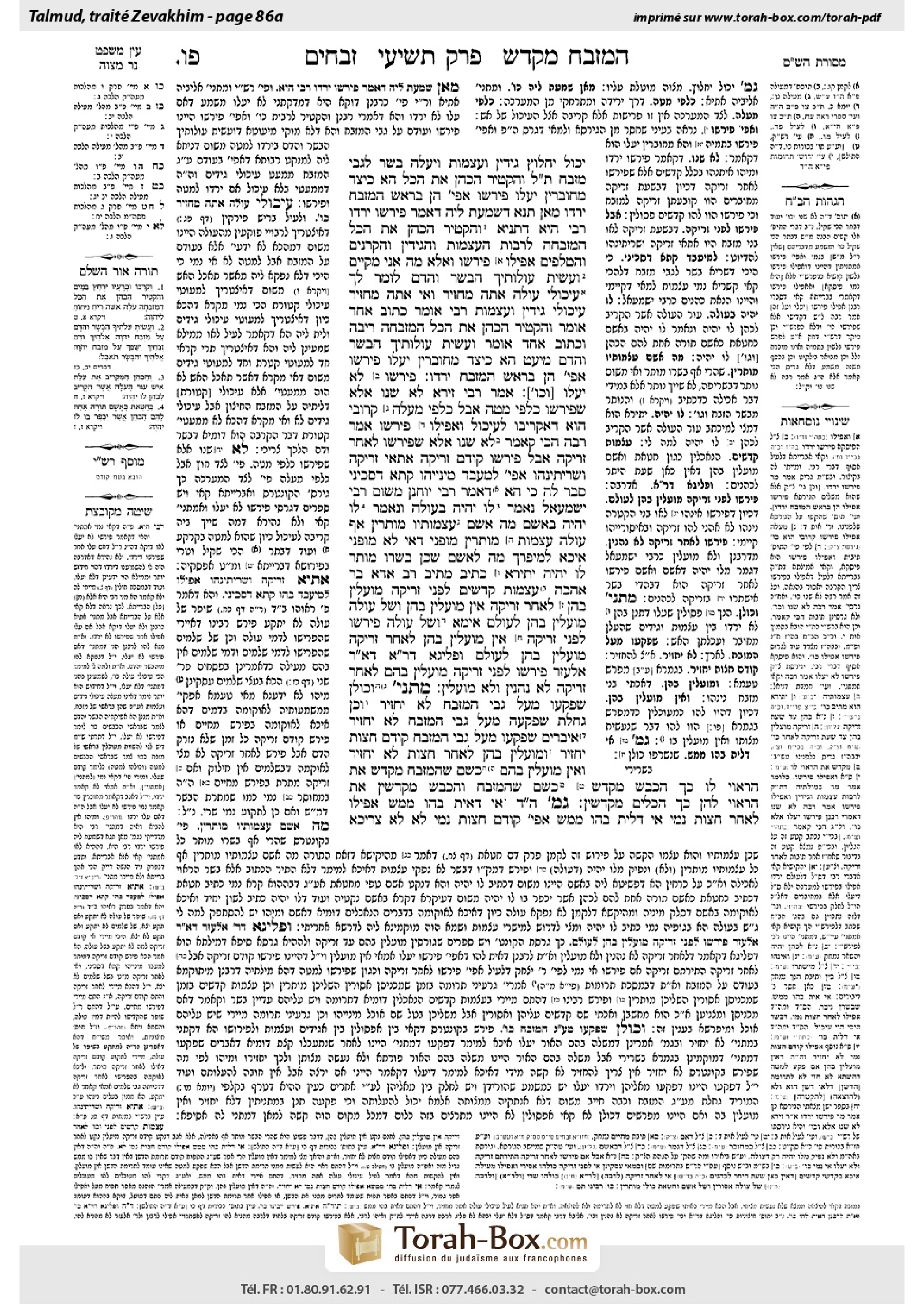
Zevachim 86a: Talmud study for Daf Yomi
Daf Yomi is the daily study of one Talmud folio. Explore 37 tractates with scans, Hebrew text, Sefaria English and AI-generated French translations where annotated.
Passage selection and English or AI-generated French translation are available where the scan has annotations. Daf Study is independent of Torah-Box and Sefaria.
Browse Zevachim · זבחים · All tractatesZevachim 86a text and translations
This page of Zevachim includes the Aramaic text, an English translation and an AI-generated French translation, alongside the scan above.
זבחים פ״ו א · Aramaic and Hebrew text
יָכוֹל יַחְלוֹץ גִּידִין וַעֲצָמוֹת, וְיַעֲלֶה בָּשָׂר לְגַבֵּי מִזְבֵּחַ? תַּלְמוּד לוֹמַר: ״וְהִקְטִיר הַכֹּהֵן אֶת הַכֹּל״. הָא כֵּיצַד? מְחוּבָּרִין – יַעֲלוּ, פֵּירְשׁוּ – אֲפִילּוּ הֵן בְּרֹאשׁ הַמִּזְבֵּחַ, יֵרְדוּ.
מַאן תַּנָּא דְּשָׁמְעַתְּ לֵיהּ דְּאָמַר: פֵּירְשׁוּ יָרְדוּ? רַבִּי הִיא, דְּתַנְיָא: ״וְהִקְטִיר הַכֹּהֵן אֶת הַכֹּל הַמִּזְבֵּחָה״ – לְרַבּוֹת הַעֲצָמוֹת וְהַגִּידִין וְהַקְּרָנַיִם וְהַטְּלָפַיִם, אֲפִילּוּ פֵּירְשׁוּ.
וְאֶלָּא מָה אֲנִי מְקַיֵּים: ״וְעָשִׂיתָ עֹלֹתֶיךָ הַבָּשָׂר וְהַדָּם״? לוֹמַר לָךְ: עִיכּוּלֵי עוֹלָה אַתָּה מַחֲזִיר, וְאִי אַתָּה מַחֲזִיר עִיכּוּלֵי גִּידִין וַעֲצָמוֹת.
רַבִּי אוֹמֵר, כָּתוּב אֶחָד אוֹמֵר: ״וְהִקְטִיר הַכֹּהֵן אֶת הַכֹּל הַמִּזְבֵּחָה״ – רִיבָּה, וְכָתוּב אֶחָד אוֹמֵר: ״וְעָשִׂיתָ עֹלֹתֶיךָ הַבָּשָׂר וְהַדָּם״ – מִיעֵט. הָא כֵּיצַד? מְחוּבָּרִין – יַעֲלוּ, פֵּירְשׁוּ – אֲפִילּוּ הֵן בְּרֹאשׁ הַמִּזְבֵּחַ, יֵרְדוּ.
פֵּירְשׁוּ לֹא יַעֲלוּ [וְכוּ׳]. אָמַר רַבִּי זֵירָא: לֹא שָׁנוּ אֶלָּא שֶׁפֵּירְשׁוּ כְּלַפֵּי מַטָּה, אֲבָל כְּלַפֵּי מַעְלָה – קָרוֹבֵי הוּא דְּאַקְרִיבוּ לְעִיכּוּל. וַאֲפִילּוּ פֵּירְשׁוּ?!
אָמַר רַבָּה, הָכִי קָאָמַר: לֹא שָׁנוּ אֶלָּא שֶׁפֵּירְשׁוּ לְאַחַר זְרִיקָה, אֲבָל פֵּירְשׁוּ קוֹדֶם זְרִיקָה – אֲתַאי זְרִיקָה וּשְׁרִיתִינְהוּ, אֲפִילּוּ לְמֶעְבַּד מִינַּיְיהוּ (קתא) [קַתָּתָא] דְּסַכִּינֵי.
סָבַר לַהּ כִּי הָא דְּאָמַר רַבִּי יוֹחָנָן מִשּׁוּם רַבִּי יִשְׁמָעֵאל: נֶאֱמַר ״לוֹ יִהְיֶה״ בְּעוֹלָה, וְנֶאֱמַר ״לוֹ יִהְיֶה״ בְּאָשָׁם; מָה אָשָׁם – עַצְמוֹתָיו מוּתָּרִין, אַף עוֹלָה – (עצמות) [עַצְמוֹתֶיהָ] מוּתָּרִין.
מוּפְנֵי; דְּאִי לָא מוּפְנֵי – אִיכָּא לְמִיפְרַךְ: מָה לְאָשָׁם, שֶׁכֵּן בְּשָׂרוֹ מוּתָּר! ״לוֹ יִהְיֶה״ יַתִּירָא כְּתִיב.
מֵתִיב רַב אַדָּא בַּר אַהֲבָה: עַצְמוֹת קָדָשִׁים, לִפְנֵי זְרִיקָה – מוֹעֲלִין בָּהֶן,
לְאַחַר זְרִיקָה – אֵין מוֹעֲלִין בָּהֶן. וְשֶׁל עוֹלָה – מוֹעֲלִין בָּהֶן לְעוֹלָם!
אֵימָא: וְשֶׁל עוֹלָה, פֵּירְשׁוּ לִפְנֵי זְרִיקָה – אֵין מוֹעֲלִין בָּהֶן, לְאַחַר זְרִיקָה – מוֹעֲלִין בָּהֶן לְעוֹלָם.
וּפְלִיגָא דְּרַבִּי אֶלְעָזָר; דְּאָמַר רַבִּי אֶלְעָזָר: פֵּירְשׁוּ לִפְנֵי זְרִיקָה – מוֹעֲלִין בָּהֶם, לְאַחַר זְרִיקָה – לֹא נֶהֱנִין וְלֹא מוֹעֲלִין.
מַתְנִי׳ וְכוּלָּן שֶׁפָּקְעוּ מֵעַל גַּבֵּי הַמִּזְבֵּחַ – לֹא יַחְזִיר, וְכֵן גַּחֶלֶת שֶׁפָּקְעָה מֵעַל גַּבֵּי הַמִּזְבֵּחַ – לֹא יַחֲזִיר. אֵיבָרִים שֶׁפָּקְעוּ מֵעַל גַּבֵּי הַמִּזְבֵּחַ קוֹדֶם חֲצוֹת – יַחְזִיר, וּמוֹעֲלִין בָּהֶן; לְאַחַר חֲצוֹת – לֹא יַחְזִיר, וְאֵין מוֹעֲלִין בָּהֶם.
כְּשֵׁם שֶׁהַמִּזְבֵּחַ מְקַדֵּשׁ אֶת הָרָאוּי לוֹ, כָּךְ הַכֶּבֶשׁ מְקַדֵּשׁ. כְּשֵׁם שֶׁהַמִּזְבֵּחַ וְהַכֶּבֶשׁ מְקַדְּשִׁין אֶת הָרָאוּי לָהֶן, כָּךְ הַכֵּלִים מְקַדְּשִׁין.
גְּמָ׳ הֵיכִי דָּמֵי? אִי דְּאִית בְּהוּ מַמָּשׁ – אֲפִילּוּ לְאַחַר חֲצוֹת נָמֵי! אִי דְּלֵית בְּהוּ מַמָּשׁ – אֲפִילּוּ קוֹדֶם חֲצוֹת נָמֵי לָא! לָא צְרִיכָא,
Zevachim 86a · English translation
then one might have thought that a priest must first remove the tendons and bones from an offering and then sacrifice the flesh upon the altar. Therefore, the verse states: “And the priest shall make the whole smoke on the altar,” including the tendons and bones. How can these texts be reconciled? If they were attached to the flesh, they shall ascend. If they separated from the flesh, then even if they are already at the top of the altar, they shall descend.
The Gemara notes: Who is the tanna that you heard that says if they separated they shall descend? It is Rabbi Yehuda HaNasi, as it is taught in a baraita: “And the priest shall make the whole smoke on the altar” (Leviticus 1:9); the term “the whole” serves to include the bones, and the tendons, and the horns, and the hooves, among those items that are offered on the altar, even if they separated from the flesh of the offering.
But if so, how do I realize the meaning of the verse: “And you shall offer your burnt offerings, the flesh and the blood” (Deuteronomy 12:27), which indicates that only the flesh and blood of an offering ascend upon the altar? This verse is necessary to tell you an additional halakha, that you return the consumed flesh of a burnt offering to the fire if it is dislodged from it, but you do not return the consumed tendons and bones if they are dislodged from the fire.
The baraita continues: Rabbi Yehuda HaNasi says that one verse states: “And the priest shall make the whole smoke on the altar,” which included tendons and bones, and one verse states: “And you shall offer your burnt offerings, the flesh and the blood,” which excluded any part other than the flesh and the blood. How can these texts be reconciled? If they were attached to the flesh, they shall ascend. If they separated from the flesh, then even if they are already on top of the altar, they shall descend.
§ The mishna teaches that items that are not meant for consumption on the altar, such as the bones and tendons, are sacrificed along with the flesh if they are attached to it. But if they separated they shall not ascend. Rabbi Zeira said: The Sages taught that if they separated from the flesh they shall not ascend only when they separated from the offering downward, i.e., away from the altar, whereby they became distanced from the pyre when they were separated. But if they separated from the offering upward, i.e., they became closer to the pyre when they were separated from the offering, they have become closer to consumption and shall ascend. The Gemara asks: And even if they separated, shall they be offered? Doesn’t the mishna state that they shall ascend only if they are still attached to the flesh?
Rabba said: This is what Rabbi Zeira is saying: It was necessary for the Sages to teach the halakha, that bones or tendons that separated from the flesh of an offering shall not ascend the altar, only where they separated after the sprinkling of its blood, since at the time that the flesh itself became permitted for the altar through the sprinkling, the bones and tendons were still attached to the flesh and therefore fit to be offered with it. But if they separated from an offering before the sprinkling of its blood they shall certainly not ascend, as they were already separated from the flesh when it became permitted for the altar. Instead, the sprinkling comes and permits them for any use, just as the hide of a burnt offering is permitted to the priests upon the sprinkling of its blood. In fact, one may even use such tendons or bones to fashion the handles of knives from them.
The Gemara elaborates: Rabba holds in accordance with that which Rabbi Yoḥanan says in the name of Rabbi Yishmael: It is stated: “He shall have the hide of the burnt offering that he has offered” (Leviticus 7:8), with regard to a burnt offering, and it is stated: “The priest that makes atonement, he shall have it” (Leviticus 7:7), with regard to a guilt offering. The following verbal analogy is derived from here: Just as after the blood of a guilt offering is presented its bones become permitted to the priest for any use, since only the portions intended for consumption on the altar are sacrificed whereas the rest of the animal is given to the priests, so too, with regard to a burnt offering, bones that are not attached to the flesh and therefore are not intended for the altar are permitted.
The Gemara notes: The phrase “He shall have” is free, i.e., superfluous in its context and therefore available for the purpose of establishing a verbal analogy, and there is a principle that such verbal analogies are not refuted. As, if these words were not considered free, the verbal analogy can be refuted by saying: What is notable about a guilt offering? It is notable in that its meat is permitted and its bones are therefore permitted as well, while the flesh of a burnt offering ascends upon the altar in its entirety. If so, halakhot may not be applied to one based on the other. Consequently, the phrase “He shall have” with regard to a burnt offering is considered as having been written superfluously, as it would have sufficed to state: The hide of the burnt offering that he has offered, to the priest.
Rav Adda bar Ahava raises an objection to the explanation of Rabba from a baraita: With regard to the bones of sacrificial animals, specifically sin offerings or guilt offerings, which are offerings of the most sacred order that are intended for consumption, before the sprinkling of their blood, one who benefits from them is liable for misuse of consecrated property, similar to the halakha with regard to the flesh of offerings of the most sacred order before their blood is sprinkled.
After the sprinkling of their blood, one who benefits from them is not liable for misuse of consecrated property, as they are not intended for sacrificing upon the altar. But concerning the bones of a burnt offering, one who benefits from them is always liable for misuse of consecrated property. This baraita contradicts the opinion of Rabba, who said that if the bones separated from a burnt offering before the sprinkling of its blood, it is permitted to derive benefit from them.
The Gemara answers: Say that the baraita meant the following: But concerning the bones of a burnt offering, if they separated before the sprinkling of its blood and its blood was then sprinkled, then one who benefits from them is not liable for misuse of consecrated property. If they separated after the sprinkling of its blood, one who benefits from them is always liable for misuse of consecrated property.
And Rabba disagrees with Rabbi Elazar, as Rabbi Elazar says: If the bones of a burnt offering separated from its flesh before sprinkling, one who benefits from them is liable for misuse of consecrated property. If they separated after sprinkling, the Sages decreed that one may not benefit from them ab initio, but if one benefitted from them after the fact, he is not liable for misuse, since by Torah law they were permitted through the sprinkling of the offering’s blood.
MISHNA: And all of those disqualified offerings with regard to which it was taught (84a) that if they ascended they do not descend, in a case where they were dislodged from upon the altar, the priest does not restore them to the altar. And likewise, with regard to an ember that was dislodged from upon the altar, the priest does not restore it to the altar. As for limbs of a fit burnt offering that were dislodged from upon the altar, if they were dislodged before midnight, the priest should restore them to the altar and one is liable for misusing them. But if they were dislodged after midnight, the priest does not restore them and one is not liable for misusing them, as one is not liable for misuse of consecrated property after it has fulfilled the purpose for which it was designated.
With regard to unfit items that if they ascended do not descend, just as the altar sanctifies items that are suited to it, so too, the ramp sanctifies items that are suited to it. Just as the altar and the ramp sanctify items that are suited to them, so too, the service vessels sanctify items that are placed in them.
GEMARA: The mishna teaches that limbs of a fit burnt offering that were dislodged from upon the altar before midnight are returned to the altar, but that if they were dislodged after midnight they are not returned. The Gemara asks: What are the circumstances? If the limbs have substance, i.e., they were not yet consumed in their entirety by the fire, then even if they were dislodged after midnight the priest must return them to the fire. If they do not have substance and have been reduced to ash, then even if they were dislodged before midnight the priest does not return them to the altar. The Gemara answers: No, it is necessary
Zevachim 86a · Traduction française (IA)
On aurait alors pu penser qu’un prêtre doit d’abord retirer les tendons et les os d’une offrande, puis faire brûler la chair sur l’autel. C’est pourquoi le verset dit : « Et le prêtre fera tout consumer sur l’autel », y compris les tendons et les os. Comment concilier ces textes ? S’ils étaient attachés à la chair, ils monteront sur l’autel. S’ils se sont détachés de la chair, ils en descendront, même s’ils se trouvent déjà au sommet de l’autel.
La Guemara fait remarquer : Quel est le tanna que vous avez entendu dire que, s’ils se sont détachés, ils descendent ? C’est Rabbi Yehouda HaNassi, comme il est enseigné dans une baraïta : « Et le prêtre fera tout consumer sur l’autel » (Lévitique 1, 9). Le terme « tout » sert à inclure les os, les tendons, les cornes et les sabots parmi les éléments offerts sur l’autel, même s’ils se sont détachés de la chair de l’offrande.
Mais alors, comment comprendre le verset : « Vous offrirez vos holocaustes, la chair et le sang » (Deutéronome 12, 27), qui indique que seuls la chair et le sang d’une offrande montent sur l’autel ? Ce verset est nécessaire pour t’enseigner une halakha supplémentaire : on remet au feu la chair consumée d’un holocauste si elle en a été éjectée, mais on n’y remet pas les tendons et les os consumés s’ils en ont été éjectés.
La baraïta poursuit : Rabbi Yehouda HaNassi dit qu’un verset énonce : « Et le prêtre fera tout consumer sur l’autel », ce qui inclut les tendons et les os, tandis qu’un autre verset énonce : « Vous offrirez vos holocaustes, la chair et le sang », ce qui exclut tout autre élément que la chair et le sang. Comment concilier ces textes ? S’ils étaient attachés à la chair, ils monteront sur l’autel. S’ils se sont détachés de la chair, ils en descendront, même s’ils se trouvent déjà au sommet de l’autel.
§ La Michna enseigne que les éléments qui ne sont pas destinés à être consumés sur l’autel, tels que les os et les tendons, sont offerts avec la chair s’ils y sont attachés. Mais s’ils s’en sont détachés, ils ne montent pas sur l’autel. Rabbi Zeira dit : Les Sages ont enseigné qu’ils ne montent pas sur l’autel s’ils se sont détachés de la chair uniquement dans le cas où ils se sont détachés de l’offrande vers le bas, c’est-à-dire en s’en éloignant de l’autel ; ainsi, au moment où ils se sont détachés, ils se sont éloignés du bûcher. Mais s’ils se sont détachés de l’offrande vers le haut, c’est-à-dire qu’ils se sont rapprochés du bûcher en se détachant de l’offrande, ils se sont rapprochés de la combustion et monteront sur l’autel. La Guemara demande : Même s’ils se sont détachés, seront-ils offerts ? La Michna n’enseigne-t-elle pas qu’ils ne montent sur l’autel que s’ils sont encore attachés à la chair ?
Rabba dit : Voici ce que Rabbi Zeira veut dire : Les Sages ont dû enseigner la halakha selon laquelle les os ou les tendons détachés de la chair d’une offrande ne montent pas sur l’autel uniquement dans le cas où ils se sont détachés après l’aspersion de son sang, car, au moment où la chair elle-même est devenue permise pour l’autel grâce à l’aspersion, les os et les tendons étaient encore attachés à la chair et pouvaient donc être offerts avec elle. Mais s’ils se sont détachés d’une offrande avant l’aspersion de son sang, ils ne monteront certainement pas sur l’autel, puisqu’ils étaient déjà détachés de la chair lorsque celle-ci est devenue permise pour l’autel. Au contraire, l’aspersion les rend permis à tout usage, tout comme la peau d’un holocauste est permise aux prêtres dès l’aspersion de son sang. En fait, on peut même utiliser de tels tendons ou de tels os pour en façonner des manches de couteaux.
La Guemara développe : Rabba suit l’enseignement de Rabbi Yoḥanan au nom de Rabbi Yishmaël : Il est dit, au sujet d’un holocauste : « Le prêtre aura la peau de l’holocauste qu’il a offert » (Lévitique 7, 8), et il est dit, au sujet d’un sacrifice de culpabilité : « Le prêtre qui fait l’expiation l’aura » (Lévitique 7, 7). On établit ici une analogie verbale : de même qu’après la présentation du sang d’un sacrifice de culpabilité, ses os deviennent permis au prêtre pour tout usage, puisque seules les parties destinées à être consumées sur l’autel sont offertes tandis que le reste de l’animal est donné aux prêtres, de même, dans le cas d’un holocauste, les os qui ne sont pas attachés à la chair et qui ne sont donc pas destinés à l’autel sont permis.
La Guemara fait remarquer : L’expression « il l’aura » est libre, c’est-à-dire superflue dans son contexte, et peut donc servir à établir une analogie verbale ; or, il existe un principe selon lequel de telles analogies verbales ne peuvent être réfutées. En effet, si ces mots n’étaient pas considérés comme libres, on pourrait réfuter l’analogie verbale en disant : Qu’est-ce qui caractérise un sacrifice de culpabilité ? Sa viande est permise, et ses os le sont donc également, alors que la chair d’un holocauste monte tout entière sur l’autel. On ne peut donc pas appliquer à l’un les halakhot de l’autre. Par conséquent, l’expression « il l’aura », au sujet d’un holocauste, est considérée comme ayant été écrite de façon superflue, puisqu’il aurait suffi de dire : « La peau de l’holocauste qu’il a offert, au prêtre. »
Rav Adda bar Ahava soulève une objection contre l’explication de Rabba à partir d’une baraïta : concernant les os des animaux offerts en sacrifice, en particulier ceux des sacrifices expiatoires ou des sacrifices de culpabilité, qui sont des offrandes de sainteté suprême destinées à être consommées, avant l’aspersion de leur sang, celui qui en tire profit est passible pour utilisation profane de biens consacrés, conformément à la halakha relative à la chair des offrandes de sainteté suprême avant l’aspersion de leur sang.
Après l’aspersion de leur sang, celui qui en tire profit n’est pas passible pour utilisation profane de biens consacrés, car ces os ne sont pas destinés à être offerts sur l’autel. Mais, concernant les os d’un holocauste, celui qui en tire profit est toujours passible pour utilisation profane de biens consacrés. Cette baraïta contredit l’opinion de Rabba, qui a dit que si les os s’étaient détachés d’un holocauste avant l’aspersion de son sang, il était permis d’en tirer profit.
La Guemara répond : Comprends plutôt que la baraïta voulait dire ceci : concernant les os d’un holocauste, s’ils se sont détachés avant l’aspersion de son sang et que le sang a ensuite été aspergé, celui qui en tire profit n’est pas passible pour utilisation profane de biens consacrés. S’ils se sont détachés après l’aspersion de son sang, celui qui en tire profit est toujours passible pour utilisation profane de biens consacrés.
Et Rabba est en désaccord avec Rabbi Elazar, car Rabbi Elazar dit : Si les os d’un holocauste se sont détachés de sa chair avant l’aspersion, celui qui en tire profit est passible pour utilisation profane de biens consacrés. S’ils se sont détachés après l’aspersion, les Sages ont décrété qu’il est interdit d’en tirer profit a priori ; mais si quelqu’un en a tiré profit après coup, il n’est pas passible, puisque, selon la Torah, ils ont été rendus permis par l’aspersion du sang de l’offrande.
MICHNA : Quant à toutes ces offrandes invalides dont il a été enseigné (84a) que, si elles montent sur l’autel, elles n’en descendent pas, si elles en ont été éjectées, le prêtre ne les remet pas sur l’autel. De même, si un charbon ardent a été éjecté de l’autel, le prêtre ne le remet pas sur l’autel. Quant aux membres d’un holocauste valide qui ont été éjectés de l’autel, si cela s’est produit avant minuit, le prêtre doit les remettre sur l’autel et celui qui en tire profit est passible pour utilisation profane de biens consacrés. Mais si cela s’est produit après minuit, le prêtre ne les remet pas sur l’autel et celui qui en tire profit n’est pas passible, car on n’est pas passible pour utilisation profane de biens consacrés une fois que ceux-ci ont rempli la fonction à laquelle ils étaient destinés.
Concernant les éléments invalides qui, s’ils montent sur l’autel, n’en descendent pas, de même que l’autel sanctifie les éléments qui lui conviennent, la rampe sanctifie elle aussi les éléments qui lui conviennent. Et de même que l’autel et la rampe sanctifient les éléments qui leur conviennent, les ustensiles de service sanctifient eux aussi les éléments qui y sont placés.
GUEMARA : La Michna enseigne que les membres d’un holocauste valide qui ont été éjectés de l’autel avant minuit sont remis sur l’autel, mais que s’ils en ont été éjectés après minuit, ils n’y sont pas remis. La Guemara demande : Dans quelles circonstances ? Si les membres ont encore de la substance, c’est-à-dire qu’ils n’ont pas encore été entièrement consumés par le feu, alors, même s’ils ont été éjectés après minuit, le prêtre doit les remettre au feu. S’ils n’ont plus de substance et ont été réduits en cendres, alors, même s’ils ont été éjectés avant minuit, le prêtre ne les remet pas sur l’autel. La Guemara répond : Non, cela est nécessaire
Traduction française générée par IA à partir de l’édition anglaise de Sefaria. Vérifie toujours un passage avec le texte source.
Text from Sefaria: William Davidson Edition - Vocalized Aramaic (CC BY NC); William Davidson Edition - English (CC BY NC).