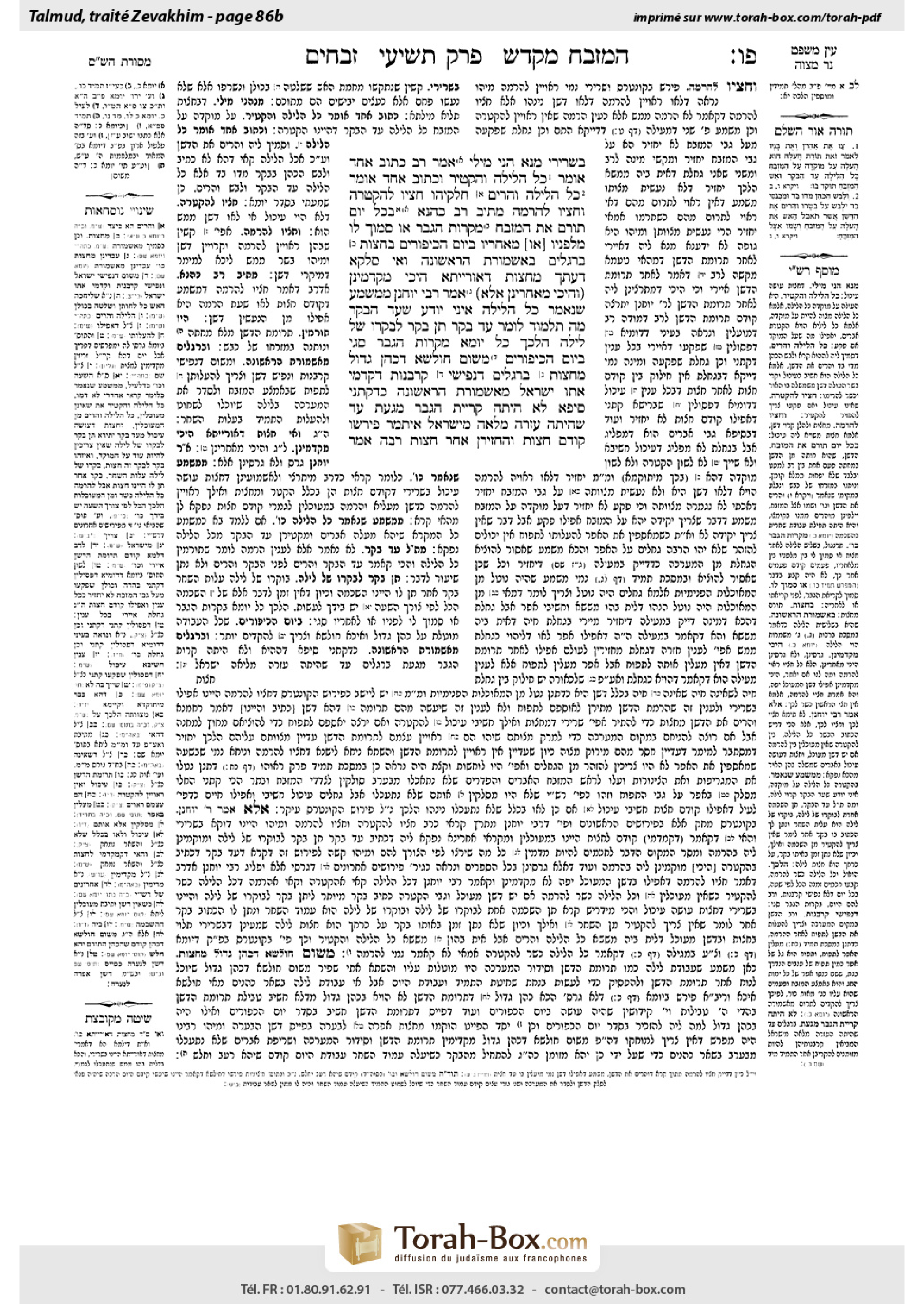
Zevachim 86b: Talmud study for Daf Yomi
Daf Yomi is the daily study of one Talmud folio. Explore 37 tractates with scans, Hebrew text, Sefaria English and AI-generated French translations where annotated.
Passage selection and English or AI-generated French translation are available where the scan has annotations. Daf Study is independent of Torah-Box and Sefaria.
Browse Zevachim · זבחים · All tractatesZevachim 86b text and translations
This page of Zevachim includes the Aramaic text, an English translation and an AI-generated French translation, alongside the scan above.
זבחים פ״ו ב · Aramaic and Hebrew text
בִּשְׁרִירֵי. מְנָא הָנֵי מִילֵּי?
אָמַר רַב, כָּתוּב אֶחָד אוֹמֵר: ״כׇּל הַלַּיְלָה״ וְהִקְטִיר, וְכָתוּב אֶחָד אוֹמֵר: ״כׇּל הַלַּיְלָה... וְהֵרִים״.
חַלְּקֵיהוּ, חֶצְיוֹ לְהַקְטָרָה וְחֶצְיוֹ לַהֲרָמָה.
מֵתִיב רַב כָּהֲנָא: בְּכׇל יוֹם תּוֹרֵם אֶת הַמִּזְבֵּחַ מִקְּרוֹת הַגֶּבֶר, אוֹ סָמוּךְ לוֹ מִלְּפָנָיו [אוֹ] מֵאַחֲרָיו. בְּיוֹם הַכִּיפּוּרִים – בַּחֲצוֹת. בָּרְגָלִים – בָּאַשְׁמוֹרֶת הָרִאשׁוֹנָה. וְאִי סָלְקָא דַעְתָּךְ מֵחֲצוֹת דְּאוֹרָיְיתָא, הֵיכִי מַקְדְּמִינַן וְהֵיכִי מְאַחֲרִינַן?
אֶלָּא אָמַר רַבִּי יוֹחָנָן: מִמַּשְׁמַע שֶׁנֶּאֱמַר ״כׇּל הַלַּיְלָה״ – אֵינִי יוֹדֵעַ שֶׁעַד הַבֹּקֶר? מָה תַּלְמוּד לוֹמַר ״עַד בֹּקֶר״? תֵּן בֹּקֶר לְבׇקְרוֹ שֶׁל לַיְלָה.
הִלְכָּךְ, כֹּל יוֹמָא – מִקְּרוֹת הַגֶּבֶר סַגִּי. בְּיוֹם הַכִּיפּוּרִים, מִשּׁוּם חוּלְשָׁא דְּכֹהֵן גָּדוֹל – מֵחֲצוֹת. בִּרְגָלִים, דִּנְפִישִׁי קׇרְבָּנוֹת דְּקָדְמִי אָתוּ יִשְׂרָאֵל – מֵאַשְׁמוֹרֶת הָרִאשׁוֹנָה; כִּדְקָתָנֵי סֵיפָא: לֹא הָיְתָה קְרִיַּית הַגֶּבֶר מַגַּעַת עַד שֶׁהָיְתָה עֲזָרָה מְלֵאָה מִיִּשְׂרָאֵל.
אִיתְּמַר: פֵּירְשׁוּ קוֹדֶם חֲצוֹת וְהֶחְזִירָן אַחַר חֲצוֹת – רַבָּה אָמַר:
Zevachim 86b · English translation
with regard to hardened limbs that were dried by the fire but have not yet been reduced to ash. The mishna teaches that before midnight, such limbs should be returned to the altar. The Gemara asks: From where is this matter derived that midnight determines whether or not they shall be returned?
Rav says: One verse states: All night and he shall burn the burnt offering, which indicates that there is a mitzva to burn the limbs of a burnt offering all night, as the verse states: “It is the burnt offering on the pyre upon the altar all night until the morning” (Leviticus 6:2). And one verse states: “All night until the morning…and he shall remove the ashes that the fire has consumed of the burnt offering on the altar, and he shall put them beside the altar” (Leviticus 6:2–3), which indicates that one may remove the ashes at any time during the night, including the limbs of a burnt offering that were already hardened by the fire. How can these texts be reconciled?
Rav explains: Divide the night into two parts: Half of the night, i.e., until midnight, is designated for the mitzva of burning, and during this time, that which is dislodged from the altar shall be returned; and half of the night, i.e., after midnight, is designated for removing.
With regard to Rav’s assertion that one may begin to remove the ashes only after midnight, Rav Kahana raises an objection from a mishna (Yoma 20a): Every day the priests would remove the ashes from the altar and place them on the east side of the ramp at the rooster’s crow or close to the time of its crowing, whether before it or after it, as there was no insistence on a precise time. On Yom Kippur they would remove the ashes at midnight. On the Festivals the ashes were removed even earlier, at the end of the first watch. Rav Kahana concludes his objection: And if it enters your mind that the proper time for removing the ashes by Torah law is from midnight, how do we advance the removal of the ashes on the Festivals, and how do we delay their removal the rest of the year?
Rather, Rabbi Yoḥanan says: The proper time of the removal of the ashes is based on the following: From the fact that it is stated with regard to the burning of the limbs: “All night” (Leviticus 6:2), don’t I know that he may burn a burnt offering until the morning? If so, what is the meaning when the verse states: “Until the morning”? It means: Add another morning to the morning of the night. Arise before dawn, as that is the time for the removal of the ashes. Nevertheless, there is no specific hour fixed for performing this removal, and one may remove the ashes from the beginning of the night.
Therefore, every day, performing the removal at the rooster’s crow is sufficient. On Yom Kippur, due to the weakness of the High Priest, who must perform the entire Temple service on that day, they would hasten to remove the ashes from midnight. On the Festivals, during which there are many offerings on account of the masses of Jewish people in Jerusalem on those days, who, in order to offer their sacrifices, would arrive early at the Temple, they would remove the ashes beginning from the end of the first watch, as the mishna teaches in the latter clause (Yoma 20a): The call of the rooster would not arrive on Festivals until the Temple courtyard was filled with Jews.
§ The Gemara previously explained the mishna as saying that limbs that were hardened by the fire but not entirely consumed are not returned to the altar if they were dislodged from it after midnight, since the mitzva of burning has been performed and the limbs are considered to have been entirely consumed. It was stated that amora’im engage in a dispute concerning the following matter: In the case of limbs that separated from upon the altar before midnight and were returned after midnight, whereby the mitzva of burning was not completed by midnight, Rabba says:
Zevachim 86b · Traduction française (IA)
À propos des membres desséchés par le feu, mais pas encore réduits en cendres, la Michna enseigne qu’avant minuit, ils doivent être remis sur l’autel. La Guemara demande : D’où apprend-on que minuit détermine s’ils doivent ou non être remis sur l’autel ?
Rav dit : Un verset énonce : « Toute la nuit, il brûlera l’holocauste », ce qui indique qu’il y a une mitsva de brûler les membres d’un holocauste toute la nuit, comme le dit le verset : « C’est l’holocauste sur le bûcher, sur l’autel, toute la nuit jusqu’au matin » (Lévitique 6,2). Un autre verset énonce : « Toute la nuit jusqu’au matin… et il enlèvera les cendres que le feu a consumées de l’holocauste sur l’autel, et il les déposera à côté de l’autel » (Lévitique 6,2-3), ce qui indique qu’on peut enlever les cendres à tout moment de la nuit, y compris les membres d’un holocauste déjà desséchés par le feu. Comment concilier ces textes ?
Rav explique : Il faut diviser la nuit en deux parties. La première moitié, c’est-à-dire jusqu’à minuit, est consacrée à la mitsva de brûler ; durant cette période, ce qui est tombé de l’autel doit y être remis. La seconde moitié, c’est-à-dire après minuit, est consacrée à l’enlèvement des cendres.
À propos de l’affirmation de Rav selon laquelle on ne peut commencer à enlever les cendres qu’après minuit, Rav Kahana soulève une objection à partir d’une Michna (Yoma 20a) : Chaque jour, les prêtres enlevaient les cendres de l’autel et les déposaient à l’est de la rampe, au chant du coq ou à peu près à l’heure où il chantait, que ce soit avant ou après, car aucune heure précise n’était imposée. À Yom Kippour, ils enlevaient les cendres à minuit. Les jours de fête, ils les enlevaient encore plus tôt, à la fin de la première veille. Rav Kahana conclut son objection : Si tu penses que, selon la Torah, le moment approprié pour enlever les cendres commence à minuit, comment peut-on avancer cet enlèvement les jours de fête et le retarder le reste de l’année ?
Rabbi Yoḥanan dit plutôt : Le moment approprié pour enlever les cendres se déduit ainsi : Puisqu’il est dit à propos de la combustion des membres : « Toute la nuit » (Lévitique 6,2), ne sais-je pas qu’on peut brûler un holocauste jusqu’au matin ? Dès lors, que signifie la précision « jusqu’au matin » ? Elle signifie : ajoute un autre matin au matin de la nuit. Lève-toi avant l’aube, car c’est le moment où l’on enlève les cendres. Néanmoins, aucune heure précise n’est fixée pour cet enlèvement, et on peut enlever les cendres dès le début de la nuit.
Par conséquent, chaque jour, il suffit d’enlever les cendres au chant du coq. À Yom Kippour, en raison de la faiblesse du grand prêtre, qui doit accomplir tout le service du Temple ce jour-là, on s’empressait d’enlever les cendres dès minuit. Les jours de fête, où les offrandes sont nombreuses en raison des foules de Juifs qui se rendent alors à Jérusalem et arrivent tôt au Temple pour offrir leurs sacrifices, on enlevait les cendres dès la fin de la première veille, comme l’enseigne la dernière partie de la Michna (Yoma 20a) : Le chant du coq ne retentissait pas les jours de fête avant que la cour du Temple ne soit remplie de Juifs.
§ La Guemara a expliqué précédemment que les membres desséchés par le feu, mais pas entièrement consumés, ne sont pas remis sur l’autel s’ils en sont tombés après minuit, puisque la mitsva de brûler a été accomplie et que ces membres sont considérés comme entièrement consumés. Il a été rapporté que les amoraïm sont en désaccord sur la question suivante : dans le cas de membres qui sont tombés de l’autel avant minuit et y ont été remis après minuit, de sorte que la mitsva de brûler n’était pas achevée à minuit, Rabba dit :
Traduction française générée par IA à partir de l’édition anglaise de Sefaria. Vérifie toujours un passage avec le texte source.
Text from Sefaria: William Davidson Edition - Vocalized Aramaic (CC BY NC); William Davidson Edition - English (CC BY NC).