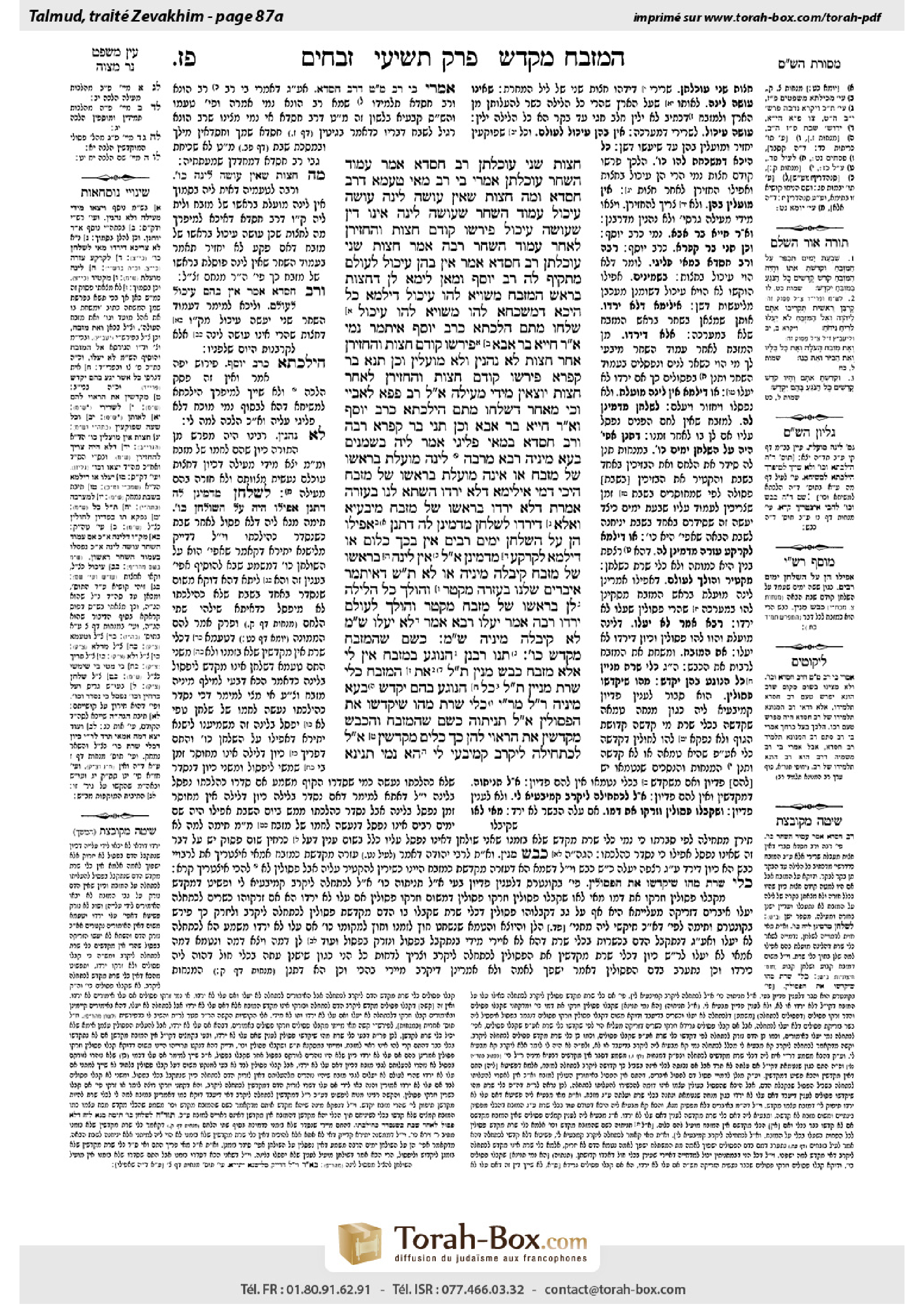
Zevachim 87a: Talmud study for Daf Yomi
Daf Yomi is the daily study of one Talmud folio. Explore 37 tractates with scans, Hebrew text, Sefaria English and AI-generated French translations where annotated.
Passage selection and English or AI-generated French translation are available where the scan has annotations. Daf Study is independent of Torah-Box and Sefaria.
Browse Zevachim · זבחים · All tractatesZevachim 87a text and translations
This page of Zevachim includes the Aramaic text, an English translation and an AI-generated French translation, alongside the scan above.
זבחים פ״ז א · Aramaic and Hebrew text
חֲצוֹת שֵׁנִי עוֹכַלְתָּן, רַב חִסְדָּא אָמַר: עַמּוּד הַשַּׁחַר עוֹכַלְתָּן.
אָמְרִי בֵּי רַב: מַאי טַעְמָא דְּרַב חִסְדָּא? וּמָה חֲצוֹת שֶׁאֵין עוֹשֶׂה לִינָה, עוֹשֶׂה עִיכּוּל; עַמּוּד הַשַּׁחַר שֶׁעוֹשֶׂה לִינָה, אֵינוֹ דִּין שֶׁעוֹשֶׂה עִיכּוּל?
פֵּירְשׁוּ קוֹדֶם חֲצוֹת, וְהֶחְזִירָן לְאַחַר עַמּוּד הַשַּׁחַר – רַבָּה אָמַר: חֲצוֹת שֵׁנִי עוֹכַלְתָּן, רַב חִסְדָּא אָמַר: אֵין בָּהֶן עִיכּוּל לְעוֹלָם.
מַתְקֵיף לַהּ רַב יוֹסֵף: וּמַאן לֵימָא לַן דַּחֲצוֹת בְּרֹאשׁ הַמִּזְבֵּחַ מְשַׁוְּיָא לְהוּ עִיכּוּל? דִּילְמָא כֹּל הֵיכָא דְּמַשְׁכְּחָא לְהוּ מְשַׁוְּיָא לְהוּ עִיכּוּל! שְׁלַחוּ מִתָּם: הִלְכְתָא כְּרַב יוֹסֵף.
אִיתְּמַר נָמֵי, אָמַר רַבִּי חִיָּיא בַּר אַבָּא: פֵּירְשׁוּ קוֹדֶם חֲצוֹת וְהֶחְזִירָן אַחַר חֲצוֹת – לֹא נֶהֱנִין וְלֹא מוֹעֲלִין. וְכֵן תָּנָא בַּר קַפָּרָא: פֵּירְשׁוּ קוֹדֶם חֲצוֹת וְהֶחְזִירָן לְאַחַר חֲצוֹת – יוֹצְאִין מִידֵי מְעִילָה.
אֲמַר לֵיהּ רַב פָּפָּא לְאַבָּיֵי: וְכִי מֵאַחַר דִּשְׁלַחוּ מִתָּם הִילְכְתָא כְּרַב יוֹסֵף, וְאָמַר רַבִּי חִיָּיא בַּר אַבָּא וְכֵן תָּנֵי בַּר קַפָּרָא – רַבָּה וְרַב חִסְדָּא בְּמַאי פְּלִיגִי? אֲמַר לֵיהּ: בִּשְׁמֵנִים.
בְּעָא מִינֵּיהּ רָבָא מֵרַבָּה: לִינָה מוֹעֶלֶת בְּרֹאשׁוֹ שֶׁל מִזְבֵּחַ, אוֹ אֵינָהּ מוֹעֶלֶת בְּרֹאשׁוֹ שֶׁל מִזְבֵּחַ? הֵיכִי דָמֵי? אִילֵּימָא דְּלֹא יָרְדוּ – הַשְׁתָּא לָנוּ בַּעֲזָרָה אָמְרַתְּ דְּלֹא יֵרְדוּ, בְּרֹאשׁוֹ שֶׁל מִזְבֵּחַ מִיבַּעְיָא?!
וְאֶלָּא דְּיָרְדוּ לְשֻׁלְחָן מְדַמֵּינַן לַהּ; דִּתְנַן: אֲפִילּוּ הֵן עַל הַשֻּׁלְחָן יָמִים רַבִּים – אֵין בְּכָךְ כְּלוּם, אוֹ דִילְמָא לְקַרְקַע מְדַמֵּינַן?
אֲמַר לֵיהּ: אֵין לִינָה בְּרֹאשׁוֹ שֶׁל מִזְבֵּחַ. קִיבְּלַהּ מִינֵּיהּ, אוֹ לָא? תָּא שְׁמַע, דְּאִיתְּמַר: אֵיבָרִים שֶׁלָּנוּ בָּעֲזָרָה – מְקַטֵּר וְהוֹלֵךְ כׇּל הַלַּיְלָה. לָן בְּרֹאשׁוֹ שֶׁל מִזְבֵּחַ – מְקַטֵּר וְהוֹלֵךְ לְעוֹלָם.
יָרְדוּ – רַבָּה אָמַר: יַעֲלוּ, רָבָא אָמַר: לֹא יַעֲלוּ. שְׁמַע מִינַּהּ: לָא קַיבְּלַהּ מִינֵּיהּ! שְׁמַע מִינַּהּ.
כְּשֵׁם שֶׁהַמִּזְבֵּחַ מְקַדֵּשׁ כּוּ׳. תָּנוּ רַבָּנַן: ״הַנֹּגֵעַ בְּמִזְבֵּחַ״ – אֵין לִי אֶלָּא מִזְבֵּחַ; כֶּבֶשׁ מִנַּיִן? תַּלְמוּד לוֹמַר: ״אֶת הַמִּזְבֵּחַ״. כְּלֵי שָׁרֵת מִנַּיִין? תַּלְמוּד לוֹמַר: ״כׇּל הַנֹּגֵעַ בָּהֶם יִקְדָּשׁ״.
בְּעָא מִינֵּיהּ רֵישׁ לָקִישׁ מֵרַבִּי יוֹחָנָן: כְּלֵי שָׁרֵת מַהוּ שֶׁיְּקַדְּשׁוּ אֶת הַפְּסוּלִין? אֲמַר לֵיהּ, תְּנֵיתוּהָ: כְּשֵׁם שֶׁהַמִּזְבֵּחַ וְהַכֶּבֶשׁ מְקַדְּשִׁין אֶת הָרָאוּי לָהֶן, כָּךְ כֵּלִים מְקַדְּשִׁין!
אֲמַר לֵיהּ: לְכַתְּחִילָּה לִיקְרַב קָמִיבְּעֵי לִי. הָא נָמֵי תְּנֵינָא:
Zevachim 87a · English translation
The second midnight, i.e., midnight of the following night, renders them consumed, and if they were dislodged from the altar thereafter they are not returned. Rav Ḥisda says: Dawn following the first evening renders them consumed, and if they were dislodged from the altar thereafter they are not returned.
They say in the school of Rav: What is the reasoning of Rav Ḥisda, who says that dawn renders these limbs consumed? It is the following a fortiori inference: And if midnight, which does not cause the disqualification of being left overnight with regard to limbs that were left off the altar until that time, still causes consumption, i.e., limbs burned on the altar until midnight are considered entirely consumed, then certainly with regard to dawn, which causes the disqualification of being left overnight with regard to limbs that were not left off the altar until that time, isn’t it logical that it causes consumption?
These amora’im also dispute the halakha in a case where the limbs separated from the altar before midnight and were returned to the altar after dawn: Rabba says that the second midnight renders them consumed, and if they separated after this time they are not returned. Rav Ḥisda says: Since these limbs were not returned to the altar by dawn, they are never subject to consumption through the passage of time. Rather, they are returned to the altar and allowed to burn until they are reduced to ash. These two disputes between Rabba and Rav Ḥisda indicate that both agree that limbs not on the altar by midnight are not considered consumed.
Rav Yosef objects to this: And who shall say to us that midnight, specifically when the limbs are at the top of the altar, effects for them consumption? Perhaps anywhere that the limbs are found, midnight effects for them consumption. The Gemara notes: They sent from there, i.e., Eretz Yisrael, that the halakha is in accordance with the opinion of Rav Yosef, i.e., the passing of midnight renders all limbs consumed, regardless of their location at that time.
It was also stated that Rabbi Ḥiyya bar Abba says: In the case of limbs that separated from upon the altar before midnight and were returned to the altar after midnight, one may not benefit from them ab initio, but if one benefited from them after the fact he is not liable for misuse of consecrated property, since the mitzva of burning is considered fulfilled after midnight has passed. And bar Kappara also taught: If they separated from upon the altar before midnight and were returned to the altar after midnight, the limbs are removed from being subject to liability for misuse of consecrated property.
Rav Pappa said to Abaye: And since they sent from there that the halakha is in accordance with the opinion of Rav Yosef that midnight effects consumption even for those items left off the altar, and Rav Ḥiyya bar Abba says this as well, and bar Kappara also teaches that this is the halakha, then with regard to what do Rabba and Rav Ḥisda disagree? Abaye said to him: They disagree with regard to fatty limbs, whose consumption is delayed due to their surrounding fat, and consequently midnight may not effect consumption for these limbs.
§ Rava raises a dilemma before Rabba: Is the disqualification of being left overnight effective in disqualifying limbs that are situated at the top of the altar at dawn but were not placed on the pyre, or is it not effective in disqualifying limbs that are at the top of the altar but were not placed on the pyre? The Gemara clarifies: What are the circumstances? If we say that the limbs have not descended from the altar, then the halakha should be obvious: Now that with regard to limbs that were left overnight in the Temple courtyard, you said in the mishna (84a) that if they ascended upon the altar they shall not descend, then with regard to limbs left on top of the altar, is it necessary to teach that they shall not descend?
But rather, the dilemma is in a case where they were left overnight on top of the altar and descended from it after dawn. Do we compare limbs left overnight on top of the altar to the Table of the shewbread, and they are therefore returned, as we learned in a mishna (Menaḥot 100a): Even if loaves of shewbread, which are supposed to be replaced every Shabbat, remained on the Table many days beyond Shabbat, there is nothing wrong with that, and the loaves are not disqualified by being left overnight. Or perhaps we compare the limbs to flesh left on the ground of the Temple courtyard, which is disqualified when left there until dawn, and they are not returned.
Rabba said to him: There is no disqualification of limbs that are left overnight at the top of the altar. The Gemara asks: Did Rava accept this response from Rabba or not? The Gemara suggests: Come and hear a proof from that which was stated: With regard to limbs that were left overnight in the Temple courtyard, the priest may place them upon the altar to burn them all night long provided that they are placed there before dawn. With regard to a limb that was left overnight at the top of the altar, the priest may burn it forever, i.e., no matter how much time has passed.
With regard to limbs that were left overnight on top of the altar and then descended from it, Rabba says that they shall ascend, while Rava says that they shall not ascend. Conclude from it that Rava did not accept the response from Rabba, as he holds here that limbs are disqualified when left overnight on top of the altar. The Gemara confirms: Indeed, conclude from it that this is so.
§ The mishna teaches: Just as the altar sanctifies items, so too, the ramp and the service vessels sanctify items. With regard to this halakha, the Sages taught: The verse states: “Whatever touches the altar shall be sacred” (Exodus 29:37). From here I have derived only that the altar sanctifies items. From where is it derived that the ramp sanctifies items as well? The verse states: “And you shall anoint…the altar [et hamizbe’aḥ]” (Exodus 40:10), and the addition of the word et serves to include the ramp. With regard to service vessels, from where is it derived that they sanctify items? The verse states with regard to them: “Whatever touches them shall be sacred” (Exodus 30:29).
Reish Lakish raises a dilemma before Rabbi Yoḥanan: What is the halakha with regard to whether service vessels sanctify disqualified items? Rabbi Yoḥanan said to him: You learned in the mishna that just as the altar and the ramp sanctify items that are suited to them even if those items are disqualified, so too, the service vessels sanctify items placed in them.
Reish Lakish said to him: The mishna indicates that service vessels sanctify that which is placed in them in the sense that they may no longer be redeemed even if they become disqualified. I raise the dilemma with regard to whether service vessels sanctify disqualified items such that they may be sacrificed ab initio. Rabbi Yoḥanan said to him: This also we learn in a mishna (84a):
Zevachim 87a · Traduction française (IA)
La seconde minuit, c’est-à-dire minuit de la nuit suivante, les rend consommés ; s’ils sont ensuite tombés de l’autel, on ne les y replace pas. Rav Ḥisda dit : l’aube qui suit le premier soir les rend consommés, et s’ils tombent ensuite de l’autel, on ne les y replace pas.
À l’école de Rav, on dit : Quel est le raisonnement de Rav Ḥisda, qui affirme que l’aube rend ces membres consommés ? C’est le raisonnement a fortiori suivant : si minuit, qui n’entraîne pas l’invalidation pour séjour nocturne des membres restés jusque-là en dehors de l’autel, entraîne néanmoins leur consommation — c’est-à-dire que les membres brûlés sur l’autel jusqu’à minuit sont considérés comme entièrement consommés —, à plus forte raison l’aube, qui entraîne l’invalidation pour séjour nocturne des membres restés jusque-là en dehors de l’autel, entraîne-t-elle leur consommation ?
Ces amoraïm sont également en désaccord sur le cas où les membres ont été retirés de l’autel avant minuit et y ont été replacés après l’aube. Rabba dit que la seconde minuit les rend consommés, et s’ils en sont retirés après ce moment, on ne les y replace pas. Rav Ḥisda dit : puisque ces membres n’ont pas été replacés sur l’autel avant l’aube, le passage du temps ne les rend jamais consommés. On les replace plutôt sur l’autel et on les laisse brûler jusqu’à ce qu’ils soient réduits en cendres. Ces deux désaccords entre Rabba et Rav Ḥisda montrent qu’ils conviennent tous deux que les membres qui ne se trouvent pas sur l’autel à minuit ne sont pas considérés comme consommés.
Rav Yosef objecte : Et qui nous dit que minuit ne produit la consommation que lorsque les membres se trouvent au sommet de l’autel ? Peut-être que minuit produit leur consommation quel que soit l’endroit où ils se trouvent. La Guemara note : On a envoyé de là-bas, c’est-à-dire de la Terre d’Israël, que la halakha suit l’opinion de Rav Yosef : le passage de minuit rend tous les membres consommés, quel que soit l’endroit où ils se trouvent à ce moment-là.
Il a également été enseigné que Rabbi Ḥiyya bar Abba dit : dans le cas de membres qui ont été retirés de l’autel avant minuit et y ont été replacés après minuit, il est interdit d’en tirer profit a priori ; mais si quelqu’un en a tiré profit après coup, il n’est pas passible de détournement d’un bien consacré, puisque la mitsva de les brûler est considérée comme accomplie une fois minuit passé. Bar Kappara a également enseigné : s’ils ont été retirés de l’autel avant minuit et y ont été replacés après minuit, les membres ne sont plus soumis à la responsabilité pour détournement d’un bien consacré.
Rav Pappa dit à Abaye : Puisqu’on a envoyé de là-bas que la halakha suit l’opinion de Rav Yosef, selon laquelle minuit produit la consommation même pour les éléments laissés en dehors de l’autel, que Rav Ḥiyya bar Abba dit la même chose et que Bar Kappara enseigne également cette halakha, sur quoi Rabba et Rav Ḥisda sont-ils donc en désaccord ? Abaye lui dit : Ils sont en désaccord au sujet des membres gras, dont la consommation est retardée par la graisse qui les entoure ; minuit pourrait donc ne pas produire leur consommation.
§ Rava soumet une question à Rabba : L’invalidation pour séjour nocturne s’applique-t-elle aux membres qui se trouvent au sommet de l’autel à l’aube, mais qui n’ont pas été placés sur le bûcher, ou ne s’applique-t-elle pas à ces membres ? La Guemara précise : Dans quelles circonstances ? Si nous disons que les membres ne sont pas descendus de l’autel, alors la halakha devrait être évidente : puisque, au sujet des membres qui ont passé la nuit dans la cour du Temple, tu as dit dans la Michna (84a) que s’ils sont montés sur l’autel, ils n’en redescendront pas, est-il nécessaire d’enseigner que les membres restés au sommet de l’autel n’en redescendront pas ?
Mais la question porte plutôt sur un cas où ils ont passé la nuit au sommet de l’autel et en sont descendus après l’aube. Doit-on comparer les membres qui ont passé la nuit au sommet de l’autel à la Table des pains de proposition, et les y replacer ? En effet, nous avons appris dans une Michna (Menaḥot 100a) que même si les pains de proposition, qui doivent être remplacés chaque Chabbat, sont restés sur la Table de nombreux jours après le Chabbat, cela ne pose aucun problème et les pains ne sont pas invalidés pour séjour nocturne. Ou peut-être doit-on comparer les membres à la chair restée à même le sol de la cour du Temple, qui est invalidée lorsqu’elle y demeure jusqu’à l’aube, et ne pas les y replacer.
Rabba lui dit : Les membres qui passent la nuit au sommet de l’autel ne sont pas invalidés. La Guemara demande : Rava a-t-il accepté ou non cette réponse de Rabba ? La Guemara propose : Viens et entends une preuve de ce qui a été enseigné : au sujet des membres qui ont passé la nuit dans la cour du Temple, le prêtre peut les placer sur l’autel pour les y brûler toute la nuit, à condition de les y placer avant l’aube. Quant à un membre qui a passé la nuit au sommet de l’autel, le prêtre peut le brûler indéfiniment, c’est-à-dire quel que soit le temps écoulé.
Au sujet des membres qui ont passé la nuit au sommet de l’autel puis en sont descendus, Rabba dit qu’ils doivent remonter, tandis que Rava dit qu’ils ne doivent pas remonter. Déduis-en que Rava n’a pas accepté la réponse de Rabba, puisqu’il estime ici que les membres sont invalidés s’ils passent la nuit au sommet de l’autel. La Guemara confirme : En effet, déduis-en que c’est bien le cas.
§ La Michna enseigne : De même que l’autel sanctifie les objets, la rampe et les ustensiles du service les sanctifient également. À propos de cette halakha, les Sages ont enseigné : Le verset dit : « Tout ce qui touche l’autel sera sacré » (Exode 29:37). De là, je n’ai déduit que la sanctification des objets par l’autel. D’où déduit-on que la rampe sanctifie également les objets ? Le verset dit : « Tu oindras […] l’autel [et hamizbe’aḥ] » (Exode 40:10), et l’ajout du mot et inclut la rampe. D’où déduit-on que les ustensiles du service sanctifient les objets ? Le verset dit à leur sujet : « Tout ce qui les touchera sera sacré » (Exode 30:29).
Reish Lakish soumet une question à Rabbi Yoḥanan : Quelle est la halakha concernant la sanctification, par les ustensiles du service, des objets invalides ? Rabbi Yoḥanan lui dit : Tu as appris dans la Michna que, de même que l’autel et la rampe sanctifient les objets qui leur sont destinés, même si ces objets sont invalides, les ustensiles du service sanctifient également les objets qui y sont placés.
Reish Lakish lui dit : La Michna indique que les ustensiles du service sanctifient ce qui y est placé en ce sens que ces objets ne peuvent plus être rachetés, même s’ils deviennent invalides. Ma question porte sur le fait de savoir si les ustensiles du service sanctifient les objets invalides au point qu’ils puissent être offerts a priori. Rabbi Yoḥanan lui dit : Nous apprenons aussi cela dans une Michna (84a) :
Traduction française générée par IA à partir de l’édition anglaise de Sefaria. Vérifie toujours un passage avec le texte source.
Text from Sefaria: William Davidson Edition - Vocalized Aramaic (CC BY NC); William Davidson Edition - English (CC BY NC).