Zevachim 87b: Talmud study for Daf Yomi
Daf Yomi is the daily study of one Talmud folio. Explore 37 tractates with scans, Hebrew text, Sefaria English and AI-generated French translations where annotated.
Passage selection and English or AI-generated French translation are available where the scan has annotations. Daf Study is independent of Torah-Box and Sefaria.
Browse Zevachim · זבחים · All tractatesZevachim 87b text and translations
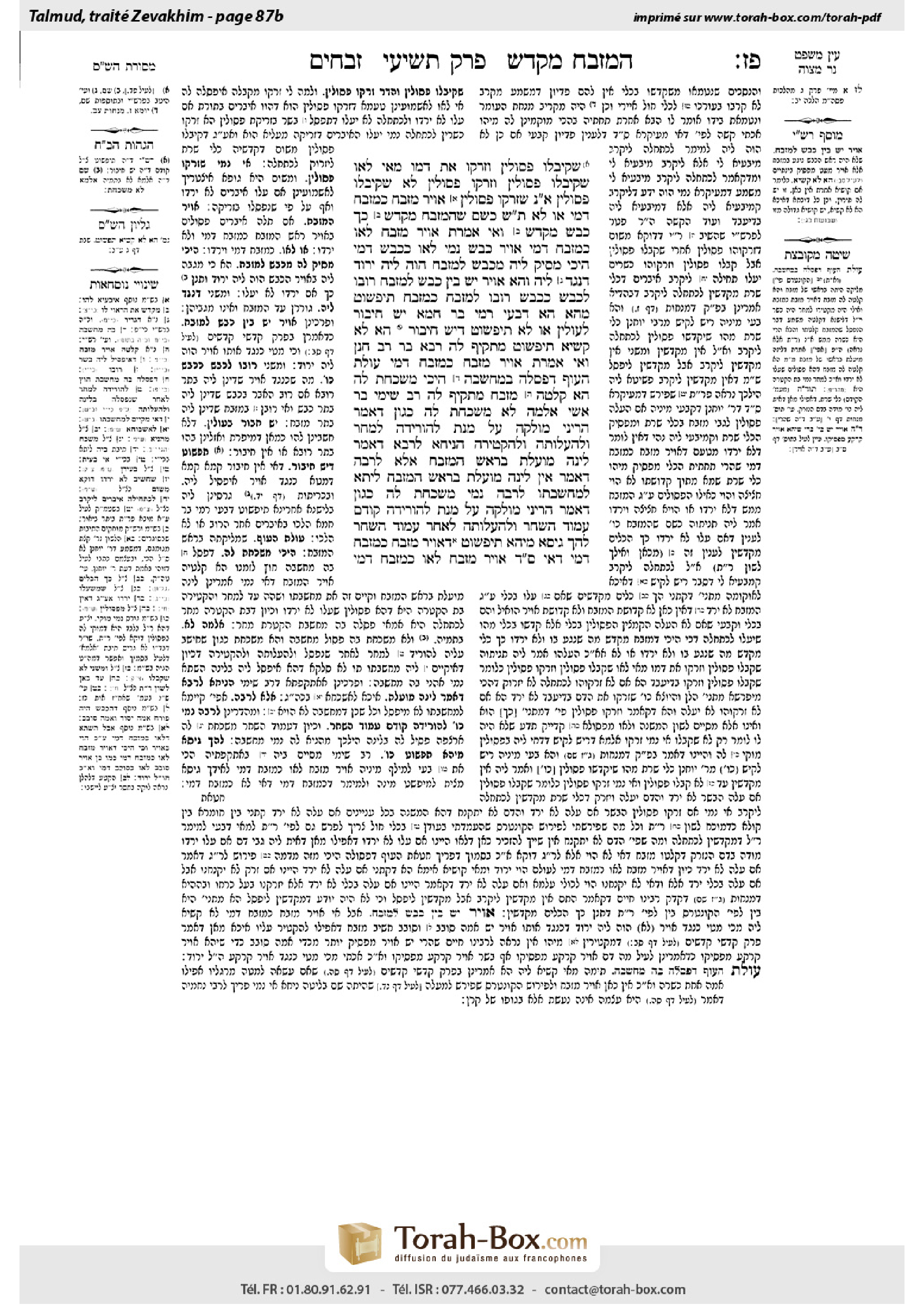
This page of Zevachim includes the Aramaic text, an English translation and an AI-generated French translation, alongside the scan above.
זבחים פ״ז ב · Aramaic and Hebrew text
שֶׁקִּיבְּלוּ פְּסוּלִין וְזָרְקוּ אֶת דָּמוֹ; מַאי, לָאו שֶׁקִּיבְּלוּ פְּסוּלִין וְזָרְקוּ פְּסוּלִין?
לֹא, שֶׁקִּיבְּלוּ פְּסוּלִין. אִי נָמֵי שֶׁזָּרְקוּ פְּסוּלִין.
אֲוִיר מִזְבֵּחַ – כְּמִזְבֵּחַ דָּמֵי, אוֹ לָא? תָּא שְׁמַע: כְּשֵׁם שֶׁהַמִּזְבֵּחַ מְקַדֵּשׁ, כָּךְ כֶּבֶשׁ מְקַדֵּשׁ.
וְאִי אָמְרַתְּ אֲוִיר מִזְבֵּחַ לָאו כַּמִּזְבֵּחַ דָּמֵי – אֲוִיר כֶּבֶשׁ נָמֵי לָאו כְּכֶבֶשׁ דָּמֵי; הֵיכִי מַסֵּיק לֵיהּ מִכֶּבֶשׁ לְמִזְבֵּחַ? הָוֵה לֵיהּ יָרוּד!
דְּנָגֵד לֵיהּ. וְהָא אֲוִיר יֵשׁ בֵּין כֶּבֶשׁ לַמִּזְבֵּחַ! רוּבּוֹ לַכֶּבֶשׁ – כַּכֶּבֶשׁ, רוּבּוֹ לַמִּזְבֵּחַ – כַּמִּזְבֵּחַ.
תִּפְשׁוֹט מֵהָא – הָא דְּבָעֵי רָמֵי בַּר חָמָא יֵשׁ חִיבּוּר לְעוֹלִין אוֹ לָא, תִּיפְשׁוֹט דְּיֵשׁ חִיבּוּר! הָא לָא קַשְׁיָא, תִּיפְשׁוֹט.
מַתְקֵיף לַהּ רָבָא בַּר רַב חָנָן: וְאִי אָמְרַתְּ אֲוִיר מִזְבֵּחַ כַּמִּזְבֵּחַ דָּמֵי, עוֹלַת הָעוֹף דְּפָסְלָה בְּמַחְשָׁבָה הֵיכִי מַשְׁכַּחַתְּ לַהּ?
הָא קַלְטַהּ מִזְבֵּחַ!
מַתְקֵיף לַהּ רַב שִׁימִי בַּר אָשֵׁי: אַלְּמָה לָא מַשְׁכַּחַתְּ לַהּ? כְּגוֹן דְּאָמַר: הֲרֵינִי מוֹלְקָהּ עַל מְנָת לְהוֹרִידָהּ לְמָחָר וּלְהַעֲלוֹתָהּ וּלְהַקְטִירָהּ.
הָנִיחָא לְרָבָא, דְּאָמַר: לִינָה מוֹעֶלֶת בְּרֹאשׁ הַמִּזְבֵּחַ; אֶלָּא לְרַבָּה, דְּאָמַר: אֵין לִינָה מוֹעֶלֶת בְּרֹאשׁ הַמִּזְבֵּחַ – לֵיתָא לְמַחְשַׁבְתּוֹ!
לְרַבָּה נָמֵי מַשְׁכַּחַתְּ לַהּ – כְּגוֹן דְּאָמַר: הֲרֵינִי מוֹלְקָהּ עַל מְנָת לְהוֹרִידָהּ קוֹדֵם עַמּוּד הַשַּׁחַר, וּלְהַעֲלוֹתָהּ לְאַחַר עַמּוּד הַשַּׁחַר.
לְהָךְ גִּיסָא מִיהָא תִּיפְשׁוֹט – דַּאֲוִיר מִזְבֵּחַ כְּמִזְבֵּחַ דָּמֵי; דְּאִי סָלְקָא דַעְתָּךְ אֲוִיר מִזְבֵּחַ לָאו כְּמִזְבֵּחַ דָּמֵי,
Zevachim 87b · English translation
An offering that people unfit for performing the Temple service collected and then sprinkled its blood shall not descend from the altar if it ascended. What, is it not that the mishna means that people unfit for performing the Temple service collected the blood and people unfit for performing the Temple service sprinkled it as well, which disqualifies it from ascending the altar? But if the collection alone was performed by people unfit for performing the Temple service, although the offering becomes disqualified, those fit to perform the Temple service may sprinkle the blood and sacrifice the offering ab initio. The reason, apparently, is that service vessels sanctify disqualified blood such that it may be sprinkled ab initio.
Reish Lakish rejects this proof: No, the mishna may be referring to two independent cases, i.e., that people unfit for performing the Temple service collected the blood, or that people unfit for performing the Temple service sprinkled the blood after it was collected by people who were fit for performing the Temple service. Accordingly, the mishna teaches only that if such offerings ascended the altar they shall not descend after the fact, but service vessels do not sanctify disqualified items such that they are offered ab initio.
§ The Gemara raises a dilemma: Is the airspace above the altar considered as the altar itself, whereby items that enter this airspace shall not descend from the altar, or is it not considered like the altar? The Gemara suggests: Come and hear the mishna, which states: Just as the altar sanctifies items, so too, the ramp sanctifies items, and if they ascended upon it they shall be sacrificed upon the altar and shall not descend.
And if you say that the airspace above the altar is not considered as the altar itself, then the airspace above the ramp as well should not be considered as the ramp. If so, how can one elevate the disqualified limbs of an offering from the ramp to the altar? The moment one elevates a limb from upon the ramp, it is considered to have descended from the ramp, and all disqualified items that descended shall not be returned.
The Gemara responds: The mishna is referring to a case where the priest drags the offering up the ramp, but it never enters its airspace. The Gemara challenges: But even if he drags it up the ramp, he must still lift it, as there is a space between the ramp and the altar. The Gemara responds: Since this gap is small, only a minority of the limb of an offering will be located over the gap as it passes from the ramp to the altar. Therefore, when a majority of the limb is on the ramp, the minority situated above the gap is considered as if it is on the ramp. Once a majority of the limb is on the altar, the minority situated above the gap is considered as if it is on the altar.
The Gemara asks: If so, resolve from this mishna the dilemma that was raised by Rami bar Ḥama: Is there a connection of limbs that ascend upon the altar, i.e., is an offering considered a unit such that even those parts that do not ascend the altar shall be considered as if they are upon it, or is there not, and each part is considered independent? Based on the previous answer, resolve the dilemma by saying that there is a connection of limbs. The Gemara responds: This is not difficult, as one may indeed resolve Rami bar Ḥama’s dilemma from here.
Rava bar Rav Ḥanan objects to the assumption that the airspace above the altar is considered as the altar itself: But if you say that the airspace above the altar is considered as the altar itself, then with regard to a bird burnt offering that one disqualified by having the intention to burn it beyond its designated time, i.e., the day after it was pinched, how can you find the circumstances for such a disqualification to take effect?
One’s intent to burn an offering beyond its designated time disqualifies it only when he intended to burn it during a time that he may not do so. Since a bird burnt offering is pinched in the airspace above the altar, the altar has already accepted it. Therefore, even if one delayed burning it until the next day, it does not descend from the altar, like all other offerings that are disqualified by being left overnight.
Rav Shimi bar Ashi objects to the objection raised by Rava bar Rav Ḥanan: Why is it not possible for a bird burnt offering to be disqualified through the intention to burn it beyond its designated time? You find it in a case where he says: I am hereby pinching it in order to take it down from the altar tomorrow and thereafter sacrifice it and burn it. If he takes it down from the altar the next day, he may not subsequently return it there for burning, as all disqualified items that have descended from the altar shall not be returned to it. Accordingly, even if the airspace above the altar is considered as the altar itself, a bird burnt offering can still be disqualified with such intention.
The Gemara questions the objection of Rav Shimi bar Ashi: This works out well according to the opinion of Rava, who says that the disqualification of being left overnight is effective even when the offering is at the top of the altar. Accordingly, if he were to take the bird burnt offering down from the altar the next day, he may not restore it to the altar for burning. But this is difficult according to the opinion of Rabba, who says: The disqualification of being left overnight is not effective when the offering is at the top of the altar, and therefore even if the next day he removed the bird burnt offering from the altar, he must return it there to burn it, as it has not been disqualified. If so, his intention is not significant, i.e., he does not disqualify a bird burnt offering with such intention.
Rav Shimi bar Ashi responds: According to the opinion of Rabba as well, you find a case of a bird burnt offering that is disqualified due to one’s intention, such as where he says: I am hereby pinching it in order to take it down from the altar before dawn and to then sacrifice it after dawn. In such a case, where the offering is removed from the altar before dawn, even Rabba would agree that one’s intention renders a bird burnt offering disqualified by being left overnight.
Rav Shimi bar Ashi adds: Irrespective of the validity of the proof of Rava bar Rav Ḥanan, in any event, resolve the issue to this side, i.e., in favor of the claim that the airspace above the altar is considered as the altar itself. As if it enters your mind that the airspace above the altar is not considered as the altar,
Zevachim 87b · Traduction française (IA)
Un sacrifice dont le sang a été recueilli puis aspergé par des personnes inaptes à accomplir le service dans le Temple ne doit pas être retiré de l’autel s’il y est monté. N’est-ce pas que la Michna signifie que des personnes inaptes à accomplir le service dans le Temple ont recueilli le sang et que des personnes également inaptes l’ont aspergé, ce qui l’empêche de monter sur l’autel ? Mais si seules des personnes inaptes à accomplir le service dans le Temple ont recueilli le sang, bien que le sacrifice devienne impropre, des personnes aptes à accomplir le service peuvent asperger le sang et offrir le sacrifice a priori. La raison en est apparemment que les ustensiles de service sanctifient le sang impropre, de sorte qu’il peut être aspergé a priori.
Reich Lakich rejette cette preuve : Non, la Michna peut porter sur deux cas indépendants : des personnes inaptes à accomplir le service dans le Temple ont recueilli le sang, ou des personnes inaptes à accomplir le service dans le Temple l’ont aspergé après qu’il eut été recueilli par des personnes aptes à accomplir le service dans le Temple. Par conséquent, la Michna enseigne seulement que si de tels sacrifices sont montés sur l’autel, ils ne doivent pas en être retirés après coup ; les ustensiles de service ne sanctifient donc pas les objets impropres de manière à permettre qu’ils soient offerts a priori.
§ La Guemara soulève un dilemme : l’espace aérien au-dessus de l’autel est-il considéré comme l’autel lui-même, de sorte que les objets qui y pénètrent ne doivent pas être retirés de l’autel, ou n’est-il pas considéré comme tel ? La Guemara propose : examinons la Michna, qui enseigne : De même que l’autel sanctifie les objets, la rampe sanctifie elle aussi les objets ; et s’ils y sont montés, ils doivent être offerts sur l’autel et ne doivent pas en être retirés.
Et si tu dis que l’espace aérien au-dessus de l’autel n’est pas considéré comme l’autel lui-même, alors l’espace aérien au-dessus de la rampe ne devrait pas non plus être considéré comme la rampe. Dans ce cas, comment peut-on faire monter sur l’autel les membres impropres d’un sacrifice depuis la rampe ? Dès qu’on soulève un membre depuis la rampe, il est considéré comme en étant descendu, et tous les objets impropres qui en sont descendus ne doivent pas y être remis.
La Guemara répond : La Michna parle d’un cas où le prêtre traîne le sacrifice en le faisant monter sur la rampe, sans jamais le faire entrer dans l’espace aérien de celle-ci. La Guemara objecte : Mais même s’il le traîne en le faisant monter sur la rampe, il doit tout de même le soulever, car il y a un espace entre la rampe et l’autel. La Guemara répond : Puisque cet intervalle est petit, seule une partie minoritaire du membre du sacrifice se trouve au-dessus de l’intervalle lorsqu’il passe de la rampe à l’autel. Par conséquent, lorsque la majeure partie du membre se trouve sur la rampe, la partie minoritaire située au-dessus de l’intervalle est considérée comme étant sur la rampe. Une fois que la majeure partie du membre se trouve sur l’autel, la partie minoritaire située au-dessus de l’intervalle est considérée comme étant sur l’autel.
La Guemara demande : Dans ce cas, peut-on déduire de cette Michna la réponse au dilemme soulevé par Rami bar Ḥama : existe-t-il une association entre les membres qui montent sur l’autel, c’est-à-dire un sacrifice est-il considéré comme un tout, de sorte que même les parties qui ne montent pas sur l’autel sont considérées comme s’y trouvant, ou n’existe-t-il pas une telle association, chaque partie étant considérée séparément ? À partir de la réponse précédente, résolvons le dilemme en disant qu’il existe une association entre les membres. La Guemara répond : Il n’y a pas de difficulté, car on peut effectivement résoudre ici le dilemme de Rami bar Ḥama.
Rava bar Rav Ḥanan objecte à l’hypothèse selon laquelle l’espace aérien au-dessus de l’autel est considéré comme l’autel lui-même : Mais si tu dis que l’espace aérien au-dessus de l’autel est considéré comme l’autel lui-même, alors, concernant un holocauste d’oiseau que quelqu’un a rendu impropre en ayant l’intention de le brûler après le délai qui lui est imparti, c’est-à-dire le lendemain de sa mélika, comment trouver un cas où cette invalidation prendrait effet ?
L’intention de brûler un sacrifice après le délai qui lui est imparti ne le rend impropre que si l’on a eu l’intention de le brûler à un moment où il est interdit de le faire. Puisque la mélika d’un holocauste d’oiseau a lieu dans l’espace aérien au-dessus de l’autel, celui-ci l’a déjà accueilli. Par conséquent, même si l’on retarde sa combustion jusqu’au lendemain, il ne descend pas de l’autel, comme tous les autres sacrifices rendus impropres parce qu’ils ont passé la nuit.
Rav Shimi bar Ashi objecte à l’objection de Rava bar Rav Ḥanan : Pourquoi serait-il impossible de rendre un holocauste d’oiseau impropre en ayant l’intention de le brûler après le délai qui lui est imparti ? On peut envisager le cas où il dit : « Voici que je fais sa mélika afin de le descendre de l’autel demain, puis de l’offrir et de le brûler. » S’il le descend de l’autel le lendemain, il ne peut pas ensuite le remettre sur l’autel pour le brûler, car tous les objets impropres qui en sont descendus ne doivent pas y être remis. Par conséquent, même si l’espace aérien au-dessus de l’autel est considéré comme l’autel lui-même, un holocauste d’oiseau peut tout de même être rendu impropre par une telle intention.
La Guemara met en question l’objection de Rav Shimi bar Ashi : cela fonctionne bien selon l’opinion de Rava, qui dit que l’invalidité due au fait d’avoir passé la nuit prend effet même lorsque le sacrifice se trouve au sommet de l’autel. Par conséquent, s’il descendait l’holocauste d’oiseau de l’autel le lendemain, il ne pourrait pas le remettre sur l’autel pour le brûler. Mais cela pose difficulté selon l’opinion de Rabba, qui dit que l’invalidité due au fait d’avoir passé la nuit ne prend pas effet lorsque le sacrifice se trouve au sommet de l’autel ; ainsi, même s’il retirait l’holocauste d’oiseau de l’autel le lendemain, il devrait le remettre sur l’autel pour le brûler, puisqu’il n’est pas devenu impropre. Dans ce cas, son intention est sans effet, c’est-à-dire qu’il ne rend pas un holocauste d’oiseau impropre par une telle intention.
Rav Shimi bar Ashi répond : même selon l’opinion de Rabba, on peut trouver un cas où un holocauste d’oiseau est rendu impropre par l’intention de quelqu’un, par exemple s’il dit : « Voici que je fais sa mélika afin de le descendre de l’autel avant l’aube, puis de l’offrir après l’aube. » Dans un tel cas, où le sacrifice est retiré de l’autel avant l’aube, Rabba conviendrait lui aussi que l’intention rend un holocauste d’oiseau impropre du fait qu’il a passé la nuit.
Rav Shimi bar Ashi ajoute : indépendamment de la validité de la preuve de Rava bar Rav Ḥanan, dans tous les cas, résous le dilemme dans ce sens, c’est-à-dire en faveur de l’affirmation selon laquelle l’espace aérien au-dessus de l’autel est considéré comme l’autel lui-même. Car si tu penses que l’espace aérien au-dessus de l’autel n’est pas considéré comme l’autel,
Traduction française générée par IA à partir de l’édition anglaise de Sefaria. Vérifie toujours un passage avec le texte source.
Text from Sefaria: William Davidson Edition - Vocalized Aramaic (CC BY NC); William Davidson Edition - English (CC BY NC).