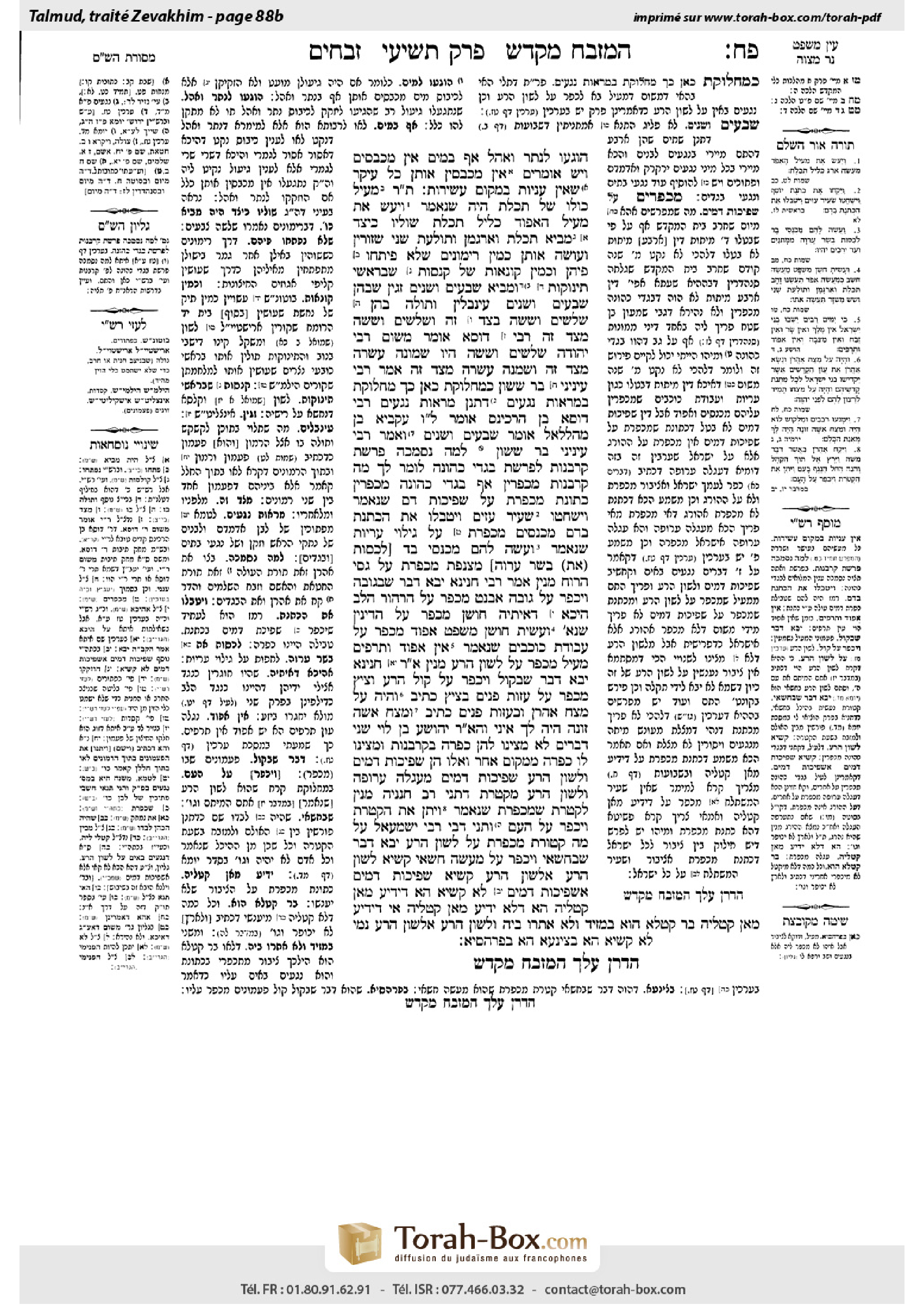
Zevachim 88b: Talmud study for Daf Yomi
Daf Yomi is the daily study of one Talmud folio. Explore 37 tractates with scans, Hebrew text, Sefaria English and AI-generated French translations where annotated.
Passage selection and English or AI-generated French translation are available where the scan has annotations. Daf Study is independent of Torah-Box and Sefaria.
Browse Zevachim · זבחים · All tractatesZevachim 88b text and translations
This page of Zevachim includes the Aramaic text, an English translation and an AI-generated French translation, alongside the scan above.
זבחים פ״ח ב · Aramaic and Hebrew text
הוּגְּעוּ לְנֶתֶר וְאָהָל – אַף בְּמַיִם אֵין מְכַבְּסִים. וְיֵשׁ אוֹמְרִים: אֵין מְכַבְּסִין אוֹתָן כׇּל עִיקָּר, שֶׁאֵין עֲנִיּוּת בִּמְקוֹם עֲשִׁירוּת.
תָּנוּ רַבָּנַן: מְעִיל – כּוּלּוֹ שֶׁל תְּכֵלֶת הָיָה, שֶׁנֶּאֱמַר: ״וַיַּעַשׂ אֶת מְעִיל הָאֵפוֹד כְּלִיל תְּכֵלֶת״. שׁוּלָיו כֵּיצַד? מֵבִיא תְּכֵלֶת וְאַרְגָּמָן וְתוֹלַעַת שָׁנִי שְׁזוּרִין, וְעוֹשֶׂה אוֹתָן כְּמִין רִימּוֹנִים שֶׁלֹּא פִּיתְּחוּ פִּיהֶן, וּכְמִין קוֹנָאוֹת שֶׁל קְנָסוֹת שֶׁבְּרָאשֵׁי תִינוֹקוֹת.
וּמֵבִיא שִׁבְעִים וּשְׁנַיִם זַגִּין שֶׁבָּהֶן שִׁבְעִים וּשְׁנַיִם עִינְבָּלִין, וְתוֹלֶה בָּהֶן שְׁלֹשִׁים וְשִׁשָּׁה בְּצַד זֶה וּשְׁלֹשִׁים וְשִׁשָּׁה מִצַּד זֶה. רַבִּי דּוֹסָא אוֹמֵר מִשּׁוּם רַבִּי יְהוּדָה: שְׁלֹשִׁים וְשִׁשָּׁה הָיוּ – שְׁמוֹנֶה עֶשְׂרֵה מִצַּד זֶה וּשְׁמֹנֶה עֶשְׂרֵה מִצַּד זֶה.
אָמַר רַבִּי עִינְיֹנִי בַּר שָׂשׂוֹן: כְּמַחְלוֹקֶת כָּאן כָּךְ מַחְלוֹקֶת בְּמַרְאוֹת נְגָעִים, דִּתְנַן: מַרְאוֹת נְגָעִים – רַבִּי דּוֹסָא בֶּן הַרְכִּינָס אוֹמֵר: שְׁלֹשִׁים וְשִׁשָּׁה, עֲקַבְיָא בֶּן מַהֲלַלְאֵל אוֹמֵר: שִׁבְעִים וּשְׁנַיִם.
וְאָמַר רַבִּי עִינְיֹנִי בַּר שָׂשׂוֹן: לָמָּה נִסְמְכָה פָּרָשַׁת קׇרְבָּנוֹת לְפָרָשַׁת בִּגְדֵי כְהוּנָּה? לוֹמַר לָךְ: מָה קׇרְבָּנוֹת מְכַפְּרִין, אַף בִּגְדֵי כְהוּנָּה מְכַפְּרִין.
כְּתוֹנֶת – מְכַפֶּרֶת עַל שְׁפִיכוּת (דם) [דָּמִים], שֶׁנֶּאֱמַר: ״וַיִּשְׁחֲטוּ שְׂעִיר עִזִּים וַיִּטְבְּלוּ אֶת הַכֻּתֹּנֶת בַּדָּם״. מִכְנָסַיִם – מְכַפֶּרֶת עַל גִּילּוּי עֲרָיוֹת, שֶׁנֶּאֱמַר: ״וַעֲשֵׂה לָהֶם מִכְנְסֵי בָד [לְכַסּוֹת (אֶת) בְּשַׂר עֶרְוָה]״. מִצְנֶפֶת – מְכַפֶּרֶת עַל גַּסֵּי הָרוּחַ. מִנַּיִן? אָמַר רַבִּי חֲנִינָא: יָבֹא דָּבָר שֶׁבַּגּוֹבַהּ, וִיכַפֵּר עַל גּוֹבַהּ.
אַבְנֵט – מְכַפֵּר עַל הִרְהוּר הַלֵּב, הֵיכָא דְּאִיתֵיהּ. חוֹשֶׁן – מְכַפֵּר עַל הַדִּינִין, שֶׁנֶּאֱמַר: ״וְעָשִׂיתָ חֹשֶׁן מִשְׁפָּט״. אֵפוֹד – מְכַפֵּר עַל עֲבוֹדָה זָרָה, שֶׁנֶּאֱמַר: ״אֵין אֵפוֹד וּתְרָפִים״.
מְעִיל – מְכַפֵּר עַל לָשׁוֹן הָרָע. מִנַּיִן? אָמַר רַבִּי חֲנִינָא: יָבֹא דָּבָר שֶׁבַּקּוֹל, וִיכַפֵּר עַל קוֹל הָרָע. וְצִיץ – מְכַפֵּר עַל עַזּוּת פָּנִים; בְּצִיץ כְּתִיב: ״וְהָיָה עַל מֵצַח אַהֲרֹן״, וּבְעַזּוּת פָּנִים כְּתִיב: ״וּמֵצַח אִשָּׁה זוֹנָה הָיָה לָךְ״.
אִינִי?! וְהָא אָמַר רַבִּי יְהוֹשֻׁעַ בֶּן לֵוִי: שְׁנֵי דְּבָרִים לֹא מָצִינוּ לָהֶן כַּפָּרָה בְּקׇרְבָּנוֹת, וּמָצִינוּ לָהֶן כַּפָּרָה מִמָּקוֹם אַחֵר; וְאֵלּוּ הֵן: שְׁפִיכוּת דָּמִים וְלָשׁוֹן הָרָע!
שְׁפִיכוּת דָּמִים – מֵעֶגְלָה עֲרוּפָה, וְלָשׁוֹן הָרָע – מִקְּטֹרֶת. דְּתָנֵי רַב חֲנַנְיָה: מִנַּיִן לִקְטֹרֶת שֶׁמְּכַפֶּרֶת? שֶׁנֶּאֱמַר: ״וַיִּתֵּן אֶת הַקְּטֹרֶת וַיְכַפֵּר עַל הָעָם״.
וְתָנֵי דְּבֵי רַבִּי יִשְׁמָעֵאל: עַל מָה קְטֹרֶת מְכַפֶּרֶת? עַל לָשׁוֹן הָרָע. יָבֹא דָּבָר שֶׁבַּחֲשַׁאי, וִיכַפֵּר עַל מַעֲשֶׂה חֲשַׁאי.
קַשְׁיָא לָשׁוֹן הָרָע אַלָּשׁוֹן הָרָע, קַשְׁיָא שְׁפִיכוּת דָּמִים אַשְּׁפִיכוּת דָּמִים!
לָא קַשְׁיָא; הָא דִּידִיעַ מַאן קַטְלֵיהּ, הָא דְּלָא יְדִיעַ מַאן קַטְלֵיהּ. אִי דִּידִיעַ מַאן קַטְלֵיהּ – בַּר קְטָלָא הוּא! בְּמֵזִיד וְלָא אַתְרוֹ בֵּיהּ.
וְלָשׁוֹן הָרָע אַלָּשׁוֹן הָרָע נָמֵי לָא קַשְׁיָא – הָא בְּצִינְעָא, הָא בְּפַרְהֶסְיָא.
הֲדַרַן עֲלָךְ הַמִּזְבֵּחַ מְקַדֵּשׁ
Zevachim 88b · English translation
But if the garments became so dirty that they reached a point that laundering them would require the use of natron or soap, then one may not launder them, even with water. And some say: One may not launder the priestly vestments at all, even if laundering them with water would suffice, because there is no poverty in a place of wealth, i.e., only priestly vestments that were clean as new should be worn, as is befitting the Temple service, and those that were laundered should not be worn.
§ With regard to the priestly vestments, the Sages taught in a baraita: The robe of the High Priest was sewn entirely of sky-blue wool, as it is stated: “And he made the robe of the ephod of woven work, all of sky-blue wool” (Exodus 39:22). With regard to its skirts, concerning which it states: “And they made upon the skirts of the robe pomegranates of sky blue, and purple, and scarlet, twined” (Exodus 39:24), how were they fashioned? The tailor brings sky-blue wool, and purple wool, and scarlet wool, which are twined together, and fashions them to appear as pomegranates that have not opened their mouths, i.e., they are sewn in the appearance of pomegranates that are not yet ripe enough for the crown on top to open, and as the cones [konaot] of the helmets [kenasot] that are found on the heads of children.
And in order to fulfill that which is stated: “And they made bells of pure gold, and put the bells between the pomegranates” (Exodus 39:25), he brings seventy-two bells, i.e., the outer part of bells, made from gold, that contain inside them seventy-two bell clappers, and he suspends them on the skirts: Thirty-six of each, i.e., pomegranates and bells, on this side of the robe, and thirty-six of each on that side, as the verse states: “A bell and a pomegranate, a bell and a pomegranate, upon the skirts of the robe around it” (Exodus 39:26). Rabbi Dosa says in the name of Rabbi Yehuda: There were thirty-six bells suspended around the skirt, eighteen from this side and eighteen from that side.
Rabbi Inini bar Sason says: Just as there is a disagreement here between tanna’im with regard to the total number of bells suspended around the skirt of the robe of the High Priest, so is there a disagreement between tanna’im with regard to the total number of shades of leprous marks. As we learned in a mishna (Nega’im 1:4): With regard to the total number of shades of leprous marks, Rabbi Dosa ben Harkinas says: There are thirty-six, while Akavya ben Mahalalel says: There are seventy-two.
§ The Gemara cites another statement of this sage: And Rabbi Inini bar Sason says: Why was the passage in the Torah that discusses offerings (Leviticus, chapters 1–7) juxtaposed to the passage that discusses the priestly vestments (Leviticus, chapter 8)? It was juxtaposed to tell you that just as offerings effect atonement, so too, priestly vestments effect atonement.
The tunic atones for bloodshed, as it is stated with regard to the brothers of Joseph after they plotted to kill him: “And they killed a goat, and dipped the tunic in the blood” (Genesis 37:31). The trousers atone for forbidden sexual relations, as it is stated with regard to fashioning the priestly vestments: “And you shall make them linen trousers to cover the flesh of their nakedness” (Exodus 28:42). The mitre atones for the arrogant. From where is this derived? Rabbi Ḥanina says: It is logical that an item that is placed at an elevation, i.e., on the head of a priest, shall come and atone for the sin of an elevated heart.
Rabbi Inini bar Sason continues: The belt atones for thought of the heart. The Gemara elaborates: The belt atones for the sins occurring where it is situated, i.e., over the heart. The breastplate of the High Priest atones for improper judgments, as it is stated: “And you shall make a breastplate of judgment” (Exodus 28:15). The ephod of the High Priest atones for idol worship, as it is stated: “And without ephod or teraphim” (Hosea 3:4), meaning that when there is no ephod, the sin of teraphim, i.e., idol worship, is found. Therefore, it may be inferred that if there is an ephod, there is no sin of idol worship.
The robe of the High Priest atones for malicious speech. From where is this known? Rabbi Ḥanina says: It is logical that an item that produces sound, i.e., the robe, which has bells, shall come and atone for an evil sound. And the frontplate of the High Priest atones for brazenness. This is derived from the fact that with regard to the frontplate it is written: “And it shall be upon Aaron’s forehead” (Exodus 28:38), and with regard to brazenness it is written: “And you had a harlot’s forehead” (Jeremiah 3:3).
The Gemara asks: Is that so, that the priestly vestments atone for these sins? But doesn’t Rabbi Yehoshua ben Levi say: There are two matters that we do not find for them an atonement with offerings, but we find for them an atonement from another place, and they are: Bloodshed and malicious speech.
With regard to bloodshed, its atonement comes from the heifer whose neck is broken. This is referring to a case where a murdered body is found but the identity of the murderer is not known. In such an instance, the Torah mandates that the neck of a heifer must be broken as an atonement for the murder. And with regard to malicious speech, its atonement comes from incense, as Rav Ḥananya teaches in a baraita: From where is it derived that the incense effects atonement? As it is stated after the Israelites spoke slanderously against Moses and Aaron and a plague was sent against them: “And he put on the incense, and made atonement for the people” (Numbers 17:12).
The Gemara continues: And similarly, the school of Rabbi Yishmael teaches: For what does incense effect atonement? It effects atonement for malicious speech, in order that an item that is offered in private, i.e., the incense, which is offered by a priest acting alone, shall come and atone for an action generally occurring in private, i.e., malicious speech.
Accordingly, there is a difficulty between that which is stated with regard to malicious speech and that which is stated with regard to malicious speech, as according to Rabbi Inini bar Sason the robe atones for malicious speech, whereas according to the baraita it is only the incense that effects atonement for that transgression. Likewise, there is a difficulty between that which is stated with regard to bloodshed and that which is stated with regard to bloodshed, as according to Rabbi Inini bar Sason the tunic effects atonement for bloodshed, whereas according to the baraita only the heifer whose neck is broken effects atonement for it.
The Gemara answers: With regard to bloodshed, it is not difficult, as this, the tunic, effects atonement for bloodshed in an instance where it is known who killed the victim, and this, the heifer, effects atonement in an instance where it is not known who killed the victim. The Gemara challenges: If it is known who killed the victim, that man is deserving of death, and there is no atonement for the community otherwise, as it is stated: “And no atonement can be made for the land for the blood that is shed within it, but by the blood of him that shed it” (Numbers 35:33). The Gemara responds: It is referring to a case where he murdered intentionally but witnesses did not forewarn him of the consequences of committing murder. Therefore, the court may not execute him, as no earthly punishment may be administered without forewarning.
And with regard to the contradiction between that which is stated with regard to malicious speech and that which is stated with regard to malicious speech, it is also not difficult. This, the incense, effects atonement for malicious speech spoken in private, whereas this, the robe, on which the bells that produce noise are placed, effects atonement for malicious speech spoken in public.
Zevachim 88b · Traduction française (IA)
Mais si les vêtements étaient devenus si sales que leur lavage nécessiterait de la potasse ou du savon, il est alors interdit de les laver, même à l’eau. Certains disent : il est interdit de laver les vêtements sacerdotaux, quelles que soient les circonstances, même si de l’eau suffirait à les nettoyer, car il n’y a pas de pauvreté en un lieu de richesse ; autrement dit, seuls des vêtements sacerdotaux propres comme s’ils étaient neufs doivent être portés, comme il convient au service du Temple, et les vêtements qui ont été lavés ne doivent pas être portés.
§ À propos des vêtements sacerdotaux, les Sages ont enseigné dans une baraïta : la robe du grand prêtre était entièrement tissée de laine bleu azur, comme il est dit : « Il fit la robe de l’éphod en tissu tissé, entièrement de laine bleu azur » (Exode 39,22). Quant à ses pans, dont il est dit : « Ils firent sur les pans de la robe des grenades de bleu azur, de pourpre et d’écarlate retors » (Exode 39,24), comment étaient-elles confectionnées ? Le tailleur prend de la laine bleu azur, de la laine pourpre et de la laine écarlate, les retord ensemble et leur donne la forme de grenades qui n’ont pas ouvert leur bouche, c’est-à-dire de grenades pas encore assez mûres pour que leur couronne s’ouvre, ainsi que des cônes [konaot] des casques [kenasot] que les enfants portent sur la tête.
Et pour accomplir ce qui est dit : « Ils firent des clochettes d’or pur et placèrent les clochettes entre les grenades » (Exode 39,25), il apporte soixante-douze clochettes, c’est-à-dire des enveloppes de clochettes en or, contenant chacune un battant, soit soixante-douze battants, et les suspend aux pans : trente-six de chaque sorte — grenades et clochettes — de ce côté de la robe, et trente-six de chaque sorte de l’autre côté, comme le verset le dit : « Une clochette et une grenade, une clochette et une grenade, sur les pans de la robe tout autour » (Exode 39,26). Rabbi Dosa dit au nom de Rabbi Yehouda : trente-six clochettes étaient suspendues tout autour du pan, dix-huit de ce côté et dix-huit de l’autre.
Rabbi Inini bar Sason dit : de même qu’il y a ici un désaccord entre tannaïm au sujet du nombre total de clochettes suspendues tout autour du pan de la robe du grand prêtre, il y a également un désaccord entre tannaïm au sujet du nombre total de nuances des marques de lèpre. En effet, nous avons appris dans une Michna (Negaïm 1,4) : quant au nombre total de nuances des marques de lèpre, Rabbi Dosa ben Harkinas dit qu’il y en a trente-six, tandis qu’Aqavya ben Mahalalel dit qu’il y en a soixante-douze.
§ La Guemara rapporte une autre déclaration de ce sage : Rabbi Inini bar Sason dit : pourquoi le passage de la Torah qui traite des sacrifices (Lévitique, chapitres 1 à 7) est-il juxtaposé à celui qui traite des vêtements sacerdotaux (Lévitique, chapitre 8) ? C’est pour t’enseigner que, de même que les sacrifices procurent l’expiation, les vêtements sacerdotaux la procurent eux aussi.
La tunique procure l’expiation pour l’effusion de sang, comme il est dit au sujet des frères de Joseph, après qu’ils eurent comploté de le tuer : « Ils égorgèrent un bouc et trempèrent la tunique dans le sang » (Genèse 37,31). Le pantalon procure l’expiation pour les relations sexuelles interdites, comme il est dit à propos de la confection des vêtements sacerdotaux : « Tu leur feras des pantalons de lin pour couvrir la chair de leur nudité » (Exode 28,42). La tiare procure l’expiation pour l’orgueil. D’où le déduit-on ? Rabbi Ḥanina dit : il est logique qu’un vêtement placé en hauteur, c’est-à-dire sur la tête du prêtre, vienne expier le péché d’un cœur orgueilleux.
Rabbi Inini bar Sason poursuit : la ceinture procure l’expiation pour les pensées du cœur. La Guemara précise : la ceinture expie les péchés commis à l’endroit où elle se trouve, c’est-à-dire au-dessus du cœur. Le pectoral du grand prêtre expie les jugements erronés, comme il est dit : « Tu feras un pectoral de jugement » (Exode 28,15). L’éphod du grand prêtre expie l’idolâtrie, comme il est dit : « Sans éphod ni téraphim » (Osée 3,4), ce qui signifie qu’en l’absence d’éphod, on trouve le péché des téraphim, c’est-à-dire l’idolâtrie. On peut donc en déduire que s’il y a un éphod, il n’y a pas de péché d’idolâtrie.
La robe du grand prêtre expie la médisance. D’où le sait-on ? Rabbi Ḥanina dit : il est logique qu’un vêtement qui produit un son — la robe, munie de clochettes — vienne expier les paroles malveillantes. Le diadème du grand prêtre expie l’impudence. On le déduit du fait qu’à propos du diadème il est écrit : « Il sera sur le front d’Aaron » (Exode 28,38), et qu’à propos de l’impudence il est écrit : « Tu avais un front de prostituée » (Jérémie 3,3).
La Guemara demande : les vêtements sacerdotaux expient-ils donc ces péchés ? Rabbi Yehoshoua ben Lévi ne dit-il pas : il y a deux choses pour lesquelles nous ne trouvons pas d’expiation par des sacrifices, mais pour lesquelles nous trouvons une expiation ailleurs : l’effusion de sang et la médisance ?
Pour l’effusion de sang, l’expiation est apportée par la génisse dont on brise la nuque. Il s’agit du cas où l’on trouve le corps d’une personne assassinée, mais où l’identité du meurtrier est inconnue. Dans une telle situation, la Torah prescrit de briser la nuque d’une génisse afin d’obtenir l’expiation pour le meurtre. Quant à la médisance, son expiation est apportée par l’encens, comme Rav Ḥananya l’enseigne dans une baraïta : d’où déduit-on que l’encens procure l’expiation ? Du verset énoncé après que les enfants d’Israël eurent calomnié Moïse et Aaron et qu’un fléau se fut abattu sur eux : « Il mit l’encens et procura l’expiation au peuple » (Nombres 17,12).
La Guemara poursuit : de même, l’école de Rabbi Yishmaël enseigne : pour quelle faute l’encens procure-t-il l’expiation ? Il expie la médisance, afin qu’un élément offert en privé — l’encens, offert par un prêtre agissant seul — vienne expier un acte qui se commet généralement en privé, à savoir la médisance.
Il y a donc une difficulté entre ce qui est dit à propos de la médisance et ce qui est dit à propos de la médisance : selon Rabbi Inini bar Sason, la robe expie la médisance, tandis que, selon la baraïta, seul l’encens expie cette transgression. De même, il y a une difficulté entre ce qui est dit à propos de l’effusion de sang et ce qui est dit à propos de l’effusion de sang : selon Rabbi Inini bar Sason, la tunique expie l’effusion de sang, tandis que, selon la baraïta, seule la génisse dont on brise la nuque expie ce crime.
La Guemara répond : en ce qui concerne l’effusion de sang, il n’y a pas de difficulté, car la tunique expie dans le cas où l’on sait qui a tué la victime, tandis que la génisse expie dans le cas où l’on ne sait pas qui l’a tuée. La Guemara objecte : si l’on sait qui a tué la victime, cet homme mérite la mort, et il n’existe pas d’autre expiation pour la communauté, comme il est dit : « Aucune expiation ne peut être faite pour le pays à cause du sang qui y est répandu, si ce n’est par le sang de celui qui l’a répandu » (Nombres 35,33). La Guemara répond : il s’agit d’un cas où il a commis le meurtre intentionnellement, mais où les témoins ne l’avaient pas averti des conséquences de son acte. Le tribunal ne peut donc pas le mettre à mort, puisqu’aucune peine humaine ne peut être infligée sans avertissement préalable.
Quant à la contradiction entre ce qui est dit à propos de la médisance et ce qui est dit à propos de la médisance, elle ne présente pas non plus de difficulté. L’encens expie la médisance prononcée en privé, tandis que la robe, sur laquelle sont fixées les clochettes qui produisent du bruit, expie la médisance prononcée en public.
Traduction française générée par IA à partir de l’édition anglaise de Sefaria. Vérifie toujours un passage avec le texte source.
Text from Sefaria: William Davidson Edition - Vocalized Aramaic (CC BY NC); William Davidson Edition - English (CC BY NC).