Baba Batra 41a en français · בבא בתרא מ״א א
Traduction française du daf 41a du traité Baba Batra (Bava Batra 41a en anglais), avec le texte araméen, l’anglais de Sefaria et le scan de la page, pour étudier le Daf Yomi.
Ouvrir dans le lecteur interactifLire le daf du jour
Traduction française de Baba Batra 41a
Les traductions françaises de Daf Study sont générées par IA à partir de l’édition anglaise de Sefaria. Elles peuvent contenir des erreurs : vérifie toujours un passage avec le texte source.
Quel est le statut d’un acte de donation qui ne précise pas si le donateur souhaitait que celle-ci soit rendue publique ? Ravina dit : « Nous ne craignons pas qu’il s’agisse d’une donation secrète », tandis que Rav Ashi dit : « Nous le craignons. » Et la halakha est que nous le craignons.
MICHNA : Toute possession qui ne s’accompagne pas d’une revendication expliquant comment le possesseur est devenu propriétaire ne suffit pas à établir une présomption de propriété. Comment cela ? Si l’ancien propriétaire dit au possesseur : « Que fais-tu sur ma terre ? » et que celui-ci lui répond : « Je possède cette terre parce que personne ne m’a jamais rien dit au sujet de ma présence ici », autrement dit, s’il ne formule aucune revendication valable expliquant pourquoi il serait propriétaire de la terre, le simple fait qu’il l’utilise ne suffit pas à établir une présomption de propriété.
Mais si le possesseur affirme : « Je possède cette terre parce que tu me l’as vendue », ou : « Parce que tu me l’as donnée », ou : « Parce que ton père me l’a vendue », ou : « Parce que ton père me l’a donnée », ces revendications de propriété sont valables. Dans ces cas, sa possession suffit à établir une présomption de propriété. Celui qui revendique la terre en vertu d’un héritage n’a pas besoin d’expliquer pourquoi ses ancêtres avaient un droit sur cette terre.
GUEMARA : La Guemara demande : Pourquoi la Michna doit-elle dire cela ? N’est-il pas évident qu’on ne peut pas établir une présomption de propriété en l’absence d’une revendication de propriété ?
La Guemara répond : La Michna doit le préciser, de peur que tu ne dises : Cet homme avait en réalité acheté la terre qu’il possédait et avait un acte de vente, mais l’avait perdu. S’il a dit qu’il possédait la terre parce que personne ne lui avait jamais rien dit, c’est qu’il pensait : « Si je dis que l’ancien propriétaire m’a vendu cette terre, le tribunal me dira : “Montre-nous ton acte de vente.” » Puisqu’il est possible que ce soit le cas, disons-lui : « Peut-être avais-tu un acte de vente et l’as-tu perdu. » Dans un cas comme celui-ci, on pourrait penser que le tribunal doit appliquer le verset : « Ouvre ta bouche pour le muet » (Proverbes 31, 8), c’est-à-dire qu’il doit indiquer à un plaideur les revendications qu’il pourrait faire, car peut-être ne les formule-t-il pas par ignorance. La Michna nous enseigne donc que le tribunal ne formule pas cette revendication à sa place et que, s’il ne la présente pas de sa propre initiative, il n’établit pas de présomption de propriété.
§ La Guemara propose un moyen mnémotechnique pour la discussion qui suit : Ayin, nun, bet.
La Guemara rapporte un incident lié à cette question : Un torrent [bideka] traversa le terrain de Rav Anan et emporta le mur qui marquait la limite entre son terrain et celui de son voisin. Rav Anan revint et reconstruisit le mur, le plaçant par inadvertance sur le terrain de son voisin. Rav Anan se présenta devant Rav Naḥman pour lui demander ce qu’il devait faire. Rav Naḥman lui dit : « Va remettre la limite à son emplacement antérieur. »
Rav Anan répondit : « Pourquoi devrais-je remettre la limite à son emplacement ? N’ai-je pas déjà établi une présomption de propriété sur cette terre ? » Rav Naḥman lui dit : « Selon l’opinion de qui revendiques-tu un droit sur cette terre ? Selon celle de Rabbi Yehuda et de Rabbi Yishmael, qui disent que toute prise de possession effectuée en présence de l’ancien propriétaire suffit à établir immédiatement une présomption de propriété ? Si tel est le cas, ta revendication n’est pas recevable, puisque la halakha ne suit pas leur opinion. »
Rav Anan dit à Rav Naḥman : « Mais le voisin n’a-t-il pas renoncé à son droit sur cette terre, puisqu’il est venu m’aider à construire le mur ? » Rav Naḥman lui répondit : « Il s’agit d’un renoncement fondé sur une erreur, car toi-même n’aurais pas placé le mur à cet endroit si tu avais su que ce n’était pas son bon emplacement. De même que tu ignorais que tu le construisais au mauvais endroit, lui aussi l’ignorait. Il est donc raisonnable de supposer qu’il n’a pas renoncé en connaissance de cause à son droit sur sa propriété. »
La Guemara rapporte un incident semblable : Un torrent traversa le champ de Rav Kahana et emporta le mur qui marquait la limite entre son terrain et celui de son voisin. Rav Kahana revint et reconstruisit le mur, le plaçant par inadvertance sur un terrain qui ne lui appartenait pas.
Texte source et traduction anglaise
בבא בתרא מ״א א · texte araméen et hébreu
סְתָמָא מַאי? רָבִינָא אָמַר: לָא חָיְישִׁינַן, רַב אָשֵׁי אָמַר: חָיְישִׁינַן. וְהִלְכְתָא: חָיְישִׁינַן:
מַתְנִי׳ כׇּל חֲזָקָה שֶׁאֵין עִמָּהּ טַעֲנָה, אֵינָהּ חֲזָקָה. כֵּיצַד? אָמַר לוֹ: ״מָה אַתָּה עוֹשֶׂה בְּתוֹךְ שֶׁלִּי?״ וְהוּא אָמַר לוֹ: ״שֶׁלֹּא אָמַר לִי אָדָם דָּבָר מֵעוֹלָם״ – אֵינָהּ חֲזָקָה.
״שֶׁמָּכַרְתָּ לִי״; ״שֶׁנָּתַתָּ לִי בְּמַתָּנָה״; ״אָבִיךָ מְכָרָה לִי״; ״אָבִיךָ נְתָנָהּ לִי בְּמַתָּנָה״ – הֲרֵי זוֹ חֲזָקָה. וְהַבָּא מִשּׁוּם יְרוּשָּׁה – אֵינוֹ צָרִיךְ טַעֲנָה.
גְּמָ׳ פְּשִׁיטָא!
מַהוּ דְּתֵימָא: הַאי גַּבְרָא – מִיזְבָּן זְבִנָה לֵיהּ הַאי אַרְעָא, וּשְׁטָרָא הֲוָה לֵיהּ וְאִירְכַס; וְהַאי דְּקָאָמַר הָכִי – סָבַר: אִי אָמֵינָא מִיזְבָּן זְבִנָה לִי הַאי אַרְעָא, אָמְרִי לִי: אַחְוִי שְׁטָרָךְ; הִלְכָּךְ לֵימָא לֵיהּ אֲנַן: דִּלְמָא שְׁטָרָא הֲוָה לָךְ וְאִירְכַס, כְּגוֹן זֶה – ״פְּתַח פִּיךָ לָאִלֵּם״ הוּא; קָא מַשְׁמַע לַן.
(עֵנָב סִימָן)
רַב עָנָן שְׁקַל בִּידְקָא בְּאַרְעֵיהּ. אֲזַל הַדַּר גּוּדָא בְּאַרְעֵיהּ דְּחַבְרֵיהּ. אֲתָא לְקַמֵּיהּ דְּרַב נַחְמָן, אֲמַר לֵיהּ: זִיל הַדַּר.
וְהָא אַחְזֵיקִי לִי! אֲמַר לֵיהּ: כְּמַאן – כְּרַבִּי יְהוּדָה וְרַבִּי יִשְׁמָעֵאל, דְּאָמְרִי: כֹּל בְּפָנָיו – לְאַלְתַּר הָוֵי חֲזָקָה? לֵית הִלְכְתָא כְּווֹתַיְיהוּ.
אֲמַר לֵיהּ: וְהָא אַחֵיל – דַּאֲתָא וְסַיַּיע בְּגוּדָא בַּהֲדַאי! אֲמַר לֵיהּ: מְחִילָה בְּטָעוּת הִיא. אַתְּ גּוּפָךְ – אִי הֲוָה יָדְעַתְּ לָא עֲבַדְתְּ; כִּי הֵיכִי דְּאַתְּ לָא הֲוָה יָדְעַתְּ, הוּא נָמֵי לָא הֲוָה יָדַע.
רַב כָּהֲנָא שְׁקַל בִּידְקָא בְּאַרְעֵיהּ. אֲזַל הַדַּר גּוּדָא בְּאַרְעָא דְּלָא דִּידֵיהּ.
Bava Batra 41a · traduction anglaise de Sefaria
What is the status of a document detailing a gift that is without specification as to whether the giver desired that it be publicized? Ravina says: We are not concerned that it may be a concealed gift, and Rav Ashi says: We are concerned. And the halakha is that we are concerned.
MISHNA: Any possession that is not accompanied by a claim explaining how the possessor became the owner is not sufficient to establish the presumption of ownership. How so? If the prior owner said to the possessor: What are you doing in my land? And the possessor said to him in response: I am in possession of the land because no person ever said anything to me about my being here, i.e., he states no valid claim as to why he would be the owner of the land, his mere use is not sufficient to establish the presumption of ownership.
But if the possessor claimed: I am in possession of the land because you sold it to me, or: Because you gave it to me as a gift, or: Because your father sold it to me, or: Because your father gave it to me as a gift, these are valid claims to ownership. In these cases, his possession is sufficient to establish the presumption of ownership. And one who comes to claim the land based on inheritance does not need a claim explaining why his ancestors had a right to the land.
GEMARA: The Gemara asks: Why does the mishna need to say this? Isn’t it obvious that one cannot establish the presumption of ownership absent a claim of ownership?
The Gemara answers: It is necessary for the mishna to state this, lest you say: That man had actually purchased this land that he possessed, and he had a bill of sale, but it was lost. And the reason that he said that he is in possession of the land because no person ever said anything to him, is that he thought: If I say that the prior owner sold me this land, the court will say to me: Show us your bill of sale. Therefore, being that this may be the case, let us say to him: Perhaps you had a bill of sale and it was lost. In a case such as this, one would think that it is a situation where the court should apply the verse: “Open your mouth for the mute” (Proverbs 31:8), meaning the court should advise a litigant of his possible claims, because perhaps he does not state them out of ignorance. Therefore, the mishna teaches us that the court does not advance this claim on his behalf, and if he does not make the claim of his own volition, he does not establish the presumption of ownership.
§ The Gemara presents a mnemonic for the discussion that follows: Ayin, nun, bet.
The Gemara tells of a related incident: A torrent [bideka] of water swept through Rav Anan’s land, removing the wall which marked the boundary between his land and that of his neighbor. Rav Anan went back and rebuilt the wall, inadvertently placing it in his neighbor’s land. Rav Anan came before Rav Naḥman to ask him what he should do about it. Rav Naḥman said to him: Go return the boundary to its prior position.
Rav Anan replied: Why should I return the boundary? But didn’t I already establish the presumption of ownership of this land? Rav Naḥman said to him: In accordance with whose opinion are you claiming a right to the land? Is it in accordance with the opinion of Rabbi Yehuda and Rabbi Yishmael, who say: Any taking of possession that is done in the presence of the prior owner is sufficient to establish the presumption of ownership immediately? If so, your claim is not accepted since the halakha is not in accordance with their opinion.
Rav Anan said to Rav Naḥman: But didn’t the neighbor waive his ownership of this land, as he came and assisted in the building of the wall with me? Rav Naḥman said to Rav Anan: It is an erroneous waiving, since you yourself would not have placed the wall there if you had known that it was the wrong location for it. Just as you did not know that you were building it in the wrong location, so too, he did not know. Therefore, it is reasonable to assume that he did not knowingly waive his ownership of his property.
The Gemara relates a similar incident: A torrent of water swept through Rav Kahana’s field, removing the wall that marked the boundary between his land and that of his neighbor. Rav Kahana went back and rebuilt the wall, inadvertently placing it in land that was not his.
Texte de Sefaria : William Davidson Edition - Vocalized Aramaic (CC BY NC) ; William Davidson Edition - English (CC BY NC).
Scan de Baba Batra 41a
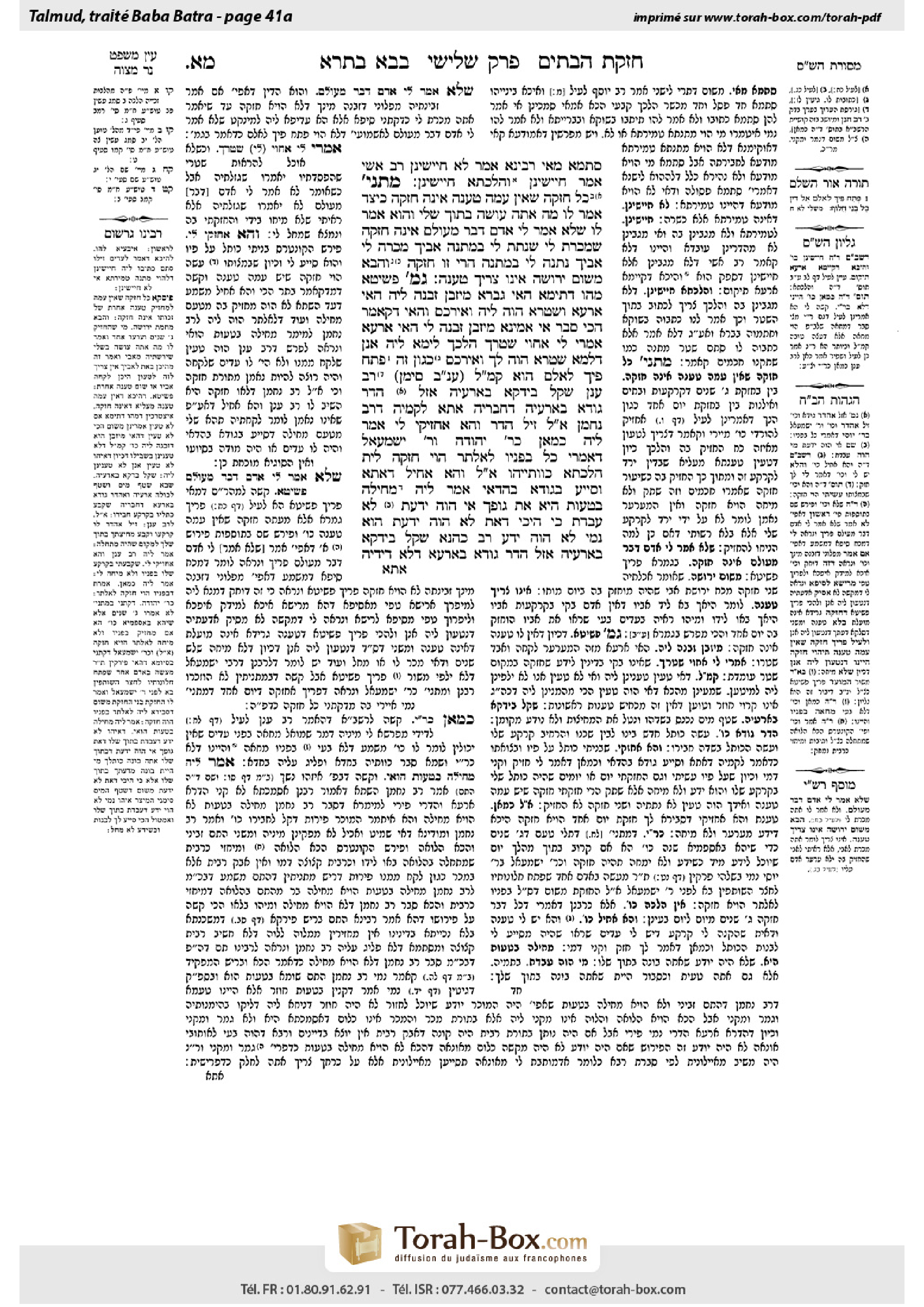
Scan : Torah-Box. Daf Study est un projet indépendant, sans affiliation ni approbation de Torah-Box ou de Sefaria.