Baba Batra 93b en français · בבא בתרא צ״ג ב
Traduction française du daf 93b du traité Baba Batra (Bava Batra 93b en anglais), avec le texte araméen, l’anglais de Sefaria et le scan de la page, pour étudier le Daf Yomi.
Ouvrir dans le lecteur interactifLire le daf du jour
Traduction française de Baba Batra 93b
Les traductions françaises de Daf Study sont générées par IA à partir de l’édition anglaise de Sefaria. Elles peuvent contenir des erreurs : vérifie toujours un passage avec le texte source.
Le vendeur restitue à l’acheteur la valeur des graines. Puisque la plupart des graines de lin vendues le sont pour être semées, la vente est entachée d’une erreur. On lui dit, c’est-à-dire à Rabbi Yossei : Beaucoup de gens, autrement dit la majorité des acheteurs, achètent des graines de lin à d’autres fins que les semailles. Par conséquent, la vente est valable.
La Guemara demande : Quels sont les tannaïm de cette baraïta dont le désaccord est parallèle à celui de Rav et Chmouel ? Si l’on dit qu’il s’agit de Rabbi Yossei et de l’opinion citée par les mots « On lui dit », ce n’est pas exact, car tous deux estiment que, dans les affaires monétaires, on suit la majorité. Leur désaccord porte seulement sur la majorité à retenir : un Sage, c’est-à-dire l’opinion citée par les mots « On lui dit », suit la majorité des acheteurs, tandis que l’autre Sage, c’est-à-dire Rabbi Yossei, suit la majorité du volume total des graines vendues. Cette différence s’explique par le fait que la majorité des ventes porte chacune sur une quantité relativement faible de graines achetées à d’autres fins que les semailles. La minorité des ventes concerne de grandes quantités de graines achetées pour être semées. Cela signifie que, sur l’ensemble des graines vendues, la majorité est achetée pour les semailles, mais que la majorité des acheteurs achète des graines à d’autres fins.
Mais le désaccord parallèle à celui de Rav et Chmouel est soit celui qui oppose le premier tanna à Rabbi Yossei, soit celui qui oppose le premier tanna à l’opinion citée par les mots « On lui dit ».
§ Les Sages ont enseigné dans une baraïta : Lorsque le vendeur assume la responsabilité des graines vendues qui n’ont pas germé, que doit-il verser à l’acheteur ? Il doit lui verser uniquement la valeur des graines elles-mêmes, et non les frais engagés par l’acheteur pour les semer, par exemple le salaire des ouvriers. Certains disent : Il doit même lui rembourser les frais engagés par l’acheteur.
La Guemara demande : Qui est le tanna dont l’opinion est citée par les mots « Certains disent » ? Rav Ḥisda dit qu’il s’agit de Rabban Chimon ben Gamliel.
La Guemara précise : De quelle déclaration de Rabban Chimon ben Gamliel ressort-il qu’il estime que le vendeur est responsable des frais engagés par l’acheteur ? On pourrait dire qu’il s’agit de la déclaration de Rabban Chimon ben Gamliel dans la Michna, car nous avons appris dans la Michna : Celui qui vend à quelqu’un des produits qui sont parfois achetés pour être consommés et parfois pour être semés, et que l’acheteur a semés sans qu’ils germent — même s’il lui avait vendu des graines de lin, qui ne sont que rarement consommées —, le vendeur n’en assume pas la responsabilité financière. La Guemara en déduit que, par implication, si ce tanna estime qu’il lui avait vendu des graines de plantes potagères, qui ne sont jamais consommées, alors le vendeur assume la responsabilité financière et doit indemniser l’acheteur pour ces graines.
La Guemara poursuit : Mais alors, comment comprendre la dernière clause ? Rabban Chimon ben Gamliel dit que, s’il lui avait vendu des graines de plantes potagères, qui ne sont jamais consommées, le vendeur en assume la responsabilité financière. La Guemara demande : Mais, d’après la déduction tirée de la première clause, le premier tanna dit lui aussi la même chose, puisqu’il estime que le vendeur n’assume pas la responsabilité financière envers l’acheteur uniquement lorsqu’il a vendu des graines de lin ; en revanche, pour la vente de graines de plantes potagères, qui ne sont jamais consommées, le vendeur en assume la responsabilité financière. Quel est donc le désaccord entre le premier tanna et Rabban Chimon ben Gamliel ?
La Guemara propose donc : Le désaccord entre eux ne porte-t-il pas sur la question de savoir si le vendeur est responsable des frais engagés par l’acheteur ? Un Sage, c’est-à-dire le premier tanna, estime que le vendeur n’est responsable que de la valeur des graines, tandis que l’autre Sage, c’est-à-dire Rabban Chimon ben Gamliel, estime que le vendeur est responsable même des frais engagés par l’acheteur.
La Guemara demande : D’où ressort-il que c’est Rabban Chimon ben Gamliel qui estime que le vendeur est responsable des frais ? Peut-être est-ce l’inverse : le premier tanna estime que le vendeur est responsable des frais, et Rabban Chimon ben Gamliel estime qu’il n’est responsable que de la valeur des graines. La Guemara rejette cette proposition : cela ne pose pas de difficulté, car le dernier tanna cité vient toujours ajouter quelque chose à la décision du premier tanna, et non en retrancher.
La Guemara propose : Mais peut-être toute la Michna exprime-t-elle l’opinion de Rabban Chimon ben Gamliel et est-elle incomplète ; voici ce qu’elle enseigne : Celui qui vend à quelqu’un des produits qui sont parfois achetés pour être consommés et parfois pour être semés, et que l’acheteur a semés sans qu’ils germent — même s’il lui avait vendu des graines de lin, qui ne sont que rarement consommées —, le vendeur n’en assume pas la responsabilité financière. Mais s’il lui a vendu des graines de plantes potagères, qui ne sont jamais consommées, le vendeur en assume la responsabilité financière. Telle est la déclaration de Rabban Chimon ben Gamliel : il dit que le vendeur n’assume pas la responsabilité financière envers l’acheteur uniquement dans le cas de la vente de graines de lin ; par implication, en revanche, dans le cas de la vente de graines de plantes potagères, qui ne sont jamais consommées, le vendeur en assume la responsabilité financière. Interprétée ainsi, la Michna ne prouve pas que Rabban Chimon ben Gamliel estime que le vendeur est responsable des frais engagés par l’acheteur.
Mais il s’agit plutôt de cette déclaration de Rabban Chimon ben Gamliel, comme il est enseigné dans une baraïta (Tosefta, Bava Kamma 10:9) : Dans le cas d’un homme qui a apporté du blé à un meunier pour le moudre, mais que le meunier n’a pas suffisamment humidifié les grains pour que la mouture soit efficace, si bien qu’il les a transformés en son ou en son grossier [mursan] ; dans le cas d’un homme qui a donné de la farine à un boulanger, lequel en a fait un pain insuffisamment cuit et qui s’émiette ; ou dans le cas d’un homme qui a confié un animal à un boucher, lequel l’a tué d’une manière qui en a fait une carcasse non abattue rituellement, dans tous ces cas, l’artisan est responsable, car il est assimilé à un gardien rémunéré.
La baraïta poursuit : Rabban Chimon ben Gamliel dit : Si le propriétaire avait invité des convives à manger et que, du fait des actes de l’artisan, il n’a pas pu les servir, l’artisan doit l’indemniser pour l’humiliation qu’il a subie, ainsi que pour celle de ses convives. De même, Rabban Chimon ben Gamliel disait : Il y avait à Jérusalem une grande coutume selon laquelle, si quelqu’un remettait à un autre les ingrédients d’un repas afin que celui-ci le lui prépare et que cette personne gâchait le repas, elle devait indemniser le premier pour l’humiliation qu’il avait subie, ainsi que pour celle de ses convives.
La baraïta poursuit : Une autre grande coutume observée à Jérusalem était que, lorsqu’on organisait un festin, on tendait une étoffe [mappa] à l’entrée de la salle. Tant que l’étoffe restait tendue, les convives entraient, car sa présence indiquait qu’il y avait de la nourriture pour d’autres convives. Lorsque l’étoffe était retirée, les convives n’entraient plus.
MICHNA : Lorsqu’on vend une quantité importante de produits ou plusieurs articles, il est possible qu’ils contiennent une certaine proportion d’impuretés ou qu’une partie soit de qualité inférieure. La Michna précise quelle proportion est considérée comme acceptable et ne permet pas à l’acheteur d’exiger une indemnisation. Celui qui vend à quelqu’un des produits, c’est-à-dire des céréales, fait accepter à l’acheteur la présence d’au plus un quart de kav d’impuretés par séa de produits achetés. Lorsqu’il achète des figues, l’acheteur accepte la présence d’au plus dix figues infestées par cent figues achetées. Lorsqu’il achète une cave contenant des tonneaux de vin, il accepte la présence d’au plus dix tonneaux de vin en train de tourner par cent tonneaux achetés. Lorsqu’il achète des cruches de vin dans la région du Sharon, il accepte la présence d’au plus dix cruches de vin de qualité inférieure [pitasot] par cent cruches achetées.
GUEMARA : Rav Ketina enseignait : Lorsque la Michna indique que l’acheteur accepte la présence d’un quart de kav d’impuretés par séa, cela signifie qu’il accepte uniquement la présence d’un quart de kav de légumineuses, mais non celle d’un quart de kav de terre. La Guemara demande : L’acheteur n’accepte-t-il donc pas aussi la présence d’une certaine quantité de terre dans les produits ? Mais Rabba bar Ḥiyya Ketosfa’a ne dit-il pas au nom de Rabba : Celui qui ramasse un caillou sur l’aire de battage d’autrui
Texte source et traduction anglaise
בבא בתרא צ״ג ב · texte araméen et hébreu
נוֹתֵן לוֹ דְּמֵי זֶרַע. אָמְרוּ לוֹ: הַרְבֵּה לוֹקְחִין אוֹתוֹ לִדְבָרִים אֲחֵרִים.
מַאן תַּנָּאֵי? אִילֵּימָא רַבִּי יוֹסֵי וְ״אָמְרוּ לוֹ״; תַּרְוַיְיהוּ בָּתַר רוּבָּא אָזְלִי – מָר אָזֵיל בָּתַר רוּבָּא דְאִינָשֵׁי, וּמָר אָזֵיל בָּתַר רוּבָּא דִזְרִיעָה!
אֶלָּא אִי תַּנָּא קַמָּא וְרַבִּי יוֹסֵי, אִי תַּנָּא קַמָּא וְ״אָמְרוּ לוֹ״.
תָּנוּ רַבָּנַן: מַהוּ נוֹתֵן לוֹ? דְּמֵי זֶרַע, וְלֹא הוֹצָאָה. וְיֵשׁ אוֹמְרִים: אַף הוֹצָאָה.
מַאן יֵשׁ אוֹמְרִים? אָמַר רַב חִסְדָּא: רַבָּן שִׁמְעוֹן בֶּן גַּמְלִיאֵל הִיא.
הֵי רַבָּן שִׁמְעוֹן בֶּן גַּמְלִיאֵל? אִילֵּימָא רַבָּן שִׁמְעוֹן בֶּן גַּמְלִיאֵל דְּמַתְנִיתִין – דִּתְנַן: הַמּוֹכֵר פֵּירוֹת לַחֲבֵירוֹ וּזְרָעָן וְלֹא צִמֵּחוּ, וַאֲפִילּוּ זֶרַע פִּשְׁתָּן – אֵינוֹ חַיָּיב בְּאַחְרָיוּתָן. הָא זֵרְעוֹנֵי גִינָּה שֶׁאֵינָן נֶאֱכָלִין – חַיָּיב בְּאַחְרָיוּתָן.
אֵימָא סֵיפָא, רַבָּן שִׁמְעוֹן בֶּן גַּמְלִיאֵל אוֹמֵר: זֵרְעוֹנֵי גִינָּה שֶׁאֵינָן נֶאֱכָלִין – חַיָּיב בְּאַחְרָיוּתָן. תַּנָּא קַמָּא נָמֵי הָכִי קָאָמַר – זֶרַע פִּשְׁתָּן הוּא דְּאֵינוֹ חַיָּיב בְּאַחְרָיוּתָן, הָא זֵרְעוֹנֵי גִינָּה שֶׁאֵינָן נֶאֱכָלִין – חַיָּיב בְּאַחְרָיוּתָן!
אֶלָּא לָאו הוֹצָאָה אִיכָּא בֵּינַיְיהוּ – מָר סָבַר דְּמֵי זֶרַע, וּמָר סָבַר אַף הוֹצָאָה?
מִמַּאי? דִּלְמָא אִיפְּכָא! הָא לָא קַשְׁיָא; כׇּל תַּנָּא בָּתְרָא, לְטַפּוֹיֵי מִילְּתָא קָא אָתֵי.
וְדִלְמָא כּוּלָּהּ רַבָּן שִׁמְעוֹן בֶּן גַּמְלִיאֵל הִיא – וְחַסּוֹרֵי מְחַסְּרָא, וְהָכִי קָתָנֵי: הַמּוֹכֵר פֵּירוֹת לַחֲבֵירוֹ וּזְרָעָן וְלֹא צִמֵּחוּ, אֲפִילּוּ זֶרַע פִּשְׁתָּן – אֵינוֹ חַיָּיב בְּאַחְרָיוּתָן, הָא זֵרְעוֹנֵי גִינָּה שֶׁאֵינָן נֶאֱכָלִין – חַיָּיב בְּאַחְרָיוּתָן; דִּבְרֵי רַבָּן שִׁמְעוֹן בֶּן גַּמְלִיאֵל; שֶׁרַבָּן שִׁמְעוֹן בֶּן גַּמְלִיאֵל אוֹמֵר: זֶרַע פִּשְׁתָּן הוּא דְּאֵינוֹ חַיָּיב בְּאַחְרָיוּתָן, הָא זֵרְעוֹנֵי גִינָּה שֶׁאֵינָן נֶאֱכָלִין – חַיָּיב בְּאַחְרָיוּתָן.
אֶלָּא הָא רַבָּן שִׁמְעוֹן בֶּן גַּמְלִיאֵל – דְּתַנְיָא: הַמּוֹלִיךְ חִטִּין לַטָּחוֹן, וְלֹא לְתָתָן – וַעֲשָׂאָן סוּבִּין אוֹ מוּרְסָן; קֶמַח לַנַּחְתּוֹם, וַאֲפָאוֹ פַּת נִיפּוּלִין; בְּהֵמָה לַטַּבָּח, וְנִיבְּלָהּ – חַיָּיב, מִפְּנֵי שֶׁהוּא כְּנוֹשֵׂא שָׂכָר.
רַבָּן שִׁמְעוֹן בֶּן גַּמְלִיאֵל אוֹמֵר: נוֹתֵן לוֹ דְּמֵי בוֹשְׁתּוֹ, וּדְמֵי בּוֹשֶׁת אוֹרְחָיו. וְכֵן הָיָה רַבָּן שִׁמְעוֹן בֶּן גַּמְלִיאֵל אוֹמֵר: מִנְהָג גָּדוֹל הָיָה בִּירוּשָׁלָיִם – הַמּוֹסֵר סְעוּדָה לַחֲבֵרוֹ, וְקִלְקְלָהּ; נוֹתֵן לוֹ דְּמֵי בׇשְׁתּוֹ וּדְמֵי בּוֹשֶׁת אוֹרְחָיו.
עוֹד מִנְהָג גָּדוֹל הָיָה בִּירוּשָׁלָיִם – מַפָּה פְּרוּסָה עַל גַּבֵּי הַפֶּתַח; כׇּל זְמַן שֶׁמַּפָּה פְּרוּסָה – אוֹרְחִין נִכְנָסִין. נִסְתַּלְּקָה הַמַּפָּה – אֵין הָאוֹרְחִין נִכְנָסִין.
מַתְנִי׳ הַמּוֹכֵר פֵּירוֹת לַחֲבֵירוֹ, הֲרֵי זֶה מְקַבֵּל עָלָיו רוֹבַע טִנּוֹפֶת לִסְאָה. תְּאֵנִים – מְקַבֵּל עָלָיו עֶשֶׂר מְתוּלָּעוֹת לְמֵאָה. מַרְתֵּף שֶׁל יַיִן – מְקַבֵּל עָלָיו עֶשֶׂר קוֹסְסוֹת לְמֵאָה. קַנְקַנִּים בַּשָּׁרוֹן – מְקַבֵּל עָלָיו עֶשֶׂר פִּיטָסוֹת לְמֵאָה.
גְּמָ׳ תָּאנֵי רַב קַטִּינָא: רוֹבַע קִטְנִית לִסְאָה. וְעַפְרוּרִית לָא?! וְהָאָמַר רַבָּה בַּר חִיָּיא קְטוֹסְפָאָה מִשְּׁמֵיהּ דְּרַבָּה: בּוֹרֵר צְרוֹר מִגׇּרְנוֹ שֶׁל חֲבֵרוֹ –
Bava Batra 93b · traduction anglaise de Sefaria
The seller gives back to the buyer the value of the seeds. Since the majority of flaxseeds are sold are for planting, it is a mistaken transaction. They said to him, i.e., to Rabbi Yosei: Many, i.e., a majority of people, purchase flaxseeds for purposes other than planting. Consequently, the sale stands.
The Gemara asks: Who are the tanna’im in this baraita who have a dispute that parallels the dispute between Rav and Shmuel? If we say that they are Rabbi Yosei and the opinion cited as: They said to him, that is incorrect, as both of them hold that one follows the majority in monetary matters. Their dispute concerns only which majority to follow: One Sage, i.e., the opinion cited as: They said to him, follows the majority of people making purchases, and one Sage, i.e., Rabbi Yosei, follows the majority of the volume of seeds that are sold overall. The disparity arises because the majority of sales are each made with a relatively small quantity of seeds that are purchased for purposes other than planting. The minority of sales involve large quantities of seeds that are purchased for planting. This means that the majority of the seeds sold overall are purchased for planting, but the majority of people purchasing seeds do so for purposes other than planting.
Rather, the dispute that parallels the dispute between Rav and Shmuel is either the dispute between the first tanna and Rabbi Yosei, or the dispute between the first tanna and the opinion cited as: They said to him.
§ The Sages taught in a baraita: When the seller bears financial responsibility for selling seeds that did not sprout, what is he liable to give to the buyer? He is liable to give him only the value of the seeds themselves, but not the expenses that the buyer incurred in planting them, e.g., the hire of laborers. And some say: He is liable to give him even the expenses that the buyer incurred.
The Gemara asks: Who is the tanna whose opinion is cited as: Some say? Rav Ḥisda said that it is Rabban Shimon ben Gamliel.
The Gemara clarifies: From which statement of Rabban Shimon ben Gamliel is it apparent that he holds the seller is liable for the buyer’s expenses? One possibility is if we say that the statement in question is that of Rabban Shimon ben Gamliel in the mishna, as we learned in the mishna: One who sells to another produce that is sometimes purchased for consumption and sometimes for planting, and the buyer planted it and it did not sprout, and even if he had sold flaxseeds, which are only occasionally eaten, the seller does not bear financial responsibility for them. The Gemara extrapolates: By inference, if this tanna holds that he had sold seeds for garden plants, which are not eaten at all, then the seller bears financial responsibility to compensate the buyer for them.
The Gemara continues: But accordingly, say the latter clause: Rabban Shimon ben Gamliel says: If he had sold seeds for garden plants, which are not eaten at all, then the seller bears financial responsibility for them. The Gemara asks: But according to the inference made from the first clause, the first tanna is also saying this, as he holds that it is only for the sale of flaxseeds that the seller does not bear financial responsibility to compensate the buyer for them, but with regard to the sale of seeds for garden plants, which are not eaten at all, the seller bears financial responsibility for them. What, then, is the dispute between the first tanna and Rabban Shimon ben Gamliel?
The Gemara therefore suggests: Rather, is it not that the difference between them is whether the seller is liable for the buyer’s expenses? One Sage, i.e., the first tanna, holds that the seller is liable only for the value of the seeds, and the other Sage, i.e., Rabban Shimon ben Gamliel, holds that the seller is liable even for the buyer’s expenses.
The Gemara asks: From where is it apparent that it is Rabban Shimon ben Gamliel who holds that the seller is liable for the expenses? Perhaps it is the opposite, i.e., it is the first tanna who holds that the seller is liable for the expenses, and Rabban Shimon ben Gamliel holds that he is liable only for the value of the seeds. The Gemara rejects this suggestion: This is not difficult, because the last tanna cited always comes to add something to the ruling of the first tanna, not to detract from it.
The Gemara suggests: But perhaps all of the mishna is stating the opinion of Rabban Shimon ben Gamliel, and the mishna is incomplete, and this is what it is teaching: With regard to one who sells produce to another that is sometimes purchased for eating and sometimes for planting, and the buyer planted it and it did not sprout, and even if he had sold flaxseeds, which are only occasionally eaten, the seller does not bear financial responsibility for them. But if he sold seeds for garden plants, which are not eaten at all, the seller bears financial responsibility for them. This is the statement of Rabban Shimon ben Gamliel, as Rabban Shimon ben Gamliel says that it is only for the sale of flaxseeds that the seller does not bear financial responsibility to compensate the buyer for them, but by inference, for the sale of seeds for garden plants, which are not eaten at all, the seller bears financial responsibility for them. Interpreted in this way, there is no evidence from the mishna that Rabban Shimon ben Gamliel holds that the seller is liable for the expenses.
Rather, the statement in question is this statement of Rabban Shimon ben Gamliel, as it is taught in a baraita (Tosefta, Bava Kamma 10:9) In a case of one who brought wheat to a miller to grind, and the miller did not wet the grains sufficiently for the grinding to be performed effectively, and as a result he converted the grain into bran or coarse bran [mursan], or in a case of one who gave flour to the baker and the baker made it into bread that is underbaked and tends to crumble, or if one gave an animal to a butcher and the butcher killed it in a way that rendered it an unslaughtered animal carcass, in all these cases the worker is liable, because he is like a paid bailee.
The baraita continues: Rabban Shimon ben Gamliel says: If the owner had invited guests to eat the food and due to the worker’s actions he was unable to serve them, then the worker must give him compensation for his humiliation and compensation for the humiliation of his guests. And similarly, Rabban Shimon ben Gamliel would say: There was a great custom in Jerusalem that if one gives raw materials for a meal to another to prepare the meal for him, and that person spoils it, that person gives the former compensation for his humiliation and compensation for the humiliation of his guests.
The baraita continues: Another great custom that was followed in Jerusalem was that when one made a feast, there would be a cloth [mappa] spread over the entrance to the hall. As long as the cloth was spread, the guests would enter, as the presence of the cloth indicated that there was food for more guests. When the cloth was removed, the guests would not enter any more.
MISHNA: When selling a significant quantity of produce or a number of items, there is a possibility that there will be a certain proportion of impurities in it or that some of the product will be of substandard quality. The mishna delineates what proportion is considered acceptable, for which a buyer may not demand compensation. With regard to one who sells produce, i.e., grain, to another, this buyer accepts upon himself that up to a quarter-kav of impurities may be present in each se’a of produce purchased. When purchasing figs, he accepts upon himself that up to ten infested figs may be present in each hundred figs purchased. When purchasing a cellar containing barrels of wine, he accepts upon himself that up to ten barrels of souring wine may be present in each hundred barrels purchased. When purchasing jugs of wine in the Sharon region, he accepts upon himself that up to ten inferior-quality jugs [pitasot] of wine may be present in each hundred jugs purchased.
GEMARA: Rav Ketina taught: When the mishna states that a buyer accepts upon himself that a quarter-kav of impurities per se’a may be present, that means only that he accepts upon himself the presence of a quarter-kav of legumes, but he does not accept upon himself the presence of a quarter-kav of dirt. The Gemara asks: And is it so that the buyer does not also accept upon himself that some quantity of dirt might be present in the produce? But doesn’t Rabba bar Ḥiyya Ketosfa’a say in the name of Rabba: One who picks out a pebble from the wheat on another’s threshing floor
Texte de Sefaria : William Davidson Edition - Vocalized Aramaic (CC BY NC) ; William Davidson Edition - English (CC BY NC).
Scan de Baba Batra 93b
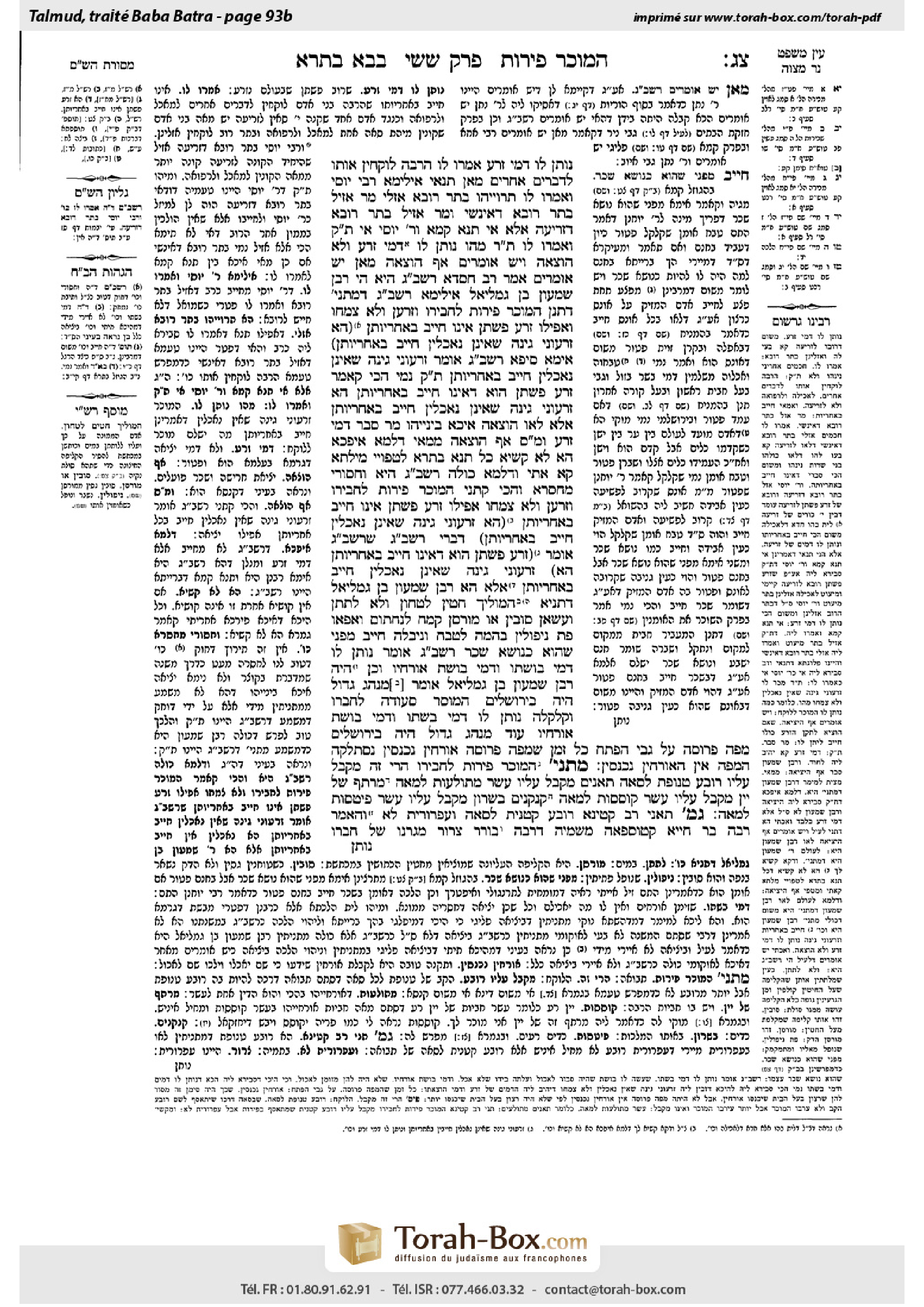
Scan : Torah-Box. Daf Study est un projet indépendant, sans affiliation ni approbation de Torah-Box ou de Sefaria.