Baba Batra 95a en français · בבא בתרא צ״ה א
Traduction française du daf 95a du traité Baba Batra (Bava Batra 95a en anglais), avec le texte araméen, l’anglais de Sefaria et le scan de la page, pour étudier le Daf Yomi.
Ouvrir dans le lecteur interactifLire le daf du jour
Traduction française de Baba Batra 95a
Les traductions françaises de Daf Study sont générées par IA à partir de l’édition anglaise de Sefaria. Elles peuvent contenir des erreurs : vérifie toujours un passage avec le texte source.
Dans ce cas, celui de la vente d’un terrain, si l’acheteur peut conserver le surplus lorsqu’il reste en deçà de la limite admise, c’est parce que le vendeur lui a dit : « Je te vends cette parcelle, qu’elle fasse un peu moins ou un peu plus d’un beit kor » ; autrement dit, il accepte une légère différence par rapport à la superficie annoncée. Mais une superficie correspondant à un quart de kav par beit se’a n’est pas significative, et le vendeur est donc prêt à y renoncer ; en revanche, une superficie supérieure à un quart de kav par beit se’a est significative, et le vendeur n’est prêt à en abandonner aucune partie. Par conséquent, tout le terrain excédentaire doit être restitué. En revanche, dans le cas de la décision de Rav Houna, l’acheteur sait qu’il est normal qu’une certaine proportion d’impuretés soit mélangée à la marchandise et accepte cette éventualité d’emblée. Par conséquent, même si la proportion d’impuretés dépasse la limite admise, il pourrait suffire que le vendeur reprenne seulement la quantité d’impuretés qui dépasse cette limite.
La Guemara explique pourquoi une superficie correspondant à plus d’un quart de kav par beit se’a est significative : c’est parce que toutes ces superficies excédentaires peuvent être réunies pour former un terrain où l’on pourrait ensemencer neuf kav. Le terrain excédentaire constitue ainsi à lui seul une parcelle significative et doit donc être restitué en totalité. Le terrain vendu avait été déclaré faire un beit kor, soit trente beit se’a. Si la superficie excédentaire dépassait quelque peu un quart de kav par beit se’a, alors trente superficies de ce type réunies équivaudraient à peu près à un terrain où l’on pourrait ensemencer neuf kav.
La Guemara propose : « Viens et entends » une preuve à l’appui de la décision de Rav Houna, tirée d’une baraïta : la halakha de la fraude sur le prix est la suivante : si l’écart est inférieur à un sixième de la valeur de la marchandise, l’acquisition est immédiatement valable et la somme correspondant à la fraude n’a pas à être restituée. Si l’écart est supérieur à un sixième, la transaction est annulée. Si l’écart est exactement d’un sixième, l’acheteur acquiert la marchandise, et celui qui a profité de la fraude restitue la totalité de la somme correspondant à celle-ci.
La Guemara explique la preuve : pourquoi, dans le cas où l’écart est exactement d’un sixième, restitue-t-on la totalité de la somme correspondant à la fraude ? Qu’il n’en restitue qu’une petite partie, jusqu’à ce que l’écart devienne inférieur à un sixième. La Guemara conclut : déduis de là que, lorsqu’on doit restituer une partie d’une vente en raison d’un écart dépassant la limite de variation admise, on doit restituer la totalité de l’écart, et non seulement la part qui dépasse cette limite. Cela vient à l’appui de la décision de Rav Houna.
La Guemara rejette cette preuve : comment comparer ces cas ? Dans le cas de la fraude, le vendeur avait d’abord dit à l’acheteur qu’il lui vendrait la marchandise à un prix égal à sa valeur. Tout écart de prix devrait donc être inacceptable. Cependant, un écart inférieur à un sixième n’est pas perceptible dans une vente d’une valeur de cent dinars, et l’on est prêt à y renoncer. En revanche, un écart d’un sixième est considéré comme significatif, et l’on n’est pas prêt à y renoncer. Par conséquent, la totalité de la somme correspondant à la fraude doit être restituée. Si l’écart dépasse un sixième, la transaction est conclue par erreur et elle est annulée. En revanche, dans le cas de la décision de Rav Houna, l’acheteur sait qu’il est normal qu’une certaine proportion d’impuretés soit mélangée à la marchandise et accepte cette éventualité d’emblée. Par conséquent, même si la proportion d’impuretés dépasse la limite admise, il pourrait suffire que le vendeur reprenne seulement la quantité d’impuretés qui dépasse cette limite.
La Guemara propose : « Viens et entends » une preuve à l’appui de la décision de Rav Houna, tirée d’une baraïta : lorsqu’une personne prend un champ à bail auprès d’une autre, avec l’obligation d’y planter des arbres, le propriétaire du champ accepte qu’il y ait jusqu’à dix arbres dépérissants pour chaque centaine d’arbres plantés, car il sait que tous les arbres plantés ne prendront pas nécessairement. Si le nombre d’arbres dépérissants dépasse cette proportion, le tribunal lui impose de remplacer tous ces arbres, et non seulement ceux qui dépassent la limite admise. Cela vient à l’appui de la décision de Rav Houna.
Rav Houna, fils de Rav Yehoshoua, dit : il n’y a pas de preuve tirée de ce cas, car, dès que le nombre d’arbres dépérissants dépasse cette proportion, la superficie où ils se trouvent équivaut à celle d’un champ entier. L’entrepreneur est donc comparable à quelqu’un qui vient planter un champ entier dès le départ et qui n’a pas rempli son obligation s’il n’y plante que quelques arbres ; il doit plutôt planter toute la superficie. Mais dans le cas de la décision de Rav Houna, les impuretés ne constituent jamais une unité indépendante ; par conséquent, il pourrait suffire que le vendeur reprenne seulement la quantité d’impuretés qui dépasse la limite admise.
§ La Michna enseigne : lorsqu’on achète une cave contenant des barils de vin, on accepte qu’il puisse y avoir jusqu’à dix barils de vin en train de tourner pour chaque centaine de barils achetés. La Guemara demande : dans quelles circonstances la vente a-t-elle lieu ? S’il a dit à l’acheteur : « Je te vends une cave à vin », sans préciser de quelle cave il s’agit, cela pose une difficulté, comme la Guemara l’expliquera bientôt. Et s’il lui a dit : « Je te vends cette cave à vin-ci », cela pose également une difficulté.
La Guemara précise : s’il lui a dit : « Je te vends cette cave à vin-ci », cela pose une difficulté, car il est enseigné dans une baraïta : si quelqu’un dit à un acheteur : « Je te vends une cave à vin », il est tenu de lui fournir du vin entièrement de bonne qualité ; autrement dit, l’acheteur n’a pas à accepter la moindre quantité de vin en train de tourner. S’il lui a dit : « Je te vends cette cave à vin-ci », il peut lui fournir le vin qu’il a en sa possession, même s’il est de la qualité vendue dans les magasins, c’est-à-dire qu’il commence à tourner. S’il lui a dit : « Je te vends cette cave-ci », sans mentionner le mot « vin », alors même si tout ce qu’il lui fournit est du vin devenu vinaigre, la vente est valable. La décision de la Michna, selon laquelle l’acheteur doit accepter que jusqu’à dix pour cent du vin soit en train de tourner, ne concorde avec aucune des décisions de la baraïta.
La Guemara répond : en réalité, la Michna traite d’un cas où il lui a dit : « Je te vends une cave à vin », sans préciser de quelle cave il s’agissait. Et rectifie la baraïta en enseignant, dans sa première clause, la précision suivante : l’acheteur accepte qu’il puisse y avoir jusqu’à dix barils de vin en train de tourner pour chaque centaine de barils achetés.
La Guemara conteste cet ajout : mais s’il a vendu à l’acheteur une cave à vin sans préciser laquelle, l’acheteur accepte-t-il donc qu’il y ait du vin en train de tourner ? Rabbi Ḥiyya n’a-t-il pas enseigné : celui qui vend un baril de vin à autrui doit lui fournir du vin entièrement de bonne qualité ? La Guemara répond : le cas d’un baril est différent, car le vin qu’il contient forme un seul ensemble et est de qualité uniforme.
La Guemara conteste de nouveau cet ajout : Rav Zevid n’a-t-il pas enseigné une baraïta de l’école de Rabbi Oshaya : si quelqu’un dit à un acheteur : « Je te vends une cave à vin », il est tenu de lui fournir du vin entièrement de bonne qualité ? De même, s’il a dit : « Je te vends cette cave à vin-ci », il est tenu de lui fournir du vin entièrement de bonne qualité, mais l’acheteur accepte dix barils de vin en train de tourner pour chaque centaine de barils.
Texte source et traduction anglaise
בבא בתרא צ״ה א · texte araméen et hébreu
הָתָם, ״הֵן חָסֵר הֵן יָתֵיר״ אֲמַר לֵיהּ, מִיהוּ רְבִיעַ לָא חֲשִׁיב; יָתֵר מֵרְבִיעַ – חֲשִׁיב,
דְּכֵיוָן דַּחֲזֵי לֵיהּ לְאִיצְטְרוֹפֵי בְּתִשְׁעַת קַבִּין, הָוְיָא לַהּ אַרְעָא חֲשִׁיבְתָּא בְּאַפֵּי נַפְשָׁא; וְהָדְרָא.
תָּא שְׁמַע: הָאוֹנָאָה; פָּחוֹת מִשְּׁתוּת – נִקְנֶה מִקָּח, יוֹתֵר מִשְּׁתוּת – בָּטֵל מִקָּח. שְׁתוּת – קָנָה, וּמַחְזִיר אוֹנָאָה.
אַמַּאי? לַיהְדַּר עַד פָּחוֹת מִשְּׁתוּת! שְׁמַע מִינַּהּ, כׇּל הֵיכִי דְּבָעֵי לְאַהְדּוֹרֵי – כּוּלַּהּ מַהְדַּר!
הָכִי הַשְׁתָּא?! הָתָם, מֵעִיקָּרָא שָׁוֶה בְּשָׁוֶה אֲמַר לֵיהּ, מִיהוּ, פָּחוֹת מִשְּׁתוּת לָא יְדִיעָה בְּמָנֶה, וּמָחֵיל אִינִישׁ; שְׁתוּת – יְדִיעָה, וְלָא מָחֵיל אִינִישׁ, יָתֵר מִשְּׁתוּת – מִקָּח טָעוּת הוּא, וּבָטֵל מִקָּח.
תָּא שְׁמַע: הַמְקַבֵּל שָׂדֶה מֵחֲבֵרוֹ לִיטַּע – הֲרֵי זֶה מְקַבֵּל עָלָיו עֶשֶׂר בּוֹרִיּוֹת לְמֵאָה. יוֹתֵר מִכָּאן – מְגַלְגְּלִין עָלָיו אֶת הַכֹּל.
אָמַר רַב הוּנָא בְּרֵיהּ דְּרַב יְהוֹשֻׁעַ: כׇּל יָתֵר מִכָּאן, כְּבָא לִיטַּע מִתְּחִלָּה דָּמֵי.
מַרְתֵּף שֶׁל יַיִן וְכוּ׳. הֵיכִי דָּמֵי? אִי דְּאָמַר לֵיהּ: ״מַרְתֵּף שֶׁל יַיִן״ סְתָם – קַשְׁיָא; אִי דְּאָמַר לֵיהּ: ״מַרְתֵּף זֶה שֶׁל יַיִן״ – קַשְׁיָא.
אִי דְּאָמַר לֵיהּ: ״מַרְתֵּף זֶה״ – קַשְׁיָא, דְּתַנְיָא: ״מַרְתֵּף שֶׁל יַיִן אֲנִי מוֹכֵר לָךְ״ – נוֹתֵן לוֹ יַיִן שֶׁכּוּלּוֹ יָפֶה. ״מַרְתֵּף זֶה שֶׁל יַיִן אֲנִי מוֹכֵר לָךְ״ – נוֹתֵן לוֹ יַיִן הַנִּמְכָּר בַּחֲנוּת. ״מַרְתֵּף זֶה אֲנִי מוֹכֵר לָךְ״ – אֲפִילּוּ כּוּלּוֹ חוֹמֶץ, הִגִּיעוֹ!
לְעוֹלָם דְּאָמַר לֵיהּ ״מַרְתֵּף שֶׁל יַיִן״ – סְתָם, וְתָנֵי בְּרֵישָׁא דְבָרַיְיתָא: וּמְקַבֵּל עָלָיו עֶשֶׂר קוֹסְסוֹת לְמֵאָה.
וּבִסְתָם מִי מְקַבֵּל?! וְהָא תָּאנֵי רַבִּי חִיָּיא: הַמּוֹכֵר חָבִית יַיִן לַחֲבֵרוֹ – נוֹתֵן לוֹ יַיִן שֶׁכּוּלּוֹ יָפֶה! שָׁאנֵי חָבִית, דְּכוּלָּא חַד חַמְרָא הוּא.
וְהָא תָּנֵי רַב זְבִיד דְּבֵי רַבִּי אוֹשַׁעְיָא: ״מַרְתֵּף שֶׁל יַיִן אֲנִי מוֹכֵר לָךְ״ – נוֹתֵן לוֹ יַיִן שֶׁכּוּלּוֹ יָפֶה. ״מַרְתֵּף זֶה שֶׁל יַיִן אֲנִי מוֹכֵר לָךְ״ – נוֹתֵן לוֹ יַיִן שֶׁכּוּלּוֹ יָפֶה, וּמְקַבֵּל עָלָיו עֶשֶׂר קוֹסְסוֹת לְמֵאָה,
Bava Batra 95a · traduction anglaise de Sefaria
There, in the case of the sale of land, the reason the buyer may keep the extra land when it is less than the acceptable limit is that the seller said to him: I am selling you this piece of land whether it is slightly less or slightly more than a beit kor, i.e., he agrees to accept a small deviation from the stated area. But while an extra quarter-kav area per beit se’a is not significant, and therefore the seller is willing to forgo it, more than a quarter-kav area per beit se’a is significant, and the seller is not willing to forgo any of it. Consequently, all of the extra land must be returned. By contrast, in the case of Rav Huna’s ruling, the buyer is aware that it is normal to have a certain proportion of impurities mixed in and accepts this possibility from the outset. Accordingly, even if the proportion of impurities is greater than the acceptable limit, it might be sufficient if the seller takes back only the quantity of impurities above the acceptable limit.
The Gemara explains why more than an area required to sow a quarter-kav of seed per beit se’a of land is significant: The reason is that since all those extra areas of land are fit to combine together to form an area in which one could sow nine kav of seed, the extra land is a significant plot of land in its own right, and therefore it must all be returned. The land that was sold was stated to be a beit kor, which is thirty beit se’a. If the area of the extra land was of a proportion somewhat more than an area required to sow a quarter-kav of seed per beit se’a of land, then thirty such areas would collectively be about equal to an area required to sow nine kav.
The Gemara suggests: Come and hear a support for Rav Huna’s ruling from a baraita: The halakha of price exploitation is that if the disparity is less than one-sixth of the value of the merchandise, the merchandise is acquired immediately and the sum of the exploitation need not be returned. If the disparity is greater than one-sixth, then the transaction is nullified. If the disparity is precisely one-sixth, the buyer has acquired the merchandise, and the one who benefited from the exploitation returns the entire sum of the exploitation.
The Gemara explains the proof: Why, in the case where the disparity is precisely one-sixth, is the entire sum of the exploitation returned? Instead, let him return only a small amount of the exploitation until the difference is less than one-sixth. The Gemara concludes: Learn from the fact that he must return the entire sum that when one is required to return part of a sale because of a discrepancy that is beyond the acceptable limit of deviation, one is required to return the entire discrepancy and not just the amount that is beyond the acceptable limit. This supports Rav Huna’s ruling.
The Gemara rejects this: How can these cases be compared? There, in the case of exploitation, the seller initially said to the buyer that he would sell the merchandise for a sum equal to its value. Any price difference should be unacceptable. But a disparity of less than one-sixth is not recognizable in a sale worth one hundred dinars, and a person will forgo it. By contrast, a disparity of one-sixth is considered significant, and a person will not forgo it. Consequently, the entire sum of the exploitation must be returned. If the disparity is greater than one-sixth, it is a mistaken transaction and the transaction is nullified. By contrast, in the case of Rav Huna’s ruling, the buyer is aware that it is normal to have a certain proportion of impurities mixed in and accepted that possibility from the outset. Accordingly, even if the proportion of impurities was greater than the acceptable limit, it might be sufficient if the seller takes back only the quantity of impurities above the acceptable limit.
The Gemara suggests: Come and hear a support for Rav Huna’s ruling from a baraita: When one receives a field from another under a contract to plant trees in it, then this field owner accepts upon himself that there may be ten deficient trees per every hundred trees planted, as he is aware that not every tree planted will necessarily flourish. If the number of deficient trees is more than this, the court imposes upon him the responsibility to replace all of those trees, and not only the number of trees above the acceptable limit. This supports Rav Huna’s ruling.
Rav Huna, son of Rav Yehoshua, said: There is no proof from this case, because any time there are more than this number of deficient trees, the overall area that contains the deficient trees is of a size equivalent to a whole field. Therefore, the contractor is comparable to one who comes to plant a whole field from the outset, who has not fulfilled his remit if he plants only a few trees; rather, he must plant the entire area. But in the case of Rav Huna’s ruling, the impurities never constitute an independent unit; consequently, it might be sufficient if the seller takes back only the quantity of impurities that is above the acceptable limit.
§ The mishna teaches: When purchasing a cellar containing barrels of wine, one accepts upon himself that up to ten barrels of souring wine may be present in each hundred barrels purchased. The Gemara asks: What are the circumstances of the sale? If one said to the buyer: I am selling to you a wine cellar, without specification of which cellar he meant, it is difficult, as the Gemara will soon explain. And if he said to him: I am selling to you this particular wine cellar, it is difficult.
The Gemara elaborates: If he said to him: I am selling to you this particular wine cellar, it is difficult, as it is taught in a baraita: If one said to a buyer: I am selling to you a wine cellar, then he is required to give him wine that is all of good quality, i.e., the buyer does not have to accept any quantity of souring wine. If he said: I am selling to you this particular wine cellar, then he may give him the wine that is in his possession, even if it is of the quality that is sold in the shops, i.e., it is beginning to sour. If he said: I am selling to you this particular cellar, without mentioning the word: Wine, then even if everything he gives him is wine that had turned into vinegar, it has come to the buyer and the sale is valid. The mishna’s ruling that the buyer must accept that up to ten percent of the wine might be souring does not accord with any of the rulings of the baraita.
The Gemara answers: Actually, the mishna concerns a case when he said to the buyer: I am selling to you a wine cellar, without specification of which cellar he was selling. And emend the baraita and teach the following qualification in the first clause of the baraita: And the buyer accepts upon himself that up to ten barrels of souring wine may be present in each hundred barrels purchased.
The Gemara challenges this addition: But if he sold the buyer a wine cellar without specification of which one he was selling, does the buyer accept upon himself any souring wine at all? Didn’t Rabbi Ḥiyya teach: One who sells a barrel of wine to another must give him wine that is all of good quality? The Gemara answers: A barrel is different, because the wine inside is all one body of wine of the same quality.
The Gemara once again challenges the addition: But didn’t Rav Zevid teach a baraita of the school of Rabbi Oshaya: If one says to a buyer: I am selling to you a wine cellar, then he is required to give him wine that is all of good quality? Similarly, if he said: I am selling to you this particular wine cellar, then he is required to give him wine that is all of good quality, but the buyer accepts upon himself ten souring barrels per hundred barrels.
Texte de Sefaria : William Davidson Edition - Vocalized Aramaic (CC BY NC) ; William Davidson Edition - English (CC BY NC).
Scan de Baba Batra 95a
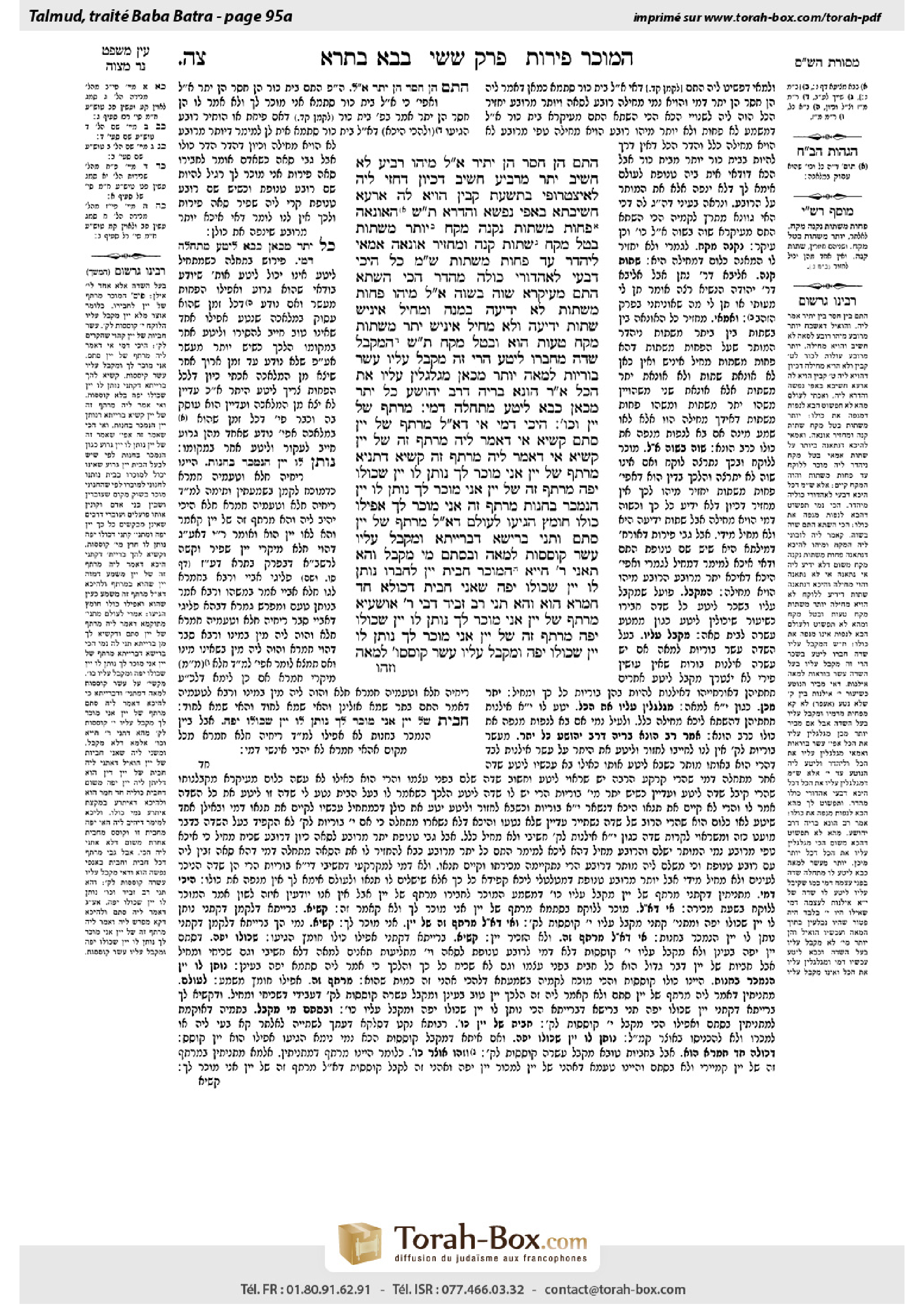
Scan : Torah-Box. Daf Study est un projet indépendant, sans affiliation ni approbation de Torah-Box ou de Sefaria.