Baba Batra 96b en français · בבא בתרא צ״ו ב
Traduction française du daf 96b du traité Baba Batra (Bava Batra 96b en anglais), avec le texte araméen, l’anglais de Sefaria et le scan de la page, pour étudier le Daf Yomi.
Ouvrir dans le lecteur interactifLire le daf du jour
Traduction française de Baba Batra 96b
Les traductions françaises de Daf Study sont générées par IA à partir de l’édition anglaise de Sefaria. Elles peuvent contenir des erreurs : vérifie toujours un passage avec le texte source.
Et Shmuel a dit : Même si le vin tourne peu après l’achat, le vendeur n’en est pas responsable, car le vin est agité lorsqu’il est transporté sur les épaules de son nouveau propriétaire, ce qui le fait tourner rapidement.
Rav Yosef statua dans un cas concret conformément à l’opinion de Rav, où de la bière s’était gâtée peu après avoir été vendue, et conformément à l’opinion de Shmuel dans un cas semblable concernant du vin. La halakha est conforme à l’opinion de Shmuel.
§ Les Sages ont enseigné dans une baraïta : Que l’on boive de la bière de dattes, de la bière d’orge ou une boisson préparée en faisant tremper dans l’eau le marc issu de la production du vin, appelée tamad, on récite à leur sujet la bénédiction : « Par la parole de qui tout est advenu. » Aḥerim disent : Sur du vin fait à partir de marc et qui a le goût du vin, on récite la bénédiction : « Qui crée le fruit de la vigne. » Rabba et Rav Yosef disent tous deux : La halakha n’est pas conforme à l’opinion d’Aḥerim.
Rava a dit : Selon les opinions de tous ceux qui sont mentionnés dans la baraïta, si l’on a versé trois cruches d’eau sur du marc de raisin et qu’ensuite, après avoir retiré le marc, le volume de la boisson obtenue est de quatre cruches, alors cette boisson est considérée comme du vin. Il est évident qu’un quart de la boisson obtenue provient du jus contenu dans le marc, qui est du vin pur, et cette proportion suffit pour que la boisson dans son ensemble soit considérée comme du vin. La Guemara reprend les propos de Rava : Par cette déclaration, Rava reste fidèle à sa ligne de raisonnement habituelle, car Rava a dit : Tout vin qui ne contient pas trois parts d’eau pour une part de vin pur n’est pas considéré comme du vin, car il est excessivement fort.
Rava poursuit : Si l’on a versé trois cruches d’eau sur du marc et que le volume de la boisson obtenue est encore de trois cruches, alors elle ne vaut rien, c’est-à-dire qu’elle n’est pas considérée comme du vin. Le désaccord entre les tannaïm de la baraïta porte sur le cas où l’on a versé trois cruches d’eau sur du marc et où le volume de la boisson obtenue est de trois cruches et demie. Les Sages, c’est-à-dire le premier tanna, considèrent que trois cruches d’eau ont été absorbées par le marc, puis que ces mêmes trois cruches d’eau se sont écoulées du marc ; il reste donc une demi-cruche de la boisson obtenue qui était à l’origine du vin pur contenu dans le marc. Mais une demi-cruche de vin pur mélangée à six demi-cruches d’eau ne vaut rien, c’est-à-dire que le mélange est trop dilué pour être considéré comme du vin.
Aḥerim considèrent que trois cruches d’eau ont été absorbées par le marc, mais que seules deux cruches et demie d’eau se sont écoulées du marc, car une cruche d’eau a remplacé la cruche de vin pur contenue dans le marc. Il reste donc une cruche de la boisson obtenue qui est du vin pur, précédemment contenu dans le marc. Une cruche de vin pur mélangée à deux cruches et demie d’eau est considérée comme du vin à part entière.
La Guemara demande : Et lorsque le volume de la boisson obtenue est supérieur à la quantité d’eau versée sur le marc, les Sages sont-ils jamais en désaccord ? Mais n’avons-nous pas appris dans une Michna (Ma’asrot 5:6) :
Texte source et traduction anglaise
בבא בתרא צ״ו ב · texte araméen et hébreu
וּשְׁמוּאֵל אָמַר: חַמְרָא – אַכַּתְפָּא דְּמָארֵיהּ שָׁוַואר.
עֲבַד רַב יוֹסֵף עוֹבָדָא כְּווֹתֵיהּ דְּרַב בְּשִׁיכְרָא, וּכְווֹתֵיהּ דִּשְׁמוּאֵל בְּחַמְרָא. וְהִלְכְתָא כְּווֹתֵיהּ דִּשְׁמוּאֵל.
תָּנוּ רַבָּנַן: אֶחָד שֵׁכַר תְּמָרִים, וְאֶחָד שֵׁכַר שְׂעוֹרִים, וְאֶחָד שִׁמְרֵי יַיִן – מְבָרְכִין עֲלֵיהֶם ״שֶׁהַכֹּל נִהְיֶה בִּדְבָרוֹ״. אֲחֵרִים אוֹמְרִים: שְׁמָרִים שֶׁיֵּשׁ בָּהֶם טַעַם יַיִן, מְבָרֵךְ עֲלֵיהֶן ״בּוֹרֵא פְּרִי הַגֶּפֶן״. רַבָּה וְרַב יוֹסֵף דְּאָמְרִי תַּרְוַיְיהוּ: אֵין הֲלָכָה כַּאֲחֵרִים.
אָמַר רָבָא: דְּכוּלֵּי עָלְמָא, רְמָא תְּלָתָא וַאֲתָא אַרְבְּעָה – חַמְרָא הוּא. רָבָא לְטַעְמֵיהּ, דְּאָמַר רָבָא: כֹּל חַמְרָא דְּלָא דָרֵי עַל חַד תְּלָת מַיָּא – לָאו חַמְרָא הוּא.
רְמָא תְּלָתָא וַאֲתָא תְּלָתָא, וְלָא כְּלוּם הוּא. כִּי פְּלִיגִי, דִּרְמָא תְּלָתָא וַאֲתָא תְּלָתָא וּפַלְגָא – דְּרַבָּנַן סָבְרִי: תְּלָתָא עָיֵיל תְּלָתָא נָפֵיק, פָּשׁ לֵיהּ פַּלְגָא – וּפַלְגָא בְּשִׁיתָּא פַּלְגֵי מַיָּא, וְלָא כְּלוּם הוּא;
וַאֲחֵרִים סָבְרִי: תְּלָתָא עוּל, תְּרֵין וּפַלְגָא נָפֵיק, פָּשׁ לֵיהּ כּוּזָא; וְכוּזָא בִּתְרֵי וּפַלְגָא חַמְרָא, מְעַלְּיָא הוּא.
וּבְיוֹתֵר מִכְּדֵי מִדָּתוֹ, מִי פְּלִיגִי?! וְהָא תְּנַן:
Bava Batra 96b · traduction anglaise de Sefaria
And Shmuel said: Even if the wine sours shortly after the purchase, the seller does not bear responsibility, as the wine is agitated as it is carried upon the shoulders of its new owner, causing it to sour quickly.
Rav Yosef ruled in an actual case in accordance with the opinion of Rav, in which beer spoiled shortly after it was sold, and in accordance with the opinion of Shmuel in a similar case involving wine. And the halakha is in accordance with the opinion of Shmuel.
§ The Sages taught in a baraita: Whether one drinks date beer, or barley beer, or a beverage made from soaking pomace from the production of wine in water, known as tamad, one recites over them the blessing: By Whose word all things came to be. Aḥerim say: Over wine made from pomace that has the taste of wine one recites the blessing: Who creates fruit of the vine. Rabba and Rav Yosef both say: The halakha is not in accordance with the opinion of Aḥerim.
Rava said: According to the opinions of everyone mentioned in the baraita, if one poured three jugs of water over grape pomace and then, after removing the pomace, the volume of the resulting beverage came to four jugs, then that beverage is regarded as wine. Evidently, a quarter of the resulting beverage is from juice that was contained in the pomace, which is pure wine, and that is a sufficient ratio for the beverage as a whole to be regarded as wine. The Gemara interjects Rava’s comments: With this statement, Rava conforms to his standard line of reasoning, as Rava said: Any wine that does not contain three parts water to one part pure wine is not regarded as wine, as it is excessively strong.
Rava continues: If one poured three jugs of water over pomace, and the volume of the resulting beverage still came to three jugs, then it is nothing, i.e., it is not regarded as wine. When the tanna’im in the baraita disagree is in a case where one poured three jugs of water over pomace and the volume of the resulting beverage came to three and a half jugs, as the Rabbis, i.e., the first tanna, hold that three jugs of water were absorbed into the pomace and then the same three jugs of water seeped out of the pomace; therefore, there remains half a jug of the resulting beverage that was originally pure wine contained in the pomace. But half a jug of pure wine mixed into six half-jugs of water is nothing, i.e., the mixture is too weak to be regarded as wine.
And Aḥerim hold that three jugs of water were absorbed into the pomace but only two and a half jugs of water seeped out of the pomace, as one jug of water replaced the one jug of pure wine contained in the pomace. Therefore, there remains one jug of the resulting beverage that is pure wine that was previously contained in the pomace. And one jug of pure wine mixed into two and a half jugs of water is regarded as full-fledged wine.
The Gemara asks: And where the volume of the resulting beverage is greater than the amount of water that was poured over the pomace, do the Sages ever disagree? But didn’t we learn in a mishna (Ma’asrot 5:6):
Texte de Sefaria : William Davidson Edition - Vocalized Aramaic (CC BY NC) ; William Davidson Edition - English (CC BY NC).
Scan de Baba Batra 96b
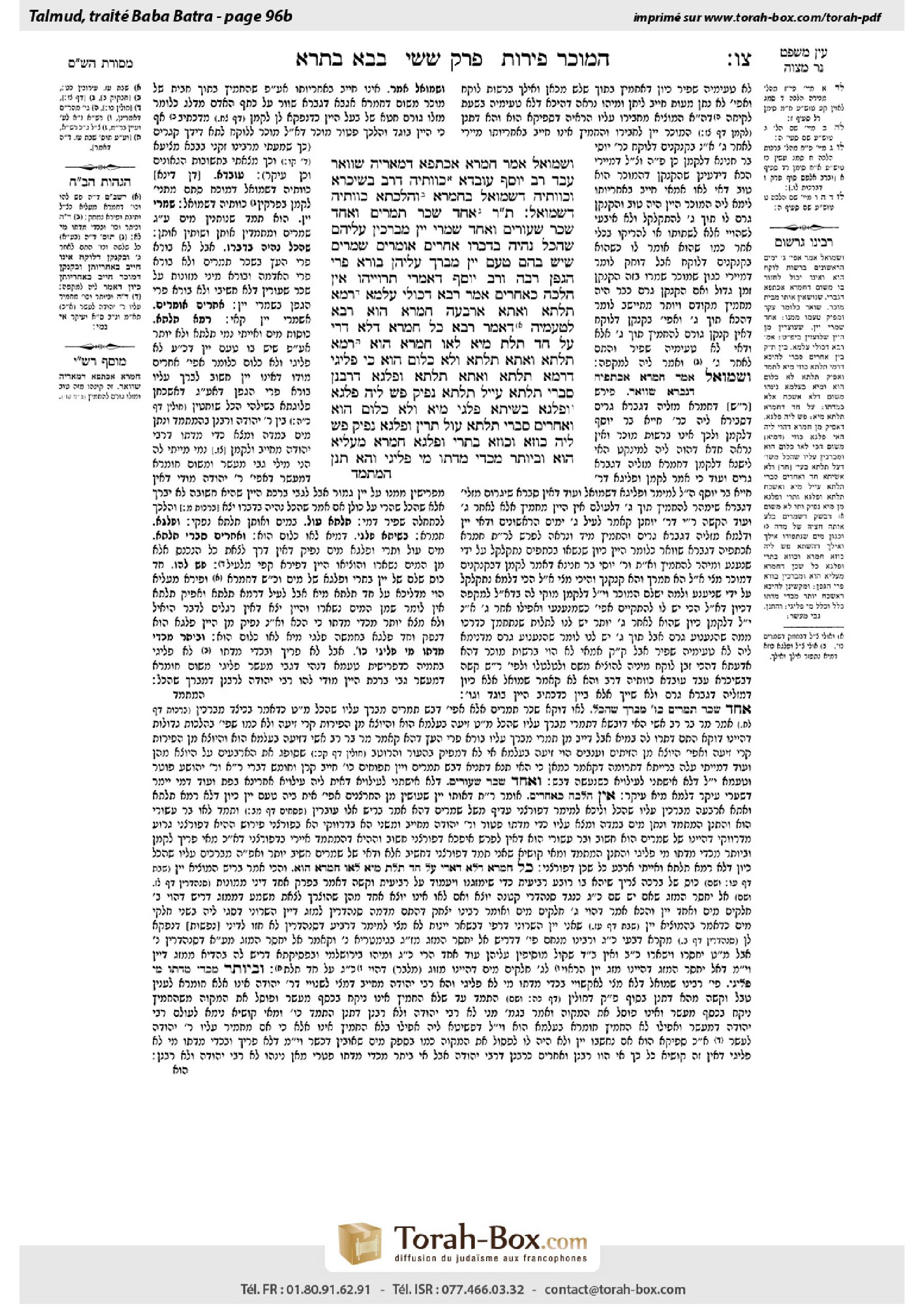
Scan : Torah-Box. Daf Study est un projet indépendant, sans affiliation ni approbation de Torah-Box ou de Sefaria.