Baba Kama 42b en français · בבא קמא מ״ב ב
Traduction française du daf 42b du traité Baba Kama (Bava Kamma 42b en anglais), avec le texte araméen, l’anglais de Sefaria et le scan de la page, pour étudier le Daf Yomi.
Ouvrir dans le lecteur interactifLire le daf du jour
Traduction française de Baba Kama 42b
Les traductions françaises de Daf Study sont générées par IA à partir de l’édition anglaise de Sefaria. Elles peuvent contenir des erreurs : vérifie toujours un passage avec le texte source.
La Guemara demande : Mais Rabbi Akiva aurait-il pu se faire à lui-même la même objection qu’il a opposée à l’interprétation de Rabbi Eliezer du verset, selon laquelle le propriétaire d’un bœuf inoffensif est exempt de payer une demi-rançon (voir 41b) : pourquoi le verset doit-il nous enseigner cela ? La réparation des dommages causés par un bœuf inoffensif n’est-elle pas prélevée uniquement sur la valeur de son corps ? Son propriétaire peut donc dire au maître de l’esclave : « Présente-le au tribunal, et tu seras payé sur sa valeur. » Puisque le bœuf a été lapidé, il n’y a rien sur quoi prélever le paiement.
Rav Shmuel bar Rav Yitzḥak dit : L’interprétation de Rabbi Akiva s’applique à un cas où le propriétaire a abattu le bœuf avant qu’il ne soit condamné à la lapidation. De peur que tu ne dises que le maître de l’esclave doit être payé sur la valeur de la viande, le verset nous enseigne que, puisque le bœuf était passible de mort, le maître de l’esclave ne doit pas être payé sur sa valeur, même si son propriétaire l’a abattu.
La Guemara demande : Si tel est le cas, pourquoi Rabbi Akiva a-t-il opposé cette objection à l’interprétation de Rabbi Eliezer ? L’interprétation de Rabbi Eliezer pourrait elle aussi s’appliquer à un cas où le propriétaire a d’abord abattu le bœuf.
La Guemara répond : En effet, l’interprétation de Rabbi Eliezer pourrait elle aussi s’expliquer de cette manière. Rabbi Akiva a soulevé cette objection parce qu’il raisonne ainsi : peut-être Rabbi Eliezer a-t-il une autre explication, meilleure que celle-ci, et la proposera-t-il. De fait, Rabbi Eliezer a répondu par une autre explication.
La Guemara demande : Mais Rabbi Eliezer aurait lui aussi pu lui répondre que le propriétaire avait d’abord abattu le bœuf. Pourquoi a-t-il proposé une autre explication ? La Guemara répond que Rabbi Eliezer aurait pu te dire : c’est précisément dans le cas auquel il faisait référence dans son explication — celui où le bœuf avait l’intention de tuer un autre animal, mais avait tué une personne à la place — que le verset est nécessaire. En effet, puisque le bœuf n’était pas du tout passible de mort, tu pourrais penser que son propriétaire doit payer une demi-rançon sur la valeur du corps du bœuf. Le verset est donc nécessaire pour l’exonérer de cette obligation. Mais ici, puisque le bœuf était passible de mort dès le départ, aucun verset n’est nécessaire pour enseigner que son propriétaire est exempt de payer une demi-rançon, même s’il l’a abattu.
La Guemara demande : Mais, selon Rabbi Akiva également, il est évident qu’un verset n’est pas nécessaire pour enseigner que le propriétaire est exempt de toute obligation s’il abat le bœuf avant son jugement.
Rav Asi dit plutôt : Il faut rejeter l’explication précédente de l’interprétation de Rabbi Akiva, car j’ai entendu la déclaration suivante d’un grand homme — et de qui s’agit-il ? De Rabbi Yosei, fils de Rabbi Ḥanina. Voici ce qu’il a dit : tu pourrais penser que, puisque Rabbi Akiva affirme dans la Michna (33a) que, lorsqu’un homme et un bœuf inoffensif se causent mutuellement des dommages au même moment, le propriétaire du bœuf inoffensif qui a blessé l’homme paie lui aussi l’intégralité des dommages, à hauteur de la différence entre les deux évaluations des dommages — car il n’y a pas de distinction entre un bœuf inoffensif et un bœuf averti pour les blessures causées à une personne —, l’indemnité pour l’esclave doit elle aussi être prélevée sur les biens de meilleure qualité du propriétaire, et non sur la valeur du corps du bœuf, comme dans le cas où un bœuf averti tue un esclave. Le propriétaire ne peut donc pas dire : « Présente-le au tribunal, et tu seras payé sur sa valeur. » Pour écarter cette possibilité, le Miséricordieux a écrit : « Le propriétaire du bœuf sera quitte », indiquant qu’il est exempt de cette obligation.
Rabbi Zeira dit à Rav Asi : Mais Rabbi Akiva n’avait-il pas déjà atténué la portée de son propos, c’est-à-dire assorti son opinion d’une réserve ? En effet, il est enseigné dans une baraïta que Rabbi Akiva dit : On aurait pu penser que le propriétaire d’un bœuf inoffensif qui a blessé une personne paie l’indemnité sur ses biens de meilleure qualité, comme le propriétaire d’un bœuf averti. Le verset dit donc : « Selon cette règle, on lui fera [lo] » (Exode 21:31), ce qui indique qu’il paie l’indemnité exclusivement sur la valeur du corps du bœuf et non sur ses biens de meilleure qualité, car le mot lo signifie aussi « à lui », c’est-à-dire au bœuf. Cela réfute l’explication de Rav Asi concernant l’interprétation de Rabbi Akiva.
Rava donne plutôt une autre explication de la déclaration de Rabbi Akiva : le verset est nécessaire, car tu pourrais penser que, puisque moi — c’est-à-dire la Torah —, je suis plus stricte dans le cas d’un bœuf averti qui tue une personne lorsqu’il s’agit d’un esclave cananéen que lorsqu’il s’agit d’un homme libre — car, pour un homme libre qui valait un sela, le propriétaire du bœuf verse un sela de rançon, et s’il valait trente sela, il verse trente sela, tandis que, dans le cas d’un esclave cananéen, la Torah impose une somme fixe, de sorte que même s’il ne valait qu’un sela, le propriétaire verse trente sela —, l’indemnité pour l’esclave doit elle aussi être prélevée sur les biens de meilleure qualité du propriétaire, puisque la Torah est plus stricte à son égard. Pour écarter cette possibilité, le Miséricordieux écrit : « Le propriétaire du bœuf sera quitte », indiquant qu’aucun paiement n’est requis lorsqu’un bœuf inoffensif tue un esclave.
Une baraïta est enseignée conformément à l’explication que Rava donne de la déclaration de Rabbi Akiva. Au sujet du verset « Le propriétaire du bœuf sera quitte », Rabbi Akiva dit : il sera quitte du paiement pour un esclave cananéen.
Rabbi Akiva examine cette interprétation : Cette halakha ne pourrait-elle pas être déduite par raisonnement logique, sans le verset ? Puisque la Torah l’a déclaré redevable pour la mort d’un esclave et l’a également déclaré redevable pour la mort d’un homme libre, de même que, lorsque la Torah l’a déclaré redevable pour un homme libre, tu as distingué entre un bœuf inoffensif et un bœuf averti — car aucune rançon n’est payée dans le cas d’un bœuf inoffensif —, distinguons aussi entre un bœuf inoffensif et un bœuf averti lorsque la Torah le déclare redevable pour un esclave.
De plus, cette halakha pourrait être démontrée par un raisonnement a fortiori : si, dans le cas d’un homme libre, dont le propriétaire paie la valeur entière, tu as distingué entre un bœuf inoffensif et un bœuf averti, alors, dans le cas d’un esclave, pour lequel il ne paie que trente sela et pas davantage, même si l’esclave valait plus, n’est-il pas logique de distinguer entre un bœuf inoffensif et un bœuf averti et d’exempter le propriétaire de toute obligation lorsque le bœuf est inoffensif ?
Rabbi Akiva rejette cette opinion : Non, on pourrait soutenir le contraire : moi — c’est-à-dire la Torah —, je suis plus stricte dans le cas d’un esclave que dans celui d’un homme libre. Pour un homme libre qui vaut un sela, le propriétaire du bœuf ne verse qu’un sela, et s’il vaut trente sela, il verse trente sela. Mais, dans le cas d’un esclave, même s’il ne vaut qu’un sela, il verse trente sela. On aurait donc pu penser qu’il est redevable pour un esclave tué par son bœuf inoffensif. Pour écarter cette possibilité, le verset dit : « Le propriétaire du bœuf sera quitte », ce qui indique qu’il sera quitte du paiement d’une indemnité pour l’esclave.
§ Les Sages ont enseigné : Au sujet d’un bœuf averti, le verset dit : « Mais si le bœuf avait déjà l’habitude d’encorner, que son propriétaire en avait été averti et qu’il ne l’avait pas gardé, et qu’il a tué un homme ou une femme, le bœuf sera lapidé » (Exode 21:29). Rabbi Akiva dit : Que vient nous enseigner ce verset ? S’il s’agit de déclarer le propriétaire redevable pour la mort d’une femme comme pour celle d’un homme, cela est déjà énoncé au sujet d’un bœuf inoffensif, puisqu’il est dit : « Lorsqu’un bœuf encorne un homme ou une femme et qu’ils meurent, le bœuf sera lapidé » (Exode 21:28).
Le verset vient plutôt établir une comparaison entre une femme et un homme concernant une autre question : de même que, pour un homme, l’indemnité pour ses blessures est versée à ses héritiers, de même, pour une femme, l’indemnité pour ses blessures est versée à ses héritiers et non à son mari.
La Guemara demande : Rabbi Akiva soutient-il donc qu’un mari n’hérite pas de sa femme ? N’est-il pas enseigné dans une baraïta : Le verset dit : « Et il en héritera [otah] » (Nombres 27:11). On en déduit que le mari hérite de sa femme, puisque otah signifie aussi « elle ». Telle est la déclaration de Rabbi Akiva.
Reish Lakish dit : Rabbi Akiva affirme que ses héritiers, et non son mari, reçoivent le paiement uniquement dans le cas d’une rançon, puisqu’elle n’est versée qu’après le décès et est donc considérée comme un bien qui lui était dû. Le mari n’hérite pas des biens dus à la défunte comme il hérite des biens qu’elle possédait. Par exemple, un héritage qui serait revenu à la femme si elle avait été en vie n’est pas attribué à son mari, mais à ses autres héritiers.
Pourquoi suppose-t-on que, même s’il est clair que la victime est sur le point de mourir, la rançon n’est pas due au mari ? Le verset dit : « Il a tué un homme ou une femme ; le bœuf sera lapidé, et son propriétaire sera aussi mis à mort. Si une rançon lui est imposée, il donnera pour le rachat de sa vie tout ce qui lui sera imposé » (Exode 21:29–30). Cela indique que l’obligation du propriétaire de payer une rançon dépend de l’obligation de lapider le bœuf, laquelle ne s’applique qu’après le décès de la victime.
La Guemara demande : Et, concernant les dommages, Rabbi Akiva n’a-t-il pas dit que les indemnités dues à une épouse sont versées à ses héritiers et non à son mari, comme dans le cas d’une rançon ?
Mais n’est-il pas enseigné dans une baraïta : Si un agresseur frappe une femme et que son fœtus est expulsé à la suite d’une fausse couche, il verse à la femme une indemnité pour le dommage et la douleur, et au mari une indemnité pour le fœtus avorté. Si le mari n’est pas en vie, il verse l’indemnité pour le fœtus à ses héritiers. Si la femme n’est pas en vie, il verse à ses héritiers le paiement qui lui était dû. Si elle était une servante cananéenne et qu’elle a ensuite été affranchie,
Texte source et traduction anglaise
בבא קמא מ״ב ב · texte araméen et hébreu
וְנֵימָא רַבִּי עֲקִיבָא לְנַפְשֵׁיהּ – וַהֲלֹא עַצְמוֹ אֵין מִשְׁתַּלֵּם אֶלָּא מִגּוּפוֹ, הֲבִיאֵהוּ לְבֵית דִּין וִישַׁלֶּם לָךְ!
אָמַר רַב שְׁמוּאֵל בַּר רַב יִצְחָק: כְּשֶׁקָּדַם בְּעָלָיו וּשְׁחָטוֹ; מַהוּ דְּתֵימָא: לִישְׁתַּלַּם מִינֵּיהּ; קָא מַשְׁמַע לַן, הוֹאִיל וּבַר קְטָלָא הוּא, אַף עַל גַּב דְּשַׁחְטֵיהּ – לָא לִישְׁתַּלַּם מִינֵּיהּ.
אִי הָכִי, לְרַבִּי אֱלִיעֶזֶר נָמֵי – כְּשֶׁקָּדַם וּשְׁחָטוֹ!
הָכִי נָמֵי; וְסָבַר: דִּלְמָא אִית לֵיהּ טַעְמָא אַחֲרִינָא דַּעֲדִיף מֵהַאי, וְנֵימָא לֵיהּ.
וְרַבִּי אֱלִיעֶזֶר נָמֵי – לִישַׁנֵּי לֵיהּ שֶׁקָּדַם וּשְׁחָטוֹ! אָמַר לָךְ: הָתָם הוּא דְּנִתְכַּוֵּון לַהֲרוֹג אֶת הַבְּהֵמָה וְהָרַג אֶת הָאָדָם, דְּשׁוֹר לָאו בַּר קְטָלָא הוּא כְּלָל; דְּסָלְקָא דַּעְתָּךְ אָמֵינָא נִיחַיַּיב – אִצְטְרִיךְ קְרָא לְמַעוֹטֵי; אֲבָל הָכָא, דְּמֵעִיקָּרָא בַּר קְטָלָא הֲוָה – לָא צְרִיךְ קְרָא, אַף עַל גַּב דְּשַׁחְטֵיהּ.
וּלְרַבִּי עֲקִיבָא נָמֵי, וַדַּאי הָכִי הֲוָה!
אֶלָּא אָמַר רַב אַסִּי: הַאי מִילְּתָא – מִפִּי דְּגַבְרָא רַבָּה שְׁמִיעַ לִי, וּמַנּוּ – רַבִּי יוֹסֵי בְּרַבִּי חֲנִינָא; סָלְקָא דַּעְתָּךְ אָמֵינָא, הוֹאִיל וְאָמַר רַבִּי עֲקִיבָא: אַף תָּם שֶׁחָבַל בָּאָדָם מְשַׁלֵּם בַּמּוֹתָר נֶזֶק שָׁלֵם, מִשְׁתַּלַּם נָמֵי [דְּמֵי עֶבֶד] מֵעֲלִיָּיה; כְּתַב רַחֲמָנָא ״בַּעַל הַשּׁוֹר נָקִי״.
אֲמַר לֵיהּ רַבִּי זֵירָא לְרַב אַסִּי: וְהָא תַּבְרֵיהּ רַבִּי עֲקִיבָא לִגְזִיזֵיהּ – דְּתַנְיָא, רַבִּי עֲקִיבָא אוֹמֵר: יָכוֹל יְשַׁלֵּם מִן הָעֲלִיָּיה – תַּלְמוּד לוֹמַר: ״כַּמִּשְׁפָּט הַזֶּה יֵעָשֶׂה לוֹ״ – מִגּוּפוֹ מְשַׁלֵּם, וְאֵינוֹ מְשַׁלֵּם מִן הָעֲלִיָּיה!
אֶלָּא אָמַר רָבָא: אִצְטְרִיךְ, סָלְקָא דַּעְתָּךְ אָמֵינָא: הוֹאִיל וּמַחְמִירַנִי בְּעֶבֶד יוֹתֵר מִבֶּן חוֹרִין, שֶׁבֶּן חוֹרִין יָפֶה סֶלַע – נוֹתֵן סֶלַע, שְׁלֹשִׁים – נוֹתֵן שְׁלֹשִׁים, וְעֶבֶד יָפֶה סֶלַע – נוֹתֵן שְׁלֹשִׁים; מִשְׁתַּלַּם נָמֵי דְּמֵי עֶבֶד מִן הָעֲלִיָּיה; כְּתַב רַחֲמָנָא: ״בַּעַל הַשּׁוֹר נָקִי״.
תַּנְיָא כְּוָתֵיהּ דְּרָבָא: ״בַּעַל הַשּׁוֹר נָקִי״ – רַבִּי עֲקִיבָא אוֹמֵר: נָקִי מִדְּמֵי עֶבֶד.
וַהֲלֹא דִּין הוּא – הוֹאִיל וְחַיָּיב בְּעֶבֶד וְחַיָּיב בְּבֶן חוֹרִין; מָה כְּשֶׁחִיֵּיב בְּבֶן חוֹרִין – חָלַקְתָּ בּוֹ בֵּין תָּם לְמוּעָד, אַף כְּשֶׁחִיֵּיב בְּעֶבֶד – נַחְלֹק בּוֹ בֵּין תָּם לְמוּעָד!
וְעוֹד, קַל וָחוֹמֶר – וּמָה בֶּן חוֹרִין, שֶׁנּוֹתֵן כׇּל שׇׁוְויוֹ, חָלַקְתָּ בּוֹ בֵּין תָּם לְמוּעָד; עֶבֶד, שֶׁאֵינוֹ נוֹתֵן אֶלָּא שְׁלֹשִׁים, אֵינוֹ דִּין שֶׁנַּחְלוֹק בּוֹ בֵּין תָּם לְמוּעָד?
לֹא, מַחְמִירַנִי בְּעֶבֶד יוֹתֵר מִבֶּן חוֹרִין; שֶׁבֶּן חוֹרִין יָפֶה סֶלַע – נוֹתֵן סֶלַע, שְׁלֹשִׁים – נוֹתֵן שְׁלֹשִׁים; וְעֶבֶד יָפֶה סֶלַע – נוֹתֵן שְׁלֹשִׁים, יָכוֹל יְהֵא חַיָּיב? תַּלְמוּד לוֹמַר: ״בַּעַל הַשּׁוֹר נָקִי״ – נָקִי מִדְּמֵי עֶבֶד.
תָּנוּ רַבָּנַן: ״וְהֵמִית אִישׁ אוֹ אִשָּׁה״ – אָמַר רַבִּי עֲקִיבָא: וְכִי מָה בָּא זֶה לְלַמְּדֵנוּ? אִם לְחַיֵּיב עַל הָאִשָּׁה כָּאִישׁ – הֲרֵי כְּבָר נֶאֱמַר: ״כִּי יִגַּח שׁוֹר אֶת אִישׁ אוֹ אֶת אִשָּׁה״!
אֶלָּא לְהַקִּישׁ אִשָּׁה לְאִישׁ, מָה אִישׁ – נְזָקָיו לְיוֹרְשָׁיו, אַף אִשָּׁה – נְזָקֶיהָ לְיוֹרְשֶׁיהָ.
וְסָבַר רַבִּי עֲקִיבָא: לָא יָרֵית לַהּ בַּעַל? וְהָתַנְיָא: ״וְיָרַשׁ אוֹתָהּ״ – מִכָּאן שֶׁהַבַּעַל יוֹרֵשׁ אֶת אִשְׁתּוֹ, דִּבְרֵי רַבִּי עֲקִיבָא!
אָמַר רֵישׁ לָקִישׁ: לֹא אָמַר אֶלָּא בְּכוֹפֶר – הוֹאִיל וְאֵין מִשְׁתַּלֵּם אֶלָּא לְאַחַר מִיתָה, וְהָוֵה לֵיהּ רָאוּי, וְאֵין הַבַּעַל נוֹטֵל בָּרָאוּי כִּבְמוּחְזָק.
מַאי טַעְמָא? אָמַר קְרָא: ״וְהֵמִית אִישׁ אוֹ אִשָּׁה, הַשּׁוֹר יִסָּקֵל וְגַם בְּעָלָיו יוּמָת. אִם כֹּפֶר יוּשַׁת עָלָיו״.
וּבִנְזָקִין לֹא אָמַר רַבִּי עֲקִיבָא?
וְהָתַנְיָא: הִכָּה אֶת הָאִשָּׁה וְיָצְאוּ יְלָדֶיהָ – נוֹתֵן נֶזֶק וָצַעַר לָאִשָּׁה, וּדְמֵי וְלָדוֹת לַבַּעַל. אֵין הַבַּעַל – נוֹתֵן לְיוֹרְשָׁיו, אֵין הָאִשָּׁה – נוֹתֶנֶת לְיוֹרְשֶׁיהָ. הָיְתָה שִׁפְחָה וְנִשְׁתַּחְרְרָה,
Bava Kamma 42b · traduction anglaise de Sefaria
The Gemara asks: But let Rabbi Akiva say to himself the same objection that he raised against Rabbi Eliezer’s interpretation of the verse, that the owner of an innocuous ox is exempt from paying half a ransom (see 41b): Why is it necessary for the verse to teach this? But isn’t compensation for damage caused by an innocuous ox itself paid only from the value of its body? Therefore, its owner can say to the slave’s owner: Bring it to court and you will be paid from it. Since the ox was stoned, there is nothing from which he can collect payment.
Rav Shmuel bar Rav Yitzḥak said: Rabbi Akiva’s interpretation is applicable in a case where its owner slaughtered it first, before it was sentenced to stoning. Lest you say that the slave’s owner should be paid from the value of the flesh, the verse teaches us that since the ox was subject to be killed, although its owner slaughtered it, the slave’s owner should not be paid from it.
The Gemara asks: If so, why did Rabbi Akiva raise this objection against Rabbi Eliezer’s interpretation? According to Rabbi Eliezer as well, it could be explained as referring to a case where its owner slaughtered it first.
The Gemara answers: Indeed, Rabbi Eliezer’s interpretation could also be explained in this manner. And the reason Rabbi Akiva raised this objection was because he reasons: Perhaps Rabbi Eliezer has another explanation that is better than this one, and will state it. Rabbi Eliezer did in fact respond with another explanation.
The Gemara asks: But let Rabbi Eliezer also answer him that the owner slaughtered it first. Why did he offer a different explanation? The Gemara answers that Rabbi Eliezer could have said to you: Specifically there, in the case Rabbi Eliezer referred to in his explanation, namely, where the ox intended to kill another animal but killed a person instead, since the ox was not subject to be killed at all, it might enter your mind to say that he should be liable to pay half a ransom from the ox’s body. Therefore, the verse is necessary to exclude the owner from liability to pay half a ransom. But here, since the ox was initially subject to be killed, a verse is not necessary to teach that the owner is exempt from paying half a ransom even if he slaughtered it.
The Gemara asks: But according to Rabbi Akiva also, certainly it is so, that a verse is not necessary to teach that if the owner slaughters the ox before its verdict he is exempt from liability.
Rather, Rav Asi said: The above explanation of Rabbi Akiva’s interpretation should be rejected, as I heard this following statement from a great man, and who is he? He is Rabbi Yosei, son of Rabbi Ḥanina. This is what he said: It might enter your mind to say that since Rabbi Akiva says in the mishna (33a) that in a case where a person and an innocuous ox damaged each other concurrently, the owner of an innocuous ox that injured a person also pays the full cost of the damage with regard to the difference between the two valuations of the damage, as there is no distinction between an innocuous ox and a forewarned ox with regard to injuries caused to a person, compensation for the slave is also paid from his superior-quality property, not from the body of the ox; just as in a case where a forewarned ox kills a slave. Therefore, its owner cannot say: Bring it to court and you will be paid from it. To counter this possibility, the Merciful One wrote: “The owner of the ox shall be clear,” indicating that he is exempt from this liability.
Rabbi Zeira said to Rav Asi: But didn’t Rabbi Akiva already break the force of his fist, i.e., qualify this opinion of his? As it is taught in a baraita that Rabbi Akiva says: One might have thought that the owner of an innocuous ox that injured a person pays compensation from his superior-quality property, the same as the owner of a forewarned ox. Therefore, the verse states: “According to this judgment shall be done to him [lo]” (Exodus 21:31), indicating that he pays restitution exclusively from the body of the ox but he does not pay from his superior-quality property, as the word lo also means: To it. This negates Rav Asi’s explanation of Rabbi Akiva’s interpretation.
Rather, Rava said a different explanation of Rabbi Akiva’s statement: The verse is necessary because it might enter your mind to say that since I, referring to the Torah, am more stringent with regard to a forewarned ox that kills a person in the case of a Canaanite slave than in the case of a freeman; as in the case of a freeman who was worth one sela the owner of the ox gives one sela in ransom, and if he was worth thirty sela he gives thirty; but in the case of a Canaanite slave the Torah imposes a fixed amount, so even if he was worth only one sela the owner gives thirty sela, therefore, since the Torah is more stringent in the case of a slave, payment for the slave should also be paid from the owner’s superior-quality property. To counter this, the Merciful One writes: “The owner of the ox shall be clear,” indicating that payment is not required in a case where an innocuous ox kills a slave.
It is taught in a baraita in accordance with the explanation of Rava to Rabbi Akiva’s statement. The baraita states that with regard to the verse “The owner of the ox shall be clear,” Rabbi Akiva says: He shall be clear from payment for a Canaanite slave.
Rabbi Akiva discusses this interpretation: And could this halakha not be derived through logical inference, without the verse? Since the Torah deemed him liable to pay for the killing of a slave and deemed him liable for the killing of a freeman as well, just as when the Torah deemed him liable for a freeman you distinguished between an innocuous ox and a forewarned ox, as no ransom is paid in the case of an innocuous ox, so too, when the Torah deemed him liable for a slave, let us distinguish between an innocuous ox and a forewarned ox.
Furthermore, this halakha could be proven through an a fortiori inference: If, in the case of a freeman, where he, the owner, gives his full value, you distinguished between an innocuous ox and a forewarned ox, with regard to a slave, where he gives only thirty sela and not more, even if the slave was worth more, is it not logical that we should distinguish between an innocuous ox and a forewarned ox, and exempt him from liability for an innocuous ox?
Rabbi Akiva rejects this opinion: No, one could disagree and say the opposite: I, referring to the Torah, am more stringent with regard to the case of a slave than with regard to that of a freeman; as for a freeman worth one sela, the ox’s owner gives only one sela, and if he is worth thirty sela he gives thirty. But in the case of a slave, even if he was worth only one sela, he gives thirty sela. Therefore, one might have thought that he should be liable to pay for a slave killed by his innocuous ox. To counter this, the verse states: “The owner of the ox shall be clear,” indicating that he shall be clear from paying compensation for a slave.
§ The Sages taught: The verse states with regard to a forewarned ox: “But if the ox was a goring ox in time past and warning has been given to its owner, and he has not secured it; and it killed a man or a woman; the ox shall be stoned” (Exodus 21:29). Rabbi Akiva said: And what does this come to teach us? If it is to deem the owner liable for the killing of a woman just as for the killing of a man, this is already stated with regard to an innocuous ox, where it is stated: “When an ox gores a man or a woman, and they die, the ox shall be stoned” (Exodus 21:28).
Rather, the verse is stated to compare a woman to a man with regard to another issue: Just as with regard to a man, payment for his injuries is paid to his heirs, so too, with regard to a woman, payment for her injuries is paid to her heirs, and not to her husband.
The Gemara asks: And does Rabbi Akiva hold that a husband does not inherit from his wife? But isn’t it taught in a baraita: The verse states: “And he shall inherit it [otah]” (Numbers 27:11). From here it is derived that the husband inherits from his wife, as otah also means: Her. This is the statement of Rabbi Akiva.
Reish Lakish said: Rabbi Akiva says that her heirs and not her husband receive the payment only with regard to ransom, since it is paid only posthumously and is therefore considered property due to her; and the husband does not take in inheritance the property due to the deceased as he does the property she possessed. For instance, an inheritance that would have gone to the woman had she been alive is not awarded to the husband, but rather, to her other heirs.
What is the reason for the assumption that even if it is clear that the victim is about to die, the husband is not owed ransom? The verse states: “And it killed a man or a woman; the ox shall be stoned, and its owner also shall be put to death. If a ransom is laid on him, then he shall give for the redemption of his life whatsoever is laid on him” (Exodus 21:29–30), indicating that the owner’s liability to pay ransom is dependent on the ox’s liability to be stoned, which, in turn, applies only after the death of the victim.
The Gemara asks: And with regard to damages, did Rabbi Akiva not say that damages due to a wife are paid to her heirs and not to her husband, just as with regard to ransom?
But isn’t it taught in a baraita: If an assailant struck the woman and her offspring emerged due to miscarriage, he gives compensation for damage and pain to the woman and compensation for miscarried offspring to the husband. If the husband is not alive, he gives the compensation for the offspring to his heirs. If the woman is not alive, he gives the payment owed to her to her heirs. If she was a Canaanite maidservant and then she was emancipated,
Texte de Sefaria : William Davidson Edition - Vocalized Aramaic (CC BY NC) ; William Davidson Edition - English (CC BY NC).
Scan de Baba Kama 42b
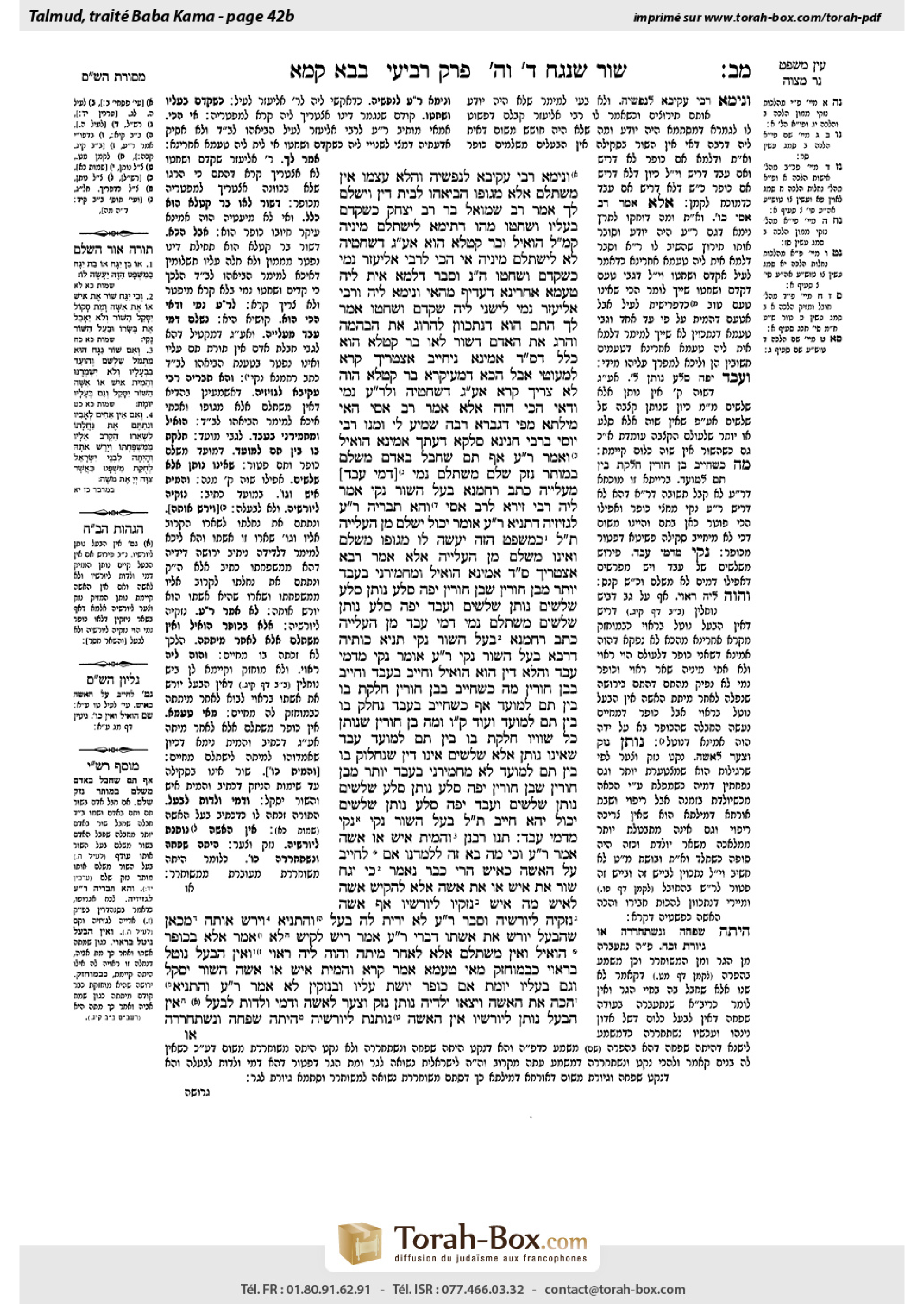
Scan : Torah-Box. Daf Study est un projet indépendant, sans affiliation ni approbation de Torah-Box ou de Sefaria.