Baba Kama 57a en français · בבא קמא נ״ז א
Traduction française du daf 57a du traité Baba Kama (Bava Kamma 57a en anglais), avec le texte araméen, l’anglais de Sefaria et le scan de la page, pour étudier le Daf Yomi.
Ouvrir dans le lecteur interactifLire le daf du jour
Traduction française de Baba Kama 57a
Les traductions françaises de Daf Study sont générées par IA à partir de l’édition anglaise de Sefaria. Elles peuvent contenir des erreurs : vérifie toujours un passage avec le texte source.
Si quelqu’un trouve un objet perdu et le rapporte en un lieu où son propriétaire le verra, il n’est plus tenu de s’en occuper. Si l’objet est volé ou perdu, celui qui l’a trouvé est financièrement responsable de la perte.
Rav Yosef formule son objection : Que signifie l’expression « a été volé ou perdu » ? Cela ne veut-il pas dire que l’objet a été volé dans la maison de celui qui l’a trouvé ou qu’il y a été perdu, avant qu’il ne le rapporte ? Puisqu’il est responsable en cas de vol ou de perte, il semble avoir le statut d’un gardien rémunéré.
Rabba rejette cette objection : Non, cela signifie que l’objet a été volé ou perdu à l’endroit où celui qui l’a trouvé l’a rapporté ; dans ce cas, même un gardien non rémunéré est responsable en cas de négligence.
Rav Yosef conteste la réponse de Rabba : Mais la baraïta enseigne que celui qui a trouvé l’objet n’est plus tenu de s’en occuper. Cela indique que le fait de ne pas s’en occuper ne constitue pas une négligence et que celui qui l’a trouvé n’en est plus responsable.
Rabba lui dit : De quel cas s’agit-il ici, à la fin de la baraïta, où il est enseigné que celui qui a trouvé l’objet est responsable ? Il s’agit d’un cas où il l’a rapporté à midi, moment où le propriétaire de l’objet perdu n’est généralement pas présent. Celui qui l’a trouvé ne l’a donc pas rapporté correctement et, si l’objet est ensuite volé ou perdu, il en est responsable, même s’il est un gardien non rémunéré.
La baraïta enseigne deux halakhot distinctes. Voici ce qu’elle enseigne : si celui qui a trouvé l’objet le rapporte le matin, quand les gens sont généralement présents, en un lieu où son propriétaire le verra — car celui-ci y entre et en sort habituellement et il est donc probable qu’il le voie —, celui qui l’a trouvé n’est plus tenu de s’en occuper et n’est pas non plus responsable si l’objet est ensuite volé ou perdu. En revanche, s’il le rapporte à midi en un lieu où son propriétaire le verra, mais à un moment où celui-ci n’y entre et n’en sort généralement pas et ne le verra donc pas, celui qui l’a trouvé est financièrement responsable de la perte si l’objet est ensuite volé ou perdu.
Rav Yosef soulève de nouveau une objection contre l’opinion de Rabba à partir de la suite de la baraïta : Celui qui trouve l’objet perdu en reste toujours responsable s’il est volé ou perdu, jusqu’à ce qu’il le rapporte dans le domaine du propriétaire. Que vient ajouter le mot « toujours » ? N’enseigne-t-il pas que même si l’objet perdu est volé dans la maison de celui qui l’a trouvé, celui-ci est responsable ? Si tel est le cas, déduis-en que celui qui trouve un objet perdu est considéré comme un gardien rémunéré.
Rabba répondit à Rav Yosef : Je te concède que, lorsqu’il s’agit de quelqu’un qui veille sur des animaux perdus, il est responsable s’ils sont volés ou perdus. En effet, comme ces animaux ont déjà pris l’habitude de quitter leur chemin habituel et de ne pas se comporter comme à l’ordinaire, ils nécessitent une garde supplémentaire, du niveau de celle qu’exige le statut de gardien rémunéré. Mais, pour les autres objets perdus, qui ne se déplacent pas d’eux-mêmes, celui qui les a trouvés n’est pas tenu de les protéger davantage qu’un gardien non rémunéré.
Rabba soulève une objection contre l’opinion de Rav Yosef : au sujet du retour des objets perdus, le verset dit : « Tu les rapporteras » (Deutéronome 22, 1), en répétant le verbe « hashev teshivem ». Les Sages l’ont interprété ainsi : du mot « hashev », j’ai seulement déduit que l’on peut rapporter l’objet à la maison du propriétaire de l’objet perdu. D’où déduire que, même si on le rapporte dans son jardin ou dans sa ruine, c’est-à-dire une construction inutilisée située sur sa propriété, on s’est acquitté de son obligation et l’on n’est plus responsable de l’objet trouvé ? Le verset dit « teshivem », répétant le verbe pour insister, afin d’enseigner que l’on accomplit la mitsva en rapportant l’objet en tout lieu appartenant à son propriétaire.
Que signifie dans la baraïta l’expression « dans son jardin ou dans sa ruine » ? Si nous disons que celui qui a trouvé l’objet perdu l’a rapporté dans le jardin clôturé du propriétaire, c’est-à-dire convenablement clos, ou dans sa ruine clôturée, il n’était pas nécessaire de le préciser : cela revient au même que sa maison, puisque ces espaces sont protégés de la même manière que sa maison. Il est donc évident que cela signifie qu’il l’a rapporté dans son jardin non clôturé ou dans sa ruine non clôturée ; néanmoins, celui qui l’a trouvé n’est plus responsable des dommages ultérieurs ou du vol de l’objet trouvé. Déduis-en que, quant à sa responsabilité, celui qui trouve un objet est comme un gardien non rémunéré et que ce niveau de protection réduit suffit lorsqu’il rapporte l’objet.
Rav Yosef lui dit : En réalité, on peut expliquer que la baraïta parle d’un cas où celui qui a trouvé l’objet l’a placé dans le jardin clôturé du propriétaire ou dans sa ruine clôturée. Quant à la difficulté que tu soulèves — que cela revient au même que sa maison —, cette décision comporte néanmoins un enseignement nouveau : elle nous apprend que, dans ce cas, nous n’exigeons pas que le propriétaire sache que l’objet lui a été rapporté. Cela est conforme à l’opinion de Rabbi Elazar.
Car Rabbi Elazar dit : tous ceux qui sont tenus de rapporter des objets à leurs propriétaires, par exemple un gardien ou un voleur, doivent s’assurer que le propriétaire sait qu’ils les lui rapportent, à l’exception de celui qui accomplit la mitsva de rapporter un objet perdu. En effet, la Torah a prévu plusieurs manières permises de rapporter des objets perdus, en employant l’expression redoublée « hashev teshivem », qui permet de rapporter l’objet perdu sans que son propriétaire le sache.
Abaye dit à Rav Yosef : Et toi, ne tiens-tu pas qu’une personne qui garde un objet perdu est comme un gardien non rémunéré ? Mais Rabbi Ḥiyya bar Abba ne dit-il pas que Rabbi Yoḥanan dit : Celui qui trouve un objet perdu, prétend à tort qu’un voleur le lui a dérobé et prête serment en ce sens doit payer le double, c’est-à-dire deux fois la valeur de l’objet. Et si tu penses que celui qui trouve un objet perdu a le même statut qu’un gardien rémunéré, pourquoi devrait-il, dans ce cas, payer le double ? Il ne devrait payer que le principal, puisqu’un gardien rémunéré est de toute façon responsable si l’objet est volé ou perdu et qu’il n’avait aucun intérêt à prétendre que l’objet avait été volé.
Rav Yosef lui dit : De quel cas s’agit-il ici ? D’un cas où celui qui a trouvé l’objet a prêté un faux serment en affirmant qu’une bande de brigands armés avait emporté le dépôt. Dans ce cas, même un gardien rémunéré est exempté. Sa déclaration l’aurait donc exonéré de toute responsabilité et, si l’objet est ensuite retrouvé en sa possession, il doit payer le double pour avoir prétendu à tort qu’il avait été volé.
Abaye lui dit : Mais un brigand armé a le statut d’un voleur à main armée et non d’un voleur clandestin. Selon cette explication, pourquoi Rabbi Yoḥanan a-t-il dit que l’objet avait été dérobé par un voleur ?
Rav Yosef lui dit : Si seul le voleur clandestin paie le double, contrairement au voleur à main armée, c’est parce que le premier dénigre Dieu : il montre qu’il craint les hommes en volant en secret, tout en ne montrant aucune crainte du Ciel. À l’inverse, le voleur à main armée vole au grand jour. Ainsi, si je dis qu’un brigand armé est considéré comme un voleur clandestin, c’est parce qu’il se cache des gens au lieu de voler ouvertement. Bien qu’en réalité il vole au grand jour, puisqu’il le fait en utilisant une arme, il montre lui aussi qu’il craint les hommes et s’apparente à un voleur clandestin. Par conséquent, les brigands armés sont tenus de payer le double, comme un voleur clandestin, et déclarer que le dépôt a été pris par des brigands armés revient à déclarer qu’il a été dérobé par des voleurs clandestins. Dès lors, puisqu’un gardien rémunéré est exonéré grâce à une telle déclaration, si l’on établit qu’elle était mensongère, il doit payer le double.
Abaye soulève une objection contre l’opinion de Rav Yosef à partir de ce qui est enseigné dans une baraïta :
Texte source et traduction anglaise
בבא קמא נ״ז א · texte araméen et hébreu
הֶחְזִירָהּ לִמְקוֹם שֶׁיִּרְאֶנָּה – אֵינוֹ חַיָּיב לִטַּפֵּל בָּהּ. נִגְנְבָה אוֹ אָבְדָה – חַיָּיב בְּאַחְרָיוּתָהּ.
מַאי ״נִגְנְבָה אוֹ אָבְדָה״? לָאו נִגְנְבָה מִבֵּיתוֹ וְאָבְדָה מִבֵּיתוֹ?
לָא, מִמְּקוֹם שֶׁהֶחְזִירָהּ.
וְהָא קָתָנֵי: אֵינוֹ חַיָּיב לִיטַּפֵּל בָּהּ!
אֲמַר לֵיהּ: הָכָא בְּמַאי עָסְקִינַן – כְּגוֹן שֶׁהֶחְזִירָהּ בַּצׇּהֳרַיִם.
וְתַרְתֵּי קָתָנֵי, וְהָכִי קָתָנֵי: הֶחְזִירָהּ שַׁחֲרִית לִמְקוֹם שֶׁיִּרְאֶנָּה, וּשְׁכִיחַ דְּעָיֵיל וְנָפֵיק וְחָזֵי לַהּ – אֵינוֹ חַיָּיב לִיטַּפֵּל בָּהּ. הֶחְזִירָהּ בַּצׇּהֳרַיִם לִמְקוֹם שֶׁיִּרְאֶנָּה, דְּלָא שְׁכִיחַ דְּעָיֵיל וְנָפֵיק, דְּלָא חָזֵי לַהּ; וְנִגְנְבָה אוֹ אָבְדָה – חַיָּיב בְּאַחְרָיוּתָהּ.
אֵיתִיבֵיהּ: לְעוֹלָם הוּא חַיָּיב, עַד שֶׁיַּחְזִירֶנָּה לִרְשׁוּתוֹ. מַאי ״לְעוֹלָם״? לָאו אֲפִילּוּ מִבֵּיתוֹ? שְׁמַע מִינַּהּ כְּשׁוֹמֵר שָׂכָר דָּמֵי!
אֲמַר לֵיהּ: מוֹדֵינָא לָךְ בְּבַעֲלֵי חַיִּים, דְּכֵיוָן דְּנָקְטִי לְהוּ נִיגְרֵא בָּרָיָיתָא – בָּעֵי נְטִירוּתָא יַתִּירְתָּא.
אֵיתִיבֵיהּ רַבָּה לְרַב יוֹסֵף: ״הָשֵׁב״ – אֵין לִי אֶלָּא בְּבֵיתוֹ, לְגִינָּתוֹ וּלְחוּרְבָּתוֹ מִנַּיִן? תַּלְמוּד לוֹמַר: ״תְּשִׁיבֵם״ מִכׇּל מָקוֹם.
מַאי ״לְגִינָּתוֹ וּלְחוּרְבָּתוֹ״? אִילֵימָא לְגִינָּתוֹ הַמִּשְׁתַּמֶּרֶת וּלְחוּרְבָּתוֹ הַמִּשְׁתַּמֶּרֶת, הַיְינוּ בֵּיתוֹ! אֶלָּא פְּשִׁיטָא, לְגִינָּתוֹ שֶׁאֵינָהּ מִשְׁתַּמֶּרֶת וּלְחוּרְבָּתוֹ שֶׁאֵינָהּ מִשְׁתַּמֶּרֶת. שְׁמַע מִינַּהּ כְּשׁוֹמֵר חִנָּם דָּמֵי!
אֲמַר לֵיהּ: לְעוֹלָם לְגִינָּתוֹ הַמִּשְׁתַּמֶּרֶת וּלְחוּרְבָּתוֹ הַמִּשְׁתַּמֶּרֶת, וּדְקָא קַשְׁיָא לָךְ: הַיְינוּ בֵּיתוֹ, הָא קָא מַשְׁמַע לַן – דְּלָא בָּעֵינַן דַּעַת בְּעָלִים, כִּדְרַבִּי אֶלְעָזָר.
דְּאָמַר רַבִּי אֶלְעָזָר: הַכֹּל צְרִיכִין דַּעַת בְּעָלִים, חוּץ מֵהֲשָׁבַת אֲבֵידָה – שֶׁהֲרֵי רִיבְּתָה בּוֹ תּוֹרָה הֲשָׁבוֹת הַרְבֵּה.
אֲמַר לֵיהּ אַבָּיֵי לְרַב יוֹסֵף: וְאַתְּ לָא תִּסְבְּרָא דְּשׁוֹמֵר אֲבֵידָה כְּשׁוֹמֵר חִנָּם דָּמֵי? וְהָא אָמַר רַבִּי חִיָּיא בַּר אַבָּא אָמַר רַבִּי יוֹחָנָן: הַטּוֹעֵן טַעֲנַת גַּנָּב בַּאֲבֵידָה – מְשַׁלֵּם תַּשְׁלוּמֵי כֶפֶל. וְאִי סָלְקָא דַעְתָּךְ שׁוֹמֵר שָׂכָר הָוֵי, אַמַּאי מְשַׁלֵּם תַּשְׁלוּמֵי כֶפֶל? קַרְנָא בָּעֵי שַׁלּוֹמֵי!
אֲמַר לֵיהּ: הָכָא בְּמַאי עָסְקִינַן – כְּגוֹן שֶׁטּוֹעֵן טַעֲנַת לִסְטִים מְזוּיָּין.
אֲמַר לֵיהּ: לִיסְטִים מְזוּיָּין – גַּזְלָן הוּא!
אֲמַר לֵיהּ, שֶׁאֲנִי אוֹמֵר: לִסְטִים מְזוּיָּין, כֵּיוָן דְּמִיטַּמַּר מֵאִינָשֵׁי – גַּנָּב הוּא.
אֵיתִיבֵיהּ:
Bava Kamma 57a · traduction anglaise de Sefaria
If one found a lost item and he returned it to a place where its owner will see it, he is no longer responsible to deal with it. If the item was stolen or lost, the finder bears financial responsibility to compensate for the loss.
Rav Yosef states his objection: What is meant by the expression: Was stolen or lost? Does it not mean that it was stolen from the finder’s house or lost from his house before he returned it? Since he is liable for theft or loss, it appears that he has the same status as a paid bailee.
Rabba rejects this challenge: No, it means that it was stolen or lost from the place where the finder returned it, in which case even an unpaid bailee is liable on the grounds of negligence.
Rav Yosef challenges Rabba’s response: But the baraita teaches that the finder is no longer responsible to deal with it, indicating that failing to deal with it is not negligence, and the finder has no further responsibility for it.
Rabba said to him: With what are we dealing here, at the end of the baraita, where it teaches that the finder is liable? We are dealing with a case where he returned it at midday, which is a time when the owner of the lost item is not typically present. Therefore, the finder has not returned the item properly, and if it is then stolen or lost, he bears responsibility even if he is an unpaid bailee.
And the baraita is teaching two separate halakhot, and this is what it is teaching: If the finder returned it in the morning, when people are typically present, to a place where the owner of the lost item will see it, and the owner typically enters and exits and it is likely that he will see it, the finder is no longer responsible to deal with it, nor does he bear responsibility if it is then stolen or lost. By contrast, if the finder returned it at midday to a place where the owner will see it, since it is a time when the owner does not typically enter and exit and will not see it, if it is then stolen or lost the finder bears financial responsibility for the loss.
Rav Yosef again raised an objection to the opinion of Rabba from that which is taught in the continuation of the baraita: The finder of the lost item always bears responsibility if the item is stolen or lost until he returns it to the owner’s property. What does the word always add? Is it not teaching that even if the lost item was stolen from the finder’s house, he is liable? If so, learn from this that one who finds a lost item is considered like a paid bailee.
Rabba said to Rav Yosef in reply: I concede to you in a case of one looking after lost animals that he is liable if they are stolen or lost. The reason is that since the animals have already taken to the habit of walking out of their usual path and not behaving in their typical manner, they require extra safeguarding, corresponding to that required of a paid bailee. But with regard to other items that are lost, those that do not move by themselves, the finder bears no greater responsibility to secure them than does an unpaid bailee.
Rabba raised an objection to the opinion of Rav Yosef: The verse states in the context of returning lost items: “Return them” (Deuteronomy 22:1), repeating the verb “hashev teshivem.” The Sages expounded as follows: From the word “hashev” I have derived only that one may return the item to the house of the owner of the lost article. From where do I derive that even if one returns it to his garden or to his ruin, i.e., an unused structure on his property, he has discharged his obligation and is no longer responsible for the item that he found? For this, the verse states: “Teshivem,” repeating the verb for emphasis, to teach that he fulfills the mitzva by returning the item to any place belonging to the owner.
What is the meaning of the phrase in the baraita: To his garden or to his ruin? If we say that the finder returned the lost item to the garden of the owner that is secured, i.e., properly enclosed, or to his ruin that is secured, it would be unnecessary to state this, as it is the same as his house, since these spaces are secured in the same way as his house. Rather, it is obvious that it means that he returned them to his garden that is not secured, or to his ruin that is not secured, and nevertheless, the finder is no longer liable for subsequent damage or theft of the found item. Conclude from it that a finder is like an unpaid bailee in terms of his liabilities, and this reduced level of safeguarding when returning the item is sufficient.
Rav Yosef said to him: Actually, one can explain that the baraita is referring to a case where the finder placed it in the owner’s garden that is secured, or his ruin that is secured; and with regard to that which poses a difficulty to you, that this is the same as his house, there is nevertheless a novelty in this ruling: This teaches us that in this case we do not require the owner’s knowledge that the article has been returned, and this is in accordance with the opinion of Rabbi Elazar.
As Rabbi Elazar says: All those who are obligated to return items to their owners, e.g., a bailee or a thief, require the owner’s knowledge that they are returning it except for one fulfilling the mitzva of returning a lost item. This is because the Torah included many permitted ways of returning lost items by employing the double expression “hashev teshivem,” which serves to permit the return of the lost item without the knowledge of the owner.
Abaye said to Rav Yosef: And you, do you not hold that one safeguarding a lost item is like an unpaid bailee? But doesn’t Rabbi Ḥiyya bar Abba say that Rabbi Yoḥanan says: With regard to one who finds a lost item but falsely states the claim that a thief stole the item from him and takes an oath to that effect, he must pay a double payment, i.e., twice the value of the item. And if it enters your mind that the finder of a lost item is considered to have the same status as a paid bailee, why in such a case must he pay a double payment? He should be required to pay only the principal, since a paid bailee is liable in any event if the article is stolen or lost, and he did not stand to benefit from the claim that the item was stolen.
Rav Yosef said to him: With what are we dealing here? It is with a case where the finder took a false oath stating the claim that the deposit was taken by an armed bandit, and in such a case even a paid bailee is exempt. Consequently, his claim would have absolved him from liability, and if the item is subsequently found in his possession, he is liable to pay double for his false claim that it was stolen.
Abaye said to him: But an armed bandit has the status of a robber and not of a thief, so according to this explanation, why did Rabbi Yoḥanan state that it was stolen by a thief?
Rav Yosef said to him: The reason that only a thief pays the double payment and not a robber is that a thief denigrates God by exhibiting fear of people by stealing surreptitiously while not exhibiting fear of Heaven. This is in contrast to a robber, who robs openly. Accordingly, the reason that I say that an armed bandit is considered as a thief, is since he hides from people rather than stealing openly. Although he in fact does steal openly, since he does so by employing a weapon he also exhibits fear of people, and is akin to a thief. Therefore, armed bandits are liable to pay a double payment as is a thief, and a claim that the deposit was seized by armed bandits is considered to be the same as a claim that it was stolen by thieves. Consequently, since a paid bailee is absolved by means of such a claim, if it is determined that his claim was false he must pay double.
Abaye raised an objection to the opinion of Rav Yosef from that which is taught in a baraita:
Texte de Sefaria : William Davidson Edition - Vocalized Aramaic (CC BY NC) ; William Davidson Edition - English (CC BY NC).
Scan de Baba Kama 57a
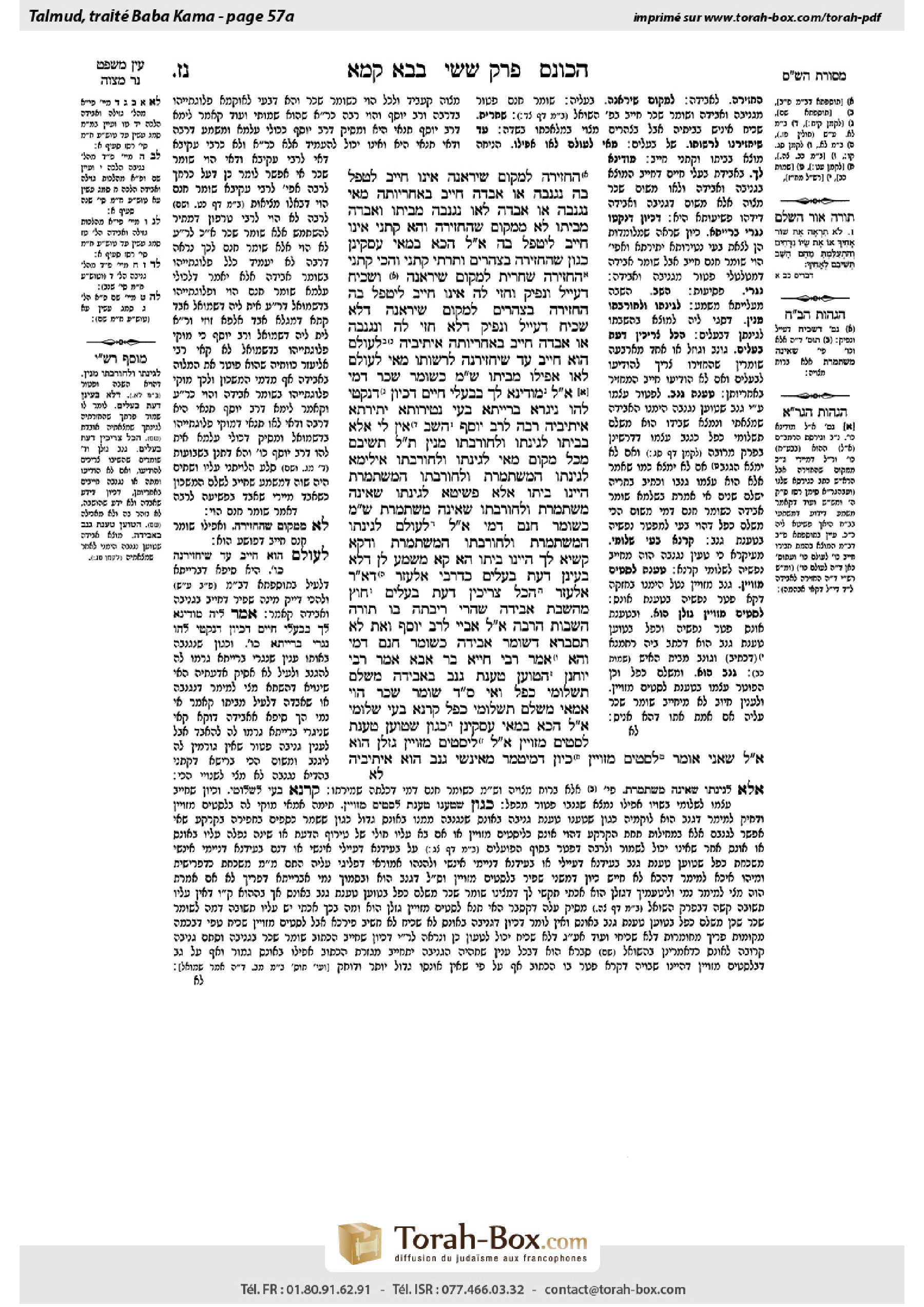
Scan : Torah-Box. Daf Study est un projet indépendant, sans affiliation ni approbation de Torah-Box ou de Sefaria.