Baba Metsia 113b en français · בבא מציעא קי״ג ב
Traduction française du daf 113b du traité Baba Metsia (Bava Metzia 113b en anglais), avec le texte araméen, l’anglais de Sefaria et le scan de la page, pour étudier le Daf Yomi.
Ouvrir dans le lecteur interactifLire le daf du jour
Traduction française de Baba Metsia 113b
Les traductions françaises de Daf Study sont générées par IA à partir de l’édition anglaise de Sefaria. Elles peuvent contenir des erreurs : vérifie toujours un passage avec le texte source.
La Guemara répond : Non, l’agent du tribunal est considéré comme le créancier, qui doit attendre dehors que le débiteur lui remette son gage.
La Guemara tente d’apporter une autre preuve. Viens et entends ce que les Sages ont enseigné : le verset dit : « Si tu prends en gage le vêtement de ton prochain, tu le lui rendras avant le coucher du soleil » (Exode 22,25). Le verset parle d’un agent du tribunal. Dirais-tu que le verset parle d’un agent du tribunal, ou peut-être ne concerne-t-il qu’un créancier ? Lorsqu’il est dit : « Tu n’entreras pas dans sa maison pour prendre son gage » (Deutéronome 24,10), le cas du créancier est déjà énoncé. Comment donc comprendre le verset : « Si tu prends en gage le vêtement de ton prochain » ? Le verset parle d’un agent du tribunal. Cela indique qu’un agent du tribunal est autorisé à prendre un gage.
La Guemara répond : cette question fait l’objet d’une controverse entre des tannaïm, comme l’enseigne une baraïta : un agent du tribunal qui vient prendre un gage à un débiteur ne peut pas entrer chez lui pour le lui prendre. L’agent se tient plutôt dehors, et l’autre, c’est-à-dire le débiteur, lui apporte le gage, comme il est dit : « Tu te tiendras dehors, et l’homme à qui tu as prêté fera sortir le gage » (Deutéronome 24,11). Selon ce tanna, l’agent du tribunal a le même statut que le créancier.
Et il est enseigné dans une autre baraïta : un créancier qui vient prendre un gage au débiteur ne peut pas entrer chez lui pour prendre son gage. Il se tient plutôt dehors, et l’autre, c’est-à-dire le débiteur, entre et lui apporte le gage, comme il est dit : « Tu te tiendras dehors, et l’homme à qui tu as prêté fera sortir le gage » (Deutéronome 24,11). Mais un agent du tribunal qui vient prendre un gage au débiteur peut entrer chez lui et prendre son gage.
La baraïta poursuit : l’agent du tribunal ne peut pas prendre en gage au débiteur des objets dont on se sert pour préparer la nourriture, car le débiteur en a besoin et la Torah a explicitement interdit de les lui retirer. L’agent laisse, c’est-à-dire ne prend pas, un lit, un second lit et des couvertures à un riche, et un lit, un second lit et une natte à un pauvre. Ces objets sont laissés au débiteur lui-même, mais non à sa femme, ni à ses fils, ni à ses filles, car la Torah n’a pas obligé le créancier à prendre soin de la famille du débiteur.
Le tanna ajoute : de même qu’on prend des dispositions pour laisser à un débiteur certains ustensiles nécessaires, on en prend également pour celui qui est tenu de verser au Trésor du Temple une somme à la suite d’un vœu relevant de la catégorie des évaluations. Si quelqu’un a fait vœu de consacrer au Sanctuaire une certaine somme correspondant à une évaluation, comme le prescrit la Torah (voir Lévitique 27), mais ne dispose pas de suffisamment d’argent pour la payer immédiatement, on prend des dispositions semblables pour lui. La Guemara s’étonne de cette dernière proposition : n’est-ce pas l’inverse ? Les dispositions relatives aux évaluations sont précisément énoncées dans la Torah, et la halakha concernant les autres dettes en est dérivée. Il faut plutôt dire : de même qu’on prend des dispositions pour les évaluations, comme l’explique la Torah, on en prend également pour un débiteur.
§ Le Maître a dit plus haut : il laisse un lit, un second lit et des couvertures à un riche, et un lit, un second lit et une natte à un pauvre. La Guemara demande : à qui est destiné ce lit supplémentaire ? Si l’on dit qu’il est destiné à sa femme, à ses fils ou à ses filles, n’as-tu pas explicitement dit que ces objets lui sont laissés à lui, mais non à sa femme, à ses fils ou à ses filles ? Il faut plutôt dire que les deux lits, celui-ci comme celui-là, sont pour lui.
La Guemara demande : pourquoi le débiteur a-t-il besoin de deux lits, alors qu’un seul devrait suffire à tous ses besoins ? La Guemara répond : l’un lui sert à manger et l’autre à dormir, conformément à l’opinion de Shmuel. En effet, Shmuel, qui était médecin de profession, disait : parmi toutes les choses qui provoquent des maladies, je connais le remède à toutes, à l’exception de ces trois-là : celui qui mange une datte amère [ahina] à jeun ; celui qui se serre les reins avec une ceinture de lin mouillée ; et celui qui mange du pain sans marcher ensuite quatre coudées. C’est pourquoi il lui faut deux lits : afin qu’il ne mange pas et ne dorme pas sur le même lit sans devoir parcourir une petite distance après son repas.
§ Un tanna enseigna une baraïta devant Rav Naḥman : de même qu’on prend des dispositions pour les évaluations, on en prend pour un débiteur. Rav Naḥman lui dit : puisque la Michna enseigne qu’on vend son gage, va-t-on lui en laisser une partie ? La Guemara demande : mais le vend-on ? N’avons-nous pas appris dans la Michna qu’on lui rend un oreiller la nuit et une charrue le jour, ce qui montre que ces objets ne sont pas vendus ?
La Guemara répond : le tanna lui enseigna la baraïta selon l’opinion de Rabban Shimon ben Gamliel, et voici ce que Rav Naḥman lui disait : puisque, selon Rabban Shimon ben Gamliel, on vend le gage, prend-on des dispositions pour lui en laisser une partie ? Car nous avons appris dans la Michna : Rabban Shimon ben Gamliel dit : même au débiteur lui-même, le gage ne doit être rendu chaque jour que jusqu’à l’expiration de trente jours ; à partir de là, le créancier peut vendre les objets au tribunal, et le produit de la vente est affecté au remboursement de la dette.
La Guemara demande : d’où sait-on que, lorsque Rabban Shimon ben Gamliel a dit qu’on vend le gage, il voulait dire qu’on peut le vendre en totalité ? Peut-être veut-il dire ceci : pendant trente jours, le créancier le rend tel quel au débiteur ; à partir de là, il lui rend ce qui lui convient et on vend ce qui ne lui convient pas.
La Guemara rejette cette suggestion : si tu penses que Rabban Shimon ben Gamliel tient ce raisonnement, alors rien ne lui est inadapté. Car Abaye a dit : Rabban Shimon ben Gamliel, Rabbi Shimon, Rabbi Yishmael et Rabbi Akiva considèrent tous que tous les Israélites sont des enfants de rois. Autrement dit, on ne considère jamais qu’un Juif ne peut pas utiliser un objet donné, même s’il s’agit d’un article de luxe.
La Guemara cite les cas où les tannaïm appliquent le principe ci-dessus. Rabban Shimon ben Gamliel l’applique, comme nous l’avons appris dans une Michna (Chabbat 126b) : on ne peut déplacer ni de l’arum cru ni de la moutarde crue pendant Chabbat, car ces aliments sont impropres à la consommation crus et sont donc mis à l’écart [muktze]. Dans le cas de l’arum, Rabban Shimon ben Gamliel permet de le déplacer, car il est considéré comme une nourriture pour les corbeaux, que des Juifs fortunés élevaient à des fins décoratives et récréatives. Puisque Rabban Shimon ben Gamliel permet à tous de déplacer l’arum, et pas seulement aux riches, il est évident qu’il considère que tous les Juifs sont réputés riches à cet égard.
Rabbi Shimon applique ce principe, comme nous l’avons appris dans une Michna (Chabbat 111a) : les princes peuvent s’enduire les plaies d’huile de rose pendant Chabbat, même si la plupart des gens utilisent cette huile à des fins médicinales et qu’il est interdit de se soigner avec de l’huile pendant Chabbat. La raison en est que, durant la semaine, les princes ont coutume de s’enduire d’huile de rose pour leur plaisir. Rabbi Shimon dit : tous les membres du peuple juif sont des princes ; il leur est donc permis de s’enduire d’huile de rose pendant Chabbat.
Rabbi Yishmael et Rabbi Akiva tiennent eux aussi cette opinion, comme l’enseigne une baraïta : si des créanciers réclament mille dinars à quelqu’un qui porte un manteau [itztela] d’une valeur de dix mille dinars, le tribunal le lui retire, le vend pour rembourser sa dette et l’habille d’un manteau qui lui convient, car un débiteur n’a pas le droit de retenir le paiement tout en possédant un vêtement aussi coûteux. Et il a été enseigné au nom de Rabbi Yishmael, et de même au nom de Rabbi Akiva : tous les membres du peuple juif peuvent porter ce manteau. Les vêtements d’une personne ne sont pas vendus pour payer une dette ; et puisque tous les Juifs sont dignes de porter les plus beaux vêtements, cette halakha s’applique également à un manteau coûteux.
La Guemara revient à la question : quant à ce que nous avions d’abord envisagé, à savoir que, selon l’opinion de Rabban Shimon ben Gamliel, le créancier lui rend ce qui lui convient et l’on vend ce qui ne lui convient pas, une difficulté se pose : les exemples donnés dans la Michna sont de la literie et une charrue. Certes, cela se comprend pour un oreiller ou un coussin, car cela peut signifier que le tribunal ne vend ces objets que si la différence de prix entre ceux qu’il possède et des modèles moins coûteux qui lui conviennent également suffit à rembourser la dette. Mais à quoi une charrue peut-elle lui convenir ? Autrement dit, comment peut-il y avoir ici une différence de prix ? Rava bar Rabba a dit : il s’agit d’une charrue en argent, qui est un ornement et ne sert pas au travail.
Rav Ḥagga objecte à toute cette opinion concernant les dispositions prises pour un débiteur : que le créancier dise au débiteur : « Tes besoins ne sont pas à ma charge. » Autrement dit, pourquoi moi, qui t’ai prêté de l’argent, devrais-je prendre en considération tes moyens de subsistance ? Abaye lui dit :
Texte source et traduction anglaise
בבא מציעא קי״ג ב · texte araméen et hébreu
לָא, שְׁלִיחַ בֵּית דִּין כְּמַלְוֶה.
תָּא שְׁמַע: ״אִם חָבֹל תַּחְבֹּל שַׂלְמַת רֵעֶךָ״ – בִּשְׁלִיחַ בֵּית דִּין הַכָּתוּב מְדַבֵּר. אַתָּה אוֹמֵר בִּשְׁלִיחַ בֵּית דִּין הַכָּתוּב מְדַבֵּר, אוֹ אֵינוֹ אֶלָּא בְּבַעַל חוֹב? כְּשֶׁהוּא אוֹמֵר ״לֹא תָבֹא אֶל בֵּיתוֹ לַעֲבֹט עֲבֹטוֹ״ – הֲרֵי בַּעַל חוֹב אָמוּר, הָא מָה אֲנִי מְקַיֵּים ״אִם חָבֹל תַּחְבֹּל שַׂלְמַת רֵעֶךָ״ – בִּשְׁלִיחַ בֵּית דִּין הַכָּתוּב מְדַבֵּר!
תַּנָּאֵי הִיא, דְּתַנְיָא: שְׁלִיחַ בֵּית דִּין שֶׁבָּא לְמַשְׁכְּנוֹ – לֹא יִכָּנֵס לְבֵיתוֹ לְמַשְׁכְּנוֹ, אֶלָּא עוֹמֵד מִבַּחוּץ, וְהַלָּה מוֹצִיא לוֹ מַשְׁכּוֹן, שֶׁנֶּאֱמַר ״בַּחוּץ תַּעֲמֹד וְהָאִישׁ״.
וְתַנְיָא אִידַּךְ: בַּעַל חוֹב שֶׁבָּא לְמַשְׁכְּנוֹ – לֹא יִכָּנֵס לְבֵיתוֹ לְמַשְׁכְּנוֹ, אֶלָּא עוֹמֵד בַּחוּץ, וְהַלָּה נִכְנָס וּמוֹצִיא לוֹ מַשְׁכּוֹנוֹ, שֶׁנֶּאֱמַר: ״בַּחוּץ תַּעֲמֹד״. וּשְׁלִיחַ בֵּית דִּין שֶׁבָּא לְמַשְׁכְּנוֹ – הֲרֵי זֶה נִכְנָס לְבֵיתוֹ וּמְמַשְׁכְּנוֹ.
וְלֹא יְמַשְׁכְּנֶנּוּ דְּבָרִים שֶׁעוֹשִׂין בָּהֶן אוֹכֶל נֶפֶשׁ. וְנוֹתֵן מִטָּה וּמִטָּה וּמַצָּע – לְעָשִׁיר. מִטָּה וּמִטָּה וּמַפָּץ – לְעָנִי. לוֹ – אֲבָל לֹא לְאִשְׁתּוֹ, וְלֹא לְבָנָיו וְלִבְנוֹתָיו.
כְּדֶרֶךְ שֶׁמְּסַדְּרִין לְבַעַל חוֹב – כָּךְ מְסַדְּרִין בַּעֲרָכִין. כְּלַפֵּי לְיָיא?! עִיקַּר סִידּוּר – בַּעֲרָכִין כְּתִיב! אֶלָּא אֵימָא: כְּדֶרֶךְ שֶׁמְּסַדְּרִין בַּעֲרָכִין – כָּךְ מְסַדְּרִין בְּבַעַל חוֹב.
אָמַר מָר: נוֹתֵן מִטָּה וּמִטָּה וּמַצָּע לְעָשִׁיר, מִטָּה וּמִטָּה וּמַפָּץ לְעָנִי. לְמַאן? אִילֵימָא לְאִשְׁתּוֹ וּלְבָנָיו וְלִבְנוֹתָיו – הָא אָמְרַתְּ, לוֹ, אֲבָל לֹא לְאִשְׁתּוֹ וּלְבָנָיו וְלִבְנוֹתָיו! אֶלָּא אִידֵּי וְאִידֵּי לְדִידֵיהּ.
תַּרְתֵּי לְמָה לִי? חֲדָא דְּאָכֵיל עֲלַהּ וַחֲדָא דְּזָג עֲלַהּ, כְּדִשְׁמוּאֵל. דְּאָמַר שְׁמוּאֵל: כֹּל מִילֵּי יָדַעְנָא אָסוּתַיְיהוּ, לְבַר מֵהָנֵי תְּלָת: מַאן דְּאָכֵיל אֲהִינָא מְרִירָא אַלִּיבָּא רֵיקָנָא, מַאן דְּאָסַר מִיתְנָא דְּכִיתָּנָא רַטִּיבָא אַחַרְצֵיהּ, וּמַאן דְּאָכֵיל נַהֲמָא וְלָא מְסַגֵּי אַרְבְּעָה גַּרְמִידֵי.
תָּנֵי תַּנָּא קַמֵּיהּ דְּרַב נַחְמָן: כְּדֶרֶךְ שֶׁמְּסַדְּרִין בַּעֲרָכִין – כָּךְ מְסַדְּרִין בְּבַעַל חוֹב. אֲמַר לֵיהּ: הַשְׁתָּא זַבּוֹנֵי מְזַבְּנִינַן לֵיהּ, סַדּוֹרֵי מְסַדְּרִינַן לֵיהּ?! וּמִי מְזַבְּנִינַן לֵיהּ? וְהָתְנַן: מַחְזִיר אֶת הַכַּר בַּלַּיְלָה, וְאֶת הַמַּחְרֵישָׁה בַּיּוֹם!
תַּנָּא כְּרַבָּן שִׁמְעוֹן בֶּן גַּמְלִיאֵל תַּנָּא קַמֵּיהּ, וְהָכִי קָאָמַר לֵיהּ: הַשְׁתָּא לְרַבָּן שִׁמְעוֹן בֶּן גַּמְלִיאֵל זַבּוֹנֵי מְזַבְּנִינַן לֵיהּ, סַדּוֹרֵי מְסַדְּרִינַן לֵיהּ? דִּתְנַן, רַבָּן שִׁמְעוֹן בֶּן גַּמְלִיאֵל אוֹמֵר: אַף לְעַצְמוֹ אֵינוֹ מַחְזִיר אֶלָּא עַד שְׁלֹשִׁים יוֹם, מִכָּאן וְאֵילָךְ מוֹכְרָן בְּבֵית דִּין.
וּמִמַּאי דְּכִי קָאָמַר רַבָּן שִׁמְעוֹן בֶּן גַּמְלִיאֵל זַבּוֹנֵי – לִגְמָרֵי קָאָמַר? דִּלְמָא הָכִי קָאָמַר: עַד שְׁלֹשִׁים יוֹם [מַ]הְדַּר לֵיהּ בְּעֵינֵיהּ, מִכָּאן וְאֵילָךְ מַיהְדַּר לֵיהּ לְמַאי דַּחֲזֵי לֵיהּ, וּמְזַבְּנִינַן מַאי דְּלָא חֲזֵי לֵיהּ?
אִי סָלְקָא דַעְתָּךְ אִית לֵיהּ לְרַבָּן שִׁמְעוֹן בֶּן גַּמְלִיאֵל הַאי סְבָרָא, לֵיכָּא מִידֵּי דְּלָא חֲזֵי לֵיהּ. דְּאָמַר אַבָּיֵי: רַבָּן שִׁמְעוֹן בֶּן גַּמְלִיאֵל, וְרַבִּי שִׁמְעוֹן, וְרַבִּי יִשְׁמָעֵאל, וְרַבִּי עֲקִיבָא – כּוּלְּהוּ סְבִירָא לְהוּ: כׇּל יִשְׂרָאֵל בְּנֵי מְלָכִים הֵן.
רַבָּן שִׁמְעוֹן בֶּן גַּמְלִיאֵל, דִּתְנַן: לֹא אֶת הַלּוּף וְלָא אֶת הַחַרְדָּל. רַבָּן שִׁמְעוֹן בֶּן גַּמְלִיאֵל מַתִּיר בַּלּוּף, מִפְּנֵי שֶׁהוּא מַאֲכָל לְעוֹרְבִין.
רַבִּי שִׁמְעוֹן, דִּתְנַן: בְּנֵי מְלָכִים סָכִין שֶׁמֶן וֶורֶד עַל גַּבֵּי מַכּוֹתֵיהֶן בְּשַׁבָּת, שֶׁכֵּן דַּרְכָּן לָסוּךְ בַּחוֹל. רַבִּי שִׁמְעוֹן אוֹמֵר: כׇּל יִשְׂרָאֵל בְּנֵי מְלָכִים הֵן.
רַבִּי יִשְׁמָעֵאל וְרַבִּי עֲקִיבָא, דְּתַנְיָא: הֲרֵי שֶׁהָיוּ נוֹשִׁין בּוֹ אֶלֶף זוּז וְלָבוּשׁ אִיצְטְלָא בַּת מֵאָה מָנֶה – מַפְשִׁיטִין אוֹתָהּ מִמֶּנּוּ וּמַלְבִּישִׁים אוֹתוֹ אִיצְטְלָא הָרְאוּיָה לוֹ. וְתָנָא מִשּׁוּם רַבִּי יִשְׁמָעֵאל, וְתָנָא מִשּׁוּם רַבִּי עֲקִיבָא: כׇּל יִשְׂרָאֵל רְאוּיִן לְאוֹתָהּ אִיצְטְלָא.
וּלְמַאי דִּסְלֵיק אַדַּעְתִּין מֵעִיקָּרָא, דְּיָהֵיב לֵיהּ מַאי דַּחֲזֵי לֵיהּ, וּמְזַבְּנִינַן מַאי דְּלָא חֲזֵי לֵיהּ? בִּשְׁלָמָא כַּר וָכֶסֶת חֲזֵי לֵיהּ דְּבֵינֵי בֵּינֵי. אֶלָּא מַחְרֵישָׁה לְמַאי חַזְיָא? אָמַר רָבָא בַּר רַבָּה: מַחְרֵישָׁה דְּכַסְפָּא.
מַתְקֵיף לַהּ רַב חַגָּא: וְלֵימָא לֵיהּ, לָאו עֲלַי קָרְמֵית? אָמַר לֵיהּ אַבָּיֵי:
Bava Metzia 113b · traduction anglaise de Sefaria
The Gemara responds: No, the agent of the court is considered like the creditor, who must wait outside for the debtor to deliver his collateral.
The Gemara attempts a further proof. Come and hear that which the Sages taught: The verse states: “If you take as collateral your neighbor’s garment, you shall restore it to him until the sun goes down” (Exodus 22:25). The verse is speaking of an agent of the court. Do you say that the verse is speaking of an agent of the court, or perhaps it is referring only to a creditor? When it says: “You shall not go into his house to take his collateral” (Deuteronomy 24:10), the case of a creditor is thereby stated. How then do I realize the meaning of the verse: “If you take as collateral your neighbor’s garment”? The verse is speaking of an agent of the court. This indicates that an agent of the court has permission to take collateral.
The Gemara responds: This issue is a dispute between tanna’im, as it is taught in a baraita: An agent of the court who comes to take collateral from a debtor may not enter his house to take the collateral from him. Rather, the agent stands outside and the other, i.e., the debtor, brings out the collateral to him, as it is stated: “You shall stand outside, and the man to whom you lend shall bring forth the collateral” (Deuteronomy 24:11). According to this tanna, the agent of the court has the same status as the creditor.
And it is taught in another baraita: A creditor who comes to take collateral from the debtor may not enter his house to take his collateral. Rather, he stands outside, and the other, i.e., the debtor, enters and brings out the collateral to him, as it is stated: “You shall stand outside, and the man to whom you lend shall bring forth the collateral” (Deuteronomy 24:11). But as for an agent of the court who comes to take collateral from the debtor, this agent may enter his house and take his collateral.
The baraita continues: The agent of the court may not take as collateral from the debtor items that people use in the preparation of food, as the debtor needs such items, and the Torah explicitly forbade their removal. And the agent gives, i.e., leaves behind, a bed, and a second bed, and blankets, for a wealthy person; and a bed, and a second bed, and a mat, for a poor person. These items are left for the debtor himself, but not for his wife, and not for his sons or for his daughters, as the Torah did not obligate the creditor to care for the debtor’s family.
The tanna adds: In the manner that arrangements are made for a debtor to be left with certain necessary utensils, so arrangements are made for one obligated to give money to the Temple treasury resulting from a vow in the category of valuations. If one vowed to give a certain valuation to the Sanctuary as specified in the Torah (see Leviticus 27) but does not have sufficient money to pay that sum immediately, a similar arrangement is made for him. The Gemara is puzzled by this last clause: Isn’t it the opposite? The primary discussion of arrangements is stated in the Torah with regard to valuations, from which the halakha of other debts is derived. Rather, say that in the manner that arrangements are made for valuations as explained by the Torah, so arrangements are made for a debtor.
§ The Master said above: He gives a bed, and a second bed, and blankets, for a wealthy person; and a bed, and a second bed, and a mat, for a poor person. The Gemara asks: For whom is this extra bed? If we say it is for his wife, for his sons, or for his daughters, didn’t you expressly say that these items are left for him, but not for his wife, for his sons, or for his daughters? Rather, both this bed and that bed are for him.
The Gemara asks: Why does the debtor need two beds when one should suffice for all his needs? The Gemara answers: One is for him to eat on it and one is for him to sleep on it, and this is in accordance with the opinion of Shmuel. As Shmuel, who was a doctor by profession, said: With regard to all items that cause illness, I know their cure, apart from these three: One who eats a bitter date [ahina] on an empty stomach, one who girds a wet linen belt around his loins, and one who eats bread and does not walk four cubits afterward. It is for this reason that one requires two beds, so that he should not eat and sleep on the same bed without having to walk a little distance between them after his meal.
§ A tanna taught a baraita before Rav Naḥman: In the manner in which arrangements are made for valuations, so arrangements are made for a debtor. Rav Naḥman said to him: Now that it states in the mishna that we sell his collateral, do we arrange for him to keep part of it? The Gemara asks: And do we sell it? But didn’t we learn in the mishna that he returns a pillow at night and a plow by day, which demonstrates that such items are not sold?
The Gemara answers: The tanna taught the baraita before him in accordance with the opinion of Rabban Shimon ben Gamliel, and this is what Rav Naḥman was saying to him: Now, since according to Rabban Shimon ben Gamliel we sell the collateral, do we make arrangements for him to keep it? As we learned in the mishna: Rabban Shimon ben Gamliel says: Even to the debtor himself he needs to return the collateral each day only until thirty days have passed, and from that point onward, the creditor can sell them in court, with the proceeds going toward payment of the debt.
The Gemara asks: And from where is it known that when Rabban Shimon ben Gamliel said that he sells the collateral, he was saying that there may be a complete sale? Perhaps this is what he is saying: Until thirty days, the creditor returns it to the debtor as is; from that point onward, the creditor returns to him that which is fit for him, and we sell what is not fit for him.
The Gemara rejects this suggestion: If it enters your mind that Rabban Shimon ben Gamliel maintains this reasoning, there is nothing that is unfit for him. As Abaye said: Rabban Shimon ben Gamliel and Rabbi Shimon and Rabbi Yishmael and Rabbi Akiva all hold that all Israel are the children of kings. In other words, a Jew is never deemed unfit to use a certain item, even if it is a luxury item.
The Gemara cites the cases in which the tanna’im apply the above principle. Rabban Shimon ben Gamliel applies this principle, as we learned in a mishna (Shabbat 126b): One may not move either raw arum or raw mustard on Shabbat, as these are unfit for consumption when they are raw, and are therefore set-aside [muktze]. In the case of arum, Rabban Shimon ben Gamliel permits moving it because it is considered food for ravens, which wealthy Jews would breed for purposes of ornamentation and amusement. As Rabban Shimon ben Gamliel permits all people to carry arum, not only the rich, it is evident that he maintains that all Jews are considered wealthy in this regard.
Rabbi Shimon applies this principle as we learned in a mishna (Shabbat 111a): Princes may smear rose oil on their wounds on Shabbat, even though most people use this oil for medicinal purposes, and healing oneself using oil is prohibited on Shabbat. The reason is that it is the usual manner of princes to smear rose oil on themselves for pleasure during the week. Rabbi Shimon says: All of the Jewish people are princes, and it is permitted for them to smear rose oil on themselves on Shabbat.
Rabbi Yishmael and Rabbi Akiva also hold this opinion, as it is taught in a baraita: If creditors were claiming one thousand dinars from someone, and he was wearing a cloak [itztela] worth ten thousand dinars, the court strips it from him and sells it for his debt, and dresses him in a cloak appropriate for him, as one who is in debt does not have the right to withhold payment while possessing such an expensive garment. And it was taught in the name of Rabbi Yishmael, and it was similarly taught in the name of Rabbi Akiva: All of the Jewish people are fit for that cloak. One’s clothing is not sold to pay a debt, and since all Jews are worthy of wearing the finest garments, this halakha applies to an expensive cloak as well.
The Gemara returns to the issue at hand: And with regard to what entered our minds initially, that according to the opinion of Rabban Shimon ben Gamliel, the creditor returns to him that which is fit for him and we sell what is not fit for him, there is a difficulty, as the examples given in the mishna are bedding and a plow. Granted, this is understandable with regard to a pillow or cushion, as it can mean that the court sells these items only if the difference in cost between the ones he has and less expensive ones that are also fit for him suffices to repay the debt. But for what is a plow fit? In other words, how can there be a difference in price in this case? Rava bar Rabba said: This is referring to a silver plow, which is an ornament and not used for work.
Rav Ḥagga objects to this entire opinion concerning the arrangement made for a debtor: Let the creditor say to the debtor: Your needs are not cast upon me. In other words, why should I, who lent you money, make allowances for your livelihood? Abaye said to him:
Texte de Sefaria : William Davidson Edition - Vocalized Aramaic (CC BY NC) ; William Davidson Edition - English (CC BY NC).
Scan de Baba Metsia 113b
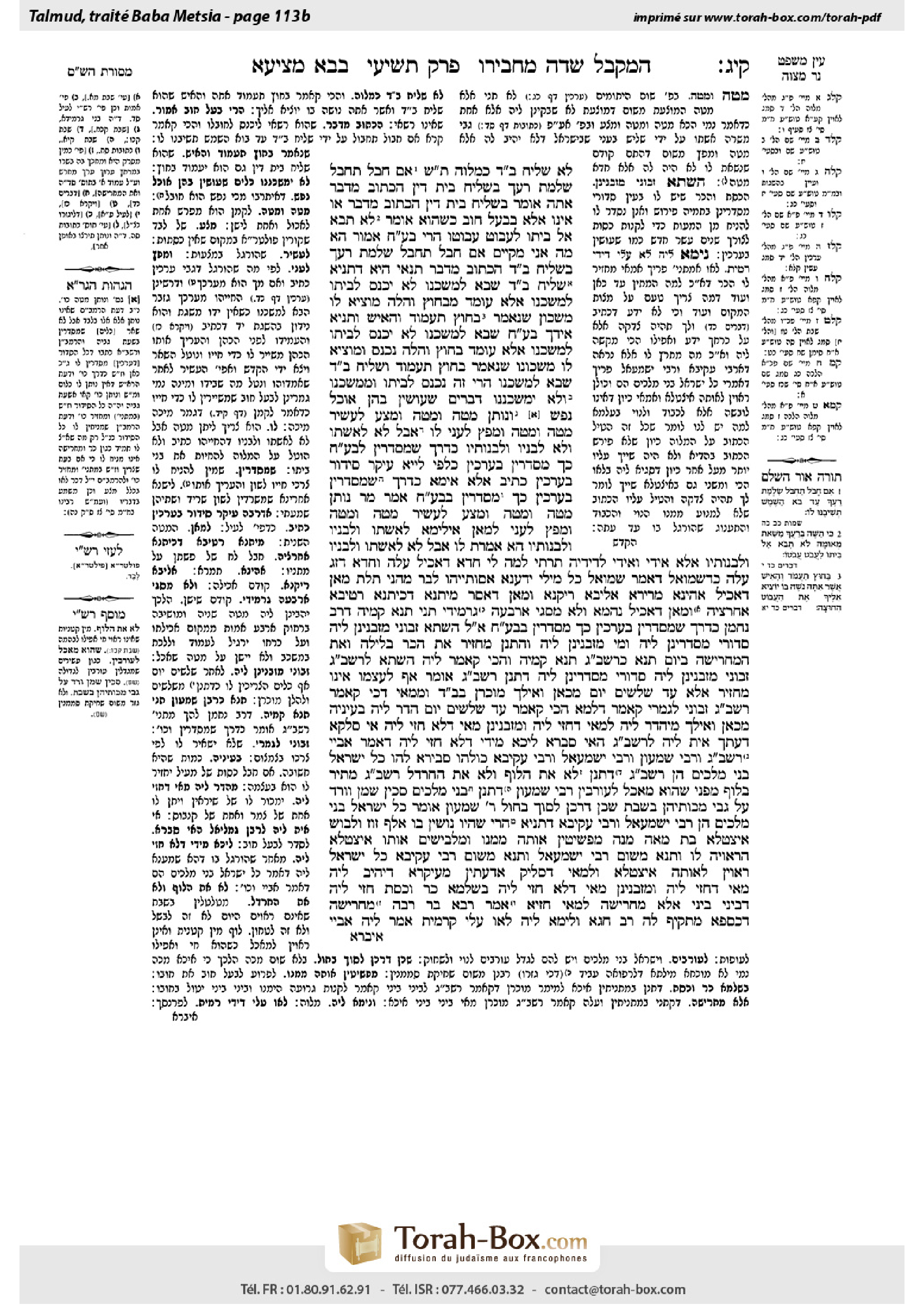
Scan : Torah-Box. Daf Study est un projet indépendant, sans affiliation ni approbation de Torah-Box ou de Sefaria.