Baba Metsia 116b en français · בבא מציעא קי״ו ב
Traduction française du daf 116b du traité Baba Metsia (Bava Metzia 116b en anglais), avec le texte araméen, l’anglais de Sefaria et le scan de la page, pour étudier le Daf Yomi.
Ouvrir dans le lecteur interactifLire le daf du jour
Traduction française de Baba Metsia 116b
Les traductions françaises de Daf Study sont générées par IA à partir de l’édition anglaise de Sefaria. Elles peuvent contenir des erreurs : vérifie toujours un passage avec le texte source.
MICHNA : Si une maison et son étage supérieur, appartenant à deux personnes différentes — l’étage inférieur à l’une et l’étage supérieur à l’autre — s’effondrent, les deux se partagent le bois, les pierres et les décombres de la structure effondrée. Le tribunal examine quelles pierres étaient susceptibles de se briser, celles de l’étage inférieur ou celles de l’étage supérieur, et attribue les pierres brisées à celui qui en était vraisemblablement propriétaire. Si l’un d’eux reconnaît certaines de ses pierres, il peut les prendre ; elles sont comptées dans son lot de pierres, et l’autre partie prend d’autres pierres en conséquence. Ils ne se partagent pas à parts égales les pierres restantes.
GUEMARA : Du fait que la Michna enseigne que le tribunal examine quelles pierres étaient susceptibles de se briser, on peut déduire que le cas est celui où il est possible de déterminer, en observant les décombres, comment l’accident s’est produit : soit la structure s’est effondrée sous la pression [ḥavasa], c’est-à-dire que l’étage inférieur s’est écroulé et que l’étage supérieur a suivi, soit elle s’est effondrée sous l’effet d’un choc, c’est-à-dire que l’étage supérieur s’est écroulé et a entraîné l’étage inférieur. Dans le premier cas, ce sont les pierres de l’étage inférieur qui étaient susceptibles de se briser ; dans le second, celles de l’étage supérieur.
La Guemara demande : si tel est le cas, s’il est possible de déterminer comment l’effondrement s’est produit, pourquoi, dans la première partie de la Michna, les parties se partagent-elles les pierres sans tenir compte des circonstances ? Qu’ils examinent la situation : si la maison s’est effondrée sous l’effet d’un choc, cela signifie que les pierres de l’étage supérieur se sont brisées, et le propriétaire de l’étage inférieur prend les pierres intactes. Et si elle s’est effondrée sous la pression, cela signifie que les pierres de l’étage inférieur se sont brisées, et le propriétaire de l’étage supérieur prend les pierres intactes.
La Guemara rejette cette analyse : non, il est nécessaire d’énoncer la règle de la Michna dans le cas où la maison s’est effondrée pendant la nuit et où personne n’a vu comment elle est tombée. La Guemara objecte : mais, dans un tel cas, qu’ils examinent les pierres le matin pour déterminer comment la maison s’est effondrée. La Guemara répond : la première partie de la Michna se rapporte à un cas où les pierres ont été déblayées ; il n’y a donc aucun moyen de déterminer ce qui s’est passé. La Guemara objecte : mais, même dans un tel cas, qu’ils voient qui les a déblayées et qu’ils lui demandent ce qui s’est passé. La Guemara explique : la règle de la première partie de la Michna est énoncée pour un cas où le public les a déblayées puis est parti, de sorte qu’il est impossible de l’interroger.
La Guemara objecte : mais, même dans un tel cas, qu’ils voient sur le domaine de qui se trouvent les pierres. Une fois cela déterminé, la halakha est que la charge de la preuve incombe au demandeur, c’est-à-dire au propriétaire des pierres qui se trouvent sur le domaine de l’autre. La Guemara répond : non, il est nécessaire d’énoncer la règle de la Michna dans le cas où les pierres se trouvent dans une cour qui leur appartient à tous deux, ou bien si elles sont tombées dans le domaine public. Et si tu le souhaites, dis plutôt que, dans des cas de ce genre, les associés ne sont pas pointilleux entre eux quant au partage de la cour, au point que l’un ne puisse pas laisser ses biens du côté de l’autre. Par conséquent, la présence des pierres dans la partie de la cour appartenant à l’un d’eux ne suffit pas à étayer sa revendication.
§ La Michna enseigne : si l’un d’eux reconnaît certaines de ses pierres, il peut les prendre. La Guemara demande : et que prétend l’autre ? S’il dit : « Oui, elles appartiennent à l’autre », cette halakha est évidente ; pourquoi la Michna aurait-elle besoin de l’énoncer ? Et s’il ne dit pas oui, pourquoi celui qui reconnaît les pierres les prend-il ? Quelle preuve a-t-il qu’elles lui appartiennent ? Il faut donc plutôt dire que l’autre lui répond : « Je ne sais pas à qui sont ces pierres. » Par conséquent, celui qui a formulé une revendication certaine est cru.
La Guemara propose : faut-il dire que cela réfute définitivement l’opinion de Rav Naḥman ? En effet, les amoraïm ont fait l’objet d’un désaccord au sujet du cas suivant : quelqu’un s’adresse à un autre et lui dit : « Tu détiens cent dinars qui m’appartiennent », et l’autre répond : « Je ne sais pas. » Rav Houna et Rav Yehouda disent : le défendeur est tenu de payer, car il n’a pas nié la revendication. Rav Naḥman et Rabbi Yoḥanan disent : il est dispensé de payer. La Michna semble indiquer que répondre « Je ne sais pas » équivaut à un aveu.
La Guemara réfute cette affirmation : de même que Rav Naḥman dit dans ce contexte que le défendeur n’est tenu de payer que lorsqu’il existe entre eux une obligation de prêter serment, de même, ici, il existe entre eux une obligation de prêter serment. Dans ce cas, Rav Naḥman statue que le défendeur est tenu de payer uniquement s’il est déjà tenu de prêter serment parce qu’il a reconnu une partie de la revendication tout en niant le reste. Comme il ignore s’il doit cette somme et ne peut donc pas prêter le serment qu’il est tenu de prêter, il doit payer. De même, dans le cas présent, la Michna parle d’une situation où celui qui dit qu’il ne sait pas est tenu de prêter serment.
La Guemara demande : dans quelles circonstances existe-t-il une obligation de prêter serment ? La Guemara explique : c’est conformément à l’enseignement de Rava. Rava dit : quelqu’un s’adresse à un autre et lui dit : « Tu détiens cent dinars qui m’appartiennent », et l’autre répond : « Je suis certain que tu as cinquante dinars chez moi ; quant au reste, je ne sais pas. » Comme il a reconnu une partie de la revendication, il est tenu, par la Torah, de prêter serment qu’il ne doit pas les cinquante autres dinars. Puisqu’il ne peut pas prêter un tel serment, car il ne sait pas s’il les doit, il doit payer.
§ La Michna enseigne : si l’un d’eux reconnaît certaines de ses pierres, il peut les prendre ; elles sont comptées dans son lot de pierres, et l’autre partie prend d’autres pierres en conséquence. Rava pensa que cela signifie qu’elles sont comptées dans son lot de pierres brisées. Autrement dit, le premier prend les pierres intactes qu’il a reconnues, en échange d’un nombre équivalent de pierres brisées, et l’autre partie prend un nombre de pierres brisées correspondant au nombre de pierres intactes revendiquées par le premier. Il semble donc que, puisque l’autre a dit : « Je ne sais pas », sa situation juridique est moins favorable.
Abayé lui dit : au contraire, c’est celui-ci, celui qui reconnaît certaines de ses pierres, qui est dans une situation moins favorable. Puisqu’il connaît et reconnaît ces pierres, il est évident qu’il ne sait rien au sujet d’autres pierres ; il n’a donc aucun droit à d’autres pierres intactes, et toutes les autres appartiennent à l’autre partie.
Abayé dit plutôt que cela signifie qu’elles sont comptées dans son lot de pierres intactes. Autrement dit, le premier prend les pierres intactes qu’il a reconnues, en échange d’un nombre équivalent de pierres intactes, et l’autre partie prend un nombre de pierres intactes correspondant au nombre de pierres intactes revendiquées par le premier. La Guemara demande : dans ce cas, qu’a gagné le premier en reconnaissant ses propres pierres ? La Guemara répond : il y gagne pour les briques de la structure, fabriquées dans un moule large. Si ses briques ont été façonnées dans un moule plus large, il a droit à ces briques légèrement plus grandes. Ou bien, si l’argile dont ses briques ont été façonnées a été mieux travaillée, il y gagne en obtenant des briques de meilleure qualité.
MICHNA : Si une maison et son étage supérieur appartiennent à une seule personne et que l’étage supérieur est loué à quelqu’un d’autre, si le plancher de l’étage supérieur est endommagé, c’est-à-dire s’il s’affaisse ou s’effondre, et que le propriétaire de la maison ne veut pas le réparer, l’occupant de l’étage supérieur peut descendre habiter dans la maison située en dessous jusqu’à ce que le propriétaire répare l’étage supérieur pour lui.
Rabbi Yossi dit : dans le cas d’une maison à deux niveaux appartenant à deux personnes — le niveau inférieur à l’une et le niveau supérieur à l’autre — dont le plafond s’est effondré, le propriétaire de l’étage inférieur fournit le plafond, fait de poutres ou de pierres, et le propriétaire de l’étage supérieur fournit le plâtre.
GUEMARA : La Guemara demande : dans quelle mesure le plancher de l’étage supérieur s’est-il brisé ? Quel degré de dommage permet à l’occupant de l’étage supérieur de dire qu’il ne peut plus y habiter ? Rav dit : la plus grande partie a été endommagée ; Chmouel dit : une ouverture de quatre palmes s’est formée.
La Guemara analyse leurs opinions. Rav dit : la plus grande partie a été endommagée, mais si l’ouverture ne mesure que quatre palmes, cette halakha ne s’applique pas, car le propriétaire de l’étage supérieur peut utiliser l’étage inférieur pour y placer l’objet qui aurait normalement été placé à l’endroit du trou ; une personne peut habiter en partie au niveau inférieur et en partie au niveau supérieur. Autrement dit, l’étage supérieur reste habitable, même s’il doit utiliser l’étage inférieur pour y entreposer une partie de ses biens. Chmouel dit qu’une ouverture de quatre palmes suffit pour que la halakha s’applique, car une personne ne peut pas habiter en partie au niveau inférieur et en partie au niveau supérieur.
La Guemara demande : dans quelles circonstances se présente le cas de la Michna ? Si le propriétaire a dit au moment de la location qu’il louait au locataire cet étage supérieur, le locataire n’a de droits que sur cet étage et a perdu la possibilité d’y habiter. Il faut donc plutôt comprendre que le propriétaire lui a dit qu’il souhaitait lui louer un étage supérieur, sans préciser lequel. Dans ce cas, le locataire a certainement droit à un logement habitable, et le propriétaire doit lui louer un étage supérieur dans une autre maison lui appartenant, où il pourra habiter.
La Guemara répond : Rava dit : non, il est nécessaire d’énoncer la règle de la Michna dans le cas où le propriétaire lui a dit : « Cet étage supérieur que je te loue, tant qu’il est fonctionnel, habite-y ; et lorsqu’il s’effondre, c’est-à-dire lorsqu’il n’est plus fonctionnel, descends avec lui et habite à l’étage inférieur. » La Guemara demande : dans ce cas, à quoi sert la Michna d’énoncer cette règle, puisqu’une condition explicite en ce sens a été posée ?
La Guemara répond : Rav Achi dit plutôt qu’il s’agit du cas où le propriétaire lui a dit : « Je te loue cet étage supérieur précis, situé au-dessus de cette maison précise. » En précisant que l’étage supérieur se trouve au-dessus de cette maison précise, le propriétaire a ainsi affecté la maison à l’étage supérieur comme garantie, bien qu’il n’ait pas explicitement déclaré que le locataire aurait le droit d’habiter dans la maison si l’étage supérieur devenait inhabitable.
La Guemara ajoute : cela concorde avec ce que Ravin bar Rav Adda a dit au nom de Rabbi Yitsḥak : un incident eut lieu concernant un homme qui dit à un autre : « Je te vends la vigne qui se trouve au-dessus de ce pêcher [parsek] », puis le pêcher fut déraciné. L’affaire fut portée devant Rabbi Ḥiyya, qui dit : « Tu es tenu de lui planter un pêcher pour soutenir la vigne, tant que celle-ci existe. »
§ Rabbi Abba bar Memel souleva une question :
Texte source et traduction anglaise
בבא מציעא קי״ו ב · texte araméen et hébreu
מַתְנִי׳ הַבַּיִת וְהָעֲלִיָּיה שֶׁל שְׁנַיִם, שֶׁנָּפְלוּ – שְׁנֵיהֶם חוֹלְקִין בָּעֵצִים וּבָאֲבָנִים וּבֶעָפָר. וְרוֹאִין אֵלּוּ אֲבָנִים הָעֲשׂוּיוֹת לְהִשְׁתַּבֵּר. אִם הָיָה אֶחָד מֵהֶן מַכִּיר מִקְצָת אֲבָנָיו – נוֹטְלָן, וְעוֹלוֹת לוֹ מִן הַחֶשְׁבּוֹן.
גְּמָ׳ מִדְּקָתָנֵי רוֹאִין – מִכְּלָל דְּאִיכָּא לְמֵיקַם עֲלַיְיהוּ, אִי בְּחַבְסָא נְפִיל, אִי בְּחַבְטָא נְפִיל.
אִי הָכִי, רֵישָׁא אַמַּאי חוֹלְקִין? נֶחְזֵי אִי בְּחַבְטָא נְפִיל – עִלָּיָיתָא אִיתְּבוּר, אִי בְּחַבְסָא נְפִיל – תַּתָּיָיתָא אִיתְּבוּר!
לָא צְרִיכָא, דִּנְפִיל בְּלֵילְיָא. וְלֶחְזִינְהוּ בְּצַפְרָא? דְּפַנִּינְהוּ. וְלִיחְזֵי מַאן פַּנִּינְהוּ וּלְשַׁיְילֵיהּ? דְּפַנִּינְהוּ בְּנֵי רְשׁוּת הָרַבִּים, וַאֲזַלוּ לְעָלְמָא.
וְלִיחְזֵי בִּרְשׁוּתָ[א] דְּמַאן יָתְבָן, וְלִיהְוֵי אִידַּךְ הַמּוֹצִיא מֵחֲבֵירוֹ עָלָיו הָרְאָיָה! לָא צְרִיכָא, דְּיָיתְבָן בְּחָצֵר דְּתַרְוַיְיהוּ, אִי נָמֵי בִּרְשׁוּת הָרַבִּים. וְאִיבָּעֵית אֵימָא: שׁוּתָּפִין בְּכִי הַאי גַּוְונָא לָא קָפְדִי אַהֲדָדֵי.
אִם הָיָה אֶחָד מֵהֶן מַכִּיר כּוּ׳. וְהַלָּה מָה טוֹעֵן? אִי דְּקָאָמַר אִין – פְּשִׁיטָא! וְאִי לָא אָמַר אִין, לָמָּה נוֹטֵל?! אֶלָּא דְּאָמַר לֵיהּ אֵינִי יוֹדֵעַ.
לֵימָא תִּהְוֵי תְּיוּבְתָּא דְּרַב נַחְמָן, דְּאִיתְּמַר: מָנֶה לִי בְּיָדְךָ, וְהַלָּה אוֹמֵר: אֵינִי יוֹדֵעַ. רַב הוּנָא וְרַב יְהוּדָה אָמְרִי: חַיָּיב. רַב נַחְמָן וְרַבִּי יוֹחָנָן אָמְרִי: פָּטוּר.
כִּדְאָמַר רַב נַחְמָן: כְּגוֹן שֶׁיֵּשׁ עֵסֶק שְׁבוּעָה בֵּינֵיהֶן. הָכָא נָמֵי: כְּגוֹן שֶׁיֵּשׁ עֵסֶק שְׁבוּעָה בֵּינֵיהֶן.
הֵיכִי דָּמֵי עֵסֶק שְׁבוּעָה? כִּדְרָבָא. דְּאָמַר רָבָא: מָנֶה לִי בְּיָדְךָ, וְהַלָּה אוֹמֵר: אֵין לְךָ בְּיָדִי אֶלָּא חֲמִשִּׁים, וְהַשְּׁאָר אֵינִי יוֹדֵעַ. מִתּוֹךְ שֶׁאֵינוֹ יָכוֹל לִישָּׁבַע – יְשַׁלֵּם.
וְעוֹלוֹת לוֹ מִן הַחֶשְׁבּוֹן. סָבַר רָבָא לְמֵימַר לְפִי חֶשְׁבּוֹן שְׁבוּרוֹת. אַלְמָא כֵּיוָן דְּאָמַר אֵינִי יוֹדֵעַ, רִיעַ טְפֵי.
אֲמַר לֵיהּ אַבָּיֵי: אַדְּרַבָּה, הָא רִיעַ טְפֵי. מִדְּהָנֵי יָדַע, טְפֵי לָא יָדַע – תּוּ לֵית לֵיהּ, וְאִידַּךְ כּוּלְּהוּ דְּהַיְאךְ נִינְהוּ!
אֶלָּא אָמַר אַבָּיֵי: לְפִי חֶשְׁבּוֹן שְׁלֵימוֹת. אִי הָכִי מַאי קָמְהַנֵּי לֵיהּ? לְמַלְבְּנָא רַוְוחָא. אִי נָמֵי טִינָא דִּמְעַבְּדָא.
מַתְנִי׳ הַבַּיִת וְהָעֲלִיָּיה. נִפְחֲתָה הָעֲלִיָּיה, וְאֵין בַּעַל הַבַּיִת רוֹצֶה לְתַקֵּן – הֲרֵי בַּעַל הָעֲלִיָּיה יוֹרֵד וְדָר לְמַטָּה, עַד שֶׁיְּתַקֵּן לוֹ אֶת הָעֲלִיָּיה.
רַבִּי יוֹסֵי אוֹמֵר: הַתַּחְתּוֹן נוֹתֵן אֶת הַתִּקְרָה, וְהָעֶלְיוֹן אֶת הַמַּעֲזִיבָה.
גְּמָ׳ נִפְחֲתָה בְּכַמָּה? רַב אָמַר: בְּרוּבָּהּ, וּשְׁמוּאֵל אָמַר: בְּאַרְבָּעָה.
רַב אָמַר: בְּרוּבָּהּ, אֲבָל בְּאַרְבָּעָה – לֹא: אָדָם דָּר חֶצְיוֹ לְמַטָּה וְחֶצְיוֹ לְמַעְלָה. וּשְׁמוּאֵל אָמַר, בְּאַרְבָּעָה: אֵין אָדָם דָּר חֶצְיוֹ לְמַטָּה וְחֶצְיוֹ לְמַעְלָה.
הֵיכִי דָמֵי? אִי דְּאָמַר עֲלִיָּיה זוֹ – אֲזַדָא! אֶלָּא דַּאֲמַר לֵיהּ עֲלִיָּיה סְתָם – לוֹגַר לֵיהּ אַחֲרִיתִי.
אָמַר רָבָא, לָא צְרִיכָא דַּאֲמַר לֵיהּ: עֲלִיָּיה זוֹ שֶׁאֲנִי מַשְׂכִּיר לָךְ, כִּי סָלְקָא – סְלֵיק בַּהֲדַהּ, וְכִי נָחֲיתָ[א] – חוּת בַּהֲדַהּ. אִי הָכִי, מַאי לְמֵימְרָא?
אֶלָּא אָמַר רַב אָשֵׁי, דַּאֲמַר לֵיהּ: ״עֲלִיָּיה זוֹ שֶׁעַל גַּבֵּי בַּיִת זֶה אֲנִי מַשְׂכִּיר לָךְ״, דְּהָא שַׁעְבֵּיד בַּיִת לַעֲלִיָּיה.
וְכִי הָא דְּאָמַר רָבִין בַּר רַב אַדָּא אָמַר רַבִּי יִצְחָק: מַעֲשֶׂה בְּאֶחָד שֶׁאָמַר לַחֲבֵירוֹ ״דָּלִית שֶׁעַל גַּבֵּי פַּרְסֵק זֶה אֲנִי מוֹכֵר לָךְ״, וְנֶעֱקַר הַפַּרְסֵק. וּבָא מַעֲשֶׂה לִפְנֵי רַבִּי חִיָּיא, וְאָמַר: חַיָּיב אַתָּה לְהַעֲמִיד לוֹ פַּרְסֵק כׇּל זְמַן שֶׁהַדָּלִית קַיֶּימֶת.
בָּעֵי רַבִּי אַבָּא בַּר מֶמֶל:
Bava Metzia 116b · traduction anglaise de Sefaria
MISHNA: In the case of the house and the upper story belonging to two people, i.e., the lower story was owned by one individual, while the upper story belonged to someone else, that collapsed, the two of them divide the timber and the stones and the earth of the collapsed structure. And the court considers which stones were likely to break, those of the lower or upper story, and gives those broken stones to the one who presumably owned them. If one of them recognized some of his stones he may take them for himself, and they count toward his amount of stones, and the other party takes other stones accordingly. They do not divide the remaining stones equally.
GEMARA: From the fact that the mishna teaches that the court considers which stones were likely to break, it can be understood by inference that the case is one in which it is possible to establish with regard to the stones, by looking at the debris, how the accident occurred: Whether it fell with pressure [ḥavasa], i.e., the lower story collapsed, and the upper story followed, or whether it fell with a blow, i.e., the upper story collapsed, and caused the lower story to follow suit. In the first instance, it is the stones of the lower story that were likely to break, in the latter instance, the stones of the upper story.
The Gemara asks: If that is so, that it is possible to ascertain how the collapse occurred, then why, in the first clause of the mishna, do they divide the stones without taking the circumstances into consideration? Let us see: If the house fell with a blow, it means that the stones of the upper story broke, and the owner of the lower story takes the unbroken stones. And if it fell with pressure, it means that the stones of the lower story broke, and the owner of the upper story takes the unbroken stones.
The Gemara rejects this analysis: No, it is necessary to state the ruling of the mishna in a case when the house collapsed at night, and no one saw how it fell. The Gemara challenges: But in such a case, let them see the stones in the morning to ascertain how the house collapsed. The Gemara answers: The first clause of the mishna is referring to a case where they had cleared away the stones, and consequently there is no way to determine what occurred. The Gemara challenges: But even in such a case, let them see who cleared them away, and let them ask them what happened. The Gemara explains: The ruling of the first clause of the mishna is stated with regard to a case where the general public cleared them away and left, so that they cannot be asked.
The Gemara challenges: But even in such a case, let them see in whose domain the stones are situated. And once this is determined, the halakha will be that the burden of proof rests upon the claimant, i.e., the owner of the stones situated in the other’s domain. The Gemara answers: No, it is necessary to state the ruling of the mishna in a case where the stones are situated in a courtyard that belongs to both of them, or alternatively, if the stones fell into the public domain. And if you wish, say that partners in cases like this are not particular with each other about dividing the courtyard in such a way that the one cannot leave his belongings on the other’s side of the courtyard, and therefore the presence of the stones in the area of the courtyard belonging to one of them does not substantiate a claim for the stones.
§ The mishna teaches: If one of them recognized his stones he may take them. The Gemara asks: And the other, what does he claim? If he says: Yes, they belong to the other, this halakha is obvious, so why would the mishna need to state this? And if he does not say yes, why does the one that recognizes the stones take them? What proof does he have that they are his? Rather, it must be that the other says to him: I don’t know whose stones they are, and consequently, the one who stated a definitive claim is deemed credible.
The Gemara suggests: Shall we say that it is a conclusive refutation of the opinion of Rav Naḥman? As it was stated that the amora’im disagreed about the following case: With regard to one who approaches another and says: I have one hundred dinars in your possession, and the other says: I don’t know, Rav Huna and Rav Yehuda say: The respondent is liable to pay, because he did not deny the claim. Rav Naḥman and Rabbi Yoḥanan say: He is exempt from payment. It appears from the mishna that the response: I don’t know, is tantamount to an admission.
The Gemara refutes this contention: Just as Rav Naḥman says in that context: He is liable to pay only in a case where there is a matter of an oath between them, here too, it is a case where there is a matter of an oath between them. In that case, Rav Naḥman rules that he is liable to pay only if he is already liable to take an oath concerning his denial of part of the claim. Since he does not know if he owes this sum, and he is therefore unable to take the oath he is liable to take, he must pay. In this case as well, the mishna is discussing a case where the one who says he does not know is liable to take an oath.
The Gemara asks: What are the circumstances of a matter of an oath? The Gemara explains: This in accordance with the statement of Rava, as Rava says: One who approaches another and says: I have one hundred dinars in your possession, and the other says: You have in my possession only fifty dinars that I am sure about, and as for the rest, I don’t know. As one who admitted to part of a claim, he is liable, by Torah law, to take an oath that he does not owe the other fifty dinars. Since he cannot take an oath to that effect, as he is unsure if he owes it, he must pay.
§ The mishna teaches: If one of them recognized some of his stones he may take them for himself, and they count toward his amount of stones, and the other party takes other stones accordingly. Rava thought to say that this means they count toward his amount of his broken stones. In other words, the first party takes the unbroken stones he recognized, in place of a similar amount of broken stones, and the other party takes an amount of broken stones correspond-ing to the amount of unbroken stones claimed by the first person. Apparently, since he said: I don’t know, his legal status is worse.
Abaye said to him: On the contrary, this one, the one who recognizes some of his stones, is worse off. He is worse off because since he knows and recognizes these stones, he evidently does not know anything about any more stones, and therefore he has no rights to any more unbroken stones, and all the others are the property of the other party.
Rather, Abaye said that it means they count toward his amount of his unbroken stones. In other words, the first party takes the unbroken stones he recognized, in place of a similar amount of unbroken stones, and the other party takes an amount of unbroken stones corresponding to the amount of unbroken stones claimed by the first person. The Gemara asks: If so, what did the first party gain from recognizing his own stones? The Gemara answers: He gains with regard to bricks from the structure made in a wide brick mold. If his bricks were constructed from a wider mold, he is entitled to these slightly larger ones. Alternatively, if the clay from which his bricks were formed was processed better, he gains by obtaining superior bricks.
MISHNA: If there was a house and an upper story owned by one person, and the upper story was rented out to another, if the floor of the upper story was broken, i.e., it fell in or collapsed, and the owner of the house does not want to repair it, the resident of the upper story can go down and live in the house below until the owner repairs the upper story for him.
Rabbi Yosei says: With regard to a house of two stories owned by two people, i.e., the lower level was owned by one and the upper level by the other, in which the ceiling collapsed; the owner of the lower story provides the ceiling of beams or stones, and the owner of the upper story provides the plaster.
GEMARA: The Gemara asks: In the case of the floor of an upper story that was broken, to what extent did it break? What is the extent of damage that permits the upper resident to say that he is no longer able to live there? Rav says: Most of it was damaged, and Shmuel says: A break of four handbreadths occurred.
The Gemara analyzes their opinions. Rav says: Most of it was damaged, but if the break is only of four handbreadths, this halakha does not apply, since the owner of the upper story can use the lower story to place the item that would normally be placed in the area of the hole, and a person can reside partially on a level below and partially on a level above. In other words, the upper story remains inhabitable even if he must use the lower story to house some of his belongings. And Shmuel says a break of four handbreadths is sufficient for the halakha to apply, since a person cannot reside partially on a level below and partially on a level above.
The Gemara asks: What are the circumstances of the case in the mishna? If the owner said at the time of the rental that he is renting this upper story to the tenant, the tenant has rights only to this upper story, and he has lost the ability to live there. Rather, the owner said to him that he wants to rent an upper story to him, without specifying which one. If so, the renter is certainly entitled to functional living quarters, and the owner must rent him an upper story in a different house belonging to this owner where he can live.
The Gemara answers: Rava says: No, it is necessary to state the ruling of the mishna in a case where the owner said to him: This upper story that I am renting to you, when it is up, i.e., functional, live up there in it, and when it descends, i.e., it is no longer functional, descend with it and live in the lower story. The Gemara asks: If so, what is the purpose of the mishna stating this ruling, as there was an explicit condition to this effect?
The Gemara answers: Rather, Rav Ashi said: This is a case where the owner said to him: I am renting to you this particular upper story, which is on top of this particular house. As by emphasizing that the upper story is above that particular house, the owner thereby rendered the house as liened with regard to the upper story, although he did not explicitly state that the renter will have the right to live in the house were the upper story to become non-functional.
The Gemara adds: And this is in accordance with that which Ravin bar Rav Adda said that Rabbi Yitzḥak said: There was an incident involving one who said to another: I am selling to you the vine that is on top of this peach tree [parsek], and then the peach tree was uprooted. And the incident came before Rabbi Ḥiyya, and he said: You are obligated to erect for him a peach tree to support the vine, as long as the vine exists.
§ Rabbi Abba bar Memel raised a dilemma:
Texte de Sefaria : William Davidson Edition - Vocalized Aramaic (CC BY NC) ; William Davidson Edition - English (CC BY NC).
Scan de Baba Metsia 116b
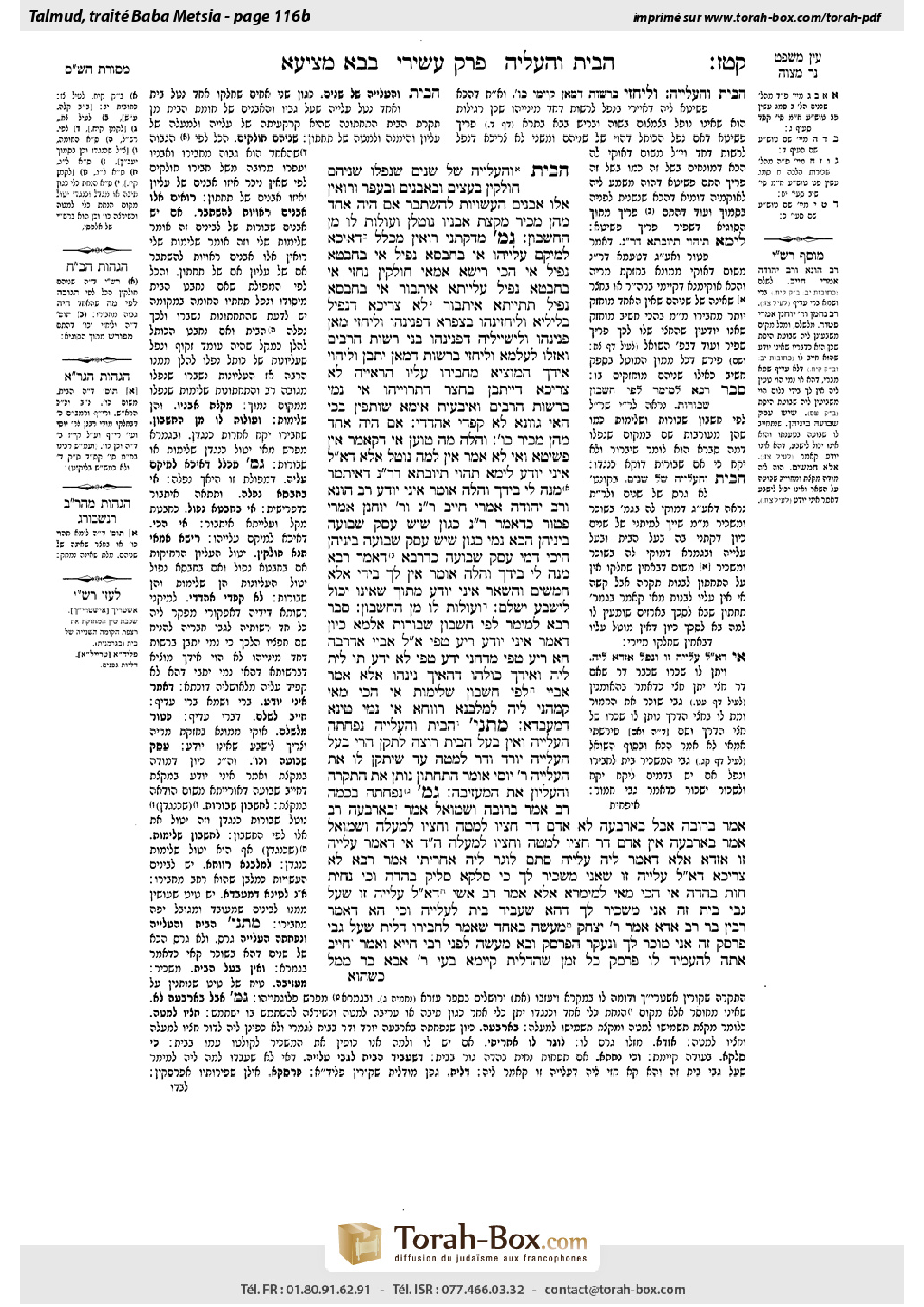
Scan : Torah-Box. Daf Study est un projet indépendant, sans affiliation ni approbation de Torah-Box ou de Sefaria.