Baba Metsia 117b en français · בבא מציעא קי״ז ב
Traduction française du daf 117b du traité Baba Metsia (Bava Metzia 117b en anglais), avec le texte araméen, l’anglais de Sefaria et le scan de la page, pour étudier le Daf Yomi.
Ouvrir dans le lecteur interactifLire le daf du jour
Traduction française de Baba Metsia 117b
Les traductions françaises de Daf Study sont générées par IA à partir de l’édition anglaise de Sefaria. Elles peuvent contenir des erreurs : vérifie toujours un passage avec le texte source.
GUEMARA : Rabbi Yoḥanan dit : En trois endroits, Rabbi Yehuda nous a enseigné le principe selon lequel il est interdit à quelqu’un de tirer profit du bien d’autrui sans que celui-ci en ait pleinement connaissance et y consente, même si l’autre ne subit aucune perte. L’un de ces endroits est la Michna que nous étudions : Rabbi Yehuda n’autorise pas quelqu’un à habiter dans le bien d’autrui sans lui payer de loyer.
Quel est un autre endroit où les paroles de Rabbi Yehuda nous enseignent ce principe ? Nous avons appris dans une Michna (Bava Kamma 100b) : Si quelqu’un donne de la laine à un teinturier pour qu’il la teigne en rouge, mais que celui-ci la teigne en noir, ou pour qu’il la teigne en noir, mais que celui-ci la teigne en rouge, Rabbi Meïr dit : Le teinturier donne au propriétaire de la laine la valeur de celle-ci. Rabbi Yehuda dit : Si la valeur de l’amélioration dépasse les frais du teinturier, le propriétaire de la laine rembourse ces frais au teinturier. Et si les frais dépassent la valeur de l’amélioration, il lui en donne la valeur. Mais le teinturier ne peut pas garder pour lui la laine teinte, car il est interdit de tirer profit du bien d’autrui.
Et quel est l’autre endroit, le troisième, où les paroles de Rabbi Yehuda nous enseignent ce principe ? Nous avons appris dans une Michna (Bava Batra 168a) : Si un débiteur a remboursé une partie de sa dette et a confié son billet de dette à un tiers, chargé de le garder pour empêcher le créancier de recouvrer la totalité de la somme, le débiteur dit au tiers : « Si je ne te donne pas le solde d’ici telle date, remets au créancier son billet de dette », ce qui lui permettra de recouvrer la totalité de la somme qui y est inscrite. Si la date convenue arrive et que le débiteur n’a pas remis le solde au tiers, Rabbi Yosei dit : Le tiers remettra le billet de dette au créancier, conformément à la condition posée par le débiteur. Rabbi Yehuda dit : Le tiers ne le remettra pas, car la condition est nulle. Ici aussi, la raison est qu’il est interdit au créancier de tirer profit du bien d’autrui.
La Guemara réfute ces preuves de la portée générale des décisions de Rabbi Yehuda. Pourquoi faut-il expliquer les choses ainsi ? Peut-être Rabbi Yehuda ne dit-il cela qu’ici, dans le cas de la Michna concernant une maison et un étage supérieur, en raison du noircissement des murs. En utilisant la maison, le propriétaire de l’étage supérieur en noircit les murs et en diminue ainsi la valeur, alors qu’il réclamera finalement la valeur d’une maison neuve qu’il aura construite. C’est pourquoi il lui est interdit d’utiliser la maison sans payer.
Autre explication : si l’on tente de déduire un principe général du cas où quelqu’un a demandé à un teinturier de teindre sa laine en rouge et que celui-ci l’a teinte en noir, on peut expliquer que la décision de Rabbi Yehuda tient au fait que le teinturier a modifié les instructions du propriétaire et s’en est écarté. N’avons-nous pas appris dans une Michna (76a) que quiconque modifie les conditions convenues par les deux parties est désavantagé ?
Quant au cas de celui qui a remboursé une partie de sa dette, là aussi, si le tiers ne peut pas remettre le billet de dette, ce n’est pas pour la raison exposée plus haut. C’est plutôt parce que la remise du billet de dette, qui permettrait ensuite au créancier de recouvrer la somme entière si le débiteur ne rembourse pas à temps, est considérée comme une transaction à intention incertaine [asmakhta] : une condition qu’une personne s’impose de manière excessive, sans s’attendre à devoir la respecter. Or, nous avons entendu Rabbi Yehuda affirmer qu’une asmakhta ne réalise pas d’acquisition. Il n’y a donc aucune preuve que Rabbi Yehuda estime qu’il est interdit de tirer profit de l’argent d’autrui.
§ Rav Aḥa bar Adda dit au nom d’Ulla : Si l’occupant du rez-de-chaussée veut reconstruire la maison effondrée et en modifier la structure en la rebâtissant avec des pierres non équarries, plus grandes que celles d’origine, le tribunal accède à sa demande, car une telle modification ne peut que profiter au propriétaire de l’étage supérieur. Mais si la maison était auparavant construite avec de grandes pierres non équarries et qu’il veut maintenant la reconstruire avec des pierres de taille, plus petites, le tribunal n’accède pas à sa demande, car cela affaiblirait la construction.
De même, si la maison était auparavant construite en briques et qu’il veut la reconstruire avec des poutres, le tribunal accède à sa demande, car ce type de mur est très stable. Mais si la maison était auparavant construite avec des poutres et qu’il veut maintenant la reconstruire en briques, le tribunal n’accède pas à sa demande. S’il veut la couvrir avec de solides poutres de cèdre, le tribunal accède à sa demande ; mais s’il veut la couvrir de bois de sycomore plutôt que de cèdre, le tribunal n’accède pas à sa demande.
S’il veut réduire le nombre de fenêtres, le tribunal accède à sa demande, car cela renforcera les murs ; mais s’il veut augmenter le nombre de fenêtres, le tribunal n’accède pas à sa demande. S’il veut augmenter la hauteur du bâtiment, le tribunal n’accède pas à sa demande, car celui-ci pourrait être moins stable qu’auparavant ; mais s’il veut en réduire la hauteur, le tribunal accède à sa demande.
La halakha est la même en sens inverse : si l’occupant de l’étage supérieur veut modifier la structure et reconstruire son étage avec des pierres de taille plutôt qu’avec de grandes pierres non équarries, le tribunal accède à sa demande, car cela réduit le poids pesant sur le rez-de-chaussée. Mais s’il veut remplacer les pierres de taille, plus petites, par de grandes pierres non équarries, le tribunal n’accède pas à sa demande, car cela alourdirait l’étage supérieur.
De même, s’il veut reconstruire l’étage avec des poutres plutôt qu’avec des briques, le tribunal n’accède pas à sa demande ; mais si l’étage était auparavant construit avec des poutres et qu’il veut maintenant le reconstruire en briques, le tribunal accède à sa demande. S’il veut le couvrir de lourdes poutres de cèdre, le tribunal n’accède pas à sa demande ; mais s’il veut le couvrir de bois de sycomore plutôt que de cèdre, le tribunal accède à sa demande. S’il veut augmenter le nombre de fenêtres, ce qui allégerait la construction, le tribunal accède à sa demande ; mais s’il veut réduire le nombre de fenêtres, le tribunal n’accède pas à sa demande. S’il veut augmenter la hauteur du bâtiment, le tribunal n’accède pas à sa demande, car cela alourdirait la construction ; mais s’il veut en réduire la hauteur, le tribunal accède à sa demande.
§ La Guemara pose une question : S’ils sont si pauvres que ni l’un ni l’autre n’a assez d’argent pour reconstruire la maison et qu’ils sont prêts à vendre le terrain, quelle est la halakha ? La Guemara répond : Une baraïta enseigne : Si ni l’un ni l’autre n’a l’argent nécessaire pour reconstruire la maison, le propriétaire de l’étage supérieur n’a aucun droit sur le terrain, dont tous les droits appartiennent au propriétaire du rez-de-chaussée.
Une autre baraïta enseigne : Rabbi Natan dit : L’occupant du rez-de-chaussée reçoit deux parts du terrain, et celui de l’étage supérieur en reçoit un tiers. D’autres disent : L’occupant du rez-de-chaussée reçoit trois parts, et celui de l’étage supérieur un quart. Rabba dit : Retiens l’avis de Rabbi Natan, car c’est un juge qui pénètre au cœur de la loi. Selon lui, dans quelle mesure la présence de l’étage supérieur diminue-t-elle la valeur de la maison ? D’un tiers. Il a donc droit à un tiers, c’est-à-dire à un tiers de la somme totale reçue pour le terrain.
MICHNA : De même, dans le cas d’un pressoir à olives construit dans une grotte creusée dans le rocher, au-dessus duquel une autre personne a planté un jardin, si le toit du pressoir se brise et que le jardin s’effondre vers l’intérieur, le propriétaire du jardin peut descendre et ensemencer en dessous jusqu’à ce que l’autre construise des arches solides pour soutenir le toit de son pressoir, afin que le propriétaire du jardin puisse de nouveau ensemencer au-dessus.
La Michna poursuit : Si un mur ou un arbre tombe sur la voie publique et cause un dommage, son propriétaire est dispensé de payer, car il s’agissait d’un accident. Si le tribunal avait constaté que le mur menaçait de s’effondrer ou que l’arbre penchait, et qu’il avait accordé au propriétaire un délai pour abattre l’arbre ou démolir le mur, puis que ceux-ci tombent, le propriétaire est dispensé si cela se produit pendant le délai accordé. Mais si leur chute survient après l’expiration de ce délai, il est tenu de payer, puisqu’il avait été averti précisément de ce risque.
Si le mur de quelqu’un, contigu au jardin d’autrui, s’effondre, le propriétaire du jardin lui dit : « Enlève tes pierres », et le propriétaire des pierres lui répond :
Texte source et traduction anglaise
בבא מציעא קי״ז ב · texte araméen et hébreu
גְּמָ׳ אָמַר רַבִּי יוֹחָנָן: בִּשְׁלֹשָׁה מְקוֹמוֹת שָׁנָה לָנוּ רַבִּי יְהוּדָה אָסוּר לְאָדָם שֶׁיֵּהָנֶה מִמָּמוֹן חֲבֵירוֹ. חֲדָא – הָא דִּתְנַן.
אִידַּךְ מָה הִיא, דִּתְנַן: הַנּוֹתֵן צֶמֶר לַצַבָּע לִצְבּוֹעַ לוֹ אָדוֹם וּצְבָעוֹ שָׁחוֹר, שָׁחוֹר וּצְבָעוֹ אָדוֹם, רַבִּי מֵאִיר אוֹמֵר: נוֹתֵן לוֹ דְּמֵי צַמְרוֹ. רַבִּי יְהוּדָה אוֹמֵר: אִם הַשֶּׁבַח יוֹתֵר עַל הַהוֹצָאָה – נוֹתֵן לוֹ הַיְּצִיאָה, וְאִם הַהוֹצָאָה יְתֵירָה עַל הַשֶּׁבַח – נוֹתֵן לוֹ אֶת הַשֶּׁבַח.
וְאִידַּךְ מַאי הִיא, דִּתְנַן: מִי שֶׁפָּרַע מִקְצָת חוֹבוֹ וְהִשְׁלִישׁ אֶת שְׁטָרוֹ וְאָמַר לוֹ: ״אִם אֵין אֲנִי נוֹתֵן לְךָ מִכָּאן וְעַד זְמַן פְּלוֹנִי – תֵּן לוֹ שְׁטָרוֹ״. הִגִּיעַ זְמַן וְלֹא נָתַן, רַבִּי יוֹסֵי אוֹמֵר: יִתֵּן, רַבִּי יְהוּדָה אוֹמֵר: לֹא יִתֵּן.
אַמַּאי? דִּלְמָא עַד כָּאן לָא קָאָמַר רַבִּי יְהוּדָה הָכָא, אֶלָּא מִשּׁוּם דְּאִיכָּא שַׁחְרוּרִיתָא.
אִי נָמֵי לִצְבּוֹעַ לוֹ אָדוֹם וּצְבָעוֹ שָׁחוֹר – מִשּׁוּם דְּקָא מְשַׁנֶּה, וְהָתְנַן: כׇּל הַמְשַׁנֶּה יָדוֹ עַל הַתַּחְתּוֹנָה.
וּמִי שֶׁפָּרַע מִקְצָת חוֹבוֹ נָמֵי הָוֵי אַסְמַכְתָּא, וְשָׁמְעִינַן לֵיהּ לְרַבִּי יְהוּדָה דְּאָמַר לָא קָנֵי.
אָמַר רַב אַחָא בַּר אַדָּא מִשְּׁמֵיהּ דְּעוּלָּא: תַּחְתּוֹן הַבָּא לְשַׁנּוֹת, בִּגְוִיל – שׁוֹמְעִין לוֹ, בְּגָזִית – אֵין שׁוֹמְעִין לוֹ.
בִּכְפִיסִין – שׁוֹמְעִין לוֹ. בִּלְבֵנִים – אֵין שׁוֹמְעִין לוֹ. לְסַכֵּךְ בַּאֲרָזִים – שׁוֹמְעִין לוֹ. בְּשִׁקְמִים – אֵין שׁוֹמְעִין לוֹ.
לְמַעֵט בְּחַלּוֹנוֹת – שׁוֹמְעִין לוֹ. לְהַרְבּוֹת בְּחַלּוֹנוֹת – אֵין שׁוֹמְעִין לוֹ. לְהַגְבִּיהַּ – אֵין שׁוֹמְעִין לוֹ. לְמַעֵט – שׁוֹמְעִין לוֹ.
עֶלְיוֹן שֶׁבָּא לְשַׁנּוֹת, בְּגָזִית – שׁוֹמְעִין לוֹ, בִּגְוִיל – אֵין שׁוֹמְעִין לוֹ.
בִּכְפִיסִין אֵין שׁוֹמְעִין לוֹ, בִּלְבֵנִים שׁוֹמְעִין לוֹ. בַּאֲרָזִים אֵין שׁוֹמְעִין לוֹ, בְּשִׁקְמָה שׁוֹמְעִין לוֹ. לְרַבּוֹת בְּחַלּוֹנוֹת שׁוֹמְעִין לוֹ, לְמַעֵט בְּחַלּוֹנוֹת אֵין שׁוֹמְעִין לוֹ. לְהַגְבִּיהַּ אֵין שׁוֹמְעִין לוֹ, לְמַעֵט שׁוֹמְעִין לוֹ.
אֵין לוֹ לָזֶה וְלֹא לָזֶה, מַאי? תַּנְיָא: אֵין לוֹ לֹא לָזֶה וְלֹא לָזֶה – אֵין לוֹ לְבַעַל עֲלִיָּיה בַּקַּרְקַע כְּלוּם.
תַּנְיָא, רַבִּי נָתָן אוֹמֵר: תַּחְתּוֹן נוֹטֵל שְׁנֵי חֲלָקִים וְהָעֶלְיוֹן שְׁלִישׁ. וַאֲחֵרִים אוֹמְרִים: תַּחְתּוֹן נוֹטֵל שְׁלֹשָׁה חֲלָקִים וְהָעֶלְיוֹן נוֹטֵל רְבִיעַ. אָמַר רַבָּה: נְקוֹט דְּרַבִּי נָתָן בִּידָךְ, דְּדַיָּינָא הוּא וְנָחֵית לְעוּמְקָא דְּדִינָא, קָא סָבַר: כַּמָּה מַפְסֵיד עֲלִיָּיה בַּבַּיִת – תִּילְתָּא, הִלְכָּךְ אִית לֵיהּ תִּילְתָּא.
מַתְנִי׳ וְכֵן בֵּית הַבַּד שֶׁהוּא בָּנוּי בַּסֶּלַע וְגִינָּה אַחַת עַל גַּבָּיו, וְנִפְחַת – הֲרֵי בַּעַל הַגִּינָּה יוֹרֵד וְזוֹרֵעַ לְמַטָּה עַד שֶׁיַּעֲשֶׂה לְבֵית בַּדּוֹ כִּיפִּין.
הַכּוֹתֶל וְהָאִילָן שֶׁנָּפְלוּ לִרְשׁוּת הָרַבִּים וְהִזִּיקוּ – פָּטוּר מִלְּשַׁלֵּם. נָתְנוּ לוֹ זְמַן לָקוֹץ אֶת הָאִילָן וְלִסְתּוֹר אֶת הַכּוֹתֶל, וְנָפְלוּ בְּתוֹךְ הַזְּמַן – פָּטוּר, לְאַחַר הַזְּמַן – חַיָּיב.
מִי שֶׁהָיָה כּוֹתְלוֹ סָמוּךְ לְגִינַּת חֲבֵירוֹ וְנָפַל, וְאָמַר לוֹ: פַּנֵּה אֲבָנֶיךָ, וְאָמַר לוֹ:
Bava Metzia 117b · traduction anglaise de Sefaria
GEMARA: Rabbi Yoḥanan says: In three places Rabbi Yehuda taught us the principle that it is forbidden for a person to derive benefit from the property of another without his full awareness and consent, even if the other does not suffer a loss. One of the places where we are taught this principle is that which we learn in the mishna, that Rabbi Yehuda does not allow one to reside in another’s property without paying him rent.
What is another place where we are taught this principle from Rabbi Yehuda’s statements? As we learned in a mishna (Bava Kamma 100b): If one gives wool to a dyer to dye it red for him and instead he dyed it black, or to dye it black and he dyed it red, Rabbi Meir says: The dyer gives the owner of the wool the value of his wool. Rabbi Yehuda says: If the value of the enhancement exceeds the dyer’s expenses, the owner of the wool gives the dyer the expenses. And if the expenses exceed the enhancement, he gives him the value of the enhancement. But the dyer may not keep the dyed wool for himself, as it is forbidden for one to benefit from another’s property.
And what is the other, third place where we are taught this principle from Rabbi Yehuda’s statements? As we learned in a mishna (Bava Batra 168a): In a case of a debtor who repaid part of his debt, and he deposited the promissory note with a third party serving as a trustee, to ensure that the creditor not collect the full amount, and the debtor said to the trustee: If I do not give you the balance from now until such and such a time, give the creditor his promissory note, thereby enabling him to collect the full amount stated in the note; if the stipulated time arrived and the debtor has not given the balance to the trustee, Rabbi Yosei says: The trustee shall give the promissory note to the creditor, in accordance with the debtor’s stipulation. Rabbi Yehuda says: The trustee shall not give it, as the stipulation is void. Here too, the reason is that the creditor is forbidden to benefit from the property of another.
The Gemara refutes these proofs as to the general applicability of Rabbi Yehuda’s rulings. Why is it necessary to explain in this manner? Perhaps Rabbi Yehuda is saying this only here, with regard to the case of the mishna concerning a house and an upper story, only because there is the blackening of the walls. By using the house, the owner of the upper story causes its walls to blacken, thereby lowering its value, and yet he will ultimately claim the value of a new house that he built. Therefore, he is prohibited from using the house without paying.
Alternatively, if one attempts to prove a general principle from the case where one instructed a dyer to dye the wool for him red and he dyed it black, it can be explained that the reason for the ruling of Rabbi Yehuda is due to the fact that the dyer is changing and deviating from the owner’s instructions, and didn’t we learn in a mishna (76a) that whoever changes the terms accepted by both parties is at a disadvantage?
And as for the case of one who repaid part of his debt, there too, the reason the trustee may not transfer the promissory note is not as explained above. Rather, it is due to the fact that the transfer of the promissory note and subsequent collection of the entire sum if he does not repay on time is considered a transaction with inconclusive intent [asmakhta], a condition that an individual accepts upon himself as an exaggerated measure that he does not expect to have to fulfill, and we heard Rabbi Yehuda who says that an asmakhta does not effect acquisition. There is therefore no proof that Rabbi Yehuda holds that it is forbidden for one to benefit from the money of another.
§ Rav Aḥa bar Adda says in the name of Ulla: In the case of a resident of the lower story who wishes to rebuild the collapsed house, who comes to change the structure and now seeks to rebuild it with untrimmed stones that are larger than the original ones, the court listens to him and accepts his wishes, since an adjustment of this kind only serves to benefit the owner of the upper story. But if the house was previously built with large untrimmed stones and he now wants to rebuild it with hewn stones, which are smaller, the court does not listen to him, as this reduces the strength of the building.
Similarly, if the house was formerly built with bricks, and he wants to rebuild it with girders, the court listens to him, as this type of wall is very stable. But if the house was previously built with girders, and he now wants to rebuild it with bricks, the court does not listen to him. If he wants to roof it with strong cedar wood, the court listens to him, but if he wants to roof it with sycamore wood, instead of cedar, the court does not listen to him.
If he wants to reduce the number of windows, the court listens to him, as this will strengthen the walls, but if he wants to increase the number of windows, the court does not listen to him. If he wants to heighten the building, the court does not listen to him, as it might be less stable than before, but if he wants to reduce its height, the court listens to him.
The halakha is the same in the reverse: In the case of a resident of the upper story who comes to change the structure, and wishes to rebuild the upper story with hewn stones instead of large untrimmed stones, the court listens to him, as this reduces the weight on the lower floor. But if he wants to change from smaller hewn stones and rebuild with larger untrimmed stones, the court does not listen to him, as this would make the upper story heavier.
Likewise, if he wants to rebuild it with girders instead of bricks, the court does not listen to him, but if it was previously built with girders, and he now wants to rebuild it with bricks, the court listens to him. If he wants to roof it with heavy cedar wood, the court does not listen to him, but if he wants to roof it with sycamore wood instead of cedar, the court listens to him. If he wants to increase the number of windows, which would lessen the weight of the construction, the court listens to him, but if he wants to reduce the number of windows, the court does not listen to him. If he wants to heighten the building, the court does not listen to him, as this increases the weight of the building, but if he wants to reduce its height, the court listens to him.
§ The Gemara poses a question: If they are so poor that neither this one nor that one has enough money to rebuild it, and they are prepared to sell the land, what is the halakha? The Gemara answers: It is taught in a baraita: If neither this one nor that one has the money to rebuild the house, the owner of the upper story does not have any rights to the land, and all rights of the land belong to the owner of the lower story.
It is taught in a different baraita: Rabbi Natan says: The resident of the lower story takes two shares of the land, and the resident of the upper story takes one-third. And others say: The resident of the lower story takes three shares, and the resident of the upper story takes one-quarter. Rabba says: Take the statement of Rabbi Natan in your hand, because he is a judge, and he descends to the depths of the law. He maintains: How much does the presence of the upper story depreciate the value of the house? One-third. Therefore he has one-third, i.e., he is entitled to one-third of the total sum that they receive for the land.
MISHNA: And likewise, in the case of an olive press that is built inside a cave in a rock, and one garden, belonging to another person, was planted on top of it, and the roof of the olive press broke, which caused the garden to collapse inward, in such a case, the owner of the garden may descend and sow below until the other one constructs for his olive press sturdy arches to support the roof, so that the owner of the garden can once again sow above him.
The mishna continues: In the case of a wall or a tree that fell into the public domain and caused damage, the owner is exempt from having to pay, as it was an accident. If the court saw that the wall was shaky, or that the tree was tilting, and they gave him time to cut down the tree or to dismantle the wall, and then they fell down, if this occurred during the allotted time, he is exempt, but if they collapsed after the time given to him had elapsed, he is liable to pay, since he was warned against this very occurrence.
In the case of one whose wall was adjacent to another’s garden, and the wall fell, and the owner of the garden said to him: Clear away your stones, and the owner of the stones said to him:
Texte de Sefaria : William Davidson Edition - Vocalized Aramaic (CC BY NC) ; William Davidson Edition - English (CC BY NC).
Scan de Baba Metsia 117b
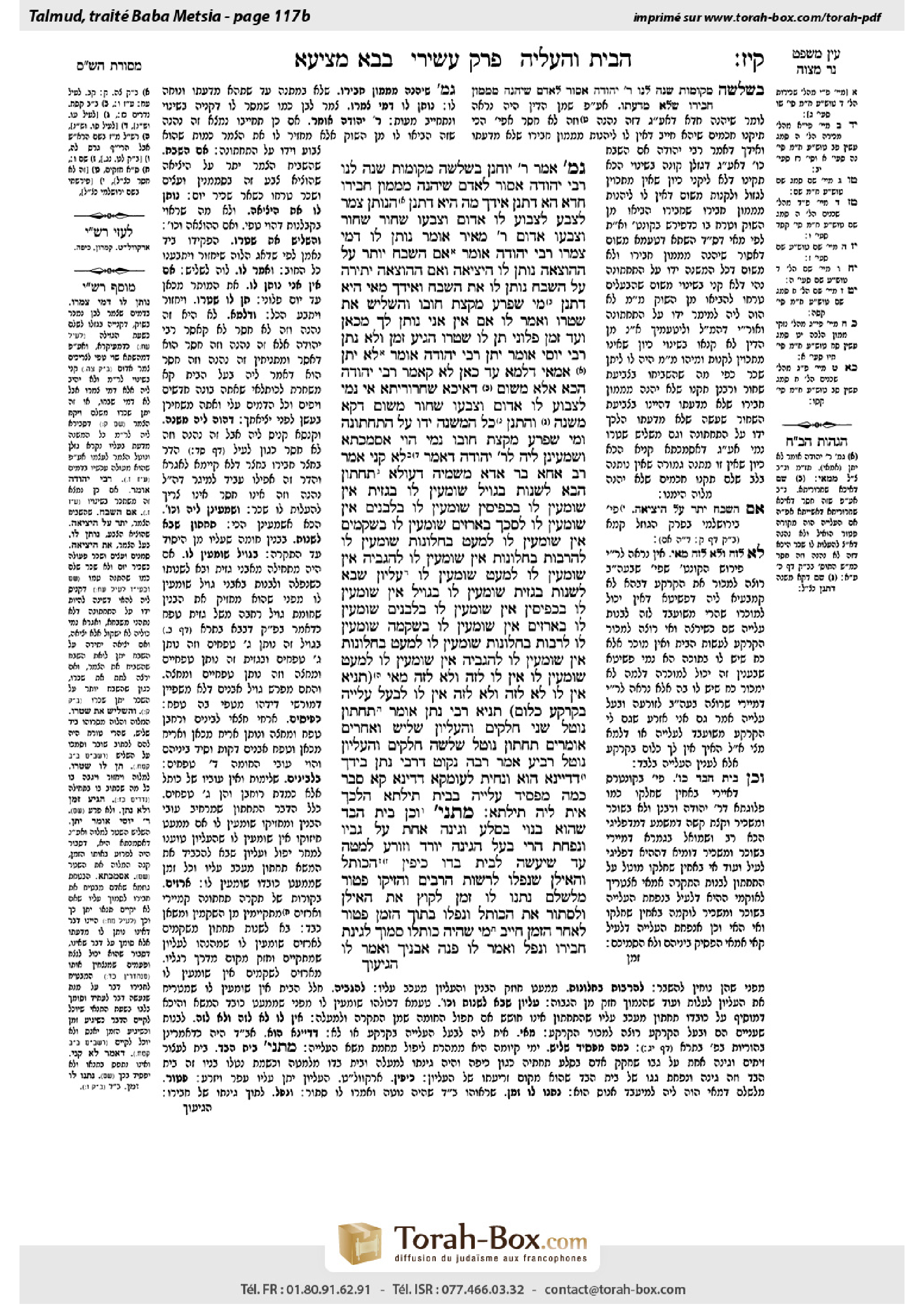
Scan : Torah-Box. Daf Study est un projet indépendant, sans affiliation ni approbation de Torah-Box ou de Sefaria.