Baba Metsia 92a en français · בבא מציעא צ״ב א
Traduction française du daf 92a du traité Baba Metsia (Bava Metzia 92a en anglais), avec le texte araméen, l’anglais de Sefaria et le scan de la page, pour étudier le Daf Yomi.
Ouvrir dans le lecteur interactifLire le daf du jour
Traduction française de Baba Metsia 92a
Les traductions françaises de Daf Study sont générées par IA à partir de l’édition anglaise de Sefaria. Elles peuvent contenir des erreurs : vérifie toujours un passage avec le texte source.
Mais un ouvrier qui marche est considéré comme quelqu’un qui effectue son travail. Pourtant, puisqu’un ouvrier qui travaille sur cette vigne ne peut pas manger des fruits d’une autre vigne, il n’aurait pas le droit de manger en marchant sans le décret des Sages.
§ La Michna enseigne : Quant à un âne, il peut manger pendant qu’on le décharge. La Guemara s’étonne de cette affirmation : où peut-il manger pendant qu’on le décharge ? Puisqu’on retire alors la charge de l’animal, comment l’âne pourrait-il en manger ? Il faut plutôt dire : il peut manger jusqu’à ce qu’on le décharge. Tant qu’il porte sa charge, l’âne peut manger la nourriture qui se trouve sur son dos. La Guemara fait remarquer : Nous apprenons dans la Michna ce que les Sages ont enseigné explicitement dans une baraïta : un âne et un chameau peuvent manger la charge qu’ils portent sur le dos, à condition que le propriétaire de l’animal ne prenne pas de nourriture dans sa main pour les nourrir.
MICHNA : Un ouvrier peut manger des concombres pendant qu’il travaille, même si la quantité qu’il mange vaut un dinar ; ou il peut manger des dattes, même si la quantité qu’il mange vaut un dinar. Rabbi Elazar Ḥisma dit : un ouvrier ne peut pas manger une quantité supérieure à la valeur de son salaire, mais les Rabbins le permettent, selon la stricte lettre de la loi. Toutefois, on enseigne à une personne à ne pas être gloutonne, afin qu’elle ne se ferme pas la porte à d’autres offres d’emploi. Lorsqu’on entendra parler de sa cupidité, on hésitera à l’embaucher.
GUEMARA : La Guemara demande : L’avis des Rabbins est identique à celui du premier tanna. Or, une Michna ne répéterait pas exactement la même opinion. La Guemara explique : la différence pratique entre eux concerne l’affirmation : « Toutefois, on enseigne à une personne à ne pas être gloutonne. » Selon le premier tanna, on n’admet pas le principe selon lequel on enseigne à une personne à ne pas être gloutonne. Selon les Rabbins, ce principe est admis.
Si tu le souhaites, dis plutôt que la différence pratique entre eux concerne une halakha enseignée par Rav Asi. Car Rav Asi dit : même s’il l’a embauché pour récolter une seule grappe, l’ouvrier peut manger. Et Rav Asi dit encore : même s’il n’a récolté qu’une seule grappe, il peut la manger.
La Guemara fait remarquer qu’il était nécessaire que Rav Asi enseigne ces deux halakhot, malgré leur apparente similitude. En effet, s’il nous avait enseigné uniquement la première, on aurait pu penser qu’il peut manger parce qu’il n’y a pas d’autre nourriture à mettre dans les récipients du propriétaire, puisqu’il a été embauché pour récolter une seule grappe. La Torah lui permet de manger ; et s’il ne lui est pas permis de manger cette grappe, que pourrait-il manger d’autre ? Mais si des fruits restent à mettre dans les récipients du propriétaire, comme dans le second cas, on aurait pu dire qu’il doit d’abord en mettre une partie dans les récipients, puis manger.
Et si Rav Asi nous avait enseigné uniquement le second cas, on aurait pu dire que la raison pour laquelle il peut manger est qu’il est finalement possible de satisfaire à l’obligation de mettre des fruits dans les récipients du propriétaire, c’est-à-dire qu’il peut manger tout en accomplissant son travail. Mais dans une situation où il lui est finalement impossible d’accomplir son travail, puisqu’après avoir mangé l’unique grappe qu’il a été embauché pour récolter, il n’aurait plus rien à faire, on aurait pu dire qu’il ne peut pas manger. C’est pourquoi les deux halakhot sont nécessaires.
La Guemara revient à la controverse de la Michna : si tu le souhaites, dis que la différence pratique entre les avis du premier tanna et des Rabbins concerne une halakha enseignée par Rav. Car Rav dit : J’ai trouvé un rouleau caché, un document qui énumère des halakhot sous une forme abrégée afin qu’on ne les oublie pas. Rav découvrit ce document dans la maison de Rabbi Ḥiyya, et il y était écrit : Isi ben Yehouda dit que, dans le verset « Lorsque tu entreras dans la vigne de ton prochain, tu pourras manger des raisins jusqu’à satiété, à ta convenance » (Deutéronome 23:25), il est question de toute personne qui passe près d’une vigne, et pas seulement d’un ouvrier.
Et Rav répondit : Isi n’a laissé aucun moyen de subsistance à qui que ce soit, car de nombreuses personnes pourraient passer et consommer tous les fruits d’une vigne. Le premier tanna est d’accord avec Rav, tandis que les Rabbins acceptent l’opinion d’Isi ben Yehouda selon laquelle, en droit, même quelqu’un qui n’est pas ouvrier peut manger.
Rav Ashi dit : J’ai exposé cette halakha devant Rav Kahana et j’ai suggéré qu’Isi ben Yehouda faisait peut-être référence à des ouvriers qui travaillent en échange de leur repas, c’est-à-dire qu’ils entrent de leur propre gré dans la vigne pour y travailler et manger. Autrement dit, Isi ben Yehouda ne voulait pas dire que n’importe qui peut se servir en fruits. Il voulait plutôt dire que si quelqu’un choisit de travailler dans la vigne d’autrui, il peut manger de ses raisins, même s’il n’a pas été embauché par le propriétaire. Rav Kahana me répondit : malgré tout, une personne préfère embaucher des ouvriers pour cueillir les fruits de son verger plutôt que de laisser tout le monde venir les manger, car elle craint que des personnes qu’elle n’a pas embauchées n’effectuent pas correctement le travail.
§ Une question fut posée aux Sages : dans le cas d’un ouvrier qui mange pendant qu’il travaille, mange-t-il de son propre bien, c’est-à-dire que la nourriture qu’il mange s’ajoute à son salaire et devient donc sa propriété privée, ou mange-t-il du bien du Ciel ? Autrement dit, peut-être la Torah lui a-t-elle accordé le droit de manger la nourriture sur laquelle il travaille comme un privilège particulier, sans pour autant qu’elle lui appartienne.
La Guemara demande : quelle est la différence pratique soulevée par cette question ? La Guemara répond : la différence concerne le cas où il dit : « Moi-même, je ne mangerai pas, mais je donnerai les fruits à ma femme et à mes enfants à ma place. » Si tu dis qu’il mange de son propre bien, on leur donne la nourriture, puisqu’elle lui appartient ; mais si tu dis qu’il mange du bien du Ciel, le Miséricordieux accorde à l’ouvrier lui-même le droit de manger, mais ne l’accorde pas à sa femme et à ses enfants. Quelle est donc la halakha ?
La Guemara propose : Viens et écoute une preuve tirée de la Michna : un ouvrier peut manger des concombres, même si la quantité qu’il mange vaut un dinar ; ou il peut manger des dattes, même si la quantité qu’il mange vaut un dinar. Si tu dis qu’il mange de son propre bien, est-il possible qu’il ait été embauché pour un sixième de dinar et qu’il puisse pourtant manger une quantité valant un dinar entier ? La Torah lui aurait-elle accordé la propriété d’une somme aussi importante par rapport à son salaire ? La Guemara réfute cet argument : Mais alors, que diras-tu ? Dirais-tu qu’il mange du bien du Ciel ? Dans ce cas aussi, il a finalement été embauché pour un sixième de dinar, et pourtant, dans la pratique, il peut manger une quantité valant un dinar. Mais que peux-tu répondre ? Que le Miséricordieux lui accorde le droit de manger davantage que son salaire. Ici aussi, on peut de même dire que le Miséricordieux lui accorde le droit de posséder davantage que son salaire.
La Guemara propose une autre possibilité : Viens et écoute une preuve tirée d’un autre passage de la Michna : Rabbi Elazar Ḥisma dit qu’un ouvrier ne peut pas manger une quantité supérieure à la valeur de son salaire, mais que les Rabbins le permettent. N’est-ce pas précisément sur ce point qu’ils sont en désaccord : un Sage, Rabbi Elazar Ḥisma, estime qu’il mange de son propre bien et qu’il ne peut donc pas manger une quantité valant plus que ce qu’il gagne ; tandis que les Rabbins estiment qu’il mange du bien du Ciel ?
La Guemara rejette cette proposition : Non ; il est possible que tous conviennent qu’il mange de son propre bien et que leur désaccord porte ici sur le sens d’un terme du verset : « Lorsque tu entreras dans la vigne de ton prochain, tu pourras manger des raisins jusqu’à satiété, à ta convenance [kenafshekha] » (Deutéronome 23:25). Un Sage, Rabbi Elazar, estime que l’expression « à ta convenance [kenafshekha] », qui signifie littéralement « selon ton âme », désigne une chose pour laquelle il engage sa propre vie, c’est-à-dire que l’ouvrier acquiert les fruits en vertu des risques qu’il accepte dans le cadre de son travail.
Et les Rabbins estiment que le terme « kenafshekha » signifie : comme toi-même. De même que, pour toi-même, c’est-à-dire le propriétaire, si tu te bâillonnes, tu es quitte, car tu n’es pas obligé de manger, de même, dans le cas d’un ouvrier, si tu le bâillonnes, c’est-à-dire si tu ne lui permets pas de manger, tu es quitte. Cela indique qu’il existe des cas où un ouvrier n’a pas le droit de manger.
La Guemara propose : Viens et écoute une preuve tirée d’une baraïta : si un nazir qui travaille dans une vigne dit : « Donnez les raisins à ma femme et à mes enfants », puisqu’il lui est interdit d’en manger lui-même, on ne l’écoute pas. Mais si tu dis qu’un ouvrier mange de son propre bien, pourquoi ne l’écouterait-on pas ? La Guemara répond : dans ce cas, la raison est différente, en vertu du proverbe bien connu concernant un nazir : « Va, va, dit-on au nazir ; fais un détour, fais un détour ; n’approche pas d’une vigne. » Il est interdit à un nazir de manger tout produit de la vigne. Afin de le tenir à l’écart de la tentation, les Sages cherchent à dissuader un nazir d’accepter un travail dans une vigne en ne lui permettant pas de donner les fruits à sa famille. Cette halakha tient donc à la crainte d’une transgression possible et n’a rien à voir avec les droits d’un ouvrier.
Viens et écoute une preuve tirée d’une baraïta : à un ouvrier qui dit : « Donnez les fruits à ma femme et à mes enfants », on ne donne pas suite. Mais si tu dis qu’il mange de son propre bien, pourquoi ne donnerait-on pas suite à sa demande ? La Guemara réfute cet argument : dans ce contexte précis, que signifie « ouvrier » ? Cela désigne un ouvrier nazir. La Guemara conteste cette réponse : Mais une baraïta n’enseigne-t-elle pas le cas d’un nazir, tandis qu’une autre baraïta enseigne le cas d’un ouvrier ? Apparemment, il s’agit de deux halakhot distinctes. La Guemara rejette cette proposition : Ces baraïtot ont-elles été enseignées côte à côte, de sorte qu’on puisse déduire une halakha de la différence de formulation ? Ce sont deux baraïtot distinctes ; on ne peut donc tirer aucune conclusion de la différence de terminologie, et toutes deux peuvent parler d’un ouvrier nazir.
La Guemara propose : Viens et écoute une preuve tirée d’une autre baraïta : d’où déduit-on que si un ouvrier dit : « Donnez les fruits à ma femme et à mes enfants », on ne donne pas suite à sa demande ? Car il est dit : « Mais tu n’en mettras pas dans ton récipient » (Deutéronome 23:25). Et si tu dis que cela concerne également un nazir, alors la raison ne serait pas le verset « Mais tu n’en mettras pas dans ton récipient », mais le principe : « Va, va, dit-on au nazir ; n’approche pas d’une vigne. »
La Guemara réfute cette preuve : Oui, c’est bien ainsi. Cette baraïta parle d’un nazir ; et, puisqu’elle enseigne la halakha en employant le terme « ouvrier », sans préciser qu’il s’agit d’un nazir, elle cite le verset qui concerne un ouvrier. En réalité, la source de cette halakha est un décret lié au naziréat, tandis que cette pratique est permise à tout autre ouvrier.
La Guemara propose : Viens et écoute une preuve tirée d’une Michna (Ma‘asrot 2:7) : à propos de celui qui embauche un ouvrier pour préparer des figues en vue de leur séchage,
Texte source et traduction anglaise
בבא מציעא צ״ב א · texte araméen et hébreu
וּמְהַלֵּךְ כְּעוֹשֶׂה מַעֲשֶׂה דָּמֵי.
וּבַחֲמוֹר כְּשֶׁהִיא פּוֹרֶקֶת. כְּשֶׁהִיא פּוֹרֶקֶת מֵהֵיכָן אָכְלָה! אֵימָא עַד שֶׁתְּהֵא פּוֹרֶקֶת. תְּנֵינָא לְהָא, דְּתָנוּ רַבָּנַן: חֲמוֹר וְגָמָל אוֹכְלִים מִמַּשּׂאוֹי שֶׁעַל גַּבֵּיהֶן, וּבִלְבַד שֶׁלֹּא יִטּוֹל בְּיָדוֹ וְיַאֲכִילֵם.
מַתְנִי׳ אוֹכֵל פּוֹעֵל קִישּׁוּת אֲפִילּוּ בְּדִינָר, כּוֹתֶבֶת וַאֲפִילּוּ בְּדִינָר. רַבִּי אֶלְעָזָר חַסָּמָא אוֹמֵר: לֹא יֹאכַל פּוֹעֵל יָתֵר עַל שְׂכָרוֹ, וַחֲכָמִים מַתִּירִין. אֲבָל מְלַמְּדִין אֶת הָאָדָם שֶׁלֹּא יְהֵא רַעַבְתָן וִיהֵא סוֹתֵם אֶת הַפֶּתַח בְּפָנָיו.
גְּמָ׳ חֲכָמִים הַיְינוּ תַּנָּא קַמָּא? אִיכָּא בֵּינַיְיהוּ אֲבָל מְלַמְּדִין: לְתַנָּא קַמָּא לֵית לֵיהּ ״מְלַמְּדִין״. לְרַבָּנַן אִית לְהוּ ״מְלַמְּדִין״.
אִיבָּעֵית אֵימָא: אִיכָּא בֵּינַיְיהוּ דְּרַב אַסִּי. דְּאָמַר רַב אַסִּי: אֲפִילּוּ לֹא שְׂכָרוֹ אֶלָּא לִבְצוֹר אֶשְׁכּוֹל אֶחָד – אוֹכְלוֹ. וְאָמַר רַב אַסִּי: אֲפִילּוּ לֹא בָּצַר אֶלָּא אֶשְׁכּוֹל אֶחָד – אוֹכְלוֹ.
וּצְרִיכָא, דְּאִי אַשְׁמְעִינַן הָךְ קַמַּיְיתָא – מִשּׁוּם דְּלָא אִיכָּא לְמִיתַּב לְכֵלָיו שֶׁל בַּעַל הַבַּיִת. אֲבָל הֵיכָא דְּאִיכָּא לְמִיתַּב לְכֵלָיו שֶׁל בַּעַל הַבַּיִת – אֵימָא לִיתֵּב בְּרֵישָׁא, וַהֲדַר לֵיכוֹל.
וְאִי אַשְׁמְעִינַן בְּהָא – דְּאֶפְשָׁר לְקַיּוֹמֵי לְבַסּוֹף, אֲבָל הָכָא דְּלָא אֶפְשָׁר לְקַיּוֹמֵי לְבַסּוֹף – אֵימָא לָא, צְרִיכָא.
אִיבָּעֵית אֵימָא: אִיכָּא בֵּינַיְיהוּ דְּרַב. דְּאָמַר רַב: מָצָאתִי מְגִילַּת סְתָרִים בֵּי רַבִּי חִיָּיא, וְכָתוּב בָּהּ: אִיסִי בֶּן יְהוּדָה אוֹמֵר: ״כִּי תָבֹא בְּכֶרֶם רֵעֶךָ״ – בְּבִיאַת כׇּל אָדָם הַכָּתוּב מְדַבֵּר.
וְאָמַר רַב: לָא שְׁבַק אִיסִי חַיֵּי לְכׇל בְּרִיָּה.
אָמַר רַב אָשֵׁי, אַמְרִיתַהּ לִשְׁמַעְתָּא קַמֵּיהּ דְּרַב כָּהֲנָא: דִּלְמָא בְּעוֹשִׂין בִּסְעוּדָּתָם, דְּעָבְדוּ וְאָכְלוּ? אָמַר לִי: אֲפִילּוּ הָכִי, נִיחָא לֵיהּ לְאִינִישׁ (לְאוֹגַר אָגוֹרֵי) [דְּנוֹגַר אֲגִירֵי] וְנִיקְטְפֵיהּ לְפַרְדֵּיסֵיהּ, וְלָא נֵיתוֹ כּוּלֵּי עָלְמָא (וְאָכְלוּ לֵיהּ).
אִיבַּעְיָא לְהוּ: פּוֹעֵל מִשֶּׁלּוֹ הוּא אוֹכֵל, אוֹ מִשֶּׁל שָׁמַיִם הוּא אוֹכֵל?
לְמַאי נָפְקָא מִינַּהּ? דְּאָמַר: תְּנוּ לְאִשְׁתִּי וּבָנַי. אִי אָמְרַתְּ: מִשֶּׁלּוֹ הוּא אוֹכֵל – יָהֲבִינַן לְהוּ, אֶלָּא אִי אָמְרַתְּ: מִשֶּׁל שָׁמַיִם הוּא אוֹכֵל – לְדִידֵיהּ זַכִּי לֵיהּ רַחֲמָנָא, לְאִשְׁתּוֹ וּבָנָיו – לָא זַכִּי לְהוּ רַחֲמָנָא, מַאי?
תָּא שְׁמַע: אוֹכֵל פּוֹעֵל קִישּׁוּת וַאֲפִילּוּ בְּדִינָר, כּוֹתֶבֶת וַאֲפִילּוּ בְּדִינָר. אִי אָמְרַתְּ מִשֶּׁלּוֹ הוּא אוֹכֵל – אֲגִיר בְּדַנְקָא אָכֵיל בְּזוּזָא?! וְאֶלָּא מַאי – מִשֶּׁל שָׁמַיִם הוּא אוֹכֵל, סוֹף סוֹף אֲגִיר בְּדַנְקָא אָכֵיל בְּזוּזָא! אֶלָּא מַאי אִית לָךְ לְמֵימַר – רַחֲמָנָא זַכִּי לֵיהּ, הָכָא נָמֵי רַחֲמָנָא זַכִּי לֵיהּ.
תָּא שְׁמַע, רַבִּי אֶלְעָזָר חַסָּמָא אוֹמֵר: לֹא יֹאכַל פּוֹעֵל יוֹתֵר עַל שְׂכָרוֹ, וַחֲכָמִים מַתִּירִין. מַאי לָאו בְּהָא קָמִיפַּלְגִי: דְּמָר סָבַר מִשֶּׁלּוֹ הוּא אוֹכֵל, וּמָר סָבַר מִשֶּׁל שָׁמַיִם הוּא אוֹכֵל.
לָא דְּכוּלֵּי עָלְמָא מִשֶּׁלּוֹ הוּא אוֹכֵל, וְהָכָא ״בִּכְנַפְשְׁךָ״ קָמִיפַּלְגִי. מָר סָבַר: כְּנַפְשְׁךָ בִּדְבַר שֶׁמּוֹסֵר נַפְשׁוֹ עָלָיו,
וּמָר סָבַר כְּנַפְשְׁךָ: מָה נַפְשְׁךָ, אִם חָסַמְתָּ – פָּטוּר, אַף פּוֹעֵל אִם חָסַמְתָּ – פָּטוּר.
תָּא שְׁמַע: נָזִיר שֶׁאָמַר ״תְּנוּ לְאִשְׁתִּי וּבָנַי״ – אֵין שׁוֹמְעִין לוֹ. וְאִי אָמְרַתְּ מִשֶּׁלּוֹ הוּא אוֹכֵל – אַמַּאי אֵין שׁוֹמְעִין לוֹ? הָתָם, מִשּׁוּם ״לָךְ לָךְ״ אָמְרִין נְזִירָא: ״סְחוֹר סְחוֹר לְכַרְמָא לָא תִּקְרַב״.
תָּא שְׁמַע: פּוֹעֵל שֶׁאָמַר ״תְּנוּ לְאִשְׁתִּי וּבָנַי״ – אֵין שׁוֹמְעִין לוֹ. וְאִי אָמְרַתְּ מִשֶּׁלּוֹ הוּא אוֹכֵל – אַמַּאי אֵין שׁוֹמְעִין לוֹ? מַאי פּוֹעֵל – נָזִיר. וְהָתַנְיָא ״נָזִיר״, וְהָתַנְיָא ״פּוֹעֵל״! מִידֵּי גַּבֵּי הֲדָדֵי תַּנְיָין?
תָּא שְׁמַע: מִנַּיִן לְפוֹעֵל שֶׁאָמַר ״תְּנוּ לְאִשְׁתִּי וּבָנַי״ שֶׁאֵין שׁוֹמְעִין לוֹ, שֶׁנֶּאֱמַר: ״וְאֶל כֶּלְיְךָ לֹא תִתֵּן״. וְכִי תֵּימָא: הָכִי נָמֵי נָזִיר, אִי הָכִי מִשּׁוּם ״אֶל כֶּלְיְךָ לֹא תִּתֵּן״, מִשּׁוּם ״לָךְ לָךְ״ אָמְרִין נְזִירָא הוּא!
אִין הָכִי נָמֵי, וְאַיְּידֵי דְּקָתָנֵי לַהּ בִּלְשׁוֹן פּוֹעֵל – קָא נָסֵיב לֵהּ קְרָא דְּפוֹעֵל.
תָּא שְׁמַע: הַשּׂוֹכֵר אֶת הַפּוֹעֵל לְקַצּוֹת בִּתְאֵנִים
Bava Metzia 92a · traduction anglaise de Sefaria
but a worker who was walking is considered like one who was performing his labor. Yet, since one who was performing labor on this vine may not eat from another vine, he would not be entitled to eat while walking if not for the ordinance of the Sages.
§ The mishna teaches: And with regard to a donkey, it is permitted to eat when it is being unloaded. The Gemara is puzzled by this statement: From where can it eat when it is being unloaded? Since the load is being removed from the animal at the time, how can the donkey eat from it? Rather, you should say: It may eat until it is unloaded. As long as it is bearing its load the donkey may eat from the food on its back. The Gemara comments: We learn in the mishna that which the Sages taught explicitly in a baraita: A donkey and a camel may eat from the load on their backs, provided that the owner of the animal does not take some of the food in his hand and feed them.
MISHNA: A laborer may eat cucumbers while he works, and this is the halakha even if the amount he eats is equal in value to a dinar; or he may eat dates, and this is the halakha even if the amount he eats is equal in value to a dinar. Rabbi Elazar Ḥisma says: A laborer may not eat more than the value of his wages, but the Rabbis permit it, according to the strict letter of the law. But one teaches a person not to be a glutton and thereby close the opening to other job offers in his face. When people hear of his greed they will be reluctant to hire him.
GEMARA: The Gemara asks: The statement of the Rabbis is identical to the statement of the first tanna. A mishna would not repeat the exact same opinion. The Gemara explains: The practical difference between them concerns the statement: But one teaches a person not to be a glutton. According to the first tanna, he does not accept the notion that one teaches a person not to be a glutton. According to the Rabbis, they do accept this principle that one teaches a person not to be a glutton.
If you wish, say instead that the practical difference between them concerns a halakha taught by Rav Asi. As Rav Asi says: Even if he hired him to harvest only one cluster, the laborer may eat. And Rav Asi further said: Even if he harvested only one cluster, he may eat it.
The Gemara comments: And it was necessary for Rav Asi to state both of these halakhot, despite their apparent similarity. As, had he taught us only this first one, one might have thought that he may eat because there is no other food to place in the homeowner’s vessels, as he was hired to harvest only a single cluster. The Torah permits him to eat, and if he is not allowed to eat that cluster, what else is there for him to eat? But if there is produce left over to place in the homeowner’s vessels, as in the second case, one might say that he should first place some in the vessels and then eat.
And had Rav Asi taught us only this second case, one might have said that the reason he may eat is that ultimately it is possible to fulfill the requirement to place produce in the owner’s vessels, i.e., he can eat and still perform the task. But in a situation where ultimately it is not possible to fulfill his task, since if he were to eat the only cluster he was hired to harvest there would be nothing left for him to do, one might say that he may not eat. Therefore, both halakhot are necessary.
The Gemara returns to the dispute of the mishna: If you wish, say that the practical difference between the opinions of the first tanna and the Rabbis concerns a halakha taught by Rav. As Rav says: I found a concealed scroll, a document that lists halakhot in shortened form so that they will not be forgotten. Rav discovered this document in Rabbi Ḥiyya’s house, and it was written in it: Isi ben Yehuda says that with regard to the verse: “When you come into your neighbor’s vineyard then you may eat grapes until you have enough at your own pleasure” (Deuteronomy 23:25), the verse is speaking of the entry of any person who passes alongside a vineyard, not only a laborer.
And Rav said in response: Isi has not left any livelihood for any entity, as many people might pass by and consume all the fruit of one’s vineyard. The first tanna agrees with Rav, while the Rabbis accept Isi ben Yehuda’s opinion that by right even one who is not a laborer may eat.
Rav Ashi said: I stated this halakha before Rav Kahana, and I suggested that perhaps Isi ben Yehuda was referring to laborers who perform labor for their meal; that is, they voluntarily enter his vineyard to perform labor and eat. In other words, Isi ben Yehuda did not mean that anyone may help themselves to produce. Rather, if one chooses to perform labor in the vineyard of another, he may eat from his grapes even if he was not hired by the owner. Rav Kahana said to me: Even so, a person prefers to hire laborers to pluck the fruit of his orchard, rather than have everyone come and eat it, as he fears that people he did not hire might not perform the work properly.
§ A dilemma was raised before the Sages: In the case of a laborer who eats while performing labor, does he eat from his own property, i.e., is the food he eats in addition to his wages and therefore considered his private property, or does he eat from the property of Heaven? In other words, perhaps the Torah granted him the right to eat the food with which he works as a special privilege, but it does not belong to him.
The Gemara asks: What is the practical difference raised by this dilemma? The Gemara answers: The difference is in a case where he says: I myself will not eat, but I will give the produce to my wife and children in my stead. If you say that he eats from his own property, we give them the food, as it belongs to him, but if you say that he eats from the property of Heaven, the Merciful One entitles the laborer himself to eat, but the Merciful One does not entitle his wife and children to do so. What, then, is the halakha?
The Gemara suggests: Come and hear a proof from the mishna: A laborer may eat cucumbers, and this is the halakha even if the amount he eats is equal in value to a dinar; or he may eat dates, and this is the halakha even if the amount he eats is equal in value to a dinar. If you say that he eats from his own property, is it possible that he was hired for one-sixth of a dinar and yet he may eat an amount worth a whole dinar? Would the Torah have granted him ownership over such a large sum relative to his wages? The Gemara refutes this argument: Rather, what then will you say? Will you say that he eats from the property of Heaven? Ultimately, in that case too he was hired for one-sixth of a dinar and yet in practice he may eat an amount worth a dinar. Rather, what have you to say? That the Merciful One entitles him to eat more than his wages. Here too, one can likewise say that the Merciful One entitles him to possess more than his wages.
The Gemara offers another suggestion: Come and hear a proof from another statement from the mishna: Rabbi Elazar Ḥisma says: A laborer may not eat more than the value of his wages, but the Rabbis permit it. What, is it not the case that they disagree with regard to this: That one Sage, Rabbi Elazar Ḥisma, holds that he eats from his own property, and therefore he may not eat an amount worth more than he earns, and one Sage, the Rabbis, holds that he eats from the property of Heaven?
The Gemara rejects this suggestion: No; it is possible that everyone agrees that he eats from his own property, and here they disagree with regard to the meaning of a term in the verse: “When you come into your neighbor’s vineyard, then you may eat grapes until you have enough at your own pleasure [kenafshekha]” (Deuteronomy 23:25). One Sage, Rabbi Elazar, holds that “at your own pleasure [kenafshekha],” which literally means: In accordance with your soul, is referring to a matter for which he hands over his soul, i.e., the laborer acquires the fruit by virtue of the risks he accepts upon himself as part of his work.
And one Sage, the Rabbis, holds that the term “kenafshekha” means: Like your own person. Just as with regard to your own person, i.e., the owner, if you muzzled yourself, you are exempt, as you yourself do not have to eat, so too, with regard to a laborer, if you muzzled him, i.e., you did not allow him to eat, you are exempt. This indicates that there are cases in which a worker is not entitled to eat.
The Gemara suggests: Come and hear a proof from a baraita: If a nazirite who is working in a vineyard says: Give the grapes to my wife and my children, as he is prohibited from eating them himself, they do not listen to him. But if you say that a laborer eats from his own property, why should they not listen to him? The Gemara answers: There, the reason is different, due to the well-known proverb concerning a nazirite: Go, go, we say to a nazirite, go round, go round; do not approach a vineyard. It is prohibited for a nazirite to eat any of the products of the vine. To keep a nazirite away from temptation, the Sages attempt to deter him from accepting work in a vineyard by not allowing him to give the fruit to his family. Consequently, this halakha is due to the concern about a possible transgression and has nothing to do with the rights of a laborer.
Come and hear a proof from a baraita: With regard to a laborer who said: Give the produce to my wife and my children, they do not listen to him. But if you say that he eats from his own property, why should they not listen to him? The Gemara refutes this argument: In this particular context, what is the meaning of a laborer? It means a nazirite laborer. The Gemara questions this response: But isn’t it taught in one baraita concerning the case of a nazirite, and isn’t it taught in another baraita concerning the case of a laborer? Apparently, these are two different halakhot. The Gemara rejects this suggestion: Were these baraitot taught alongside one another, such that one can deduce a halakha from the change in wording? These are two separate baraitot, and therefore no inference can be drawn from the difference in terminology, and both may be referring to a nazirite laborer.
The Gemara suggests: Come and hear proof from another baraita: From where is it derived with regard to a laborer who said: Give the produce to my wife and my children, that they do not listen to him? As it is stated: “But you shall not put any in your vessel” (Deuteronomy 23:25). And if you would say that so too, this is referring to a nazirite, if so, the reason is not due to the verse: “But you shall not put any in your vessel”; rather, it is due to the principle: Go, go, we say to a nazirite, do not approach a vineyard.
The Gemara refutes this proof: Yes, it is indeed so. This baraita is discussing a nazirite, and since it teaches the halakha by utilizing the language of a laborer, without specifying that he is a nazirite, it cites the verse that is stated with regard to a laborer. In fact, the actual source for the halakha is a decree due to naziriteship, while the practice is permitted to any other laborer.
The Gemara suggests: Come and hear a proof from a mishna (Ma’asrot 2:7): With regard to one who hires a laborer to prepare figs for drying,
Texte de Sefaria : William Davidson Edition - Vocalized Aramaic (CC BY NC) ; William Davidson Edition - English (CC BY NC).
Scan de Baba Metsia 92a
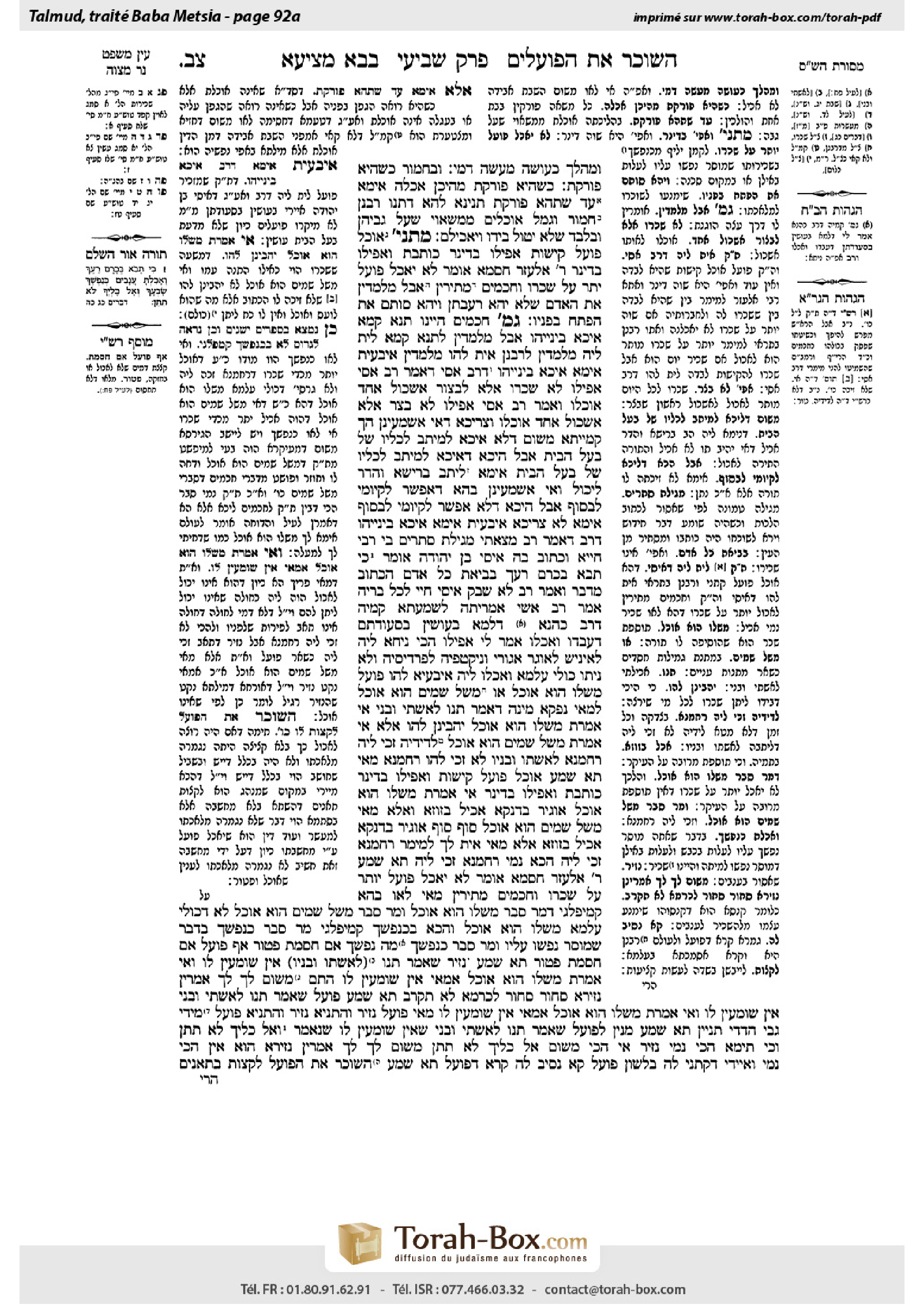
Scan : Torah-Box. Daf Study est un projet indépendant, sans affiliation ni approbation de Torah-Box ou de Sefaria.