Beitsa 21b en français · ביצה כ״א ב
Traduction française du daf 21b du traité Beitsa (Beitzah 21b en anglais), avec le texte araméen, l’anglais de Sefaria et le scan de la page, pour étudier le Daf Yomi.
Ouvrir dans le lecteur interactifLire le daf du jour
Traduction française de Beitsa 21b
Les traductions françaises de Daf Study sont générées par IA à partir de l’édition anglaise de Sefaria. Elles peuvent contenir des erreurs : vérifie toujours un passage avec le texte source.
ce qui signifie « pour vous », mais pas pour les chiens. Telle est l’opinion de Rabbi Yosei HaGelili. Rabbi Akiva dit : Lorsque le verset dit « toute âme », il vient enseigner que même l’âme d’un animal est incluse. Si tel est le cas, que signifie l’expression « pour vous » ? Elle signifie : pour vous, mais pas pour les non-Juifs.
La Guemara demande : Qu’avez-vous constaté qui vous ait amené à inclure les chiens parmi ceux pour lesquels il est permis d’effectuer un travail un jour de fête, et à exclure les non-Juifs ? La Guemara explique : J’inclus les chiens, car leur subsistance est à votre charge, puisque vous êtes tenus de nourrir les animaux que vous possédez ; et j’exclus les non-Juifs, car leur subsistance n’est pas à votre charge.
À propos de cette baraïta, Abaye dit à Rav Yosef : Selon Rabbi Yosei HaGelili, qui dit que le verset signifie « pour vous », mais pas pour les chiens, comment nous est-il permis de jeter des noyaux de dattes aux animaux un jour de fête ? Puisque les noyaux de dattes ne conviennent pas à la consommation humaine, ils devraient être considérés comme mouktsé et il devrait donc être interdit de les manipuler.
Rav Yosef lui dit : Puisqu’ils peuvent servir de combustible, on peut les manipuler et donc aussi les donner aux animaux. Abaye objecta : Cela convient dans le cas des noyaux de dattes secs ; mais que dire des noyaux humides, qui ne conviennent pas comme combustible ? Il lui répondit : Ils peuvent être utilisés dans un grand feu, qui les sèche, après quoi ils brûlent bien.
Abaye souleva une autre objection : Cela convient dans le cas d’un jour de fête, où il est permis d’alimenter un feu, mais que dire du Chabbat ? Pourquoi serait-il permis de manipuler des noyaux de dattes le Chabbat ? Rav Yosef répondit : On les déplace avec du pain. On pose les noyaux de dattes sur une miche de pain et on les déplace avec elle. Cela est conforme à l’opinion de Shmuel, car Shmuel a dit : Une personne peut satisfaire tous ses besoins au moyen du pain ; tant que celui-ci reste comestible, elle n’a pas à craindre de le traiter avec mépris.
La Guemara fait remarquer que la décision de Rav Huna, selon laquelle il est permis de cuire pour des non-Juifs un jour de fête s’ils autorisent un Juif à manger du pain, diffère de l’opinion de Rabbi Yehoshua ben Levi. En effet, Rabbi Yehoshua ben Levi a dit : On peut inviter un non-Juif à un repas le Chabbat, car on ne cuira certainement pas pour lui le Chabbat, et il est permis de donner à un non-Juif des aliments préparés la veille. Mais on ne peut pas inviter un non-Juif à un repas un jour de fête ; cela est interdit par mesure préventive, de crainte qu’on ne se mette à cuire davantage pour lui. Cela indique que Rabbi Yehoshua ben Levi estime qu’on ne peut pas préparer davantage pour un non-Juif, même si le repas est principalement destiné à des Juifs.
Rav Aḥa bar Ya’akov dit : Même le Chabbat, on ne peut pas inviter un non-Juif à un repas, en raison des restes de vin dans les coupes. Une fois qu’un non-Juif a bu du vin dans une coupe, le vin qui y reste ne peut être utilisé et est donc considéré comme mouktsé. Par conséquent, un Juif ne peut pas recevoir un non-Juif le Chabbat, de crainte qu’il ne manipule ces restes de vin mouktsé. La Guemara demande : Si tel est le cas, nos coupes devraient elles aussi être interdites, puisqu’elles contiennent également des restes de vin qui ne servent absolument à rien et devraient donc être considérés comme mouktsé. La Guemara répond : Les restes dans nos coupes conviennent aux poulets. La Guemara objecte : Si tel est le cas, les restes dans leurs coupes conviennent eux aussi aux poulets. La Guemara rejette cet argument : Les restes dans leurs coupes sont des substances dont il est interdit de tirer le moindre profit ; on ne peut donc absolument pas les manipuler.
La Guemara demande : Qu’on déplace donc le reste du vin en raison de la coupe, qui est un récipient que l’on peut manipuler, puisque les restes de vin devraient être considérés comme négligeables par rapport à la coupe. Rava n’a-t-il pas dit : On peut déplacer un brasero [kannuna] en raison des cendres qui peuvent servir à recouvrir des excréments, même s’il contient des morceaux de bois brisés qui ne servent à rien ? Cela indique qu’on peut déplacer un objet mouktsé avec un autre objet que l’on est autorisé à manipuler.
La Guemara rejette cet argument : les deux cas sont différents. Dans le premier cas, les morceaux de bois brisés ne sont pas des objets dont il est interdit de tirer profit ; ils sont simplement mouktsé. Ici, en revanche, le reste de vin dans la coupe du non-Juif est une substance dont il est interdit de tirer profit ; l’interdiction est donc plus stricte.
Rav Aḥa de Difti dit à Ravina : Mais que l’on considère cela comme un pot de chambre contenant des excréments, qu’on peut retirer d’une pièce parce qu’il est répugnant. De même, ne devrait-on pas être autorisé à retirer les restes de ces coupes, puisqu’il est inconvenant de les laisser sur la table ? Ravina lui dit : Si les coupes contiennent de tels restes, on peut les retirer ; mais peut-on mettre d’emblée un pot de chambre contenant des excréments dans une pièce ? Les Sages ont statué qu’on ne peut pas inviter un non-Juif à un repas le Chabbat, afin d’éviter de telles complications.
En résumé de cette halakha, la Guemara rapporte que Rava autorisa le Sage Mar Shmuel, de la maison de l’Exilarque, à donner un enseignement public, et que celui-ci enseigna : On peut inviter un non-Juif à un repas le Chabbat, mais on ne peut pas l’inviter à un repas un jour de fête, par mesure préventive, de peur que l’on ne cuisine davantage pour lui. Il est rapporté que Mareimar et Mar Zutra, lorsqu’un non-Juif se présentait par hasard chez eux un jour de fête, lui disaient : Si la nourriture que nous avons préparée pour nous-mêmes te suffit, tant mieux ; sinon, nous ne nous donnerons pas davantage de peine pour toi.
MICHNA : Beit Shammaï disent : On ne peut pas faire chauffer de l’eau un jour de fête pour se laver les pieds, à moins qu’elle ne convienne aussi à la boisson, car ils considèrent qu’il n’est permis d’allumer un feu un jour de fête que pour préparer de la nourriture, et non pour se laver. Mais Beit Hillel permettent d’allumer un feu un jour de fête même pour se laver. On peut allumer un grand feu et s’y réchauffer.
GUEMARA : Les Sages soulevèrent une question : Qui a enseigné cette halakha au sujet du feu ? Est-ce un enseignement admis par tous, y compris Beit Shammaï, qui distinguent entre un bénéfice touchant tout le corps et un bénéfice touchant un seul membre, de sorte qu’ils reconnaissent que l’allumage d’un feu pour réchauffer tout le corps est comparable à l’allumage d’un feu pour préparer de la nourriture et est donc permis, tandis que chauffer de l’eau pour se laver les pieds reste interdit ? Ou bien cet enseignement vient-il de Beit Hillel, alors que Beit Shammaï ne distinguent pas entre les deux cas et ne permettent d’allumer un feu un jour de fête que pour préparer de la nourriture ?
Viens et entends une preuve tirée d’une baraïta explicite : Beit Shammaï disent : On ne peut pas allumer un feu et s’y réchauffer, mais Beit Hillel le permettent. Il ressort clairement de là que la dernière partie de la Michna a été enseignée uniquement selon l’opinion de Beit Hillel.
MICHNA : Rabban Gamliel était rigoureux sur trois points, conformément à l’opinion de Beit Shammaï : on ne peut pas isoler des aliments chauds pour le Chabbat un jour de fête si on ne l’a pas fait au préalable ; il convient de le faire la veille du jour de fête. On ne peut pas non plus remettre en place un chandelier en métal qui est tombé un jour de fête. Enfin, on ne peut pas cuire de gros pains un jour de fête, mais seulement des pains minces, en raison du grand effort qu’exige la préparation des premiers. Rabban Gamliel dit : Depuis l’époque de la maison de mon père, on n’a jamais cuit de gros pains un jour de fête, mais seulement des pains minces. Les Sages lui dirent : Que pouvons-nous faire au sujet de la maison de ton père ? Ses membres étaient rigoureux envers eux-mêmes, mais se montraient indulgents envers tout le peuple juif, en permettant à tous de cuire de gros pains et des galettes cuites sur la braise.
GUEMARA : À propos de la déclaration de la Michna selon laquelle Rabban Gamliel ne permettait pas d’isoler d’emblée des aliments chauds un jour de fête, la Guemara demande : Dans quelles circonstances ? S’il s’agit d’un cas où il avait préparé un érouv tavchiline [érouv des plats cuits], pourquoi Beit Shammaï l’interdisent-ils ? Et s’il s’agit d’un cas où il n’avait pas préparé d’érouv tavchiline, pourquoi Beit Hillel rendent-ils une décision indulgente ? Rav Huna dit : En réalité, je vais vous dire que la Michna parle d’un cas où l’on n’a pas préparé d’érouv tavchiline, mais Beit Hillel estiment que les Sages ont néanmoins permis à cette personne de préparer ce dont elle a besoin pour sa subsistance élémentaire.
La Guemara fait remarquer que Rav Huna suit son raisonnement habituel, car Rav Huna a dit : Celui qui n’a pas préparé d’érouv tavchiline la veille d’un jour de fête peut recevoir d’autres personnes un pain cuit et un plat cuisiné.
Texte source et traduction anglaise
ביצה כ״א ב · texte araméen et hébreu
״לָכֶם״ — וְלֹא לִכְלָבִים, דִּבְרֵי רַבִּי יוֹסֵי הַגְּלִילִי. רַבִּי עֲקִיבָא אוֹמֵר: אֲפִילּוּ נֶפֶשׁ בְּהֵמָה בַּמַּשְׁמָע. אִם כֵּן, מָה תַּלְמוּד לוֹמַר ״לָכֶם״ — לָכֶם וְלֹא לְגוֹיִם.
וּמָה רָאִיתָ לְרַבּוֹת אֶת הַכְּלָבִים וּלְהוֹצִיא אֶת הַגּוֹיִם? מְרַבֶּה אֲנִי אֶת הַכְּלָבִים — שֶׁמְּזוֹנוֹתָן עָלֶיךָ, וּמוֹצִיא אֲנִי אֶת הַגּוֹיִם — שֶׁאֵין מְזוֹנוֹתָן עָלֶיךָ.
אֲמַר לֵיהּ אַבָּיֵי לְרַב יוֹסֵף: וּלְרַבִּי יוֹסֵי הַגְּלִילִי, דְּאָמַר ״לָכֶם״ וְלֹא לִכְלָבִים, הָנֵי סוּפְלֵי לְחֵיוָתָא הֵיכִי שָׁדֵינַן לְהוּ בְּיוֹם טוֹב?
אֲמַר לֵיהּ: הוֹאִיל וַחֲזוּ לְהַסָּקָה. תִּינַח בְּיַבִּישְׁתָּא, בְּרַטִּיבְתָּא מַאי אִיכָּא לְמֵימַר? אֲמַר לֵיהּ: חֲזוּ לְהֶיסֵּק גָּדוֹל.
תִּינַח בְּיוֹם טוֹב, בְּשַׁבָּת מַאי אִיכָּא לְמֵימַר? מְטַלְטְלִינַן לְהוּ אַגַּב רִיפְתָּא. כְּדִשְׁמוּאֵל, דְּאָמַר שְׁמוּאֵל: עוֹשֶׂה אָדָם כׇּל צָרְכּוֹ בְּפַת.
וּפְלִיגָא דְּרַבִּי יְהוֹשֻׁעַ בֶּן לֵוִי, דְּאָמַר רַבִּי יְהוֹשֻׁעַ בֶּן לֵוִי: מְזַמְּנִין אֶת הַגּוֹי בְּשַׁבָּת, וְאֵין מְזַמְּנִין אֶת הַגּוֹי בְּיוֹם טוֹב, גְּזֵרָה שֶׁמָּא יַרְבֶּה בִּשְׁבִילוֹ.
רַב אַחָא בַּר יַעֲקֹב אָמַר: אֲפִילּוּ בְּשַׁבָּת נָמֵי לָא, מִשּׁוּם שִׁיּוּרֵי כוֹסוֹת. אִי הָכִי, דִּידַן נָמֵי! דִּידַן חֲזוּ לְתַרְנְגוֹלִין. דִּידְהוּ נָמֵי חֲזוּ לְתַרְנְגוֹלִין! דִּידְהוּ — אִיסּוּרֵי הֲנָאָה נִינְהוּ.
וּלְטַלְטְלִינְהוּ אַגַּב כָּסָא? מִי לָא אָמַר רָבָא: מְטַלְטְלִין כָּנוּנָא אַגַּב קִטְמֵיהּ, אַף עַל גַּב דְּאִיכָּא עֲלֵיהּ שִׁבְרֵי עֵצִים!
הָתָם — לָאו אִיסּוּרֵי הֲנָאָה נִינְהוּ, הָכָא — אִיסּוּרֵי הֲנָאָה נִינְהוּ.
אֲמַר לֵיהּ רַב אַחָא מִדִּפְתִּי לְרָבִינָא: וְלֶהֱוֵי כִּגְרָף שֶׁל רְעִי! אֲמַר לֵיהּ: וְכִי עוֹשִׂין גְּרָף שֶׁל רְעִי לְכַתְּחִלָּה?
אַדְבְּרֵיהּ רָבָא לְמָר שְׁמוּאֵל, וּדְרַשׁ: מְזַמְּנִין אֶת הַגּוֹי בְּשַׁבָּת, וְאֵין מְזַמְּנִין אֶת הַגּוֹי בְּיוֹם טוֹב, גְּזֵרָה שֶׁמָּא יַרְבֶּה בִּשְׁבִילוֹ. מָרִימָר וּמַר זוּטְרָא, כִּי הֲוָה מִקְּלַע לְהוּ גּוֹי בְּיוֹם טוֹב, אָמְרִי לֵיהּ: אִי נִיחָא לָךְ בְּמַאי דִּטְרִיחָא לַן מוּטָב, וְאִי לָא — טִרְחָא יַתִּירָא אַדַּעְתָּא דִּידָךְ לָא טָרְחִינַן.
מַתְנִי׳ בֵּית שַׁמַּאי אוֹמְרִים: לֹא יָחֵם אָדָם חַמִּין לְרַגְלָיו אֶלָּא אִם כֵּן רְאוּיִין לִשְׁתִיָּה. וּבֵית הִלֵּל מַתִּירִין. עוֹשֶׂה אָדָם מְדוּרָה וּמִתְחַמֵּם כְּנֶגְדָּהּ.
גְּמָ׳ אִיבַּעְיָא לְהוּ: הַאי מְדוּרָה מַאן קָתָנֵי לַהּ? דִּבְרֵי הַכֹּל הִיא, וְשָׁנֵי לְהוּ לְבֵית שַׁמַּאי בֵּין הֲנָאַת כׇּל גּוּפוֹ לַהֲנָאַת אֵבֶר אֶחָד, אוֹ דִלְמָא בֵּית הִלֵּל קָתָנֵי לַהּ, אֲבָל בֵּית שַׁמַּאי לָא שָׁנֵי לְהוּ?
תָּא שְׁמַע, בֵּית שַׁמַּאי אוֹמְרִים: לֹא יַעֲשֶׂה אָדָם מְדוּרָה וְיִתְחַמֵּם כְּנֶגְדָּהּ. וּבֵית הִלֵּל מַתִּירִין.
מַתְנִי׳ שְׁלֹשָׁה דְּבָרִים רַבָּן גַּמְלִיאֵל מַחְמִיר כְּדִבְרֵי בֵּית שַׁמַּאי: אֵין טוֹמְנִין אֶת הַחַמִּין לְכַתְּחִלָּה בְּיוֹם טוֹב, וְאֵין זוֹקְפִין אֶת הַמְּנוֹרָה בְּיוֹם טוֹב, וְאֵין אוֹפִין פִּתִּין גְּרִיצִין אֶלָּא רְקִיקִין. אָמַר רַבָּן גַּמְלִיאֵל: מִימֵיהֶן שֶׁל בֵּית אַבָּא לֹא הָיוּ אוֹפִין פִּתִּין גְּרִיצִין אֶלָּא רְקִיקִין. אָמְרוּ לוֹ: מָה נַעֲשֶׂה לְבֵית אָבִיךְ, שֶׁהָיוּ מַחְמִירִין עַל עַצְמָן וּמְקִילִּין לְכׇל יִשְׂרָאֵל לִהְיוֹת אוֹפִין פִּתִּין גְּרִיצִין וַחֲרָרִין.
גְּמָ׳ הֵיכִי דָמֵי? אִי דְּאַנַּח עֵירוּבֵי תַבְשִׁילִין — מַאי טַעְמָא דְּבֵית שַׁמַּאי? וְאִי דְּלָא אַנַּח עֵירוּבֵי תַבְשִׁילִין — מַאי טַעְמָא דְּבֵית הִלֵּל? אָמַר רַב הוּנָא: לְעוֹלָם אֵימָא לָךְ שֶׁלֹּא הִנִּיחַ עֵירוּבֵי תַבְשִׁילִין, וּכְדֵי חַיָּיו שָׁרוּ לֵיהּ רַבָּנַן.
וְרַב הוּנָא לְטַעְמֵיהּ, דְּאָמַר רַב הוּנָא: מִי שֶׁלֹּא הִנִּיחַ עֵירוּבֵי תַבְשִׁילִין — אוֹפִין לוֹ פַּת אַחַת, וּמְבַשְּׁלִין לוֹ קְדֵרָה אַחַת,
Beitzah 21b · traduction anglaise de Sefaria
indicating for you, but not for dogs; this is the statement of Rabbi Yosei HaGelili. Rabbi Akiva says: When the verse states “every soul,” it comes to teach that even the soul of an animal is included. If so, what is the meaning when the verse states “for you”? It means for you, but not for gentiles.
The Gemara asks: And what did you see that led you to include dogs among those on whose behalf one is permitted to perform a labor on a Festival, and to exclude gentiles? The Gemara explains: I include dogs because the responsibility for their sustenance is incumbent upon you, as one is obligated to feed the animals in his possession; and I exclude gentiles because the responsibility for their sustenance is not incumbent upon you.
With regard to this baraita, Abaye said to Rav Yosef: And according to Rabbi Yosei HaGelili, who said that the verse indicates: “For you,” but not for dogs, how are we permitted to cast date stones to animals on a Festival? Since date stones are not fit for human consumption, they should be considered muktze, and therefore it should be prohibited to handle them.
Rav Yosef said to him: Since they are fit for fuel, they may be handled, and therefore they may also be given to animals. Abaye objected: This works out well in the case of dry date stones; but in the case of moist ones, which are not suited for fuel, what is there to say? He said to him: They are fit for a large fire, which dries them out, after which they burn well.
Abaye raised another objection: This works out well in the case of a Festival, when it is permitted to fuel a fire, but in the case of Shabbat, what is there to say? Why should one be permitted to handle date stones on Shabbat? Rav Yosef answered: We carry them along with bread. We place the date stones upon a loaf of bread and move them together with it. This is in accordance with the opinion of Shmuel, as Shmuel said: A person may perform all his needs with bread; as long as the bread remains edible, he need not be concerned that he is treating the bread contemptuously.
The Gemara comments: And the ruling of Rav Huna that one is permitted to bake for gentiles on a Festival if they allow a Jew to eat of the bread differs from the opinion of Rabbi Yehoshua ben Levi. As Rabbi Yehoshua ben Levi said: One may invite a gentile for a meal on Shabbat, as he will certainly not cook for him on Shabbat, and it is permitted to give a gentile food that was prepared the day before. But one may not invite a gentile for a meal on a Festival; this is prohibited as a preventive measure lest he come to cook more for the gentile’s sake. This indicates that Rabbi Yehoshua ben Levi holds that one may not prepare more for a gentile, even if the meal is primarily meant for Jews.
Rav Aḥa bar Ya’akov said: Even on Shabbat as well, one may not invite a gentile for a meal due to the wine remnants in the cups. Once a gentile has drunk wine from a cup, whatever remains in the cup may not be used and is therefore considered muktze. Therefore, a Jew may not host a gentile on Shabbat lest he come to handle the muktze wine remnants on Shabbat. The Gemara asks: If so, our cups should also be prohibited, as they too contain wine remnants that have no use whatsoever and should therefore be considered muktze. The Gemara answers: The remnants in our cups are fit for chickens. The Gemara objects: If so, the remnants in their cups are also fit for chickens. The Gemara rejects this argument: The remnants in their cups are items from which it is prohibited to derive any benefit whatsoever; consequently, they may not be handled at all.
The Gemara asks: And let him move what remains of the wine on account of the cup, which is a vessel that may be handled, as the wine remnants should be considered nullified in relation to the cup. Didn’t Rava say: One may move a coal pan [kannuna] on account of the ashes that can be used to cover filth, even though there are broken pieces of wood on it that have no use? This indicates that one may move something that is muktze along with something else that one is permitted to handle.
The Gemara rejects this argument: There is a difference between the two cases. There, the broken sticks are not items from which it is prohibited to derive any benefit but are merely muktze, whereas here, what remains of the wine in the gentile’s cup is an item from which it is prohibited to derive any benefit, and therefore the prohibition is more stringent.
Rav Aḥa of Difti said to Ravina: But let it be like a chamber pot for feces, which may be removed from a room because it is repulsive. One should likewise be permitted to discard the remnants of these cups, since it is unseemly to leave them on the table. Ravina said to him: If the cups contain such remnants, they may be removed, but may one make a chamber pot for feces ab initio? The Sages ruled that one may not invite a gentile for a meal on Shabbat so as to avoid such complications.
In summary of this halakha, the Gemara states that Rava authorized the Sage Mar Shmuel, from the house of the Exilarch, to deliver a public lecture, and the latter taught: One may invite a gentile for a meal on Shabbat, but one may not invite a gentile for a meal on a Festival as a preventive measure, lest he come to cook more for his sake. It is related about Mareimar and Mar Zutra that when a gentile would happen to come to their house on a Festival, they would say to him: If you are satisfied with the food that we have prepared for ourselves, good; and if not, we will not go to any extra trouble on your account.
MISHNA: Beit Shammai say: A person may not heat water on a Festival in order to wash his feet unless it is also fit for drinking, as they hold that kindling a fire on a Festival is permitted only for the sake of preparing food, but not for washing. But Beit Hillel permit one to kindle a fire on a Festival even for washing. A person may kindle a large fire and warm himself at it.
GEMARA: A dilemma was raised before the Sages: This halakha with regard to a fire, who taught it? Is it a statement accepted by all, including Beit Shammai, and Beit Shammai differentiate between benefit affecting one’s entire body and benefit affecting a single limb, so that they agree that kindling a fire to heat one’s entire body is similar to kindling a fire for food and is therefore permitted, while heating water to wash one’s feet remains prohibited? Or perhaps Beit Hillel taught it, but Beit Shammai do not differentiate between the two cases, and they permit kindling a fire on a Festival only for the purpose of preparing food.
Come and hear a proof from an explicit baraita: Beit Shammai say: A person may not make a fire and warm himself at it, but Beit Hillel permit it. It is clear from here that the latter clause of the mishna was taught only in accordance with the opinion of Beit Hillel.
MISHNA: Rabban Gamliel was stringent about three things in accordance with the statement of Beit Shammai: One may not insulate hot food on a Festival for Shabbat ab initio, but rather one ought to do so on the eve of the Festival; and one may not set up a metal candelabrum that fell on a Festival; and one may not bake thick loaves on a Festival but only thin ones, due to the great effort entailed in preparing the former. Rabban Gamliel said: From the days of my father’s household they would never bake thick loaves on a Festival, but only thin ones. The Sages said to him: What shall we do for your father’s household, who were stringent with themselves but lenient with all of the Jewish people, to allow them to bake thick loaves and cakes baked on coals.
GEMARA: With regard to the mishna’s statement that Rabban Gamliel would not permit the insulation of hot water on a Festival ab initio, the Gemara asks: What are the circumstances? If it is referring to a case where he prepared a joining of cooked foods [eiruv tavshilin], what is the reason that Beit Shammai prohibit it? And if it speaks of a case where he did not set aside an eiruv tavshilin, what is the reason for the lenient ruling of Beit Hillel? Rav Huna said: Actually, I will say to you that the mishna is referring to a case where one did not prepare an eiruv tavshilin, but Beit Hillel hold that the Sages nevertheless permitted him to prepare what he needs for his basic sustenance.
The Gemara comments: And Rav Huna conforms to his standard line of reasoning, as Rav Huna said: With regard to one who did not prepare an eiruv tavshilin on the eve of a Festival, others may bake one loaf of bread for him, and cook one pot of food for him,
Texte de Sefaria : William Davidson Edition - Vocalized Aramaic (CC BY NC) ; William Davidson Edition - English (CC BY NC).
Scan de Beitsa 21b
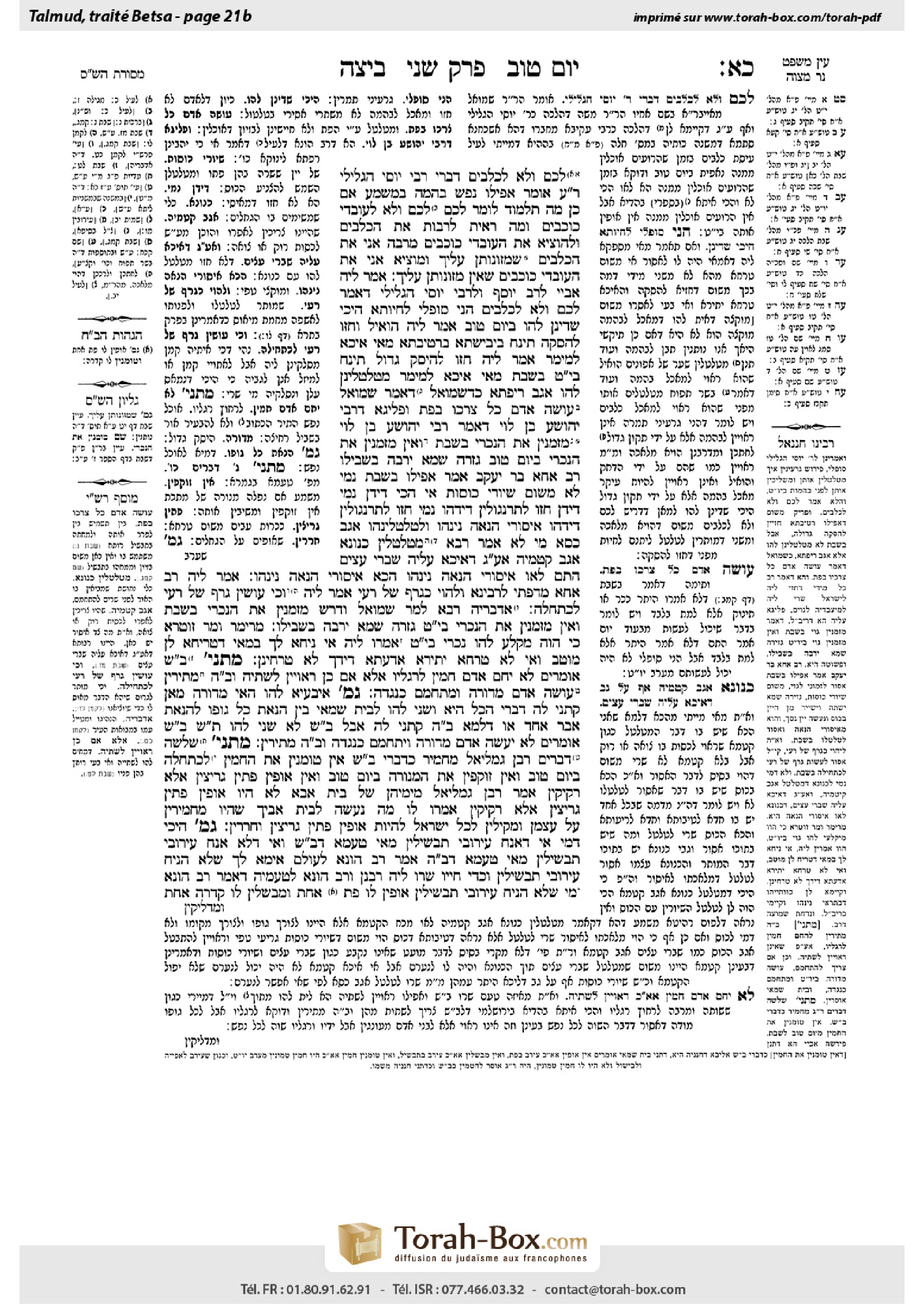
Scan : Torah-Box. Daf Study est un projet indépendant, sans affiliation ni approbation de Torah-Box ou de Sefaria.