Bekhorot 40b en français · בכורות מ׳ ב
Traduction française du daf 40b du traité Bekhorot, avec le texte araméen, l’anglais de Sefaria et le scan de la page, pour étudier le Daf Yomi.
Ouvrir dans le lecteur interactifLire le daf du jour
Traduction française de Bekhorot 40b
Les traductions françaises de Daf Study sont générées par IA à partir de l’édition anglaise de Sefaria. Elles peuvent contenir des erreurs : vérifie toujours un passage avec le texte source.
La Guemara poursuit cette version de la Michna : Il y eut aussi un cas où la mâchoire inférieure d’un premier-né dépassait la mâchoire supérieure. Rabban Shimon ben Gamliel demanda aux Sages de statuer, et ils répondirent : « C’est un défaut qui permet l’abattage du premier-né. »
La Guemara objecte : Or, c’est au sujet des défauts d’un homme que nous avons appris dans une Michna (44a) : « Si sa lèvre supérieure dépasse sa lèvre inférieure, ou si sa lèvre inférieure dépasse sa lèvre supérieure, c’est un défaut. » Et ce n’est qu’à propos d’un homme qu’il est écrit : « Tout homme de la descendance d’Aaron » (Lévitique 22,4), ce qui enseigne que, pour être apte au service du Temple, un prêtre doit être un homme semblable à la descendance d’Aaron, c’est-à-dire présenter une apparence ordinaire, comme les autres prêtres. Mais cette exigence n’est pas énoncée à propos d’un animal ; un animal ne devrait donc pas être considéré comme atteint d’un défaut lorsque sa lèvre inférieure dépasse sa lèvre supérieure.
Rav Pappa répondit : Il n’y a pas de difficulté. Cette Michna parle d’un cas où la mâchoire inférieure comporte un os plus long que celui de la mâchoire supérieure ; dans ce cas, c’est un défaut même chez un animal. L’autre Michna, en revanche, parle d’un cas où la mâchoire inférieure ne comporte pas d’os ; c’est donc un défaut uniquement chez un homme.
MICHNA : À propos de l’oreille d’un chevreau qui est repliée et semble former deux oreilles, les Sages ont dit : lorsque l’oreille supplémentaire est constituée d’un seul os, c’est-à-dire qu’elle possède son propre cartilage, c’est un défaut ; lorsqu’elle ne possède pas son propre os, ce n’est pas un défaut. Rabbi Ḥananya ben Gamliel dit : La queue d’un chevreau qui ressemble à celle d’un porc, ou qui est si courte qu’elle ne comporte pas trois articulations, constitue un défaut.
GUEMARA : Les Sages ont enseigné : lorsqu’un animal premier-né a la bouche enflée, ou que ses pattes sont enflées, la distinction suivante s’applique : si le gonflement est dû au vent, c’est-à-dire qu’il a simplement enflé, ce n’est pas un défaut. S’il est dû à un os particulièrement gros, c’est un défaut. Si ses oreilles sont doublées, lorsqu’elles n’ont qu’un cartilage, c’est un défaut ; lorsqu’elles ont deux cartilages, ce n’est pas un défaut.
§ La Michna enseigne que Rabban Gamliel dit : la queue d’un chevreau qui ressemble à celle d’un porc constitue un défaut. Rav Pappa dit : Ne dis pas que cela constitue un défaut uniquement lorsque sa queue est fine comme celle d’un porc ; si elle est enroulée comme celle d’un porc, même si elle est épaisse comme celle d’une chèvre, cela constitue également un défaut.
§ La Michna a enseigné : « Ou si la queue d’un chevreau est si courte qu’elle ne comporte pas trois articulations, c’est un défaut. » Rav Huna dit : pour la queue d’un chevreau, si elle comporte deux articulations, c’est un défaut ; si elle en comporte trois, ce n’est pas un défaut. Pour un agneau, si sa queue comporte trois articulations, c’est un défaut ; si elle en comporte quatre, ce n’est pas un défaut. La Guemara soulève une objection à partir d’une baraïta : pour un chevreau, si sa queue comporte une articulation, c’est un défaut ; si elle en comporte deux, ce n’est pas un défaut. Pour un agneau, si sa queue comporte deux articulations, c’est un défaut ; si elle en comporte trois, ce n’est pas un défaut. La Guemara conclut : C’est une réfutation décisive de l’opinion de Rav Huna.
La Guemara fait remarquer : Rav Huna a formulé son enseignement parce que la Michna l’a induit en erreur. Il a pensé que, puisque la première partie parle d’un chevreau dont la queue ressemble à celle d’un porc, on peut en déduire que la dernière partie, qui mentionne trois articulations, parle elle aussi d’un chevreau. Mais ce n’est pas le cas : la première partie parle d’un chevreau, tandis que la dernière parle d’un agneau, comme l’explique la baraïta.
MICHNA : Rabbi Ḥanina ben Antigonos dit que les animaux suivants sont atteints d’un défaut : celui qui a une verrue dans l’œil ; celui dont l’os de la patte antérieure ou postérieure est endommagé ; celui dont l’os de la bouche, c’est-à-dire la mâchoire, est déboîté ; et l’animal dont un œil est grand et l’autre petit, ou dont une oreille est grande et l’autre petite, si la différence de taille est visible à l’œil nu, mais non si elle n’est décelable qu’en prenant les mesures. Rabbi Yehuda dit : un animal est atteint d’un défaut si l’un de ses deux testicules est aussi gros que les deux réunis de l’autre, mais les Sages ne furent pas d’accord avec lui.
GUEMARA : La Michna enseigne qu’un animal qui a une verrue dans l’œil est atteint d’un défaut. La Guemara demande : Cela signifie-t-il qu’une verrue est considérée comme un défaut ? On peut soulever une contradiction à partir de la Michna (41a) : « Voici les défauts en raison desquels on n’abat pas le premier-né, ni dans le Temple ni dans le reste du pays, car ils ne sont pas considérés comme des défauts à part entière […] : un animal atteint de furoncles humides à l’intérieur comme à l’extérieur, et un animal ayant des verrues. »
La Guemara répond : Comment comprendre qu’une verrue ne soit pas un défaut ? Après tout, une verrue figure dans la liste des défauts de la Torah (voir Lévitique 22,22). Il n’y a cependant pas de difficulté : cette Michna, qui dit qu’une verrue n’est pas un défaut à part entière, parle d’un défaut sur le corps de l’animal, tandis que la verrue mentionnée dans la Torah et dans la Michna ici se trouve dans son œil.
La Guemara demande : Or, le verset est formulé sans précision. Quelle importance y a-t-il à ce que la verrue soit sur le corps ou dans l’œil ? Comment cette distinction se déduit-elle du verset ? La Guemara propose une autre explication : Il n’y a pas de difficulté, car l’un parle d’une verrue qui comporte un os, et l’autre d’une verrue qui n’en comporte pas.
La Guemara précise : La verrue mentionnée dans le verset et dans la Michna ici comporte un os, tandis que celle dont parle l’autre Michna n’en comporte pas. Par conséquent, si la verrue se trouve dans l’œil, c’est un défaut, comme l’indiquent le verset et la Michna ici ; mais si elle se trouve sur le corps, ce n’est pas un défaut, bien que l’animal soit inapte à être offert, conformément à la décision de l’autre Michna.
La Guemara demande : Et si une verrue sans os se trouve sur le corps, l’animal est-il inapte à être offert ? Ce n’est que de la chair pendante, or nous avons appris dans une Michna (45b) que Rabbi Eliezer dit : chez un homme, une excroissance de chair ou de peau qui pend du corps constitue un défaut disqualifiant ; mais un animal présentant une telle excroissance reste apte. Il faut plutôt dire que cette Michna-ci et l’autre Michna parlent toutes deux d’une verrue dans l’œil de l’animal. Il n’y a pas de difficulté : cette Michna parle d’une verrue dans la partie noire de l’œil, la pupille, tandis que l’autre Michna parle d’une verrue dans la partie blanche de l’œil.
La Guemara demande : Mais il a été établi qu’il n’y a pas de défauts dans la partie blanche de l’œil, ce qui indique que l’animal n’est même pas disqualifié pour être offert sur l’autel. Il faut plutôt dire que l’affirmation selon laquelle il n’y a pas de défauts dans la partie blanche de l’œil et la décision de la Michna selon laquelle une verrue disqualifie l’animal pour être offert portent toutes deux sur une verrue dans la partie blanche de l’œil. Reish Lakish dit : Il n’y a pas de difficulté ; l’une parle d’une verrue qui comporte un poil, auquel cas l’animal est inapte à être offert sur l’autel, tandis que l’autre parle d’un cas où la verrue ne comporte pas de poil. Quant à la Michna ici, qui statue qu’une verrue est un défaut à part entière, elle parle d’une verrue dans la pupille, comme cela a été expliqué.
§ La Michna enseigne qu’un animal dont un œil est grand et l’autre petit est atteint d’un défaut. À ce propos, une baraïta enseigne : lorsque la Michna emploie le terme « grand », cela signifie que l’œil est aussi grand que celui d’un veau ; lorsqu’elle emploie le terme « petit », cela signifie qu’il est aussi petit que celui d’une oie.
La Michna enseigne : si l’une de ses oreilles est grande et l’autre petite, la différence doit être visible à l’œil nu, et non décelable uniquement par la mesure. Rabbi Yehuda dit : un animal est atteint d’un défaut si l’un de ses deux testicules est aussi gros que les deux réunis de l’autre, mais les Sages ne furent pas d’accord avec lui. La Guemara demande : Selon les Sages, quelle peut être l’ampleur de la différence entre les deux testicules sans que celle-ci soit considérée comme un défaut ? La Guemara répond qu’une baraïta enseigne qu’Aḥerim disent : même si le second testicule, le plus petit, n’est pas plus gros qu’un haricot, l’animal reste apte.
MICHNA : Lorsque la queue d’un veau n’atteint pas l’articulation de la jambe [la’arkov], les Sages ont dit que c’est un défaut, car la croissance des veaux se déroule toujours ainsi : tant qu’ils grandissent, leur queue s’étend sous l’articulation de la jambe. À quelle articulation de la jambe les Sages faisaient-ils référence ? Rabbi Ḥanina ben Antigonos dit : ils faisaient référence à l’articulation située au milieu de la cuisse.
Texte source et traduction anglaise
בכורות מ׳ ב · texte araméen et hébreu
וּמַעֲשֶׂה נָמֵי שֶׁלְּחִי הַתַּחְתּוֹן עוֹדֵף עַל הָעֶלְיוֹן, שָׁאַל רַבָּן שִׁמְעוֹן בֶּן גַּמְלִיאֵל לַחֲכָמִים וְאָמְרוּ: הֲרֵי זֶה מוּם.
וְהָא גַּבֵּי אָדָם הוּא דִּתְנַן: שְׂפָתוֹ הָעֶלְיוֹנָה עוֹדֶפֶת עַל הַתַּחְתּוֹנָה, אוֹ שֶׁתַּחְתּוֹנָה עוֹדֶפֶת עַל הָעֶלְיוֹנָה — הֲרֵי זֶה מוּם. גַּבֵּי אָדָם הוּא דִּכְתִיב: ״אִישׁ אִישׁ מִזֶּרַע אַהֲרֹן״, אִישׁ שֶׁשָּׁוֶה בְּזַרְעוֹ שֶׁל אַהֲרֹן, אֲבָל בִּבְהֵמָה לָא!
אָמַר רַב פָּפָּא: לָא קַשְׁיָא, הָא דְּאִית בַּהּ עֶצֶם, הָא דְּלֵית בַּהּ עֶצֶם.
מַתְנִי׳ אוֹזֶן הַגְּדִי הָיְתָה כְּפוּלָה, אָמְרוּ חֲכָמִים: בִּזְמַן שֶׁהוּא עֶצֶם אֶחָד — מוּם, בִּזְמַן שֶׁאֵין בּוֹ עֶצֶם — אֵינוֹ מוּם. רַבִּי חֲנַנְיָא בֶּן גַּמְלִיאֵל אוֹמֵר: זְנַב הַגְּדִי שֶׁהוּא דּוֹמֶה לְשֶׁל חֲזִיר, וְשֶׁאֵין בָּהּ שְׁלֹשׁ חוּלְיוֹת — הֲרֵי זֶה מוּם.
גְּמָ׳ תָּנוּ רַבָּנַן: פִּיו בָּלוּם וְרַגְלָיו מְבוּלָּמוֹת, מֵחֲמַת הָרוּחַ — אֵינוֹ מוּם, מֵחֲמַת הָעֶצֶם — הֲרֵי זֶה מוּם. אׇזְנָיו כְּפוּלוֹת, בְּחַסְחֲסוּת אַחַת — הֲרֵי זֶה מוּם, בִּשְׁתֵּי חַסְחֲסֻיוֹת — אֵינוֹ מוּם.
רַבָּן גַּמְלִיאֵל אוֹמֵר: זְנַב הַגְּדִי שֶׁהוּא דּוֹמֶה לְשֶׁל חֲזִיר. אָמַר רַב פָּפָּא: לָא תֵּימָא דְּקַטִּינָא, אֶלָּא דִּכְרִיכָא, אַף עַל גַּב דַּאֲלִימָא.
אוֹ שֶׁאֵין בָּהּ שָׁלֹשׁ חוּלְיוֹת וְכוּ׳. אָמַר רַב הוּנָא: בַּגְּדִי — שְׁתַּיִם הֲרֵי זֶה מוּם, שָׁלֹשׁ אֵינוֹ מוּם. בַּטָּלֶה — שָׁלֹשׁ הֲרֵי זֶה מוּם, אַרְבַּע אֵינוֹ מוּם. מֵיתִיבִי: בַּגְּדִי — אַחַת הֲרֵי זֶה מוּם, שְׁתַּיִם אֵינוֹ מוּם. בַּטָּלֶה — שְׁתַּיִם הֲרֵי זֶה מוּם, שָׁלֹשׁ אֵינוֹ מוּם. תְּיוּבְתָּא דְרַב הוּנָא.
וְרַב הוּנָא, מַתְנִיתִין אַטְעִיתֵיהּ; אִיהוּ סָבַר: מִדְּרֵישָׁא בִּגְדִי — סֵיפָא נָמֵי בִּגְדִי, וְלָא הִיא — רֵישָׁא בִּגְדִי, וְסֵיפָא בְּטָלֶה.
מַתְנִי׳ רַבִּי חֲנִינָא בֶּן אַנְטִיגְנוֹס אוֹמֵר: אֶת שֶׁיַּבֶּלֶת בְּעֵינָיו, וְשֶׁנִּפְגַּם עֶצֶם יָדוֹ וְרַגְלוֹ, וְשֶׁנִּפְרַק עַצְמוֹ שֶׁל פִּיו, עֵינוֹ אַחַת גְּדוֹלָה וְאַחַת קְטַנָּה, אׇזְנוֹ אַחַת גְּדוֹלָה וְאַחַת קְטַנָּה, בַּמַּרְאֶה אֲבָל לֹא בַּמִּדָּה. רַבִּי יְהוּדָה אוֹמֵר: שְׁתֵּי בֵּיצָיו, אַחַת גְּדוֹלָה כִּשְׁתַּיִם שֶׁבַּחֲבֶירְתָּהּ, וְלֹא הוֹדוּ לוֹ חֲכָמִים.
גְּמָ׳ לְמֵימְרָא דְּיַבֶּלֶת הָוֵי מוּמָא? וּרְמִינְהוּ: וְאֵלּוּ שֶׁאֵין שׁוֹחֲטִין עֲלֵיהֶן לֹא בְּמִקְדָּשׁ וְלֹא בַּמְּדִינָה — בַּעַל גָּרָב וּבַעַל יַבֶּלֶת!
וְתִסְבְּרָא? הָא כְּתִיבָא ״יַבֶּלֶת״ בְּאוֹרָיְיתָא! אֶלָּא, לָא קַשְׁיָא: הָא — בְּגוּפוֹ, הָא — בְּעֵינוֹ.
מִכְּדֵי קְרָא סְתָמָא, מָה לִי בְּגוּפוֹ וּמָה לִי בְּעֵינוֹ? אֶלָּא לָא קַשְׁיָא, הָא דְּאִית בַּהּ עֶצֶם, הָא דְּלֵית בַּהּ עֶצֶם.
דִּקְרָא — דְּאִית בַּהּ עֶצֶם, מַתְנִיתִין — דְּלֵית בַּהּ עֶצֶם; בְּעֵינוֹ — הָוֵי מוּמָא, בְּגוּפָא — לָא הָוֵי מוּמָא.
וְלֵית לַהּ עֶצֶם בְּגוּפָא פְּסוּלָה? הֲרֵי תִּלְתּוּל בְּעָלְמָא הוּא, דִּתְנַן: רַבִּי אֱלִיעֶזֶר אוֹמֵר: בַּעֲלֵי הַתִּילּוּלִין פְּסוּלִין בָּאָדָם וּכְשֵׁירִין בַּבְּהֵמָה! אֶלָּא, אִידֵּי וְאִידֵּי בְּעֵינוֹ, וְלָא קַשְׁיָא: הָא — בַּשָּׁחוֹר, הָא — בַּלָּבָן.
וְהָא אֵין מוּמִין בַּלָּבָן! אֶלָּא: אִידֵּי וְאִידֵּי בַּלָּבָן, וְאָמַר רֵישׁ לָקִישׁ: לָא קַשְׁיָא, הָא — דְּאִית בַּהּ שֵׂעָר, הָא — דְּלֵית בַּהּ שֵׂעָר.
עֵינוֹ אַחַת גְּדוֹלָה וְכוּ׳. תָּנָא: גְּדוֹלָה כְּשֶׁל עֵגֶל, קְטַנָּה כְּשֶׁל אַוָּוז.
אׇזְנוֹ אַחַת גְּדוֹלָה וְכוּ׳. וְרַבָּנַן עַד כַּמָּה? תַּנְיָא, אֲחֵרִים אוֹמְרִים: אֲפִילּוּ אֵינָהּ לַשְּׁנִיָּה אֶלָּא כְּפוֹל — כְּשֵׁירָה.
מַתְנִי׳ זְנַב הָעֵגֶל — שֶׁאֵינָהּ מַגַּעַת לָעַרְקוֹב, אָמְרוּ חֲכָמִים: כֹּל מַרְבִּית עֲגָלִים כֵּן, כׇּל זְמַן שֶׁיְּהוּ מְגַדְּלִין — הֵן נִמְתָּחוֹת. אֵיזֶהוּ עַרְקוֹב שֶׁאָמְרוּ? רַבִּי חֲנִינָא בֶּן אַנְטִיגְנוֹס אוֹמֵר: בְּעַרְקוֹב שֶׁבְּאֶמְצַע הַיָּרֵךְ.
Bekhorot 40b · traduction anglaise de Sefaria
The Gemara continues this version of the mishna: And there was also an incident where the lower jaw of the firstborn protruded beyond the upper jaw, and Rabban Shimon ben Gamliel asked the Sages for a ruling, and they said: That is a blemish that enables the slaughter of the firstborn.
The Gemara challenges: But it is with regard to the blemishes of a person that we learned in a mishna (44a): If his upper lip protrudes beyond the lower lip or his lower lip protrudes beyond the upper lip, that is a blemish. And it is only with regard to a person that it is written: “Whatever man of the seed of Aaron” (Leviticus 22:4), which teaches that in order to be fit for the Temple service a priest must be a man who is equal to the seed of Aaron, i.e., he has an ordinary appearance like other priests. But this requirement is not stated with regard to an animal, and therefore an animal should not be considered blemished if its lower lip protrudes beyond the upper lip.
Rav Pappa said in response: That is not difficult; this mishna is referring to a case where the lower jaw contains a bone that is longer than the upper jaw, in which case it is a blemish even for an animal, whereas that mishna is referring to a case where the lower jaw does not contain a bone, and therefore it is a blemish only in the case of a person.
MISHNA: With regard to the ear of the kid that was doubled and appeared like two ears, the Sages said: When the additional ear is one bone, i.e., it has its own cartilage, it is a blemish; when it does not have its own bone it is not a blemish. Rabbi Ḥananya ben Gamliel says: In the case of the tail of a kid that is similar to that of a pig or one that is so short that it does not have three joints, that is a blemish.
GEMARA: The Sages taught: In a case where the mouth of a firstborn animal is swollen, and likewise, if its legs are swollen, the following distinction applies: If it is swollen due to the wind, i.e., it simply swelled up, it is not a blemish. If it is swollen due to a particularly large bone, this is a blemish. If its ears are doubled, in a case where it has one cartilage, this is a blemish; in a case where it has two cartilages, this is not a blemish.
§ The mishna teaches that Rabban Gamliel says: With regard to the tail of a kid that is similar to that of a pig, that is a blemish. Rav Pappa says: Do not say that it is a blemish only where its tail is thin like that of a pig; rather, if it is round, i.e., curly like a pig’s tail, even though it is thick, like the tail of a goat, this is considered a blemish.
§ The mishna stated: Or if the tail of a kid is so short that it does not have three joints, that is a blemish. Rav Huna says: In the case of the tail of a kid, if it has two joints, that is a blemish; if it has three joints, it is not a blemish. With regard to a lamb, if it has three joints, that is a blemish; if it has four joints, it is not a blemish. The Gemara raises an objection from a baraita: In the case of a kid, if its tail has one joint, that is a blemish; if it has two joints, it is not a blemish. With regard to a lamb, if it has two joints, that is a blemish; if it has three joints, it is not a blemish. The Gemara concludes: This is a conclusive refutation of the opinion of Rav Huna.
The Gemara comments: And Rav Huna issued his statement because the mishna misled him. He thought that from the fact that the first clause is referring to a kid, whose tail is similar to that of a pig, it can be inferred that the latter clause, with its mention of three joints, is also referring to a kid. But it is not so. Rather, the first clause is referring to a kid, but the latter clause is referring to a lamb, as explained in the baraita.
MISHNA: Rabbi Ḥanina ben Antigonus says that these are blemished animals: One that has a wart in its eyes; and one where the bone of its foreleg or hind leg was damaged; and one where the bone of its mouth, i.e., its jaw, was dislocated; and an animal with one of its eyes large and one small, or one of its ears large and one small where the difference in size is detectable by sight, but not if it is detectable only by being measured. Rabbi Yehuda says: An animal is blemished if with regard to its two testicles, one is as large as two of the other, but the Rabbis did not agree with his opinion.
GEMARA: The mishna teaches that if an animal has a wart in its eyes, it is blemished. The Gemara asks: Is this to say that a wart is considered a blemish? And one can raise a contradiction from the mishna (41a): And these are the blemishes that one does not slaughter the firstborn due to them, neither in the Temple nor in the rest of the country, as these are not considered full-fledged blemishes…an animal with boils that are moist inside and out, and one with warts.
The Gemara responds: And how can you understand that a wart is not a blemish? After all, a wart is written in the Torah in its list of blemishes (see Leviticus 22:22). Rather, it is not difficult, as that mishna, which states that a wart is not a full-fledged blemish, is referring to a blemish on the animal’s body, whereas this mention of a wart in the Torah and the mishna here is referring to a wart in its eye.
The Gemara asks: Now consider that the verse is written in an unspecified manner. What difference is it to me if the wart is on its body, and what difference is it to me if the wart is in its eye? How is this distinction derived from the verse? The Gemara suggests an alternative explanation: Rather, it is not difficult, as this is referring to a wart that has a bone,and that is referring to a wart that does not have a bone.
The Gemara elaborates: The wart mentioned in the verse and the mishna here is one that has a bone, whereas the wart addressed by the mishna there is one that does not have a bone. Consequently, if the wart is in its eye, it is a blemish, as stated in the verse and the mishna here, but if it is on its body, it is not a blemish, although the animal is disqualified from being sacrificed, in accordance with the ruling of the mishna there.
The Gemara asks: And with regard to a wart that does not have a bone and is on the body, is the animal disqualified from being sacrificed? It is merely hanging flesh, as we learned in a mishna (45b) that Rabbi Eliezer says: With regard to those with flesh or skin that hangs from their body, such a blemish disqualifies a person, but with regard to such an animal, it is fit. Rather, both this mishna here and that mishna there are referring to a wart in the animal’s eye, and it is not difficult, as this mishna is referring to a wart in the black of the eye, the pupil, whereas that mishna is referring to a wart in the white of the eye.
The Gemara asks: But it has been established that there are no blemishes in the white part of the eye, which indicates that the animal is not even disqualified from being sacrificed on the altar. Rather, both this statement that there are no blemishes in the white of the eye and that ruling of the mishna that a wart disqualifies the animal from being sacrificed are referring to a wart in the white part of the eye. And Reish Lakish says: It is not difficult; this is referring to a wart that has a hair, and therefore the animal is unfit for the altar, whereas that statement is referring to a case where the wart does not have a hair. As for the mishna here, which rules that a wart is a full-fledged blemish, it is referring to a wart in the pupil of the eye, as explained.
§ The mishna teaches with regard to an animal where one of its eyes is large and one is small that this is a blemish. In this regard, it is taught in a baraita: When the mishna states the term large, it means the eye is as large as the eye of a calf, and when it states the term small, it means it is as small as that of a goose.
The mishna teaches: Or one of its ears is large and one is small, which is detectable by sight, but not if it is detectable only by being measured. Rabbi Yehuda says: An animal is blemished if with regard to its two testicles, one is as large as two of the other, but the Rabbis did not agree with his opinion. The Gemara asks: And according to the Rabbis, how large can the difference between the two testicles be without this discrepancy being considered a blemish? The Gemara answers that it is taught in a baraita that Aḥerim say: Even if the second, smaller testicle is no bigger than a bean, the animal is fit.
MISHNA: In the case of the tail of a calf that does not reach the leg joint [la’arkov], the Sages said: It is a blemish, because all growth of calves is in this manner:As long as they grow, their tails are extended beneath the leg joint. Which is the leg joint about which the Sages spoke? Rabbi Ḥanina ben Antigonus says: They are referring to the leg joint that is in the middle of the thigh.
Texte de Sefaria : William Davidson Edition - Vocalized Aramaic (CC BY NC) ; William Davidson Edition - English (CC BY NC).
Scan de Bekhorot 40b
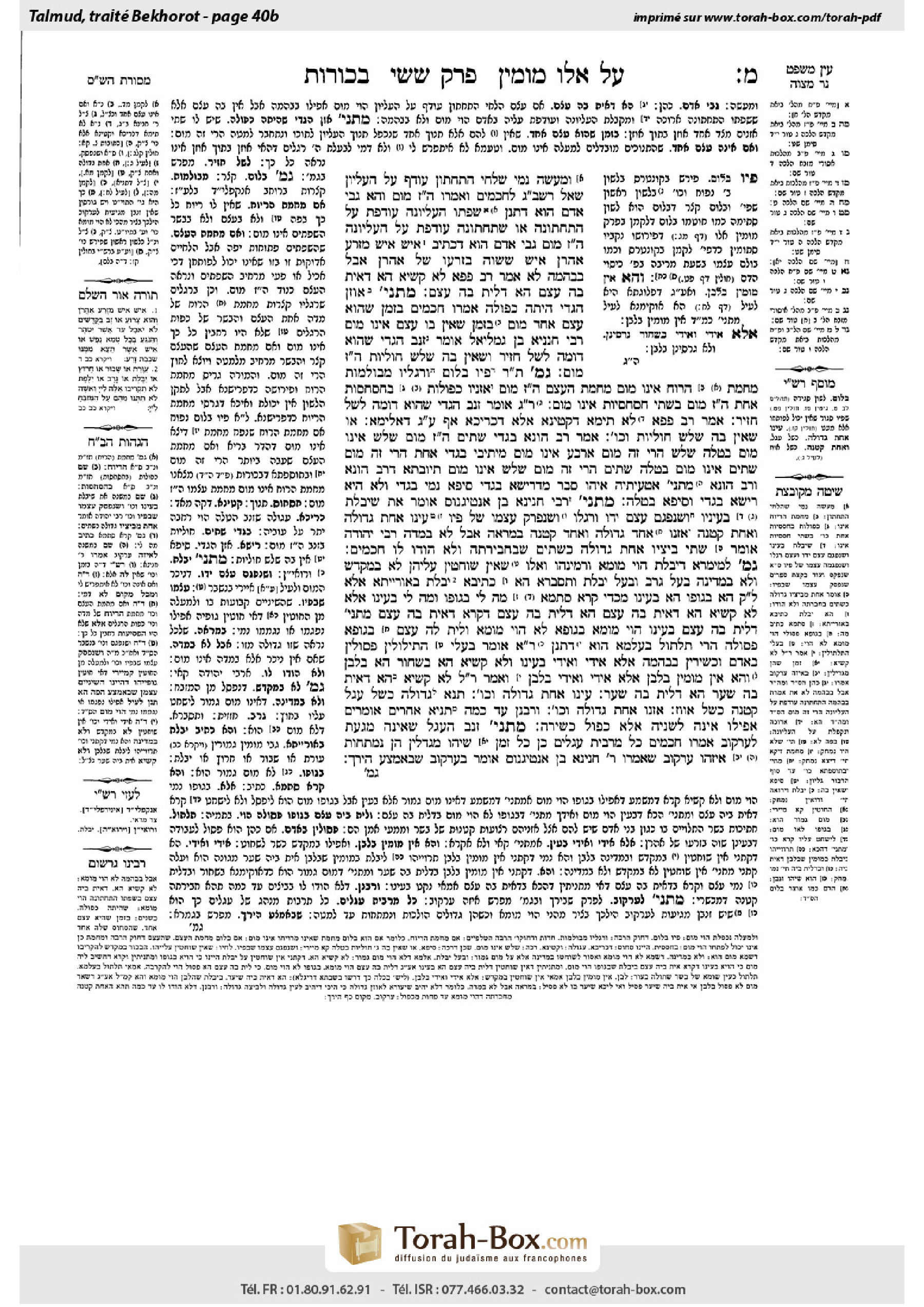
Scan : Torah-Box. Daf Study est un projet indépendant, sans affiliation ni approbation de Torah-Box ou de Sefaria.