Haguiga 9a en français · חגיגה ט׳ א
Traduction française du daf 9a du traité Haguiga (Chagigah 9a en anglais), avec le texte araméen, l’anglais de Sefaria et le scan de la page, pour étudier le Daf Yomi.
Ouvrir dans le lecteur interactifLire le daf du jour
Traduction française de Haguiga 9a
Les traductions françaises de Daf Study sont générées par IA à partir de l’édition anglaise de Sefaria. Elles peuvent contenir des erreurs : vérifie toujours un passage avec le texte source.
Ils ont enseigné qu’on peut offrir le sacrifice de paix de fête le premier jour de la fête, mais pas pendant les sept jours, comme cela est rapporté plus bas dans la baraïta de ce daf, uniquement dans le cas où il n’a pas terminé. En revanche, s’il a terminé, il peut revenir l’offrir.
La Guemara demande : Que signifie ici le terme « terminer » ? Si l’on dit qu’il a terminé d’offrir tous ses sacrifices, que lui reste-t-il à revenir offrir ? Il faut plutôt comprendre que, si le jour n’était pas terminé et qu’il lui restait encore des sacrifices à offrir, il ne peut pas revenir les offrir les autres jours de fête. En revanche, si le jour s’est achevé alors qu’il n’avait pas terminé d’offrir ses sacrifices, il peut revenir les offrir. Cela montre que Rabbi Yoḥanan reconnaît que, dans ces circonstances, il est permis d’offrir des sacrifices de paix de fête pendant les jours restants de la fête.
MICHNA : Celui qui n’a pas célébré la fête de Soukkot en apportant le sacrifice de paix de fête le premier jour peut le faire pendant tous les jours restants de la fête de pèlerinage, même le dernier jour de la fête, c’est-à-dire le huitième jour de l’Assemblée.
Si la fête de pèlerinage est passée sans qu’il ait célébré en apportant le sacrifice de paix de fête, il n’est pas tenu de le remplacer. Même s’il avait consacré un animal à cette fin et l’a perdu, une fois la fête terminée, il n’est pas tenu d’en consacrer un autre, car il a manqué l’occasion d’accomplir cette mitsva. À ce sujet, il est dit : « Ce qui est tortueux ne peut être redressé, et ce qui manque ne peut être compté » (Ecclésiaste 1,15).
Rabbi Shimon ben Menasya dit : Qui est le tortueux qui ne peut être redressé ? Ce verset parle de celui qui a eu des relations avec une femme qui lui était interdite et a engendré avec elle un mamzer. Cet homme ne peut réparer sa faute, car le statut de l’enfant illégitime est permanent. Et si tu dis que le verset parle de celui qui vole ou commet un vol avec violence, bien qu’il soit dans une situation tortueuse, il peut restituer ce qu’il a volé et ainsi réparer sa faute.
Rabbi Shimon ben Yoḥai dit : On ne qualifie de tortueux que celui qui était d’abord droit et qui est ensuite devenu tortueux. Et qui est-ce ? C’est un érudit en Torah qui abandonne l’étude de la Torah. Voilà l’exemple d’une chose droite devenue tortueuse.
GUEMARA : La Michna enseigne que celui qui n’a pas apporté son sacrifice de paix de fête le premier jour de la fête de Soukkot peut l’apporter même le huitième jour de l’Assemblée, bien que ce soit une fête distincte. La Guemara demande : D’où déduit-on ces règles ? Rabbi Yoḥanan a dit au nom de Rabbi Yishmael que cette halakha se déduit au moyen d’une analogie verbale. Le terme « assemblée » apparaît (Deutéronome 16,8) au sujet du septième jour de Pessaḥ, et le terme « assemblée » apparaît (Lévitique 23,36) au sujet du huitième jour de la fête de Soukkot. De même que là, à Pessaḥ, le jour de l’assemblée, c’est-à-dire le septième jour de Pessaḥ, permet de rattraper le sacrifice, puisqu’il fait certainement partie de la fête, de même ici, dans le cas de Soukkot, le huitième jour de l’Assemblée permet de le rattraper.
La Guemara ajoute que le terme « assemblée » est, dans chacun de ces contextes, disponible pour cette analogie verbale, c’est-à-dire qu’il est superflu dans les deux passages. En effet, s’il n’était pas disponible, on pourrait réfuter l’analogie verbale, puisque chacun des contextes où apparaît le terme comporte des caractéristiques qui ne s’appliquent pas à l’autre. Que peut-on dire du septième jour de Pessaḥ ? Qu’il ne se distingue pas des jours qui le précèdent en ce qui concerne les sacrifices de fête et l’interdiction de manger du pain levé. Peut-on en dire autant du huitième jour de la fête de Soukkot, qui se distingue des jours qui le précèdent, c’est-à-dire que le huitième jour de l’Assemblée n’implique pas les mêmes mitsvot que la fête de Soukkot ?
Cependant, ce n’est pas le cas [la’ei], car le terme « assemblée » est bien disponible. Or, que signifie « assemblée [atzeret] » ? Cela signifie que l’on est retenu [atzur], c’est-à-dire empêché de travailler. Mais n’est-il pas déjà écrit : « Tu ne feras aucun travail » (Deutéronome 16,8) ? Pourquoi donc le Miséricordieux a-t-il écrit le terme atzeret ? Il faut plutôt en déduire qu’il est disponible pour l’analogie verbale.
La Guemara fait remarquer : Et un tanna apporte une preuve de ce passage, car il est enseigné dans une baraïta, au sujet d’un verset qui concerne la fête de Soukkot : « Vous en ferez une fête pour le Seigneur pendant sept jours » (Lévitique 23,41). On aurait pu penser que l’on peut continuer à célébrer en apportant le sacrifice de paix de fête pendant les sept jours de la fête. Le verset dit donc : « En », ce qui enseigne : c’est le premier jour de la fête que tu célébreras avec ces sacrifices, et tu ne célébreras pas pendant les sept jours. Dès lors, pourquoi le mot « sept » est-il mentionné ? Pour permettre de rattraper le sacrifice : si quelqu’un a omis d’apporter un sacrifice le premier jour, il peut le faire pendant les sept jours.
Et d’où déduit-on que celui qui n’a pas célébré en apportant le sacrifice de paix de fête le premier jour de la fête de Soukkot peut continuer à célébrer pendant toute la fête de pèlerinage, même le dernier jour de la fête de Soukkot, qui est le huitième jour de l’Assemblée ? Le verset dit : « Vous le célébrerez au septième mois » (Lévitique 23,41), ce qui indique qu’on peut apporter les sacrifices de fête même après les sept jours de la fête. Si le verset disait seulement : « Au septième mois », on aurait pu penser que l’on peut continuer à célébrer en apportant le sacrifice à n’importe quel moment du reste du mois. Le verset dit donc : « Le », indiquant que l’on célèbre l’un de ces jours de fête, mais pas en dehors de ces jours.
§ La Guemara demande : Que signifie la notion de rattrapage mentionnée dans la baraïta ? La Guemara répond que Rabbi Yoḥanan a dit : Les autres jours permettent de rattraper le premier jour. Si l’on n’a pas apporté le sacrifice de fête le premier jour, on peut encore le faire les jours restants de la fête. Et Rabbi Oshaya a dit : Les jours permettent de se compenser les uns les autres. Chaque jour peut être considéré comme le jour principal de l’obligation ; autrement dit, si l’on n’a pas apporté le sacrifice le premier jour où cela était possible, on peut le faire les jours restants.
La Guemara demande : Quelle est la différence pratique entre ces deux explications ? Rabbi Zeira a dit : La différence pratique concerne le cas de celui qui était boiteux le premier jour de la fête et qui a guéri le deuxième jour. Selon Rabbi Yoḥanan, les autres jours permettent de rattraper le premier jour ; puisqu’il n’était pas apte à sacrifier ses offrandes le premier jour, il ne l’est pas non plus le deuxième, car ce dernier permet de rattraper le premier. Le deuxième jour ne concerne pas ceux qui étaient totalement dispensés le premier jour, mais ceux qui étaient tenus de sacrifier et ont négligé de le faire. Selon Rabbi Oshaya, les jours permettent de se compenser les uns les autres. Par conséquent, même s’il n’était pas apte à apporter le sacrifice le premier jour, il l’est le deuxième. Puisqu’une obligation distincte s’applique chaque jour, même si l’on n’était pas apte à apporter le sacrifice le premier jour, on doit le faire dès qu’on le devient.
La Guemara demande : Rabbi Yoḥanan a-t-il vraiment dit cela ? Rabbi Yoḥanan était impliqué dans une controverse au sujet d’un nazir. Un nazir qui devient rituellement impur à la suite d’un contact avec un cadavre doit suivre un processus de purification rituelle de sept jours, après quoi il doit apporter un ensemble de sacrifices et recommencer à compter les jours de sa période de naziréat. En règle générale, un nazir peut apporter un seul ensemble de sacrifices, même après plusieurs épisodes d’impureté rituelle. Toutefois, s’il entre de nouveau en contact avec un cadavre le huitième jour après être devenu rituellement impur pour la première fois, il doit apporter deux ensembles de sacrifices, car cette seconde impureté s’est produite à un moment où il aurait pu recommencer à compter les jours de son vœu de naziréat. Les amoraïm discutent des détails de cette halakha.
La Guemara poursuit : Ḥizkiya n’a-t-il pas dit que si un nazir devient rituellement impur le huitième jour même, il apporte un second ensemble de sacrifices ? En revanche, s’il devient rituellement impur la nuit précédente, il n’apporte pas d’ensemble supplémentaire de sacrifices, car il n’aurait pas pu apporter le sacrifice pendant la nuit. Bien que sept jours complets se soient écoulés, puisqu’il n’a pas encore eu l’occasion d’apporter le sacrifice, c’est comme si ses sept jours n’étaient pas encore achevés. Par conséquent, il peut encore apporter un seul ensemble de sacrifices pour les deux épisodes d’impureté rituelle.
Et Rabbi Yoḥanan a dit : Même si le nazir devient rituellement impur pendant la nuit où commence le huitième jour, il apporte lui aussi un second ensemble de sacrifices. Rabbi Yoḥanan considère que ce nazir est, en pratique, prêt à recommencer à compter les jours de son vœu ; seule la règle technique interdisant d’apporter des sacrifices la nuit l’en empêche. Cela montre que, selon l’opinion de Rabbi Yoḥanan, même lorsqu’on est incapable de sacrifier ses offrandes, l’obligation demeure. De même, dans le cas d’un boiteux, son obligation d’apporter le sacrifice de fête s’applique en théorie même le premier jour, ce qui signifie qu’il devrait pouvoir apporter les sacrifices plus tard au cours de la fête.
Rabbi Yirmeya a dit : Le cas de celui qui ne peut pas apporter un sacrifice en raison d’une impureté rituelle est différent. Il n’est pas totalement exclu, car il existe une possibilité de rattraper une fois rétabli dans la pureté rituelle. Cela peut être démontré par la halakha du second Pessaḥ. De même que celui qui est rituellement impur et ne peut pas offrir le sacrifice pascal a la possibilité de rattraper grâce au second Pessaḥ, de même toute personne qui ne peut pas apporter un sacrifice en raison de l’impureté peut le rattraper à une date ultérieure.
Rav Pappa formule une objection vigoureuse à ce raisonnement : Cela convient selon celui qui dit que le second Pessaḥ
Texte source et traduction anglaise
חגיגה ט׳ א · texte araméen et hébreu
לֹא שָׁנוּ אֶלָּא שֶׁלֹּא גָּמַר, אֲבָל גָּמַר — חוֹזֵר וּמַקְרִיב.
מַאי ״גָּמַר״? אִילֵּימָא גָּמַר קׇרְבְּנוֹתָיו — מַאי מַקְרִיב? אֶלָּא שֶׁלֹּא גָּמַר הַיּוֹם, אֲבָל גָּמַר הַיּוֹם — חוֹזֵר וּמַקְרִיב.
מַתְנִי׳ מִי שֶׁלֹּא חָג בְּיוֹם טוֹב הָרִאשׁוֹן שֶׁל חַג — חוֹגֵג אֶת כָּל הָרֶגֶל וְיוֹם טוֹב הָאַחֲרוֹן שֶׁל חַג.
עָבַר הָרֶגֶל וְלֹא חָג — אֵינוֹ חַיָּיב בְּאַחְרָיוּתוֹ, עַל זֶה נֶאֱמַר ״מְעֻוָּות לֹא יוּכַל לִתְקוֹן וְחֶסְרוֹן לֹא יוּכַל לְהִמָּנוֹת״.
רַבִּי שִׁמְעוֹן בֶּן מְנַסְּיָיא אוֹמֵר: אֵיזֶהוּ מְעֻוָּות שֶׁאֵינוֹ יָכוֹל לְהִתָּקֵן? זֶה הַבָּא עַל הָעֶרְוָה וְהוֹלִיד מִמֶּנָּה מַמְזֵר. אִם תֹּאמַר בְּגוֹנֵב וְגוֹזֵל — יָכוֹל הוּא לְהַחְזִירוֹ, וִיתַקֵּן.
רַבִּי שִׁמְעוֹן בֶּן יוֹחַי אוֹמֵר: אֵין קוֹרִין מְעֻוָּות אֶלָּא לְמִי שֶׁהָיָה מְתוּקָּן בַּתְּחִילָּה וְנִתְעַוֵּות, וְאֵי זֶה? זֶה תַּלְמִיד חָכָם הַפּוֹרֵשׁ מִן הַתּוֹרָה.
גְּמָ׳ מְנָהָנֵי מִילֵּי? אָמַר רַבִּי יוֹחָנָן מִשּׁוּם רַבִּי יִשְׁמָעֵאל: נֶאֱמַר ״עֲצֶרֶת״ בִּשְׁבִיעִי שֶׁל פֶּסַח, וְנֶאֱמַר ״עֲצֶרֶת״ בִּשְׁמִינִי שֶׁל חַג. מָה לְהַלָּן לְתַשְׁלוּמִין — אַף כָּאן לְתַשְׁלוּמִין.
מוּפְנֶה. דְּאִי לָאו מוּפְנֶה, אִיכָּא לְמִיפְרַךְ: מָה לִשְׁבִיעִי שֶׁל פֶּסַח שֶׁכֵּן אֵינוֹ חָלוּק מִשֶּׁלְּפָנָיו, תֹּאמַר בִּשְׁמִינִי שֶׁל חַג שֶׁחָלוּק מִשֶּׁלְּפָנָיו.
לָאיֵי אִפְּנוֹיֵי מוּפְנֶה. מִכְּדֵי מַאי ״עֲצֶרֶת״ — עָצוּר בַּעֲשִׂיַּית מְלָאכָה, הָכְתִיב: ״לֹא תַעֲשֶׂה מְלָאכָה״, ״עֲצֶרֶת״ דִּכְתַב רַחֲמָנָא לְמָה לִי? אֶלָּא שְׁמַע מִינַּהּ לְאַפְנוֹיֵי.
וְתַנָּא מַיְיתֵי לַהּ מֵהָכָא, דְּתַנְיָא: ״וְחַגּוֹתֶם אוֹתוֹ חַג לַה׳ שִׁבְעַת יָמִים״, יָכוֹל יְהֵא חוֹגֵג וְהוֹלֵךְ כָּל שִׁבְעָה — תַּלְמוּד לוֹמַר: ״אוֹתוֹ״ — אוֹתוֹ אַתָּה חוֹגֵג, וְאִי אַתָּה חוֹגֵג כׇּל שִׁבְעָה. אִם כֵּן לָמָּה נֶאֱמַר ״שִׁבְעָה״ — לְתַשְׁלוּמִין.
וּמִנַּיִן שֶׁאִם לֹא חָג יוֹם טוֹב הָרִאשׁוֹן שֶׁל חַג שֶׁחוֹגֵג וְהוֹלֵךְ אֶת כָּל הָרֶגֶל וְיוֹם טוֹב הָאַחֲרוֹן — תַּלְמוּד לוֹמַר: ״בַּחֹדֶשׁ הַשְּׁבִיעִי תָּחֹגּוּ אוֹתוֹ״, אִי ״בַּחֹדֶשׁ הַשְּׁבִיעִי״, יָכוֹל יְהֵא חוֹגֵג וְהוֹלֵךְ הַחֹדֶשׁ כּוּלּוֹ — תַּלְמוּד לוֹמַר: ״אוֹתוֹ״ — אוֹתוֹ אַתָּה חוֹגֵג, וְאִי אַתָּה חוֹגֵג חוּצָה לוֹ.
וּמַאי תַּשְׁלוּמִין? רַבִּי יוֹחָנָן אָמַר: תַּשְׁלוּמִין לָרִאשׁוֹן, וְרַבִּי אוֹשַׁעְיָא אָמַר: תַּשְׁלוּמִין זֶה לָזֶה.
מַאי בֵּינַיְיהוּ? אָמַר רַבִּי זֵירָא: חִיגֵּר בְּיוֹם רִאשׁוֹן וְנִתְפַּשֵּׁט בְּיוֹם שֵׁנִי אִיכָּא בֵּינַיְיהוּ. רַבִּי יוֹחָנָן אָמַר: תַּשְׁלוּמִין לָרִאשׁוֹן, כֵּיוָן דְּלָא חֲזֵי בָּרִאשׁוֹן — לָא חֲזֵי בַּשֵּׁנִי. וְרַבִּי אוֹשַׁעְיָא אָמַר: תַּשְׁלוּמִין זֶה לָזֶה, אַף עַל גַּב דְּלָא חֲזֵי בָּרִאשׁוֹן — חֲזֵי בִּשְׁנֵי.
וּמִי אָמַר רַבִּי יוֹחָנָן הָכִי?
וְהָאָמַר חִזְקִיָּה: נִטְמָא בַּיּוֹם — מֵבִיא, בַּלַּיְלָה — אֵינוֹ מֵבִיא.
וְרַבִּי יוֹחָנָן אָמַר: אַף בַּלַּיְלָה נָמֵי מֵבִיא.
אָמַר רַבִּי יִרְמְיָה: שָׁאנֵי טוּמְאָה, דְּיֵשׁ לָהּ תַּשְׁלוּמִין בְּפֶסַח שֵׁנִי.
מַתְקֵיף לַהּ רַב פָּפָּא: הָנִיחָא לְמַאן דְּאָמַר פֶּסַח
Chagigah 9a · traduction anglaise de Sefaria
They taught that one may sacrifice the Festival peace-offering on the first Festival day but not on all seven days, as recorded in the baraita on this amud below, only in a case where he did not finish. However, if he finished, he may go back and sacrifice.
The Gemara asks: What is the meaning of the term: Finish, in this context? If we say it means that he finished sacrificing all of his offerings, what is he going back to sacrifice? Rather, it means that if the day did not end and he still has offerings left over, he may not return to sacrifice those on other Festival days. However, if the day ended and he had not finished sacrificing his offerings, he may go back and sacrifice them. This shows that Rabbi Yoḥanan concedes that in these circumstances it is permitted to sacrifice Festival peace-offerings during the remaining days of the Festival.
MISHNA: With regard to one who did not celebrate by bringing the Festival peace-offering on the first day of the festival of Sukkot, he may celebrate and bring it during the entire remaining days of the pilgrimage Festival, and even on the final day of the Festival, i.e., on the Eighth Day of Assembly.
If the pilgrimage Festival passed and one did not celebrate by bringing the Festival peace-offering, he is not obligated to pay restitution for it. Even if he consecrated an animal for this purpose and it was lost, once the Festival is over he has no obligation to replace it, as he has missed the opportunity for performing this mitzva. And about this it is stated: “That which is crooked cannot be made straight; and that which is wanting cannot be numbered” (Ecclesiastes 1:15).
Rabbi Shimon ben Menasya says: Who is the crooked that cannot be made straight? This verse is referring to one who engaged in intercourse with a woman forbidden to him and fathered a mamzer with her. This individual is unable to rectify his sin, because the status of the illegitimate child is permanent. And if you say that it is referring to one who steals or robs, although he is crooked he can return what he stole and in this manner his sin will be rectified.
Rabbi Shimon ben Yoḥai says: One calls crooked only someone who was initially straight and subsequently became crooked. And who is this? This is a Torah scholar who leaves his Torah study. Here is an example of something straight that became crooked.
GEMARA: The mishna taught that if one did not bring his Festival peace-offering on the first day of the festival of Sukkot, he may bring it even on the Eighth Day of Assembly, despite the fact that it is a separate Festival. The Gemara asks: From where are these matters derived? Rabbi Yoḥanan said in the name of Rabbi Yishmael that this halakha is derived by means of a verbal analogy. It is stated: “Assembly” (Deuteronomy 16:8), with regard to the seventh day of Passover, and it is stated: “Assembly” (Leviticus 23:36), with regard to the eighth day of the festival of Sukkot. Just as there, with regard to Passover, the day of assembly, i.e., the seventh day of Passover, is available for redress, as it is certainly part of the Festival, so too here, in the case of Sukkot, the Eighth Day of Assembly is available for redress.
The Gemara adds that the term assembly in each of these contexts is free for this verbal analogy, i.e., it is superfluous in both contexts. As, if it is not free the verbal analogy can be refuted, because each context in which the term appears contains features that do not apply to the other one. What can one say about the seventh day of Passover? That it is not distinct from the days preceding it with regard to the Festival offerings and the prohibition against eating leavened bread. Can you say the same with regard to the eighth day of the festival of Sukkot, which is distinct from the days preceding it, i.e., that the Eighth Day of Assembly does not involve the same mitzvot as the festival of Sukkot?
However, this is not so [la’ei], as the term assembly is certainly free. Now, what is the meaning of: “assembly [atzeret]”? It means that one is stopped [atzur], i.e., prohibited, from performing labor. But isn’t it already written: “You shall not perform labor” (Deuteronomy 16:8)? Why then do I need this term atzeret that the Merciful One writes? Rather, learn from here that it is free for the verbal analogy.
The Gemara comments: And a tanna cites proof from here, as it is taught in a baraita with regard to a verse that deals with the festival of Sukkot: “And you shall keep it a feast to the Lord seven days” (Leviticus 23:41). One might have thought that one may continue to celebrate by bringing the Festival peace-offering all seven days of the Festival. Therefore, the verse states: “It,” which teaches: It, i.e., the first day of the Festival, you shall celebrate with these offerings, and you may not celebrate all seven days. If so, why is “seven” stated? For redress, i.e., if one failed to bring an offering on the first day he may do so all seven days.
And from where is it derived that if one did not celebrate by bringing the Festival peace-offering on the first day of the festival of Sukkot that he may continue to celebrate throughout the pilgrimage Festival and even on the last festival day of Sukkot, which is the Eighth Day of Assembly? The verse states: “You shall keep it in the seventh month” (Leviticus 23:41), which indicates that one may bring the Festival offerings even after the seven days of the Festival. If the verse said only: “In the seventh month,” one might have thought that one may continue to celebrate by bringing the offering at any time during the rest of the entire month. Therefore, the verse states: “It,” indicating that you celebrate it, i.e., any of the Festival days, and you may not celebrate outside of these days.
§ The Gemara asks: What is the meaning of the concept of redress mentioned in the baraita? The Gemara answers that Rabbi Yoḥanan said: The other days are redress for the first day. If one did not bring the Festival offering on the first day, he may still do so on the remaining days of the Festival. And Rabbi Oshaya said: The days are redress for one another. Each day can be considered the main day of obligation, i.e., if one did not bring the offering on the first available day he may do so on the remaining days.
The Gemara asks: What is the practical difference between these two explanations? Rabbi Zeira said: The practical difference between them is in a case of one who was lame on the first day of the Festival and was healed on the second day. Rabbi Yoḥanan said that the other days are redress for the first day; since he was not fit, i.e., was not qualified to sacrifice his offerings on the first day, he is not fit to do so even on the second, as the second day is redress for the first. The second day is not for those who were completely exempt on the first, but for those who were obligated to sacrifice but neglected to do so. And Rabbi Oshaya said that the days are redress for one another. Consequently, even though he was not fit to bring the offering on the first day, he is fit to do so on the second. Since a separate obligation applies on each day, even if one was unfit to bring the offering on the first day he must do so when he becomes fit.
The Gemara asks: And did Rabbi Yoḥanan actually say this? Rabbi Yoḥanan was involved in a dispute with regard to a nazirite. A nazirite who becomes ritually impure as a result of contact with a corpse must undergo a seven-day process of ritual purification, after which he must bring a set of offerings and restart counting the days of his nazirite period. Usually, a nazirite may bring one set of offerings even for many occurrences of ritual impurity. However, if he came into contact with a corpse for a second time on the eighth day after he first became ritually impure he must bring two sets of offerings, as the second impurity occurred at a time when he could have begun counting the days of his nazirite vow again. The amora’im dispute the details of this halakha.
The Gemara continues. Didn’t Ḥizkiya say that if a nazirite became ritually impure on the eighth day itself, he brings a second set of offerings? However, if he became ritually impure on the previous night he does not bring an additional set of offerings, because he could not have brought the offering at night. Although seven complete days have passed, as he did not yet have the opportunity to bring the offering, it is as though his seven days were not yet complete. Consequently, he may still bring one set of offerings for the two instances of ritual impurity.
And Rabbi Yoḥanan said: Even if the nazirite became ritually impure on the night on which the eighth day begins, he also brings a second set of offerings. Rabbi Yoḥanan maintains that this nazirite is effectively ready to begin counting the days of his vow again, as only the technicality that one may not bring offerings at night prevents him from doing so. This shows that according to the opinion of Rabbi Yoḥanan, even when one is incapable of sacrificing his offerings, his obligation remains intact. So too, in the case of a lame person, his obligation to bring the Festival offering applies in theory even on the first day, which means that he should be able to bring the offerings at a later date during the Festival.
Rabbi Yirmeya said: The case of one who cannot bring an offering due to ritual impurity is different. He is not completely disqualified, as there is redress for ritual purity. This can be demonstrated from the halakha of the second Pesaḥ. Just as one who is ritually impure and may not sacrifice the Paschal offering has the opportunity to redress the situation by means of the second Pesaḥ, so too, anyone who cannot bring an offering due to impurity may redress this at a later date.
Rav Pappa strongly objects to this reasoning: This works out well according to the one who said that the second Pesaḥ
Texte de Sefaria : William Davidson Edition - Vocalized Aramaic (CC BY NC) ; William Davidson Edition - English (CC BY NC).
Scan de Haguiga 9a
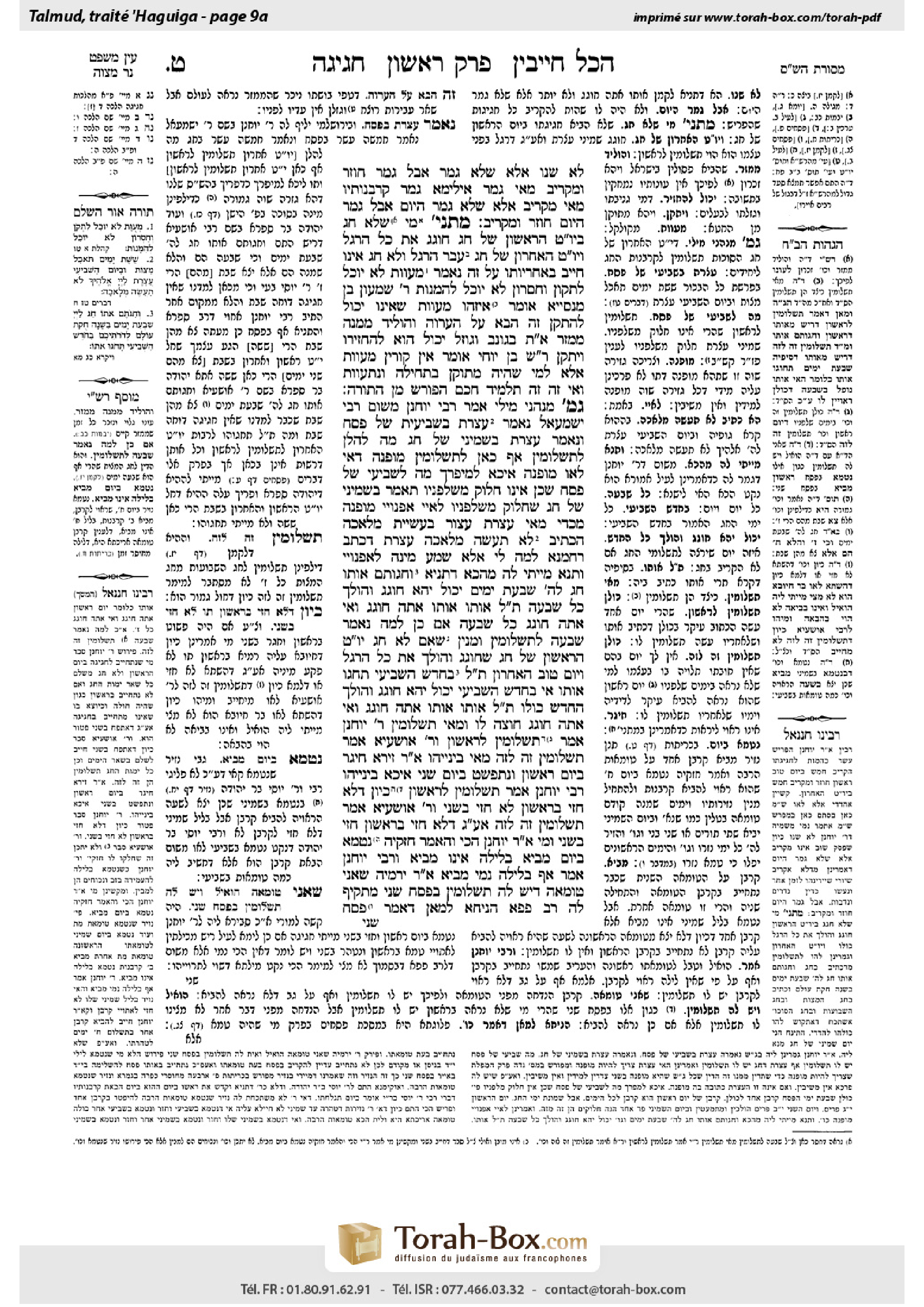
Scan : Torah-Box. Daf Study est un projet indépendant, sans affiliation ni approbation de Torah-Box ou de Sefaria.