Houlin 14b en français · חולין י״ד ב
Traduction française du daf 14b du traité Houlin (Chullin 14b en anglais), avec le texte araméen, l’anglais de Sefaria et le scan de la page, pour étudier le Daf Yomi.
Ouvrir dans le lecteur interactifLire le daf du jour
Traduction française de Houlin 14b
Les traductions françaises de Daf Study sont générées par IA à partir de l’édition anglaise de Sefaria. Elles peuvent contenir des erreurs : vérifie toujours un passage avec le texte source.
La Guemara fait remarquer : Cela ne prouve rien, car, dans ce cas, l’opinion de Rabbi Yehouda s’explique par ce qui est enseigné dans la dernière partie de la baraïta : Les Sages dirent à Rabbi Meïr : « Ne reconnais-tu pas qu’il se peut que l’outre éclate avant qu’il ait le temps de prélever la terouma, et que cet homme se retrouve alors à avoir consommé rétroactivement des produits non soumis à la dîme ? » Rabbi Meïr dit aux Sages : « La simple possibilité que cela se produise ne constitue pas un motif d’inquiétude. Lorsqu’elle éclatera effectivement, je m’en inquiéterai. » Il ressort de là que l’opinion de Rabbi Yehouda ne repose pas sur son rejet du principe de la désignation rétroactive, mais sur sa crainte que l’outre éclate avant que les dîmes ne soient effectivement prélevées.
Mais on apprend plutôt de ce qu’enseigne Ayo que Rabbi Yehouda n’admet pas le principe de la désignation rétroactive. Il s’agit du cas où l’on sait que deux sages de la Torah prévoient de donner des cours le Chabbat hors des limites de la ville, l’un à l’est et l’autre à l’ouest, et où, la veille du Chabbat, on n’a pas encore décidé auquel des cours on souhaite assister. Dans ce cas, on peut placer la nourriture destinée à l’érouv tehoumin des deux côtés de la ville et stipuler qu’on pourra dépasser les limites de la ville dans la direction que l’on choisira.
Ayo enseigne en effet que Rabbi Yehouda dit : « On ne peut pas stipuler que son érouv tehoumin prendra effet simultanément pour deux possibilités. On peut plutôt stipuler que, si un Sage vient à l’est, l’érouv prendra effet à l’est, et que, s’il vient à l’ouest, il prendra effet à l’ouest. Mais si l’on stipule qu’il prendra effet ici ou là, et qu’on ira dans la direction de son choix, l’érouv ne prend pas effet. »
Et nous avons discuté de cette baraïta : en quoi le cas où l’on stipule que l’érouv prendra effet ici ou là diffère-t-il, de sorte que l’érouv ne prend pas effet ? C’est parce qu’il n’existe pas de désignation rétroactive. Si tel est le cas, la stipulation selon laquelle l’érouv prendra effet à l’est ou à l’ouest, selon l’endroit où se rend le Sage, ne devrait pas non plus prendre effet, puisqu’il n’existe pas de désignation rétroactive.
Rabbi Yoḥanan dit : Il s’agit d’un cas où, au moment où il formule sa stipulation, le Sage est déjà arrivé à l’est ou à l’ouest, et l’érouv prend effet dans cette direction. Il formule une stipulation parce qu’il ignore où le Sage est arrivé. L’érouv prend effet sans qu’intervienne le principe de la désignation rétroactive. Néanmoins, puisque le premier cas rapporté par Ayo montre clairement que Rabbi Yehouda n’admet pas ce principe, la question demeure : d’où déduit-on qu’un animal abattu le Chabbat ou à Yom Kippour est interdit à la consommation le jour où il a été abattu ?
Rav Yossef dit plutôt : Lorsque Rav a dit que l’interdiction de consommer l’animal ce jour-là relève de l’opinion de Rabbi Yehouda, il faisait référence à l’opinion de Rabbi Yehouda au sujet des ustensiles, comme nous l’avons appris dans une Michna (Chabbat 124b) : Tous les ustensiles qu’il est permis de déplacer le Chabbat peuvent aussi être déplacés sous forme de tessons, à condition que ceux-ci conviennent à un certain usage. Les tessons d’un grand bol peuvent servir à couvrir l’ouverture d’un tonneau. Les tessons d’un récipient en verre peuvent servir à couvrir l’ouverture d’une fiole.
Rabbi Yehouda dit : « Il est permis de déplacer les tessons à condition qu’ils conviennent à un usage semblable à leur usage initial. Pour les tessons d’un grand bol, il faut qu’ils puissent contenir un bouillon épais ; pour ceux d’un récipient en verre, il faut qu’ils puissent contenir de l’huile. »
La Guemara déduit : s’ils conviennent à un usage semblable à leur usage initial, on peut les déplacer ; mais s’ils conviennent à un autre usage, on ne peut pas les déplacer. Apparemment, puisque le tesson n’avait pas été préparé la veille pour cet usage, il est interdit de le déplacer. De même ici, puisque l’animal abattu n’avait pas été préparé la veille, il est interdit de le consommer.
Abayé dit à Rav Yossef : Peut-on comparer ces cas ? Là, dans la Michna concernant les ustensiles, il s’agissait initialement d’un ustensile et il s’agit maintenant d’un tesson d’ustensile : c’est donc un cas d’objet nouvellement apparu, qu’il est par conséquent interdit de déplacer. Ici, dans le cas d’un animal abattu le Chabbat, il était destiné à servir de nourriture de son vivant et, après l’abattage, il est toujours de la nourriture ; il s’agit donc simplement d’un aliment qui s’est détaché [de’ifrat].
Or, nous avons appris que c’est Rabbi Yehouda qui dit qu’un aliment qui s’est détaché est permis, comme nous l’avons appris dans une Michna (Chabbat 143b) : On ne doit pas presser des fruits le Chabbat pour en extraire des liquides. Si des liquides s’en écoulent spontanément, il est interdit de les utiliser le Chabbat, de peur qu’on en vienne à presser des fruits le Chabbat.
Rabbi Yehouda dit : « Si les fruits étaient destinés à être consommés, le liquide qui s’en est écoulé le Chabbat est permis. Mais si les fruits étaient destinés à fournir leur liquide, celui qui s’en est écoulé le Chabbat est interdit, de peur qu’on en vienne à les presser le Chabbat. » Dans le cas de fruits destinés à la consommation, le liquide est considéré comme un aliment qui s’est détaché et il est permis. La même halakha s’applique à un animal abattu le Chabbat : puisqu’il était destiné à la consommation, sa viande est un aliment qui s’est détaché et devrait donc être permise selon Rabbi Yehouda.
La Guemara rejette cette interprétation et affirme qu’au contraire, il est prouvé que Rabbi Yehouda interdirait de consommer un animal abattu le Chabbat. N’a-t-il pas été enseigné au sujet de cette Michna que Rav Yehouda dit au nom de Chmouel : Rabbi Yehouda a reconnu le bien-fondé de l’opinion des Sages dans le cas de paniers d’olives et de raisins, habituellement destinés à fournir leur liquide, même si l’on avait prévu de les manger : le liquide qui s’en écoule est interdit ?
Apparemment, puisque les olives et les raisins sont habituellement destinés à être pressés, on pense à utiliser leur liquide ; s’il était permis d’utiliser le liquide qui s’en écoule le Chabbat, on craindrait qu’on en vienne à les presser le Chabbat. Les Sages ont donc décrété que ce liquide est interdit. De même ici, puisque l’animal est destiné à être abattu, on pense à le manger. S’il était permis de manger sa viande le Chabbat, on craindrait qu’on en vienne à l’abattre le Chabbat. Par conséquent, les Sages ont décrété que sa viande est interdite.
La Guemara justifie l’interprétation d’Abayé concernant la Michna : cette explication n’est valable que selon Rav, qui a dit que l’interdiction de consommer un animal abattu le Chabbat avant la fin du Chabbat relève de l’opinion de Rabbi Yehouda. Rav n’a-t-il pas dit que Rabbi Yehouda était en désaccord avec les Sages même dans le cas de paniers d’olives et de raisins ? Selon Rav lui-même, de même que Rabbi Yehouda considère comme permis le liquide qui s’écoule spontanément des olives et des raisins, il aurait également dû considérer comme permis, pour ce jour-là, un animal abattu le Chabbat.
Rav Chéchet, fils de Rav Idi, dit plutôt : Lorsque Rav a dit que l’interdiction de consommer l’animal ce jour-là relève de l’opinion de Rabbi Yehouda, il faisait référence à l’opinion de Rabbi Yehouda au sujet des lampes, comme l’enseigne une baraïta : On peut déplacer, à d’autres fins que pour éclairer, une lampe neuve en terre cuite qui n’a jamais été utilisée. Mais on ne peut pas déplacer une vieille lampe couverte de résidus d’huile et de suie, car on la met de côté en raison de son aspect répugnant. Puisqu’elle a été mise de côté au début du Chabbat, elle l’est pour tout le Chabbat et on ne peut pas la déplacer, même si le besoin s’en présente ; telle est la déclaration de Rabbi Yehouda. La même halakha s’applique à un animal abattu le Chabbat : puisqu’il était interdit au début du Chabbat en tant que membre d’un être vivant, il reste interdit pendant tout le Chabbat.
La Guemara rejette cette comparaison. Disons que tu as entendu Rabbi Yehouda interdire l’objet pendant tout le Chabbat lorsqu’il a été mis de côté parce qu’il est répugnant, comme la vieille lampe. L’as-tu entendu dire qu’il est interdit pendant tout le Chabbat lorsqu’il a été mis de côté en raison d’une interdiction, comme l’animal ? La Guemara répond : Oui, comme nous l’avons appris dans une baraïta, où Rabbi Yehouda dit :
Texte source et traduction anglaise
חולין י״ד ב · texte araméen et hébreu
הָתָם כִּדְקָתָנֵי טַעְמָא, אָמְרוּ לוֹ לְרַבִּי מֵאִיר: ״אִי אַתָּה מוֹדֶה שֶׁמָּא יִבָּקַע הַנּוֹד וְנִמְצָא שׁוֹתֶה טְבָלִים לְמַפְרֵעַ?״ אָמַר לָהֶן: ״לִכְשֶׁיִּבָּקַע״.
אֶלָּא מִדְּתָנֵי אַיּוֹ.
דְּתָנֵי אַיּוֹ, רַבִּי יְהוּדָה אוֹמֵר: אֵין אָדָם מַתְנֶה עַל שְׁנֵי דְּבָרִים כְּאֶחָד, אֶלָּא אִם בָּא חָכָם לַמִּזְרָח – עֵירוּבוֹ לַמִּזְרָח, לַמַּעֲרָב – עֵירוּבוֹ לַמַּעֲרָב, וְאִילּוּ לְכָאן וּלְכָאן – לָא.
וְהָוֵינַן בַּהּ: מַאי שְׁנָא לְכָאן וּלְכָאן דְּלָא, דְּאֵין בְּרֵירָה? מִזְרָח וּמַעֲרָב נָמֵי אֵין בְּרֵירָה!
וְאָמַר רַבִּי יוֹחָנָן: וּכְבָר בָּא חָכָם.
אֶלָּא אָמַר רַב יוֹסֵף: רַבִּי יְהוּדָה דְּכֵלִים הִיא, דִּתְנַן: כׇּל הַכֵּלִים הַנִּיטָּלִין בַּשַּׁבָּת, שִׁבְרֵיהֶן נִיטָּלִין, וּבִלְבַד שֶׁיְּהוּ עוֹשִׂין מֵעֵין מְלָאכָה. שִׁבְרֵי עֲרֵיבָה – לְכַסּוֹת בָּהֶן פִּי חָבִית, שִׁבְרֵי זְכוּכִית – לְכַסּוֹת בָּהֶן פִּי הַפַּךְ.
רַבִּי יְהוּדָה אוֹמֵר: וּבִלְבַד שֶׁיְּהוּ עוֹשִׂין מֵעֵין מְלַאכְתָּן, שִׁבְרֵי עֲרֵיבָה – לָצוּק לְתוֹכָן מִקְפָּה, שִׁבְרֵי זְכוּכִית – לָצוּק לְתוֹכָן שֶׁמֶן.
מֵעֵין מְלַאכְתָּן – אִין, מֵעֵין מְלָאכָה אַחֶרֶת – לָא; אַלְמָא, כֵּיוָן דְּלָא אִיתְּכַן מֵאֶתְמוֹל לְהָךְ מְלָאכָה – אֲסִירִי; הָכָא נָמֵי, כֵּיוָן דְּלָא אִיתְּכַן מֵאֶתְמוֹל – אֲסוּרָה.
אֲמַר לֵיהּ אַבָּיֵי: מִי דָּמֵי? הָתָם מֵעִיקָּרָא כְּלִי, וְהַשְׁתָּא שֶׁבֶר כְּלִי, וְהָוֵה לֵיהּ נוֹלָד, וְאָסוּר. הָכָא מֵעִיקָּרָא אוּכְלָא, וּלְבַסּוֹף אוֹכֶל, אוּכְלָא דְּאִיפְּרַת הוּא.
וְשָׁמְעִינַן לֵיהּ לְרַבִּי יְהוּדָה דְּאָמַר: אוּכְלָא דְּאִיפְּרַת שַׁפִּיר דָּמֵי, דִּתְנַן: אֵין סוֹחֲטִין אֶת הַפֵּירוֹת לְהוֹצִיא מֵהֶן מַשְׁקִין, וְאִם יָצְאוּ מֵעַצְמָן – אֲסוּרִין.
רַבִּי יְהוּדָה אוֹמֵר: אִם לָאֳכָלִין – הַיּוֹצֵא מֵהֶן מוּתָּר, וְאִם לְמַשְׁקִין – הַיּוֹצֵא מֵהֶן אָסוּר.
לָאו אִתְּמַר עֲלַהּ, אָמַר רַב יְהוּדָה אָמַר שְׁמוּאֵל: מוֹדֶה הָיָה רַבִּי יְהוּדָה לַחֲכָמִים בְּסַלֵּי זֵיתִים וַעֲנָבִים.
אַלְמָא, כֵּיוָן דְּלִסְחִיטָה קָיְימִי – יָהֵיב דַּעְתֵּיהּ; הָכָא נָמֵי, כֵּיוָן דְּלִשְׁחִיטָה קָיְימָא – יָהֵיב דַּעְתֵּיהּ.
מִידֵּי הוּא טַעְמָא, אֶלָּא לְרַב, הָאָמַר רַב: חָלוּק הָיָה רַבִּי יְהוּדָה אֲפִילּוּ בְּסַלֵּי זֵיתִים וַעֲנָבִים.
אֶלָּא אָמַר רַב שֵׁשֶׁת בְּרֵיהּ דְּרַב אִידִי: רַבִּי יְהוּדָה דְּנֵרוֹת הִיא, דְּתַנְיָא: מְטַלְטְלִין נֵר חָדָשׁ, אֲבָל לֹא יָשָׁן, דִּבְרֵי רַבִּי יְהוּדָה.
אֵימַר דְּשָׁמְעַתְּ לֵיהּ לְרַבִּי יְהוּדָה בְּמוּקְצֶה מֵחֲמַת מִיאוּס, מוּקְצֶה מֵחֲמַת אִיסּוּר מִי שָׁמְעַתְּ לֵיהּ? אִין, דִּתְנַן: רַבִּי יְהוּדָה אוֹמֵר:
Chullin 14b · traduction anglaise de Sefaria
The Gemara comments: That is no proof, as there, the reason for the opinion of Rabbi Yehuda is as is taught in the latter clause of the baraita: The Rabbis said to Rabbi Meir: Don’t you concede that perhaps the wineskin will burst before he manages to separate the teruma, and this person will have been found retroactively to be drinking untithed produce? Rabbi Meir said to the Rabbis: The mere possibility that this may occur is not a concern. When it actually bursts, I will be concerned. Evidently, Rabbi Yehuda’s opinion is not due to his rejection of the principle of retroactive designation, but due to his concern that the wineskin will burst before the tithes are actually separated.
Rather, the fact that Rabbi Yehuda does not accept the principle of retroactive designation is learned from that which Ayo teaches with regard to the joining of Shabbat boundaries in a case where one knows that two Torah scholars are planning to deliver lectures on Shabbat outside the city limits, one east of the city and one west of the city, and on Shabbat eve one has not yet decided which of the lectures he wishes to attend. In that case, he may place the food for the joining of boundaries on both sides of the city and stipulate that he will be able to go beyond the city limits in whichever direction he chooses.
As Ayo teaches that Rabbi Yehuda says: A person may not stipulate that his joining of the boundaries will take effect on two matters as one. Rather, he may stipulate that if one Sage comes to the east, his joining of the boundaries takes effect to the east, and if he comes to the west, his joining takes effect to the west, while if he stipulates that it should take effect to here or to there and he will go in whichever direction he chooses, in that case, the joining does not take effect.
And we discussed this baraita: What is different in a case where one stipulates that it should take effect to here or to there such that the joining does not take effect? It is because there is no retroactive designation. If so, stipulating that the joining will take effect to the east or west, depending upon where the Sage goes, should also not take effect because there is no retroactive designation.
And Rabbi Yoḥanan said: This is a case where when he makes the stipulation, the Sage has already come to either the east or the west, and the joining takes effect in that direction. He makes a stipulation because he does not know where the Sage came. The joining takes effect without the principle of retroactive designation. Nevertheless, since it is clear from the first case of Ayo that Rabbi Yehuda does not accept the principle of retroactive designation, the question remains: From where is it derived that an animal that is slaughtered on Shabbat or Yom Kippur is forbidden for the day that it was slaughtered?
Rather, Rav Yosef said: When Rav said that the halakha that consumption of the animal is prohibited for that day is the opinion of Rabbi Yehuda, the reference is to the opinion of Rabbi Yehuda with regard to vessels, as we learned in a mishna (Shabbat 124b): With regard to all vessels that may be moved on Shabbat, their shards may be moved as well, provided that they are suited for some type of labor. Shards of a large bowl may be used to cover the mouth of a barrel. Shards of a glass vessel may be used to cover the mouth of a cruse.
Rabbi Yehuda says: And it is permitted to use the shards provided that they are suited for a type of labor similar to their original use. In the case of shards of a large bowl, it must be possible to pour a thick broth into them, and in the case of shards of a glass vessel, it must be possible to pour oil into them.
The Gemara infers: If they are suited for a type of labor similar to their original use, yes, they may be moved; but if they are suitable for another type of labor, they may not be moved. Apparently, since the shard was not prepared from yesterday for this type of labor, it is prohibited to move it. Here too, since the animal that was slaughtered was not prepared from yesterday, it is prohibited to eat it.
Abaye said to Rav Yosef: Are the cases comparable? There, in the mishna with regard to vessels, initially it was a vessel and now it is the shard of a vessel, and it is a case of an item that came into being, and it is therefore prohibited to move it. Here, in the case of an animal slaughtered on Shabbat, initially, during its lifetime, it was designated as food, and ultimately, after slaughter, it is food, so it is merely food that was separated [de’ifrat].
And we heard that it is Rabbi Yehuda who says: Food that was separated is permitted, as we learned in a mishna (Shabbat 143b): One may not squeeze fruits on Shabbat in order to extract liquids from them. And if liquids seeped out on their own, it is prohibited to use them on Shabbat, lest one come to squeeze fruit on Shabbat.
Rabbi Yehuda says: If the fruits were designated for eating, the liquid that seeped from them on Shabbat is permitted. And if the fruits were designated for their liquids, the liquids that seeped from them on Shabbat are forbidden, lest he come to squeeze them on Shabbat. With regard to fruits that are designated for consumption, the liquid is considered food that was separated and is permitted. The same halakha applies with regard to an animal slaughtered on Shabbat: Since it was designated for consumption, its meat is food that was separated and should be permitted according to Rabbi Yehuda.
The Gemara rejects that interpretation and states that, on the contrary, there is proof that Rabbi Yehuda would prohibit eating an animal that was slaughtered on Shabbat. Wasn’t it stated with regard to that mishna that Rav Yehuda says that Shmuel says: Rabbi Yehuda conceded to the Rabbis in the case of baskets of olives and grapes that are typically designated for their liquids, even though one had planned to eat them, that liquid that seeps from them is forbidden?
Apparently, since olives and grapes are typically designated for squeezing, one sets his mind to use them for their liquids, and were it permitted for him to use their liquids that seep out on Shabbat, the concern is that he will come to squeeze them on Shabbat. Therefore, the Sages decreed that the liquids are forbidden. Here too, since the animal is designated for slaughter, a person sets his mind to eat it. Therefore, were it permitted for him to eat the meat on Shabbat, the concern is that he will come to slaughter it on Shabbat. Consequently, the Sages decreed that the meat is prohibited.
The Gemara justifies Abaye’s interpretation of the mishna: This explanation is valid only according to Rav, who said that the ruling that it is prohibited to eat an animal slaughtered on Shabbat until after Shabbat is according to the opinion of Rabbi Yehuda. Didn’t Rav say: Rabbi Yehuda was in disagreement with the Rabbis even in the case of baskets of olives and grapes? According to Rav himself, just as Rabbi Yehuda deems permitted liquids that seeped from olives and grapes on their own, Rabbi Yehuda should have also deemed an animal that was slaughtered on Shabbat permitted for that day.
Rather, Rav Sheshet, son of Rav Idi, said: When Rav said that the halakha that it is prohibited to consume the animal that day is the opinion of Rabbi Yehuda, the reference is to the opinion of Rabbi Yehuda with regard to lamps, as it is taught in a baraita: One may move, for purposes other than lighting it, a new earthenware lamp that was never used. But one may not move an old lamp covered with residue of oil and soot, because a person sets it aside from use due to repugnance. Since it was set aside at the beginning of Shabbat, it is set aside for the entire Shabbat and it may not be moved even if a need to move it arises; this is the statement of Rabbi Yehuda. The same halakha applies with regard to an animal slaughtered on Shabbat: Since it was prohibited when Shabbat began as the limb of a living being, it remains prohibited for the entire Shabbat.
The Gemara rejects that analogy. Say that you heard Rabbi Yehuda rule that it is prohibited for the entire Shabbat in a case where it is set aside due to repugnance, like the old lamp. Did you hear that he said that it is prohibited for the entire Shabbat in a case where it is set aside due to a prohibition, like the animal? The Gemara answers: Yes, as we learned in a baraita that Rabbi Yehuda says:
Texte de Sefaria : William Davidson Edition - Vocalized Aramaic (unknown) ; William Davidson Edition - English (CC BY NC).
Scan de Houlin 14b
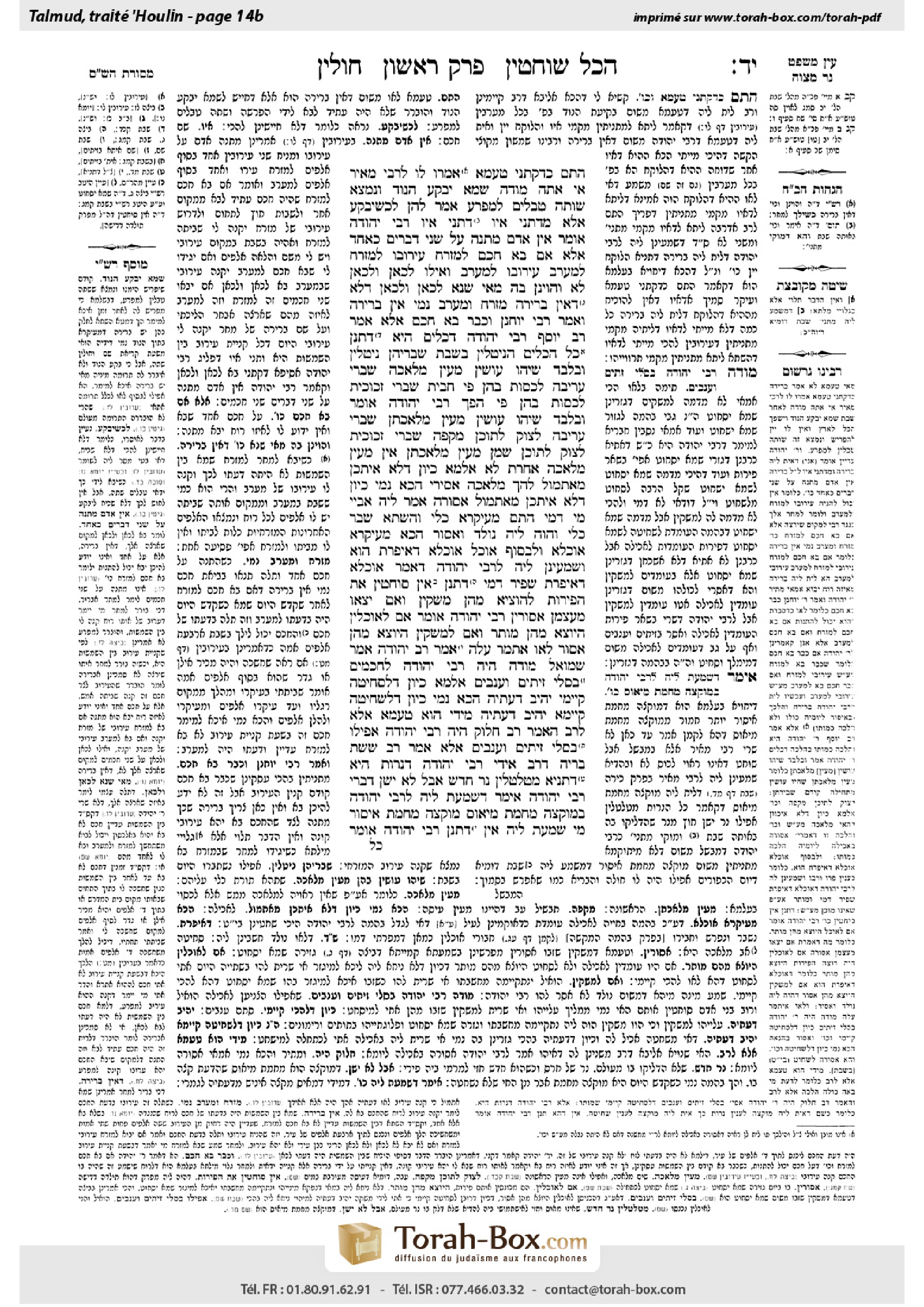
Scan : Torah-Box. Daf Study est un projet indépendant, sans affiliation ni approbation de Torah-Box ou de Sefaria.