Houlin 44a en français · חולין מ״ד א
Traduction française du daf 44a du traité Houlin (Chullin 44a en anglais), avec le texte araméen, l’anglais de Sefaria et le scan de la page, pour étudier le Daf Yomi.
Ouvrir dans le lecteur interactifLire le daf du jour
Traduction française de Houlin 44a
Les traductions françaises de Daf Study sont générées par IA à partir de l’édition anglaise de Sefaria. Elles peuvent contenir des erreurs : vérifie toujours un passage avec le texte source.
Et celui qui souhaite adopter à la fois les rigueurs de Beit Shammaï et celles de Beit Hillel, à son sujet le verset dit : « L’insensé marche dans les ténèbres » (Ecclésiaste 2,14). Il faut plutôt agir soit conformément à Beit Shammaï, en suivant à la fois leurs dispenses et leurs rigueurs, soit conformément à Beit Hillel, en suivant à la fois leurs dispenses et leurs rigueurs.
La Guemara objecte à la formulation de la baraïta : cette baraïta elle-même pose une difficulté. D’abord, tu dis que la halakha suit toujours l’avis de Beit Hillel, puis tu enseignes que celui qui souhaite agir conformément à l’avis de Beit Shammaï peut le faire.
La Guemara répond : il n’y a pas de difficulté. Ici, l’affirmation selon laquelle chacun peut agir comme il le souhaite a été énoncée avant que la Voix céleste ne se fasse entendre et n’annonce que la halakha suit toujours Beit Hillel. Là, l’affirmation selon laquelle la halakha suit toujours Beit Hillel a été énoncée après que la Voix céleste eut rendu cette décision.
Et si tu le souhaites, dis plutôt que même l’affirmation selon laquelle chacun peut agir comme il le souhaite a été énoncée après que la Voix céleste eut annoncé que la halakha suit Beit Hillel ; cette affirmation est conforme à l’opinion de Rabbi Yehoshoua, qui dit : on ne tient pas compte d’une Voix céleste qui tente d’intervenir dans les questions de halakha. Selon lui, le différend entre Beit Shammaï et Beit Hillel n’a pas encore été tranché.
La Guemara fait remarquer : quoi qu’il en soit, la décision de Rava pose une difficulté. Comment a-t-il pu statuer selon deux rigueurs contradictoires afin de déclarer l’animal tereifa ?
Rav Tavout a dit : Rava a suivi entièrement l’opinion de Rav. En effet, lorsque Rami bar Yeḥezkel est venu, il a dit : « Ne prêtez pas attention aux principes formulés par Rav Yehouda, mon frère, au nom de Rav. » Bien que Rav estime qu’une perforation de n’importe quelle partie de l’entrée de l’œsophage rende l’animal tereifa, ce n’est pas parce qu’il s’agirait d’un endroit où l’abattage rituel est valide. Rav a plutôt dit ceci : les Sages ont fixé une mesure délimitant la partie de l’œsophage où l’abattage rituel est valide. On en déduit que l’entrée de l’œsophage n’est pas un endroit où l’abattage rituel est valide. Et pourtant, il dit qu’une perforation, quelle qu’en soit l’étendue, rend l’animal tereifa.
Puisqu’il a été mentionné que les Sages ont fixé une mesure délimitant la partie de l’œsophage où l’abattage rituel est valide, la Guemara demande : jusqu’où s’étend vers le haut la limite de l’abattage rituel valide ? Rav Naḥman a dit : jusqu’au point où il ne reste que juste assez d’espace pour saisir l’œsophage à la main. La Guemara demande : jusqu’où s’étend vers le bas la limite ? Rav Naḥman a dit que Rabba bar Avouh a dit : jusqu’à ce que l’œsophage devienne velu, c’est-à-dire jusqu’à l’ouverture du rumen, dont la paroi interne est velue.
La Guemara demande : en est-il vraiment ainsi ? Ravina ne dit-il pas que Geneiva a dit au nom de Rav : « Le palme inférieur de l’œsophage, près du rumen, correspond au rumen interne » ? Si tel est le cas, pourquoi Rav Naḥman autorise-t-il l’abattage rituel jusqu’à l’ouverture du rumen ? Lorsqu’on abat dans le palme inférieur, on abat dans le rumen, et l’abattage devrait être invalide.
Il faut plutôt corriger l’énoncé de Rav comme suit : le palme supérieur du rumen, près de l’œsophage, correspond au rumen interne, qui n’est pas un endroit où l’abattage rituel est valide. En revanche, le palme inférieur de l’œsophage est un endroit où l’abattage rituel est valide. Et si tu le souhaites, dis plutôt que lorsque Rav dit que le palme inférieur de l’œsophage est considéré comme le rumen, il fait spécifiquement référence à un taureau, particulièrement velu, chez lequel des poils apparaissent jusque dans le palme inférieur de l’œsophage lui-même. En revanche, chez les autres animaux, toute la partie inférieure de l’œsophage est un endroit où l’abattage rituel est valide.
§ Rav Naḥman dit au nom de Shmouel : si l’entrée de l’œsophage a été entièrement détachée de la mâchoire, l’animal est cacher. Le tanna de la Michna l’a également enseigné plus loin (54a) : si la mâchoire inférieure a été entièrement détachée, l’animal est cacher.
Rav Pappa objecte : comment Shmouel peut-il dire que si l’entrée de l’œsophage est détachée, l’animal est cacher ? N’y a-t-il pas déchirement des simanim — l’œsophage et la trachée — à leur point d’attache ? Cela devrait rendre l’animal tereifa.
La Guemara intervient : mais, selon Rav Pappa, la Michna pose elle aussi une difficulté, puisqu’elle dit : « Si la mâchoire inférieure a été détachée, l’animal est cacher. » Si la mâchoire inférieure est détachée, la trachée et l’œsophage le seront nécessairement aussi, puisqu’ils y sont attachés.
La Guemara répond : il est vrai que la Michna ne pose pas de difficulté pour Rav Pappa. Cette halakha, selon laquelle le déchirement des simanim rend l’animal tereifa, ne s’applique que lorsque les simanim sont complètement arrachés de la mâchoire. L’énoncé de la Michna, selon lequel un animal dont la mâchoire est détachée est cacher, concerne un cas où la mâchoire inférieure est sectionnée au-dessus de son point d’attache aux simanim, lesquels restent eux-mêmes attachés à la chair restante de la mâchoire. Mais la halakha selon laquelle le déchirement des simanim rend l’animal tereifa pose une difficulté pour Shmouel. Comment un animal peut-il rester cacher lorsque l’entrée de son œsophage est retirée, si cela entraîne le déchirement des simanim ?
La Guemara répond : ne dis pas que Shmouel déclare l’animal cacher si l’entrée de l’œsophage a été entièrement détachée. Dis plutôt qu’il ne le déclare cacher que si elle a été détachée en majorité.
La Guemara demande : mais Rabba bar bar Ḥana ne dit-il pas que Shmouel dit que des simanim détachés en majorité rendent l’animal tereifa ? Rav Sheisha, fils de Rav Idi, a dit : cet énoncé de Shmouel, selon lequel l’animal est cacher même si les simanim sont détachés en majorité, ne s’applique qu’à un cas où l’entrée de l’œsophage a été décollée de la chair de la mâchoire, de sorte que les tissus encore attachés sont concentrés en un seul endroit. Dans un tel cas, l’animal pourrait se rétablir. Là, lorsque Shmouel déclare l’animal tereifa, il fait référence à un cas où les simanim ont été arrachés de force [de’ippruk ipprukei] de la mâchoire et ne tiennent plus que par quelques lambeaux de chair discontinus. Dans un tel cas, l’animal ne peut pas se rétablir.
§ La Michna dit : ou un animal dont la trachée est coupée transversalement est tereifa. À ce sujet, les Sages ont enseigné : quelle partie de la trachée doit être coupée pour que l’animal soit tereifa ? La majorité. Et quelle est cette majorité ? Rav dit :
Texte source et traduction anglaise
חולין מ״ד א · texte araméen et hébreu
מֵחוּמְרֵי בֵּית שַׁמַּאי וּמֵחוּמְרֵי בֵּית הִלֵּל – עָלָיו הַכָּתוּב אוֹמֵר: ״הַכְּסִיל בַּחוֹשֶׁךְ הוֹלֵךְ״. אֶלָּא אִי כְּבֵית שַׁמַּאי – כְּקוּלֵּיהֶן וּכְחוּמְרֵיהֶן, אִי כְּבֵית הִלֵּל – כְּקוּלֵּיהֶן וּכְחוּמְרֵיהֶן.
הָא גּוּפַאּ קַשְׁיָא, אָמְרַתְּ: לְעוֹלָם הֲלָכָה כְּדִבְרֵי בֵּית הִלֵּל, וַהֲדַר תָּנֵי: וְהָרוֹצֶה לַעֲשׂוֹת כְּדִבְרֵי בֵּית שַׁמַּאי יַעֲשֶׂה!
לָא קַשְׁיָא, כָּאן – קוֹדֶם בַּת קוֹל, כָּאן – לְאַחַר בַּת קוֹל.
וְאִי בָּעֵית אֵימָא, אַף לְאַחַר בַּת קוֹל, וְרַבִּי יְהוֹשֻׁעַ הִיא, דְּאָמַר: אֵין מַשְׁגִּיחִין בְּבַת קוֹל.
מִכׇּל מָקוֹם, קַשְׁיָא.
אָמַר רַב טָבוּת: כּוּלַּהּ כְּרַב עַבְדַהּ, דְּכִי אֲתָא רָמֵי בַּר יְחֶזְקֵאל אָמַר: לָא תְּצִיתוּ לְהוּ לְהָנֵי כְּלָלֵי דְּכָיֵיל יְהוּדָה אֲחִי מִשְּׁמֵיהּ דְּרַב! הָכִי אָמַר רַב: וֶושֶׁט נָתְנוּ [בּוֹ] חֲכָמִים שִׁיעוּר, מִכְּלָל דְּתוּרְבַּץ הַוֶּושֶׁט לָאו מְקוֹם שְׁחִיטָה הוּא, וְקָאָמַר בְּמַשֶּׁהוּ.
לְמַעְלָה עַד כַּמָּה? אָמַר רַב נַחְמָן: עַד כְּדֵי תְּפִיסַת יָד. לְמַטָּה עַד כַּמָּה? אָמַר רַב נַחְמָן אָמַר רַבָּה בַּר אֲבוּהּ: עַד כְּדֵי שֶׁיַּשְׂעִיר.
אִינִי? וְהָאָמַר רָבִינָא אָמַר גְּנִיבָא מִשְּׁמֵיהּ דְּרַב: טֶפַח בַּוֶּושֶׁט סָמוּךְ לַכָּרֵס – זֶהוּ כָּרֵס הַפְּנִימִי. אַמַּאי? כִּי קָא שָׁחֵט בְּכָרֵס קָא שָׁחֵיט!
אֵימָא: טֶפַח בְּכָרֵס סָמוּךְ לַוֶּושֶׁט – זֶהוּ כָּרֵס הַפְּנִימִי. אִיבָּעֵית אֵימָא: כִּי קָאָמַר רַב – בְּתוֹרָא, דְּמַשְׂעַר טְפֵי.
אָמַר רַב נַחְמָן אָמַר שְׁמוּאֵל: תּוּרְבַּץ הַוֶּושֶׁט שֶׁנִּיטַּל כּוּלּוֹ מִלֶּחִי – כָּשֵׁר, וּתְנָא תּוּנָא: נִיטַּל לֶחִי הַתַּחְתּוֹן – כָּשֵׁר.
מַתְקֵיף לַהּ רַב פָּפָּא: וְהָאִיכָּא עִיקּוּר סִימָנִים?
וּלְרַב פָּפָּא קַשְׁיָא מַתְנִיתִין: נִיטַּל לֶחִי הַתַּחְתּוֹן – כָּשֵׁר.
בִּשְׁלָמָא מַתְנִיתִין לְרַב פָּפָּא לָא קַשְׁיָא, הָא דְּאִיעֲקוּר אִיעֲקוֹרֵי, הָא דְּאִיגּוּם אִיגּוֹמֵי מֵעִילָּוֵי סִימָנִים, אֶלָּא לִשְׁמוּאֵל קַשְׁיָא!
לָא תֵּימָא כּוּלּוֹ, אֶלָּא אֵימָא רוּבּוֹ.
וְהָאָמַר רַבָּה בַּר בַּר חָנָה אָמַר שְׁמוּאֵל: סִימָנִים שֶׁנִּדַּלְדְּלוּ בְּרוּבָּן – טְרֵפָה? אָמַר רַב שִׁישָׁא בְּרֵיהּ דְּרַב אִידִי: הָא דְּאִקְּפַל אִיקְּפוֹלֵי, הָתָם דְּאִפְּרוּק אִפְּרוֹקֵי.
וּפְסוּקַת הַגַּרְגֶּרֶת. תָּנָא: כַּמָּה פְּסוּקַת הַגַּרְגֶּרֶת? בְּרוּבָּהּ. וְכַמָּה רוּבָּה? רַב אָמַר:
Chullin 44a · traduction anglaise de Sefaria
And one who wishes to adopt both the stringencies of Beit Shammai and the stringencies of Beit Hillel, with regard to him the verse states: “The fool walks in darkness” (Ecclesiastes 2:14). Rather, one should act either in accordance with Beit Shammai, following both their leniencies and their stringencies, or in accordance with Beit Hillel, following both their leniencies and their stringencies.
The Gemara objects to the wording of the baraita: This baraita itself is difficult. First you say that the halakha is always in accordance with the statement of Beit Hillel, and then you teach that one who wishes to act in accordance with the statement of Beit Shammai may do so.
The Gemara responds: This is not difficult. Here, the statement that a person may act as he wishes was made before the Divine Voice emerged and announced that the halakha is always in accordance with Beit Hillel. There, the statement that the halakha is always in accordance with Beit Hillel was made after the Divine Voice issued this ruling.
And if you wish, say instead that even the statement that a person may act as he wishes was made after the Divine Voice announced that the halakha is in accordance with Beit Hillel, and this statement is in accordance with the opinion of Rabbi Yehoshua, who says: One disregards a Divine Voice that attempts to intervene in matters of halakha. According to him, the dispute between Beit Shammai and Beit Hillel has not yet been decided.
The Gemara notes: In any case, Rava’s ruling is difficult. How could he rule in accordance with two contradictory stringencies in order to deem the animal a tereifa?
Rav Tavut said: Rava acted entirely in accordance with the opinion of Rav. As when Rami bar Yeḥezkel came, he said: Do not listen to those principles that Rav Yehuda, my brother, formulated in the name of Rav. Although Rav holds that a perforation of any part of the entrance of the gullet renders an animal a tereifa, this is not because it is a location fit for slaughter. Rather, this is what Rav said: The Sages gave a measure defining the portion of the gullet that is valid for slaughter. By inference, one learns that the entrance of the gullet is not a location fit for slaughter. And nevertheless, he says that a perforation in any amount renders the animal a tereifa.
Since it was mentioned that the Sages gave a measure defining the portion of the gullet that is valid for slaughter, the Gemara asks: How far up the gullet is the upper boundary for valid slaughter? Rav Naḥman said: It is until the point that there remains only sufficient space for a hand to grip the gullet. The Gemara asks: How far down is the lower boundary? Rav Naḥman said that Rabba bar Avuh said: Until the gullet becomes hairy, i.e., until the opening of the rumen, whose lining is hairy.
The Gemara asks: Is that so? But doesn’t Ravina say that Geneiva says in the name of Rav: The lowermost handbreadth in the gullet, adjacent to the rumen, this is the inner rumen? If so, why does Rav Naḥman permit slaughter until the opening of the rumen? When one slaughters within the bottom handbreadth, he is slaughtering in the rumen, and his slaughter should be invalid.
Rather, say that Rav’s statement should be amended, as follows: The uppermost handbreadth in the rumen, adjacent to the gullet, this is the inner rumen, which is not a valid location for slaughter. By contrast, the lowermost handbreadth of the gullet is a valid location for slaughter. And if you wish, say instead that when Rav says that the lowermost handbreadth of the gullet is considered the rumen, he is referring specifically to a bull, which is especially hairy, and hairs appear even within the lowermost handbreadth of the gullet itself. By contrast, in other animals, the entire lower gullet is a valid location for slaughter.
§ Rav Naḥman says that Shmuel says: If the entrance of the gullet was completely detached from the jaw, the animal is kosher. And the tanna of the mishna also taught this later (54a): If the lower jaw was detached entirely, it is kosher.
Rav Pappa objects to this: How can Shmuel say that if the entrance of the gullet is detached the animal is kosher? But isn’t there ripping of the simanim, the gullet and the windpipe, from their place? This should render the animal a tereifa.
The Gemara interjects: But according to Rav Pappa, the mishna is difficult as well, since it states: If the lower jaw was detached, it is kosher. If the lower jaw is detached, the windpipe and gullet will necessarily be detached as well, since they are attached to it.
The Gemara responds: Granted, the mishna is not difficult for Rav Pappa. This halakha, that the ripping of the simanim renders the animal a tereifa, applies only when the simanim are completely ripped from the jaw. That statement of the mishna, that an animal whose jaw is detached is kosher, is referring to a case where the lower jaw is severed above its connection to the simanim, which themselves remain connected to the remaining flesh of the jaw. But the halakha that the ripping of the simanim renders the animal a tereifa is difficult for Shmuel. How can an animal remain kosher when the entrance of its gullet is removed, if this entails the ripping of the simanim?
The Gemara responds: Do not say that Shmuel deems the animal kosher if the entrance of the gullet was completely detached. Rather, say that he deems it kosher only if it was mostly detached.
The Gemara asks: But doesn’t Rabba bar bar Ḥana say that Shmuel says: Simanim that were detached in their majority render the animal a tereifa? Rav Sheisha, son of Rav Idi, said: This statement of Shmuel, that the animal is kosher even if the simanim are mostly detached, applies only to a case in which the entrance of the gullet was peeled off from the flesh of the jaw, such that the connected tissue is concentrated in one area. In such a case, the animal might recover. There, where Shmuel deems the animal a tereifa, he is referring to a case in which the simanim were forcibly separated [de’ippruk ipprukei] from the jaw and are connected only by a few discontinuous pieces of flesh. In such a case the animal cannot recover.
§ The mishna states: Or an animal with a cut windpipe, cut across its width, is a tereifa. With regard to this the Sages taught: How much must the windpipe be cut to render the animal a tereifa? In its majority. And how much is its majority? Rav says:
Texte de Sefaria : William Davidson Edition - Vocalized Aramaic (unknown) ; William Davidson Edition - English (CC BY NC).
Scan de Houlin 44a
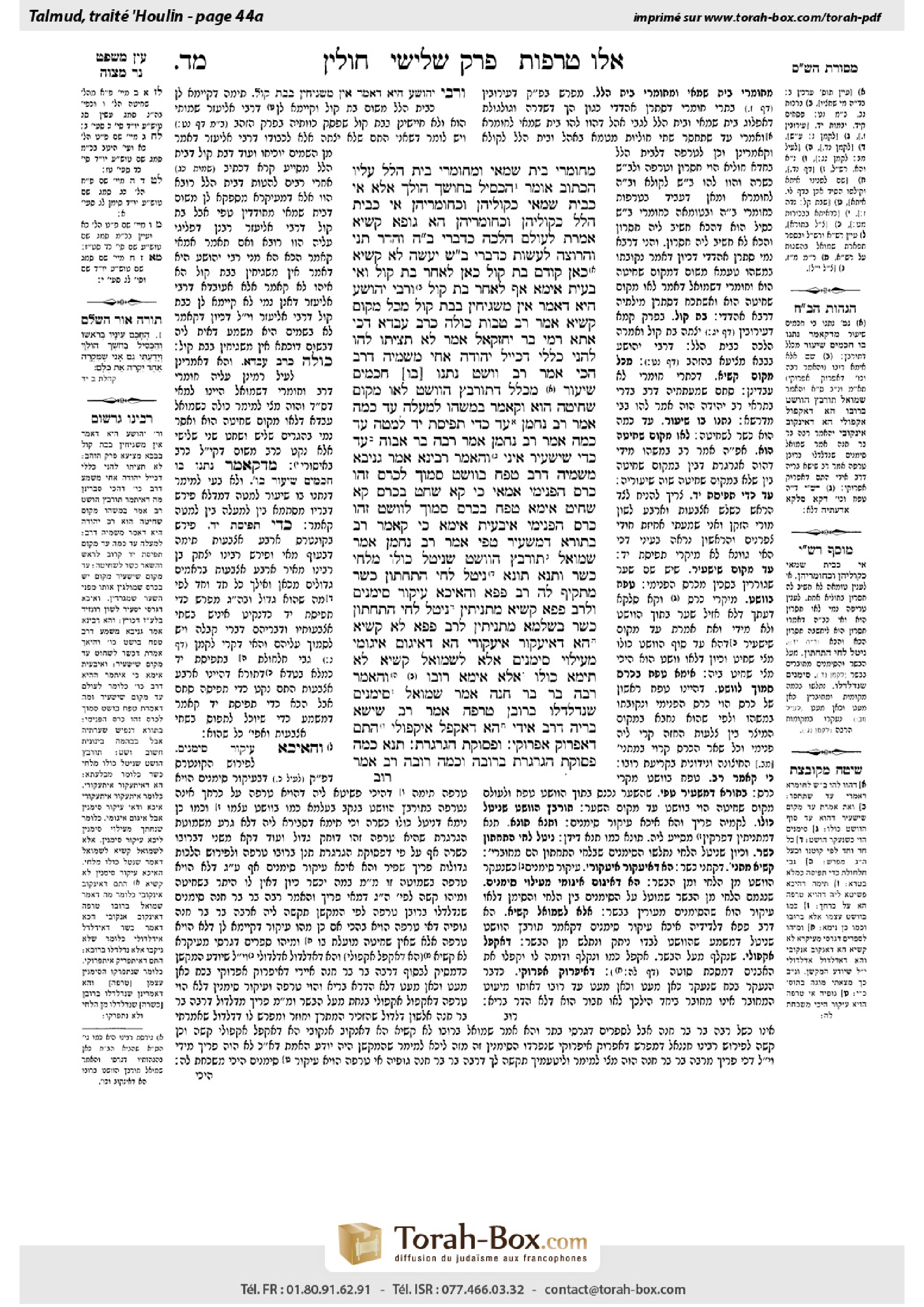
Scan : Torah-Box. Daf Study est un projet indépendant, sans affiliation ni approbation de Torah-Box ou de Sefaria.