Houlin 50b en français · חולין נ׳ ב
Traduction française du daf 50b du traité Houlin (Chullin 50b en anglais), avec le texte araméen, l’anglais de Sefaria et le scan de la page, pour étudier le Daf Yomi.
Ouvrir dans le lecteur interactifLire le daf du jour
Traduction française de Houlin 50b
Les traductions françaises de Daf Study sont générées par IA à partir de l’édition anglaise de Sefaria. Elles peuvent contenir des erreurs : vérifie toujours un passage avec le texte source.
des bouteilles vides, c’est-à-dire pour ne pas lui attribuer à tort des propos ? Rav Naḥman dit donc : à l’endroit où le rectum est attaché aux hanches, même s’il a été entièrement retiré, l’animal est cacher. Cette halakha ne s’applique que s’il en reste une partie suffisante pour qu’on puisse la saisir. La Guemara demande : quelle quantité est suffisante pour pouvoir la saisir ? Abaye dit : la largeur d’un doigt. Cette mesure suffit même dans le cas d’un grand taureau.
§ La Michna enseigne que si le rumen interne est perforé ou si la majeure partie du rumen externe est déchirée, l’animal est une tereifa. À ce sujet, Rav Yehouda dit que Rav a rapporté : Natan bar Sheila, le chef des bouchers de Tsippori, témoigna devant Rabbi Yehouda HaNassi au nom de Rabbi Natan : « Quel est le rumen interne ? C’est le cæcum. » Rabbi Yehoshua ben Korḥa dit de même : c’est le cæcum. Rabbi Yishmaël dit : c’est l’ouverture [istumka] du rumen.
Rav Asi dit que Rabbi Yoḥanan a rapporté : il y a une partie étroite du rumen, qui constitue le rumen interne ; tout le reste est le rumen externe. Mais je ne sais pas quelle zone correspond à cette partie étroite. Rav Naḥman bar Yitzḥak dit : le rumen est tombé dans une fosse, c’est-à-dire que, puisqu’on ignore quelle zone est considérée comme la partie étroite, une perforation en n’importe quel endroit du rumen rend l’animal tereifa. Rav Aḥa bar Rav Ava dit que Rav Asi a rapporté : le rumen interne s’étend depuis la partie étroite, là où le rumen commence à se rétrécir en s’approchant de l’œsophage, vers le bas, en direction de l’œsophage, lorsque l’animal est suspendu par les pattes.
Rabbi Ya’akov bar Naḥmani dit au nom de Shmuel : le rumen interne est la partie du rumen dépourvue de villosités, c’est-à-dire de petites excroissances duveteuses sur sa face interne. Rabbi Avina dit au nom de Geneiva, qui l’a dit au nom de Rav : le téfaḥ de l’œsophage adjacent au rumen constitue le rumen interne.
En Occident, c’est-à-dire en Terre d’Israël, on disait au nom de Rabbi Yosei bar Ḥanina : le rumen tout entier est le rumen interne. Si tel est le cas, quel est le rumen externe ? C’est la chair qui enveloppe la majeure partie du rumen sur la face inférieure de l’animal. Rabba bar Rav Huna dit : le rumen interne est le mafrata. La Guemara demande : qu’est-ce que le mafrata ? Rav Avya dit : c’est la partie que le boucher met à découvert lorsqu’il ouvre l’animal, c’est-à-dire la face inférieure de l’estomac.
La Guemara rapporte : à Neharde’a, on suivait l’avis de Rabba bar Rav Huna. Rav Ashi dit à Ameimar, l’un des Sages de Neharde’a : que faire de toutes ces autres opinions, selon lesquelles le rumen interne correspond à une autre partie du rumen ? Ameimar lui répondit : selon Rabba bar Rav Huna, elles sont toutes incluses dans la définition du rumen interne. Le cæcum, l’ouverture du rumen et la partie dépourvue de villosités sont tous orientés vers la face inférieure de l’estomac, c’est-à-dire le mafrata.
Rav Ashi répondit : et que dire de l’opinion que Rav Asi rapporte au nom de Rabbi Yoḥanan, selon laquelle le rumen interne est une zone étroite dont l’emplacement est inconnu ? Ne faudrait-il pas alors considérer le rumen tout entier comme le rumen interne ? Ameimar lui répondit : Rav Aḥa bar Ava a déjà expliqué qu’il s’agit de la zone qui s’étend depuis la partie étroite jusqu’à l’œsophage. Cette zone est elle aussi comprise dans le mafrata. Rav Ashi demanda encore : et que dire de l’opinion de Rabbi Avina, selon laquelle le rumen interne est le téfaḥ situé près de l’œsophage, ainsi que de celle des habitants d’Occident, en Terre d’Israël, selon laquelle il s’agit du rumen tout entier ? Ameimar lui répondit : ces opinions sont certes en désaccord avec celle de Rabba bar Rav Huna, mais nous ne les suivons pas.
§ La Michna enseigne : Rabbi Yehouda dit qu’en cas de déchirure du rumen externe, une déchirure d’un téfaḥ rend l’animal tereifa si celui-ci est grand, tandis que, s’il est petit, il n’est tereifa que si la majeure partie du rumen est déchirée. Rabbi Binyamin bar Yefet dit que Rabbi Elazar a rapporté : les termes « grand » et « petit » ne désignent pas littéralement un grand ou un petit animal. Il s’agit plutôt de tout animal assez grand pour que son rumen externe puisse être déchiré sur un téfaḥ sans que cela en constitue la majeure partie : c’est ce que nous avons appris en disant que, pour un grand animal, une déchirure d’un téfaḥ le rend tereifa. Et il s’agit de tout animal assez petit pour que la majeure partie de son rumen externe puisse être déchirée sans que cela atteigne un téfaḥ : c’est ce que nous avons appris en disant que, pour un petit animal, il n’est tereifa que si la majeure partie est déchirée. Autrement dit, une déchirure du rumen externe rend l’animal tereifa dès qu’elle atteint soit un téfaḥ, soit la majeure partie du rumen.
La Guemara demande : si la majeure partie du rumen externe est déchirée sans que cela atteigne un téfaḥ, n’est-il pas évident que l’animal devient tereifa ? En effet, il existe un principe selon lequel la majorité d’une chose est considérée comme la totalité. La Guemara répond : non, cette précision est nécessaire dans le cas où la déchirure n’atteindrait un téfaḥ qu’en dépassant la majeure partie, c’est-à-dire lorsque le rumen externe mesure un peu moins de deux téfaḥim. De peur que tu ne dises que, dans un tel cas, l’animal n’est tereifa qu’une fois qu’un téfaḥ a été déchiré, cette halakha nous apprend qu’il n’en est pas ainsi. Au contraire, si la majeure partie du rumen est déchirée, l’animal est tereifa, même si cela représente moins d’un téfaḥ.
Geneiva dit que Rabbi Asi a rapporté : si un trou rond de la taille d’une pièce de sela est percé dans le rumen externe, l’animal est tereifa, car si l’on étire un trou de cette taille, il atteindra la longueur d’un téfaḥ. Rabbi Ḥiyya bar Abba dit : Geneiva lui-même m’a expliqué cette question, lorsque nous étions sur le bac de Neharde’a : si le trou a exactement la taille d’un sela, l’animal est cacher ; si le trou est plus grand qu’un sela, l’animal est tereifa. La Guemara demande : à partir de quelle taille le trou est-il considéré comme plus grand qu’un sela ? Rav Yosef dit : par exemple, si trois noyaux de datte couverts de restes de chair de datte peuvent passer difficilement par le trou, ou si ces noyaux, sans aucun reste de chair, peuvent y passer aisément, le trou est considéré comme plus grand qu’un sela.
§ La Michna enseigne qu’un animal est tereifa si la caillette ou le réseau est perforé vers l’extérieur, c’est-à-dire vers la cavité abdominale. À ce sujet, les Sages ont enseigné : dans le cas d’une aiguille trouvée dans l’épaisseur du réseau, si elle n’a percé la paroi que d’un seul côté, l’animal est cacher. Si elle a percé la paroi des deux côtés, c’est-à-dire si l’aiguille a traversé complètement la paroi de l’estomac, l’animal est tereifa. Mais même si elle ressort des deux côtés, l’animal n’est pas toujours tereifa, et il faut procéder à un examen supplémentaire : si une goutte de sang coagulé se trouve au-dessus de l’aiguille,
Texte source et traduction anglaise
חולין נ׳ ב · texte araméen et hébreu
בּוּקֵי סְרִיקִי? הָכִי אָמַר רַב נַחְמָן: מְקוֹם הַדֶּבֶק, אֲפִילּוּ נִיטַּל כּוּלּוֹ – כָּשֵׁר, וְהוּא שֶׁנִּשְׁתַּיֵּיר בּוֹ כְּדֵי תְּפִיסָה. וְכַמָּה? אָמַר אַבָּיֵי: כִּמְלֵא בַּטְדָּא בְּתוֹרָא.
הַכָּרֵס הַפְּנִימִי. אָמַר רַב יְהוּדָה אָמַר רַב: הֵעִיד נָתָן בַּר שֵׁילָא רֵישׁ טַבָּחַיָּא דְּצִפּוֹרִי לִפְנֵי רַבִּי מִשּׁוּם רַבִּי נָתָן: אֵי זוֹ הִיא כָּרֵס הַפְּנִימִי? סַנְיָא דֵּיבֵי. וְכֵן אָמַר רַבִּי יְהוֹשֻׁעַ בֶּן קׇרְחָה: סַנְיָא דֵּיבֵי. רַבִּי יִשְׁמָעֵאל אָמַר: אִיסְתּוּמְכָא דְּכַרְסָא.
רַב אַסִּי אָמַר רַבִּי יוֹחָנָן: מָקוֹם צַר יֵשׁ בַּכָּרֵס, וְאֵינִי יוֹדֵעַ אֵיזֶהוּ. אָמַר רַב נַחְמָן בַּר יִצְחָק: נְפַל כְּרֵסָא בְּבֵירָא. אָמַר רַב אַחָא בַּר רַב עַוָּא אָמַר רַב אַסִּי: מִן הַמֵּיצַר וּלְמַטָּה.
רַבִּי יַעֲקֹב בַּר נַחְמָנִי אָמַר שְׁמוּאֵל: מְקוֹם שֶׁאֵין בּוֹ מֵילָת. רַבִּי אֲבִינָא אָמַר גְּנִיבָא מִשְּׁמֵיהּ דְּרַב: טֶפַח בַּוֶּושֶׁט סָמוּךְ לַכָּרֵס – זוֹ הִיא כָּרֵס הַפְּנִימִית.
אָמְרִי בְּמַעְרְבָא מִשְּׁמֵיהּ דְּרַבִּי יוֹסֵי בַּר חֲנִינָא: כׇּל הַכָּרֵס כּוּלּוֹ – זוֹ הִיא כָּרֵס הַפְּנִימִית, וְאֵיזֶהוּ כָּרֵס הַחִיצוֹן? בָּשָׂר הַחוֹפֶה אֶת רוֹב הַכָּרֵס. רַבָּה בַּר רַב הוּנָא אָמַר: מַפְרַעְתָּה. מַאי מַפְרַעְתָּה? אָמַר רַב אַוְיָא: הֵיכָא דְּפָרְעִי טַבָּחֵי.
בִּנְהַרְדְּעָא עָבְדִי כְּרַבָּה בַּר רַב הוּנָא. אֲמַר לֵיהּ רַב אָשֵׁי לְאַמֵּימָר: כֹּל הָנֵי שְׁמַעְתָּתָא מַאי? אֲמַר לֵיהּ: כּוּלְּהוּ שָׁיְיכָן בִּדְרַבָּה בַּר רַב הוּנָא.
וּדְרַב אַסִּי אָמַר רַבִּי יוֹחָנָן, מַאי אֲמַר לֵיהּ? כְּבָר פֵּירְשָׁה רַב אַחָא בַּר עַוָּא. וּדְרַבִּי אֲבִינָא וְדִבְנֵי מַעְרְבָא, מַאי אֲמַר לֵיהּ? הָנֵי וַדַּאי פְּלִיגִי.
רַבִּי יְהוּדָה אוֹמֵר: בִּגְדוֹלָה כּוּ׳. אָמַר רַבִּי בִּנְיָמִין בַּר יֶפֶת אָמַר רַבִּי אֶלְעָזָר: לֹא ״גְּדוֹלָה״ – גְּדוֹלָה מַמָּשׁ, וְלֹא ״קְטַנָּה״ – קְטַנָּה מַמָּשׁ, אֶלָּא כֹּל שֶׁנִּקְרַע בָּהּ טֶפַח וְלָא הָוֵי רוּבָּא – זוֹ הִיא שֶׁשָּׁנִינוּ: ״בִּגְדוֹלָה טֶפַח״, רוּבָּא וְלָא הָוֵי טֶפַח – זוֹ הִיא שֶׁשָּׁנִינוּ: ״בִּקְטַנָּה בְּרוּבָּא״.
רוּבָּא וְלָא הָוֵי טֶפַח, פְּשִׁיטָא! לָא צְרִיכָא, דְּהָוְיָא טֶפַח בְּמַשֶּׁהוּ, מַהוּ דְּתֵימָא: עַד דְּמִיקְּרַע בַּהּ טֶפַח לָא הָוֵי טְרֵפָה, קָא מַשְׁמַע לַן.
אָמַר גְּנִיבָא אָמַר רַבִּי אַסִּי: נִקְדְּרָה כְּסֶלַע – טְרֵפָה, שֶׁאִם תִּמָּתַח תַּעֲמוֹד עַל הַטֶּפַח. אָמַר רַבִּי חִיָּיא בַּר אַבָּא: לְדִידִי מִפָּרְשָׁא לִי מִינֵּיהּ דִּגְנִיבָא אַמַּבָּרָא דִּנְהַרְדְּעָא – כְּסֶלַע כְּשֵׁרָה, יָתֵר מִכְּסֶלַע טְרֵפָה. וְכַמָּה יָתֵר מִכְּסֶלַע? אָמַר רַב יוֹסֵף: כְּגוֹן דְּעָיְילָן תְּלָת קַשְׁיָיתָא בְּצִיפָּא בְּדוּחְקָא, בְּלָא צִיפָּא בְּרַוְוחָא.
הֶמְסֵס וּבֵית הַכּוֹסוֹת, תָּנוּ רַבָּנַן: מַחַט שֶׁנִּמְצֵאת בְּעוֹבִי בֵּית הַכּוֹסוֹת מִצַּד אֶחָד – כְּשֵׁרָה, מִשְּׁנֵי צְדָדִים – טְרֵפָה. נִמְצָא עָלֶיהָ קוֹרֶט דָּם –
Chullin 50b · traduction anglaise de Sefaria
empty bottles, i.e., not to falsely attribute statements to him? So said Rav Naḥman: With regard to the place that the rectum is attached to the hips, even if all of it was removed, the animal is kosher. And this is the halakha only where sufficient space remains of it for a hand to grip. The Gemara asks: And how much is considered sufficient to grip? Abaye said: The width of a finger. This measure is sufficient even in the case of a large bull.
§ The mishna states that if the internal rumen was perforated or most of the external rumen was torn, the animal is a tereifa. With regard to this, Rav Yehuda says that Rav says: Natan bar Sheila, chief butcher of Tzippori, testified before Rabbi Yehuda HaNasi in the name of Rabbi Natan: Which is the internal rumen? It is the cecum. And so said Rabbi Yehoshua ben Korḥa: It is the cecum. Rabbi Yishmael said: It is the opening [istumka] of the rumen.
Rav Asi says that Rabbi Yoḥanan says: There is a narrow place in the rumen, and this is the internal rumen; all the rest is the external rumen. But I do not know which area is this narrow place. Rav Naḥman bar Yitzḥak said: The rumen has fallen in a pit, i.e., since it is unknown which area is considered the narrow place, a perforation in any part of the rumen renders the animal a tereifa. Rav Aḥa bar Rav Ava says that Rav Asi says: The inner rumen extends from the narrow place, where the rumen begins to narrow as it approaches the gullet, and downward toward the gullet when the animal is suspended by its legs.
Rabbi Ya’akov bar Naḥmani says in the name of Shmuel: The internal rumen is the place in the rumen that has no wool, i.e., downy projections on the inside of the rumen. Rabbi Avina says in the name of Geneiva, who said in the name of Rav: The handbreadth in the gullet adjacent to the rumen, this is the internal rumen.
In the West, Eretz Yisrael, they said in the name of Rabbi Yosei bar Ḥanina: The entire rumen is the internal rumen. And if so, which is the external rumen? It is the flesh that envelops the majority of the rumen on the underside of the animal. Rabba bar Rav Huna says: The internal rumen is the mafrata. The Gemara asks: What is the mafrata? Rav Avya said: It is the place that the butcher exposes when he opens up the animal, i.e., the underside of the stomach.
The Gemara recounts: In Neharde’a, they practiced in accordance with the opinion of Rabba bar Rav Huna. Rav Ashi said to Ameimar, one of the Sages of Neharde’a: What about all these other statements, that the internal rumen is another part of the rumen? Ameimar said to him: They are all included in the definition of the rumen according to Rabba bar Rav Huna. The cecum, the opening of the stomach, and the place with no wool all face the underside of the stomach, i.e., the mafrata.
Rav Ashi replied: And what about the opinion that Rav Asi says in the name of Rabbi Yoḥanan, that the internal rumen is an unknown narrow area? Shouldn’t the entire rumen be treated as the internal rumen? Ameimar said to him: Rav Aḥa bar Ava already explained that it is the area extending from the narrow place until the gullet. This area is also included in the mafrata. Rav Ashi asked further: And what of the opinion of Rabbi Avina, that the internal rumen is the handbreadth near the gullet, and of the residents of the West, Eretz Yisrael, that it is the entire rumen? Ameimar said to him: These opinions certainly disagree with that of Rabba bar Rav Huna, but we do not follow them.
§ The mishna states: Rabbi Yehuda says: With regard to a tear in the external rumen, for a large animal, a tear of one handbreadth renders it a tereifa, while for a small animal, it is a tereifa only if most of it was torn. Rabbi Binyamin bar Yefet says that Rabbi Elazar says: The word: Large, is not referring literally to a large animal, and the word: Small, is not referring literally to a small animal. Rather, concerning any animal large enough that its external rumen can be torn one handbreadth and this does not constitute most of it, this is what we learned: For a large animal, a tear of one handbreadth renders it a tereifa. And concerning any animal small enough that most of its external rumen can be torn and this does not constitute one handbreadth, this is what we learned: For a small animal, it is a tereifa only if most of it was torn. In other words, any external rumen torn either one handbreadth or in its majority renders the animal a tereifa.
The Gemara asks: If most of the external rumen is torn but it does not constitute a handbreadth, isn’t it obvious that the animal is rendered a tereifa? There is a principle that the majority of an entity is considered like all of it. The Gemara responds: No, it is necessary to teach this for a case where the tear would constitute a handbreadth with any amount more than a majority, i.e., the external rumen is slightly smaller than two handbreadths. Lest you say that in such a case, the animal is not a tereifa until a handbreadth of it is torn, this halakha teaches us that this is not so. Rather, if the majority of the rumen is torn, the animal is a tereifa, even if this constitutes less than a handbreadth.
Geneiva says that Rabbi Asi says: If a round hole was bored through the external rumen as large as a sela coin, the animal is a tereifa, since if a hole of such size will be stretched, it will reach the length of a handbreadth. Rabbi Ḥiyya bar Abba said: This matter was explained to me personally by Geneiva himself, when we were on the ferry of Neharde’a: If the hole is exactly as large as a sela, the animal is kosher. If the size of the hole is greater than a sela, it is a tereifa. The Gemara asks: And how much is considered greater than a sela? Rav Yosef said: For example, if three date pits covered in remains of the date can fit through the hole with difficulty, or if, without being covered in any remains, they can fit comfortably, this is considered a hole larger than a sela.
§ The mishna states: An animal is a tereifa if the omasum or the reticulum was perforated to the outside, i.e., to the abdominal cavity. With regard to this, the Sages taught: In the case of a needle that is found in the thickness of the reticulum, if it pierced the wall from only one side, the animal is kosher. If it pierced the wall from both sides, i.e., the needle completely pierced the wall of the stomach, it is a tereifa. But even if it protrudes from both sides, it is not always a tereifa, and it may be inspected further: If a drop of congealed blood is found on top of the needle,
Texte de Sefaria : William Davidson Edition - Vocalized Aramaic (unknown) ; William Davidson Edition - English (CC BY NC).
Scan de Houlin 50b
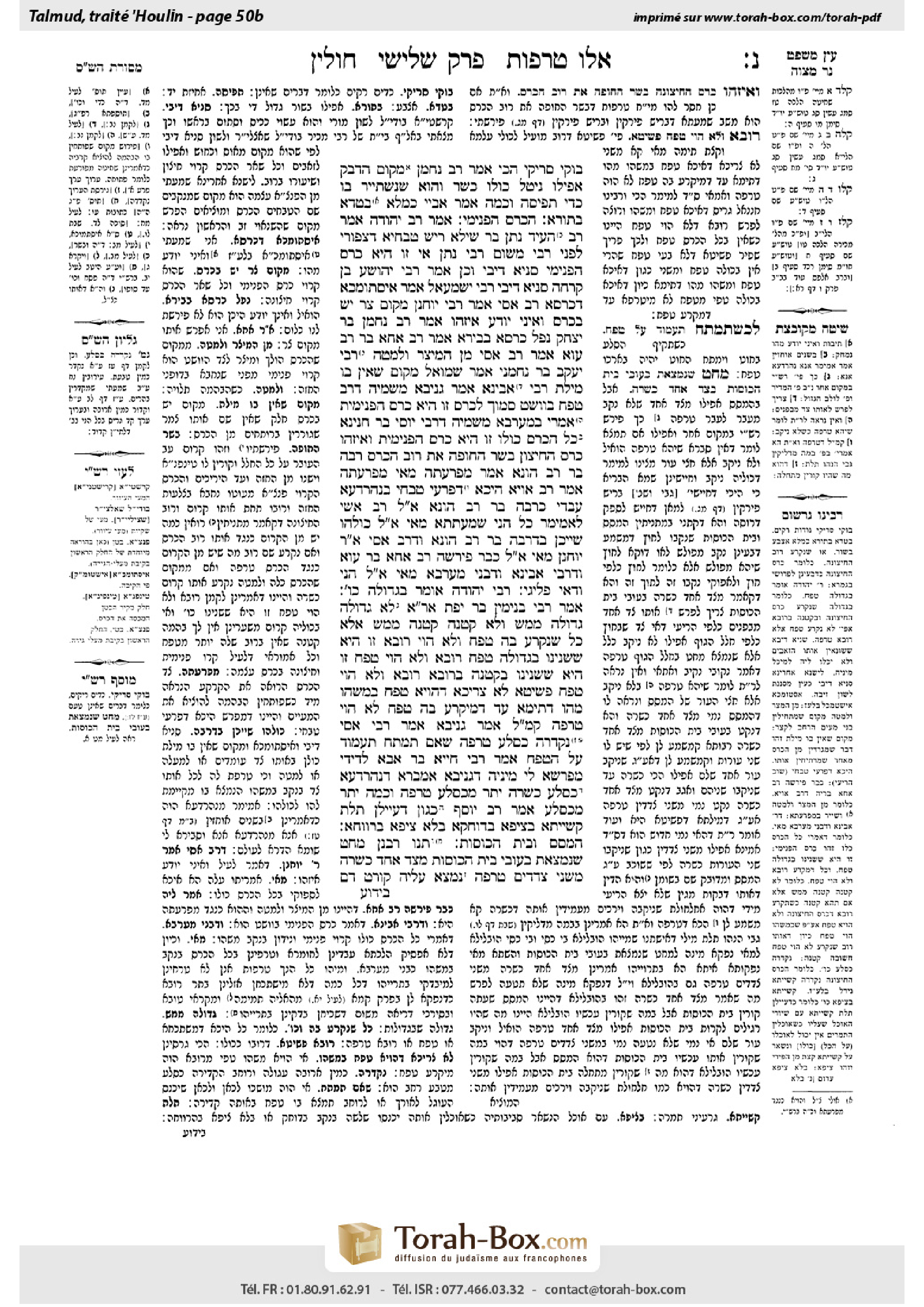
Scan : Torah-Box. Daf Study est un projet indépendant, sans affiliation ni approbation de Torah-Box ou de Sefaria.