Houlin 92b en français · חולין צ״ב ב
Traduction française du daf 92b du traité Houlin (Chullin 92b en anglais), avec le texte araméen, l’anglais de Sefaria et le scan de la page, pour étudier le Daf Yomi.
Ouvrir dans le lecteur interactifLire le daf du jour
Traduction française de Houlin 92b
Les traductions françaises de Daf Study sont générées par IA à partir de l’édition anglaise de Sefaria. Elles peuvent contenir des erreurs : vérifie toujours un passage avec le texte source.
qu’ils ne rédigent pas de contrat de mariage pour une union entre deux hommes ; bien qu’ils transgressent l’interdiction des relations homosexuelles, ils ne sont pas assez effrontés pour rédiger un contrat de mariage comme pour un mariage ordinaire. L’une des trois mitsvot est que, bien qu’ils soient soupçonnés de manger des êtres humains, ils ne pèsent pas la chair des morts dans les boucheries [bemakkulin] pour la vendre publiquement ; et l’une consiste à honorer la Torah.
§ La Michna enseigne (89b) que l’interdiction de consommer le nerf sciatique ne s’applique pas à un oiseau, car le verset désigne le nerf sciatique comme étant « sur la paume de la cuisse » (Genèse 32:33), et un oiseau n’a pas de paume de la cuisse. La Guemara objecte : Pourtant, on voit bien qu’il a une protubérance charnue sur la cuisse. La Guemara répond : Il a une protubérance, mais celle-ci n’est pas arrondie.
Rabbi Yirmeya soulève une question : si un oiseau a une protubérance arrondie sur l’os de la cuisse, ou si un animal a une protubérance non arrondie sur l’os de la cuisse, quelle est la halakha ? Faut-il se fier à cette caractéristique, c’est-à-dire faire dépendre le statut du nerf sciatique des propriétés physiques de chaque animal particulier, ou faut-il se fier à son espèce, de sorte que le nerf sciatique d’un animal soit toujours interdit et celui d’un oiseau toujours permis ? La Guemara répond : La question reste sans réponse.
§ La Michna énonce que l’interdiction du nerf sciatique s’applique au fœtus animal arrivé à terme dans le ventre de sa mère. Rabbi Yehuda dit : elle ne s’applique pas au fœtus, et sa graisse est permise. Shmuel dit : Lorsque la Michna énonce : « Et sa graisse est permise », cela vaut selon tous.
La Guemara demande : De quelle graisse s’agit-il ? Si l’on dit qu’il s’agit de la graisse d’un fœtus, les tannaïm ne sont-ils pas en désaccord à ce sujet, comme l’enseigne une baraïta : L’interdiction du nerf sciatique s’applique au fœtus arrivé à terme, et sa graisse est interdite ; telle est l’opinion de Rabbi Meir. Rabbi Yehuda dit que l’interdiction du nerf sciatique ne s’applique pas au fœtus arrivé à terme et que sa graisse est permise.
Et Rabbi Elazar dit au nom de Rabbi Oshaya, pour expliquer la baraïta : cette controverse porte sur un fœtus de neuf mois, c’est-à-dire arrivé à terme, qui reste vivant après l’abattage rituel de sa mère. Rabbi Meir suit ici son opinion générale (voir 74a), selon laquelle ce fœtus est considéré comme un animal vivant, indépendant de sa mère. Par conséquent, il doit subir l’abattage rituel pour que sa viande soit permise à la consommation, et ses graisses ainsi que son nerf sciatique sont interdits comme ceux de tout autre animal. Rabbi Yehuda suit son opinion générale, selon laquelle un tel fœtus n’est pas considéré comme un animal vivant, mais comme une partie de sa mère. Par conséquent, il n’a pas besoin de subir l’abattage rituel, et ses graisses ainsi que son nerf sciatique sont permis.
Mais peut-être la déclaration de Shmuel concernait-elle la graisse du nerf sciatique. Or, les tannaïm sont également en désaccord sur ce cas, comme l’enseigne une baraïta : Pour le nerf sciatique, on racle tout autour afin de le retirer entièrement, partout où il se trouve dans la cuisse, et l’on enlève sa graisse à la source, c’est-à-dire même la graisse incrustée dans la chair ; telle est l’opinion de Rabbi Meir. Rabbi Yehuda dit : on retire le nerf et la graisse jusqu’à ce qu’ils soient au niveau de la chair [hashufi] de la cuisse, mais il n’est pas nécessaire de racler les parties incrustées dans la chair. Il existe donc également une controverse au sujet de la graisse qui entoure le nerf sciatique.
La Guemara répond : En réalité, Shmuel parlait de la graisse du nerf sciatique, et il reconnaît que, selon l’opinion de Rabbi Meir, la graisse qui entoure le nerf sciatique est interdite par décret rabbinique, mais permise par la Torah. Car il est enseigné dans une baraïta : Sa graisse est permise par la Torah, mais le peuple juif, par piété, l’a considérée comme interdite. La Guemara en déduit : N’est-ce pas que cette baraïta est conforme à l’opinion de Rabbi Meir, qui dit que la graisse est permise par la Torah, mais interdite par décret rabbinique ?
La Guemara objecte : Comment peut-on établir que cette baraïta est conforme à l’opinion de Rabbi Meir ? Peut-être est-elle conforme à celle de Rabbi Yehuda, tandis que, selon Rabbi Meir, la graisse est même interdite par la Torah.
La Guemara écarte cette objection : Il ne te viendrait pas à l’esprit que cette baraïta soit conforme à l’opinion de Rabbi Yehuda, car une baraïta enseigne : Pour le nerf sciatique, on racle tout autour afin de le retirer entièrement, partout où il se trouve dans la cuisse, et sa graisse est permise. La Guemara explique : Qui as-tu entendu soutenir qu’il faut racler ? Rabbi Meir. Or, la baraïta affirme que sa graisse est permise. Par conséquent, Rabbi Meir doit tenir que la graisse qui entoure le nerf sciatique est permise par la Torah et interdite par décret rabbinique.
§ Au sujet du nerf sciatique, Rav Yitzḥak bar Shmuel bar Marta dit au nom de Rav : La Torah n’a interdit que ses fines fibres nerveuses, semblables à des filaments [kenokanot], qui en partent et longent le nerf sciatique sous la chair. En revanche, le nerf sciatique lui-même, qui est immangeable et n’a pas de goût, est considéré comme du bois plutôt que comme un aliment et n’est donc pas interdit. À l’inverse, Ulla dit : Le nerf sciatique est immangeable et n’a pas de goût, comme du bois ; néanmoins, la Torah rend passible celui qui le consomme.
Abaye dit : Il semble raisonnable que la halakha soit conforme à l’opinion d’Ulla, car Rav Sheshet dit au nom de Rav Asi : Les filaments des veines qui se trouvent dans la graisse interdite sont interdits, mais celui qui les consomme n’est pas passible. Apparemment, lorsque le Miséricordieux déclare dans la Torah qu’il est interdit de consommer la graisse, l’interdiction ne s’applique qu’à la graisse elle-même, et non aux filaments des veines. De même ici, le Miséricordieux déclare dans la Torah qu’il est interdit de consommer le nerf sciatique, mais cela n’inclut pas les fibres nerveuses semblables à des filaments.
§ La Guemara revient maintenant au sujet lui-même, cité plus haut dans la discussion : Rav Sheshet dit au nom de Rav Asi : Les filaments des veines qui se trouvent dans la graisse interdite sont interdits, mais celui qui les consomme n’est pas passible. Les filaments des veines qui se trouvent dans le rein sont interdits, mais celui qui les consomme n’est pas passible. Au sujet de la graisse blanche du rein, Rabbi Yehuda HaNasi et Rabbi Ḥiyya sont en désaccord : l’un en interdit la consommation, parce qu’elle ressemble aux graisses interdites par la Torah ; l’autre en permet la consommation.
La Guemara rapporte que Rabba raclait le rein pour en enlever tout résidu de graisse blanche. De même, Rabbi Yoḥanan la raclait du rein. En revanche, Rabbi Asi la coupait à la surface du rein sans racler le reste. Abaye dit : Il semble raisonnable que la halakha soit conforme à l’opinion de Rabbi Asi, car Rabbi Abba dit au nom de Rav Yehuda, qui dit au nom de Shmuel :
Texte source et traduction anglaise
חולין צ״ב ב · texte araméen et hébreu
שֶׁאֵין כּוֹתְבִין כְּתוּבָּה לִזְכָרִים, וְאַחַת שֶׁאֵין שׁוֹקְלִין בְּשַׂר הַמֵּת בְּמָקוֹלִין, וְאַחַת שֶׁמְּכַבְּדִין אֶת הַתּוֹרָה.
וְאֵינוֹ נוֹהֵג בָּעוֹף. וְהָא קָא חָזֵינַן דְּאִית לֵיהּ? אִית לֵיהּ, וְלָא עֲגִיל.
בָּעֵי רַבִּי יִרְמְיָה: אִית לֵיהּ לְעוֹף וַעֲגִיל, אִית לֵיהּ לִבְהֵמָה וְלָא עֲגִיל, מַאי? בָּתַר דִּידֵיהּ אָזְלִינַן, אוֹ בָּתַר מִינֵיהּ אָזְלִינַן? תֵּיקוּ.
וְנוֹהֵג בַּשְּׁלִיל. אָמַר שְׁמוּאֵל: וְחֶלְבּוֹ מוּתָּר לְדִבְרֵי הַכֹּל.
חֶלְבּוֹ דְּמַאי? אִילֵימָא דִּשְׁלִיל – וְהָא מִיפְלָג פְּלִיגִי בֵּיהּ, דְּתַנְיָא: נוֹהֵג בַּשְּׁלִיל, וְחֶלְבּוֹ אָסוּר, דִּבְרֵי רַבִּי מֵאִיר. רַבִּי יְהוּדָה אוֹמֵר: אֵינוֹ נוֹהֵג בַּשְּׁלִיל, וְחֶלְבּוֹ מוּתָּר.
וְאָמַר רַבִּי אֶלְעָזָר, אָמַר רַבִּי אוֹשַׁעְיָא: מַחְלוֹקֶת בְּבֶן תִּשְׁעָה חַי, וְהָלַךְ רַבִּי מֵאִיר לְשִׁיטָתוֹ, וְרַבִּי יְהוּדָה לְשִׁיטָתוֹ.
וְאֶלָּא חֶלְבּוֹ דְּגִיד? הָא מִיפְלָג פְּלִיגִי בָּהּ, דְּתַנְיָא: גִּיד הַנָּשֶׁה מְחַטֵּט אַחֲרָיו בְּכׇל מָקוֹם שֶׁהוּא, וְחוֹתֵךְ שׇׁמְנוֹ מֵעִיקָּרוֹ – דִּבְרֵי רַבִּי מֵאִיר. רַבִּי יְהוּדָה אוֹמֵר: גּוֹמְמוֹ עִם הַשּׁוֹפִי.
לְעוֹלָם חֶלְבּוֹ דְּגִיד, מוֹדֶה שְׁמוּאֵל דִּלְרַבִּי מֵאִיר מִדְּרַבָּנַן אָסוּר, דְּתַנְיָא: וְשׇׁמְנוֹ מוּתָּר, וְיִשְׂרָאֵל קְדוֹשִׁים נָהֲגוּ בּוֹ אִיסּוּר. מַאי לָאו רַבִּי מֵאִיר הִיא, דְּאָמַר: מוּתָּר מִן הַתּוֹרָה וְאָסוּר מִדְּרַבָּנַן?
מִמַּאי דִּילְמָא רַבִּי יְהוּדָה הִיא, אֲבָל לְרַבִּי מֵאִיר מִדְּאוֹרָיְיתָא נָמֵי אֲסִיר!
לָא סָלְקָא דַּעְתָּךְ, דְּתַנְיָא: גִּיד הַנָּשֶׁה מְחַטֵּט אַחֲרָיו בְּכׇל מָקוֹם שֶׁהוּא, וְשׇׁמְנוֹ מוּתָּר. מַאן שָׁמְעַתְּ לֵיהּ דְּאִית לֵיהּ חֲטִיטָה? רַבִּי מֵאִיר, וְקָאָמַר: שׇׁמְנוֹ מוּתָּר.
אָמַר רַב יִצְחָק בַּר שְׁמוּאֵל בַּר מָרְתָּא, אָמַר רַב: לֹא אָסְרָה תּוֹרָה אֶלָּא קְנוֹקָנוֹת שֶׁבּוֹ. עוּלָּא אָמַר: עֵץ הוּא, וְהַתּוֹרָה חִיְּיבָה עָלָיו.
אָמַר אַבָּיֵי: כְּוָותֵיהּ דְּעוּלָּא מִסְתַּבְּרָא, דְּאָמַר רַב שֵׁשֶׁת אָמַר רַב אַסִּי: חוּטִין שֶׁבַּחֵלֶב אֲסוּרִין, וְאֵין חַיָּיבִין עֲלֵיהֶן, אַלְמָא ״חֵלֶב״ אָמַר רַחֲמָנָא וְלֹא חוּטִין, הָכָא נָמֵי ״גִּיד״ אָמַר רַחֲמָנָא וְלֹא קְנוֹקָנוֹת.
גּוּפָא: אָמַר רַב שֵׁשֶׁת אָמַר רַב אַסִּי: חוּטִין שֶׁבַּחֵלֶב אֲסוּרִין, וְאֵין חַיָּיבִין עֲלֵיהֶן. שֶׁבַּכּוּלְיָא אֲסוּרִין, וְאֵין חַיָּיבִין עֲלֵיהֶן. לוֹבֶן כּוּלְיָא – רַבִּי וְרַבִּי חִיָּיא: חַד אָסַר, וְחַד שָׁרֵי.
רַבָּה מְמַרְטֵט לֵיהּ, רַבִּי יוֹחָנָן מְמַרְטֵט לֵיהּ, רַבִּי אַסִּי גָּאֵים לֵיהּ. אָמַר אַבָּיֵי: כְּוָותֵיהּ דְּרַבִּי אַסִּי מִסְתַּבְּרָא, דְּאָמַר רַבִּי אַבָּא אָמַר רַב יְהוּדָה אָמַר שְׁמוּאֵל:
Chullin 92b · traduction anglaise de Sefaria
that they do not write a marriage contract for a wedding between two males; although they violate the prohibition against engaging in homosexuality, they are not so brazen as to write a marriage contract as for a regular marriage. And one of the three mitzvot is that although they are suspected of eating human beings, they do not weigh the flesh of the dead in butcher shops [bemakkulin] and sell it publicly; and one is that they honor the Torah.
§ The mishna teaches (89b) that the prohibition of eating the sciatic nerve does not apply to a bird due to the fact that the verse is referring to the sciatic nerve as being “upon the spoon of the thigh” (Genesis 32:33), and a bird has no spoon of the thigh. The Gemara challenges: But we see that it does have a protrusion of flesh on its thigh. The Gemara answers: It has a protrusion, but that protrusion is not rounded.
Rabbi Yirmeya raises a dilemma: If a bird has a protrusion on its thigh bone and it is rounded, or an animal has a protrusion on its thigh bone but it is not rounded, what is the halakha? Do we follow it, i.e., does the status of the sciatic nerve depend upon the physical properties of each particular animal, or do we follow its species, so that the sciatic nerve of an animal is always forbidden and that of a bird is always permitted? The Gemara responds: The question shall stand unresolved.
§ The mishna states that the prohibition of the sciatic nerve applies to a late-term animal fetus in the womb. Rabbi Yehuda says: It does not apply to a fetus; and its fat is permitted. Shmuel says: When the mishna states: And its fat is permitted, that is according to everyone.
The Gemara asks: The fat of what? If we say that it is referring to the fat of a fetus, don’t the tanna’im disagree about it, as it is taught in a baraita: The prohibition of the sciatic nerve applies to a late-term fetus, and its fat is prohibited; this is the statement of Rabbi Meir. Rabbi Yehuda says that the prohibition of the sciatic nerve does not apply to a late-term fetus, and its fat is permitted.
And Rabbi Elazar says that Rabbi Oshaya says in explanation of the baraita: This dispute applies to a nine-month-old, i.e., a full-term, fetus that remains alive after its mother has been slaughtered. And Rabbi Meir followed his general opinion in this regard (see 74a), that this fetus is considered a live animal independent of its mother. Consequently, it must undergo ritual slaughter in order for its meat to be permitted for consumption, and its fats and sciatic nerve are forbidden like those of any other animal. And Rabbi Yehuda followed his general opinion that such a fetus is not considered a live animal but rather part of its mother. Consequently, it does not require ritual slaughter, and its fats and sciatic nerve are permitted.
But rather, perhaps Shmuel’s statement was said with regard to the fat of the sciatic nerve. But the tanna’im disagree about this case as well, as it is taught in a baraita: With regard to the sciatic nerve, one scrapes around it to remove it entirely in any place that it is found in the thigh, and one cuts out its fat from its source, i.e., even the fat that is embedded in the flesh; this is the statement of Rabbi Meir. Rabbi Yehuda says: One cuts out the nerve and fat so that they are level with the flesh [hashufi] of the thigh, but there is no need to scrape out the parts embedded in the flesh. Consequently, there is a dispute about the fat surrounding the sciatic nerve as well.
The Gemara answers: Actually, Shmuel was referring to the fat of the sciatic nerve, and Shmuel concedes that according to the opinion of Rabbi Meir the fat surrounding the sciatic nerve is forbidden by rabbinic law but permitted by Torah law. As it is taught in a baraita: Its fat is permitted by Torah law, but the Jewish people are holy and treated it as forbidden. The Gemara infers: What, is it not that this baraita is in accordance with the opinion of Rabbi Meir, who said that the fat is permitted by Torah law but forbidden by rabbinic law?
The Gemara challenges this: From where can it be proven that this baraita is in accordance with the opinion of Rabbi Meir? Perhaps it is in accordance with the opinion of Rabbi Yehuda, but according to the opinion of Rabbi Meir it is even forbidden by Torah law.
The Gemara rejects this challenge: It would not enter your mind that this baraita is in accordance with the opinion of Rabbi Yehuda, as it is taught in a baraita: With regard to the sciatic nerve, one scrapes around it to remove it entirely from any place that it is found in the thigh, and its fat is permitted. The Gemara explains: Whom have you heard who holds that scraping is required? It is Rabbi Meir. And the baraita states that its fat is permitted. Consequently, Rabbi Meir must hold that the fat surrounding the sciatic nerve is permitted by Torah law and forbidden by rabbinic law.
§ With regard to the sciatic nerve Rav Yitzḥak bar Shmuel bar Marta says that Rav says: The Torah prohibited only its thin, tendril-like nerve fibers [kenokanot] that branch off and run alongside the sciatic nerve, under the flesh. By contrast, the sciatic nerve itself, which is inedible and has no flavor, is therefore considered like wood rather than food, and is not forbidden. Conversely, Ulla says: The sciatic nerve is inedible and has no flavor, like wood, but nevertheless the Torah rendered one liable for eating it.
Abaye said: It stands to reason that the halakha is in accordance with the opinion of Ulla, because Rav Sheshet said that Rav Asi said: The strands of veins that are in the forbidden fat are forbidden, but one is not liable for eating them. Apparently, when the Merciful One states in the Torah that it is prohibited to eat fat, the prohibition applies only to the fat itself but not to the strands of veins. Here also, the Merciful One states in the Torah that it is prohibited to eat the sciatic nerve, but that does not include the tendril-like nerve fibers.
§ The Gemara now returns to the matter itself cited in the discussion above: Rav Sheshet said that Rav Asi said: The strands of veins that are in the forbidden fat are forbidden, but one is not liable for eating them. The strands of veins that are in the kidney are forbidden, but one is not liable for eating them. With regard to the white fat of the kidney, there is a dispute between Rabbi Yehuda HaNasi and Rabbi Ḥiyya: One of them prohibits its consumption, because it is similar to the fats that are prohibited by the Torah; and one of them permits eating it.
The Gemara relates that Rabba would scrape every remnant of white fat away from the kidney. Similarly, Rabbi Yoḥanan would scrape it away from the kidney. By contrast, Rabbi Asi would cut it from the surface of the kidney but would not scrape out the rest of it. Abaye said: It stands to reason that the halakha is in accordance with the opinion of Rabbi Asi, because Rabbi Abba said that Rav Yehuda said that Shmuel said:
Texte de Sefaria : William Davidson Edition - Vocalized Aramaic (unknown) ; William Davidson Edition - English (CC BY NC).
Scan de Houlin 92b
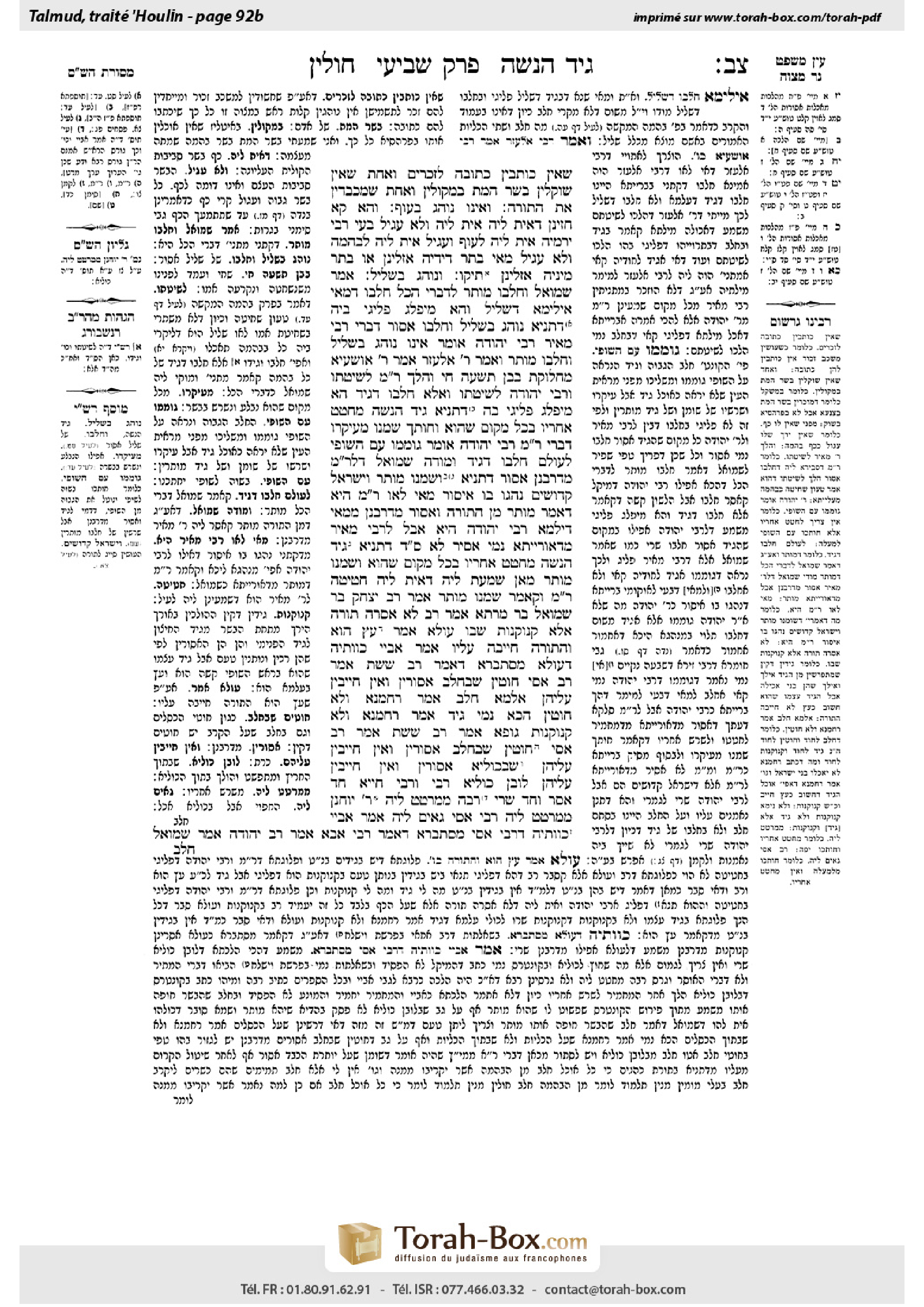
Scan : Torah-Box. Daf Study est un projet indépendant, sans affiliation ni approbation de Torah-Box ou de Sefaria.