Erouvin 24a en français · עירובין כ״ד א
Traduction française du daf 24a du traité Erouvin (Eruvin 24a en anglais), avec le texte araméen, l’anglais de Sefaria et le scan de la page, pour étudier le Daf Yomi.
Ouvrir dans le lecteur interactifLire le daf du jour
Traduction française de Erouvin 24a
Les traductions françaises de Daf Study sont générées par IA à partir de l’édition anglaise de Sefaria. Elles peuvent contenir des erreurs : vérifie toujours un passage avec le texte source.
est annulée par rapport à la partie la plus grande, et c’est comme si le karpef était entièrement ensemencé. Il est donc considéré comme un karpef de plus de deux beit séa, où il est interdit de transporter.
Mais si cette déclaration a été rapportée, voici ce qu’a dit Rav Houna, fils de Rav Yehochoua : si la plus grande partie du karpef a été ensemencée, il est interdit d’y transporter. Il en découle que si seule une petite partie du karpef a été ensemencée, il est permis d’y transporter. Rav Houna, fils de Rav Yehochoua, a dit : Nous avons dit que cela n’est permis que si la partie ensemencée mesure moins de deux beit séa ; en revanche, si elle mesure au moins deux beit séa, il est interdit de transporter dans tout le karpef, même si la plus grande partie n’est pas ensemencée.
La Guemara demande : Selon l’opinion de qui cette déclaration a-t-elle été faite ? Selon celle des Rabbins, qui sont en désaccord avec Rabbi Chimon et disent qu’un karpef et une cour sont considérés comme des domaines distincts, de sorte qu’il est interdit de transporter de l’un à l’autre.
Rav Yirmeya de Difti enseignait cette règle comme une permission, ainsi : il a été dit que si la plus grande partie du karpef a été ensemencée, il est interdit d’y transporter. Il en découle que si seule une petite partie a été ensemencée, il est permis d’y transporter. Rav Houna, fils de Rav Yehochoua, a dit : Nous avons dit que cela n’est permis que si la partie ensemencée ne dépasse pas deux beit séa ; mais si elle dépasse deux beit séa, il est interdit d’y transporter. Selon l’opinion de qui cette déclaration a-t-elle été faite ? Selon celle de Rabbi Chimon.
Il a été dit précédemment que si la plus grande partie du karpef est plantée d’arbres, il est considéré comme une cour et il est permis d’y transporter. Rav Yéhouda a dit qu’Avimi avait dit : Cela ne s’applique que si les arbres ont été plantés en rangées [itztablaot], comme on a coutume de planter des arbres d’ornement dans une cour. Mais s’ils sont disposés autrement, le lieu est considéré comme un verger, qui n’est pas destiné à l’habitation et où il est interdit de transporter. Rav Na’hman a dit, toutefois : Cela s’applique même si les arbres n’ont pas été plantés en rangées, car les gens plantent couramment des arbres selon toutes sortes de dispositions dans les cours de leurs maisons.
Mar Yehouda se rendit par hasard chez Rav Houna bar Yehouda, où il vit des arbres qui n’étaient pas plantés en rangées, alors que les gens transportaient néanmoins parmi eux. Mar Yehouda dit à Rav Houna : Le Maître ne suit-il pas l’opinion d’Avimi ? Rav Houna lui répondit : Je suis l’opinion de Rav Na’hman, selon laquelle il est permis de transporter même si les arbres ne sont pas plantés en rangées.
Rav Na’hman a dit au nom de Chmouel : Que doit faire celui qui souhaite transporter dans un karpef de plus de deux beit séa qui n’a pas été clôturé à l’origine à des fins d’habitation ? Il doit pratiquer dans la clôture une brèche de plus de dix coudées, ce qui annule la séparation, puis la refermer en réduisant l’ouverture à dix coudées seulement, créant ainsi une entrée. Il lui est alors permis de transporter dans le karpef, car celui-ci est désormais considéré comme ayant été clôturé à des fins d’habitation.
La Guemara soulève une question : que se passe-t-il s’il n’a pas pratiqué la brèche d’un seul coup, mais a ouvert une coudée, puis l’a clôturée, ensuite a ouvert une autre coudée et l’a clôturée, et ainsi de suite jusqu’à avoir achevé d’ouvrir et de clôturer une longueur de plus de dix coudées ? Quelle est la halakha ?
Il lui dit : N’est-ce pas comparable à ce que nous avons appris dans une Michna : tous les ustensiles en bois rituellement impurs appartenant à des particuliers deviennent rituellement purs lorsqu’on les brise, s’ils ont des trous de la taille de grenades ?
Et ‘Hizkiya souleva une question : si un ustensile a été percé d’un trou assez grand pour laisser passer une olive, puis que le trou a été rebouché, et qu’il a ensuite été percé de nouveau d’un trou assez grand pour laisser passer une olive, puis que celui-ci a été rebouché à son tour, et ainsi de suite jusqu’à ce que les trous réunis forment une ouverture assez grande pour laisser passer une grenade, quelle est la halakha ? Autrement dit, l’ustensile est-il pur au motif que la somme de tous les trous atteint la taille d’une grenade, ou reste-t-il rituellement impur parce que chaque trou a été rebouché avant que le suivant ne soit formé ?
Rabbi Yo’hanan, son élève, lui dit : Maître, vous nous avez enseigné qu’une sandale devenue rituellement impure par l’impureté transmise par le piétinement d’un zav demeure rituellement impure de l’impureté de piétinement [midras] si l’une de ses oreilles, c’est-à-dire l’une de ses lanières, se déchire et qu’on la répare ; elle peut encore rendre des personnes et des ustensiles rituellement impurs. Si l’une des lanières d’une sandale se déchire, celle-ci peut encore servir de sandale et ne perd donc pas son statut d’ustensile.
Si la seconde oreille se déchire et qu’on la répare, la sandale est rituellement pure en ce sens qu’elle ne rend plus les autres objets rituellement impurs comme le ferait un ustensile devenu une source primaire d’impureté rituelle par l’impureté transmise par le piétinement. Toutefois, la sandale elle-même est rituellement impure par contact avec un objet devenu rituellement impur par l’impureté de piétinement, c’est-à-dire la sandale avant que sa seconde lanière ne se déchire. Elle peut donc transmettre l’impureté rituelle aux aliments et aux liquides.
Et vous avez dit à propos de cette halakha : pourquoi, lorsque la première oreille se déchire, la sandale demeure-t-elle impure ? Parce que la seconde est intacte. Mais lorsque la seconde oreille se déchire, la première est intacte ; comment la sandale perd-elle donc son statut d’ustensile ?
Puis vous nous avez dit à ce sujet que la raison pour laquelle elle n’est plus un ustensile est qu’une nouvelle entité est apparue ici. Le statut juridique de la sandale dont les deux oreilles ont été réparées n’est pas celui de la sandale d’origine : c’est une nouvelle sandale. De même, à propos d’un ustensile percé à plusieurs reprises, lorsque la somme de tous les trous atteint la taille d’une grenade, disons qu’une nouvelle entité est apparue ici, car toute la surface du trou est entièrement nouvelle et l’ustensile n’est plus le même que celui qui était rituellement impur.
‘Hizkiya fut si impressionné par la remarque de Rabbi Yo’hanan qu’il s’exclama à son sujet : « Ce n’est pas un être humain, c’est un ange », car il est capable de résoudre, à partir d’un enseignement que j’ai moi-même transmis, un problème qui me donne du fil à retordre. Selon certains, il dit : « C’est un être humain accompli. » Cette analyse parallèle enseigne que si quelqu’un ouvre une coudée, la clôture, ouvre une autre coudée, la clôture, et continue ainsi jusqu’à avoir ouvert et clôturé une longueur de plus de dix coudées, cela est efficace ; il n’a pas besoin d’ouvrir plus de dix coudées d’un seul coup.
Rav Kahana a dit : une cour clôturée située derrière un groupe de maisons, qui sert à entreposer des objets dont on ne se sert pas régulièrement et qui mesure plus de deux beit séa, n’est pas considérée comme un domaine privé à part entière. On ne peut donc y transporter des objets que sur une distance de quatre coudées.
Rav Na’hman a dit : si quelqu’un y ouvre une entrée depuis la maison, il est permis de transporter dans toute la cour, car l’entrée le permet et fait considérer la cour comme une partie de la maison. Cette permission n’a été accordée que si la personne a ouvert l’entrée puis clôturé la zone ; mais si elle l’a d’abord clôturée et n’a ouvert l’entrée qu’ensuite, elle ne peut pas transporter dans toute la cour.
La Guemara soulève une difficulté : s’il a d’abord ouvert l’entrée puis clôturé la zone, il est évident qu’il est permis de transporter dans toute la cour, puisqu’il est clair que la zone a été clôturée en vue de l’entrée, c’est-à-dire afin qu’on puisse l’utiliser depuis la maison. La Guemara répond : cette règle est nécessaire uniquement dans le cas où il y a une aire de battage dans la cour. En effet, on aurait pu dire qu’il a aménagé l’entrée en pensant à l’aire de battage, et non pour pouvoir utiliser toute la cour. Il vient donc nous enseigner que l’entrée permet de transporter dans la cour en toutes circonstances.
La Guemara examine un nouveau cas : au sujet d’un karpef de plus de deux beit séa qui avait été clôturé à des fins d’habitation, mais qui s’est rempli d’eau à cause d’inondations ou de toute autre cause, les Rabbins envisagent de dire que l’eau est considérée comme des semences. Cela signifie que le karpef est considéré comme s’il était ensemencé, de sorte qu’il est interdit d’y transporter. Il n’est plus considéré comme ayant été clôturé à des fins d’habitation, puisqu’il n’est pas habituel de vivre dans un lieu rempli d’eau.
Rav Abba, père de Rav, fils de Rav Mesharshiya, a dit : nous rapportons au nom de Rava ce qui suit : l’eau est considérée comme des arbres plantés, de sorte qu’il est permis d’y transporter. Une cour remplie d’eau reste propre à l’habitation, car l’eau est utile aux habitants de la cour.
Texte source et traduction anglaise
עירובין כ״ד א · texte araméen et hébreu
בְּטִיל לֵיהּ לְגַבַּי רוּבָּה, וְהָוֵה לֵיהּ קַרְפֵּף יוֹתֵר מִבֵּית סָאתַיִם — וְאָסוּר.
אֶלָּא אִי אִיתְּמַר הָכִי אִיתְּמַר: הָא מִיעוּטָא — שָׁרֵי. אָמַר רַב הוּנָא בְּרֵיהּ דְּרַב יְהוֹשֻׁעַ: לָא אֲמַרַן אֶלָּא דְּלָא הָוֵי בֵּית סָאתַיִם, אֲבָל בֵּית סָאתַיִם — אָסוּר.
כְּמַאן? כְּרַבָּנַן.
וְרַב יִרְמְיָה מִדִּיפְתִּי מַתְנֵי לְקוּלָּא: הָא מִיעוּטָא — שְׁרֵי, אָמַר רַב הוּנָא בְּרֵיהּ דְּרַב יְהוֹשֻׁעַ: לָא אֲמַרַן אֶלָּא בֵּית סָאתַיִם, אֲבָל יוֹתֵר מִבֵּית סָאתַיִם — אָסוּר. כְּמַאן? כְּרַבִּי שִׁמְעוֹן.
נָטַע רוּבּוֹ — הֲרֵי הוּא כְּחָצֵר, וּמוּתָּר. אָמַר רַב יְהוּדָה אָמַר אֲבִימִי: וְהוּא שֶׁעֲשׂוּיִין אִצְטַבְּלָאוֹת. וְרַב נַחְמָן אָמַר: אַף עַל פִּי שֶׁאֵין עֲשׂוּיִין אִצְטַבְּלָאוֹת.
מָר יְהוּדָה אִקְּלַע לְבֵי רַב הוּנָא בַּר יְהוּדָה. חֲזַנְהוּ לְהָנְהוּ דְּלָא עֲבִידִי אִצְטַבְּלָאוֹת, וְקָא מְטַלְטְלִי בְּגַוַּיְיהוּ. אֲמַר לֵיהּ: לָא סָבַר לַהּ מָר לְהָא דַּאֲבִימִי? אֲמַר לֵיהּ: אֲנָא כְּרַב נַחְמָן סְבִירָא לִי.
אָמַר רַב נַחְמָן אָמַר שְׁמוּאֵל: קַרְפֵּף יוֹתֵר מִבֵּית סָאתַיִם שֶׁלֹּא הוּקַּף לְדִירָה, כֵּיצַד הוּא עוֹשֶׂה? פּוֹרֵץ בּוֹ פִּירְצָה יוֹתֵר מֵעֶשֶׂר, וְגוֹדְרוֹ וּמַעֲמִידוֹ עַל עֶשֶׂר, וּמוּתָּר.
אִיבַּעְיָא לְהוּ: פָּרַץ אַמָּה וְגָדַר אַמָּה [וּפָרַץ אַמָּה וּגְדָרָהּ], עַד שֶׁהִשְׁלִימוֹ לְיוֹתֵר מֵעֶשֶׂר, מַהוּ?
אֲמַר לֵיהּ, לָאו הַיְינוּ דִּתְנַן: כׇּל כְּלֵי בַּעֲלֵי בָתִּים, שִׁיעוּרָן כְּרִמּוֹנִים.
וּבָעֵי חִזְקִיָּה: נִיקַּב כְּמוֹצִיא זַיִת וּסְתָמוֹ, וְחָזַר וְנִיקַּב כְּמוֹצִיא זַיִת וּסְתָמוֹ, עַד שֶׁהִשְׁלִימוֹ לְמוֹצִיא רִמּוֹן מַהוּ?
וַאֲמַר לֵיהּ רַבִּי יוֹחָנָן: רַבִּי, שָׁנִיתָה לָנוּ: סַנְדָּל שֶׁנִּפְסְקָה אַחַת מֵאׇזְנָיו וְתִיקְּנָהּ — טָמֵא מִדְרָס.
נִפְסְקָה שְׁנִיָּה וְתִיקְּנָהּ — טָהוֹר בָּהּ מִן הַמִּדְרָס, אֲבָל טָמֵא מַגַּע מִדְרָס.
וַאֲמַרְתְּ עֲלַהּ: מַאי שְׁנָא רִאשׁוֹנָה — דְּהָא קָיְימָא שְׁנִיָּה? שְׁנִיָּה נָמֵי — הָא קָיְימָא רִאשׁוֹנָה?!
וַאֲמַרְתְּ לַן עֲלַהּ: פָּנִים חֲדָשׁוֹת בָּאוּ לְכָאן. הָכָא נָמֵי, פָּנִים חֲדָשׁוֹת בָּאוּ לְכָאן.
קָרֵי עֲלֵיהּ: לֵית דֵּין בַּר אִינָשׁ. אִיכָּא דְּאָמְרִי: כְּגוֹן דֵּין בַּר נַשׁ.
אָמַר רַב כָּהֲנָא: רְחָבָה שֶׁאֲחוֹרֵי הַבָּתִּים — אֵין מְטַלְטְלִין בּוֹ אֶלָּא בְּאַרְבַּע אַמּוֹת.
וְאָמַר רַב נַחְמָן: אִם פָּתַח לוֹ פֶּתַח — מוּתָּר לְטַלְטֵל בְּכוּלּוֹ, פֶּתַח מַתִּירוֹ. וְלָא אֲמַרַן אֶלָּא שֶׁפָּתַח וּלְבַסּוֹף הוּקַּף, אֲבָל הוּקַּף וּלְבַסּוֹף פָּתַח — לָא.
פָּתַח וּלְבַסּוֹף הוּקַּף פְּשִׁיטָא! לָא צְרִיכָא, דְּאִית בֵּיהּ בֵּי דָרֵי. מַהוּ דְּתֵימָא: אַדַּעְתָּא דְּבֵי דָרֵי עַבְדֵיהּ. קָא מַשְׁמַע לַן.
קַרְפֵּף יוֹתֵר מִבֵּית סָאתַיִם שֶׁהוּקַּף לְדִירָה וְנִתְמַלֵּא מַיִם, סְבוּר רַבָּנַן לְמֵימַר כִּזְרָעִים דָּמוּ — וַאֲסִיר.
אֲמַר לְהוּ רַב אַבָּא אֲבוּהּ דְּרַב בְּרֵיהּ דְּרַב מְשַׁרְשְׁיָא: הָכִי אָמְרִינַן מִשְּׁמֵיהּ דְּרָבָא: מַיִם כִּנְטָעִים דָּמוּ, וּשְׁרֵי.
Eruvin 24a · traduction anglaise de Sefaria
is nullified relative to the greater part, and it is as though the karpef were entirely sown. And therefore, it is regarded as a karpef greater than two beit se’a, in which it is prohibited to carry.
Rather, if this was stated, this is what was stated by Rav Huna, son of Rav Yehoshua: If the greater part of the karpef was sown, it is prohibited to carry within it. It follows that if only a minor part of the karpef was sown, it is permitted to carry within it. Rav Huna, son of Rav Yehoshua, said: We said that it is permitted to carry only if the sown section is not as large as two beit se’a, however, if it is at least two beit se’a, it is prohibited to carry anywhere in the karpef, even though most of it is not sown.
The Gemara asks: According to whose opinion was this stated? It is according to the opinion of the Rabbis, who disagree with Rabbi Shimon and say that a karpef and a courtyard are regarded as separate domains, so that it is prohibited to carry from one to the other.
And Rav Yirmeya from Difti would teach this matter as a leniency, as follows: It was stated that if the greater part of the karpef was sown, it is prohibited to carry within it. From here it follows that if only a minor part was sown, it is permitted to carry within it. Rav Huna, son of Rav Yehoshua said: We only said that it is permitted to carry if the sown section is not more than two beit se’a, but if it is more than two beit se’a, it is prohibited to carry. According to whose opinion was this stated? It was according to the opinion of Rabbi Shimon.
It was stated earlier that if the greater part of the karpef was planted with trees, it is considered like a courtyard, and it is permitted to carry. Rav Yehuda said that Avimi said: This is only if the trees were planted in rows [itztablaot], the customary manner of planting ornamental trees in a courtyard. But if they were arranged differently it is considered an orchard, which is not made for dwelling, and where it is prohibited to carry. But Rav Naḥman said: This applies even if they were not planted in rows, as people commonly plant trees in any arrangement in the courtyards of their houses.
Mar Yehuda happened to come to the house of Rav Huna bar Yehuda, where he saw certain trees that were not planted in rows, and people were nevertheless carrying among them. Mar Yehuda said to Rav Huna: Doesn’t the Master hold in accordance with this opinion of Avimi? Rav Huna said to him: I hold like the opinion of Rav Naḥman, that it is permitted to carry even if the trees are not planted in rows.
Rav Naḥman said that Shmuel said: With regard to a karpef that is greater than two beit se’a, and which was not enclosed from the outset for the purpose of residence, what should one do if he wishes to carry within it? He should make a breach in the fence larger than ten cubits, which nullifies the partition, and then fence it off and reduce the opening to only ten cubits, which thereby creates an entrance. He is then permitted to carry in the karpef, because it is now regarded as having been enclosed for the purpose of residence.
The Gemara raises a dilemma: If he did not make the breach at once, but rather he breached one cubit and fenced off that same cubit, and then breached another cubit and fenced it off, until he completed the breaching and fencing off of more than ten cubits, what is the law?
He said to him: Is this not as we learned in a mishna: All ritually impure wooden utensils belonging to ordinary homeowners become ritually pure through breaking the utensil, if they have holes the size of pomegranates.
And Ḥizkiya raised a dilemma: If a utensil was perforated with a hole large enough for an olive to emerge, and he sealed it, and then it was perforated again with a hole large enough for an olive to emerge, and he sealed it again, and this went on until the holes together completed a space large enough for a pomegranate to emerge, what is the halakha? In other words, is the ruling that because the sum of all the holes is the size of a pomegranate the utensil is pure, or is the ruling that it remains ritually impure because each hole was filled before the next hole was formed?
Rabbi Yoḥanan his student said to him: Master, you taught us that with regard to a sandal that became ritually impure by impurity imparted by the treading of a zav, and one of its ears, i.e., straps, broke and he repaired it, it remains ritually impure with impurity imparted by treading [midras] and can still render people and utensils ritually impure. If one of a sandal’s straps is torn, it can still be used as a sandal, and therefore it does not lose its status as a utensil.
If the second ear broke and he repaired it, it is ritually pure in the sense that it no longer renders other objects ritually impure as would a vessel that became a primary source of ritual impurity by means of impurity imparted by treading. However, the sandal itself is ritually impure due to contact with an object that became ritually impure with impurity imparted by treading, i.e., the sandal before its second strap ripped. Therefore, it can transmit ritual impurity to food and liquids.
And you said about this halakha: What is different in a case where the first ear breaks, that the sandal remains impure? It is because the second one is intact. However, when the second ear breaks, the first ear is intact; so how does the sandal lose its utensil status?
And then you said to us with regard to this that the reason it is no longer a utensil is because a new entity has arrived here. The legal status of the sandal with the two repaired ears is not that of the original sandal; it is a new sandal. Here, too, with regard to a utensil that was perforated several times, where the sum of all the holes adds up to the size of a pomegranate, let us say that a new entity has arrived here, as the entire area of the hole is completely new, and the utensil is no longer the same utensil that had been ritually impure.
Ḥizkiya was so impressed by Rabbi Yoḥanan’s comment that he exclaimed about him: This is not a human being; rather, he is an angel, as he is capable of resolving a problem that I struggle with, from something that I myself taught. Some say that he said: This is an ideal human being. This parallel analysis teaches that if one breached one cubit and fenced it off, breached another cubit and fenced it off, and continued this way until he breached and fenced off more than ten cubits, then this is effective, and he need not breach more than ten meters at once.
Rav Kahana said: A fenced-in yard located behind a group of houses, which is used to store objects not in regular use and which measures more than two beit se’a, is not treated as a full-fledged private domain. Therefore, inside it, one may carry objects a distance of only four cubits.
Rav Naḥman said: If one opened an entrance to it from the house, it is permitted to carry throughout the entire area, because the entrance permits it, allowing it to be considered as part of the house. And we stated this allowance only where he opened the entrance and afterward fenced in the area; but if he first fenced it in and only afterward opened the entrance, he may not carry throughout the yard.
The Gemara raises a difficulty: If he first opened the entrance and afterward fenced in the area, it is obvious that it is permitted to carry throughout the yard, because it is clear that the area was enclosed for the entrance, i.e., in order to use it from the house. The Gemara answers: This ruling is necessary only in the case where there is a threshing floor in the yard. This is because you might have said that he made the entrance with the threshing floor in mind, and not so that he would be able to use the entire yard. He therefore comes and teaches us that the entrance renders it permitted to carry in the yard in all cases.
The Gemara considers a new case: With regard to a karpef measuring more than two beit se’a, which had been enclosed for the purpose of residence but became filled with water, by floods or any other cause, the Rabbis thought to say that the water is considered like seeds. This means that the karpef is regarded as if it were sown with seeds, so that it is prohibited to carry. It is no longer considered as having been enclosed for the purpose of dwelling, since it is not normal to live in a place filled with water.
Rav Abba, father of Rav, son of Rav Mesharshiya, said: We say in the name of Rava as follows: Water is considered like planted trees, so that one is permitted to carry. A courtyard filled with water is still suitable for dwelling, since the water benefits the residents of the courtyard.
Texte de Sefaria : William Davidson Edition - Vocalized Aramaic (CC BY NC) ; William Davidson Edition - English (CC BY NC).
Scan de Erouvin 24a
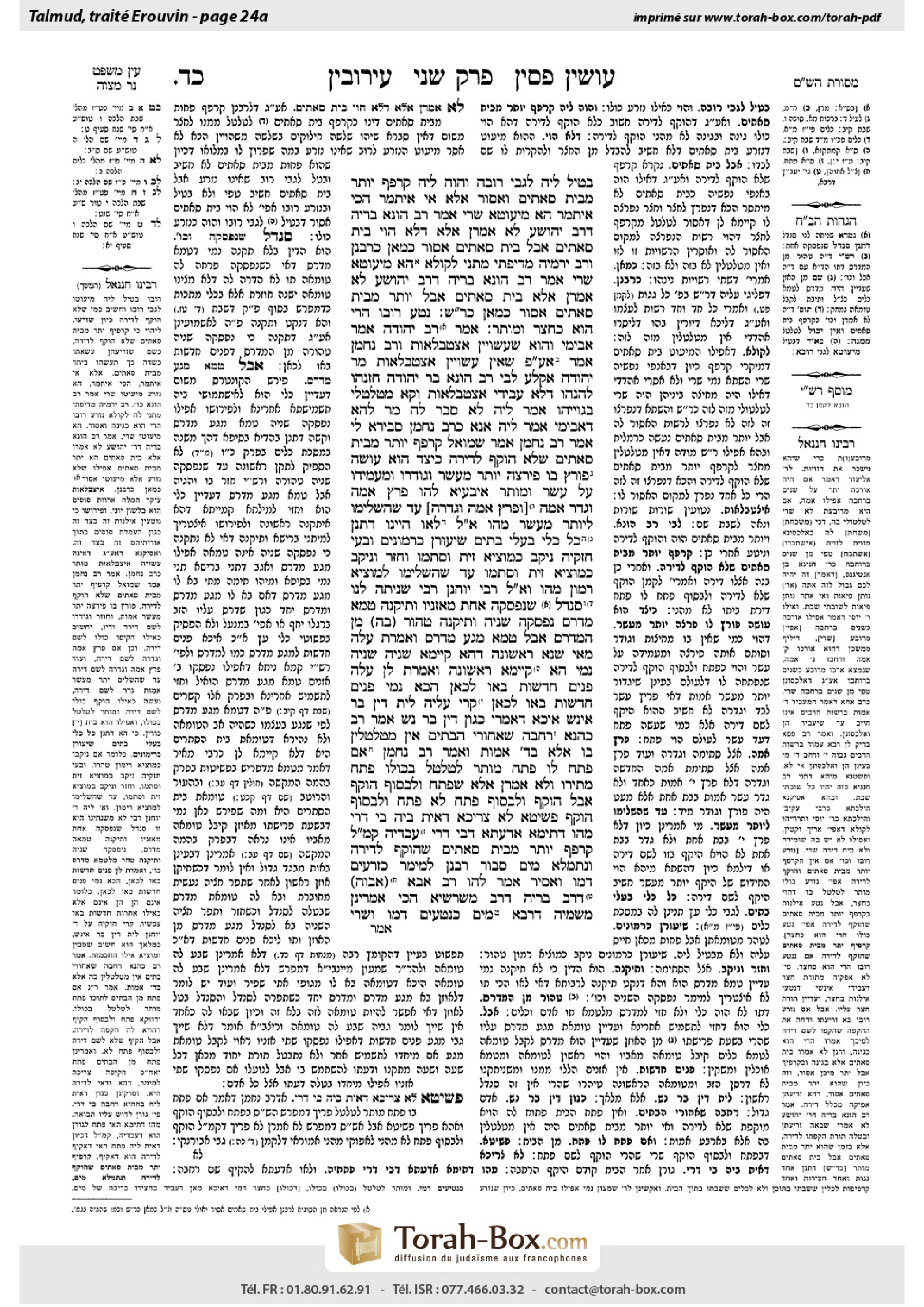
Scan : Torah-Box. Daf Study est un projet indépendant, sans affiliation ni approbation de Torah-Box ou de Sefaria.