Erouvin 24b en français · עירובין כ״ד ב
Traduction française du daf 24b du traité Erouvin (Eruvin 24b en anglais), avec le texte araméen, l’anglais de Sefaria et le scan de la page, pour étudier le Daf Yomi.
Ouvrir dans le lecteur interactifLire le daf du jour
Traduction française de Erouvin 24b
Les traductions françaises de Daf Study sont générées par IA à partir de l’édition anglaise de Sefaria. Elles peuvent contenir des erreurs : vérifie toujours un passage avec le texte source.
Ameimar dit : Cette règle ne s’applique que si l’eau convient à son usage habituel, c’est-à-dire à la consommation, car elle répond alors aux besoins de résidence. En revanche, si l’eau ne convient pas à cet usage, l’endroit n’est pas considéré comme un espace planté d’arbres. Le karpef n’est donc plus considéré comme clôturé à des fins d’habitation, et il est interdit d’y transporter des objets.
Rav Ashi dit : Même lorsque l’eau convient à cet usage, cette règle ne s’applique que si elle n’atteint pas une profondeur de dix palmes sur une superficie supérieure à deux beit séa. Mais si elle atteint une profondeur de dix palmes sur une superficie supérieure à deux beit séa, il est interdit d’y transporter des objets, car le karpef n’est alors plus considéré comme clôturé à des fins d’habitation.
La Guemara fait remarquer que ce n’est pas le cas d’un tas de fruits : même si celui-ci est très grand, le karpef ne perd pas son statut de lieu clôturé à des fins d’habitation.
La Guemara rapporte : Il y avait dans la ville de Pum Nahara une cour dont la superficie dépassait deux beit séa et qui n’avait pas été clôturée à des fins d’habitation. L’un de ses côtés donnait sur une ruelle de la ville, et l’autre sur un chemin bordé de murs qui traversait les vignes. Ce chemin menait à la rive d’un fleuve, haute de dix palmes ; celle-ci est considérée comme une cloison.
Abaye dit : Que faire pour permettre d’y transporter des objets dans cette cour, qui est un karmelit, sans devoir pratiquer une brèche de plus de dix coudées dans l’un de ses murs, puis la refermer ? Faut-il construire une cloison sur la rive du fleuve, afin que le chemin des vignes soit entouré de cloisons de tous côtés ? Ce n’est pas une solution viable, car on ne peut pas construire une cloison efficace au-dessus d’une autre cloison déjà existante, et la rive du fleuve est considérée comme une cloison par rapport au fleuve.
Faut-il installer un encadrement de porte à l’entrée du chemin des vignes ? Ce n’est pas non plus une solution efficace dans ce cas, car les chameaux qui empruntent ce chemin pour boire l’eau du fleuve viendront le renverser.
Abaye dit plutôt : Il faut installer un poteau latéral à l’ouverture du chemin des vignes sur la cour. Puisqu’il est efficace pour le chemin des vignes et permet d’y transporter des objets, celui-ci ne débouchant alors plus sur un karmelit, il l’est aussi pour la cour. Le poteau latéral sera considéré comme une cloison supplémentaire, permettant d’y transporter des objets.
Rava lui dit : Dans ce cas, les gens diront qu’un poteau latéral permet généralement de transporter des objets sur un chemin des vignes, ce qui induira le public en erreur, car les chemins des vignes sont habituellement ouverts aux deux extrémités et ne mènent pas à un fleuve ou à un endroit semblable.
Rava dit plutôt : Il faut installer un poteau latéral à l’ouverture de la cour sur la ville. Puisque ce poteau latéral est efficace et considéré comme une cloison pour la ville, il l’est aussi pour la cour et permet d’y transporter des objets.
En résumé, il est donc permis de transporter des objets à l’intérieur de la ville elle-même et à l’intérieur de la cour elle-même. Toutefois, Rav Aḥa et Ravina sont en désaccord au sujet du transport d’objets de la ville à la cour ou de la cour à la ville : l’un l’interdit et l’autre le permet.
Texte source et traduction anglaise
עירובין כ״ד ב · texte araméen et hébreu
אָמַר אַמֵּימָר: וְהוּא דְּחַזְיִין לְתַשְׁמִישְׁתָּא, אֲבָל לָא חַזְיִין לְתַשְׁמִישְׁתָּא — לָא.
אָמַר רַב אָשֵׁי: וּדְחַזְיִין לְתַשְׁמִישְׁתָּא נָמֵי לָא אֲמַרַן אֶלָּא שֶׁאֵין בְּעוֹמְקוֹ יוֹתֵר מִבֵּית סָאתַיִם, אֲבָל אִם יֵשׁ בְּעוֹמְקוֹ יוֹתֵר מִבֵּית סָאתַיִם — אָסוּר.
וְלָאו מִילְּתָא הִיא, מִידֵּי דְּהָוֵה אַכַּרְיָא דְפֵירֵי.
הָהִיא רְחָבָה דַּהֲוַאי בְּפוּם נַהֲרָא, דְּחַד גִּיסָא הֲוָה פְּתִיחַ לְמָתָא, וְחַד גִּיסָא הֲוָה פְּתִיחַ לִשְׁבִיל שֶׁל כְּרָמִים, וּשְׁבִיל שֶׁל כְּרָמִים הֲוָה סָלֵיק לְגוּדָּא דְנַהֲרָא.
אָמַר אַבָּיֵי: הֵיכִי נַעֲבֵיד? לַעֲבֵיד לֵיהּ מְחִיצָה אַגּוּדָּא דְנַהֲרָא — אֵין עוֹשִׂין מְחִיצָה עַל גַּבֵּי מְחִיצָה.
וְלַעֲבֵיד לֵיהּ צוּרַת הַפֶּתַח אַפּוּמָּא דִּשְׁבִיל שֶׁל כְּרָמִים — אָתוּ גַּמְלֵי שָׁדְיָין לֵיהּ.
אֶלָּא אָמַר אַבָּיֵי: לֶיעְבֵּיד לֶחִי אַפִּיתְחָא דִּשְׁבִיל שֶׁל כְּרָמִים, דְּמִגּוֹ דְּמַהְנְיָא לִשְׁבִיל שֶׁל כְּרָמִים, מְהַנֵּי נָמֵי לִרְחָבָה.
אֲמַר לֵיהּ רָבָא: יֹאמְרוּ לֶחִי מוֹעִיל לִשְׁבִיל שֶׁל כְּרָמִים דְּעָלְמָא.
אֶלָּא אָמַר רָבָא: עָבְדִינַן לֵיהּ לֶחִי לְפִיתְחָא דְמָתָא, דְּמִגּוֹ דְּמַהְנֵי לֵיהּ לֶחִי לְמָתָא, מַהְנֵי נָמֵי לִרְחָבָה.
הִלְכָּךְ: טַלְטוֹלֵי בְּמָתָא גּוּפַהּ — שְׁרֵי. טַלְטוֹלֵי בִּרְחָבָה גּוּפַהּ — שְׁרֵי. מִמָּתָא לִרְחָבָה וּמֵרְחָבָה לְמָתָא, פְּלִיגִי בַּהּ רַב אַחָא וְרָבִינָא: חַד אָסַר וְחַד שָׁרֵי.
Eruvin 24b · traduction anglaise de Sefaria
Ameimar said: This ruling applies only if the water is fit for its regular use, i.e., for drinking, because in that case it provides for the needs of residence. However, if the water is not fit for use, then it is not considered like planted trees. Therefore, the karpef is no longer considered enclosed for the purpose of residence, and it is prohibited to carry in the karpef.
Rav Ashi said: And even where the water is fit for use, this ruling applies only if the water is not ten handbreadths deep over an area greater than two beit se’a; but if the water is ten handbreadths deep over an area greater than two beit se’a, it is prohibited to carry in it, as in such a case the karpef is no longer considered enclosed for the sake of dwelling.
The Gemara comments: And it is not so, just as it is in the case of a pile of fruit, as even if the pile of fruit is very large, the karpef does not lose its status as having been enclosed for the purpose of residence.
The Gemara relates: There was a certain yard in the town of Pum Nahara that was larger than two beit se’a and that had not been enclosed for the purpose of residence. One of its sides opened to an alleyway in the town, and the other opened to a walled path between the vineyards, and that vineyard path led to the bank of a river ten handbreadths high, which is considered a partition.
Abaye said: What shall we do to permit carrying in the yard, which is a karmelit, without having to make a breach in one of its walls wider than ten cubits and then fence it up again? Shall we construct a partition for it on the river bank, so that the vineyard path is surrounded by partitions on all sides? This is not a viable solution, as one cannot construct an effective partition on top of another partition that already exists, and the river bank is considered a partition relative to the river.
Shall we arrange a doorframe at the mouth of the vineyard path? That is also not an effective solution in this case, for the camels that walk down this path in order to drink water from the river will come and knock it over.
Rather, Abaye said: We should arrange a side post at the opening of the vineyard path to the yard, since as it is effective for the vineyard path, to allow one to carry on the path, as it is no longer breached into a karmelit, it is also effective for the yard, and the side post will be considered an additional partition that renders it permitted to carry in the yard.
Rava said to him: If so, people will say that a side post is effective in permitting one to carry in a vineyard path generally, and this will cause the public to err, as vineyard paths are usually open at both ends and do not lead to a river or the like.
Rather, Rava said: They should arrange a side post at the opening of the yard to the town, as since the side post is effective and is considered a partition for the town, it is also effective for the yard, to permit one to carry within it.
Therefore, in summary, it is permitted to carry within the town itself and to carry within the yard itself. However, with regard to carrying from the town to the yard or from the yard to the town, Rav Aḥa and Ravina disagree: One prohibits doing so and the other permits it.
Texte de Sefaria : William Davidson Edition - Vocalized Aramaic (CC BY NC) ; William Davidson Edition - English (CC BY NC).
Scan de Erouvin 24b
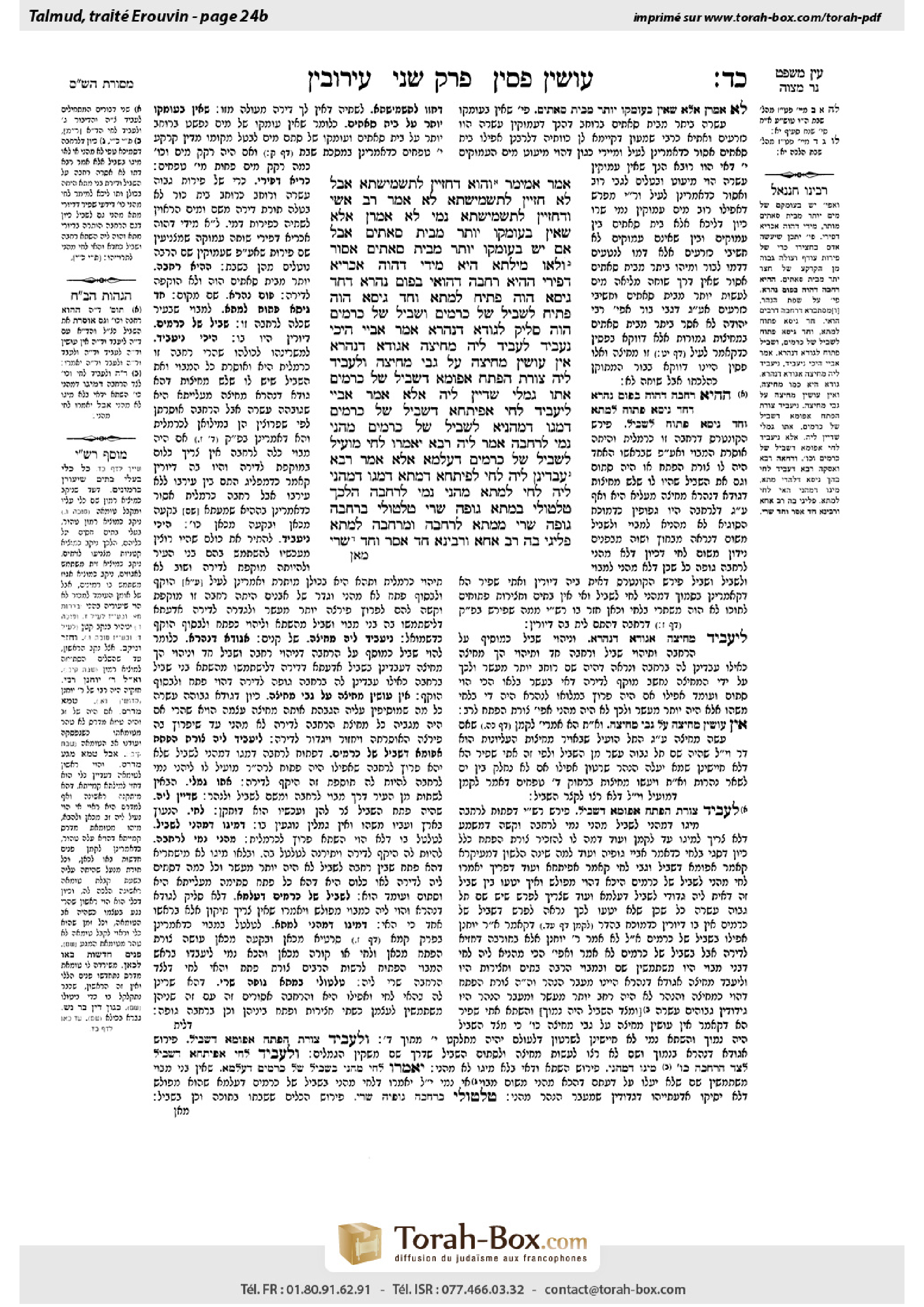
Scan : Torah-Box. Daf Study est un projet indépendant, sans affiliation ni approbation de Torah-Box ou de Sefaria.