Erouvin 43a en français · עירובין מ״ג א
Traduction française du daf 43a du traité Erouvin (Eruvin 43a en anglais), avec le texte araméen, l’anglais de Sefaria et le scan de la page, pour étudier le Daf Yomi.
Ouvrir dans le lecteur interactifLire le daf du jour
Traduction française de Erouvin 43a
Les traductions françaises de Daf Study sont générées par IA à partir de l’édition anglaise de Sefaria. Elles peuvent contenir des erreurs : vérifie toujours un passage avec le texte source.
car elles ne sont faites que pour empêcher l’eau d’entrer ; autrement dit, les parois d’un bateau ne sont pas conçues pour en faire un lieu d’habitation, mais pour le protéger de l’eau. Elles n’ont donc pas le statut de cloisons aménagées à des fins d’habitation.
La Guemara demande : Quant à Rabba, pourquoi n’a-t-il pas exprimé son avis conformément à celui de Rabbi Zeira ? La Guemara répond : Pour un bateau en mouvement, tous sont d’accord, c’est-à-dire que même Rabbi Yehoshua et Rabbi Akiva reconnaissent qu’il est permis de circuler dans tout le bateau. Leur désaccord porte uniquement sur un bateau à l’arrêt. Rabban Gamliel considère que les parois du bateau constituent des cloisons efficaces, tandis que Rabbi Yehoshua n’est pas d’accord.
Rav Naḥman bar Yitzḥak dit : La Michna laisse elle aussi entendre avec précision que les tannaïm ne sont pas en désaccord au sujet d’un bateau en mouvement. La Guemara demande : Qu’est-ce qui le laisse entendre ? Ce qui est enseigné : Il arriva que tous ces Sages revenaient de Pelandarsin, et que leur bateau prit la mer pendant Chabbat, les emmenant au-delà de leur limite de Chabbat. Rabban Gamliel et Rabbi Elazar ben Azarya circulèrent dans tout le bateau, tandis que Rabbi Yehoshua et Rabbi Akiva ne dépassèrent pas quatre coudées, car ils voulaient être rigoureux envers eux-mêmes.
Rav Naḥman bar Yitzḥak explique : Il est compréhensible que, si l’on dit qu’ils ne sont pas en désaccord au sujet d’un bateau en mouvement, il soit enseigné qu’ils voulaient être rigoureux envers eux-mêmes ; autrement dit, ils souhaitaient observer une rigueur alors qu’ils n’y étaient pas tenus, car ils craignaient que le bateau ne s’immobilise, c’est-à-dire qu’il ne s’arrête.
Mais si l’on dit qu’ils sont en désaccord même dans le cas d’un bateau en mouvement, l’expression « voulaient être rigoureux » pose problème, car la Michna n’aurait pas dû parler d’un souhait d’être rigoureux : selon leur avis, cela serait formellement interdit.
À propos de la question précédente, Rav Ashi dit : La Michna laisse également entendre ce point avec précision d’une autre manière, car elle enseigne la règle concernant un bateau en parallèle avec celle concernant un enclos et une étable. De même qu’un enclos et une étable sont fixes à leur emplacement, de même la Michna traite d’un bateau fixe à son emplacement.
Rav Aḥa, fils de Rava, dit à Rav Ashi : Rav et Shmuel ont tous deux dit que la halakha suit l’avis de Rabban Gamliel au sujet d’un bateau. Or, s’ils ont dû trancher la halakha, cela implique que les tannaïm étaient en désaccord sur la question. C’est difficile, car les mots « ils voulaient être rigoureux envers eux-mêmes » laissent entendre qu’il n’y avait aucun désaccord de fond.
Rav Ashi répondit : Oui, les tannaïm sont effectivement en désaccord au sujet d’un bateau à l’arrêt. Lorsque la Michna dit que Rabbi Yehoshua et Rabbi Akiva voulaient être rigoureux envers eux-mêmes, ce qui laisse entendre qu’il n’y a pas de véritable désaccord, elle parle d’un bateau à l’arrêt. Et il a été enseigné dans une baraïta : Ḥananya, fils du frère de Rabbi Yehoshua, dit : Toute cette journée, ils la passèrent sur le bateau, assis à discuter de halakha ; et, le soir venu, mon oncle, c’est-à-dire Rabbi Yehoshua, trancha ainsi : La halakha suit l’avis de Rabban Gamliel pour un bateau en mouvement, c’est-à-dire qu’il est permis d’y circuler partout. Et la halakha suit l’avis de Rabbi Akiva pour un enclos et une étable, c’est-à-dire qu’on ne peut y parcourir que quatre coudées ; il en va de même pour un bateau à l’arrêt.
Rav Ḥananya souleva un dilemme : L’interdiction des limites de Chabbat s’applique-t-elle au-dessus de dix palmes du sol, ou bien ne s’applique-t-elle pas au-dessus de dix palmes ? Autrement dit, l’interdiction des limites de Chabbat s’applique-t-elle uniquement près du sol, auquel cas il serait permis de se déplacer à plus de dix palmes au-dessus du sol ?
La Guemara précise le cas auquel se rapporte ce dilemme : au sujet d’un poteau haut de dix palmes et large de quatre palmes, situé en partie à l’intérieur de la limite et en partie au-delà, le cas ne devrait pas vous poser de dilemme. Un poteau aussi stable est assimilé à un sol ferme, bien qu’il soit plus élevé que le terrain alentour ; il est donc interdit de passer de la partie située à l’intérieur de la limite à celle qui se trouve au-delà.
Le cas qui devrait vous poser un dilemme est celui d’un poteau haut de dix palmes, mais large de moins de quatre palmes, ou d’un cas semblable. Autre possibilité : il s’agit d’une personne qui avance en sautant dans les airs à plus de dix palmes du sol.
La Guemara présente une autre version du dilemme précédent : quelle est la halakha concernant un bateau qui vogue à la surface de l’eau, à plus de dix palmes du fond de la mer ou du fleuve ? L’interdiction des limites de Chabbat s’applique-t-elle ou non ?
Rav Hoshaya dit : Viens et entends une réponse à ce dilemme dans ce qui a été enseigné dans la Michna : Il arriva que tous ces Sages revenaient de Pelandarsin, et que leur bateau prit la mer, etc. Il est compréhensible que Rabbi Yehoshua et Rabbi Akiva aient voulu être rigoureux si l’on dit que l’interdiction des limites de Chabbat s’applique au-dessus de dix palmes. Mais si l’on dit que cette interdiction ne s’applique pas au-dessus de dix palmes, pourquoi voulaient-ils être rigoureux ?
La Guemara répond : On peut avancer, comme Rava l’a dit à propos d’un cas parallèle, qu’il s’agissait d’un bateau qui avançait dans des eaux peu profondes et marécageuses ; ici aussi, il s’agit d’un bateau qui avançait dans des eaux peu profondes et marécageuses, à moins de dix palmes du fond de la mer, de sorte que l’interdiction des limites de Chabbat s’applique certainement.
La Guemara cite une autre preuve. Viens et entends une réponse dans la Michna : Une fois, à la veille de Chabbat, ils n’entrèrent dans le port qu’après la tombée de la nuit, etc. Il est compréhensible qu’ils aient demandé s’ils pouvaient ou non débarquer si l’on dit que l’interdiction des limites de Chabbat s’applique au-dessus de dix palmes. Mais si l’on dit que cette interdiction ne s’applique pas au-dessus de dix palmes, même si Rabban Gamliel leur avait dit : « Nous n’étions pas dans les limites de la ville avant la tombée de la nuit », qu’est-ce que cela aurait changé ? Ils auraient pu descendre du bateau, car celui-ci se trouvait à plus de dix palmes, hauteur à laquelle l’interdiction des limites de Chabbat ne s’applique pas.
La Guemara répond que Rava a dit : La Michna se réfère à un cas où le bateau avançait dans des eaux peu profondes et marécageuses, à moins de dix palmes du fond de la mer.
La Guemara cite une autre preuve : Viens et entends une réponse à partir de l’incident concernant les sept enseignements qui furent d’abord énoncés le matin de Chabbat devant Rav Ḥisda, à Soura, puis répétés vers la fin de ce Chabbat devant Rava, à Poumbedita, bien que la distance entre ces deux lieux soit trop grande pour qu’une personne ait pu la parcourir pendant Chabbat.
Qui a énoncé ces enseignements et les a transmis d’un lieu à l’autre ? N’était-ce pas le prophète Élie, qui voyagea de Soura à Poumbedita par un saut miraculeux dans les airs, à plus de dix palmes du sol, et qui les énonça ? Cela semble indiquer que l’interdiction des limites de Chabbat ne s’applique pas au-dessus de dix palmes, car Élie n’aurait pas transgressé cette interdiction. La Guemara rejette cet argument : cela ne constitue pas une preuve ; peut-être est-ce Yosef le démon, qui n’observe pas Chabbat, qui rapporta ces enseignements et les apporta de Soura à Poumbedita.
La Guemara tente d’apporter une autre preuve : Viens et entends ce qui a été enseigné dans une baraïta : celui qui a dit : « Je serai nazir le jour où viendra le fils de David », c’est-à-dire à l’arrivée du Messie, est autorisé à boire du vin le Chabbat et les jours de fête, car le Messie n’arrivera pas l’un de ces jours.
Texte source et traduction anglaise
עירובין מ״ג א · texte araméen et hébreu
לְהַבְרִיחַ מַיִם עֲשׂוּיוֹת.
וְרַבָּה, מַאי טַעְמָא לָא אָמַר כְּרַבִּי זֵירָא? בִּמְהַלֶּכֶת — כּוּלֵּי עָלְמָא לָא פְלִיגִי. כִּי פְּלִיגִי בְּשֶׁעָמְדָה.
אָמַר רַב נַחְמָן בַּר יִצְחָק: מַתְנִיתִין נָמֵי דַּיְקָא דְּבִמְהַלֶּכֶת לָא פְּלִיגִי. מִמַּאי? מִדְּקָתָנֵי: מַעֲשֶׂה שֶׁבָּאוּ מִפְּלַנְדַּרְסִין וְהִפְלִיגָה סְפִינָתָם בַּיָּם. רַבָּן גַּמְלִיאֵל וְרַבִּי אֶלְעָזָר בֶּן עֲזַרְיָה הָלְכוּ אֶת כּוּלָּהּ, וְרַבִּי יְהוֹשֻׁעַ וְרַבִּי עֲקִיבָא לֹא זָזוּ מֵאַרְבַּע אַמּוֹת, שֶׁרָצוּ לְהַחֲמִיר עַל עַצְמָן.
אִי אָמְרַתְּ בִּשְׁלָמָא בִּמְהַלֶּכֶת לָא פְּלִיגִי — הַיְינוּ דְּקָתָנֵי ״רָצוּ״, דִּילְמָא עָמְדָה.
אֶלָּא אִי אָמְרַתְּ פְּלִיגִי, הַאי ״רָצוּ לְהַחֲמִיר״ — אִיסּוּרָא הוּא!
אָמַר רַב אָשֵׁי: מַתְנִיתִין נָמֵי דַּיְקָא, דְּקָתָנֵי: סְפִינָה, דֻּומְיָא דְּדִיר וְסַהַר. מָה דִּיר וְסַהַר — דִּקְבִיעִי, אַף סְפִינָה נָמֵי דִּקְבִיעָא.
אֲמַר לֵיהּ רַב אַחָא בְּרֵיהּ דְּרָבָא לְרַב אָשֵׁי: הִלְכְתָא כְּרַבָּן גַּמְלִיאֵל בִּסְפִינָה, הִלְכְתָא מִכְּלָל דִּפְלִיגִי!
אִין, וְהָתַנְיָא חֲנַנְיָא (בֶּן אֲחִי רַבִּי יְהוֹשֻׁעַ) אוֹמֵר: כׇּל אוֹתוֹ הַיּוֹם יָשְׁבוּ וְדָנוּ בִּדְבַר הֲלָכָה, אֶמֶשׁ הִכְרִיעַ אֲחִי אַבָּא הֲלָכָה כְּרַבָּן גַּמְלִיאֵל בִּסְפִינָה, וַהֲלָכָה כְּרַבִּי עֲקִיבָא בְּדִיר וְסַהַר.
בָּעֵי רַב חֲנַנְיָא: יֵשׁ תְּחוּמִין לְמַעְלָה מֵעֲשָׂרָה, אוֹ אֵין תְּחוּמִין לְמַעְלָה מֵעֲשָׂרָה?
עַמּוּד גָּבוֹהַּ עֲשָׂרָה וְרָחָב אַרְבָּעָה, לָא תִּיבְּעֵי לָךְ — דְּאַרְעָא סְמִיכְתָּא הִיא.
כִּי תִּיבְּעֵי לָךְ, בְּעַמּוּד גָּבוֹהַּ עֲשָׂרָה וְאֵינוֹ רָחָב אַרְבָּעָה. אִי נָמֵי, דְּקָאָזֵיל בִּקְפִיצָה.
לִישָּׁנָא אַחֲרִינָא: בִּסְפִינָה, מַאי?
אָמַר רַב הוֹשַׁעְיָא, תָּא שְׁמַע: מַעֲשֶׂה שֶׁבָּאוּ מִפְּלַנְדַּרְסִין וְהִפְלִיגָה סְפִינָתָם בַּיָּם וְכוּ׳, אִי אָמְרַתְּ בִּשְׁלָמָא יֵשׁ תְּחוּמִין — מִשּׁוּם הָכִי רָצוּ. אֶלָּא, אִי אָמְרַתְּ אֵין תְּחוּמִין — אַמַּאי רָצוּ?!
כִּדְאָמַר רָבָא — בִּמְהַלֶּכֶת בִּרְקָק, הָכָא נָמֵי — בִּמְהַלֶּכֶת בִּרְקָק.
תָּא שְׁמַע: פַּעַם אַחַת לֹא נִכְנְסוּ לַנָּמָל עַד שֶׁחָשֵׁיכָה וְכוּ׳. אִי אָמְרַתְּ בִּשְׁלָמָא יֵשׁ תְּחוּמִין — שַׁפִּיר, אֶלָּא אִי אָמְרַתְּ אֵין תְּחוּמִין — כִּי לֹא הָיִינוּ בְּתוֹךְ הַתְּחוּם, מַאי הָוֵי!
אָמַר רָבָא: בִּמְהַלֶּכֶת בִּרְקָק.
תָּא שְׁמַע: הָנֵי שָׁב שְׁמַעְתָּא דְּאִיתְאַמְרָן בְּצַפְרָא בְּשַׁבְּתָא קַמֵּיהּ דְּרַב חִסְדָּא בְּסוּרָא, בַּהֲדֵי פַּנְיָא בְּשַׁבְּתָא קַמֵּיהּ דְּרָבָא בְּפוּמְבְּדִיתָא.
מַאן אַמְרִינְהוּ? לָאו אֵלִיָּהוּ אַמְרִינְהוּ? אַלְמָא אֵין תְּחוּמִין לְמַעְלָה מֵעֲשָׂרָה! לָא, דִּלְמָא יוֹסֵף שֵׁידָא אַמְרִינְהוּ.
תָּא שְׁמַע: הֲרֵינִי נָזִיר בַּיּוֹם שֶׁבֶּן דָּוִד בָּא — מוּתָּר לִשְׁתּוֹת יַיִן בְּשַׁבָּתוֹת וּבְיָמִים טוֹבִים,
Eruvin 43a · traduction anglaise de Sefaria
for they are only made to keep the water out; that is to say, a boat’s walls are not designed to turn it into a place of residence, but to protect it from the water. Therefore, they do not have the status of partitions made for the purpose of residence.
The Gemara asks: As for Rabba, what is the reason he did not state his opinion in accordance with the opinion of Rabbi Zeira? The Gemara answers: With regard to a boat that is moving, all agree, i.e., even Rabbi Yehoshua and Rabbi Akiva, that one is permitted to walk about the entire boat. They disagree only with regard to a boat that is stationary. Rabban Gamliel holds that the boat’s walls constitute effective partitions, whereas Rabbi Yehoshua disagrees.
Rav Naḥman bar Yitzḥak said: The mishna is also precise in its implication that the tanna’im do not disagree with regard to a moving boat. The Gemara asks: From where is this implied? From that which is taught: There was an incident where all of these Sages were coming from Pelandarsin, and their boat set sail on the sea on Shabbat, taking them out beyond their Shabbat limit. Rabban Gamliel and Rabbi Elazar ben Azarya walked about the entire boat, while Rabbi Yehoshua and Rabbi Akiva did not move beyond four cubits, as they sought to be stringent with themselves.
Rav Naḥman bar Yitzḥak explains: Granted, if you say that they do not disagree with regard to a moving boat, that is why it is taught that they sought to be stringent with themselves, i.e., they wished to practice stringency although they were under no obligation to do so, as they were concerned that perhaps the boat will stand, i.e., come to a stop.
But if you say that they disagree even in the case of a boat that is moving, this phrase: Sought to be stringent, is problematic, for the mishna should not refer to a desire to be stringent, as according to their opinion it is an outright prohibition.
With regard to the previous issue, Rav Ashi said: The mishna is also precise, implying this point in another manner as well, for it teaches the law governing a boat parallel to the law governing a pen and a stable. Just as a pen and a stable are fixed in their place, so too, the mishna discusses a boat that is fixed in its place.
Rav Aḥa, son of Rava, said to Rav Ashi: Rav and Shmuel both said that the halakha is in accordance with Rabban Gamliel with regard to a boat, and if they had to decide the halakha, then this proves by inference that the tanna’im disagreed about the issue. This is difficult, as the words: They wished to be stringent upon themselves, imply that there was no fundamental dispute at all.
Rav Ashi replied: Yes, the tanna’im do in fact disagree about a boat that is standing. When the mishna says that Rabbi Yehoshua and Rabbi Akiva wished to be stringent upon themselves, implying that there is no real dispute, it is referring to a boat that is stationary. And it was taught in a baraita: Ḥananya, son of Rabbi Yehoshua’s brother, says: All that day they spent on the boat, they sat and discussed the matter of halakha; and come evening my father’s brother, i.e., Rabbi Yehoshua, determined: The halakha is in accordance with the opinion of Rabban Gamliel with regard to a moving boat, i.e., one is permitted to walk about all of it. And the halakha is in accordance with the opinion of Rabbi Akiva with regard to a pen and a stable, i.e., one may only walk four cubits in them, and the same applies to a stationary boat.
Rav Ḥananya raised a dilemma: Does the prohibition of Shabbat limits apply above ten handbreadths from the ground, or perhaps does the prohibition of Shabbat limits not apply above ten handbreadths? In other words, does the Shabbat limit apply only close to the ground, in which case walking more than ten handbreadths above the ground, would be permitted?
The Gemara clarifies the case in which this dilemma arises: With regard to a post ten handbreadths high and four handbreadths wide, partly within the limit and partly outside of it, this case should not be a dilemma for you. Such a stable post is like solid ground, although it differs from the surrounding area in height; therefore, it is prohibited to walk from the part within the limit to the part outside of it.
The case where there should be a dilemma for you is that of a post ten handbreadths high but not four handbreadths wide, or the like. Alternatively, the case is one where he advances by way of a leap in the air above ten handbreadths from the ground.
The Gemara presents another version of the previous dilemma: What is the halakha with regard to a boat sailing on the surface of the water more than ten handbreadths from the sea or river bed? Does the prohibition of Shabbat limits apply or not?
Rav Hoshaya said: Come and hear a resolution to this dilemma from what was taught in the mishna: It once happened that all of these Sages were coming from Pelandarsin, and their boat set sail on the sea, etc. Granted, if you say that the prohibition of Shabbat limits applies above ten handbreadths, this is why Rabbi Yehoshua and Rabbi Akiva sought to be stringent. However, if you say that the prohibition of Shabbat limits does not apply above ten handbreadths, why did they seek to be stringent?
The Gemara answers: It may be suggested as Rava said with regard to a parallel case, establishing that case as one where the boat was moving through shallow, swampy water; here, too, we are dealing with a case where the boat was moving through shallow, swampy water, within ten handbreadths of the sea’s bed, so that the prohibition of Shabbat limits certainly applies.
The Gemara cites another proof. Come and hear a resolution from the mishna: On one occasion on a Shabbat eve, they did not enter the port until after nightfall, etc. Granted, if you say that the prohibition of Shabbat limits applies above ten handbreadths, it was well that they asked whether or not they may disembark. However, if you say that the prohibition of Shabbat limits does not apply above ten handbreadths, even if Rabban Gamliel had told them: We were not within the city’s limit before nightfall, what difference would it have made? They could have alighted from the boat, for the boat was above ten handbreadths, where the prohibition of Shabbat limits does not apply.
The Gemara answers that Rava said: The mishna refers to a case where the boat was moving through shallow, swampy water within ten handbreadths of the sea’s bed.
The Gemara cites another proof: Come and hear a resolution from the incident involving the seven teachings that were first said on Shabbat morning before Rav Ḥisda in Sura and then repeated toward the conclusion of that Shabbat before Rava in Pumbedita, despite the fact that the distance between them is too great for someone to have traversed it on Shabbat.
Who said those teachings, and delivered them from one place to the other? Was it not Elijah the Prophet, who traveled from Sura to Pumbedita by way of a miraculous leap through the air above ten handbreadths from the ground, who said them? Apparently, the prohibition of Shabbat limits does not apply above ten handbreadths, for Elijah would not have transgressed this prohibition. The Gemara rejects this argument: This is no proof; perhaps Yosef the demon, who does not observe Shabbat, reported these teachings and brought them from Sura to Pumbedita.
The Gemara attempts to bring a different proof: Come and hear that which was taught in a baraita: With regard to one who said: I will be a nazirite on the day that the son of David comes, i.e., upon the arrival of the Messiah, he is permitted to drink wine on Shabbat and Festivals, for the Messiah will not arrive on one of those days.
Texte de Sefaria : William Davidson Edition - Vocalized Aramaic (CC BY NC) ; William Davidson Edition - English (CC BY NC).
Scan de Erouvin 43a
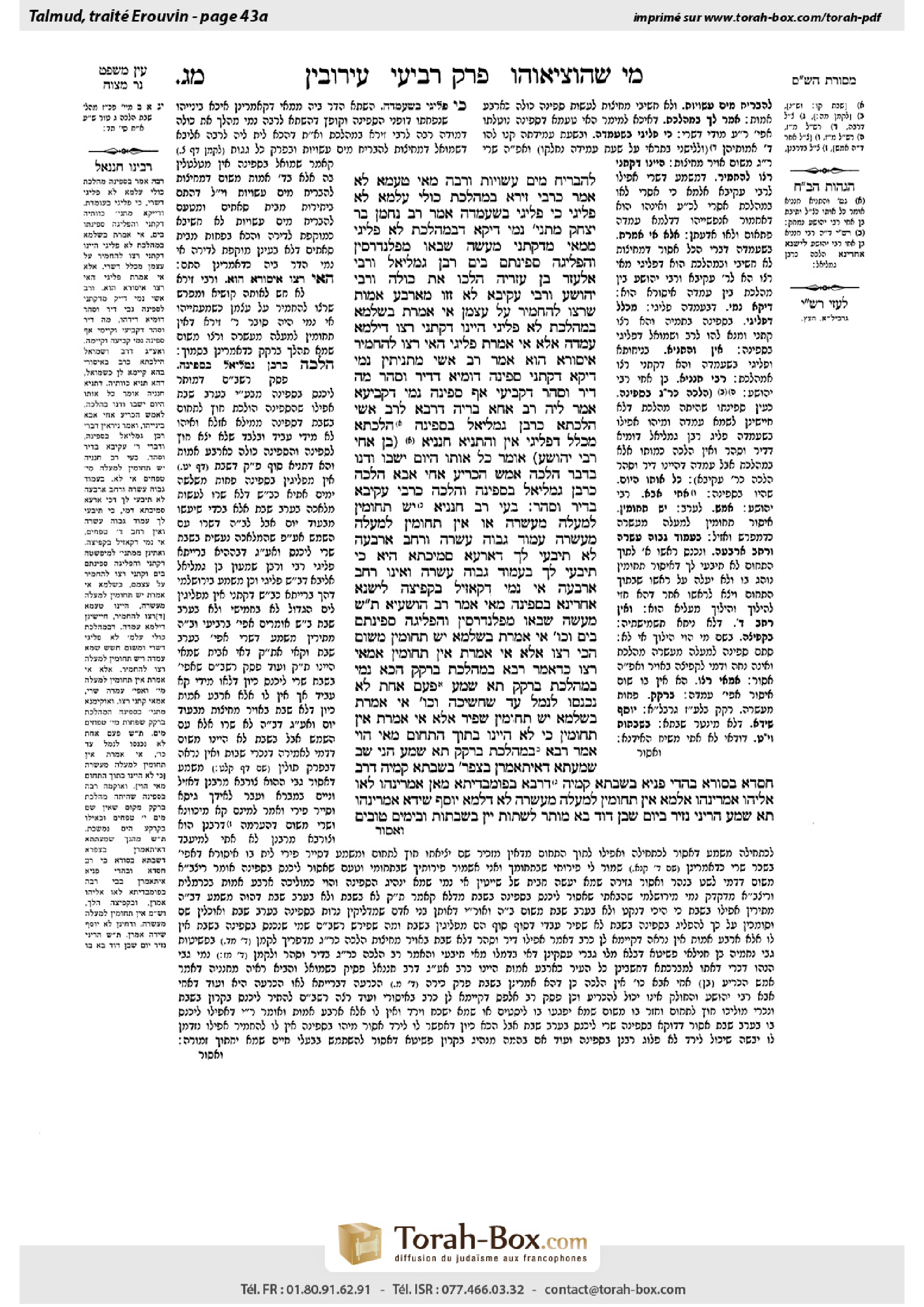
Scan : Torah-Box. Daf Study est un projet indépendant, sans affiliation ni approbation de Torah-Box ou de Sefaria.