Guittin 69b en français · גיטין ס״ט ב
Traduction française du daf 69b du traité Guittin (Gittin 69b en anglais), avec le texte araméen, l’anglais de Sefaria et le scan de la page, pour étudier le Daf Yomi.
Ouvrir dans le lecteur interactifLire le daf du jour
Traduction française de Guittin 69b
Les traductions françaises de Daf Study sont générées par IA à partir de l’édition anglaise de Sefaria. Elles peuvent contenir des erreurs : vérifie toujours un passage avec le texte source.
Qu’il en laisse tomber quelques gouttes sur trois tiges de chou, puis remue avec un brin de marjolaine. Lorsque le brin de marjolaine aura bouilli, tout aura bouilli. S’il ne peut pas faire cela, qu’il prenne des excréments de chien blanc et les mélange avec du baume. Autant que possible, qu’il évite de manger les excréments, car ils provoquent la séparation des membres.
Comme remède contre une douleur lancinante [gira], qu’il prenne une pierre appelée « flèche de Lilith » et la retourne. Qu’il verse de l’eau dessus et la boive. S’il ne peut pas faire cela, qu’il prenne de l’eau dans laquelle un chien a bu pendant la nuit. Qu’il veille à ne pas laisser cette eau à découvert pendant la nuit, de crainte qu’un serpent n’y ait bu et n’y ait laissé son venin. Pour remédier à l’ingestion d’eau laissée à découvert, il faut boire un quart de log [anpaka] de vin pur.
Comme remède contre une plaie purulente, qu’il boive un quart de log de vin dans lequel a macéré de la ficoïde glaciale rouge.
Comme remède aux palpitations cardiaques, c’est-à-dire lorsque son cœur bat trop vite, qu’il prenne trois pains d’orge et les fasse tremper dans du kamka qui n’a pas encore quarante jours. Qu’il mange les pains, puis boive du vin coupé d’eau. Rav Aḥa de Difti dit à Ravina : « À plus forte raison, ces aliments lui donneront des palpitations ! » Ravina lui répondit : « Tu as mal entendu ce que j’ai dit : je parlais d’un remède contre une lourdeur au cœur. »
Comme remède aux palpitations cardiaques, qu’il prenne trois pains de blé, les fasse tremper dans du miel et les mange. Ensuite, qu’il boive du vin pur.
Comme remède à une douleur cardiaque, qu’il prenne trois mesures de menthe de la taille d’un œuf, ainsi qu’une mesure de cumin et une mesure de graines de sésame, chacune de la taille d’un œuf, et qu’il les mange ensemble.
Comme remède aux douleurs intestinales, qu’il prenne trois cents poivres longs et en boive cent chaque jour avec du vin. On raconte que Ravin, de la ville de Neresh, prépara cent cinquante de nos poivres, c’est-à-dire des poivres babyloniens, pour la fille de Rav Ashi, qui souffrait de cette maladie, et qu’elle guérit.
Comme remède au ver rond, qu’il boive un quart de log de vin dans lequel ont macéré des feuilles de laurier. Comme remède au ver blanc, qu’il prenne du cresson et l’attache dans un morceau de tissu. Qu’il le fasse tremper dans l’eau et boive cette eau. Qu’il prenne garde aux graines : s’il n’y veille pas suffisamment, elles risquent de pousser à l’intérieur de lui et de perforer ses intestins.
Pour resserrer les intestins, c’est-à-dire soigner la diarrhée, le remède consiste à consommer la plante de camomille [sisin] lorsqu’elle est mouillée. Pour relâcher les intestins et soulager la constipation, le remède consiste à boire de la camomille séchée trempée dans l’eau, qui agit comme laxatif. Voici un moyen mnémotechnique pour ne pas confondre ces remèdes : l’herbe humide [itza] sert à barrer les rivières ; on se souviendra ainsi que la camomille humide sert à arrêter la diarrhée.
Comme remède à une maladie de la rate, qu’il prenne sept sangsues, les fasse sécher à l’ombre et en boive deux ou trois chaque jour avec du vin. S’il ne peut pas faire cela, qu’il prenne la rate d’une chèvre qui n’a pas mis bas, la place dans le four et se tienne en face d’elle, en disant : « De même que cette rate se dessèche, que la rate d’Untel, fils d’Untel, se dessèche. »
S’il ne peut pas faire cela, qu’il place la rate de chèvre entre les briques d’une maison neuve et prononce la même formule. Sinon, qu’il cherche quelqu’un qui soit mort le Chabbat, prenne la main du défunt, la pose sur sa rate et dise : « De même que la main d’Untel s’est desséchée, que la rate d’Untel, fils d’Untel, se dessèche elle aussi. »
S’il ne peut pas faire cela, qu’il prenne un poisson et le fasse rôtir dans l’atelier d’un forgeron. Qu’il le mange avec l’eau de l’atelier dans laquelle on refroidit le métal porté au rouge. Qu’il boive de l’eau de l’atelier du forgeron. La Guemara apporte un élément à l’appui de ce remède : une certaine chèvre but de l’eau de l’atelier du forgeron et, lorsqu’on l’abattit, on ne trouva pas de rate en elle.
S’il ne peut pas faire cela, qu’il ouvre un tonneau de vin pour lui, c’est-à-dire qu’il boive une grande quantité de vin. Rav Aḥa, fils de Rava, dit à Rav Ashi : « S’il a un tonneau de vin, il ne viendra pas consulter mon Maître pour un remède, car le vin l’aura déjà guéri. » Que doit-il donc faire pour préserver sa santé ? Qu’il s’habitue à manger du pain le matin, car cela est bénéfique à tout son corps.
Comme remède aux hémorroïdes, qu’il prenne de l’acacia [akika], de l’aloès [ilava], du mercure, des scories d’argent, un bouquet [ḥumreta] d’herbes odorantes [defilon] et des excréments de pigeons [ḥamimta]. Qu’il mette le tout dans des sachets de lin en été, ou de coton en hiver, et les place sur la zone atteinte. S’il ne peut pas faire cela, qu’il boive de la bière coupée d’eau.
Pour la rhumatismale [shigrona], qu’il prenne un récipient rempli de saumure de petits poissons [moninei] et le fasse rouler soixante fois sur une cuisse, puis soixante fois sur l’autre.
Comme remède à un calcul vésical [litzmireta], qu’il prenne trois gouttes d’huile de goudron, c’est-à-dire l’huile qui se dégage de la combustion du bois, trois gouttes de jus extrait [itzra] de poireaux et trois gouttes de vin pur. Qu’il applique ce mélange sur le pénis chez un homme et sur cet endroit, c’est-à-dire la région génitale, chez une femme.
S’il ne peut pas faire cela, qu’il prenne l’oreille, c’est-à-dire l’anse, d’une outre à vin et la suspende au pénis d’un homme ou aux seins d’une femme. S’il ne peut pas faire cela, qu’il prenne un fil cramoisi filé par une femme soupçonnée de prostitution, elle-même fille d’une femme soupçonnée, et le suspende au pénis d’un homme ou aux seins d’une femme.
Sinon, qu’il prenne un pou mâle et un pou femelle, et les suspende au pénis d’un homme ou à cet endroit, c’est-à-dire la région génitale, chez une femme. Lorsqu’il urine, qu’il urine sur une branche sèche [sisna], près du gond de la porte. Qu’il examine le calcul vésical qui sort avec son urine, car, broyé et utilisé, il est efficace comme remède contre toute maladie accompagnée de fièvre [tzimra].
Comme remède à une fièvre externe, qu’il prenne trois séa de noyaux de dattes [suflei] et trois séa [gerivei] de feuilles d’un arbre eder. Qu’il fasse cuire chacun séparément et s’assoie entre eux. Qu’il les mette dans deux bassines, apporte une table et la place au-dessus de lui. Qu’il se lève de l’une des bassines et s’assoie au-dessus de l’autre, puis se lève de cette bassine et s’assoie au-dessus de la première, jusqu’à ce que la chaleur monte en lui et qu’il ait très chaud. Qu’il se lave avec l’eau des deux bassines et, lorsqu’il boit, qu’il boive dans la bassine contenant l’eau d’eder. Mais qu’il ne boive pas dans celle contenant l’eau de dattes, car cela provoque la stérilité.
Comme remède à une fièvre interne, qu’il prenne sept poignées de feuilles de betterave provenant de sept sillons. Qu’il les fasse cuire avec leur terre et les mange. Qu’il boive une préparation de feuilles d’eder mélangées à de la bière ou
Texte source et traduction anglaise
גיטין ס״ט ב · texte araméen et hébreu
וְנִיטַּיְיפֵיהּ אַתְּלָת קִלְחֵי כְּרָבָא, וְנִיבְחֲשֵׁיהּ בִּגְווֹזָא דְּמַרְמְהִין; וְכִי בְּשִׁיל גְּווֹזָא דְמַרְמָהִין – בְּשִׁיל לֵיהּ כּוּלֵּיהּ. וְאִי לָא – לַיְתֵי נִפְקָא דְּכַלְבָּא חִיוָּרָא, וְנִיגְבּוֹל בְּנִטְפָא. וְכַמָּה דְּאֶפְשָׁר – נִפְקָא לָא נֵיכוֹל, דִּמְפָרֵיק.
לְגִירָא – לַיְתֵי גִּירָא דְלִילִיתָא, וְנֵיפְכֵיהּ, וְנִשְׁדֵּי מַיָּא עִלָּוֵיהּ וְנִשְׁתֵּי. וְאִי לָא – לַיְתֵי מִמַּיָּא דְּאִישְׁתִּי מִינַּיְיהוּ כַּלְבָּא בְּלֵילְיָא; וְנִיזְדְּהַר מִגִּילּוּיָא. לְגִילּוּיָא – אַנְפָּקָא דְחַמְרָא חַיָּיא.
לְמוּרְסָא – אַנְפָּקָא דְּחַמְרָא, בְּאַהֲלָא תּוֹלָאנָא.
לְפִירְחָא דְלִיבָּא – לַיְתֵי תְּלָת בְּרוֹשִׁיָּיאתָא דִשְׂעָרֵי, וְנִשְׁטְרִינְהוּ בְּכַמְכָּא דְּלָא עֲבַר עִילָּוֵיהּ אַרְבְּעִין יוֹמִין, וְנֵיכוֹל; וְנִשְׁתֵּי אַבָּתְרַיְיהוּ חַמְרָא מַרְקָא. אֲמַר לֵיהּ רַב אַחָא מִדִּיפְתִּי לְרָבִינָא: וְכׇל שֶׁכֵּן דְּפָרַח לִיבֵּיהּ! אֲמַר לֵיהּ: אֲנָא – לְיוּקְרָא דְלִיבָּא אֲמַרִי;
לְפִירְחָא דְלִיבָּא – לַיְתֵי תְּלָת בְּרוֹשִׁיָּיאתָא דְחִיטֵּי, וְנִישְׁטְרִינְהוּ בְּדוּבְשָׁא וְנֵיכוֹל, וְנִישְׁתֵּי אַבָּתְרַיְיהוּ חַמְרָא חַיָּיא.
לְצִרְחָא דְלִיבָּא – לַיְתֵי תְּלָת בֵּיעֵי נִינְיָיא, וּבֵיעֲתָא דְכַמּוֹנָא, וּבֵיעֲתָא דְשֻׁומְשְׁמֵי, וְלֵיכוֹל.
לִכְאֵב מְעֵי – לַיְתֵי תְּלָת מְאָה פִּלְפְּלֵי אֲרִיכָתָא, וְכֹל יוֹמֵי נִשְׁתֵּי מְאָה מִינַּיְיהוּ בְּחַמְרָא. רָבִין דְּמִן נָרֶשׁ עֲבַד לַהּ לְבַרְתֵּיהּ דְּרַב אָשֵׁי מְאָה וְחַמְשִׁין מֵהָנֵי דִּידַן, וְאִתְּסִיאַת.
לְכִירְצָא – אַנְפָּקָא דְּחַמְרָא בַּאֲטַרְפָּא דְעָרָאָה. לְכִירְצָא חִיוָּרָא – לַיְתֵי בִּיזְרָא גַּלְגִּילָא וְנִיצְיְירֵהּ בְּשִׁיסְתַּג, וְנִיתְיְירֵיהּ בְּמַיָּא וְנִשְׁתְּיֵהּ; וְנִזְדְּהַר מִבִּינְתָּא, דְּאִי לָא – מְנַקְּבָא לַהּ לְמַעְיָינֵיהּ.
לְמֵיסַר – סִיסִין רַטִּיבָא בְּמַיָּא. לְמִישְׁרֵא – יַבִּישְׁתָּא בְּמַיָּא. וְסִימָנָךְ: אִיצָא רַטִּיבְ[תָּ]א דְּסָכַר נַהֲרָא.
לִטְחָלָא – לַיְתֵי שַׁב בִּינֵי דְמַיָּא וּנְיַיבְּשִׁינְהוּ בְּטוּלָּא, וְכֹל יוֹמָא נִישְׁתֵּי תַּרְתֵּי וְתִלְתָּא בְּחַמְרָא. וְאִי לָא – לַיְתֵי טְחָלָא דִצְיפִרְתָּא דְּלָא אִיפְּתַח, וְנִטְחֲיֵיהּ בְּתַנּוּרָא, וְנוֹקֵי לַהֲדֵיהּ, וְנֵימָא: ״כִּי הֵיכִי דְּיַבִּישׁ הַאי טְחָלָא, נִיַּיבַּשׁ טְחָלֵיהּ דִּפְלוֹנִי בַּר פְּלוֹנִיתָא״.
וְאִי לָא – נִיטְחֲיֵיהּ בֵּינֵי אוּרְבֵי דְבֵיתָא חַדְתָּא, וְנֵימָא הָכִי. וְאִי לָא, לִיבְקֵי שָׁכְבָא דִּשְׁכֵיב בְּשַׁבְּתָא, וְנִישְׁקְלֵיהּ לִידֵיהּ וְנוֹתְבַהּ אַטְּחָלֵיהּ, וְנֵימָא: ״כִּי הֵיכִי דְּיַבִּישׁ הָא יְדָא, נִיַּיבַּשׁ טְחָלֵיהּ דִּפְלוֹנִי בַּר פְּלוֹנִיתָא״.
וְאִי לָא – נַיְתֵי בִּינִיתָא וְנִיטְוְויֵיהּ בֵּי נַפָּחָא, וְנֵיכְלֵיהּ בְּמַיָּא דְּבֵי נַפָּחָא, וְנִישְׁתֵּי מִמַּיָּא דְּבֵי נַפָּחָא. הָהִיא עִיזָּא דַּהֲוָת שָׁתְיָא מַיָּא דְּבֵי נַפָּחָא, אִישְׁתְּחִיט – וְלָא אִישְׁתְּכַח לַהּ טְחָלָא.
וְאִי לָא – לִיפְתַּח חָבִיתָא דְּחַמְרָא לִשְׁמֵיהּ. אֲמַר לֵיהּ רַב אַחָא בְּרֵיהּ דְּרָבָא לְרַב אָשֵׁי: אִי אִית לֵיהּ חָבִיתָא דְחַמְרָא, לָא אָתֵי לְקַמֵּיהּ דְּמָר. אֶלָּא מַרְגַּל בְּפַת שַׁחֲרִית, דִּמְעַלְּיָא לְכוּלֵּי גּוּפֵיהּ.
לְרוּשְׁחָתָא – לַיְתֵי אַקִּיקָא, וְאִילְווֹא, וְאַסְפִּירְכָא, וּמַרְתְּכָא, וְחוּמַרְתָּא דְפִילוֹן, וּשְׁיָאפָא דַחֲמִימְתָּא, וְנִינְקֹט בְּשַׁחֲקֵי דְכִיתָּנָא – בְּקַיְיטָא, וְדַעֲמַר גּוּפְנָא – בְּסִיתְוָא. וְאִי לָא – לִישְׁתֵּי שִׁיכְרָא מַרְקָא.
לְשִׁיגְרוֹנָא – לַיְתֵי פַּתְיָא דְמוֹנִינֵי, וְנִיגַנְדְּרֵיהּ שִׁיתִּין זִימְנֵי אַהָא מְטַחְתֵּיהּ, וְשִׁיתִּין זִימְנֵי אַהָא מְטַחְתֵּיהּ.
לִצְמִירְתָּא – נֵיתֵי תְּלָת נִיטּוּפְיָיתָא מִישְׁחָא דְכוּפְרָא, וּתְלָת נִיטּוּפְיָיתָא אִיצְרָא דְכַרָּתֵי, וּתְלָת נִיטּוּפְיָיתָא דְחַמְרָא נְקִידָא, וְלִישְׁדֵּי לֵיהּ לְאִישׁ – בָּאַמָּה, וּלְאִשָּׁה – בְּאוֹתוֹ מָקוֹם.
וְאִי לָא – לַיְתֵי אוּנָּא דְזִיקָא, וְלִתְלֵי לֵיהּ לְאִישׁ בָּאַמָּה, וּלְאִשָּׁה בַּדַּדִּין. וְאִי לָא – לַיְתֵי חוֹטֵא דִּזְהוֹרִיתָא דִּשְׂדֹתֶיהָ דּוּמָה בַּת דּוּמָה, וְלִיתְלֵי לֵיהּ לְאִישׁ בָּאַמָּה וּלְאִשָּׁה בַּדַּדִּין.
וְאִי לָא – לַיְתֵי כִּינָּה דְּזָכָר וּנְקֵבָה, וְלִיתְלֵי לֵיהּ לְאִישׁ בָּאַמָּה וּלְאִשָּׁה בְּאוֹתוֹ מָקוֹם; וְכִי מַשְׁתִּין, נַשְׁתִּין אַסִּיסָנָא יַבִּישְׁתָּא בְּצִינּוֹרָא דְּדַשָּׁא, וּנְעַיֵּין בְּחוּמַרְתָּא דְּנָפְקָא מִינֵּיהּ, דִּמְעַלְּיָא לְכוּלְּהוּ צִימְרִי.
לְצִימְרָא בָּרָא – לַיְתֵי תְּלָתָא גְּרִיבֵי סוּפְלֵי, וּתְלָתָא גְּרִיבֵי אַטְרַף אַדָּרָא, וְנִישְׁלוֹקִינְהוּ כֹּל חַד לְחוֹדֵיהּ; וְלִיתֵיב בֵּינַיְיהוּ; וְלֹתְבִינְהוּ בְּתַרְתֵּי מְשִׁיכְלֵי, וְנַיְתֵי פָּתוּרָא וְנַנַּח עִילָּוֵיהּ, וְנֵיקוּם מֵעִילָּוֵי הַאי וְלֵותֵיב עִילָּוֵי הַאי, וּמֵעִילָּוֵי הַאי וְלֵותֵיב עִילָּוֵי הַאי, עַד דְּנִיסַּק בֵּיהּ הַבְלָא; וְלִסְחֵי מִינַּיְיהוּ, וְכִי שָׁתֵי – מִמַּיָּא דְאַדָּרָא לִישְׁתֵּי, מִמַּיָּא דְסוּפְלֵי לָא לִישְׁתֵּי; מִשּׁוּם דִּמְיעַקְּרִי.
לְצִימְרָא גַּוְונָא – לַיְתֵי שִׁבְעָה בּוּנֵי דְסִילְקָא מִשַּׁב מְשָׁארֵי, וְנִישְׁלוֹקִינְהוּ בְּעַפְרַיְיהוּ, וְנֵיכוֹל, וְנִישְׁתֵּי אַטְרַף אַדָּרָא בְּשִׁיכְרָא, אוֹ
Gittin 69b · traduction anglaise de Sefaria
and let him drip it on three stalks of cabbage and stir it with a sprig from a marjoram bush. And when the sprig of marjoram is boiled all of it will be boiled. And if he is not able to do that, let him take the feces of a white dog and let him mix it with balm. And as much as possible let him not eat the feces because it causes the separation of the limbs.
With regard to a remedy for a stinging pain [gira], let him bring a stone called an arrow of Lilith, and let him turn it upside down. And let him pour water on it and drink it. And if he is not able to do that, let him bring water from which a dog drank at night, and let him be careful about leaving the water uncovered at night, in case a snake drank from it and left its venom in the water. A remedy for drinking uncovered water is to drink a quarter-log [anpaka] of undiluted wine.
As a remedy for a pus-filled wound, one should drink a quarter-log of wine steeped in red ice plant.
As a remedy for palpitations of the heart, i.e., if his heart is beating too fast, let him bring three loaves of barley, and soak them in kamka from which forty days have not yet passed since being made. And let him eat the loaves and drink diluted wine after consuming them. Rav Aḥa of Difti said to Ravina: All the more so his heart will palpitate from these foods. Ravina said to him: You misheard what I had said; I said this as a remedy for heaviness of the heart.
As a remedy for palpitations of the heart, let him bring three loaves of wheat, soak them in honey, and eat them. And let him drink undiluted wine after them.
As a remedy for heart pain, let him bring three egg-bulks of mint, and an egg-bulk of cumin, and an egg-bulk of sesame seeds, and let him eat them together.
As a remedy for pain of the intestines, let him bring three hundred long peppers, and every day let him drink one hundred of them with wine. It is told: Ravin of the city of Neresh prepared one hundred and fifty of our, i.e., Babylonian, peppers for the daughter of Rav Ashi, who had this illness, and she was healed.
As a remedy for roundworm, he should drink a quarter-log of wine steeped in laurel leaves. As a remedy for white worm, let him bring cress and tie it with a piece of woven cloth. And let him soak it in water and drink it. And let him be careful with the seed, as if he is not careful enough there is a danger that it will grow inside him and puncture his intestines.
The remedy to bind the bowels, i.e., to cure diarrhea, is to consume the chamomile [sisin] plant when it is wet with water. And the remedy to relax the bowels and relieve constipation is to drink dry chamomile soaked in water, which acts as a laxative. And your mnemonic so as not to confuse these remedies is as follows: Wet grass [itza] that is used to dam rivers, and through this he will remember that moist chamomile is used to stop diarrhea.
As a remedy for illness of the spleen, let him bring seven leeches, dry them in the shade, and every day drink two or three of them with wine. And if he is not able to do this, let him bring the spleen of a female goat that has not given birth, and place it in the oven, and stand across from it, and let him say: Just as this spleen is dried, so shall the spleen of so-and-so, son of so-and-so, be dried.
And if he is not able to do this, let him place the goat spleen between the bricks of a new house, and let him say this same statement. And if not, let him search for someone who died on Shabbat and let him take the hand of the deceased, and let him place it on his spleen and say: Just as the hand of so-and-so was dried, so too, the spleen of so-and-so, the son of so-and-so, should be dried.
And if he is not able to do this, let him take a fish and roast it in the house of a blacksmith. And let him eat it with the water from the blacksmith’s house in which the red-hot metal is cooled. And let him drink water from the blacksmith’s house. The Gemara brings corroborative evidence to this remedy: A certain goat drank water from the blacksmith’s house, and when it was slaughtered there was no spleen found inside it.
And if he is not able to do this, let him open a barrel of wine for his sake, i.e., let him drink a large amount of wine. Rav Aḥa, son of Rava, said to Rav Ashi: If he has a barrel of wine he will not come before my Master for a remedy, as the wine will already have healed him. Rather, what should he do to maintain his health? Let him become accustomed to eat bread in the morning, because it benefits his entire body.
As a remedy for hemorrhoids, let him bring acacia [akika], and aloe [ilava], and mercury, and silver dross, and a bundle [ḥumreta] of fragrant herbs [defilon], and feces of pigeons [ḥamimta]. And let him take it in linen bags in the summer, or cotton bags in the winter, and place them on the afflicted area. And if he is not able to do that, let him drink diluted beer.
For rheumatism [shigrona], let him bring a vessel full of brine from small fish [moninei] and roll it sixty times on this thigh and sixty times on that thigh.
As a remedy for a bladder stone [litzmireta], let him bring three drops of tar oil, which is oil that emerges from burning wood, three drops from the squeezing [itzra] of leeks, and three drops of clean wine, and place this mixture, for a man on the penis, and for a woman on that place, i.e., her genital area.
And if he is not able to do this, let him bring the ear, i.e., handle, of a wine sac and suspend it, for a man from his penis, and for a woman from her breasts. And if he is not able to do this, let him bring a crimson string spun by a woman suspected of prostitution who is also the daughter of a suspected woman, and let him suspend it, for a man from his penis and for a woman from her breasts.
And if not, let him bring a louse from a male and a louse from a female, and suspend it, for a man from his penis, and for a woman on that place, i.e., her genital area. And when he urinates let him urinate on a dry branch [sisna] by the door pivot. And let him examine the bladder stone that comes out of him with the urine, as it is effective as a remedy for any illness accompanied by a fever [tzimra] if he grinds it and uses it.
As a remedy for an external fever, let him bring three se’a of date pits [suflei], and three se’a [gerivei] of leaves of an eder tree. Let him cook each one individually and sit between them. And let him place them in two basins, and bring a table and place it over him. And let him stand up from over this basin and sit over this basin, and then let him stand up from over this basin and sit over this basin, until the heat rises on him and he becomes very hot. And let him wash from the water of both basins, and when he drinks, let him drink from the basin containing the eder water. But do not let him drink from the basin containing the date water, because it causes infertility.
As a remedy for an internal fever, let him bring seven handfuls of beet leaves from seven furrows. And let him cook them with their dirt and eat them. And let him drink from eder leaves mixed with beer or
Texte de Sefaria : William Davidson Edition - Vocalized Aramaic (CC BY NC) ; William Davidson Edition - English (CC BY NC).
Scan de Guittin 69b
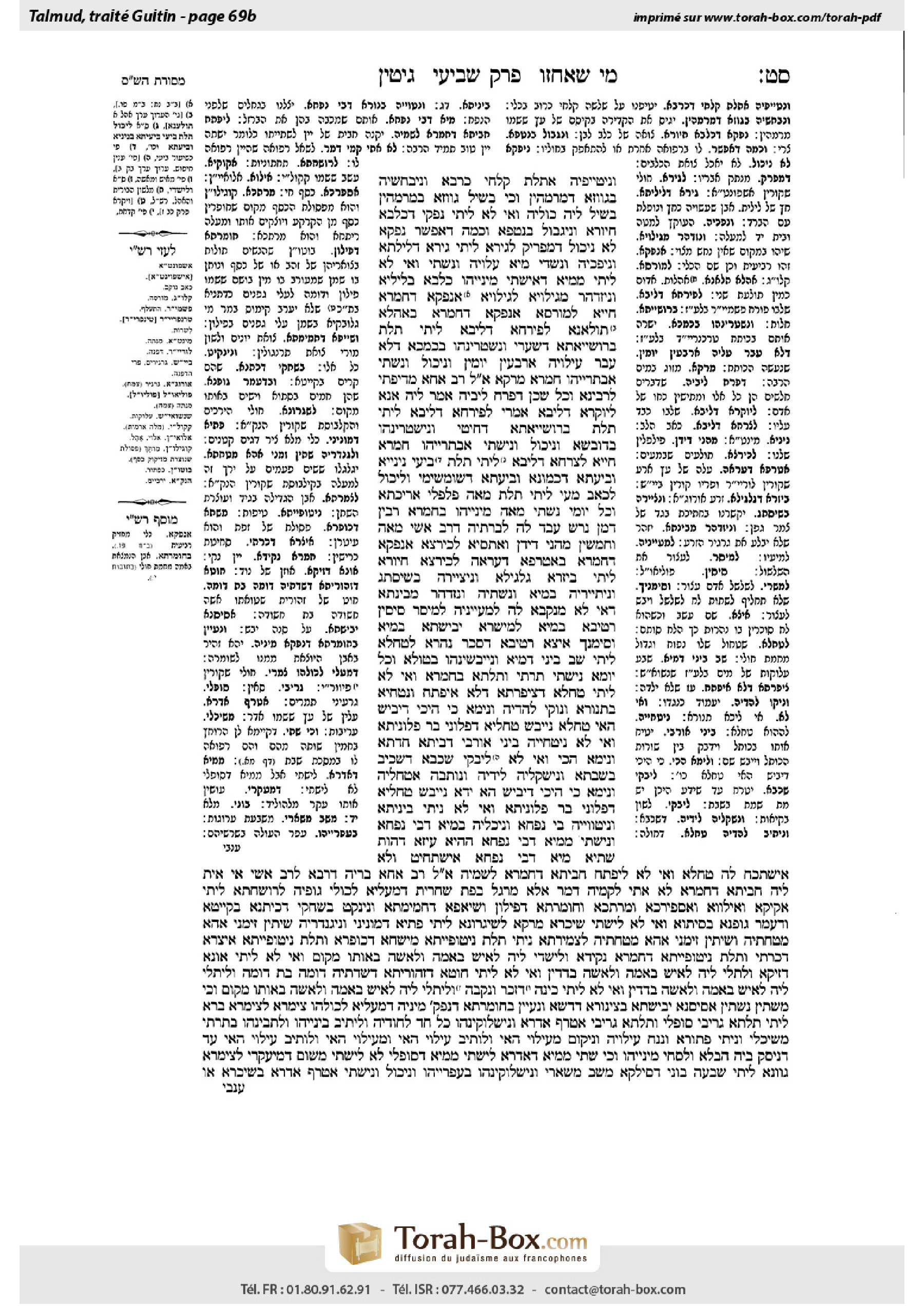
Scan : Torah-Box. Daf Study est un projet indépendant, sans affiliation ni approbation de Torah-Box ou de Sefaria.