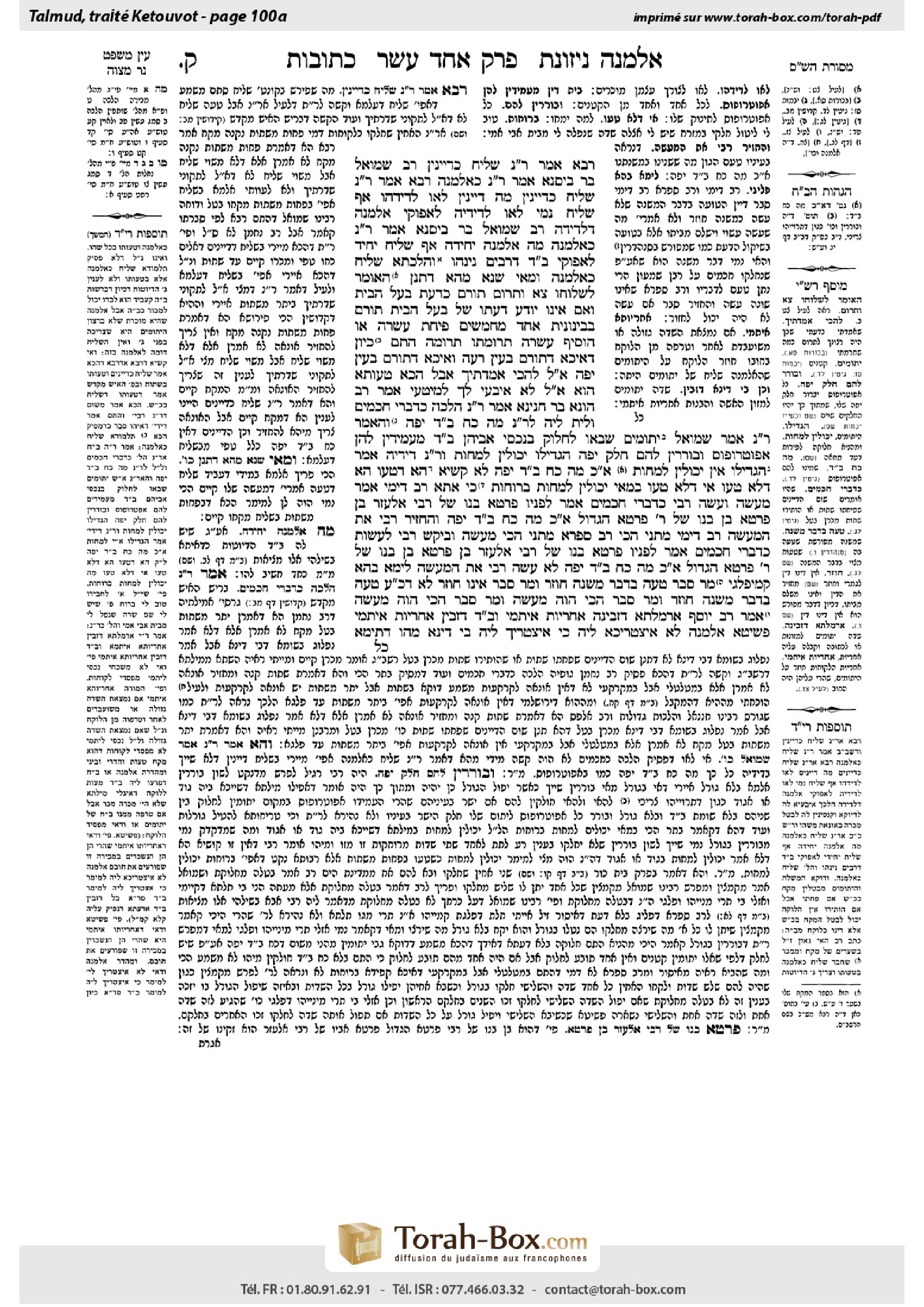
Ketubot 100a: Talmud study for Daf Yomi
Daf Yomi is the daily study of one Talmud folio. Explore 37 tractates with scans, Hebrew text, Sefaria English and AI-generated French translations where annotated.
Passage selection and English or AI-generated French translation are available where the scan has annotations. Daf Study is independent of Torah-Box and Sefaria.
Browse Ketubot · כתובות · All tractatesKetubot 100a text and translations
This page of Ketubot includes the Aramaic text, an English translation and an AI-generated French translation, alongside the scan above.
כתובות ק׳ א · Aramaic and Hebrew text
רָבָא אָמַר רַב נַחְמָן: שָׁלִיחַ כְּדַיָּינִין. רַב שְׁמוּאֵל בַּר בִּיסְנָא אָמַר רַב נַחְמָן: כְּאַלְמָנָה.
רָבָא אָמַר רַב נַחְמָן: שָׁלִיחַ כְּדַיָּינִין. מָה דַיָּינִין לָאו לְדִידְהוּ — אַף שָׁלִיחַ נָמֵי לָאו לְדִידֵיהּ, לְאַפּוֹקֵי אַלְמָנָה דִּלְדִידַהּ.
רַב שְׁמוּאֵל בַּר בִּיסְנָא אָמַר רַב נַחְמָן: כְּאַלְמָנָה, מָה אַלְמָנָה יְחִידָה — אַף שָׁלִיחַ יָחִיד, לְאַפּוֹקֵי בֵּית דִּין — דְּרַבִּים נִינְהוּ. וְהִלְכְתָא, שָׁלִיחַ כְּאַלְמָנָה.
וּמַאי שְׁנָא מֵהָא דִּתְנַן: הָאוֹמֵר לִשְׁלוּחוֹ ״צֵא וּתְרוֹם״ — תּוֹרֵם כְּדַעַת בַּעַל הַבַּיִת, וְאִם אֵינוֹ יוֹדֵעַ דַּעְתּוֹ שֶׁל בַּעַל הַבַּיִת — תּוֹרֵם בְּבֵינוֹנִית אֶחָד מֵחֲמִשִּׁים. פִּיחֵת עֲשָׂרָה אוֹ הוֹסִיף עֲשָׂרָה, תְּרוּמָתוֹ תְּרוּמָה.
הָתָם כֵּיוָן דְּאִיכָּא דְּתוֹרֵם בְּעַיִן רָעָה וְאִיכָּא דְּתוֹרֵם בְּעַיִן יָפָה, אֲמַר לֵיהּ: לְהָכִי אֲמַדְתָּיךְ. אֲבָל הָכָא טָעוּתָא הוּא, אָמַר לֵיהּ: לָא אִיבְּעִי לָךְ לְמִיטְעֵי.
אָמַר רַב הוּנָא בַּר חֲנִינָא אָמַר רַב נַחְמָן, הֲלָכָה כְּדִבְרֵי חֲכָמִים: וְלֵית לֵיהּ לְרַב נַחְמָן מָה כֹּחַ בֵּית דִּין יָפֶה? וְהָאָמַר רַב נַחְמָן אָמַר שְׁמוּאֵל: יְתוֹמִים שֶׁבָּאוּ לַחְלוֹק בְּנִכְסֵי אֲבִיהֶן — בֵּית דִּין מַעֲמִידִין לָהֶן אַפּוֹטְרוֹפּוֹס, וּבוֹרְרִין לָהֶם חֵלֶק יָפֶה. הִגְדִּילוּ — יְכוֹלִין לְמַחוֹת. וְרַב נַחְמָן דִּידֵיהּ אָמַר: הִגְדִּילוּ — אֵין יְכוֹלִין לְמַחוֹת, אִם כֵּן מָה כֹּחַ בֵּית דִּין יָפֶה.
לָא קַשְׁיָא: הָא דִּטְעוֹ, הָא דְּלָא טְעוֹ.
אִי דְּלָא טְעוֹ, בְּמַאי יְכוֹלִין לְמַחוֹת? בְּרוּחוֹת.
כִּי אֲתָא רַב דִּימִי, אָמַר: מַעֲשֶׂה וְעָשָׂה רַבִּי כְּדִבְרֵי חֲכָמִים, אָמַר לְפָנָיו פַּרְטָא בְּנוֹ שֶׁל רַבִּי אֶלְעָזָר בֶּן פַּרְטָא בֶּן בְּנוֹ שֶׁל רַבִּי פַּרְטָא הַגָּדוֹל: אִם כֵּן מָה כֹּחַ בֵּית דִּין יָפֶה, וְהֶחְזִיר רַבִּי אֶת הַמַּעֲשֶׂה.
רַב דִּימִי מַתְנֵי הָכִי, רַב סָפְרָא מַתְנֵי הָכִי: מַעֲשֶׂה וּבִיקֵּשׁ רַבִּי לַעֲשׂוֹת כְּדִבְרֵי חֲכָמִים, אָמַר לְפָנָיו פַּרְטָא בְּנוֹ שֶׁל רַבִּי אֶלְעָזָר בֶּן פַּרְטָא בֶּן בְּנוֹ שֶׁל רַבִּי פַּרְטָא הַגָּדוֹל: אִם כֵּן מָה כֹּחַ בֵּית דִּין יָפֶה? לֹא עָשָׂה רַבִּי אֶת הַמַּעֲשֶׂה.
לֵימָא בְּהָא קָמִיפַּלְגִי, מָר סָבַר: טָעָה בִּדְבַר מִשְׁנָה — חוֹזֵר, וּמָר סָבַר: אֵינוֹ חוֹזֵר.
לָא, דְּכוּלֵּי עָלְמָא טָעָה בִּדְבַר מִשְׁנָה חוֹזֵר, וּמָר סָבַר הָכִי הֲוָה מַעֲשֶׂה, וּמָר סָבַר הָכִי הֲוָה מַעֲשֶׂה.
אָמַר רַב יוֹסֵף: אַרְמַלְתָּא דְּזַבִּינָה — אַחְרָיוּת אַיַּתְמֵי. וּבֵית דִּין דְּזַבֵּין — אַחְרָיוּת אַיַּתְמֵי.
פְּשִׁיטָא!
אַלְמָנָה לָא אִיצְטְרִיכָא לֵיהּ. כִּי אִיצְטְרִיךְ לֵיהּ, בֵּי דִינָא — מַהוּ דְּתֵימָא:
Ketubot 100a · English translation
Rava said that Rav Naḥman said: The halakha with regard to the agent is like the halakha pertaining to the judges. Rav Shmuel bar Bisna said that Rav Naḥman said: The halakha with regard to the agent is like the halakha with regard to a widow.
Rava said that Rav Naḥman said: The halakha with regard to the agent is like the halakha with regard to the judges. Just as the judges have an advantage because they do not assess the value of property for their own benefit, so too, the agent also does not act for his own benefit; this is to the exclusion of a widow who sells for her own benefit.
Rav Shmuel, son of Bisna, said that Rav Naḥman said: The halakha with regard to the agent is like the halakha with regard to a widow. Just as a widow is an individual, so too the agent is an individual. This is to the exclusion of the court, which is composed of many people. The Gemara concludes: And the halakha is that with regard to this matter, an agent is like a widow.
The Gemara asks: And in what way is that case different from this case? As we learned in a mishna (Terumot 4:4): In the case of one who says to his agent: Go out and separate teruma, the agent separates teruma in accordance with the mind-set of the homeowner. And if he does not know the mind-set of homeowner, he separates an intermediate measure, i.e., one-fiftieth of the produce. If he subtracted ten from the denominator and separated one-fortieth or added ten to the denominator and separated one-sixtieth of the produce, his teruma is considered teruma. If the agent is comparable to a widow, then why isn’t the halakha that the teruma that he has separated is nullified, since he did not act in accordance with the wishes of the homeowner?
The Gemara answers: There, since there are those who separate in a miserly fashion one-sixtieth, and there are those who separate generously one-fortieth, the agent can say to his employer: I estimated you to be generous or miserly. However, here there is no logical reason for the mistake made by the agent. It is simply an error on the part of the agent, and so the owner can say to him: You ought not to have erred.
§ Rav Huna bar Ḥanina said that Rav Naḥman said: The halakha is in accordance with the statement of the Rabbis in the mishna. The Gemara asks: Does Rav Naḥman not agree with the argument: What advantage is there to the power of the court? Didn’t Rav Naḥman say that Shmuel said: In a case of orphans who came to divide their father’s property, the court appoints a steward [apotropos] for them and selects for the orphans appropriate portions and divides the property accordingly. Afterward, once the orphans have matured, they are able to protest this division of the property. And Rav Naḥman said his own statement: Once the orphans have matured, they are not able to protest, as if they were able to do so, what advantage would there be to the power of the court? This proves that Rav Naḥman agrees with Rabban Shimon ben Gamliel.
The Gemara answers: This is not difficult. The case of the mishna was one where the judges erred in their assessment, and therefore Rav Naḥman said that the sale is void in accordance with the Rabbis. However, the case of the division of property among the orphans is one where they did not err, and so he ruled in accordance with the principle of Rabban Shimon ben Gamliel, that the court is given an advantage and the orphans are not able to protest the division.
The Gemara asks: If the case is one where the judges did not err, with regard to what could the orphans protest? After all, the judges acted correctly. The Gemara answers: They can protest with regard to the locations; one of the orphans can contend that he prefers property in a different location than he was given.
When Rav Dimi came from Eretz Yisrael, he said: A similar incident occurred and Rabbi Yehuda HaNasi acted in accordance with the statement of the Rabbis of the mishna. Perata, son of Rabbi Elazar ben Perata, grandson of Rabbi Perata the Great, said before him: If that is the case, what advantage is there to the power of the court over an ordinary person? And Rabbi Yehuda HaNasi reversed his ruling about the incident.
Rav Dimi would teach the incident in this way, as described above. Rav Safra would teach it in this slightly altered way: There was an incident, and Rabbi Yehuda HaNasi wished to act in accordance with the statement of the Rabbis of the mishna. Perata, son of Rabbi Elazar ben Perata, grandson of Rabbi Perata the Great, said before him: If that is the case, what advantage is there to the power of the court over an ordinary person? Consequently, Rabbi Yehuda HaNasi did not take action according to the statement of the Rabbis.
The Gemara suggests: Let us say that they disagree about this: One Sage, Rav Dimi, holds that if one erred in a matter that appears in the Mishna, the decision is revoked. And one Sage, Rav Safra, holds that if one erred in this manner the decision is not revoked. This is why, in Rav Safra’s version, Rabbi Yehuda HaNasi changed his mind before issuing his ruling.
The Gemara rejects this: No, everyone agrees that if one erred in a matter that appears in the Mishna, the decision is revoked. There is no fundamental dispute between them, only a disagreement as to the details of the case. One Sage holds that the incident occurred in this way, and one Sage holds that the incident occurred in this way.
§ Rav Yosef said: In the case of a widow who sold property to support herself or as payment of her marriage contract, the property guarantee rests upon the orphans. Therefore, if she sold liened property that was then seized from the purchasers in payment of a previous debt, the buyers are entitled to be reimbursed from the property of the orphans. And so too, if the court sold property for the same purpose, the property guarantee rests upon the orphans.
The Gemara asks: Isn’t this obvious? The widow does not sell her own property, but rather she sells property from her husband’s estate to pay off his debts to her, and so clearly the guarantee rests on his properties that now belong to the orphans.
The Gemara answers: In truth, it was not necessary for Rav Yosef to mention this with regard to the widow, as it is clear that the property guarantee rests upon the orphans. Where it was necessary for him to mention this halakha was with regard to the court. Lest you say:
Ketubot 100a · Traduction française (IA)
Rava a dit au nom de Rav Naḥman : La halakha concernant le mandataire est la même que celle qui s’applique aux juges. Rav Shmuel bar Bisna a dit au nom de Rav Naḥman : La halakha concernant le mandataire est la même que celle qui s’applique à une veuve.
Rava a dit au nom de Rav Naḥman : La halakha concernant le mandataire est la même que celle qui s’applique aux juges. De même que les juges ont cet avantage qu’ils n’évaluent pas les biens dans leur propre intérêt, le mandataire, lui aussi, n’agit pas dans son propre intérêt ; cela le distingue d’une veuve, qui vend dans son propre intérêt.
Rav Shmuel, fils de Bisna, a dit au nom de Rav Naḥman : La halakha concernant le mandataire est la même que celle qui s’applique à une veuve. De même qu’une veuve est une personne seule, le mandataire est lui aussi une personne seule. Cela le distingue du tribunal, qui est composé de plusieurs personnes. La Guemara conclut : La halakha est donc que, sur ce point, le mandataire est comme une veuve.
La Guemara demande : En quoi ce cas diffère-t-il de l’autre ? En effet, nous avons appris dans une Michna (Teroumot 4:4) : Celui qui dit à son mandataire : « Va prélever la terouma », voit son mandataire prélever la terouma selon les intentions du propriétaire. S’il ignore les intentions du propriétaire, il prélève une quantité moyenne, c’est-à-dire un cinquantième de la récolte. S’il a réduit le dénominateur de dix et prélevé un quarantième, ou l’a augmenté de dix et prélevé un soixantième de la récolte, son prélèvement est considéré comme de la terouma. Si le mandataire est comparable à une veuve, pourquoi la terouma qu’il a prélevée n’est-elle pas annulée, puisqu’il n’a pas agi selon les souhaits du propriétaire ?
La Guemara répond : Dans ce cas, puisqu’il y en a qui prélèvent avec parcimonie un soixantième et d’autres qui prélèvent généreusement un quarantième, le mandataire peut dire à son employeur : « J’ai estimé que vous étiez généreux ou parcimonieux. » Ici, en revanche, l’erreur du mandataire n’a aucune raison logique. Il s’agit simplement d’une erreur de sa part, et le propriétaire peut donc lui dire : « Tu n’aurais pas dû te tromper. »
§ Rav Huna bar Ḥanina a dit au nom de Rav Naḥman : La halakha est conforme à l’avis des rabbins dans la Michna. La Guemara demande : Rav Naḥman ne reconnaît-il pas la pertinence de l’argument : « Quel avantage le pouvoir du tribunal confère-t-il ? » Rav Naḥman n’a-t-il pas dit au nom de Shmuel : Lorsque des orphelins viennent se partager les biens de leur père, le tribunal leur nomme un administrateur [apotropos], choisit pour eux des parts appropriées et répartit les biens en conséquence. Ensuite, une fois devenus majeurs, les orphelins peuvent contester cette répartition des biens. Or Rav Naḥman a lui-même déclaré : Une fois devenus majeurs, les orphelins ne peuvent pas la contester, car s’ils le pouvaient, quel avantage le pouvoir du tribunal conférerait-il ? Cela prouve que Rav Naḥman adhère à l’avis de Rabban Shimon ben Gamliel.
La Guemara répond : Il n’y a pas de difficulté. Dans le cas de la Michna, les juges se sont trompés dans leur évaluation ; Rav Naḥman a donc déclaré, conformément à l’avis des rabbins, que la vente est nulle. En revanche, dans le cas du partage des biens entre les orphelins, les juges ne se sont pas trompés ; Rav Naḥman a donc statué selon le principe de Rabban Shimon ben Gamliel, selon lequel le tribunal bénéficie d’un avantage et les orphelins ne peuvent pas contester le partage.
La Guemara demande : Si les juges ne se sont pas trompés, sur quoi les orphelins pourraient-ils contester le partage ? Après tout, les juges ont agi correctement. La Guemara répond : Ils peuvent contester le choix des emplacements ; l’un des orphelins peut soutenir qu’il préfère des biens situés ailleurs que ceux qui lui ont été attribués.
Lorsque Rav Dimi vint de la terre d’Israël, il dit : Un cas similaire s’est produit, et Rabbi Yehuda HaNasi a statué conformément à l’avis des rabbins de la Michna. Perata, fils de Rabbi Elazar ben Perata et petit-fils de Rabbi Perata le Grand, lui dit : « Si c’est le cas, quel avantage le pouvoir du tribunal confère-t-il par rapport à celui d’une personne ordinaire ? » Rabbi Yehuda HaNasi revint alors sur sa décision concernant cette affaire.
Rav Dimi rapportait l’affaire de la manière décrite ci-dessus. Rav Safra la rapportait avec une légère variante : Un cas s’est produit, et Rabbi Yehuda HaNasi souhaitait statuer conformément à l’avis des rabbins de la Michna. Perata, fils de Rabbi Elazar ben Perata et petit-fils de Rabbi Perata le Grand, lui dit : « Si c’est le cas, quel avantage le pouvoir du tribunal confère-t-il par rapport à celui d’une personne ordinaire ? » Par conséquent, Rabbi Yehuda HaNasi ne statua pas conformément à l’avis des rabbins.
La Guemara suggère : Peut-être sont-ils en désaccord sur le point suivant : selon un Sage, Rav Dimi, si quelqu’un se trompe sur une question qui figure dans la Michna, la décision est annulée ; selon l’autre Sage, Rav Safra, si quelqu’un se trompe de cette manière, la décision n’est pas annulée. C’est pourquoi, dans la version de Rav Safra, Rabbi Yehuda HaNasi a changé d’avis avant de rendre sa décision.
La Guemara rejette cette hypothèse : Non, tous conviennent que si quelqu’un se trompe sur une question qui figure dans la Michna, la décision est annulée. Il n’y a entre eux aucun désaccord de fond, seulement un désaccord sur les détails de l’affaire : selon un Sage, elle s’est déroulée de cette manière, et selon l’autre Sage, elle s’est déroulée de cette manière.
§ Rav Yosef a dit : Lorsqu’une veuve vend des biens pour subvenir à ses besoins ou pour obtenir le paiement de sa ketouba, la garantie des biens incombe aux orphelins. Par conséquent, si elle a vendu des biens grevés d’un privilège qui sont ensuite saisis auprès des acheteurs pour régler une dette antérieure, les acheteurs ont droit à être remboursés sur les biens des orphelins. De même, si le tribunal a vendu des biens dans le même but, la garantie des biens incombe aux orphelins.
La Guemara demande : Cela n’est-il pas évident ? La veuve ne vend pas ses propres biens, mais des biens de la succession de son mari afin de recouvrer les dettes qu’il a envers elle. Il est donc clair que la garantie incombe aux biens de son mari, qui appartiennent désormais aux orphelins.
La Guemara répond : En vérité, Rav Yosef n’avait pas besoin de mentionner ce principe à propos de la veuve, car il est évident que la garantie des biens incombe aux orphelins. Il était nécessaire de mentionner cette halakha à propos du tribunal. De crainte que tu ne dises :
Traduction française générée par IA à partir de l’édition anglaise de Sefaria. Vérifie toujours un passage avec le texte source.
Text from Sefaria: William Davidson Edition - Vocalized Aramaic (CC BY NC); William Davidson Edition - English (CC BY NC).