Ketubot 100b: Talmud study for Daf Yomi
Daf Yomi is the daily study of one Talmud folio. Explore 37 tractates with scans, Hebrew text, Sefaria English and AI-generated French translations where annotated.
Passage selection and English or AI-generated French translation are available where the scan has annotations. Daf Study is independent of Torah-Box and Sefaria.
Browse Ketubot · כתובות · All tractatesKetubot 100b text and translations
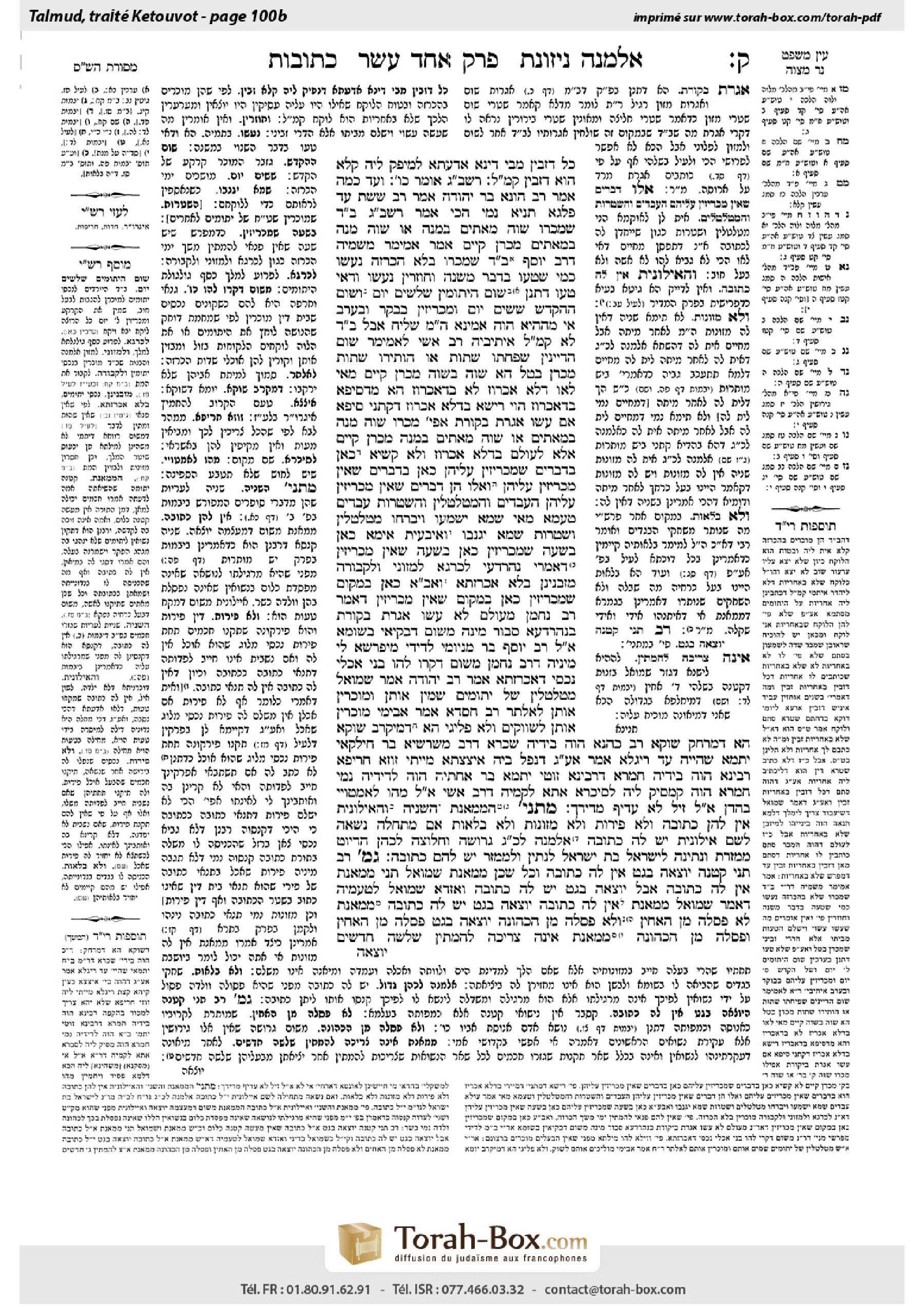
This page of Ketubot includes the Aramaic text, an English translation and an AI-generated French translation, alongside the scan above.
כתובות ק׳ ב · Aramaic and Hebrew text
כֹּל דְּזָבֵין מִבֵּי דִינָא — אַדַּעְתָּא לְמִיפַּק לֵיהּ קָלָא הוּא דְּזָבֵין, קָא מַשְׁמַע לַן.
רַבָּן שִׁמְעוֹן בֶּן גַּמְלִיאֵל אוֹמֵר כּוּ׳. וְעַד כַּמָּה? אָמַר רַב הוּנָא בַּר יְהוּדָה אָמַר רַב שֵׁשֶׁת: עַד פַּלְגָא.
תַּנְיָא נָמֵי הָכִי, אָמַר רַבָּן שִׁמְעוֹן בֶּן גַּמְלִיאֵל: בֵּית דִּין שֶׁמָּכְרוּ שָׁוֶה מָאתַיִם בְּמָנֶה אוֹ שָׁוֶה מָנֶה בְּמָאתַיִם — מִכְרָן קַיָּים.
אָמַר אַמֵּימָר מִשְּׁמֵיהּ דְּרַב יוֹסֵף: בֵּית דִּין שֶׁמָּכְרוּ בְּלֹא הַכְרָזָה — נַעֲשׂוּ כְּמִי שֶׁטָּעוּ בִּדְבַר מִשְׁנָה וְחוֹזְרִין.
נַעֲשׂוּ? וַדַּאי טָעוּ! דִּתְנַן: שׁוּם הַיְּתוֹמִין שְׁלֹשִׁים יוֹם, וְשׁוּם הַהֶקְדֵּשׁ שִׁשִּׁים יוֹם, וּמַכְרִיזִין בַּבֹּקֶר וּבָעֶרֶב.
אִי מֵהַהִיא הֲוָה אָמֵינָא הָנֵי מִילֵּי שָׁלִיחַ, אֲבָל בֵּית דִּין — לָא, קָא מַשְׁמַע לַן.
אֵיתִיבֵיהּ רַב אָשֵׁי לְאַמֵּימָר: שׁוּם הַדַּיָּינִין שֶׁפִּחֲתוּ שְׁתוּת אוֹ הוֹתִירוּ שְׁתוּת — מִכְרָן בָּטֵל. הָא שָׁוֶה בְּשָׁוֶה — מִכְרָן קַיָּים. מַאי לָאו דְּלָא אַכְרוּז? לָא, בִּדְאַכְרוּז.
הָא מִדְּסֵיפָא בִּדְאַכְרוּז הָוֵי, רֵישָׁא בִּדְלָא אַכְרוּז, דְּקָתָנֵי סֵיפָא: אִם עָשׂוּ אִגֶּרֶת בִּקּוֹרֶת, אֲפִילּוּ מָכְרוּ שָׁוֶה מָנֶה בְּמָאתַיִם אוֹ שָׁוֶה מָאתַיִם בְּמָנֶה — מִכְרָן קַיָּים.
אֶלָּא, לְעוֹלָם בִּדְלָא אַכְרוּז, וְלָא קַשְׁיָא: כָּאן בִּדְבָרִים שֶׁמַּכְרִיזִין עֲלֵיהֶן, כָּאן בִּדְבָרִים שֶׁאֵין מַכְרִיזִין עֲלֵיהֶן.
וְאֵלּוּ הֵן דְּבָרִים שֶׁאֵין מַכְרִיזִין עֲלֵיהֶן: הָעֲבָדִים וְהַמִּטַּלְטְלִין וְהַשְּׁטָרוֹת. עֲבָדִים טַעְמָא מַאי? שֶׁמָּא יִשְׁמְעוּ וְיִבְרְחוּ. מִטַּלְטְלִין וּשְׁטָרוֹת — שֶׁמָּא יִגָּנְבוּ.
וְאִיבָּעֵית אֵימָא: כָּאן בְּשָׁעָה שֶׁמַּכְרִיזִין, כָּאן בְּשָׁעָה שֶׁאֵין מַכְרִיזִין.
דְּאָמְרִי נְהַרְדָּעֵי: לִכְרָגָא לִמְזוֹנֵי וְלִקְבוּרָה — מְזַבְּנִינַן בְּלָא אַכְרָזְתָּא.
וְאִיבָּעֵית אֵימָא: כָּאן בִּמְקוֹם שֶׁמַּכְרִיזִין, כָּאן בִּמְקוֹם שֶׁאֵין מַכְרִיזִין. דְּאָמַר רַב נַחְמָן: מֵעוֹלָם לֹא עָשׂוּ אִגֶּרֶת בִּקּוֹרֶת בִּנְהַרְדְּעָא.
סְבוּר מִינַּהּ מִשּׁוּם דִּבְקִיאֵי בְּשׁוּמָא. אֲמַר לֵיהּ רַב יוֹסֵף בַּר מִנְיוֹמֵי: לְדִידִי מִיפָּרְשָׁא לִי מִינֵּיהּ דְּרַב נַחְמָן, מִשּׁוּם דְּקָרוּ לְהוּ ״בְּנֵי אָכְלִי נִכְסֵי דְאַכְרָזְתָּא״.
אָמַר רַב יְהוּדָה אָמַר שְׁמוּאֵל: מִטַּלְטְלִין שֶׁל יְתוֹמִים — שָׁמִין אוֹתָן וּמוֹכְרִין אוֹתָן לְאַלְתַּר. רַב חִסְדָּא אָמַר אֲבִימִי: מוֹכְרִין אוֹתָן לִשְׁוָוקִים.
וְלָא פְּלִיגִי: הָא — דִּמְיקָרַב שׁוּקָא, הָא — דִּמְרַחַק שׁוּקָא.
רַב כָּהֲנָא הֲוָה בִּידֵיהּ שִׁכְרָא דְּרַב מְשַׁרְשְׁיָא בַּר חִילְקַאי יַתְמָא. שַׁהֲיֵיהּ עַד רִיגְלָא, אָמַר: אַף עַל גַּב דְּנָפֵל בֵּיהּ אִיצְצָתָא, מַיְיתֵי זוּזָא חֲרִיפָא.
רָבִינָא הֲוָה בִּידֵיהּ חַמְרָא דְּרָבִינָא זוּטֵי יַתְמָא בַּר אֲחָתֵיהּ. הֲוָה לְדִידֵיהּ נָמֵי חַמְרָא, הֲוָה קָמַסֵּיק לֵיהּ לְסִיכְרָא.
אֲתָא לְקַמֵּיהּ דְּרַב אָשֵׁי, אֲמַר לֵיהּ: מַהוּ לְאַמְטוֹיֵי בַּהֲדַן? אֲמַר לֵיהּ: זִיל, לָא עֲדִיף מִדִּידָךְ.
מַתְנִי׳ הַמְמָאֶנֶת, הַשְּׁנִיָּה, וְהָאַיְלוֹנִית — אֵין לָהֶן כְּתוּבָּה, וְלֹא פֵּירוֹת וְלֹא מְזוֹנוֹת וְלֹא בְּלָאוֹת.
אִם מִתְּחִלָּה נְשָׂאָהּ לְשֵׁם אַיְלוֹנִית — יֵשׁ לָהּ כְּתוּבָּה.
אַלְמָנָה לְכֹהֵן גָּדוֹל, גְּרוּשָׁה וַחֲלוּצָה לְכֹהֵן הֶדְיוֹט, מַמְזֶרֶת וּנְתִינָה לְיִשְׂרָאֵל, בַּת יִשְׂרָאֵל לְנָתִין וּלְמַמְזֵר — יֵשׁ לָהֶם כְּתוּבָּה.
גְּמָ׳ רַב תָּנֵי: קְטַנָּה — יוֹצְאָה בְּגֵט אֵין לָהּ כְּתוּבָּה. וְכׇל שֶׁכֵּן מְמָאֶנֶת.
שְׁמוּאֵל תָּנֵי: מְמָאֶנֶת — אֵין לָהּ כְּתוּבָּה, אֲבָל יוֹצְאָה בְּגֵט — יֵשׁ לָהּ כְּתוּבָּה.
וְאַזְדָּא שְׁמוּאֵל לְטַעְמֵיהּ, דְּאָמַר שְׁמוּאֵל: מְמָאֶנֶת — אֵין לָהּ כְּתוּבָּה, יוֹצְאָה בְּגֵט — יֵשׁ לָהּ כְּתוּבָּה.
מְמָאֶנֶת — לֹא פְּסָלָהּ מִן הָאַחִין, וְלֹא פְּסָלָהּ מִן הַכְּהוּנָּה. יוֹצְאָה בְּגֵט — פְּסָלָהּ מִן הָאַחִין, וּפְסָלָהּ מִן הַכְּהוּנָּה.
מְמָאֶנֶת אֵינָהּ צְרִיכָה לְהַמְתִּין שְׁלֹשָׁה חֳדָשִׁים,
Ketubot 100b · English translation
Everyone who buys from the court buys with the implicit understanding that the sale generates publicity, as a court sale is conducted in public with notices. The buyer could therefore think to himself that if no claimants came forward until the time of the actual purchase, then it is certain that there can be no problem with his purchase and he forgoes his property guarantee. Lest you say this, Rav Yosef teaches us that there is nevertheless a guarantee on the property, and it rests upon the orphans and not on the court.
§ The mishna teaches: Rabban Shimon ben Gamliel says that even if the judges err, the transaction is not void because of the prerogative of the court. The Gemara asks: And to what extent can they err without causing the deal to be reversed? Rav Huna bar Yehuda said that Rav Sheshet said: Until half of the value.
That is also taught in a baraita: Rabban Shimon ben Gamliel said: A court that sold property worth one hundred dinars for two hundred dinars, or property worth two hundred dinars for one hundred dinars, their sale is valid. Since he doesn’t give as an example a larger gap between the market value and the sale price, this must be the most extreme case in which the transaction is not reversed.
Ameimar said in the name of Rav Yosef: With regard to a court that sold without an announcement, it is considered as if they erred in a matter that appears in the Mishna and their decision is reversed.
The Gemara asks: Why does Rav Yosef say that it is considered as if the court erred in a matter that appears in the Mishna, when it certainly erred in this manner? As we learned in a mishna (Arakhin 21b): The assessment of the orphans is for thirty days, and the assessment for consecrated property is for sixty days, and they make announcements during the thirty and the sixty days respectively both in the morning and in the evening. The mishna states explicitly that announcements must be made. If the court did not make the announcements, it clearly erred in a matter that appears in the Mishna.
The Gemara answers: If all the information that I had were from that mishna, I would say that this applies to an agent but not to a court. Therefore, Rav Yosef teaches us that even a court that sold property without making announcements has erred.
Rav Ashi raised an objection to the statement of Ameimar: The mishna teaches that the halakha with regard to the assessment of the value of a piece of property in order to sell it through the judges is as follows: In a case where they decreased the price by one-sixth of its market value or added one-sixth to its market value, their sale is void. One can see from here that if the judges sold the property for its value, their sale is valid. What, is the mishna not discussing a case where no announcement was made? Ameimar replied: No, the case under discussion is one where they did make an announcement.
The Gemara asks: Since the last clause is referring to a case where the court made an announcement, the first clause must be referring to a case where they did not make announcements, as it teaches in the final clause: If they made a document of inspection and announced the sale publicly, then even if they sold property worth one hundred dinars for two hundred dinars or property worth two hundred dinars for one hundred dinars, their sale is valid.
Rather, this should be understood differently. Actually, the first clause of the mishna is referring to a case where they did not make an announcement, and this is not difficult. Here, Ameimar is referring to items for which one makes an announcement, and if this was not done then the sale is void. There, the mishna is speaking of items for which one does not make announcements.
And these are the items for which one does not make an announcement: Slaves, movable property, and contracts. The Gemara explains: What is the reason that slaves are sold without an announcement? Slaves are sold without an announcement lest they hear that they are about to be sold and escape. Why is the sale of movable property and contracts also not announced? Lest they be stolen.
And if you wish, say instead that here Ameimar is referring to a time when one makes an announcement, while there the mishna is referring to a time when one does not make an announcement.
When does one not make an announcement? As the Sages of Neharde’a say: For the purpose of paying head tax, and for payment to provide for children’s sustenance, and for burial, the court sells property inherited by orphans without an announcement because these are pressing needs. There is no time to wait for an announcement.
And if you wish, say instead that here, Ameimar is referring to a locale where one makes an announcement, while there, the mishna is referring to a locale where one does not make an announcement, as Rav Naḥman said: They never made a document of inspection in Neharde’a.
Some of the students understood from Rav Naḥman’s statement that no announcements were made in Neharde’a because the Sages there were all expert in the appraisal of an article’s value. Rav Yosef bar Minyumi said to them: This was explained to me personally by Rav Naḥman himself: It was because those who purchase the property are called: People who consume property that was publicly announced. This disparaging nickname was given because the purchasers were perceived as taking advantage of the distress of others by running to buy the property of someone in trouble. Since decent, honest people did not wish to buy property whose sale had been announced, they stopped making announcements.
Rav Yehuda said that Shmuel said: Movable property that belongs to orphans is appraised and sold immediately so that it not deteriorate over time. Rav Ḥisda said that Avimi said: The movable property is sold on a market day, when there are many potential buyers and the items will sell for a proper price.
The Gemara notes: And they do not disagree with each other. Rather, this opinion, that the items are sold on a market day, applies when the market day is approaching, so the property is not sold immediately. That opinion, that the items are sold immediately, applies when the market day is far off.
Rav Kahana was in possession of beer that belonged to Rav Mesharshiyya bar Ḥilkai, who was an orphan. He delayed selling it until the Festival. He explained the rationale for his actions and said: Although it is possible that it may deteriorate [itzatzta] and sour a little, it nevertheless brings in money at the time of the Festival, as it will sell for a higher price and for money, not credit. Consequently, it is in the best interests of Rav Mesharshiyya bar Ḥilkai to hold off and sell the beer at the next Festival.
It is also related that Ravina was in possession of wine belonging to the orphan Ravina the younger, who was his sister’s son. He also had wine of his own, which he was taking to Sikhra to sell.
He came before Rav Ashi and said to him: What is the halakha here, am I able to bring his wine along with my wine, or must I wait for a more opportune time to sell it? He said to him: Go to Sikhra and take his wine along as well, as his is no better than yours, and if you sell your own wine in this manner, it is clear that you think this is the best way to sell, and it is permitted for you to sell his wine in this manner.
MISHNA: An orphan girl who was married off by her mother or brother before reaching the age of majority may refuse to continue living with her husband upon reaching the age of majority, thereby retroactively annulling their marriage. In the case of one who refuses to continue living with her husband in this manner; and in the case of a woman who is a secondary forbidden relative by rabbinic law; and in the case of a sexually underdeveloped woman [ailonit], who is incapable of bearing children, each of these women is not entitled to payment of a marriage contract; and they are not entitled to remuneration for the produce that the husband consumed; and they are not entitled to sustenance; and they are not entitled to their worn clothes that were brought in to the marriage as part of their dowry and became worn out during the marriage.
If, from the start, he married her with the understanding that she is an ailonit, then she is entitled to payment of a marriage contract.
In the case of a widow who married a High Priest; or a divorcée or a yevama who performed ḥalitza and later married a common priest; or a daughter born from an incestuous or adulterous relationship [mamzeret] who married an Israelite; or a Gibeonite woman who married an Israelite; or a Jewish woman who married a Gibeonite or a mamzer, although each of these unions is prohibited by Torah law, the woman is still entitled to payment of a marriage contract.
GEMARA: Rav taught that a minor girl who was married off by her mother or by her brother and who is divorced with a bill of divorce is not entitled to her marriage contract. According to Torah law, this marriage never took effect, and it was never established that in this situation she would receive a marriage contract. And all the more so, one who refuses to continue living with her husband and annuls the marriage herself is not entitled to payment of a marriage contract.
Shmuel taught that one who refuses to continue living with her husband is not entitled to her marriage contract, but one who is divorced with a bill of divorce is entitled to her marriage contract.
The Gemara notes: And Shmuel follows his line of reasoning, as Shmuel said: One who refuses to continue living with her husband is not entitled to her marriage contract, but one who is divorced with a bill of divorce is entitled to her marriage contract.
Shmuel also said: One who refuses to continue living with her husband is not disqualified from marrying one of the brothers of her husband. Her refusal annuls the marriage, and it is as if it never happened. And for the same reason, unlike a divorcée, this girl is not disqualified from marrying a member of the priesthood. However, one who is divorced with a bill of divorce is disqualified from marrying one of the brothers and is also disqualified from marrying a member of the priesthood.
Another difference between a woman who refuses to continue living with her husband and a woman who was divorced normally is the following: One who refuses to continue living with her husband does not need to wait three months before remarrying, as other women who separate from their husbands must.
Ketubot 100b · Traduction française (IA)
Quiconque achète auprès du tribunal le fait en sachant implicitement que la vente sera rendue publique, puisqu’une vente judiciaire se déroule publiquement et fait l’objet d’annonces. L’acheteur peut donc se dire que, si aucun réclamant ne s’est manifesté jusqu’au moment de l’achat proprement dit, il est certain que son achat ne pose aucun problème, et renoncer à la garantie du bien. Pour écarter cette possibilité, Rav Yosef nous enseigne qu’il existe néanmoins une garantie du bien, qui incombe aux orphelins et non au tribunal.
§ La Michna enseigne que Rabban Shimon ben Gamliel dit que, même si les juges se trompent, la transaction n’est pas annulée, en vertu de la prérogative du tribunal. La Guemara demande : Jusqu’à quel point peuvent-ils se tromper sans que la vente soit annulée ? Rav Huna bar Yehuda a dit au nom de Rav Sheshet : jusqu’à la moitié de la valeur.
Cela est également enseigné dans une baraïta : Rabban Shimon ben Gamliel a dit : Si un tribunal a vendu pour deux cents dinars un bien qui en vaut cent, ou pour cent dinars un bien qui en vaut deux cents, sa vente est valide. Puisqu’il ne donne pas comme exemple un écart plus important entre la valeur marchande et le prix de vente, il faut en conclure que c’est le cas extrême où la transaction n’est pas annulée.
Ameimar a dit au nom de Rav Yosef : Lorsqu’un tribunal a vendu sans faire d’annonce, c’est comme s’il avait commis une erreur sur un point explicite dans la Michna, et sa décision est annulée.
La Guemara demande : Pourquoi Rav Yosef dit-il que c’est comme si le tribunal avait commis une erreur sur un point explicite dans la Michna, alors qu’il a bel et bien commis une telle erreur ? En effet, nous avons appris dans une Michna (Arakhin 21b) : L’estimation des biens des orphelins dure trente jours, et celle des biens consacrés, soixante jours ; pendant ces trente et ces soixante jours, respectivement, on fait des annonces matin et soir. La Michna stipule explicitement que des annonces doivent être faites. Si le tribunal ne les a pas faites, il a manifestement commis une erreur sur un point explicite dans la Michna.
La Guemara répond : Si je ne connaissais que cette Michna, j’aurais dit que cela s’applique à un mandataire, mais pas à un tribunal. Rav Yosef nous enseigne donc que même un tribunal qui a vendu un bien sans faire d’annonces a commis une erreur.
Rav Ashi objecte à l’enseignement d’Ameimar : La Michna enseigne que, pour l’estimation de la valeur d’un bien en vue de sa vente par les juges, la halakha est la suivante : s’ils ont diminué le prix d’un sixième de sa valeur marchande ou l’ont augmenté d’un sixième, leur vente est annulée. On peut en déduire que si les juges ont vendu le bien à sa valeur, leur vente est valide. La Michna ne parle-t-elle pas d’un cas où aucune annonce n’a été faite ? Ameimar répondit : Non, le cas dont il est question est celui où ils ont effectivement fait une annonce.
La Guemara demande : Puisque la dernière partie se rapporte à un cas où le tribunal a fait une annonce, la première partie doit se rapporter à un cas où il n’en a pas fait, puisque la dernière partie enseigne : S’ils ont établi un procès-verbal d’estimation et annoncé publiquement la vente, alors, même s’ils ont vendu pour deux cents dinars un bien qui en vaut cent, ou pour cent dinars un bien qui en vaut deux cents, leur vente est valide.
Il faut plutôt comprendre les choses autrement. En réalité, la première partie de la Michna se rapporte à un cas où aucune annonce n’a été faite, et il n’y a pas de difficulté : ici, Ameimar parle de biens pour lesquels il faut faire une annonce, et si cela n’a pas été fait, la vente est annulée. Là, la Michna parle de biens pour lesquels on ne fait pas d’annonces.
Voici les biens pour lesquels on ne fait pas d’annonce : les esclaves, les biens mobiliers et les contrats. La Guemara explique : Pourquoi vend-on les esclaves sans annonce ? Pour éviter qu’ils n’apprennent qu’ils sont sur le point d’être vendus et ne s’enfuient. Pourquoi ne fait-on pas non plus d’annonce pour la vente des biens mobiliers et des contrats ? Pour éviter qu’ils ne soient volés.
Et si tu préfères, dis plutôt qu’ici, Ameimar parle d’une époque où l’on fait des annonces, tandis que là, la Michna parle d’une époque où l’on n’en fait pas.
Quand ne fait-on pas d’annonce ? Comme l’ont dit les Sages de Neharde’a : pour payer l’impôt par tête, assurer la subsistance des enfants et payer les funérailles, le tribunal vend les biens hérités par des orphelins sans annonce, car il s’agit de besoins urgents. Il n’y a pas le temps d’attendre qu’une annonce soit faite.
Et si tu préfères, dis plutôt qu’ici, Ameimar parle d’un lieu où l’on fait des annonces, tandis que là, la Michna parle d’un lieu où l’on n’en fait pas, comme l’a dit Rav Naḥman : à Neharde’a, on n’établissait jamais de procès-verbal d’estimation.
Certains étudiants ont compris de la déclaration de Rav Naḥman qu’on ne faisait pas d’annonces à Neharde’a parce que les Sages de cette ville étaient tous experts dans l’estimation de la valeur des biens. Rav Yosef bar Minyumi leur dit : Rav Naḥman lui-même m’a expliqué la raison : les acquéreurs de ces biens étaient appelés « ceux qui dévorent les biens annoncés publiquement ». Ce sobriquet péjoratif leur était donné parce qu’on considérait qu’ils profitaient de la détresse d’autrui en se précipitant pour acheter les biens de quelqu’un en difficulté. Comme les gens honnêtes et respectables ne voulaient pas acheter des biens dont la vente avait été annoncée, on a cessé de faire des annonces.
Rav Yehuda a dit au nom de Shmuel : Les biens mobiliers appartenant à des orphelins sont estimés et vendus immédiatement, afin qu’ils ne se détériorent pas avec le temps. Rav Ḥisda a dit au nom d’Avimi : Les biens mobiliers sont vendus un jour de marché, où se trouvent de nombreux acheteurs potentiels et où les objets se vendront à un prix convenable.
La Guemara précise : Ils ne sont pas en désaccord. L’avis selon lequel les objets sont vendus un jour de marché s’applique lorsque ce jour approche ; les biens ne sont alors pas vendus immédiatement. L’avis selon lequel les objets sont vendus immédiatement s’applique lorsque le jour de marché est encore éloigné.
Rav Kahana détenait de la bière appartenant à Rav Mesharshiyya bar Ḥilkai, qui était orphelin. Il en retarda la vente jusqu’à la fête. Il expliqua son raisonnement ainsi : même si la bière risque de se détériorer [itzatzta] et de tourner un peu, elle rapporte néanmoins davantage au moment de la fête, car elle se vendra plus cher et au comptant, et non à crédit. Il est donc dans l’intérêt de Rav Mesharshiyya bar Ḥilkai d’attendre et de vendre la bière à la prochaine fête.
On raconte également que Ravina détenait du vin appartenant à Ravina le Jeune, un orphelin qui était le fils de sa sœur. Il avait aussi son propre vin, qu’il emmenait à Sikhra pour le vendre.
Il se rendit auprès de Rav Ashi et lui demanda : Quelle est la halakha dans ce cas ? Puis-je emporter son vin avec le mien, ou dois-je attendre un moment plus propice pour le vendre ? Rav Ashi lui répondit : Va à Sikhra et emporte aussi son vin, car le sien ne vaut pas mieux que le tien ; et si tu vends ton propre vin de cette manière, c’est que tu estimes qu’il s’agit de la meilleure façon de le vendre. Il t’est donc permis de vendre son vin de cette manière.
MICHNA : Une orpheline que sa mère ou son frère a mariée avant qu’elle n’atteigne la majorité peut refuser de continuer à vivre avec son mari lorsqu’elle atteint la majorité, annulant ainsi rétroactivement leur mariage. Celle qui refuse ainsi de continuer à vivre avec son mari, la femme qui est une parente interdite à titre secondaire par la loi rabbinique, et la femme présentant un sous-développement sexuel [ailonit], incapable d’avoir des enfants, n’ont chacune droit ni au paiement d’une ketouba, ni à une compensation pour les produits que le mari a consommés, ni à une pension alimentaire, ni à récupérer leurs vêtements usés, apportés au mariage dans leur trousseau et qui se sont usés pendant le mariage.
S’il l’a épousée dès le départ en sachant qu’elle était ailonit, elle a droit au paiement d’une ketouba.
Dans le cas d’une veuve qui a épousé un Grand Prêtre ; d’une divorcée ou d’une yevama qui a accompli la ḥalitza et a ensuite épousé un prêtre ordinaire ; d’une fille née d’une relation incestueuse ou adultère [mamzeret] qui a épousé un Israélite ; d’une femme guivonite qui a épousé un Israélite ; ou d’une femme juive qui a épousé un Guivonite ou un mamzer, bien que chacune de ces unions soit interdite par la Torah, la femme a néanmoins droit au paiement d’une ketouba.
GUEMARA : Rav a enseigné qu’une jeune fille mineure que sa mère ou son frère a mariée, puis qui est divorcée au moyen d’un acte de divorce, n’a pas droit à sa ketouba. Selon la Torah, ce mariage n’a jamais pris effet, et il n’a jamais été établi que, dans cette situation, elle recevrait une ketouba. À plus forte raison, celle qui refuse de continuer à vivre avec son mari et annule elle-même le mariage n’a pas droit au paiement d’une ketouba.
Shmuel a enseigné que celle qui refuse de continuer à vivre avec son mari n’a pas droit à sa ketouba, tandis que celle qui est divorcée au moyen d’un acte de divorce y a droit.
La Guemara note que Shmuel reste cohérent avec sa propre position, car il a dit : Celle qui refuse de continuer à vivre avec son mari n’a pas droit à sa ketouba, tandis que celle qui est divorcée au moyen d’un acte de divorce y a droit.
Shmuel a également dit : Celle qui refuse de continuer à vivre avec son mari n’est pas empêchée d’épouser l’un des frères de son mari. Son refus annule le mariage, comme s’il n’avait jamais eu lieu. Pour la même raison, contrairement à une divorcée, cette jeune fille n’est pas empêchée d’épouser un membre de la famille sacerdotale. En revanche, celle qui est divorcée au moyen d’un acte de divorce ne peut épouser ni l’un des frères de son mari ni un membre de la famille sacerdotale.
Voici une autre différence entre une femme qui refuse de continuer à vivre avec son mari et une femme qui a été divorcée normalement : celle qui refuse de continuer à vivre avec son mari n’a pas besoin d’attendre trois mois avant de se remarier, contrairement aux autres femmes qui se séparent de leur mari.
Traduction française générée par IA à partir de l’édition anglaise de Sefaria. Vérifie toujours un passage avec le texte source.
Text from Sefaria: William Davidson Edition - Vocalized Aramaic (CC BY NC); William Davidson Edition - English (CC BY NC).