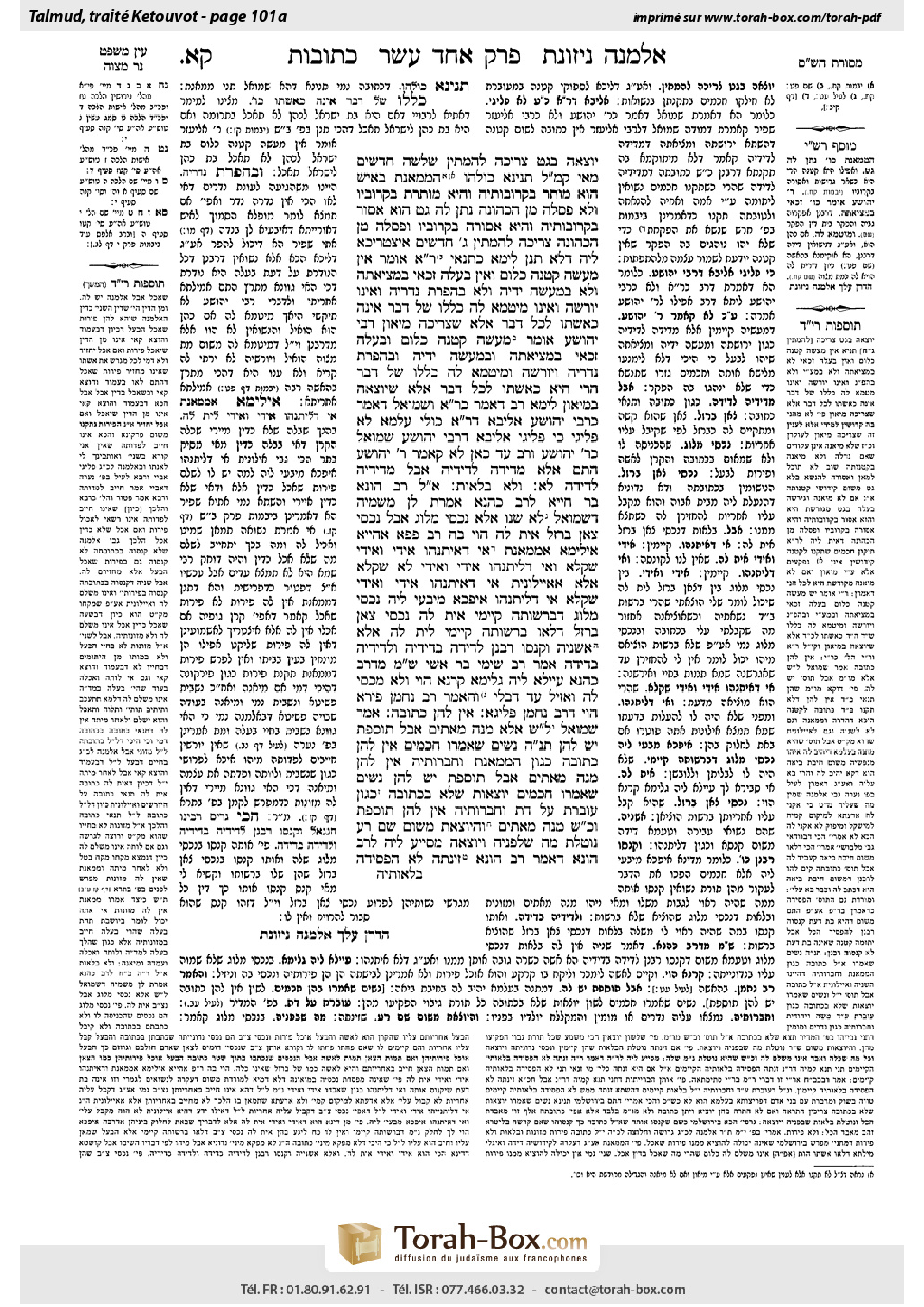
Ketubot 101a: Talmud study for Daf Yomi
Daf Yomi is the daily study of one Talmud folio. Explore 37 tractates with scans, Hebrew text, Sefaria English and AI-generated French translations where annotated.
Passage selection and English or AI-generated French translation are available where the scan has annotations. Daf Study is independent of Torah-Box and Sefaria.
Browse Ketubot · כתובות · All tractatesKetubot 101a text and translations
This page of Ketubot includes the Aramaic text, an English translation and an AI-generated French translation, alongside the scan above.
כתובות ק״א א · Aramaic and Hebrew text
יוֹצְאָה בְּגֵט צְרִיכָה לְהַמְתִּין שְׁלֹשָׁה חֳדָשִׁים.
מַאי קָא מַשְׁמַע לַן? תְּנֵינָא כּוּלְּהוּ: הַמְמָאֶנֶת בְּאִישׁ — הוּא מוּתָּר בִּקְרוֹבוֹתֶיהָ, וְהִיא מוּתֶּרֶת בִּקְרוֹבָיו, וְלֹא פְּסָלָהּ מִן הַכְּהוּנָּה. נָתַן לָהּ גֵּט — הוּא אָסוּר בִּקְרוֹבוֹתֶיהָ, וְהִיא אֲסוּרָה בִּקְרוֹבָיו, וּפְסָלָהּ מִן הַכְּהוּנָּה.
צְרִיכָה לְהַמְתִּין שְׁלֹשָׁה חֳדָשִׁים אִיצְטְרִיכָא לֵיהּ, דְּלָא תְּנַן.
לֵימָא כְּתַנָּאֵי, רַבִּי אֱלִיעֶזֶר אוֹמֵר: אֵין מַעֲשֵׂה קְטַנָּה כְּלוּם, וְאֵין בַּעְלָהּ זַכַּאי בִּמְצִיאָתָהּ, וְלֹא בְּמַעֲשֵׂה יָדֶיהָ, וְלֹא בַּהֲפָרַת נְדָרֶיהָ, וְאֵינוֹ יוֹרְשָׁהּ, וְאֵינוֹ מִיטַּמֵּא לָהּ. כְּלָלוֹ שֶׁל דָּבָר: אֵינָהּ כְּאִשְׁתּוֹ לְכׇל דָּבָר, אֶלָּא שֶׁצְּרִיכָה מֵיאוּן.
רַבִּי יְהוֹשֻׁעַ אוֹמֵר: מַעֲשֵׂה קְטַנָּה כְּלוּם, וּבַעְלָהּ זַכַּאי בִּמְצִיאָתָהּ, וּבְמַעֲשֵׂה יָדֶיהָ, וּבַהֲפָרַת נְדָרֶיהָ, וְיוֹרְשָׁהּ, וּמִיטַּמֵּא לָהּ. כְּלָלוֹ שֶׁל דָּבָר: הֲרֵי הִיא כְּאִשְׁתּוֹ לְכׇל דָּבָר, אֶלָּא שֶׁיּוֹצְאָה בְּמֵיאוּן.
לֵימָא רַב דְּאָמַר כְּרַבִּי אֱלִיעֶזֶר וּשְׁמוּאֵל דְּאָמַר כְּרַבִּי יְהוֹשֻׁעַ?
אַלִּיבָּא דְּרַבִּי אֱלִיעֶזֶר כּוּלֵּי עָלְמָא לָא פְּלִיגִי.
כִּי פְּלִיגִי אַלִּיבָּא דְּרַבִּי יְהוֹשֻׁעַ: שְׁמוּאֵל כְּרַבִּי יְהוֹשֻׁעַ, וְרַב: עַד כָּאן לָא קָאָמַר רַבִּי יְהוֹשֻׁעַ הָתָם אֶלָּא מִדִּידַהּ לְדִידֵיהּ, אֲבָל מִדִּידֵיהּ לְדִידַהּ — לָא.
וְלֹא בְּלָאוֹת. אֲמַר לֵיהּ רַב הוּנָא בַּר חִיָּיא לְרַב כָּהֲנָא: אֲמַרְתְּ לַן מִשְּׁמֵיהּ דִּשְׁמוּאֵל: לֹא שָׁנוּ אֶלָּא נִכְסֵי מְלוֹג, אֲבָל נִכְסֵי צֹאן בַּרְזֶל, אִית לַהּ.
הָוֵי בַּהּ רַב פָּפָּא: אַהֵיָיא? אִילֵּימָא אַמְּמָאֶנֶת, אִי דְּאִיתַנְהוּ — אִידֵּי וְאִידֵּי שָׁקְלָא. וְאִי דְּלֵיתַנְהוּ — אִידֵּי וְאִידִי לָא שָׁקְלָא!
אֶלָּא אַאַיְילוֹנִית: אִי דְּאִיתַנְהוּ — אִידֵּי וְאִידֵּי שָׁקְלָא, אִי דְּלֵיתַנְהוּ — אִיפְּכָא מִיבְּעֵי לֵיהּ: נִכְסֵי מְלוֹג דְּבִרְשׁוּתַהּ קָיְימִי — אִית לַהּ, נִכְסֵי צֹאן בַּרְזֶל דְּלָאו בִּרְשׁוּתַהּ קָיְימִי — לֵית לַהּ!
אֶלָּא אַשְּׁנִיָּה, וּקְנַסוּ רַבָּנַן לְדִידַהּ בְּדִידֵיהּ וּלְדִידֵיהּ בְּדִידַהּ.
אָמַר רַב שִׁימִי בַּר אָשֵׁי, שְׁמַע מִינַּהּ מִדְּרַב כָּהֲנָא: עַיִּילָא לֵיהּ גְּלִימָא — קַרְנָא הָוֵי, וְלָא מִכַּסֵּי לַהּ וְאָזֵיל עַד דְּבָלֵי.
וְהָאָמַר רַב נַחְמָן פֵּירָא הָוֵי! דְּרַב נַחְמָן פְּלִיגָא.
אֵין לָהֶן כְּתוּבָּה. אָמַר שְׁמוּאֵל: לֹא שָׁנוּ אֶלָּא מָנֶה מָאתַיִם, אֲבָל תּוֹסֶפֶת, יֵשׁ לָהֶן.
תַּנְיָא נָמֵי הָכִי: נָשִׁים שֶׁאָמְרוּ חֲכָמִים אֵין לָהֶן כְּתוּבָּה, כְּגוֹן הַמְמָאֶנֶת וְחַבְרוֹתֶיהָ — אֵין לָהֶן מָנֶה מָאתַיִם, אֲבָל תּוֹסֶפֶת — יֵשׁ לָהֶן.
נָשִׁים שֶׁאָמְרוּ חֲכָמִים יוֹצְאוֹת שֶׁלֹּא בִּכְתוּבָּה, כְּגוֹן עוֹבֶרֶת עַל דָּת וְחַבְרוֹתֶיהָ — אֵין לָהֶן תּוֹסֶפֶת, וְכׇל שֶׁכֵּן מָנֶה מָאתַיִם. וְהַיּוֹצֵאת מִשּׁוּם שֵׁם רָע — נוֹטֶלֶת מַה שֶּׁלְּפָנֶיהָ וְיוֹצְאָה.
מְסַיַּיע לֵיהּ לְרַב הוּנָא, דְּאָמַר רַב הוּנָא: זִינְּתָה לֹא הִפְסִידָה
Ketubot 101a · English translation
One who leaves the marriage union through a bill of divorce is required to wait three months before remarrying.
The Gemara asks: What is Shmuel teaching us by telling us all of this? We already learned it all in Yevamot (108a): In the case of one who refuses to continue living with a certain man, he is permitted to her relatives and she is permitted to his relatives, and she is not disqualified from marrying into the priesthood. If he gave her a bill of divorce, then he is forbidden to her relatives and she is forbidden to his relatives, and she is disqualified from marrying into the priesthood.
The Gemara answers: It was necessary for him to mention that if she receives a bill of divorce, she is required to wait three months before remarrying, as we did not learn that halakha in the mishna. Once Shmuel mentioned the difference between one who refuses to continue living with her husband and one who is divorced, he mentioned the other differences between the two cases.
The Gemara suggests: Let us say that this dispute between Rav and Shmuel is parallel to a dispute between tanna’im, as the baraita teaches: Rabbi Eliezer says: The act of marriage by a minor girl is nothing, i.e., has no legal impact, when she is married off not by her father, and her husband is not entitled to any lost article that she finds, and not to her earnings; and he is not able to annul her vows; and he does not inherit from her; nor does he become impure for her if he is a priest. The principle is that her legal status is not that of his wife in every sense, only that she requires a refusal in order to leave the marriage.
Rabbi Yehoshua says: The act of marriage by a minor girl is something, i.e., has legal impact, and her husband is entitled to any lost article that she finds and to her earnings; and he is able to annul her vows; and he inherits from her; and he becomes impure for her, even if he is a priest. The principle is that her legal status is that of his wife in every sense, except for the fact that she leaves this union through refusal and does not need a bill of divorce.
Shall we say that Rav said that she does not receive payment of her marriage contract in accordance with the opinion of Rabbi Eliezer, who holds that her marriage did not take effect, and that Shmuel said that she does receive payment of her marriage contract in accordance with the opinion of Rabbi Yehoshua, who holds that her marriage did take effect?
The Gemara rejects this: According to the opinion of Rabbi Eliezer, everyone agrees that a minor girl’s marriage has no legal standing and, as Rav said, she is not entitled to payment of her marriage contract.
When they disagree, they disagree in accordance with the opinion of Rabbi Yehoshua. Shmuel is in accordance with the literal opinion of Rabbi Yehoshua. And Rav says that when Rabbi Yehoshua said there that a minor girl has a legal status of his wife in every sense, it was only with regard to her obligations toward him. But with regard to his obligations toward her, since according to Torah law they are not married, the Sages could not obligate the husband to pay her anything.
§ The mishna teaches that a girl who refuses to continue living with her husband, a woman who is forbidden by rabbinic law as a secondary relative, and an ailonit are not entitled to payment of a marriage contract and are not entitled to their worn clothes. Rav Huna bar Ḥiyya said to Rav Kahana: You told us in the name of Shmuel: They taught that she is not entitled to her worn clothes only with regard to the worn-out items of usufruct property [nikhsei melog], but she does have rights to the worn-out items of her guaranteed property [tzon barzel].
Rav Pappa discussed it and wondered: To which part of the mishna is this referring? If we say that it is referring to one who refuses to continue living with her husband, then if the worn-out articles are still in existence, she takes both the usufruct and the guaranteed properties. Since the marriage is annulled, she takes whatever belongs to her. And if they are no longer in existence and were completely worn out over the course of time, then she does not take compensation for either of them, as the husband was within his rights to make use of them.
Rather, it must be that Shmuel’s statement is in reference to an ailonit. This too is difficult as, in that case, if the articles are still in existence she takes both the usufruct and the guaranteed properties. If they are no longer in existence, then Shmuel should have stated the opposite and said: With regard to the usufruct property, which remains in her possession during the marriage, she does receive compensation for it in the event that the marriage is annulled. However, she does not receive compensation for the guaranteed property, which does not remain in her possession during the marriage but in the possession of her husband.
Rather, it must be that Shmuel’s statement is in reference to a secondary forbidden relative, and the rationale for this halakha is that the Sages penalized both the husband and the wife for violating a rabbinic prohibition. The Sages assigned a penalty to her with regard to his obligations to her, and she is not reimbursed for the worn-out usufruct property. And they assigned a penalty to him with regard to her obligations to him so that he is responsible for reimbursing her for the worn-out guaranteed property.
Rav Shimi bar Ashi said: Conclude from the statement of Rav Kahana that if a wife brought home to her husband a cloak after they were already married, it is viewed as capital, and he may not go and cover himself with it until it wears out. With regard to land that the wife obtains during the marriage, the husband has the right to benefit from it by consuming its produce. From the fact that Rav Kahana stated that it is only in this particular case that the woman is not reimbursed for clothing that became worn out through her husband’s use, one can infer that generally, the husband does not have the right to use a garment she obtains, to the degree that it becomes worn out.
The Gemara asks: But didn’t Rav Naḥman say that use of the cloak is considered the produce of her property, to which the husband is entitled? The Gemara answers: The statement of Rav Naḥman is in disagreement with that opinion.
§ The mishna teaches that these specific women are not entitled to payment of a marriage contract. Shmuel said: They taught this only with regard to the principal of the marriage contract, which the Sages instituted for all women, amounting to one hundred dinars for a widow and two hundred dinars for a virgin. However, the additional sum listed in the marriage contract, which their husband specified for them of his own accord, is considered a gift and they are entitled to it.
The Gemara notes: That is also taught in a baraita: Women with regard to whom the Sages said: They are not entitled to payment of a marriage contract, for example, one who refused to remain married to her husband, and her companions, they are not entitled to the principal of one hundred dinars or two hundred dinars. But as for the additional sum stipulated in the marriage contract that the husband added of his own accord, they are entitled to it.
However, women with regard to whom the Sages said: They are divorced without receiving payment for their marriage contract, for example, a woman who violates the precepts of halakha or Jewish custom, and her companions, are not entitled to the additional sum stipulated by their husbands in the marriage contract. And since they violated and transgressed the mitzvot, it is all the more so that they are not entitled to receive the principal one hundred dinars or two hundred dinars, as the Sages penalized them and negated all of their husband’s obligations that are recorded in the marriage contract. And one who is divorced because she received a bad reputation for licentiousness takes what is left of her usufruct property and is divorced.
The Gemara notes: This baraita supports the opinion of Rav Huna, as Rav Huna said: A woman who was licentious has not lost
Ketubot 101a · Traduction française (IA)
Celle qui quitte le lien conjugal par un acte de divorce doit attendre trois mois avant de se remarier.
La Guemara demande : Que nous enseigne Chmouel en disant tout cela ? Nous avons déjà tout appris dans Yevamot (108a) : dans le cas d’une femme qui refuse de continuer à vivre avec un certain homme, celui-ci peut épouser ses parentes et elle peut épouser ses parents, et elle n’est pas disqualifiée pour épouser un membre de la famille sacerdotale. S’il lui a remis un acte de divorce, il lui est interdit d’épouser ses parentes et elle ne peut pas épouser ses parents, et elle est disqualifiée pour épouser un membre de la famille sacerdotale.
La Guemara répond : Il était nécessaire de préciser que si elle reçoit un acte de divorce, elle doit attendre trois mois avant de se remarier, car cette halakha n’est pas enseignée dans la Michna. Dès lors que Chmouel a mentionné la différence entre celle qui refuse de continuer à vivre avec son mari et celle qui est divorcée, il a également mentionné les autres différences entre ces deux cas.
La Guemara propose : Disons que cette controverse entre Rav et Chmouel correspond à une controverse entre des tannaïm, car la baraïta enseigne : Rabbi Eliezer dit : Le mariage d’une jeune fille mineure n’a aucun effet juridique lorsqu’elle est mariée sans l’intervention de son père ; son mari n’a aucun droit sur les objets perdus qu’elle trouve ni sur ses gains ; il ne peut pas annuler ses vœux ; il n’hérite pas d’elle ; et, s’il est prêtre, il ne devient pas impur à cause d’elle. Le principe est que, juridiquement, elle n’est pas son épouse à tous égards ; toutefois, elle doit exprimer son refus pour sortir du mariage.
Rabbi Yehoshoua dit : Le mariage d’une jeune fille mineure a un effet juridique ; son mari a droit aux objets perdus qu’elle trouve et à ses gains ; il peut annuler ses vœux ; il hérite d’elle ; et il devient impur à cause d’elle, même s’il est prêtre. Le principe est que, juridiquement, elle est son épouse à tous égards, sauf qu’elle quitte cette union en exprimant son refus et n’a pas besoin d’un acte de divorce.
Dirons-nous que Rav a dit qu’elle ne reçoit pas le paiement de sa ketouba conformément à l’opinion de Rabbi Eliezer, selon laquelle son mariage n’a pas pris effet, et que Chmouel a dit qu’elle reçoit le paiement de sa ketouba conformément à l’opinion de Rabbi Yehoshoua, selon laquelle son mariage a pris effet ?
La Guemara rejette cette proposition : selon l’opinion de Rabbi Eliezer, tous conviennent que le mariage d’une jeune fille mineure n’a aucun statut juridique et, comme l’a dit Rav, elle n’a pas droit au paiement de sa ketouba.
Le désaccord porte sur l’opinion de Rabbi Yehoshoua. Chmouel suit Rabbi Yehoshoua à la lettre. Rav dit que lorsque Rabbi Yehoshoua a déclaré là-bas qu’une jeune fille mineure a le statut juridique d’épouse à tous égards, cela ne concerne que ses obligations envers son mari. Mais en ce qui concerne les obligations du mari envers elle, puisque, selon la Torah, ils ne sont pas mariés, les Sages ne pouvaient pas obliger le mari à lui verser quoi que ce soit.
§ La Michna enseigne qu’une jeune fille qui refuse de continuer à vivre avec son mari, une femme qui est interdite en vertu d’une interdiction rabbinique en tant que parente secondaire, et une aïlonit n’ont pas droit au paiement d’une ketouba ni à leurs vêtements usés. Rav Houna bar Ḥiyya dit à Rav Kahana : Tu nous as rapporté au nom de Chmouel qu’ils ont enseigné qu’elle n’a pas droit aux vêtements usés uniquement lorsqu’il s’agit des biens de jouissance [nikhsei melog] usés, mais qu’elle a droit aux biens garantis [tzon barzel] usés.
Rav Pappa examina cette affirmation et s’interrogea : À quelle partie de la Michna se rapporte-t-elle ? Si elle concerne celle qui refuse de continuer à vivre avec son mari, alors, si les objets usés existent encore, elle récupère à la fois les biens de jouissance et les biens garantis. Puisque le mariage est annulé, elle reprend tout ce qui lui appartient. Et s’ils n’existent plus, parce qu’ils se sont complètement usés avec le temps, elle ne reçoit de compensation pour aucun des deux, puisque le mari était en droit de les utiliser.
Il faut plutôt dire que la déclaration de Chmouel concerne une aïlonit. Cela aussi pose une difficulté : dans ce cas, si les objets existent encore, elle récupère à la fois les biens de jouissance et les biens garantis. S’ils n’existent plus, Chmouel aurait dû dire le contraire : pour les biens de jouissance, qui restent en sa possession pendant le mariage, elle reçoit une compensation si le mariage est annulé. En revanche, elle ne reçoit pas de compensation pour les biens garantis, qui ne restent pas en sa possession pendant le mariage, mais en celle de son mari.
Il faut plutôt dire que la déclaration de Chmouel concerne une parente secondaire interdite, et que cette halakha s’explique par le fait que les Sages ont pénalisé à la fois le mari et la femme pour avoir enfreint une interdiction rabbinique. Les Sages l’ont pénalisée en ce qui concerne les obligations de son mari envers elle : elle n’est pas indemnisée pour les biens de jouissance usés. Ils l’ont également pénalisé, lui, en ce qui concerne ses obligations envers lui, de sorte qu’il doit l’indemniser pour les biens garantis usés.
Rav Shimi bar Ashi dit : Conclus de la déclaration de Rav Kahana que si une femme apporte un manteau à son mari après leur mariage, celui-ci est considéré comme un capital, et il ne peut pas s’en couvrir jusqu’à ce qu’il soit usé. Quant aux terres acquises par la femme pendant le mariage, le mari a le droit d’en tirer profit en consommant leurs produits. Puisque Rav Kahana a précisé que c’est uniquement dans ce cas particulier que la femme n’est pas indemnisée pour les vêtements usés par l’usage qu’en a fait son mari, on peut en déduire qu’en général, le mari n’a pas le droit d’utiliser un vêtement qu’elle acquiert au point de l’user.
La Guemara demande : Mais Rav Naḥman n’a-t-il pas dit que l’usage du manteau est considéré comme le produit de ses biens, auquel le mari a droit ? La Guemara répond : La déclaration de Rav Naḥman est en désaccord avec cette opinion.
§ La Michna enseigne que ces femmes précises n’ont pas droit au paiement d’une ketouba. Chmouel dit : Cela n’a été enseigné qu’au sujet du montant principal de la ketouba, que les Sages ont institué pour toutes les femmes, soit cent dinars pour une veuve et deux cents dinars pour une vierge. En revanche, le montant supplémentaire inscrit dans la ketouba, que le mari leur a accordé de sa propre initiative, est considéré comme un cadeau et elles y ont droit.
La Guemara fait remarquer : Cela est également enseigné dans une baraïta : les femmes dont les Sages ont dit qu’elles n’ont pas droit au paiement d’une ketouba, par exemple celle qui a refusé de rester mariée à son mari et les autres femmes dans le même cas, n’ont pas droit au montant principal de cent ou deux cents dinars. Mais elles ont droit au montant supplémentaire stipulé dans la ketouba, que le mari a ajouté de sa propre initiative.
En revanche, les femmes dont les Sages ont dit qu’elles sont divorcées sans recevoir le paiement de leur ketouba, par exemple une femme qui enfreint les préceptes de la halakha ou de la coutume juive, ainsi que les autres femmes dans le même cas, n’ont pas droit au montant supplémentaire stipulé par leur mari dans la ketouba. Puisqu’elles ont enfreint et transgressé les mitsvot, à plus forte raison n’ont-elles pas droit au montant principal de cent ou deux cents dinars, car les Sages les ont pénalisées et ont annulé toutes les obligations de leur mari consignées dans la ketouba. Quant à celle qui est divorcée parce qu’elle a acquis une mauvaise réputation de débauche, elle reprend ce qui reste de ses biens de jouissance et est divorcée.
La Guemara fait remarquer : Cette baraïta étaye l’opinion de Rav Houna, car Rav Houna a dit : Une femme qui s’est livrée à la débauche n’a pas perdu
Traduction française générée par IA à partir de l’édition anglaise de Sefaria. Vérifie toujours un passage avec le texte source.
Text from Sefaria: William Davidson Edition - Vocalized Aramaic (CC BY NC); William Davidson Edition - English (CC BY NC).