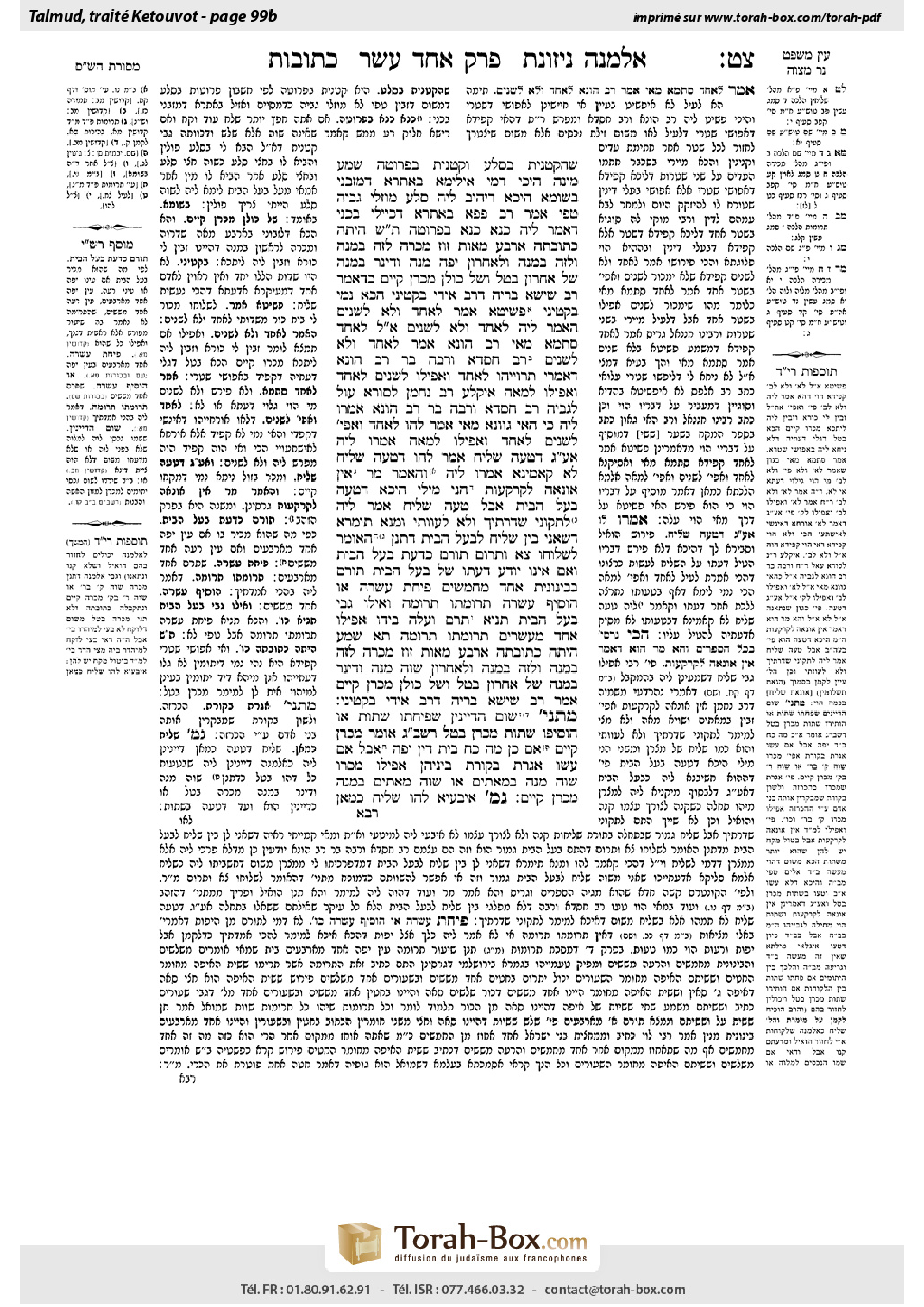
Ketubot 99b: Talmud study for Daf Yomi
Daf Yomi is the daily study of one Talmud folio. Explore 37 tractates with scans, Hebrew text, Sefaria English and AI-generated French translations where annotated.
Passage selection and English or AI-generated French translation are available where the scan has annotations. Daf Study is independent of Torah-Box and Sefaria.
Browse Ketubot · כתובות · All tractatesKetubot 99b text and translations
This page of Ketubot includes the Aramaic text, an English translation and an AI-generated French translation, alongside the scan above.
כתובות צ״ט ב · Aramaic and Hebrew text
שֶׁהַקִּטְנִית בְּסֶלַע, וְקִטְנִית בִּפְרוּטָה. שְׁמַע מִינַּהּ.
הֵיכִי דָמֵי? אִילֵּימָא בְּאַתְרָא דִּמְזַבְּנִי בְּשׁוּמָא, הֵיכָא דְּיָהֵיב לֵיהּ סֶלַע — מוֹזְלִי גַּבֵּיהּ טְפֵי!
אָמַר רַב פָּפָּא: בְּאַתְרָא דְּכָיְילִי בְּכַנֵּי, דְּאָמַר לֵיהּ: ״כַּנָּא כַּנָּא בִּפְרוּטָה״.
תָּא שְׁמַע: הָיְתָה כְּתוּבָּתָהּ אַרְבַּע מֵאוֹת זוּז, מָכְרָה לָזֶה בְּמָנֶה וְלָזֶה בְּמָנֶה וְלָאַחֲרוֹן יָפֶה מָנֶה וְדִינָר בְּמָנֶה — שֶׁל אַחֲרוֹן בָּטֵל, וְשֶׁל כּוּלָּן מִכְרָן קַיָּים.
כִּדְאָמַר רַב שִׁישָׁא בְּרֵיהּ דְּרַב אִידִי, בְּקַטִּינֵי, הָכָא נָמֵי בְּקַטִּינֵי.
פְּשִׁיטָא, אָמַר ״לְאֶחָד, וְלֹא לִשְׁנַיִם״ — הָאֲמַר לֵיהּ ״לְאֶחָד וְלֹא לִשְׁנַיִם״. אֲמַר לֵיהּ ״לְאֶחָד״ סְתָמָא, מַאי?
רַב הוּנָא אָמַר: ״לְאֶחָד״, וְלֹא לִשְׁנַיִם. רַב חִסְדָּא וְרַבָּה בַּר רַב הוּנָא דְּאָמְרִי תַּרְוַיְיהוּ: ״לְאֶחָד״, וַאֲפִילּוּ לִשְׁנַיִם. ״לְאֶחָד״, וַאֲפִילּוּ לְמֵאָה.
אִיקְּלַע רַב נַחְמָן לְסוּרָא, עוּל לְגַבֵּיהּ רַב חִסְדָּא וְרַבָּה בַּר רַב הוּנָא, אֲמַרוּ לֵיהּ: כִּי הַאי גַוְונָא מַאי? אֲמַר לְהוּ: ״לְאֶחָד״ וַאֲפִילּוּ לִשְׁנַיִם, ״לְאֶחָד״ וַאֲפִילּוּ לְמֵאָה.
אֲמַרוּ לֵיהּ: אַף עַל גַּב דִּטְעָה שָׁלִיחַ? אֲמַר לְהוּ: דִּטְעָה שָׁלִיחַ לָא קָאָמֵינָא. אֲמַרוּ לֵיהּ: וְהָאָמַר מָר אֵין אוֹנָאָה לְקַרְקָעוֹת!
הָנֵי מִילֵּי הֵיכָא דִּטְעָה בַּעַל הַבַּיִת, אֲבָל טְעָה שָׁלִיחַ, אֲמַר לֵיהּ: ״לְתַקּוֹנֵי שַׁדַּרְתָּיךָ וְלָא לְעַוּוֹתֵי״.
וּמְנָא תֵּימְרָא דְּשָׁאנֵי בֵּין שָׁלִיחַ לְבַעַל הַבַּיִת?
דִּתְנַן: הָאוֹמֵר לִשְׁלוּחוֹ צֵא וּתְרוֹם — תּוֹרֵם כְּדַעַת בַּעַל הַבַּיִת. וְאִם אֵינוֹ יוֹדֵעַ דַּעְתּוֹ שֶׁל בַּעַל הַבַּיִת — תּוֹרֵם בְּבֵינוֹנִית אֶחָד מֵחֲמִשִּׁים, פִּיחֵת עֲשָׂרָה אוֹ הוֹסִיף עֲשָׂרָה — תְּרוּמָתוֹ תְּרוּמָה.
וְאִילּוּ גַּבֵּי בַּעַל הַבַּיִת תַּנְיָא: תָּרַם וְעָלָה בְּיָדוֹ אֲפִילּוּ אֶחָד מֵעֶשְׂרִים — תְּרוּמָתוֹ תְּרוּמָה.
תָּא שְׁמַע: הָיְתָה כְּתוּבָּתָהּ אַרְבַּע מֵאוֹת זוּז, מָכְרָה לָזֶה בְּמָנֶה וְלָזֶה בְּמָנֶה וְלָאַחֲרוֹן שָׁוֶה מָנֶה וְדִינָר בְּמָנֶה — שֶׁל אַחֲרוֹן בָּטֵל, וְשֶׁל כּוּלָּן מִכְרָן קַיָּים.
אָמַר רַב שִׁישָׁא בְּרֵיהּ דְּרַב אִידִי: בְּקַטִּינֵי.
מַתְנִי׳ שׁוּם הַדַּיָּינִין שֶׁפִּיחֲתוּ שְׁתוּת אוֹ הוֹסִיפוּ שְׁתוּת — מִכְרָן בָּטֵל.
רַבָּן שִׁמְעוֹן בֶּן גַּמְלִיאֵל אוֹמֵר: מִכְרָן קַיָּים. אִם כֵּן — מָה כֹּחַ בֵּית דִּין יָפֶה? אֲבָל אִם עָשׂוּ אִגֶּרֶת בִּקּוֹרֶת בֵּינֵיהֶן, אֲפִילּוּ מָכְרוּ שָׁוֶה מָנֶה בְּמָאתַיִם אוֹ שָׁוֶה מָאתַיִם בְּמָנֶה — מִכְרָן קַיָּים.
גְּמָ׳ אִיבַּעְיָא לְהוּ: שָׁלִיחַ, כְּמַאן?
Ketubot 99b · English translation
As, whether he bought legumes for a sela or whether he bought legumes for a peruta, the price would have been the same even if he bought in bulk. The Gemara concludes: Learn from here that this is the proper interpretation of the mishna.
The Gemara asks about the sale of legumes: What are the circumstances where the price stays the same even if one bought in bulk? If we say that it occurs in a locale where they sell legumes by appraisal of an article’s value, then when he gives the merchant a sela as payment, the seller reduces the price for him more than if he had bought less. In such a place the buyer profits, and it is clear that even legumes do not have a fixed price.
Rav Pappa said: It is referring to a locale where one measures with vessels and to a case where the merchant said to him: Fill each vessel for a peruta. The buyer then receives the product in accordance to how much he pays, and does not pay less if he buys in bulk.
The Gemara suggests: Come and hear a proof from the mishna: If her marriage contract was worth four hundred dinars, and she sold property to this one for one hundred dinars, and she sold property to that one for one hundred dinars, and again to a third one, and she sold property to the last one worth one hundred dinars and a dinar for only one hundred dinars, the sale of the last property is void, and all of the others, their sale is valid, as they were sold for the correct price. Here, the widow was appointed as an agent to sell property worth four hundred dinars, and she initially sold property worth only one hundred dinars, and nevertheless the sale is valid. The mishna does not say that she disregarded the orphan’s instructions and the sale is void.
The Gemara answers: It is as Rav Sheisha, son of Rav Idi, said in another context: This is stated with regard to small tracts of land that are geographically separated and do not form one land mass that can be sold as a single unit. Here too, the ruling of the mishna is stated with regard to small tracts of land that are not part of one larger field, and so this case is not proof that an agent who sells less than he was instructed to is considered to be adding to and not disregarding his employer’s instructions.
§ In continuation of the previous discussion, the Gemara raises another problem: It is obvious that if the employer said to his agent: Sell my property to one person, but not to two, and the agent sold the property to two people, since he said to him: To one, but not to two, it is certain that the agent has disregarded his instructions and is no longer considered an agent. However, if the employer said to the agent: Sell to one person, without specifying that he should not sell to two people, what is the halakha if the agent did sell the property to two people?
Rav Huna said: The employer meant to sell to one person and not to two people. It is Rav Ḥisda and Rabba, son of Rav Huna, who both say: He meant to one person and even to two people. When he said to one person, he meant and even to one hundred people, as he did not mean one person specifically.
Rav Naḥman happened to come to Sura. Rav Ḥisda and Rabba bar Rav Huna entered before him. They said to him: In a case like this one, which was discussed above in the Gemara, what is the halakha? He said to them: When he said to one person, he meant and even to two people. When he said to one person, he meant and even to one hundred people.
Rav Ḥisda and Rabba bar Rav Huna said to him: Is the agent considered to be performing his assigned agency even though he erred, e.g., by selling property for less than its value? Rav Naḥman said to them: I do not say so in a case where the agent erred. They said to him: But didn’t the Master say that there is no prohibition against fraud in the sale of land, and land does not have a set value?
He replied to them: This applies only where the homeowner erred, e.g., where he sold land for less than its market value. In that case, he cannot claim that the sale is invalid because of fraud. However, in a case where the agent erred, the homeowner can say to the agent: I sent you to act for my benefit and not to my detriment, and his appointment as an agent is nullified.
The Gemara explains: And from where do you say that there is a legal difference between an error made by an agent and an error made by a homeowner?
As we learned in a mishna (Terumot 4:4): In the case of one who says to his agent: Go out and separate the portion of the produce designated for the priest [teruma], the agent separates teruma in accordance with the mind-set of the homeowner. He must separate the amount that he assumes the owner would want to give, as there is no fixed fraction for the amount that one must set aside as teruma. A generous person would give as much as a fortieth of the produce as teruma, while a stingy person would give a sixtieth. And if he does not know the mind-set of the homeowner, he separates an intermediate measure, i.e., one-fiftieth of the produce. If he subtracted ten from the denominator and separated one-fortieth, or added ten to the denominator and separated one-sixtieth of the produce, his teruma is considered teruma.
Whereas with regard to the homeowner himself it is taught in a baraita: If he separated teruma and even one-twentieth of the produce came up in his hand, his donation is effective and is considered teruma. The agent may deviate from the intention of the homeowner only within certain parameters. If he misunderstood the homeowner’s wishes and separated an unusually large percentage of the produce, his action accomplished nothing. The same action, however, when performed by the homeowner, is effective; if the homeowner himself mistakenly separated an unusually large percentage of his produce, it becomes teruma.
The Gemara returns to discuss whether a person is particular about having too many documents with his name on them. The Gemara suggests: Come and hear a proof from the mishna: If her marriage contract was worth four hundred dinars, and she sold property to this one for one hundred dinars, and she sold property to that one for one hundred dinars, and again to a third one, and she sold property to the last one worth one hundred dinars and a dinar for only one hundred dinars, the sale of the last property is void, and all of the others, their sale is valid, as they were sold for the correct price. She should have sold the land to one individual and not increased the number of documents bearing guarantees for the orphans to worry about. Still, if she did sell to several people, the sales are all valid.
The Gemara answers: Rav Sheisha, son of Rav Idi, said: This is stated with regard to small tracts of land that are geographically separated and do not form one land mass that can be sold as a single unit.
MISHNA: The halakha with regard to the assessment of the judges of the value of a piece of property in order to sell it is as follows: Where they decreased the price by one-sixth of its market value or added one-sixth to its market value, their sale is void.
Rabban Shimon ben Gamliel says: Their sale is valid. If it were so that the sale is void, then what advantage is there to the power of the court over an ordinary person? However, if they made a document of inspection, i.e., an announcement that people should come to inspect the field and bid on the property, then even if they sold property worth one hundred dinars for two hundred dinars, or sold property worth two hundred dinars for one hundred dinars, their sale is valid, as the transaction was agreed upon and done publicly.
GEMARA: A dilemma was raised before the Sages: An agent who mistakenly sold land for less than its value is like whom? Is he comparable to a judge, whose sale is effective if he did not err by more than one-sixth of the market price, or is he comparable to a widow, whose sale is void if she sold for anything less than the market price?
Ketubot 99b · Traduction française (IA)
En effet, qu’il ait acheté des légumineuses pour un sela ou pour une perouta, le prix aurait été le même, même s’il en avait acheté en grande quantité. La Guemara conclut : « Déduis-en que telle est l’interprétation correcte de la Michna. »
La Guemara pose une question au sujet de la vente de légumineuses : dans quelles circonstances le prix reste-t-il le même, même si l’on achète en grande quantité ? Si l’on dit que cela se passe dans un endroit où l’on vend les légumineuses en évaluant la valeur de la marchandise, alors, lorsqu’il donne un sela au marchand en paiement, celui-ci lui accorde une réduction plus importante que s’il en avait acheté moins. Dans un tel endroit, l’acheteur y gagne, et il est clair que même les légumineuses n’ont pas de prix fixe.
Rav Pappa dit : Il s’agit d’un endroit où l’on mesure à l’aide de récipients, et d’un cas où le marchand lui a dit : « Remplis chaque récipient pour une perouta. » L’acheteur reçoit alors une quantité de marchandise proportionnelle à ce qu’il paie et ne paie pas moins lorsqu’il achète en grande quantité.
La Guemara propose : « Viens entendre une preuve tirée de la Michna : si sa ketouba valait quatre cents dinars, et qu’elle vendit des biens à celui-ci pour cent dinars, à celui-là pour cent dinars, puis à un troisième, et qu’elle vendit au dernier un bien d’une valeur de cent dinars et un dinar pour seulement cent dinars, la vente du dernier bien est annulée, tandis que toutes les autres ventes sont valides, car elles ont été conclues au juste prix. » Ici, la veuve avait été nommée mandataire pour vendre des biens d’une valeur de quatre cents dinars ; elle a d’abord vendu des biens d’une valeur de seulement cent dinars, et pourtant la vente est valide. La Michna ne dit pas qu’elle a outrepassé les instructions des orphelins et que la vente est annulée.
La Guemara répond : Cela s’explique comme l’a dit Rav Sheisha, fils de Rav Idi, dans un autre contexte : cette règle concerne de petites parcelles de terrain géographiquement séparées, qui ne forment pas un seul ensemble pouvant être vendu en un seul lot. Ici aussi, la décision de la Michna concerne de petites parcelles qui ne font pas partie d’un champ plus vaste ; ce cas ne prouve donc pas qu’un mandataire qui vend moins que ce qui lui a été demandé est considéré comme ajoutant aux instructions de son mandant, et non comme les outrepassant.
§ Dans le prolongement de la discussion précédente, la Guemara soulève un autre problème : il est évident que si le mandant a dit à son mandataire : « Vends mes biens à une seule personne, mais pas à deux », et que le mandataire les a vendus à deux personnes, puisqu’il lui a dit « à une seule personne, mais pas à deux », il est certain que le mandataire a outrepassé ses instructions et n’est plus considéré comme son mandataire. Cependant, si le mandant a dit au mandataire : « Vends à une seule personne », sans préciser qu’il ne devait pas vendre à deux personnes, quelle est la halakha si le mandataire a effectivement vendu les biens à deux personnes ?
Rav Houna dit : Le mandant voulait dire qu’il fallait vendre à une seule personne et non à deux. Rav Ḥisda et Rabba, fils de Rav Houna, disent tous deux : Il voulait dire à une seule personne, et même à deux. Lorsqu’il a dit « à une seule personne », il entendait même cent personnes, car il ne visait pas spécifiquement une seule personne.
Rav Naḥman vint par hasard à Soura. Rav Ḥisda et Rabba bar Rav Houna se présentèrent devant lui. Ils lui dirent : « Dans un cas comme celui-ci, dont on a discuté plus haut dans la Guemara, quelle est la halakha ? » Il leur répondit : « Lorsqu’il a dit “à une seule personne”, il entendait même deux personnes. Lorsqu’il a dit “à une seule personne”, il entendait même cent personnes. »
Rav Ḥisda et Rabba bar Rav Houna lui dirent : « Le mandataire est-il considéré comme ayant exécuté le mandat qui lui a été confié, même s’il a commis une erreur, par exemple en vendant un bien au-dessous de sa valeur ? » Rav Naḥman leur répondit : « Je ne dis pas cela dans le cas où le mandataire a commis une erreur. » Ils lui dirent : « Pourtant, le Maître ne dit-il pas qu’il n’y a pas d’interdiction de fraude dans la vente de terrains et que les terrains n’ont pas de valeur fixe ? »
Il leur répondit : « Cela ne s’applique que lorsque le propriétaire s’est trompé, par exemple s’il a vendu un terrain au-dessous de sa valeur marchande. Dans ce cas, il ne peut prétendre que la vente est invalide pour cause de fraude. En revanche, si c’est le mandataire qui s’est trompé, le propriétaire peut lui dire : “Je t’ai envoyé agir dans mon intérêt et non à mon détriment”, et son mandat est annulé. »
La Guemara explique : « Et d’où déduisez-vous qu’il existe une différence juridique entre une erreur commise par un mandataire et une erreur commise par un propriétaire ? »
Comme nous l’avons appris dans une Michna (Teroumot 4:4) : dans le cas de celui qui dit à son mandataire : « Va prélever la part de la récolte destinée au prêtre [terouma] », le mandataire prélève la terouma selon les intentions du propriétaire. Il doit prélever la quantité qu’il suppose que le propriétaire voudrait donner, car aucune fraction fixe ne détermine la quantité de terouma à mettre de côté. Une personne généreuse donnerait un quarantième de la récolte au titre de la terouma, tandis qu’une personne avare en donnerait un soixantième. S’il ignore les intentions du propriétaire, il prélève une quantité intermédiaire, c’est-à-dire un cinquantième de la récolte. S’il a diminué le dénominateur de dix et prélevé un quarantième, ou augmenté le dénominateur de dix et prélevé un soixantième de la récolte, son prélèvement est considéré comme de la terouma.
En revanche, au sujet du propriétaire lui-même, une baraïta enseigne : s’il a prélevé de la terouma et que même un vingtième de la récolte lui est venu à l’esprit, son don prend effet et est considéré comme de la terouma. Le mandataire ne peut s’écarter des intentions du propriétaire que dans certaines limites. S’il a mal compris les souhaits du propriétaire et prélevé une proportion exceptionnellement élevée de la récolte, son acte n’a aucun effet. Le même acte, toutefois, prend effet lorsqu’il est accompli par le propriétaire : si celui-ci a lui-même prélevé par erreur une proportion exceptionnellement élevée de sa récolte, celle-ci devient de la terouma.
La Guemara revient à la question de savoir si une personne tient à éviter que trop de documents portent son nom. La Guemara propose : « Viens entendre une preuve tirée de la Michna : si sa ketouba valait quatre cents dinars, et qu’elle vendit des biens à celui-ci pour cent dinars, à celui-là pour cent dinars, puis à un troisième, et qu’elle vendit au dernier un bien d’une valeur de cent dinars et un dinar pour seulement cent dinars, la vente du dernier bien est annulée, tandis que toutes les autres ventes sont valides, car elles ont été conclues au juste prix. » Elle aurait dû vendre le terrain à une seule personne et ne pas augmenter le nombre de documents garantis que les orphelins auraient à prendre en compte. Pourtant, si elle l’a vendu à plusieurs personnes, toutes les ventes sont valides.
La Guemara répond : Rav Sheisha, fils de Rav Idi, a dit : cette règle concerne de petites parcelles de terrain géographiquement séparées, qui ne forment pas un seul ensemble pouvant être vendu en un seul lot.
MICHNA : La halakha relative à l’estimation par les juges de la valeur d’un bien en vue de sa vente est la suivante : s’ils ont diminué le prix d’un sixième de sa valeur marchande ou l’ont augmenté d’un sixième, leur vente est annulée.
Rabban Shimon ben Gamliel dit : leur vente est valide. Si la vente était annulée, quel avantage le pouvoir du tribunal aurait-il sur celui d’une personne ordinaire ? Toutefois, s’ils ont établi un acte d’inspection, c’est-à-dire une annonce invitant les gens à venir inspecter le champ et à faire une offre pour le bien, alors, même s’ils ont vendu un bien d’une valeur de cent dinars pour deux cents dinars, ou un bien d’une valeur de deux cents dinars pour cent dinars, leur vente est valide, car la transaction a été convenue et réalisée publiquement.
GUEMARA : Les Sages posèrent la question suivante : à qui comparer un mandataire qui a vendu par erreur un terrain au-dessous de sa valeur ? Est-il comparable à un juge, dont la vente prend effet s’il ne s’est pas trompé de plus d’un sixième du prix du marché, ou à une veuve, dont la vente est annulée dès lors qu’elle a vendu au-dessous du prix du marché ?
Traduction française générée par IA à partir de l’édition anglaise de Sefaria. Vérifie toujours un passage avec le texte source.
Text from Sefaria: William Davidson Edition - Vocalized Aramaic (CC BY NC); William Davidson Edition - English (CC BY NC).