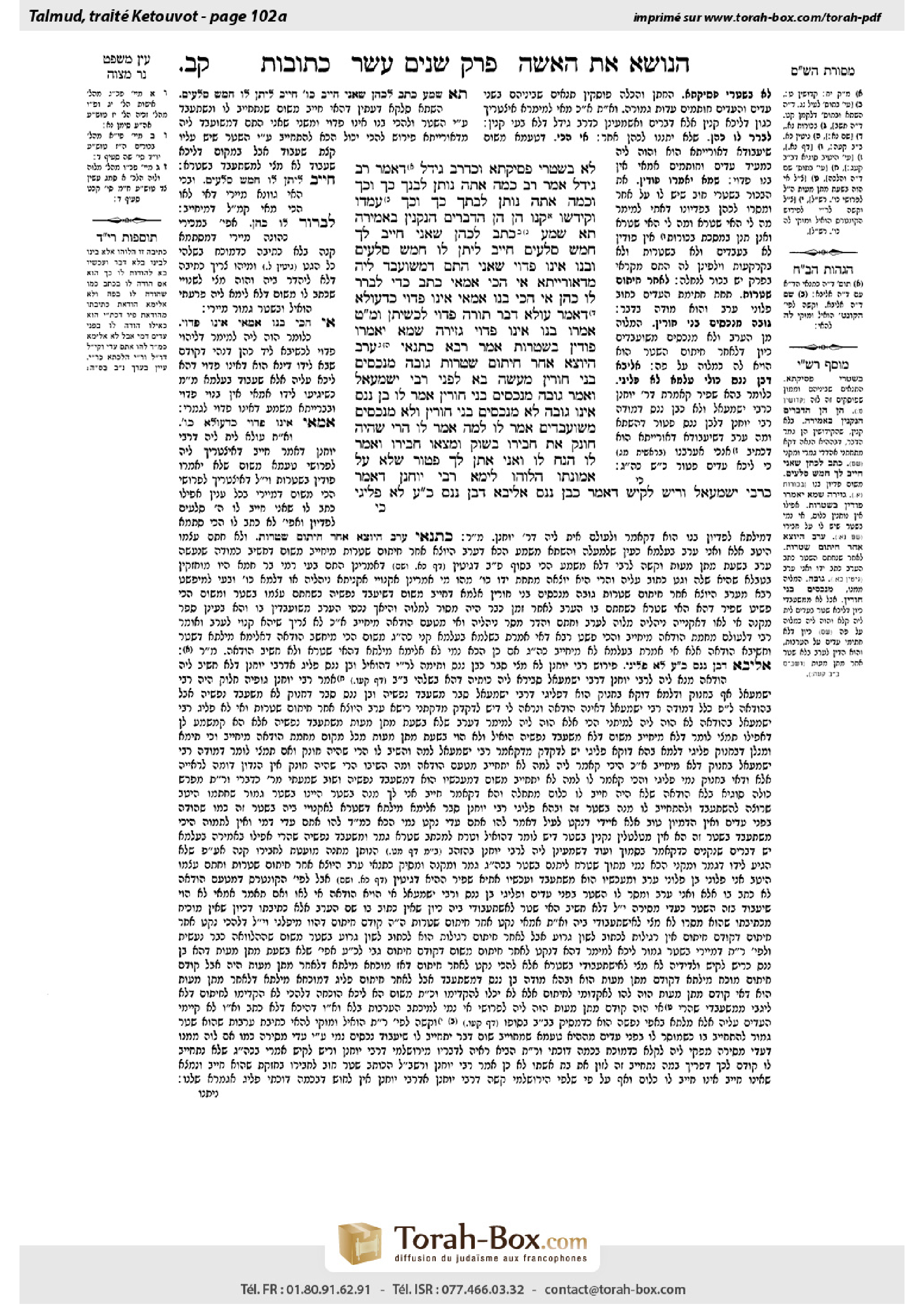
Ketubot 102a: Talmud study for Daf Yomi
Daf Yomi is the daily study of one Talmud folio. Explore 37 tractates with scans, Hebrew text, Sefaria English and AI-generated French translations where annotated.
Passage selection and English or AI-generated French translation are available where the scan has annotations. Daf Study is independent of Torah-Box and Sefaria.
Browse Ketubot · כתובות · All tractatesKetubot 102a text and translations
This page of Ketubot includes the Aramaic text, an English translation and an AI-generated French translation, alongside the scan above.
כתובות ק״ב א · Aramaic and Hebrew text
לָא, בִּשְׁטָרֵי פְסִיקָתָא, וְכִדְרַב גִּידֵּל.
דְּאָמַר רַב גִּידֵּל אָמַר רַב: כַּמָּה אַתָּה נוֹתֵן לְבִנְךָ? כָּךְ וְכָךְ. וְכַמָּה אַתָּה נוֹתֵן לְבִתְּךָ? כָּךְ וְכָךְ. עָמְדוּ וְקִידְּשׁוּ — קָנוּ. הֵן הֵן הַדְּבָרִים הַנִּקְנִין בַּאֲמִירָה.
תָּא שְׁמַע, כָּתַב לְכֹהֵן: ״שֶׁאֲנִי חַיָּיב לְךָ חָמֵשׁ סְלָעִים״ — חַיָּיב לִיתֵּן לוֹ חָמֵשׁ סְלָעִים, וּבְנוֹ אֵינוֹ פָּדוּי.
שָׁאנֵי הָתָם דִּמְשׁוּעְבַּד לֵיהּ מִדְּאוֹרָיְיתָא: אִי הָכִי, אַמַּאי כָּתַב? כְּדֵי לְבָרֵר לוֹ כֹּהֵן.
אִי הָכִי, בְּנוֹ אַמַּאי אֵינוֹ פָּדוּי? כִּדְעוּלָּא. דְּאָמַר עוּלָּא: דְּבַר תּוֹרָה — פָּדוּי לִכְשֶׁיִּתֵּן, וּמַאי טַעְמָא אָמְרוּ בְּנוֹ אֵינוֹ פָּדוּי? גְּזֵירָה שֶׁמָּא יֹאמְרוּ פּוֹדִין בִּשְׁטָרוֹת.
אָמַר רָבָא, כְּתַנָּאֵי: עָרֵב הַיּוֹצֵא אַחַר חִיתּוּם שְׁטָרוֹת — גּוֹבֶה מִנְּכָסִים בְּנֵי חוֹרִין.
מַעֲשֶׂה בָּא לִפְנֵי רַבִּי יִשְׁמָעֵאל, וְאָמַר: גּוֹבֶה מִנְּכָסִים בְּנֵי חוֹרִין. אָמַר לוֹ בֶּן נַנָּס: אֵינוֹ גּוֹבֶה לֹא מִנְּכָסִים בְּנֵי חוֹרִין וְלֹא מִנְּכָסִים מְשׁוּעְבָּדִים.
אָמַר לוֹ: לָמָּה? אָמַר לוֹ: הֲרֵי שֶׁהָיָה חוֹנֵק אֶת חֲבֵירוֹ בַּשּׁוּק, וּמְצָא[וֹ] חֲבֵירוֹ וְאָמַר לוֹ: הַנַּח לוֹ, וַאֲנִי אֶתֵּן לָךְ — פָּטוּר, שֶׁלֹּא עַל אֱמוּנָתוֹ הִלְוָהוּ.
לֵימָא רַבִּי יוֹחָנָן דְּאָמַר כְּרַבִּי יִשְׁמָעֵאל, וְרֵישׁ לָקִישׁ דְּאָמַר כְּבֶן נַנָּס.
אַלִּיבָּא דְּבֶן נַנָּס כּוּלֵּי עָלְמָא לָא פְּלִיגִי,
Ketubot 102a · English translation
The Gemara rejects this: No, the mishna is referring to a case of documents of stipulation that record the amounts that parents agree to provide to their son or daughter, and this is in accordance with the opinion of Rav Giddel.
As Rav Giddel said that Rav said: When two families negotiate the terms of marriage for their respective children, one side says to the other: How much do you give your son? And the second side answers: Such and such amount. How much do you give your daughter? And the first side responds: Such and such amount. Then, if the son and daughter arose and performed the betrothal, all of these obligations are acquired and therefore binding. These are among the things that are acquired through words alone, without the need for an additional act of acquisition. The mishna is referring to a document that records such an agreement.
Come and hear another challenge to the opinion of Reish Lakish, based upon the following mishna (Bekhorot 51a): If he wrote to a priest with whom he wants to perform the redemption of his firstborn son: I am obligated to pay you five sela, then he is obligated to give him five sela and his son is not redeemed even once he pays the money. This baraita apparently supports the opinion of Rabbi Yoḥanan.
The Gemara answers: It is different there, because he is obligated to give the five sela to him by Torah law in order to fulfill his obligation of redeeming his firstborn son, even without writing a contract. The Gemara asks: If that is so, why did he write the contract at all? The Gemara answers: In order to select for himself a specific priest with whom to perform the redemption of his son.
The Gemara asks: If that is so, why is his son not redeemed once he pays the money? The Gemara answers: This is in accordance with the opinion of Ulla. As Ulla said, by Torah law a son is redeemed when the father gives the money. And for what reason did the Sages say: His son is not redeemed? It is a rabbinic decree that was enacted lest people say that one can redeem a firstborn son with documents, i.e., by giving a document allowing the priest to collect a debt from a third party. This is not effective, since the Torah requires that one redeem his son with actual money.
Rava said: The dispute between Rabbi Yoḥanan and Reish Lakish is like a dispute between tanna’im over the same matter in the following mishna (Bava Batra 175b): In a case where a guarantor appears after the signatures in contracts, i.e., someone wrote that he is a guarantor for a loan after the contract was signed, the creditor collects only from the unsold property of the guarantor. Since the guarantee is not viewed as though it were written in the document, it is like a loan by oral agreement, which is collected only from unsold property.
An incident came before Rabbi Yishmael, and he said: The creditor collects from unsold property. Ben Nannas said to him: He does not collect from the guarantor at all; not from unsold property, nor from liened property that was sold, since what the guarantor wrote has no legal standing whatsoever.
Rabbi Yishmael said to him: Why? Ben Nannas said to him: If someone was strangling another in the marketplace and demanding money that is owed to him, and a friend of the victim found him and said to the strangler: Leave him alone and I will give you what you are demanding from him, the friend of the victim is exempt from having to make any payment. This is because the creditor did not lend the money based on his trust in the friend of the victim, as the friend promised to repay the loan only after the money had been loaned. The same should apply in the case of the guarantor who comes after the contracts were already signed.
Rava concludes: Let us say that Rabbi Yoḥanan stated his ruling in accordance with the opinion of Rabbi Yishmael, that the obligation that one accepts upon himself is binding, and Reish Lakish stated his ruling in accordance with the opinion of ben Nannas.
The Gemara responds: According to the opinion of ben Nannas, everyone agrees that if he wrote in a contract: I owe you one hundred dinars, he is not obligated to pay.
Ketubot 102a · Traduction française (IA)
La Guemara rejette cette explication : non, la Michna parle de documents d’engagement qui consignent les sommes que les parents s’engagent à donner à leur fils ou à leur fille ; elle suit l’opinion de Rav Giddel.
Car Rav Giddel a dit au nom de Rav : lorsque deux familles négocient les conditions du mariage de leurs enfants respectifs, l’une demande à l’autre : « Combien donnez-vous à votre fils ? » L’autre répond : « Telle et telle somme. » Puis la première demande : « Combien donnez-vous à votre fille ? » L’autre famille répond : « Telle et telle somme. » Si le fils et la fille se lèvent ensuite et se fiancent, toutes ces obligations sont acquises et deviennent donc contraignantes. Ce sont là des choses qui s’acquièrent par la seule parole, sans qu’un acte d’acquisition supplémentaire soit nécessaire. La Michna parle d’un document qui consigne un tel accord.
Viens et écoute une autre objection à l’opinion de Reish Lakish, fondée sur la Michna suivante (Bekhorot 51a) : si quelqu’un écrit à un prêtre auprès duquel il souhaite procéder au rachat de son fils premier-né : « Je m’engage à te payer cinq séla », il est tenu de lui donner cinq séla, mais son fils n’est pas racheté, même après le versement de l’argent. Cette Michna semble donc appuyer l’opinion de Rabbi Yoḥanan.
La Guemara répond : le cas est différent, car, en vertu de la Torah, il est tenu de lui donner les cinq séla afin de s’acquitter de son obligation de racheter son fils premier-né, même sans avoir rédigé de contrat. La Guemara demande : si tel est le cas, pourquoi a-t-il rédigé le contrat ? La Guemara répond : afin de choisir un prêtre précis auprès duquel procéder au rachat de son fils.
La Guemara demande : si tel est le cas, pourquoi son fils n’est-il pas racheté une fois l’argent versé ? La Guemara répond : cela suit l’opinion d’Ulla. Car Ulla a dit qu’en vertu de la Torah, un fils est racheté lorsque son père donne l’argent. Pourquoi les Sages ont-ils alors dit que son fils n’est pas racheté ? Il s’agit d’un décret rabbinique, institué de peur que les gens ne disent qu’on peut racheter un fils premier-né au moyen de documents, c’est-à-dire en donnant un document qui permet au prêtre de recouvrer une créance auprès d’un tiers. Cela n’est pas valable, puisque la Torah exige que l’on rachète son fils avec de l’argent réel.
Rava a dit : le désaccord entre Rabbi Yoḥanan et Reish Lakish correspond à un désaccord entre des tannaïm sur la même question, dans la Michna suivante (Bava Batra 175b) : lorsqu’un garant intervient après les signatures figurant sur un contrat, c’est-à-dire lorsqu’une personne écrit qu’elle se porte garante d’un prêt après la signature du contrat, le créancier ne peut recouvrer sa créance que sur les biens non vendus du garant. Puisque la garantie n’est pas considérée comme ayant été écrite dans le document, elle équivaut à un prêt consenti par accord oral, qui ne peut être recouvré que sur les biens non vendus.
Un cas fut présenté à Rabbi Yishmael, qui dit : « Le créancier recouvre sa créance sur les biens non vendus. » Ben Nannas lui dit : « Il ne recouvre rien du garant, ni sur les biens non vendus ni sur les biens vendus qui sont grevés d’un privilège, car ce que le garant a écrit n’a absolument aucune valeur juridique. »
Rabbi Yishmael lui dit : « Pourquoi ? » Ben Nannas lui répondit : « Si quelqu’un étranglait un autre homme sur la place du marché en lui réclamant l’argent qu’il lui doit, et qu’un ami de la victime le trouvait et disait à celui qui l’étranglait : “Laisse-le tranquille, et je te donnerai ce que tu lui réclames”, l’ami de la victime serait dispensé de tout paiement. En effet, le créancier n’a pas prêté l’argent en se fiant à l’ami de la victime, puisque celui-ci n’a promis de rembourser le prêt qu’après que l’argent eut été prêté. Il devrait en être de même dans le cas du garant qui intervient après que les contrats ont déjà été signés. »
Rava conclut : disons que Rabbi Yoḥanan a formulé sa décision conformément à l’opinion de Rabbi Yishmael, selon laquelle l’obligation qu’une personne accepte d’assumer est contraignante, et que Reish Lakish a formulé la sienne conformément à l’opinion de Ben Nannas.
La Guemara répond : selon l’opinion de Ben Nannas, tous conviennent que si quelqu’un écrit dans un contrat : « Je te dois cent dinars », il n’est pas tenu de payer.
Traduction française générée par IA à partir de l’édition anglaise de Sefaria. Vérifie toujours un passage avec le texte source.
Text from Sefaria: William Davidson Edition - Vocalized Aramaic (CC BY NC); William Davidson Edition - English (CC BY NC).