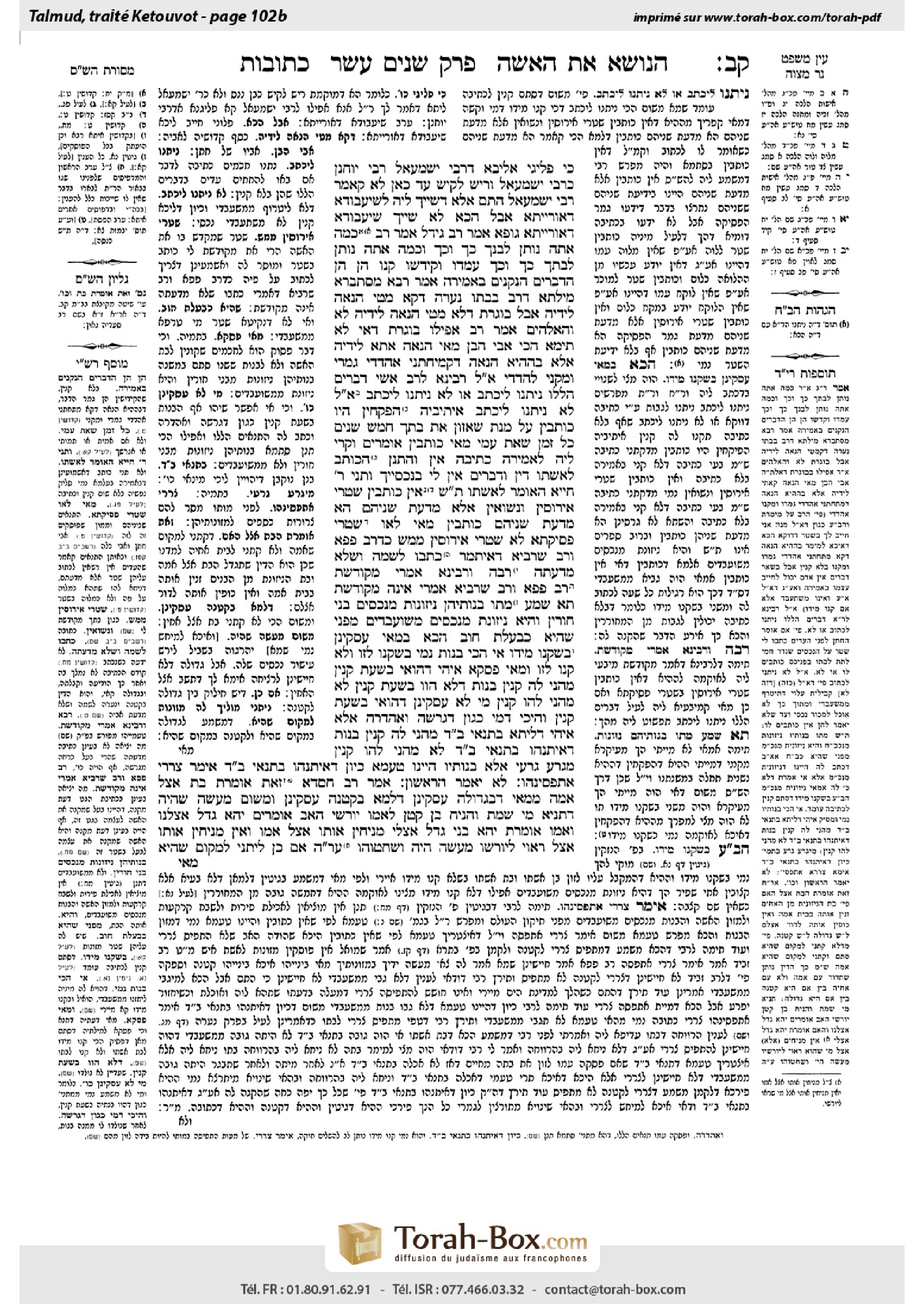
Ketubot 102b: Talmud study for Daf Yomi
Daf Yomi is the daily study of one Talmud folio. Explore 37 tractates with scans, Hebrew text, Sefaria English and AI-generated French translations where annotated.
Passage selection and English or AI-generated French translation are available where the scan has annotations. Daf Study is independent of Torah-Box and Sefaria.
Browse Ketubot · כתובות · All tractatesKetubot 102b text and translations
This page of Ketubot includes the Aramaic text, an English translation and an AI-generated French translation, alongside the scan above.
כתובות ק״ב ב · Aramaic and Hebrew text
כִּי פְּלִיגִי אַלִּיבָּא דְּרַבִּי יִשְׁמָעֵאל. רַבִּי יוֹחָנָן כְּרַבִּי יִשְׁמָעֵאל, וְרֵישׁ לָקִישׁ — עַד כָּאן לָא קָאָמַר רַבִּי יִשְׁמָעֵאל הָתָם אֶלָּא דְּשָׁיֵיךְ לֵיהּ לְשִׁיעְבּוּדָא דְאוֹרָיְיתָא, אֲבָל הָכָא לָא שָׁיֵיךְ שִׁיעְבּוּדָא דְאוֹרָיְיתָא.
גּוּפָא, אָמַר רַב גִּידֵּל אָמַר רַב: ״כַּמָּה אַתָּה נוֹתֵן לְבִנְךָ?״, ״כָּךְ וְכָךְ״. ״וְכַמָּה אַתָּה נוֹתֵן לְבִתְּךָ?״, ״כָּךְ וְכָךְ״. עָמְדוּ וְקִידְּשׁוּ קָנוּ, הֵן הֵן הַדְּבָרִים הַנִּקְנִים בַּאֲמִירָה.
אָמַר רָבָא: מִסְתַּבְּרָא מִילְּתָא דְּרַב בְּבִתּוֹ נַעֲרָה — דְּקָא מָטֵי הֲנָאָה לִידֵיהּ, אֲבָל בּוֹגֶרֶת דְּלָא מָטֵי הֲנָאָה לִידֵיהּ — לָא.
וְהָאֱלֹהִים! אָמַר רַב: אֲפִילּוּ בּוֹגֶרֶת. דְּאִי לָא תֵּימָא הָכִי, אֲבִי הַבֵּן מַאי הֲנָאָה אֲתָא לִידֵיהּ? אֶלָּא בְּהַהִיא הֲנָאָה דְּקָמִיחַתְּנִי אַהֲדָדֵי גָּמְרִי וּמַקְנִי לַהֲדָדֵי.
אֲמַר לֵיהּ רָבִינָא לְרַב אָשֵׁי: דְּבָרִים הַלָּלוּ נִיתְּנוּ לִיכָּתֵב, אוֹ לֹא נִיתְּנוּ לִיכָּתֵב? אֲמַר לֵיהּ: לֹא נִיתְּנוּ לִיכָּתֵב.
אֵיתִיבֵיהּ: הַפִּקְחִין הָיוּ כּוֹתְבִין ״עַל מְנָת שֶׁאָזוּן אֶת בִּתֵּךְ חָמֵשׁ שָׁנִים כׇּל זְמַן שֶׁאַתְּ עִמִּי״! מַאי ״כּוֹתְבִין״ — אוֹמְרִים.
וְקָרֵי לֵיהּ לַאֲמִירָה כְּתִיבָה? אִין, וְהָתְנַן: הַכּוֹתֵב לְאִשְׁתּוֹ ״דִּין וּדְבָרִים אֵין לִי בִּנְכָסַיִיךְ״, וְתָנֵי רַבִּי חִיָּיא: הָאוֹמֵר לְאִשְׁתּוֹ.
תָּא שְׁמַע: אֵין כּוֹתְבִין שְׁטָרֵי אֵירוּסִין וְנִשּׂוּאִין אֶלָּא מִדַּעַת שְׁנֵיהֶם. הָא מִדַּעַת שְׁנֵיהֶם כּוֹתְבִין. מַאי לָאו שְׁטָרֵי פְסִיקָתָא!
לָא, שְׁטָרֵי אֵירוּסִין מַמָּשׁ. כִּדְרַב פָּפָּא וְרַב שֵׁרֵבְיָא. דְּאִיתְּמַר: כְּתָבוֹ לִשְׁמָהּ, וְשֶׁלֹּא מִדַּעְתָּהּ — רַבָּה וְרָבִינָא אָמְרִי: מְקוּדֶּשֶׁת, רַב פָּפָּא וְרַב שֵׁרֵבְיָא אָמְרִי: אֵינָהּ מְקוּדֶּשֶׁת.
תָּא שְׁמַע: מֵתוּ — בְּנוֹתֵיהֶן נִיזּוֹנוֹת מִנְּכָסִים בְּנֵי חוֹרִין, וְהִיא נִיזּוֹנֶת מִנְּכָסִים מְשׁוּעְבָּדִים, מִפְּנֵי שֶׁהִיא כְּבַעֲלַת חוֹב.
הָכָא בְּמַאי עָסְקִינַן — בְּשֶׁקָּנוּ מִיָּדוֹ.
אִי הָכִי, בָּנוֹת נָמֵי! בְּשֶׁקָּנוּ לָזוֹ וְלֹא קָנוּ לָזוֹ.
וּמַאי פַּסְקָא? אִיהִי דַּהֲוַאי בִּשְׁעַת קִנְיָן — מַהֲנֵי לַהּ קִנְיָן, בָּנוֹת דְּלָא הֲווֹ בִּשְׁעַת קִנְיָן — לָא מַהֲנֵי לְהוּ קִנְיָן.
מִי לָא עָסְקִינַן דַּהֲוַאי בִּשְׁעַת קִנְיָן, וְהֵיכִי דָּמֵי — כְּגוֹן דְּגָרְשַׁהּ וְאַהְדְּרַהּ!
אֶלָּא: אִיהִי דְּלֵיתַאּ בִּתְנַאי בֵּית דִּין — מַהֲנֵי לַהּ קִנְיָן, בָּנוֹת דְּאִיתַנְהוּ בִּתְנַאי בֵּית דִּין — לָא מַהֲנֵי לְהוּ קִנְיָן.
מִגְרָע גָּרְעִי? אֶלָּא: בְּנוֹתָיו הַיְינוּ טַעְמָא — כֵּיוָן דְּאִיתַנְהוּ בִּתְנַאי בֵּית דִּין, אֵימַר צְרָרֵי אֶתְפְּסִינְהוּ.
לֹא יֹאמַר הָרִאשׁוֹן. אָמַר רַב חִסְדָּא: זֹאת אוֹמֶרֶת בַּת אֵצֶל אִמָּהּ.
מִמַּאי דְּבִגְדוֹלָה עָסְקִינַן? דִּלְמָא בִּקְטַנָּה עָסְקִינַן, וּמִשּׁוּם מַעֲשֶׂה שֶׁהָיָה.
דְּתַנְיָא: מִי שֶׁמֵּת וְהִנִּיחַ בֵּן קָטָן לְאִמּוֹ, יוֹרְשֵׁי הָאָב אוֹמְרִים: יְהֵא גָּדֵל אֶצְלֵנוּ, וְאִמּוֹ אוֹמֶרֶת: יְהֵא בְּנִי גָּדֵל אֶצְלִי — מַנִּיחִין אוֹתוֹ אֵצֶל אִמּוֹ, וְאֵין מַנִּיחִין אוֹתוֹ אֵצֶל רָאוּי לְיוֹרְשׁוֹ. מַעֲשֶׂה הָיָה וּשְׁחָטוּהוּ עֶרֶב הַפֶּסַח!
אִם כֵּן לִיתְנֵי לְמָקוֹם שֶׁהִיא,
Ketubot 102b · English translation
When they disagree, it is in accordance with the opinion of Rabbi Yishmael. Rabbi Yoḥanan stated his ruling in accordance with the simple interpretation of the opinion of Rabbi Yishmael. And Reish Lakish holds that Rabbi Yishmael states his opinion only there, in the case of the guarantor, which relates to an obligation of Torah law, since a guarantor is obligated by Torah law to pay. But here, where the case does not relate to an obligation of Torah law, as the man did not owe any money until he accepted this obligation upon himself, even Rabbi Yishmael would exempt him from paying.
§ The Gemara continues to analyze the matter itself mentioned earlier: Rav Giddel said that Rav said: When two families negotiate the terms of marriage for their respective children and one side says to the other: How much do you give your son? And the second side answers: Such and such amount. How much do you give your daughter? And the first side responds: Such and such amount. Then, if the son and daughter arose and performed the betrothal, all of these obligations are acquired and therefore binding. These are among the things that are acquired through words alone, without the need for an additional act of acquisition. The mishna is referring to a document that records such an agreement.
Rava said: Rav’s statement is reasonable in a case of a father whose daughter is a young woman, since the father derives benefit from this betrothal. The money given by the groom for the betrothal, as well as the rights to the bride’s marriage contract, belong to the father of the bride. Consequently, he accepts through verbal agreement alone the obligation to pay the money he specified. However, in the case of a grown woman, where the father does not derive benefit from the betrothal because the rights to the betrothal money and marriage contract belong to the woman herself, no, the father does not become obligated to pay the money he specified through verbal agreement alone.
Rava continues: But by God! Rav said his ruling even with regard to a grown woman, as, if you do not say so, in the case of the father of the groom, what monetary benefit does he derive from the betrothal? Rather, it must be explained that in exchange for that benefit, i.e., that the groom and bride marry each other, the fathers fully transfer the rights to the respective payments to each other.
Ravina said to Rav Ashi: Are these matters, i.e., verbal agreements concerning an upcoming marriage, allowed to be written down afterward in a proper contract, or are they not allowed to be written down afterward in a proper contract? Rav Ashi said to him: They are not allowed to be written down.
Ravina raised an objection to this from the mishna: The perspicacious ones would write an explicit stipulation into the agreement: I agree on the condition that I will sustain your daughter for five years only as long as you are with me. This indicates that one may document these verbal agreements. Rav Ashi responded: What is the meaning of the term write in this case? It means say.
Ravina continued to ask: Does the tanna refer to saying as writing? Rav Ashi replied: Yes. And so we learned in the mishna (83a): One who writes to his wife: I have no legal dealings or involvement in your properties, and Rabbi Ḥiyya taught in explanation, that it means: One who says to his wife. This proves that verbal agreements are sometimes referred to in the Mishna as writing.
The Gemara suggests: Come and hear a proof from the following mishna (Bava Batra 167b): One writes documents of betrothal and marriage only with the consent of both of them. It may be derived from here that with the consent of both of them, one may write the documents. What, is it not that this mishna is discussing documents of stipulation that specify the agreements accepted by each side before the marriage?
The Gemara rejects this: No, the discussion concerns actual betrothal documents. In other words, in a case where a man betroths a woman by giving her a document that states: You are hereby betrothed to me, the document must be written with the consent of both the man and the woman, in accordance with the opinions of Rav Pappa and Rav Sherevya. As it was stated: If the husband wrote a betrothal document for the sake of a specific woman and gave it to her, but he wrote it without her consent, Rabba and Ravina say: She is betrothed to this man. Rav Pappa and Rav Sherevya say: She is not betrothed.
The Gemara suggests further: Come and hear another proof that verbal agreements may be written down, based upon the mishna: If the two husbands died, their daughters are sustained from unsold property, and she, their wife’s daughter, whom they agreed to sustain for five years, is sustained even from liened property that was sold. This is due to the fact that her legal status is like that of a creditor, given that they are contractually obligated to pay her. The fact that she is able to repossess liened property indicates that the agreement is recorded in a document.
The Gemara rejects this proof: Here, we are dealing with a case where the woman acquired from each husband the right to her daughter’s sustenance, i.e., they performed an act of acquisition and did not suffice with a mere verbal agreement. Consequently, the agreement may be recorded in a document.
The Gemara asks: If that is so, that a proper mode of acquisition was employed, then let the husbands’ own daughters also repossess liened properties that were sold. The Gemara answers: The case is such where they acquired the right to receive sustenance for this daughter of the wife, and they did not acquire this right for that daughter, i.e., they did not perform an act of acquisition confirming their obligations to provide sustenance for their own daughters.
The Gemara asks: What makes it necessary to say that the case is one in which an acquisition was made on behalf of the wife’s daughter and not on behalf of the husbands’ own daughters? The Gemara answers: She, the wife’s daughter from a previous marriage, was present at the time of the transaction when her mother was wed. Consequently, for her the transaction is effective. With regard to the daughters of the husbands, who were born after their parents’ marriage and were not present at the time of the transaction, for them the transaction is not effective.
The Gemara asks: Are we not also dealing with a situation where the husband’s daughters were present at the time of the transaction? And what are the circumstances that would allow for such a reality? This could occur in a situation such as where each one divorced his wife and then took her back, and they had a daughter from their first marriage.
Rather, the distinction is as follows: She, the wife’s daughter, is not included in the stipulation of the court requiring a husband to support his daughters. Consequently, for her the transaction is effective. However, with regard to the husband’s own daughters, who are included in the stipulation of the court, for them the transaction is not effective.
The Gemara wonders about this: Because they are included in the stipulation of the court they are worse off? On the contrary, since the stipulation of the court demands that they be supported, they should wield more power. Rather, this is the reason that his own daughters do not collect from liened property: Since they are included in the stipulation of the court, and it is therefore the norm for fathers to take care to provide their support, say that their father gave them bundles of money while he was still alive. Due to this concern, they cannot repossess liened property. However, in the case of the wife’s daughter, who is not included in the stipulation of the court, there is no concern that the husband gave her anything prior to his death.
§ We learned in the mishna that the first husband may not say that he will provide his wife’s daughter with support only when she is with him. Rather, he must bring the sustenance to her in the place where her mother lives. Rav Ḥisda said: That is to say that in a case of divorce, a daughter lives with her mother.
The Gemara asks: From where do we know that we are dealing with a case of an adult woman and there is a general guideline that in cases of divorce, a girl lives with her mother? Perhaps we are dealing with a case of a minor girl, and she lives with her mother because of concern for her safety, due to an incident that occurred.
As it is taught in a baraita: In the case of one who died and left a minor son to the care of his mother, and the heirs of the father say: The son should grow up with us, and his mother says: My son should grow up with me, the halakha is that one leaves the child with his mother, and one does not leave the child with one who is fit to inherit from him, i.e., the father’s heirs. An incident occurred, and the boy lived with his father’s heirs, and they slaughtered him on the eve of Passover. So too, a minor girl is not left in the care of those who are obligated to sustain her and who have a financial interest in her demise.
The Gemara answers: If that is so, let the mishna teach that the husband must bring the sustenance to the place where she, the daughter, is located.
Ketubot 102b · Traduction française (IA)
Lorsqu’ils sont en désaccord, c’est conformément à l’opinion de Rabbi Yishmael. Rabbi Yoḥanan a statué selon l’interprétation littérale de l’opinion de Rabbi Yishmael. Reish Lakish, quant à lui, estime que Rabbi Yishmael n’exprime son opinion que dans ce cas-là, celui du garant, qui concerne une obligation relevant de la Torah, puisque le garant est tenu par la Torah de payer. Mais ici, puisque le cas ne concerne pas une obligation relevant de la Torah, car l’homme ne devait aucune somme avant d’assumer cette obligation, même Rabbi Yishmael l’exempterait de payer.
§ La Guemara poursuit l’analyse de la question mentionnée précédemment : Rav Giddel a dit au nom de Rav : Lorsque deux familles négocient les conditions du mariage de leurs enfants respectifs, l’une demande à l’autre : « Combien donnez-vous à votre fils ? » L’autre répond : « Telle somme. » Puis la première demande : « Combien donnez-vous à votre fille ? » et la seconde répond : « Telle somme. » Si le fils et la fille se lèvent ensuite et se fiancent, toutes ces obligations sont acquises et, par conséquent, contraignantes. Elles font partie des choses qui sont acquises par la seule parole, sans qu’un acte d’acquisition supplémentaire soit nécessaire. La Michna parle d’un document qui consigne un tel accord.
Rava a dit : La déclaration de Rav est raisonnable lorsqu’il s’agit du père d’une jeune fille, car il tire profit de ces fiançailles. L’argent donné par le fiancé pour les fiançailles, ainsi que les droits sur la ketouba de la fiancée, reviennent au père de celle-ci. Par conséquent, il accepte, par la seule parole, l’obligation de verser la somme qu’il a indiquée. En revanche, dans le cas d’une femme adulte, le père ne tire aucun profit des fiançailles, puisque les droits sur l’argent des fiançailles et sur la ketouba appartiennent à la femme elle-même ; le père ne devient donc pas tenu de verser la somme qu’il a indiquée par la seule parole.
Rava poursuit : Mais, par Dieu ! Rav a formulé sa décision même au sujet d’une femme adulte. Car, si tu ne l’admets pas, quel avantage financier le père du fiancé tire-t-il des fiançailles ? Il faut donc plutôt expliquer qu’en échange de cet avantage, c’est-à-dire du mariage du fiancé et de la fiancée, les pères se transfèrent pleinement l’un à l’autre les droits sur les sommes respectives.
Ravina demanda à Rav Ashi : Ces accords, c’est-à-dire les accords verbaux concernant un mariage à venir, peut-on les consigner ensuite dans un contrat en bonne et due forme, ou non ? Rav Ashi lui répondit : On ne peut pas les consigner ensuite.
Ravina objecta à partir de la Michna : Les perspicaces inséraient dans l’accord une condition explicite : « J’accepte à la condition que je n’entretienne ta fille pendant cinq ans que tant que tu es avec moi. » Cela indique que l’on peut consigner ces accords verbaux. Rav Ashi répondit : Que signifie ici le terme « écrire » ? Il signifie « dire ».
Ravina poursuivit : Le tanna emploie-t-il le terme « dire » au sens d’« écrire » ? Rav Ashi répondit : Oui. Nous avons également appris dans la Michna (83a) : « Celui qui écrit à sa femme : “Je n’ai aucun droit ni aucune prérogative sur tes biens” » ; et Rabbi Ḥiyya a enseigné, pour expliquer ce passage, qu’il faut comprendre : « Celui qui dit à sa femme ». Cela prouve que, dans la Michna, des accords verbaux sont parfois désignés comme des écrits.
La Guemara propose : Viens et entends une preuve tirée de la Michna suivante (Bava Batra 167b) : « On ne rédige des actes de fiançailles et de mariage qu’avec le consentement des deux parties. » N’en déduit-on pas qu’avec leur consentement à tous deux, on peut rédiger ces documents ? La Michna ne parle-t-elle pas d’actes de stipulation précisant les accords acceptés par chaque partie avant le mariage ?
La Guemara rejette cette interprétation : Non, il s’agit d’actes de fiançailles proprement dits. Autrement dit, lorsqu’un homme fiance une femme en lui remettant un document portant la formule : « Tu m’es par la présente fiancée », le document doit être rédigé avec le consentement de l’homme et de la femme, conformément aux opinions de Rav Pappa et de Rav Sherevya. En effet, il a été enseigné : Si le mari a rédigé un acte de fiançailles pour une femme précise et le lui a remis, mais qu’il l’a rédigé sans son consentement, Rabba et Ravina disent : « Elle est fiancée à cet homme. » Rav Pappa et Rav Sherevya disent : « Elle n’est pas fiancée. »
La Guemara propose encore : Viens et entends une autre preuve que des accords verbaux peuvent être consignés par écrit, tirée de la Michna : « Si les deux maris meurent, leurs filles sont entretenues sur les biens non vendus, tandis que la fille de leur épouse, qu’ils s’étaient engagés à entretenir pendant cinq ans, est entretenue même sur les biens grevés d’un privilège et vendus. » En effet, son statut juridique est celui d’une créancière, puisqu’ils sont contractuellement tenus de la payer. Le fait qu’elle puisse faire valoir son droit sur des biens grevés d’un privilège indique que l’accord est consigné dans un document.
La Guemara rejette cette preuve : Ici, il s’agit d’un cas où la femme a obtenu de chacun des maris qu’il acquière pour sa fille le droit à l’entretien ; autrement dit, ils ont accompli un acte d’acquisition et ne se sont pas contentés d’un simple accord verbal. Par conséquent, l’accord peut être consigné dans un document.
La Guemara demande : Si tel est le cas, puisqu’un mode d’acquisition valable a été employé, que les propres filles des maris puissent elles aussi faire valoir leur droit sur les biens grevés d’un privilège et vendus ! La Guemara répond : Il s’agit d’un cas où ils ont acquis le droit à l’entretien pour cette fille de l’épouse, mais ne l’ont pas acquis pour cette autre fille, c’est-à-dire qu’ils n’ont pas accompli d’acte d’acquisition confirmant leur obligation d’entretenir leurs propres filles.
La Guemara demande : Pourquoi faut-il dire qu’une acquisition a été faite au profit de la fille de l’épouse et non au profit des propres filles des maris ? La Guemara répond : Elle, la fille de l’épouse issue d’un mariage précédent, était présente lors de la transaction, au moment du mariage de sa mère. La transaction est donc effective pour elle. En revanche, les filles des maris, nées après le mariage de leurs parents et qui n’étaient pas présentes au moment de la transaction, ne sont pas concernées par celle-ci.
La Guemara demande : Ne sommes-nous pas également dans une situation où les filles du mari étaient présentes au moment de la transaction ? Dans quelles circonstances cela pourrait-il se produire ? Par exemple, si chacun a divorcé de sa femme puis l’a reprise, et qu’ils avaient une fille issue de leur premier mariage.
Il faut plutôt distinguer ainsi : Elle, la fille de l’épouse, n’est pas concernée par la stipulation des sages imposant à un mari d’entretenir ses filles. La transaction est donc effective pour elle. En revanche, les propres filles du mari sont concernées par cette stipulation des sages ; la transaction n’est donc pas effective pour elles.
La Guemara s’étonne : Le fait qu’elles soient concernées par la stipulation des sages les désavantage-t-il ? Au contraire, puisque cette stipulation exige qu’elles soient entretenues, elles devraient avoir davantage de droits. Il faut plutôt expliquer que ses propres filles ne peuvent pas faire valoir leur créance sur les biens grevés d’un privilège pour la raison suivante : puisqu’elles sont concernées par la stipulation des sages et qu’il est donc d’usage que les pères veillent à subvenir à leurs besoins, on peut supposer que leur père leur a donné des sommes d’argent de son vivant. En raison de cette crainte, elles ne peuvent pas faire valoir leur droit sur les biens grevés d’un privilège. En revanche, dans le cas de la fille de l’épouse, qui n’est pas concernée par la stipulation des sages, rien ne permet de craindre que le mari lui ait donné quoi que ce soit avant sa mort.
§ Nous avons appris dans la Michna que le premier mari ne peut pas dire qu’il ne subviendra aux besoins de la fille de son épouse que lorsqu’elle sera chez lui. Il doit plutôt lui apporter de quoi la faire vivre là où habite sa mère. Rav Ḥisda a dit : Cela signifie qu’en cas de divorce, une fille vit avec sa mère.
La Guemara demande : D’où savons-nous qu’il s’agit d’une femme adulte et qu’il existe une règle générale selon laquelle, en cas de divorce, une fille vit avec sa mère ? Peut-être s’agit-il d’une fille mineure, qui vit avec sa mère par souci de sa sécurité, en raison d’un incident qui s’est produit.
Comme il est enseigné dans une baraïta : Si un homme meurt en laissant un fils mineur sous la garde de sa mère, et que les héritiers du père disent : « Que le fils grandisse avec nous », tandis que sa mère dit : « Que mon fils grandisse avec moi », la halakha est qu’on laisse l’enfant avec sa mère et qu’on ne le confie pas à ceux qui sont susceptibles d’hériter de lui, c’est-à-dire aux héritiers du père. Un incident s’est produit : le garçon vivait avec les héritiers de son père, et ils l’ont égorgé la veille de Pessa’h. De même, une fille mineure n’est pas confiée à ceux qui sont tenus de l’entretenir et qui ont un intérêt financier à sa mort.
La Guemara répond : Si tel est le cas, que la Michna enseigne que le mari doit apporter de quoi la faire vivre là où elle, la fille, se trouve.
Traduction française générée par IA à partir de l’édition anglaise de Sefaria. Vérifie toujours un passage avec le texte source.
Text from Sefaria: William Davidson Edition - Vocalized Aramaic (CC BY NC); William Davidson Edition - English (CC BY NC).