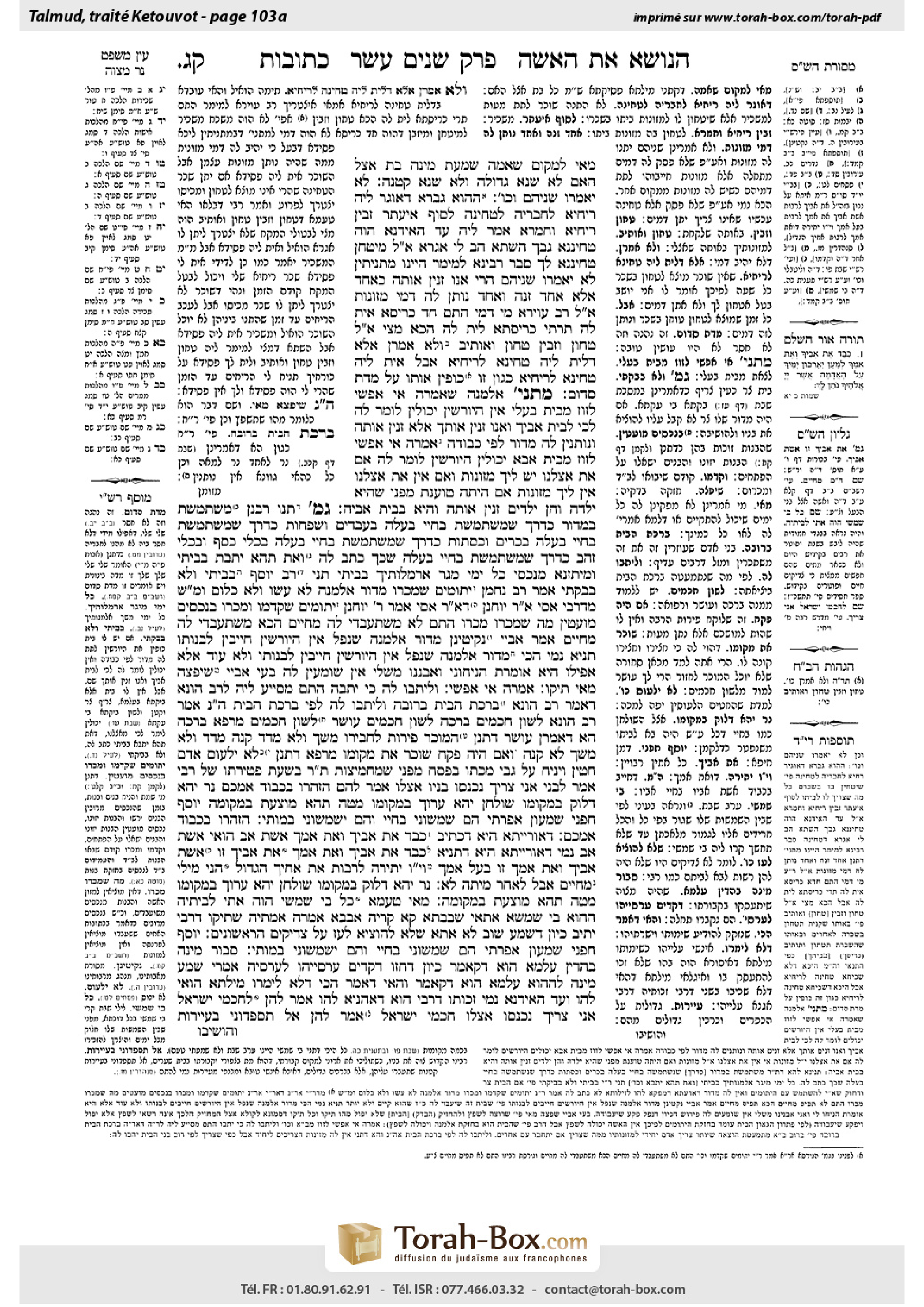
Ketubot 103a: Talmud study for Daf Yomi
Daf Yomi is the daily study of one Talmud folio. Explore 37 tractates with scans, Hebrew text, Sefaria English and AI-generated French translations where annotated.
Passage selection and English or AI-generated French translation are available where the scan has annotations. Daf Study is independent of Torah-Box and Sefaria.
Browse Ketubot · כתובות · All tractatesKetubot 103a text and translations
This page of Ketubot includes the Aramaic text, an English translation and an AI-generated French translation, alongside the scan above.
כתובות ק״ג א · Aramaic and Hebrew text
מַאי לִמְקוֹם שֶׁאִמָּהּ? שָׁמְעַתְּ מִינַּהּ בַּת אֵצֶל הָאֵם, לָא שְׁנָא גְּדוֹלָה וְלָא שְׁנָא קְטַנָּה.
לֹא יֹאמְרוּ שְׁנֵיהֶם וְכוּ׳.
הָהוּא גַּבְרָא דְּאוֹגַר לֵיהּ רִיחְיָא לְחַבְרֵיהּ לִטְחִינָה. לְסוֹף אִיעַתַּר, זְבֵין רִיחְיָא וְחַמְרָא,
אֲמַר לֵיהּ: עַד הָאִידָּנָא הֲוָה טָחֵינְנָא גַּבָּךְ, הַשְׁתָּא הַב לִי אַגְרָא. אֲמַר לֵיהּ: מִיטְחָן טָחֵינְנָא לָךְ.
סְבַר רָבִינָא לְמֵימַר: הַיְינוּ מַתְנִיתִין לֹא יֹאמְרוּ שְׁנֵיהֶם ״הֲרֵי אָנוּ זָנִין אוֹתָהּ כְּאֶחָד״, אֶלָּא אֶחָד זָנָהּ וְאֶחָד נוֹתֵן לָהּ דְּמֵי מְזוֹנוֹת.
אֲמַר לֵיהּ רַב עַוִּירָא: מִי דָּמֵי? הָתָם, חַד כְּרֵיסָא אִית לַהּ, תַּרְתֵּי כְּרֵיסָתָא לֵית לַהּ. הָכָא מָצֵי אֲמַר לֵיהּ: טְחוֹן וְזַבֵּין, טְחוֹן וְאוֹתֵיב.
וְלָא אֲמַרַן אֶלָּא דְּלֵית לֵיהּ טְחִינָא לְרִיחְיָא, אֲבָל אִית לֵיהּ טְחִינָא לְרִיחְיָא — כְּגוֹן זוֹ כּוֹפִין אוֹתוֹ עַל מִדַּת סְדוֹם.
מַתְנִי׳ אַלְמָנָה שֶׁאָמְרָה: אִי אֶפְשִׁי לָזוּז מִבֵּית בַּעְלִי — אֵין הַיּוֹרְשִׁין יְכוֹלִין לוֹמַר לָהּ: ״לְכִי לְבֵית אָבִיךְ וְאָנוּ זָנִין אוֹתָךְ״, אֶלָּא זָנִין אוֹתָהּ, וְנוֹתְנִין לָהּ מָדוֹר לְפִי כְּבוֹדָהּ.
אָמְרָה: ״אִי אֶפְשִׁי לָזוּז מִבֵּית אַבָּא״ — יְכוֹלִין הַיּוֹרְשִׁין לוֹמַר לָהּ: אִם אַתְּ אֶצְלֵנוּ — יֵשׁ לִיךְ מְזוֹנוֹת, וְאִם אֵין אַתְּ אֶצְלֵנוּ אֵין לִיךְ מְזוֹנוֹת.
אִם הָיְתָה טוֹעֶנֶת מִפְּנֵי שֶׁהִיא יַלְדָּה וְהֵן יְלָדִים — זָנִין אוֹתָהּ וְהִיא בְּבֵית אָבִיהָ.
גְּמָ׳ תָּנוּ רַבָּנַן: מִשְׁתַּמֶּשֶׁת בַּמָּדוֹר כְּדֶרֶךְ שֶׁמִּשְׁתַּמֶּשֶׁת בְּחַיֵּי בַעְלָהּ. בַּעֲבָדִים וּשְׁפָחוֹת כְּדֶרֶךְ שֶׁמִּשְׁתַּמֶּשֶׁת בְּחַיֵּי בַעְלָהּ. בְּכָרִים וּכְסָתוֹת כְּדֶרֶךְ שֶׁמִּשְׁתַּמֶּשֶׁת בְּחַיֵּי בַעְלָהּ. בִּכְלֵי כֶסֶף וּבִכְלֵי זָהָב כְּדֶרֶךְ שֶׁמִּשְׁתַּמֶּשֶׁת בְּחַיֵּי בַעְלָהּ. שֶׁכָּךְ כָּתַב לָהּ: ״וְאַתְּ תְּהֵא יָתְבַתְּ בְּבֵיתִי וּמִיתַּזְנָא מִנִּכְסַי כֹּל יְמֵי מֵגַר אַרְמְלוּתִיךְ בְּבֵיתִי״.
תָּנֵי רַב יוֹסֵף: ״בְּבֵיתִי״ — וְלֹא בְּבִקְתִּי.
אָמַר רַב נַחְמָן: יְתוֹמִים שֶׁמָּכְרוּ מְדוֹר אַלְמָנָה — לֹא עָשׂוּ וְלֹא כְּלוּם.
וּמַאי שְׁנָא מִדְּרַבִּי אַסִּי אָמַר רַבִּי יוֹחָנָן? דְּאָמַר רַבִּי אַסִּי אָמַר רַבִּי יוֹחָנָן: יְתוֹמִים שֶׁקָּדְמוּ וּמָכְרוּ בִּנְכָסִים מוּעָטִין — מַה שֶּׁמָּכְרוּ מָכְרוּ.
הָתָם לָא מִשְׁתַּעְבְּדִי לַהּ מֵחַיִּים, הָכָא מִשְׁתַּעְבְּדִי לַהּ מֵחַיִּים.
אָמַר אַבָּיֵי, נְקִיטִינַן: מְדוֹר אַלְמָנָה שֶׁנָּפַל — אֵין הַיּוֹרְשִׁין חַיָּיבִין לִבְנוֹתוֹ,
תַּנְיָא נָמֵי הָכִי: מְדוֹר אַלְמָנָה שֶׁנָּפַל — אֵין הַיּוֹרְשִׁין חַיָּיבִין לִבְנוֹתוֹ. וְלֹא עוֹד, אֶלָּא אֲפִילּוּ הִיא אוֹמֶרֶת ״הַנִּיחוּנִי וְאֶבְנֶנּוּ מִשֶּׁלִּי״ — אֵין שׁוֹמְעִין לָהּ.
בָּעֵי אַבָּיֵי: שִׁיפְּצָה, מַאי? תֵּיקוּ.
אָמְרָה אִי אֶפְשִׁי.
וְלִיתְּבוּ לַהּ כִּי יָתְבָה הָתָם? מְסַיַּיע לֵיהּ לְרַב הוּנָא. דְּאָמַר רַב הוּנָא: בִּרְכַּת הַבַּיִת בְּרוּבָּה.
וְלִיתְּבוּ לַהּ לְפִי בִּרְכַּת הַבַּיִת? הָכִי נָמֵי.
אָמַר רַב הוּנָא: לְשׁוֹן חֲכָמִים בְּרָכָה, לְשׁוֹן חֲכָמִים עוֹשֶׁר, לְשׁוֹן חֲכָמִים מַרְפֵּא. בְּרָכָה הָא דַּאֲמַרַן.
עוֹשֶׁר, דִּתְנַן: הַמּוֹכֵר פֵּירוֹת לַחֲבֵירוֹ, מָשַׁךְ וְלֹא מָדַד — קָנָה, מָדַד וְלֹא מָשַׁךְ — לֹא קָנָה. וְאִם הָיָה פִּקֵּחַ — שׂוֹכֵר אֶת מְקוֹמוֹ.
מַרְפֵּא, דִּתְנַן: לֹא יִלְעוֹס אָדָם חִטִּין וְיַנִּיחַ עַל גַּבֵּי מַכָּתוֹ בַּפֶּסַח, מִפְּנֵי שֶׁמַּחְמִיצוֹת.
תָּנוּ רַבָּנַן, בִּשְׁעַת פְּטִירָתוֹ שֶׁל רַבִּי, אָמַר: לְבָנַי אֲנִי צָרִיךְ. נִכְנְסוּ בָּנָיו אֶצְלוֹ. אָמַר לָהֶם: הִזָּהֲרוּ בִּכְבוֹד אִמְּכֶם. נֵר יְהֵא דָּלוּק בִּמְקוֹמוֹ, שׁוּלְחָן יְהֵא עָרוּךְ בִּמְקוֹמוֹ, מִטָּה תְּהֵא מוּצַּעַת בִּמְקוֹמָהּ. יוֹסֵף חׇפְנִי שִׁמְעוֹן אֶפְרָתִי הֵם שִׁמְּשׁוּנִי בְּחַיַּי, וְהֵם יְשַׁמְּשׁוּנִי בְּמוֹתִי.
הִזָּהֲרוּ בִּכְבוֹד אִמְּכֶם. דְּאוֹרָיְיתָא הִיא, דִּכְתִיב: ״כַּבֵּד אֶת אָבִיךָ וְאֶת אִמֶּךָ״! אֵשֶׁת אָב הֲוַאי.
אֵשֶׁת אָב נָמֵי דְּאוֹרָיְיתָא הִיא, דְּתַנְיָא: ״כַּבֵּד אֶת אָבִיךָ וְאֶת אִמֶּךָ״, ״אֶת אָבִיךָ״ — זוֹ אֵשֶׁת אָבִיךָ, ״וְאֶת אִמֶּךָ״ — זוֹ בַּעַל אִמֶּךָ, וָיו יְתֵירָה — לְרַבּוֹת אֶת אָחִיךָ הַגָּדוֹל!
הָנֵי מִילֵּי מֵחַיִּים, אֲבָל לְאַחַר מִיתָה לָא.
״נֵר יְהֵא דָּלוּק בִּמְקוֹמוֹ, שׁוּלְחָן יְהֵא עָרוּךְ בִּמְקוֹמוֹ, מִטָּה תְּהֵא מוּצַּעַת בִּמְקוֹמָהּ״, מַאי טַעְמָא? כֹּל בֵּי שִׁמְשֵׁי הֲוָה אָתֵי לְבֵיתֵיהּ.
הַהוּא בֵּי שִׁמְשָׁא אֲתַאי שִׁבָבְתָּא, קָא קָרְיָה אַבָּבָא, אֲמַרָה אַמְּתֵיהּ: שְׁתִיקוּ, דְּרַבִּי יָתֵיב. כֵּיוָן דִּשְׁמַע, שׁוּב לָא אֲתָא, שֶׁלֹּא לְהוֹצִיא לַעַז עַל צַדִּיקִים הָרִאשׁוֹנִים.
״יוֹסֵף חׇפְנִי שִׁמְעוֹן אֶפְרָתִי, הֵם שִׁמְּשׁוּנִי בְּחַיַּי וְהֵם יְשַׁמְּשׁוּנִי בְּמוֹתִי״. סְבוּר מִינָּה בְּהָדֵין עָלְמָא הוּא דְּקָאָמַר, כֵּיוָן דַּחֲזוֹ דְּקָדֵים עַרְסַיְיהוּ לְעַרְסֵיהּ, אָמְרִי: שְׁמַע מִינַּהּ לְהָהוּא עָלְמָא הוּא דְּקָאָמַר.
וְהַאי דַּאֲמַר הָכִי — דְּלָא לֵימְרוּ: מִילְּתָא הֲוַאי לְהוּ וְעַד הָאִידָּנָא נָמֵי זְכוּתוֹ דְּרַבִּי הוּא דְּאַהַנְיָא לְהוּ.
אָמַר לָהֶן: לְחַכְמֵי יִשְׂרָאֵל אֲנִי צָרִיךְ. נִכְנְסוּ אֶצְלוֹ חַכְמֵי יִשְׂרָאֵל, אָמַר לָהֶן: ״אַל תִּסְפְּדוּנִי בָּעֲיָירוֹת,
Ketubot 103a · English translation
What is the purpose of emphasizing: To the place where her mother lives? Conclude from here that a daughter lives with her mother; it is no different if she is an adult woman, and it is no different if she is a minor girl.
§ It was taught in the mishna that if two men are obligated to support this girl, both of them may not jointly say that they will be partners in her support. Rather, each one fulfills his obligation independently.
The Gemara relates that there was a certain man who rented out a millstone to another for the price of grinding, i.e., the one who rented the millstone was to pay the cost of the rental by grinding whatever the owner needed to be ground. In the end, the owner of the millstone became rich, and he purchased another millstone and a donkey, and he no longer required the services of the renter to grind things for him.
The owner of the millstone said to the renter: Until now I would have what I needed ground by you, and the service that you provided was in place of payment for the rental of the millstone. Now, since I no longer require this service, give me payment for the millstone. The renter said back to him: I will grind for you because that is what I agreed to, but I did not agree to have to pay money.
Ravina thought to say that this is the same as the mishna that states that both of them may not jointly say: We will sustain the girl as one in a partnership. Rather, one sustains her, providing her with food, while the other gives her the monetary value of the sustenance. In that case, although the original condition was to provide the girl with support in the form of food, when circumstances changed, the previous husband became obligated to pay her support in the form of money. So too here, due to the change in circumstances, the renter should pay the owner of the millstone with money.
Rav Avira said to Ravina: Are the two cases comparable? There, in the case of the girl, she has only one stomach; she does not have two stomachs. Therefore, it is impossible for both of them to support her with food. Here, in the case of the millstone, the renter is able to say to him: Grind and sell, grind and store for later use, i.e., the owner of the millstone can use his new millstone to grind for others at a profit, and at the same time the renter will continue grinding the owner’s grain as per their agreement. Therefore, the renter is not obligated to change the terms of the original agreement.
The Gemara notes: We said this only in a case where the renter does not have any other grinding to do with the millstone and without the grinding that the renter does for the owner the mill will remain inoperative. However, if he has other grinding to do with the millstone, i.e., instead of grinding the owner’s grain he can grind the grain of others for a fee and thereby pay money for his rental, in a case such as this one forces him to cease his conduct characteristic of Sodom and to pay his rental fee in the form of money.
MISHNA: In the case of a widow who said: I do not want to move from my husband’s house, but instead I wish to remain there, the heirs are not able to say to her: Go to your father’s house and we will sustain you. Rather, they sustain her in her husband’s house and they give her living quarters befitting her dignity.
However, if she said: I do not want to move from my father’s house, and you should bring me my support there, the heirs are able to say to her: If you are living with us, you will have sustenance from us, but if you are not living with us, you will not have sustenance from us.
If she argued that she does not wish to live in her deceased husband’s house because she is young, and they, the heirs, are also young, and it is improper for them to be living in the same house together, then they sustain her and she stays in her father’s house.
GEMARA: The Sages taught: A widow that remains in her husband’s house uses the living quarters in the same manner that she would use them in her husband’s lifetime. She uses the slaves and the maidservants in the same manner that she would use them in her husband’s lifetime, the pillows and the sheets in the same manner that she would use them in her husband’s lifetime, and the silver utensils and gold utensils in the same manner that she would use them in her husband’s lifetime. She maintains all the rights she had during her husband’s lifetime because this is what he wrote to her in the text of the marriage contract: And you will reside in my house and be sustained from my property all the days that you live in my house as a widow.
Rav Yosef taught: The husband stipulated in the marriage contract: You will reside in my house, with the implication: And not in my hut. Therefore, if the house is too small, she cannot obligate the heirs to allow her to live in the house with them.
Rav Naḥman said: Orphans who sold the living quarters of a widow did not do anything, i.e., the sale is invalid.
The Gemara asks: And in what way is this case different from that which Rabbi Asi said that Rabbi Yoḥanan said? As Rabbi Asi said that Rabbi Yoḥanan said: With regard to orphans who preemptively sold from the small quantity of property left to them by their father before the court appropriated it for the purpose of providing for female children, who do not inherit, what they sold is sold, even though they acted improperly. Why, then, is the sale of a widow’s living quarters invalid?
The Gemara answers: There, in the case of orphans selling property that according to halakha should be retained in order to support the orphaned daughters, the property is not mortgaged to the orphaned daughters from the lifetime of their father, since the lien on the property arising from the obligation to provide support for the daughters occurs only after the father’s death. Here, in the case of the widow’s living quarters, the property is mortgaged to her from the lifetime of her husband, who was obligated even while he was alive to provide her with a place to live.
Abaye said: We hold on the authority of tradition that in the case of a widow’s living quarters that collapsed, the heirs are not obligated to rebuild it, since they are obligated to maintain her in the residence that was mortgaged to her and are not required to provide her with a place to live.
This is also taught in a baraita: In the case of a widow’s living quarters that collapsed, the heirs are not obligated to rebuild it. And not only this, but even if she says: Leave me be and I will rebuild it from my own funds, one does not listen to her, and the heirs do not have to let her rebuild it.
Abaye raised a dilemma: If she repaired the house, what is the halakha? Is it as though the house collapsed and was rebuilt, in which case she no longer has rights to it, or may she stay in the house as long as it remains standing? The Gemara concludes: The dilemma shall stand unresolved.
§ We learned in the mishna: If she said: I do not want to move from my father’s house and you should bring me my support there, the heirs are not obligated to support her.
The Gemara asks: And why is this so? They should give her support just as they would if she were living there, i.e., in her husband’s house. The Gemara answers: This supports the view of Rav Huna, as Rav Huna said: The blessing of the house is in its abundance of residents. This means that the amount of blessing in a home is proportionate to the number of people who live there. When there are many people living together in one home, the expenses per capita are decreased. The heirs can say to her that if she stays with them in the house, the expense of her upkeep will be less than if she lives on her own.
The Gemara asks: And they should give her the support in her father’s house according to the blessing of the house, i.e., according to the amount they would be required to pay if she lived with them. The Gemara answers: Indeed, the intent of the mishna is that they may pay her this amount, not that they may entirely avoid supporting her.
Rav Huna said: The language of the Sages teaches blessing, the language of the Sages teaches wealth, and the language of the Sages teaches healing. One can learn important lessons about these matters from the manner in which the Sages formulated their halakhic rulings. How is this so? With regard to blessing, it is that which we said above about the blessings of the home.
The language of the Sages teaches about wealth, as we learned in a mishna (Bava Batra 84b): One who sells produce to another, if the buyer pulled the produce as an act of acquisition but did not measure it, he has acquired the produce. If he measured the produce but did not pull it, he has not acquired it. And if the buyer was perspicacious and wanted to ensure that the seller would not back out of the deal, he would rent the place where the produce was located, and he would thereby acquire the produce immediately from the time he measures it. This mishna teaches good counsel in money-related matters.
The language of the Sages teaches about healing, as we learned in a mishna (Pesaḥim 39b): A person should not chew wheat and then place it on his wound during Passover because the wheat will become leavened as a result. This comment of the Sages indicates that chewed wheat is beneficial for treating a wound.
§ The Sages taught: At the time of the passing of Rabbi Yehuda HaNasi, he said: I need my sons. His sons entered his room. He said to them as a last will and testament: Be careful with the honor of your mother. He said further: My lamp should be lit in its usual place, my table should be set in its usual place, and the bed should be arranged in its usual place. Yosef Ḥeifani and Shimon Efrati; they served me during my lifetime and they will serve me in my death.
The Gemara clarifies the various requests that he made of his sons: Be careful with the honor of your mother. The Gemara asks: Why would he need to say this? After all, this is required by Torah law, as it is written: “Honor your father and your mother” (Exodus 20:11)? The Gemara answers: She was their father’s wife. She was not their mother, but their stepmother, and he therefore needed to caution them concerning her honor.
The Gemara asks: Honoring a father’s wife is also required by Torah law, as it is taught in a baraita: Honor your father [et avikha] and your mother [ve’et immekha]. The preposition et in the phrase: Your father; this teaches that you must honor your father’s wife. Similarly, the preposition et in the phrase: And your mother; this teaches that you must honor your mother’s husband. And the extra letter vav, which is appended as a prefix in the phrase “ve’et immekha” is included in order to add your older brother to those who must be honored.
The Gemara answers: This halakha, that one is obligated by Torah law to respect his father’s wife, applies only during his father’s lifetime. While the father is alive, out of respect for him, his wife must also be treated with respect. However, following his death, no, there is no longer any obligation to honor a stepmother. It was for this reason that Rabbi Yehuda HaNasi had to caution his sons in this matter.
Rabbi Yehuda HaNasi commanded his sons: My lamp should be lit in its usual place, my table should be set in its usual place, and the bed should be arranged in its usual place. The Gemara asks: What is the reason he made these requests? The Gemara explains: Every Shabbat eve, even after his passing, Rabbi Yehuda HaNasi would come to his house as he had done during his lifetime, and he therefore wished for everything to be set up as usual.
The Gemara relates the following incident: It happened on a certain Shabbat eve that a neighbor came by and called and knocked at the door. His maidservant said to her: Be quiet, for Rabbi Yehuda HaNasi is sitting. When he heard his maidservant reveal his presence to the neighbor, he did not come again, so as not to cast aspersions on earlier righteous individuals who did not appear to their families following their death.
The Gemara elaborates on Rabbi Yehuda HaNasi’s statement: Yosef Ḥeifani and Shimon Efrati, they served me during my lifetime and they will serve me in my death. It was understood from this statement that Rabbi Yehuda HaNasi was speaking of this world, that these two should serve him in his death and administer his burial. However, when they saw that their biers preceded his bier, i.e., they died before him, they said: Conclude from here that he was speaking of that world. They will attend to him in the World-to-Come.
And the reason he said this was so that people should not say: There was something wrong with them, and until now, too, it was the merit of Rabbi Yehuda HaNasi that benefited them and prevented them from dying due to their sins. Now that Rabbi Yehuda HaNasi is dying, his merit no longer protects them. Rabbi Yehuda HaNasi therefore clarified that the reason for their deaths was in order to enable them to escort him in death as in life.
§ Rabbi Yehuda HaNasi said further to his attendants: I need the Sages of Israel. The Sages of Israel entered his room. He said to them: Do not eulogize me in the small towns
Ketubot 103a · Traduction française (IA)
À quoi bon préciser : « Au lieu où vit sa mère » ? On en déduit qu’une fille vit avec sa mère, qu’elle soit adulte ou mineure.
§ Il a été enseigné dans la Michna que, lorsque deux hommes sont tenus d’entretenir cette fille, ils ne peuvent pas dire ensemble qu’ils se partageront les frais de son entretien. Au contraire, chacun s’acquitte séparément de son obligation.
La Guemara rapporte qu’un homme avait loué à un autre une meule, le prix de la location devant être acquitté sous forme de mouture : le locataire devait moudre ce dont le propriétaire avait besoin. Finalement, le propriétaire de la meule s’enrichit, acheta une autre meule et un âne, et n’eut plus besoin des services du locataire pour moudre ce dont il avait besoin.
Le propriétaire de la meule dit au locataire : « Jusqu’à présent, je te faisais moudre ce dont j’avais besoin, et le service que tu me rendais tenait lieu de paiement pour la location de la meule. Maintenant que je n’ai plus besoin de ce service, paie-moi la location de la meule. » Le locataire lui répondit : « Je moudrai pour toi, puisque c’est ce à quoi je me suis engagé, mais je ne me suis pas engagé à payer en argent. »
Ravina envisagea de dire que ce cas est comparable à celui de la Michna, qui enseigne qu’ils ne peuvent pas dire ensemble : « Nous entretiendrons la fille en nous partageant les frais. » Au contraire, l’un l’entretient en lui fournissant de la nourriture, tandis que l’autre lui verse la valeur monétaire de son entretien. Dans ce cas, bien que l’accord initial ait prévu de subvenir aux besoins de la fille en lui fournissant de la nourriture, lorsque les circonstances changèrent, l’ancien mari fut tenu de payer son entretien en argent. De même, ici, en raison du changement de circonstances, le locataire devrait payer le propriétaire de la meule en argent.
Rav Avira dit à Ravina : « Les deux cas sont-ils comparables ? Dans le cas de la fille, elle n’a qu’un seul estomac, pas deux. Il est donc impossible que tous deux subviennent à ses besoins en lui fournissant de la nourriture. Ici, dans le cas de la meule, le locataire peut lui dire : “Mouds et vends, mouds et entrepose pour plus tard”, c’est-à-dire que le propriétaire peut utiliser sa nouvelle meule pour moudre pour d’autres et en tirer profit, tandis que le locataire continuera à moudre les céréales du propriétaire conformément à leur accord. Le locataire n’est donc pas tenu de modifier les conditions de l’accord initial. »
La Guemara précise : nous n’avons dit cela que dans le cas où le locataire n’a rien d’autre à moudre avec la meule et où, sans ce qu’il moud pour le propriétaire, la meule resterait inutilisée. Toutefois, s’il a autre chose à moudre avec la meule, c’est-à-dire que, au lieu de moudre les céréales du propriétaire, il peut moudre celles d’autres personnes contre rémunération et ainsi payer la location en argent, dans un tel cas on le contraint à renoncer à sa conduite caractéristique de Sodome et à payer son loyer en argent.
MICHNA : Dans le cas d’une veuve qui dit : « Je ne veux pas quitter la maison de mon mari ; je souhaite plutôt y rester », les héritiers ne peuvent pas lui dire : « Va chez ton père et nous pourvoirons à tes besoins. » Au contraire, ils subviennent à ses besoins dans la maison de son mari et lui donnent un logement conforme à sa dignité.
Toutefois, si elle dit : « Je ne veux pas quitter la maison de mon père ; apportez-moi là-bas ce qui est nécessaire à mon entretien », les héritiers peuvent lui dire : « Si tu vis avec nous, nous pourvoirons à tes besoins ; mais si tu ne vis pas avec nous, tu ne recevras pas d’entretien de notre part. »
Si elle fait valoir qu’elle ne souhaite pas vivre dans la maison de son défunt mari parce qu’elle est jeune et que les héritiers sont eux aussi jeunes, et qu’il ne convient pas qu’ils vivent tous ensemble dans la même maison, alors ils subviennent à ses besoins et elle demeure chez son père.
GUEMARA : Les Sages ont enseigné : une veuve qui reste dans la maison de son mari use du logement comme elle en usait du vivant de son mari. Elle use des esclaves et des servantes comme elle en usait du vivant de son mari, des coussins et des draps comme elle en usait du vivant de son mari, et des ustensiles d’argent et d’or comme elle en usait du vivant de son mari. Elle conserve tous les droits dont elle jouissait du vivant de son mari, car c’est ce qu’il lui a écrit dans le contrat de mariage : « Tu résideras dans ma maison et tu seras entretenue par mes biens tous les jours où tu vivras dans ma maison en tant que veuve. »
Rav Yossef enseigna que le mari avait stipulé dans le contrat de mariage : « Tu résideras dans ma maison », ce qui implique : et non dans ma cabane. Par conséquent, si la maison est trop petite, elle ne peut pas obliger les héritiers à la laisser vivre avec eux dans cette maison.
Rav Naḥman dit : les orphelins qui ont vendu le logement d’une veuve n’ont rien fait, c’est-à-dire que la vente est invalide.
La Guemara demande : en quoi ce cas diffère-t-il de ce que Rabbi Asi a dit au nom de Rabbi Yoḥanan ? Rabbi Asi a en effet dit au nom de Rabbi Yoḥanan : concernant des orphelins qui ont vendu par anticipation une partie du peu de biens que leur père leur avait laissés, avant que le tribunal ne s’en saisisse afin de pourvoir à l’entretien des filles, qui n’héritent pas, ce qu’ils ont vendu est vendu, bien qu’ils aient agi de manière répréhensible. Pourquoi, alors, la vente du logement d’une veuve est-elle invalide ?
La Guemara répond : dans le cas des orphelins qui vendent des biens qui, selon la halakha, devraient être conservés pour entretenir les filles orphelines, ces biens ne sont pas grevés en faveur des filles orphelines du vivant de leur père, car le privilège sur les biens résultant de l’obligation d’entretenir les filles ne prend effet qu’après la mort du père. Ici, dans le cas du logement de la veuve, les biens sont grevés en sa faveur du vivant de son mari, qui était tenu, même de son vivant, de lui fournir un lieu où habiter.
Abayé dit : nous tenons par tradition que, si le logement d’une veuve s’est effondré, les héritiers ne sont pas tenus de le reconstruire, car ils sont tenus de la maintenir dans le logement qui était grevé en sa faveur et ne sont pas obligés de lui fournir un lieu où habiter.
Cela est également enseigné dans une baraïta : si le logement d’une veuve s’est effondré, les héritiers ne sont pas tenus de le reconstruire. Et non seulement cela : même si elle dit « Laissez-moi faire, je le reconstruirai avec mes propres fonds », on ne l’écoute pas, et les héritiers ne sont pas tenus de la laisser le reconstruire.
Abayé souleva un dilemme : si elle a réparé la maison, quelle est la halakha ? Est-ce comme si la maison s’était effondrée puis avait été reconstruite, auquel cas elle n’y a plus de droits, ou peut-elle y rester tant que la maison tient debout ? La Guemara conclut : le dilemme reste sans réponse.
§ Nous avons appris dans la Michna : si elle dit « Je ne veux pas quitter la maison de mon père ; apportez-moi là-bas ce qui est nécessaire à mon entretien », les héritiers ne sont pas tenus de pourvoir à ses besoins.
La Guemara demande : pourquoi en est-il ainsi ? Ils devraient pourvoir à ses besoins comme ils le feraient si elle habitait là, c’est-à-dire dans la maison de son mari. La Guemara répond : cela appuie l’opinion de Rav Houna, car Rav Houna a dit : la bénédiction de la maison réside dans le nombre de ses habitants. Cela signifie que la bénédiction dont bénéficie une maison est proportionnelle au nombre de personnes qui y vivent. Lorsque beaucoup de personnes vivent ensemble dans une maison, les dépenses par personne diminuent. Les héritiers peuvent lui dire que, si elle reste avec eux dans la maison, les frais de son entretien seront moins élevés que si elle vit seule.
La Guemara demande : ils devraient lui fournir son entretien chez son père en fonction de la bénédiction de la maison, c’est-à-dire à hauteur de la somme qu’ils seraient tenus de payer si elle vivait avec eux. La Guemara répond : en effet, la Michna entend dire qu’ils peuvent lui verser cette somme, et non qu’ils peuvent entièrement se soustraire à l’obligation de subvenir à ses besoins.
Rav Houna dit : le langage des Sages enseigne la bénédiction, le langage des Sages enseigne la richesse, et le langage des Sages enseigne la guérison. On peut tirer des enseignements importants sur ces sujets de la manière dont les Sages ont formulé leurs décisions halakhiques. Comment cela ? Pour la bénédiction, il s’agit de ce que nous avons dit plus haut au sujet de la bénédiction de la maison.
Le langage des Sages enseigne la richesse, comme nous l’avons appris dans une Michna (Bava Batra 84b) : celui qui vend des produits à quelqu’un : si l’acheteur les a tirés, en signe d’acquisition, mais ne les a pas mesurés, il les a acquis. S’il les a mesurés mais ne les a pas tirés, il ne les a pas acquis. Et si l’acheteur était perspicace et voulait s’assurer que le vendeur ne se rétracterait pas, il louait l’endroit où se trouvaient les produits et les acquérait ainsi immédiatement dès qu’il les mesurait. Cette Michna donne un bon conseil en matière d’affaires.
Le langage des Sages enseigne la guérison, comme nous l’avons appris dans une Michna (Pessa’him 39b) : pendant Pessa’h, une personne ne doit pas mâcher du blé puis le poser sur sa plaie, car le blé fermenterait. Cette remarque des Sages indique que le blé mâché est bénéfique pour soigner une plaie.
§ Les Sages ont enseigné : au moment de la mort de Rabbi Yehouda HaNassi, il dit : « J’ai besoin de mes fils. » Ses fils entrèrent dans sa chambre. Il leur dit comme dernières volontés : « Veillez à l’honneur de votre mère. » Il ajouta : « Que ma lampe soit allumée à sa place habituelle, que ma table soit dressée à sa place habituelle et que mon lit soit disposé à sa place habituelle. Yossef Ḥeifani et Shimon Efrati m’ont servi de mon vivant et me serviront après ma mort. »
La Guemara précise les différentes demandes qu’il adressa à ses fils : « Veillez à l’honneur de votre mère. » La Guemara demande : pourquoi avait-il besoin de le dire ? Cela est pourtant exigé par la Torah, comme il est écrit : « Honore ton père et ta mère » (Exode 20, 11). La Guemara répond : elle était l’épouse de leur père. Elle n’était pas leur mère, mais leur belle-mère ; il devait donc les mettre en garde de respecter son honneur.
La Guemara demande : honorer l’épouse de son père n’est-il pas également exigé par la Torah ? Car il est enseigné dans une baraïta : « Honore ton père [et avikha] et ta mère [ve’et immekha]. » La particule et dans l’expression « ton père » enseigne qu’on doit honorer l’épouse de son père. De même, la particule et dans l’expression « et ta mère » enseigne qu’on doit honorer le mari de sa mère. Et la lettre vav supplémentaire, ajoutée comme préfixe dans l’expression « ve’et immekha », est incluse afin d’ajouter le frère aîné à ceux qu’il faut honorer.
La Guemara répond : cette halakha, selon laquelle on est tenu par la Torah d’honorer l’épouse de son père, ne s’applique que du vivant de son père. Tant que le père est vivant, par respect pour lui, son épouse doit elle aussi être traitée avec respect. Mais après sa mort, non : il n’y a plus d’obligation d’honorer une belle-mère. C’est pourquoi Rabbi Yehouda HaNassi dut mettre ses fils en garde à ce sujet.
Rabbi Yehouda HaNassi ordonna à ses fils : « Que ma lampe soit allumée à sa place habituelle, que ma table soit dressée à sa place habituelle et que mon lit soit disposé à sa place habituelle. » La Guemara demande : pourquoi fit-il ces demandes ? La Guemara explique : chaque veille de Chabbat, même après sa mort, Rabbi Yehouda HaNassi venait chez lui comme il l’avait fait de son vivant ; il souhaitait donc que tout soit installé comme d’habitude.
La Guemara rapporte l’incident suivant : un certain vendredi soir, une voisine passa, appela et frappa à la porte. Sa servante lui dit : « Silence, Rabbi Yehouda HaNassi est assis. » Lorsqu’il entendit sa servante révéler à la voisine qu’il était présent, il ne revint plus, afin de ne pas jeter le discrédit sur les justes des générations précédentes, qui ne se manifestaient pas à leur famille après leur mort.
La Guemara développe les paroles de Rabbi Yehouda HaNassi : « Yossef Ḥeifani et Shimon Efrati m’ont servi de mon vivant et me serviront après ma mort. » On comprit ces paroles comme une référence à ce monde : ces deux hommes devaient le servir après sa mort et s’occuper de son enterrement. Toutefois, lorsqu’ils virent que leurs cercueils précédaient le sien, c’est-à-dire qu’ils étaient morts avant lui, ils dirent : on en déduit qu’il parlait de l’autre monde. Ils s’occuperont de lui dans le Monde à venir.
Il avait dit cela afin que les gens ne disent pas : « Il y avait quelque chose qui n’allait pas chez eux ; jusqu’à présent, c’est aussi le mérite de Rabbi Yehouda HaNassi qui les protégeait et les empêchait de mourir à cause de leurs péchés. Maintenant que Rabbi Yehouda HaNassi va mourir, son mérite ne les protège plus. » Rabbi Yehouda HaNassi précisa donc que leur mort avait pour but de leur permettre de l’accompagner après sa mort, comme ils l’avaient servi de son vivant.
§ Rabbi Yehouda HaNassi dit encore à ses assistants : « J’ai besoin des Sages d’Israël. » Les Sages d’Israël entrèrent dans sa chambre. Il leur dit : « Ne faites pas mon éloge funèbre dans les petites villes.
Traduction française générée par IA à partir de l’édition anglaise de Sefaria. Vérifie toujours un passage avec le texte source.
Text from Sefaria: William Davidson Edition - Vocalized Aramaic (CC BY NC); William Davidson Edition - English (CC BY NC).