Ketubot 103b: Talmud study for Daf Yomi
Daf Yomi is the daily study of one Talmud folio. Explore 37 tractates with scans, Hebrew text, Sefaria English and AI-generated French translations where annotated.
Passage selection and English or AI-generated French translation are available where the scan has annotations. Daf Study is independent of Torah-Box and Sefaria.
Browse Ketubot · כתובות · All tractatesKetubot 103b text and translations
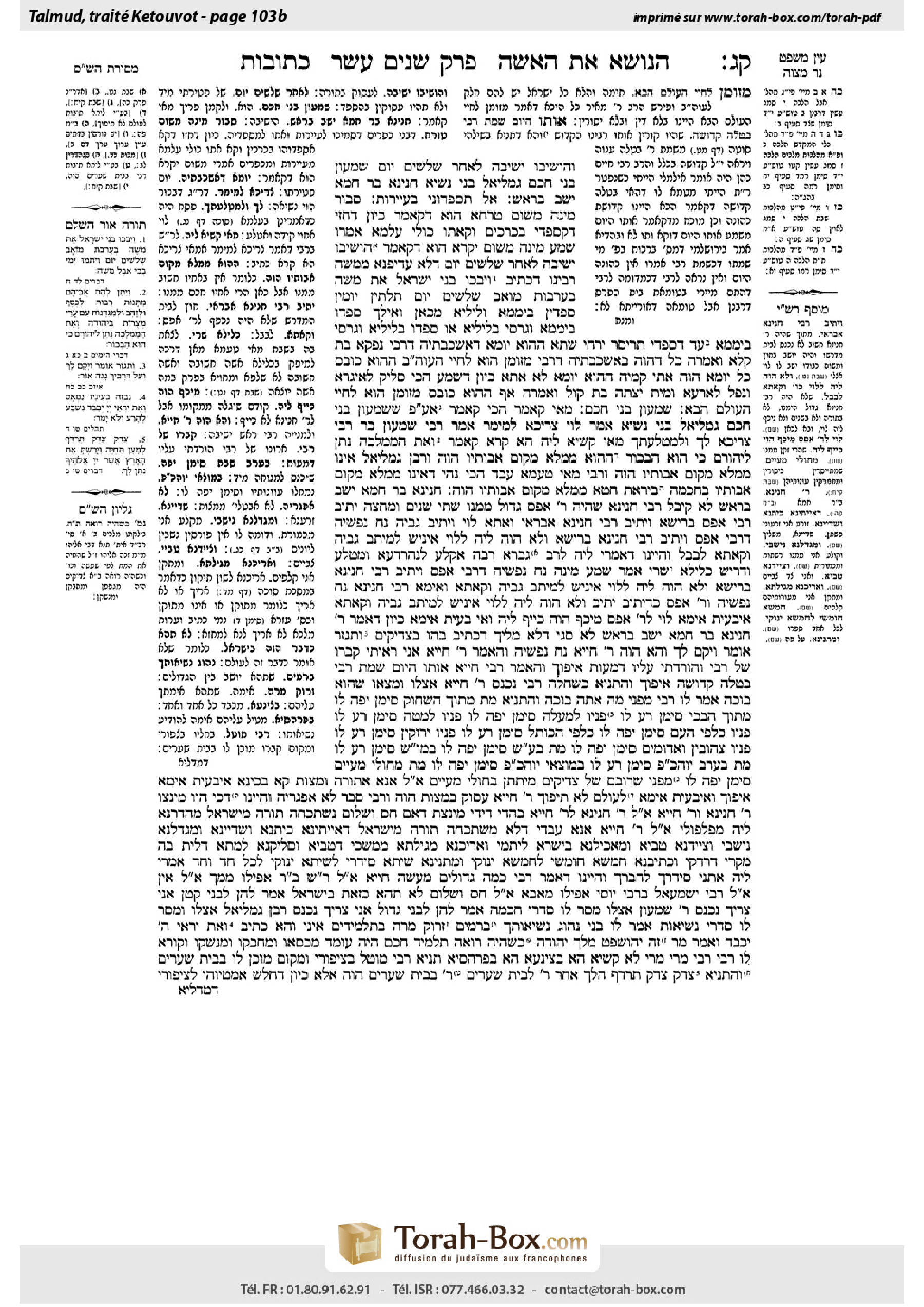
This page of Ketubot includes the Aramaic text, an English translation and an AI-generated French translation, alongside the scan above.
כתובות ק״ג ב · Aramaic and Hebrew text
וְהוֹשִׁיבוּ יְשִׁיבָה לְאַחַר שְׁלֹשִׁים יוֹם״. ״שִׁמְעוֹן בְּנִי חָכָם, גַּמְלִיאֵל בְּנִי נָשִׂיא, חֲנִינָא בַּר חָמָא יֵשֵׁב בָּרֹאשׁ״.
אַל תִּסְפְּדוּנִי בָּעֲיָירוֹת — סְבוּר מִינַּהּ מִשּׁוּם טִרְחָא הוּא דְּקָאָמַר. כֵּיוָן דַּחֲזוֹ דְּקָסָפְדִי בִּכְרַכִּים וְקָאָתוּ כּוּלֵּי עָלְמָא, אָמְרוּ: שְׁמַע מִינַּהּ מִשּׁוּם יְקָרָא הוּא דְּקָאָמַר.
הוֹשִׁיבוּ יְשִׁיבָה לְאַחַר שְׁלֹשִׁים יוֹם — דְּלָא עֲדִיפְנָא מִמֹּשֶׁה רַבֵּינוּ, דִּכְתִיב: ״וַיִּבְכּוּ בְנֵי יִשְׂרָאֵל אֶת מֹשֶׁה בְּעַרְבוֹת מוֹאָב שְׁלֹשִׁים יוֹם״, תְּלָתִין יוֹמִין סָפְדִין בִּימָמָא וְלֵילְיָא, מִכָּאן וְאֵילָךְ סָפְדוּ בִּימָמָא וְגָרְסִי בְּלֵילְיָא, אוֹ סָפְדוּ בְּלֵילְיָא וְגָרְסִי בִּימָמָא, עַד דְּסָפְדִי תְּרֵיסַר יַרְחֵי שַׁתָּא.
הָהוּא יוֹמָא דְּאַשְׁכָּבְתֵּיהּ דְּרַבִּי נְפַקָא בַּת קָלָא וַאֲמַרָה: כֹּל דַּהֲוָה בְּאַשְׁכָּבְתֵּיהּ דְּרַבִּי, מְזוּמָּן הוּא לְחַיֵּי הָעוֹלָם הַבָּא. הָהוּא כּוֹבֵס כֹּל יוֹמָא הֲוָה אָתֵי קַמֵּיהּ, הָהוּא יוֹמָא לָא אֲתָא. כֵּיוָן דִּשְׁמַע הָכִי, סְלֵיק לְאִיגָּרָא וּנְפַל לְאַרְעָא וּמִית. יָצְתָה בַּת קוֹל וְאָמְרָה: אַף הַהוּא כּוֹבֵס מְזוּמָּן הוּא לְחַיֵּי הָעוֹלָם הַבָּא.
שִׁמְעוֹן בְּנִי חָכָם — מַאי קָאָמַר? הָכִי קָאָמַר: אַף עַל פִּי שֶׁשִּׁמְעוֹן בְּנִי חָכָם, גַּמְלִיאֵל בְּנִי נָשִׂיא.
אָמַר לֵוִי: צְרִיכָא לְמֵימַר? אָמַר רַבִּי שִׁמְעוֹן בַּר רַבִּי: צְרִיכָא לָךְ וּלְמַטְלַעְתָּךְ. מַאי קַשְׁיָא לֵיהּ — הָא קְרָא קָאָמַר: ״וְאֶת הַמַּמְלָכָה נָתַן לִיהוֹרָם כִּי הוּא הַבְּכוֹר״!
הַהוּא, מְמַלֵּא מְקוֹם אֲבוֹתָיו הֲוָה, וְרַבָּן גַּמְלִיאֵל אֵינוֹ מְמַלֵּא מְקוֹם אֲבוֹתָיו הֲוָה.
וְרַבִּי מַאי טַעְמָא עֲבַד הָכִי? נְהִי דְּאֵינוֹ מְמַלֵּא מְקוֹם אֲבוֹתָיו בְּחׇכְמָה — בְּיִרְאַת חֵטְא מְמַלֵּא מְקוֹם אֲבוֹתָיו הֲוָה.
חֲנִינָא בַּר חָמָא יֵשֵׁב בָּרֹאשׁ — לֹא קִיבֵּל רַבִּי חֲנִינָא, שֶׁהָיָה רַבִּי אַפָּס גָּדוֹל מִמֶּנּוּ שְׁתֵּי שָׁנִים וּמֶחֱצָה. יְתֵיב רַבִּי אַפָּס בְּרֵישָׁא וִיתֵיב רַבִּי חֲנִינָא אַבָּרַאי, וַאֲתָא לֵוִי וִיתֵיב גַּבֵּיהּ.
נָח נַפְשֵׁיהּ דְּרַבִּי אַפָּס וִיתֵיב רַבִּי חֲנִינָא בְּרֵישָׁא, וְלָא הֲוָה לֵיהּ לְלֵוִי אִינִישׁ לְמֵיתַב גַּבֵּיהּ, וְקָאָתֵא לְבָבֶל. וְהַיְינוּ דְּאָמְרִי לֵיהּ לְרַב: גַּבְרָא רַבָּה אִקְּלַע לִנְהַרְדְּעָא וּמַטְלַע וְדָרֵישׁ כְּלִילָא שְׁרֵי. אֲמַר: שְׁמַע מִינַּהּ נָח נַפְשֵׁיהּ דְּרַבִּי אַפָּס, וִיתֵיב רַבִּי חֲנִינָא בְּרֵישָׁא, וְלָא הֲוָה לֵיהּ לְלֵוִי אִינִישׁ לְמֵיתַב גַּבֵּיהּ, וְקָאָתֵי.
וְאֵימָא, רַבִּי חֲנִינָא נָח נַפְשֵׁיהּ וְרַבִּי אַפָּס כְּדִיתֵיב יְתֵיב, וְלָא הֲוָה לֵיהּ לְלֵוִי אִינִישׁ לְמֵיתַב גַּבֵּיהּ וְקָאָתֵי? אִיבָּעֵית אֵימָא: לֵוִי לְרַבִּי אַפָּס מִיכָּף הֲוָה כַּיִיף לֵיהּ.
וְאִי בָּעֵית אֵימָא: כֵּיוָן דְּאָמַר ״רַבִּי חֲנִינָא בַּר חָמָא יֵשֵׁב בָּרֹאשׁ״ — לָא סַגִּי דְּלָא מָלֵיךְ, דִּכְתִיב בְּהוּ בְּצַדִּיקִים: ״וְתִגְזַר אוֹמֶר וְיָקׇם לָךְ״.
וְהָא הֲוָה רַבִּי חִיָּיא! נָח נַפְשֵׁיהּ. וְהָאָמַר רַבִּי חִיָּיא: אֲנִי רָאִיתִי קִבְרוֹ שֶׁל רַבִּי, וְהוֹרַדְתִּי עָלָיו דְּמָעוֹת! אֵיפוֹךְ.
וְהָאָמַר רַבִּי חִיָּיא: אוֹתוֹ הַיּוֹם שֶׁמֵּת רַבִּי בָּטְלָה קְדוּשָּׁה! אֵיפוֹךְ.
וְהָתַנְיָא: כְּשֶׁחָלָה רַבִּי, נִכְנַס רַבִּי חִיָּיא אֶצְלוֹ וּמְצָאוֹ שֶׁהוּא בּוֹכֶה, אָמַר לוֹ: רַבִּי, מִפְּנֵי מָה אַתָּה בּוֹכֶה? וְהָתַנְיָא: מֵת מִתּוֹךְ הַשְּׂחוֹק — סִימָן יָפֶה לוֹ, מִתּוֹךְ הַבֶּכִי — סִימָן רַע לוֹ. פָּנָיו לְמַעְלָה — סִימָן יָפֶה לוֹ, פָּנָיו לְמַטָּה — סִימָן רַע לוֹ. פָּנָיו כְּלַפֵּי הָעָם — סִימָן יָפֶה לוֹ, כְּלַפֵּי הַכּוֹתֶל — סִימָן רַע לוֹ. פָּנָיו יְרוּקִּין — סִימָן רַע לוֹ, פָּנָיו צְהוּבִּין וַאֲדוּמִּים — סִימָן יָפֶה לוֹ. מֵת בְּעֶרֶב שַׁבָּת — סִימָן יָפֶה לוֹ. בְּמוֹצָאֵי שַׁבָּת — סִימָן רַע לוֹ. מֵת בְּעֶרֶב יוֹם הַכִּפּוּרִים — סִימָן רַע לוֹ, בְּמוֹצָאֵי יוֹם הַכִּפּוּרִים — סִימָן יָפֶה לוֹ. מֵת מֵחוֹלִי מֵעַיִים — סִימָן יָפֶה לוֹ, מִפְּנֵי שֶׁרוּבָּם שֶׁל צַדִּיקִים מִיתָתָן בְּחוֹלִי מֵעַיִים.
אֲמַר לֵיהּ: אֲנָא אַתּוֹרָה וּמִצְוֹת קָא בָכֵינָא!
אִיבָּעֵית אֵימָא אֵיפוֹךְ, וְאִיבָּעֵית אֵימָא לְעוֹלָם לָא תֵּיפוֹךְ, רַבִּי חִיָּיא עָסוּק בְּמִצְוֹת הֲוָה וְרַבִּי סָבַר לָא אֲפַגְּרֵיהּ.
וְהַיְינוּ דְּכִי הֲווֹ מִינְּצוּ רַבִּי חֲנִינָא וְרַבִּי חִיָּיא, אֲמַר לֵיהּ רַבִּי חֲנִינָא לְרַבִּי חִיָּיא: בַּהֲדֵי דִידִי מִינְּצֵת? דְּאִם חַס וְשָׁלוֹם נִשְׁתַּכְּחָה תּוֹרָה מִיִּשְׂרָאֵל, מַהְדַּרְנָא לֵיהּ מִפִּלְפּוּלַי.
אֲמַר לֵיהּ רַבִּי חִיָּיא: אֲנָא עֲבַדִי דְּלָא מִשְׁתַּכְחָה תּוֹרָה מִיִּשְׂרָאֵל. דְּאַיְיתִינָא כִּיתָּנָא וְשָׁדֵיינָא, וּמְגַדֵּלְנָא נִישְׁבֵּי, וְצָיֵידְנָא טְבֵי(א), וּמַאֲכֵילְנָא בִּישְׂרָא לְיַתְמֵי, וְאָרֵיכְנָא מְגִילְּתָא מִמַּשְׁכֵי דִטְבֵי, וְסָלֵיקְנָא לְמָתָא דְּלֵית בַּהּ מַקְרֵי דַרְדְּקֵי, וְכָתֵיבְנָא חַמְשָׁא חוּמְשֵׁי לְחַמְשָׁא יָנוֹקֵי, וּמַתְנֵינָא שִׁיתָּא סִידְרֵי לְשִׁיתָּא יָנוֹקֵי, לְכֹל חַד וְחַד אֲמַרִי לֵיהּ אַתְנִי סִידְרָךְ לְחַבְרָךְ.
וְהַיְינוּ דְּאָמַר רַבִּי: כַּמָּה גְּדוֹלִים מַעֲשֵׂה חִיָּיא. אֲמַר לֵיהּ רַבִּי שִׁמְעוֹן בְּרַבִּי: אֲפִילּוּ מִמְּךָ? אֲמַר לֵיהּ: אִין. אֲמַר לֵיהּ רַבִּי יִשְׁמָעֵאל בְּרַבִּי יוֹסֵי: אֲפִילּוּ מֵאַבָּא? אֲמַר לֵיהּ: חַס וְשָׁלוֹם, לֹא תְּהֵא כָּזֹאת בְּיִשְׂרָאֵל.
אָמַר לָהֶן: לִבְנִי קָטָן אֲנִי צָרִיךְ. נִכְנַס רַבִּי שִׁמְעוֹן אֶצְלוֹ, מָסַר לוֹ סִדְרֵי חׇכְמָה,
אָמַר לָהֶן: לִבְנִי גָּדוֹל אֲנִי צָרִיךְ. נִכְנַס רַבָּן גַּמְלִיאֵל אֶצְלוֹ, וּמָסַר לוֹ סִדְרֵי נְשִׂיאוּת. אָמַר לוֹ: ״בְּנִי, נְהוֹג נְשִׂיאוּתָךְ בְּרָמִים, זְרוֹק מָרָה בַּתַּלְמִידִים״.
אִינִי? וְהָא כְּתִיב: ״וְאֶת יִרְאֵי ה׳ יְכַבֵּד״, וְאָמַר מָר: זֶה יְהוֹשָׁפָט מֶלֶךְ יְהוּדָה, כְּשֶׁהָיָה רוֹאֶה תַּלְמִיד חָכָם הָיָה עוֹמֵד מִכִּסְּאוֹ, וּמְחַבְּקוֹ וּמְנַשְּׁקוֹ, וְקוֹרֵא לוֹ: רַבִּי רַבִּי, מָרִי מָרִי!
לָא קַשְׁיָא: הָא בְּצִינְעָא, הָא בְּפַרְהֶסְיָא.
תַּנְיָא: רַבִּי מוּטָל בְּצִיפּוֹרִי, וּמָקוֹם מוּכָן לוֹ בְּבֵית שְׁעָרִים. וְהָתַנְיָא: ״צֶדֶק צֶדֶק תִּרְדֹּף״ — הַלֵּךְ אַחַר רַבִּי לְבֵית שְׁעָרִים!
רַבִּי בְּבֵית שְׁעָרִים הֲוָה, אֶלָּא כֵּיוָן דַּחֲלַשׁ אַמְטְיוּהִי לְצִיפּוֹרִי,
Ketubot 103b · English translation
and reconvene the study sessions at the yeshiva after thirty days of mourning. My son Shimon is a Sage. My son Gamliel should be the Nasi. Ḥanina bar Ḥama will sit at the head of the yeshiva.
The Gemara explains the requests of Rabbi Yehuda HaNasi: Do not eulogize me in the small towns. They understood from this statement that he said this due to the trouble that would be caused for many if he were eulogized in every town, since they would have to travel from the outlying villages to take part in the eulogies. However, when they saw that they were eulogizing him in the cities and everyone came despite the trouble, they said: Conclude from here that he said this due to considerations of honor. Had they eulogized him in the towns, the gatherings would have been small and unfitting for a man of his stature. He therefore requested that they arrange things in a way that large crowds would gather.
Rabbi Yehuda HaNasi further instructed: Reconvene the study sessions at the yeshiva after thirty days of mourning. This is because I am not better than Moses, our teacher, as it is written: “And the children of Israel wept for Moses in the plains of Moab thirty days” (Deuteronomy 34:8), which means that for thirty days they eulogized him by day and night. From this point forward they eulogized him by day and they studied by night, or they eulogized him by night and studied by day, until they eulogized him for twelve months of the year.
The Gemara relates that on the day of the funeral of Rabbi Yehuda HaNasi, a Divine Voice emerged and said: Whoever was present at the funeral of Rabbi Yehuda HaNasi is destined for life in the World-to-Come. There was a certain launderer who would come before Rabbi Yehuda HaNasi every day. On that particular day, he did not come and was therefore not present at the funeral. When he heard this, that Rabbi Yehuda HaNasi had died, he was so full of grief that he ascended to the roof and fell to the ground and died. A Divine Voice emerged and said: That launderer too is destined for life in the World-to-Come.
§ Rabbi Yehuda HaNasi said: My son Shimon is a Sage; my son Gamliel should be the Nasi. What was he saying, i.e., what did he mean by these remarks? The Gemara explains: This is what he was saying: Although my son Shimon is a greater Sage, my son Gamliel should be the Nasi.
Levi said: Need this be said? After all, Gamliel was the firstborn. Rabbi Shimon, son of Rabbi Yehuda HaNasi, said: It is necessary for you and for your limp. The Gemara asks: What did Rabbi Shimon find difficult with Levi’s question that caused him to scoff? Doesn’t the verse state: “But the kingdom he gave to Jehoram because he was the firstborn” (II Chronicles 21:3)? This indicates that the firstborn is the one who inherits his father’s appointment, and so Levi legitimately asked why Rabbi Yehuda HaNasi had to leave specific instructions about this.
The Gemara explains: He, Jehoram, filled the place of his fathers, i.e., he was their equal in his personal attributes and leadership capabilities. However, Rabban Gamliel did not fill the place of his fathers, and for this reason Rabbi Yehuda HaNasi had to specifically command that he nevertheless be appointed as the Nasi.
The Gemara asks: And if that is so, what is the reason that Rabbi Yehuda HaNasi did this? Why did he choose this son to be his successor if he was unfit for the position? The Gemara answers: Although he did not fill the place of his fathers with regard to wisdom, as he was not as great a Torah scholar as his father, he did fill the place of his fathers with regard to fear of sin and was therefore fit to be appointed as the Nasi.
§ Rabbi Yehuda HaNasi instructed: Ḥanina bar Ḥama will sit at the head of the yeshiva. The Gemara relates: Rabbi Ḥanina did not accept this appointment, because Rabbi Afes was older than him by two and a half years and he did not want to precede him in accepting this position. Consequently, Rabbi Afes sat at the head of the yeshiva, and Rabbi Ḥanina sat outside, as it was unbefitting for him to sit as a student before Rabbi Afes. And Levi came and sat and studied with him outside.
Rabbi Afes died, and Rabbi Ḥanina, taking his place, sat at the head of the yeshiva. And Levi did not have anyone to sit and study with, and so he came to Babylonia. And this is the background to the incident in which they said to Rav: A great man came to Neharde’a, and he limps, and he taught: It is permitted for a woman who is wearing a kelila, a tiara-like ornament, to go out into the public domain on Shabbat. Rav then said: Conclude from this that Rabbi Afes died and Rabbi Ḥanina, taking his place, sat at the head of the yeshiva, and Levi did not have anyone to sit and study with, and so he came to Babylonia.
The Gemara asks: How did Rav know that it was Rabbi Afes who died? Say that Rabbi Ḥanina was the one who died, and Rabbi Afes sat as he had sat, i.e., he continued to sit at the head of the yeshiva, and Levi did not have anyone to sit with, and so he came to Babylonia. The Gemara answers: If you wish, say that Levi was subordinate to Rabbi Afes and would have sat before him as a student had Rabbi Afes still been alive, and the only reason why he sat outside in the first place was in deference to Rabbi Ḥanina, who sat outside because he did not consider himself subordinate to Rabbi Afes.
And if you wish, say instead that since Rabbi Yehuda HaNasi had said: Ḥanina bar Ḥama will sit at the head of the yeshiva, it is not possible that he will not one day rule the yeshiva. Therefore, it must have been Rabbi Afes who died and Rabbi Ḥanina who took his place, as it is written about the righteous: “You shall also decree a thing, and it shall be established unto you” (Job 22:28).
The Gemara asks: But wasn’t Rabbi Ḥiyya there? Why didn’t Rabbi Yehuda HaNasi appoint him as head of the yeshiva? The Gemara answers: He died before Rabbi Yehuda HaNasi. The Gemara asks: But didn’t Rabbi Ḥiyya say: I saw the grave site of Rabbi Yehuda HaNasi and I shed tears over it? The Gemara answers: Reverse the names. It was Rabbi Yehuda HaNasi who said that he saw the grave site of Rabbi Ḥiyya.
The Gemara asks: But didn’t Rabbi Ḥiyya say: On that day that Rabbi Yehuda HaNasi died, sanctity ceased? The Gemara answers: Reverse the names. It was Rabbi Yehuda HaNasi who made this statement about Rabbi Ḥiyya.
The Gemara asks: But isn’t it taught in a baraita: When Rabbi Yehuda HaNasi fell ill, Rabbi Ḥiyya entered to be with him and found him crying. He said to him: My teacher, for what reason are you crying? Isn’t it taught in a baraita:
If one dies while laughing, it is a good sign for him; while crying, it is a bad sign for him.
If one dies with his face upward, it is a good sign for him; with his face downward, it is a bad sign for him.
If one dies with his face facing the people standing around him, it is a good sign for him; with his face facing the wall, it is a bad sign for him.
If one’s face is sallow, it is a bad sign for him; if his face is yellow or ruddy, it is a good sign for him.
If one dies on the Shabbat eve it is a good sign for him, because he is heading straight into the Shabbat rest; if one dies at the conclusion of Shabbat it is a bad sign for him.
If one dies on the eve of Yom Kippur, it is a bad sign for him, as his sins have not yet been forgiven; if one dies at the conclusion of Yom Kippur it is a good sign for him, because he died after his sins have been forgiven.
If one dies due to an intestinal disease, it is a good sign for him, because most of the righteous die due to intestinal disease.
Rabbi Yehuda HaNasi said to him: I am crying for the Torah and the mitzvot that I will be unable to fulfill after I die. This indicates that Rabbi Ḥiyya was present at the time of Rabbi Yehuda HaNasi’s death.
The Gemara answers: If you wish, say that one must reverse the names and that it was Rabbi Yehuda HaNasi who came to visit Rabbi Ḥiyya prior to his death. And if you wish, say instead that actually we do not need to reverse the names in all of the above statements, but rather explain that Rabbi Ḥiyya was occupied with the performance of mitzvot and Rabbi Yehuda HaNasi thought: I will not hold him back from his performance of mitzvot by appointing him head of the yeshiva.
And this is the background to an exchange that took place when Rabbi Ḥanina and Rabbi Ḥiyya argued. Rabbi Ḥanina said to Rabbi Ḥiyya: You are arguing with me? If, Heaven forfend, the Torah would be forgotten from the Jewish people, I would restore it through my analyses, i.e., using my abilities of analysis I would be able to rediscover all that had been lost.
Rabbi Ḥiyya said to Rabbi Ḥanina: I am working to ensure that the Torah will not be forgotten from the Jewish people. For I bring flax and I plant it, and I then weave nets from the flax fibers. I then go out and trap deer, and I feed the meat to orphans, and I form scrolls from the skins of the deer. And I go to a town that has no teachers of children in it and I write the five books of the Torah for five children. And I teach the six orders of the Mishna to six children. To each and every one of these children I say: Teach your order to your friends. In this way all of the children will learn the whole of the Torah and the Mishna.
And this is what Rabbi Yehuda HaNasi referred to when he said: How great are the actions of Ḥiyya. Rabbi Shimon, son of Rabbi Yehuda HaNasi, said to his father: Even greater than your works? He said to him: Yes. Rabbi Yishmael, son of Rabbi Yosei, said to Rabbi Yehuda HaNasi: Even greater than the work of Rabbi Yosei, my father? Rabbi Yehuda HaNasi said to him: Heaven forfend. Such comments should not be made among the Jewish people.
§ The Gemara returns to the narrative of the impending death of Rabbi Yehuda HaNasi: He said to them: I need my younger son. Rabbi Shimon entered his presence. He transmitted to him the orders of wisdom, including how he should conduct himself and the essential principles of the Torah.
He said to them: I need my older son. Rabban Gamliel entered his presence, and Rabbi Yehuda HaNasi transmitted to him the procedures of the office of the Nasi. Rabbi Yehuda HaNasi said to Rabban Gamliel: My son, conduct your term as Nasi with assertiveness and cast fear upon your students, i.e., treat them in a firm manner so that they will fear you.
The Gemara asks: Is that so that it is correct to behave in such a manner? But isn’t it written: “But he honors those that fear the Lord” (Psalms 15:4), and the Master said: This is referring to Jehoshaphat, king of Judea. When he would see a Torah scholar he would rise from his throne and hug him and kiss him and call to him: My teacher, my teacher, my master, my master. This demonstrates that it is appropriate even for a king to behave with affection toward Torah scholars.
The Gemara answers: This is not difficult. This display of affection should be applied in private, when only the teacher and student are present, and that stern demeanor should be applied in public, in order to ensure the teacher’s authority.
It is taught in a baraita: Rabbi Yehuda HaNasi was lying ill in Tzippori and a burial site was ready for him in Beit She’arim. The Gemara asks: But isn’t it taught in a baraita: “Justice, justice shall you follow” (Deuteronomy 16:20); follow Rabbi Yehuda HaNasi to Beit She’arim, i.e., one should seek to have his case adjudicated by Rabbi Yehuda HaNasi’s court in Beit She’arim. This indicates that Beit She’arim, not Tzippori, was Rabbi Yehuda HaNasi’s place of residence, and therefore he must have been lying ill in Beit She’arim.
The Gemara answers: Rabbi Yehuda HaNasi was in Beit She’arim, but when he became ill they transferred him to Tzippori,
Ketubot 103b · Traduction française (IA)
et reprendre les séances d’étude à la yéchiva après trente jours de deuil. Mon fils Shimon est un Sage. Mon fils Gamliel doit être le Nassi. Ḥanina bar Ḥama siégera à la tête de la yéchiva.
La Guemara explique les demandes de Rabbi Yehuda HaNassi : « Ne prononcez pas mon éloge funèbre dans les petites villes. » Ils comprirent qu’il avait dit cela en raison des difficultés que cela causerait à beaucoup de gens si son éloge funèbre était prononcé dans chaque ville, puisqu’ils devraient venir des villages alentour pour y assister. Cependant, lorsqu’ils le virent célébrer dans les villes et que tous s’y rendirent malgré les difficultés, ils dirent : « Déduisons-en qu’il avait dit cela pour des raisons de dignité. » Si son éloge funèbre avait été prononcé dans les petites villes, les rassemblements auraient été peu nombreux et indignes d’un homme de son rang. Il avait donc demandé qu’on organise les choses de manière à réunir de grandes foules.
Rabbi Yehuda HaNassi avait en outre ordonné : « Reprenez les séances d’étude à la yéchiva après trente jours de deuil. » Car je ne suis pas supérieur à Moïse, notre maître, comme il est écrit : « Les enfants d’Israël pleurèrent Moïse dans les plaines de Moav pendant trente jours » (Deutéronome 34:8), ce qui signifie qu’ils prononcèrent son éloge funèbre jour et nuit durant trente jours. À partir de ce moment, ils prononcèrent son éloge funèbre le jour et étudièrent la nuit, ou prononcèrent son éloge funèbre la nuit et étudièrent le jour, jusqu’à ce qu’ils aient prononcé son éloge funèbre pendant douze mois.
La Guemara rapporte que, le jour des funérailles de Rabbi Yehuda HaNassi, une voix céleste se fit entendre et dit : « Quiconque a assisté aux funérailles de Rabbi Yehuda HaNassi est destiné à la vie dans le Monde à venir. » Un certain blanchisseur venait chaque jour auprès de Rabbi Yehuda HaNassi. Ce jour-là, il ne vint pas et ne fut donc pas présent aux funérailles. Lorsqu’il apprit que Rabbi Yehuda HaNassi était mort, il fut accablé de chagrin ; il monta sur le toit, se jeta au sol et mourut. Une voix céleste se fit entendre et dit : « Ce blanchisseur aussi est destiné à la vie dans le Monde à venir. »
§ Rabbi Yehuda HaNassi dit : « Mon fils Shimon est un Sage ; mon fils Gamliel doit être le Nassi. » Que voulait-il dire par ces paroles ? La Guemara explique : voici ce qu’il voulait dire : bien que mon fils Shimon soit un Sage supérieur, mon fils Gamliel doit être le Nassi.
Levi dit : « Faut-il vraiment le préciser ? Après tout, Gamliel était le premier-né. » Rabbi Shimon, fils de Rabbi Yehuda HaNassi, dit : « C’est nécessaire pour toi et pour ta boiterie. » La Guemara demande : Qu’est-ce qui, dans la question de Levi, posait problème à Rabbi Shimon au point qu’il s’en moque ? Le verset ne dit-il pas : « Mais il donna le royaume à Yehoram, parce qu’il était le premier-né » (II Chroniques 21:3) ? Cela indique que le premier-né hérite de la charge de son père ; Levi pouvait donc légitimement demander pourquoi Rabbi Yehuda HaNassi devait donner des instructions précises à ce sujet.
La Guemara explique : Yehoram, lui, avait été à la hauteur de ses pères, c’est-à-dire qu’il leur était égal par ses qualités personnelles et ses capacités de dirigeant. Rabban Gamliel, en revanche, n’était pas à la hauteur de ses pères ; c’est pourquoi Rabbi Yehuda HaNassi dut ordonner expressément qu’il soit néanmoins nommé Nassi.
La Guemara demande : Si tel est le cas, pourquoi Rabbi Yehuda HaNassi a-t-il agi ainsi ? Pourquoi a-t-il choisi ce fils comme successeur s’il n’était pas apte à cette fonction ? La Guemara répond : Bien qu’il ne fût pas à la hauteur de ses pères en matière de sagesse, puisqu’il n’était pas un érudit de Torah aussi éminent que son père, il était à leur hauteur par sa crainte du péché et était donc apte à être nommé Nassi.
§ Rabbi Yehuda HaNassi avait ordonné : « Ḥanina bar Ḥama siégera à la tête de la yéchiva. » La Guemara rapporte que Rabbi Ḥanina n’accepta pas cette nomination, car Rabbi Afes avait deux ans et demi de plus que lui et il ne voulait pas le devancer en acceptant cette fonction. Rabbi Afes siégea donc à la tête de la yéchiva, tandis que Rabbi Ḥanina s’assit à l’extérieur, car il ne convenait pas qu’il s’assît comme élève devant Rabbi Afes. Levi vint s’asseoir et étudier avec lui à l’extérieur.
Rabbi Afes mourut et Rabbi Ḥanina prit sa place à la tête de la yéchiva. Levi n’eut alors personne avec qui s’asseoir et étudier, et il vint donc en Babylonie. Voilà le contexte de l’incident où l’on dit à Rav : « Un grand homme est arrivé à Neharde’a ; il boite et a enseigné qu’une femme portant un kelila, un ornement semblable à un diadème, a le droit de sortir dans le domaine public le Chabbat. » Rav dit alors : « Déduisons-en que Rabbi Afes est mort, que Rabbi Ḥanina a pris sa place à la tête de la yéchiva et que Levi, n’ayant personne avec qui s’asseoir et étudier, est venu en Babylonie. »
La Guemara demande : Comment Rav savait-il que c’était Rabbi Afes qui était mort ? Supposons que ce soit Rabbi Ḥanina qui soit mort, que Rabbi Afes ait continué à siéger comme auparavant, c’est-à-dire à la tête de la yéchiva, et que Levi, n’ayant personne avec qui s’asseoir, soit venu en Babylonie. La Guemara répond : On peut dire que Levi était subordonné à Rabbi Afes et se serait assis devant lui comme un élève si Rabbi Afes avait encore été en vie ; s’il s’était assis à l’extérieur au départ, c’était uniquement par égard pour Rabbi Ḥanina, qui s’asseyait à l’extérieur parce qu’il ne se considérait pas comme subordonné à Rabbi Afes.
Ou bien, on peut dire que puisque Rabbi Yehuda HaNassi avait déclaré : « Ḥanina bar Ḥama siégera à la tête de la yéchiva », il était impossible qu’il ne dirige pas un jour la yéchiva. Il fallait donc que ce soit Rabbi Afes qui soit mort et Rabbi Ḥanina qui ait pris sa place, comme il est écrit au sujet des justes : « Tu décideras une chose, et elle s’accomplira pour toi » (Job 22:28).
La Guemara demande : Mais Rabbi Ḥiyya n’était-il pas là ? Pourquoi Rabbi Yehuda HaNassi ne l’a-t-il pas nommé à la tête de la yéchiva ? La Guemara répond : Il mourut avant Rabbi Yehuda HaNassi. La Guemara demande : Mais Rabbi Ḥiyya n’a-t-il pas dit : « J’ai vu le lieu de sépulture de Rabbi Yehuda HaNassi et j’ai pleuré sur lui » ? La Guemara répond : Inversez les noms. C’est Rabbi Yehuda HaNassi qui dit avoir vu le lieu de sépulture de Rabbi Ḥiyya.
La Guemara demande : Mais Rabbi Ḥiyya n’a-t-il pas dit : « Le jour où Rabbi Yehuda HaNassi mourut, la sainteté prit fin » ? La Guemara répond : Inversez les noms. C’est Rabbi Yehuda HaNassi qui fit cette déclaration à propos de Rabbi Ḥiyya.
La Guemara demande : Mais n’est-il pas enseigné dans une baraïta : lorsque Rabbi Yehuda HaNassi tomba malade, Rabbi Ḥiyya entra auprès de lui et le trouva en train de pleurer. Il lui dit : « Mon maître, pourquoi pleurez-vous ? N’est-il pas enseigné dans une baraïta : Si quelqu’un meurt en riant, c’est un bon signe pour lui ; s’il meurt en pleurant, c’est un mauvais signe pour lui. Si quelqu’un meurt le visage tourné vers le haut, c’est un bon signe pour lui ; s’il meurt le visage tourné vers le bas, c’est un mauvais signe pour lui. Si quelqu’un meurt le visage tourné vers les personnes qui l’entourent, c’est un bon signe pour lui ; si son visage est tourné vers le mur, c’est un mauvais signe pour lui. Si le visage de quelqu’un est blême, c’est un mauvais signe pour lui ; si son visage est jaune ou rougeaud, c’est un bon signe pour lui. Si quelqu’un meurt la veille de Chabbat, c’est un bon signe pour lui, car il entre directement dans le repos du Chabbat ; s’il meurt à la fin du Chabbat, c’est un mauvais signe pour lui. Si quelqu’un meurt la veille de Yom Kippour, c’est un mauvais signe pour lui, car ses péchés n’ont pas encore été pardonnés ; s’il meurt à la fin de Yom Kippour, c’est un bon signe pour lui, car ses péchés ont alors été pardonnés. Si quelqu’un meurt d’une maladie intestinale, c’est un bon signe pour lui, car la plupart des justes meurent d’une maladie intestinale. »
Rabbi Yehuda HaNassi lui dit : « Je pleure pour la Torah et les mitsvot que je ne pourrai plus accomplir après ma mort. » Cela indique que Rabbi Ḥiyya était présent au moment de la mort de Rabbi Yehuda HaNassi.
La Guemara répond : On peut dire qu’il faut inverser les noms et que c’est Rabbi Yehuda HaNassi qui vint rendre visite à Rabbi Ḥiyya avant sa mort. Ou bien, on peut dire qu’en réalité il n’est pas nécessaire d’inverser les noms dans toutes les déclarations précédentes ; il faut plutôt expliquer que Rabbi Ḥiyya était occupé à accomplir des mitsvot et que Rabbi Yehuda HaNassi pensa : « Je ne l’empêcherai pas d’accomplir des mitsvot en le nommant à la tête de la yéchiva. »
C’est dans ce contexte qu’eut lieu l’échange suivant, lorsque Rabbi Ḥanina et Rabbi Ḥiyya se disputèrent. Rabbi Ḥanina dit à Rabbi Ḥiyya : « Tu contestes mes paroles ? Si, à Dieu ne plaise, la Torah venait à être oubliée par le peuple juif, je la rétablirais grâce à mes analyses ; autrement dit, grâce à mes capacités d’analyse, je pourrais redécouvrir tout ce qui aurait été perdu. »
Rabbi Ḥiyya dit à Rabbi Ḥanina : « Je travaille à faire en sorte que la Torah ne soit pas oubliée par le peuple juif. En effet, j’apporte du lin et je le plante, puis je tisse des filets avec ses fibres. Ensuite, je sors chasser des cerfs et je donne leur viande à des orphelins, puis je fabrique des rouleaux avec leurs peaux. Je me rends dans une ville où il n’y a pas de maîtres pour les enfants et j’écris les cinq livres de la Torah pour cinq enfants. J’enseigne les six ordres de la Michna à six enfants. À chacun de ces enfants, je dis : “Enseigne ton ordre à tes camarades.” Ainsi, tous les enfants apprendront l’ensemble de la Torah et de la Michna. »
C’est à cela que Rabbi Yehuda HaNassi faisait référence lorsqu’il disait : « Que les actes de Ḥiyya sont grands ! » Rabbi Shimon, fils de Rabbi Yehuda HaNassi, dit à son père : « Plus grands encore que tes actes ? » Il lui répondit : « Oui. » Rabbi Yishmael, fils de Rabbi Yosei, dit à Rabbi Yehuda HaNassi : « Plus grands encore que les actes de Rabbi Yosei, mon père ? » Rabbi Yehuda HaNassi lui répondit : « À Dieu ne plaise. De telles remarques ne doivent pas être faites parmi le peuple juif. »
§ La Guemara revient au récit de la mort imminente de Rabbi Yehuda HaNassi : il leur dit : « J’ai besoin de mon fils cadet. » Rabbi Shimon entra auprès de lui. Il lui transmit les principes de sagesse, notamment la manière dont il devait se conduire et les principes essentiels de la Torah.
Il leur dit : « J’ai besoin de mon fils aîné. » Rabban Gamliel entra auprès de lui, et Rabbi Yehuda HaNassi lui transmit les règles de la fonction de Nassi. Rabbi Yehuda HaNassi dit à Rabban Gamliel : « Mon fils, exerce ta charge de Nassi avec fermeté et inspire la crainte à tes élèves », c’est-à-dire traite-les avec fermeté afin qu’ils te craignent.
La Guemara demande : Est-il donc juste de se comporter ainsi ? N’est-il pas écrit : « Mais il honore ceux qui craignent le Seigneur » (Psaumes 15:4), et le Maître a dit que cela désigne Yehoshaphat, roi de Judée ? Lorsqu’il voyait un érudit de Torah, il se levait de son trône, l’étreignait et l’embrassait, puis lui disait : « Mon maître, mon maître, mon seigneur, mon seigneur. » Cela montre qu’il convient même à un roi de témoigner de l’affection aux érudits de Torah.
La Guemara répond : Il n’y a pas de contradiction. Les marques d’affection doivent être manifestées en privé, lorsque seuls le maître et l’élève sont présents, tandis que cette attitude sévère doit être adoptée en public, afin de préserver l’autorité du maître.
Il est enseigné dans une baraïta : Rabbi Yehuda HaNassi était malade et alité à Tzippori, et un lieu de sépulture était prêt pour lui à Beit She’arim. La Guemara demande : Mais n’est-il pas enseigné dans une baraïta : « C’est la justice, la justice que tu poursuivras » (Deutéronome 16:20) ; « Suis Rabbi Yehuda HaNassi à Beit She’arim », c’est-à-dire qu’il faut chercher à faire juger son affaire par le tribunal de Rabbi Yehuda HaNassi à Beit She’arim ? Cela indique que Beit She’arim, et non Tzippori, était le lieu de résidence de Rabbi Yehuda HaNassi ; il devait donc être malade et alité à Beit She’arim.
La Guemara répond : Rabbi Yehuda HaNassi se trouvait à Beit She’arim, mais lorsqu’il tomba malade, on le transféra à Tzippori,
Traduction française générée par IA à partir de l’édition anglaise de Sefaria. Vérifie toujours un passage avec le texte source.
Text from Sefaria: William Davidson Edition - Vocalized Aramaic (CC BY NC); William Davidson Edition - English (CC BY NC).