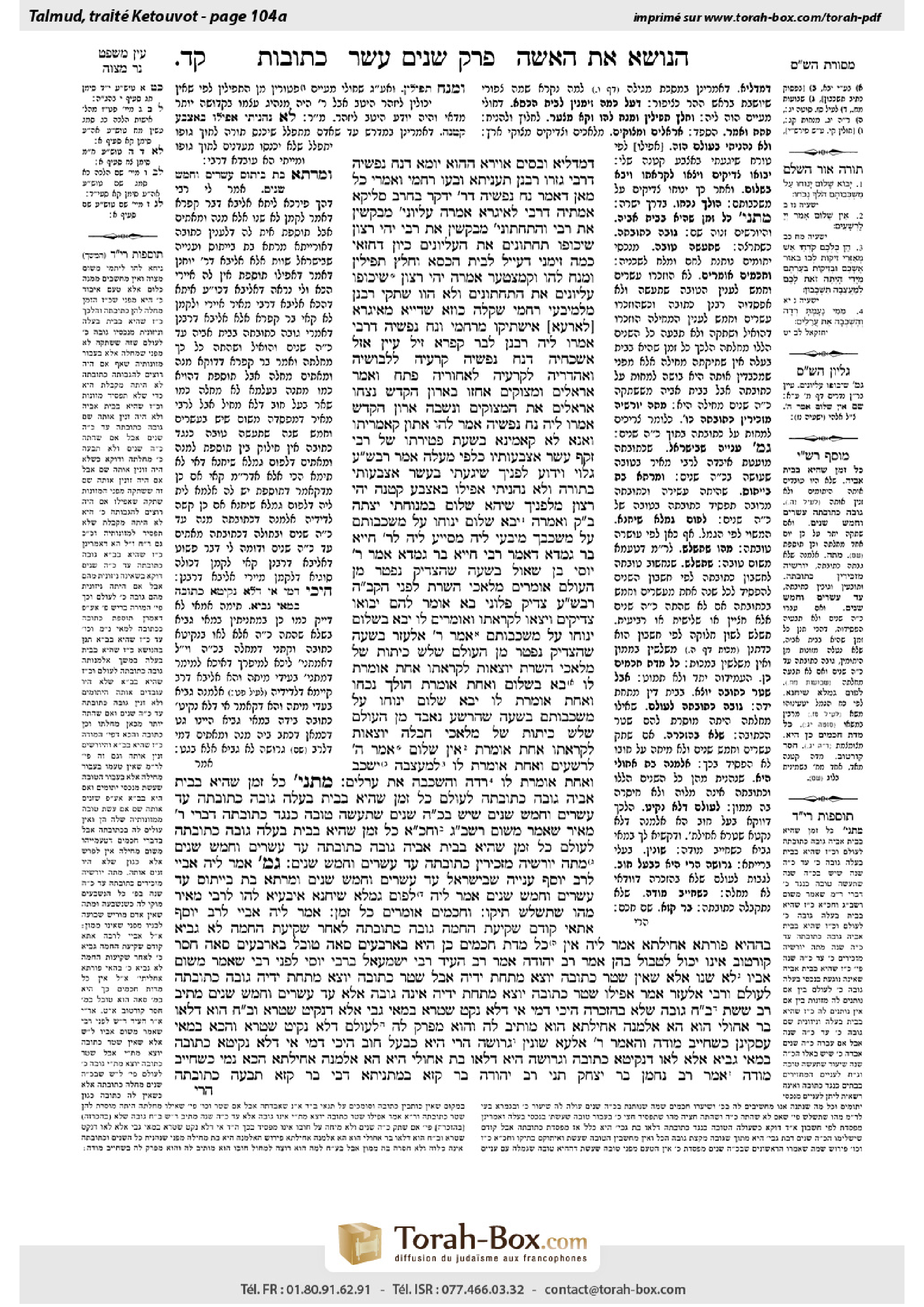
Ketubot 104a: Talmud study for Daf Yomi
Daf Yomi is the daily study of one Talmud folio. Explore 37 tractates with scans, Hebrew text, Sefaria English and AI-generated French translations where annotated.
Passage selection and English or AI-generated French translation are available where the scan has annotations. Daf Study is independent of Torah-Box and Sefaria.
Browse Ketubot · כתובות · All tractatesKetubot 104a text and translations
This page of Ketubot includes the Aramaic text, an English translation and an AI-generated French translation, alongside the scan above.
כתובות ק״ד א · Aramaic and Hebrew text
דְּמִדַּלְיָא וּבְסִים אַוֵּירָא.
הָהוּא יוֹמָא דְּנָח נַפְשֵׁיהּ דְּרַבִּי, גְּזַרוּ רַבָּנַן תַּעֲנִיתָא, וּבְעוֹ רַחֲמֵי, וְאָמְרִי: כֹּל מַאן דְּאָמַר ״נָח נַפְשֵׁיהּ דְּרַבִּי״ — יִדָּקֵר בַּחֶרֶב.
סְלִיקָא אַמְּתֵיהּ דְּרַבִּי לְאִיגָּרָא, אָמְרָה: עֶלְיוֹנִים מְבַקְּשִׁין אֶת רַבִּי, וְהַתַּחְתּוֹנִים מְבַקְּשִׁין אֶת רַבִּי. יְהִי רָצוֹן שֶׁיָּכוֹפוּ תַּחְתּוֹנִים אֶת הָעֶלְיוֹנִים. כֵּיוָן דַּחֲזַאי כַּמָּה זִימְנֵי דְּעָיֵיל לְבֵית הַכִּסֵּא וְחָלַץ תְּפִילִּין וּמַנַּח לְהוּ וְקָמִצְטַעַר, אֲמַרָה: יְהִי רָצוֹן שֶׁיָּכוֹפוּ עֶלְיוֹנִים אֶת הַתַּחְתּוֹנִים.
וְלָא הֲווֹ שָׁתְקִי רַבָּנַן מִלְּמִיבְעֵי רַחֲמֵי. שָׁקְלָה כּוּזָא, שָׁדְיָיא מֵאִיגָּרָא [לְאַרְעָא], אִישְׁתִּיקוּ מֵרַחֲמֵי, וְנָח נַפְשֵׁיהּ דְּרַבִּי.
אֲמַרוּ לֵיהּ רַבָּנַן לְבַר קַפָּרָא: זִיל עַיֵּין, אֲזַל אַשְׁכְּחֵיהּ דְּנָח נַפְשֵׁיהּ. קַרְעֵיהּ לִלְבוּשֵׁיהּ וְאַהְדְּרֵיהּ לְקִרְעֵיהּ לַאֲחוֹרֵיהּ, פְּתַח וַאֲמַר: אֶרְאֶלִּים וּמְצוּקִים אָחֲזוּ בַּאֲרוֹן הַקֹּדֶשׁ, נִצְּחוּ אֶרְאֶלִּים אֶת הַמְּצוּקִים, וְנִשְׁבָּה אֲרוֹן הַקֹּדֶשׁ. אֲמַרוּ לֵיהּ: נָח נַפְשֵׁיהּ? אֲמַר לְהוּ: אַתּוּן קָאָמְרִיתוּ וַאֲנָא לָא קָאָמֵינָא.
בִּשְׁעַת פְּטִירָתוֹ שֶׁל רַבִּי זָקַף עֶשֶׂר אֶצְבְּעוֹתָיו כְּלַפֵּי מַעְלָה, אֲמַר: רִבּוֹנוֹ שֶׁל עוֹלָם! גָּלוּי וְיָדוּעַ לְפָנֶיךָ שֶׁיָּגַעְתִּי בְּעֶשֶׂר אֶצְבְּעוֹתַי בַּתּוֹרָה, וְלֹא נֶהֱנֵיתִי אֲפִילּוּ בְּאֶצְבַּע קְטַנָּה. יְהִי רָצוֹן מִלְּפָנֶיךָ שֶׁיְּהֵא שָׁלוֹם בִּמְנוּחָתִי. יָצְתָה בַּת קוֹל וְאָמְרָה: ״יָבֹא שָׁלוֹם יָנוּחוּ עַל מִשְׁכְּבוֹתָם״.
״עַל מִשְׁכָּבְךָ״ מִיבְּעֵי לֵיהּ! מְסַיֵּיעַ לֵיהּ לְרַבִּי חִיָּיא בַּר גַּמָּדָא. דְּאָמַר רַבִּי חִיָּיא בַּר גַּמָּדָא אָמַר רַבִּי יוֹסֵי בֶּן שָׁאוּל: בְּשָׁעָה שֶׁהַצַּדִּיק נִפְטָר מִן הָעוֹלָם, אוֹמְרִים מַלְאֲכֵי הַשָּׁרֵת לִפְנֵי הַקָּדוֹשׁ בָּרוּךְ הוּא: רִבּוֹנוֹ שֶׁל עוֹלָם, צַדִּיק פְּלוֹנִי בָּא. אוֹמֵר לָהֶם: יָבוֹאוּ צַדִּיקִים וְיֵצְאוּ לִקְרָאתוֹ, וְאוֹמְרִים לוֹ: ״יָבֹא בְּשָׁלוֹם״, יָנוּחוּ עַל מִשְׁכְּבוֹתָם.
אָמַר רַבִּי אֶלְעָזָר: בְּשָׁעָה שֶׁהַצַּדִּיק נִפְטָר מִן הָעוֹלָם, שָׁלֹשׁ כִּיתּוֹת שֶׁל מַלְאֲכֵי הַשָּׁרֵת יוֹצְאוֹת לִקְרָאתוֹ, אַחַת אוֹמֶרֶת לוֹ: ״בֹּא בְּשָׁלוֹם״, וְאַחַת אוֹמֶרֶת: ״הוֹלֵךְ נִכְחוֹ״, וְאַחַת אוֹמֶרֶת לוֹ: ״יָבֹא שָׁלוֹם יָנוּחוּ עַל מִשְׁכְּבוֹתָם״. בְּשָׁעָה שֶׁהָרָשָׁע נֶאֱבָד מִן הָעוֹלָם, שָׁלֹשׁ כִּיתּוֹת שֶׁל מַלְאֲכֵי חַבָּלָה יוֹצְאוֹת לִקְרָאתוֹ, אַחַת אוֹמֶרֶת: ״אֵין שָׁלוֹם אָמַר ה׳ לָרְשָׁעִים״, וְאַחַת אוֹמֶרֶת לוֹ: ״לְמַעֲצֵבָה יִשְׁכַּב״, וְאַחַת אוֹמֶרֶת לוֹ: ״רְדָה וְהׇשְׁכְּבָה אֶת עֲרֵלִים״.
מַתְנִי׳ כׇּל זְמַן שֶׁהִיא בְּבֵית אָבִיהָ, גּוֹבָה כְּתוּבָּתָהּ לְעוֹלָם. כׇּל זְמַן שֶׁהִיא בְּבֵית בַּעְלָהּ, גּוֹבָה כְּתוּבָּתָהּ עַד עֶשְׂרִים וְחָמֵשׁ שָׁנִים. שֶׁיֵּשׁ בְּעֶשְׂרִים וְחָמֵשׁ שָׁנִים שֶׁתַּעֲשֶׂה טוֹבָה כְּנֶגֶד כְּתוּבָּתָהּ, דִּבְרֵי רַבִּי מֵאִיר שֶׁאָמַר מִשּׁוּם רַבָּן שִׁמְעוֹן בֶּן גַּמְלִיאֵל.
וַחֲכָמִים אוֹמְרִים: כׇּל זְמַן שֶׁהִיא בְּבֵית בַּעְלָהּ — גּוֹבָה כְּתוּבָּתָהּ לְעוֹלָם, כׇּל זְמַן שֶׁהִיא בְּבֵית אָבִיהָ — גּוֹבָה כְּתוּבָּתָהּ עַד עֶשְׂרִים וְחָמֵשׁ שָׁנִים.
מֵתָה — יוֹרְשֶׁיהָ מַזְכִּירִין כְּתוּבָּתָהּ עַד עֶשְׂרִים וְחָמֵשׁ שָׁנִים.
גְּמָ׳ אֲמַר לֵיהּ אַבָּיֵי לְרַב יוֹסֵף: עֲנִיָּיה שֶׁבְּיִשְׂרָאֵל עַד עֶשְׂרִים וְחָמֵשׁ שָׁנִים, וּמָרְתָּא בַּת בַּיְיתּוֹס עַד עֶשְׂרִים וְחָמֵשׁ שָׁנִים?
אֲמַר לֵיהּ: לְפוּם גַּמְלָא שִׁיחְנָא.
אִיבַּעְיָא לְהוּ: לְרַבִּי מֵאִיר מַהוּ שֶׁתְּשַׁלֵּשׁ? תֵּיקוּ.
וַחֲכָמִים אוֹמְרִים: כׇּל זְמַן. אֲמַר לֵיהּ אַבָּיֵי לְרַב יוֹסֵף: אֲתַאי קוֹדֶם שְׁקִיעַת הַחַמָּה — גּוֹבָה כְּתוּבָּתָהּ, לְאַחַר שְׁקִיעַת הַחַמָּה לָא גָּבְיָא? בְּהַהִיא פּוּרְתָּא אַחֵילְתַּהּ?
אֲמַר לֵיהּ: אִין, כׇּל מִדַּת חֲכָמִים, כֵּן הִיא. בְּאַרְבָּעִים סְאָה — טוֹבֵל, בְּאַרְבָּעִים סְאָה חָסֵר קוּרְטוֹב — אֵינוֹ יָכוֹל לִטְבּוֹל בָּהֶן.
אָמַר רַב יְהוּדָה אָמַר רַב: הֵעִיד רַבִּי יִשְׁמָעֵאל בְּרַבִּי יוֹסֵי לִפְנֵי רַבִּי, שֶׁאָמַר מִשּׁוּם אָבִיו: לֹא שָׁנוּ אֶלָּא שֶׁאֵין שְׁטַר כְּתוּבָּה יוֹצֵא מִתַּחַת יָדֶיהָ, אֲבָל שְׁטַר כְּתוּבָּה יוֹצֵא מִתַּחַת יָדֶיהָ — גּוֹבָה כְּתוּבָּתָהּ לְעוֹלָם. וְרַבִּי אֶלְעָזָר אָמַר: אֲפִילּוּ שְׁטַר כְּתוּבָּה יוֹצֵא מִתַּחַת יָדֶיהָ — אֵינָהּ גּוֹבָה אֶלָּא עַד עֶשְׂרִים וְחָמֵשׁ שָׁנִים.
מֵתִיב רַב שֵׁשֶׁת: בַּעַל חוֹב גּוֹבֶה שֶׁלֹּא בְּהַזְכָּרָה. הֵיכִי דָמֵי, אִי דְּלָא נָקֵט שְׁטָרָא — בְּמַאי גָּבֵי? אֶלָּא דְּנָקֵיט שְׁטָרָא: וּבַעַל חוֹב הוּא דְּלָאו בַּר אַחוֹלֵי הוּא, הָא אַלְמָנָה אַחֵילְתַּהּ!
הוּא מוֹתֵיב לַהּ וְהוּא מְפָרֵק לַהּ: לְעוֹלָם דְּלָא נָקֵיט שְׁטָרָא, וְהָכָא בְּמַאי עָסְקִינַן — כְּשֶׁחַיָּיב מוֹדֶה.
וְהָאָמַר רַבִּי אִלְעָא, שׁוֹנִין: גְּרוּשָׁה הֲרֵי הִיא כְּבַעַל חוֹב. הֵיכִי דָמֵי? אִי דְּלָא נְקִיטָא כְּתוּבָּה, בְּמַאי גָּבְיָא? אֶלָּא לָאו דִּנְקִיטָא כְּתוּבָּה, וּגְרוּשָׁה הִיא דְּלָאו בַּת אַחוֹלֵי הִיא, הָא אַלְמָנָה אַחֵילְתַּהּ!
הָכָא נָמֵי כְּשֶׁחַיָּיב מוֹדֶה.
אָמַר רַב נַחְמָן בַּר יִצְחָק: תָּנֵי רַב יְהוּדָה בַּר קָזָא בְּמַתְנִיתָא דְּבֵי בַּר קָזָא: תָּבְעָה כְּתוּבָּתָהּ —
Ketubot 104a · English translation
which is situated at a high altitude and whose air is scented.
§ It is related that on the day that Rabbi Yehuda HaNasi died, the Sages decreed a fast, and begged for divine mercy so that he would not die. And they said: Anyone who says that Rabbi Yehuda HaNasi has died will be stabbed with a sword.
The maidservant of Rabbi Yehuda HaNasi ascended to the roof and said: The upper realms are requesting the presence of Rabbi Yehuda HaNasi, and the lower realms are requesting the presence of Rabbi Yehuda HaNasi. May it be the will of God that the lower worlds should impose their will upon the upper worlds. However, when she saw how many times he would enter the bathroom and remove his phylacteries, and then exit and put them back on, and how he was suffering with his intestinal disease, she said: May it be the will of God that the upper worlds should impose their will upon the lower worlds.
And the Sages, meanwhile, would not be silent, i.e., they would not refrain, from begging for mercy so that Rabbi Yehuda HaNasi would not die. So she took a jug [kuza] and threw it from the roof to the ground. Due to the sudden noise, the Sages were momentarily silent and refrained from begging for mercy, and Rabbi Yehuda HaNasi died.
The Sages said to bar Kappara: Go and ascertain the condition of Rabbi Yehuda HaNasi. He went and found that Rabbi Yehuda HaNasi had died. He tore his clothing and reversed them so that the tear would be behind him and not be noticed. When he returned to the Sages he opened his remarks and said: The angels [erelim] and righteous mortals [metzukim] both clutched the sacred ark. The angels triumphed over the righteous, and the sacred ark was captured. They said to him: Has he died? He said to them: You have said it and I did not say it, as it had been decided that no one should say that he died.
It is further related: At the time of the death of Rabbi Yehuda HaNasi, he raised his ten fingers toward Heaven and said in prayer: Master of the Universe, it is revealed and known before You that I toiled with my ten fingers in the Torah, and I have not derived any benefit from the world even with my small finger. May it be Your will that there be peace in my repose. A Divine Voice emerged and said: “He enters in peace, they rest in their beds” (Isaiah 57:2).
The Gemara asks: Why does it say: “They rest in their beds,” in the plural? It should have said: In your bed, in the singular, as the beginning of the verse is phrased in the singular. The Gemara notes: This supports the opinion of Rabbi Ḥiyya bar Gamda. As Rabbi Ḥiyya bar Gamda said that Rabbi Yosei ben Shaul said: At the time when a righteous individual departs from the world, the ministering angels say before the Holy One, Blessed be He: Master of the Universe, the righteous individual so-and-so is coming. The Holy One, Blessed be He, then says to them: The righteous should come forth and they should go out toward him. And the righteous say to the newly deceased individual: He enters in peace, and subsequently, the righteous rest in their beds.
Rabbi Elazar said: At the time when a righteous individual departs from the world, three contingents of ministering angels go out toward him. One says to him: Enter in peace; and one says to him: Each one that walks in his uprightness; and one says to him: He enters in peace, they rest in their beds. At the time when a wicked person perishes from the world, three contingents of angels of destruction go out toward him. One says to him: “There is no peace, says the Lord concerning the wicked” (Isaiah 48:22); and one says to him: “You shall lie down in sorrow” (Isaiah 50:11); and one says to him: “Go down, and be laid with the uncircumcised” (Ezekiel 32:19).
MISHNA: As long as a widow is living in the house of her father and is being supported by her husband’s heirs, she may always collect payment of her marriage contract, even after many years. As long as she is living in the house of her husband, she may collect payment of her marriage contract until twenty-five years later, at which point she may no longer collect the payment. This is because there is enough time in twenty-five years for her to do favors and give to others, thereby spending the resources of the orphans, until what she has spent equals the value of her marriage contract. This is the statement of Rabbi Meir, who said it in the name of Rabban Shimon ben Gamliel.
And the Rabbis say the opposite: As long as she is residing in the house of her husband she may always collect payment of her marriage contract, since during this time the heirs are caring for her and she is therefore embarrassed to sue them for payment of her marriage contract. However, as long as she is in the house of her father she may collect payment of her marriage contract until twenty-five years later, and if by then she has not sued for it, it is assumed that she has waived her rights to it.
If she died, her heirs mention her marriage contract up until twenty-five years later.
GEMARA: The mishna stated that according to Rabbi Meir, over a period of twenty-five years a woman will spend a sum equal to her marriage contract from the resources of the orphans. Abaye said to Rav Yosef: Is it true that the poorest woman among the Jewish people, whose marriage contract is of minimal value, will not spend this amount until twenty-five years have passed, and Marta bat Baitos, who was very wealthy and whose marriage contract was worth a huge sum, will also spend a sum equal to her marriage contract within twenty-five years?
He said to him: According to the camel is the load, i.e., a wealthy woman, whose marriage contract is of greater value, will spend more money over a particular period of time than a poor woman, whose marriage contract is of lesser value.
A dilemma was raised before the Sages: According to Rabbi Meir, the amount of benefit she gains is determined by the years that have passed. If so, what is the halakha with regard to whether she divides the value of her marriage contract in accordance with the number of years that have gone by, such that if some of the twenty-five years passed, she forfeits the proportionate value of her marriage contract? No answer was found for this dilemma, and the Gemara concludes: The dilemma shall stand unresolved.
§ We learned in the mishna: And the Rabbis say: As long as she is in her husband’s house she may collect payment of her marriage contract at any time, but while she is in her father’s house she may collect it only within twenty-five years. Abaye said to Rav Yosef: If she came before the setting of the sun at the end of the twenty-five-year period, she collects payment of her marriage contract, but if she came after the setting of the sun she may not collect it? In that slight period of time did she waive her rights to the payment of her marriage contract?
He said to him: Yes. All the measures of the Sages that prescribe specific parameters or sizes are such that if one oversteps the fixed limits, he has not accomplished anything as far as the halakha is considered. Consequently, in a ritual bath containing forty se’a of water, one may immerse and become ritually pure. However, in a ritual bath containing forty se’a less one kortov, a small amount, he is unable to immerse therein and become ritually pure.
Rav Yehuda said that Rav said: Rabbi Yishmael, son of Rabbi Yosei, testified before Rabbi Yehuda HaNasi and said in the name of his father, Rabbi Yosei: They taught all of the above only in a case where she does not have a marriage contract in her possession, such as in a locale where the custom is not to write a marriage contract, but in a situation where she does have a marriage contract in her possession, she may collect payment of her marriage contract forever. And Rabbi Elazar said: Even if she has a marriage contract in her possession, she still collects payment of her marriage contract only within twenty-five years after the death of her husband.
Rav Sheshet raised an objection against the opinion of Rabbi Yishmael, son of Rabbi Yosei, based upon the Tosefta (Ketubot 12:3): A creditor may collect the money he is owed even after a long time has passed without his having mentioned the debt. The Gemara clarifies: What are the circumstances? If he does not hold the document that records the debt, with what is he collecting the debt? Rather, it must be that he does hold the document. It can be inferred that even so, it is specifically a creditor, who it could be assumed is not one to have forgiven his debt, who may continue to collect the debt after a long period of time. But a widow is presumed to have waived her rights to the payment of her marriage contract even if she has the marriage contract in her possession. This conclusion contradicts the statement of Rabbi Yishmael, son of Rabbi Yosei.
The Gemara states that Rav Sheshet raised the objection and he resolved it: Actually, the case in the Tosefta is where the creditor does not hold a document that records the debt, and the reason he may collect the debt is because here we are dealing with a case where the debtor admits that he owes the creditor money. Consequently, it cannot be proven from this case that a widow who has a marriage contract in her possession is unable to collect its payment.
The Gemara asks: But didn’t Rabbi Ela say: The Sages teach in a baraita: A divorcée is like a creditor and may collect her marriage contract after a long period of time even if she has not made mention of it during the course of that time? The Gemara clarifies: What are the circumstances? If she does not hold a marriage contract in her possession, with what is she collecting payment? Rather, is it not that she holds a marriage contract in her possession, and it is a divorcée who may collect under these circumstances, as she is not one who could be assumed to have waived the rights to the payment owed to her, as she does not maintain a relationship with the family that would prompt her to waive the rights to her claims? But a widow is likely to waive the rights to her claim, even though she is in possession of a contract.
The Gemara answers: Here too, the case is one where the debtor, i.e., the husband, admits to owing the divorcée payment for her marriage contract, although she does not have the marriage contract in her possession.
Rav Naḥman bar Yitzḥak said: Rav Yehuda bar Kaza teaches in a baraita of the school of bar Kaza: If the widow demanded payment of her marriage contract,
Ketubot 104a · Traduction française (IA)
qui se trouve en altitude et dont l’air est parfumé.
§ On rapporte que le jour où Rabbi Yehouda HaNassi mourut, les Sages décrétèrent un jeûne et implorèrent la miséricorde divine afin qu’il ne meure pas. Ils dirent : « Quiconque prétend que Rabbi Yehouda HaNassi est mort sera transpercé par une épée. »
La servante de Rabbi Yehouda HaNassi monta sur le toit et dit : « Les mondes supérieurs réclament la présence de Rabbi Yehouda HaNassi, et les mondes inférieurs réclament la présence de Rabbi Yehouda HaNassi. Puisse-t-il être Ta volonté, Dieu, que les mondes inférieurs imposent leur volonté aux mondes supérieurs. » Cependant, lorsqu’elle vit combien de fois il entrait aux toilettes pour retirer ses tefillin, puis en ressortait pour les remettre, et combien il souffrait de sa maladie intestinale, elle dit : « Puisse-t-il être Ta volonté que les mondes supérieurs imposent leur volonté aux mondes inférieurs. »
Entre-temps, les Sages ne cessaient pas d’implorer la miséricorde afin que Rabbi Yehouda HaNassi ne meure pas. Elle prit alors une cruche [kuza] et la jeta du toit à terre. À cause du bruit soudain, les Sages se turent un instant et cessèrent d’implorer la miséricorde ; Rabbi Yehouda HaNassi mourut alors.
Les Sages dirent à bar Kappara : « Va vérifier l’état de Rabbi Yehouda HaNassi. » Il y alla et constata que Rabbi Yehouda HaNassi était mort. Il déchira ses vêtements et les retourna, de sorte que la déchirure se trouve derrière lui et ne soit pas remarquée. De retour auprès des Sages, il commença ainsi : « Les anges [erelim] et les justes mortels [metzukim] se sont tous deux emparés de l’Arche sainte. Les anges l’ont emporté sur les justes et l’Arche sainte a été capturée. » Ils lui demandèrent : « Est-il mort ? » Il leur répondit : « C’est vous qui l’avez dit, pas moi », car il avait été décidé que personne ne dirait qu’il était mort.
On rapporte encore qu’au moment de sa mort, Rabbi Yehouda HaNassi leva ses dix doigts vers le Ciel et pria ainsi : « Maître de l’Univers, il est révélé et connu devant Toi que j’ai peiné de mes dix doigts dans l’étude de la Torah et que je n’ai tiré aucun profit du monde, pas même avec mon petit doigt. Puisse-t-il être Ta volonté que je repose en paix. » Une Voix céleste se fit entendre et dit : « Il entre en paix, ils reposent dans leurs lits » (Isaïe 57, 2).
La Guemara demande : Pourquoi est-il dit « ils reposent dans leurs lits », au pluriel ? Il aurait fallu dire « dans ton lit », au singulier, puisque le début du verset est formulé au singulier. La Guemara relève que cela confirme l’opinion de Rabbi Ḥiyya bar Gamda. En effet, Rabbi Ḥiyya bar Gamda a dit au nom de Rabbi Yosei ben Shaul : Au moment où un juste quitte le monde, les anges chargés du service divin disent devant le Saint, béni soit-Il : « Maître de l’Univers, untel, le juste, arrive. » Le Saint, béni soit-Il, leur dit alors : « Que les justes sortent et aillent à sa rencontre. » Les justes disent au défunt qui vient d’arriver : « Il entre en paix », puis les justes reposent dans leurs lits.
Rabbi Elazar a dit : Au moment où un juste quitte le monde, trois groupes d’anges chargés du service divin vont à sa rencontre. L’un lui dit : « Entre en paix » ; un autre lui dit : « Chacun marche dans son intégrité » ; et le troisième lui dit : « Il entre en paix, ils reposent dans leurs lits. » Au moment où un méchant périt et quitte le monde, trois groupes d’anges de destruction vont à sa rencontre. L’un lui dit : « Il n’y a pas de paix, dit le Seigneur, pour les méchants » (Isaïe 48, 22) ; un autre lui dit : « Tu te coucheras dans la douleur » (Isaïe 50, 11) ; et le troisième lui dit : « Descends et couche-toi avec les incirconcis » (Ézéchiel 32, 19).
Michna : Tant qu’une veuve vit dans la maison de son père et est entretenue par les héritiers de son mari, elle peut toujours réclamer le paiement de sa ketouba, même après de nombreuses années. Tant qu’elle vit dans la maison de son mari, elle peut réclamer le paiement de sa ketouba pendant vingt-cinq ans ; passé ce délai, elle ne peut plus le réclamer. En effet, vingt-cinq ans suffisent pour qu’elle rende des services et fasse des dons à autrui, dépensant ainsi les ressources des orphelins, jusqu’à ce que ses dépenses atteignent la valeur de sa ketouba. Telle est l’opinion de Rabbi Meïr, qui l’a rapportée au nom de Rabban Shimon ben Gamliel.
Les Sages disent le contraire : tant qu’elle réside dans la maison de son mari, elle peut toujours réclamer le paiement de sa ketouba, car pendant cette période les héritiers prennent soin d’elle et elle est donc gênée de leur en réclamer le paiement. En revanche, tant qu’elle réside dans la maison de son père, elle peut réclamer le paiement de sa ketouba pendant vingt-cinq ans ; si elle ne l’a pas réclamé à l’expiration de ce délai, on considère qu’elle a renoncé à ses droits.
Si elle meurt, ses héritiers peuvent invoquer sa ketouba jusqu’à vingt-cinq ans plus tard.
Guemara : La Michna indique que, selon Rabbi Meïr, une femme dépense en vingt-cinq ans, sur les ressources des orphelins, une somme égale à la valeur de sa ketouba. Abayé dit à Rav Yossef : Est-il vrai que la femme la plus pauvre du peuple juif, dont la ketouba a une valeur minime, ne dépensera pas cette somme avant que vingt-cinq ans se soient écoulés, tandis que Marta bat Baitos, qui était très riche et dont la ketouba valait une somme considérable, dépensera elle aussi une somme égale à la valeur de sa ketouba en vingt-cinq ans ?
Il lui répondit : « La charge est proportionnée au chameau », autrement dit, une femme riche, dont la ketouba a une valeur plus élevée, dépensera davantage sur une période donnée qu’une femme pauvre, dont la ketouba a une valeur moindre.
Une question fut posée aux Sages : Selon Rabbi Meïr, le montant du bénéfice qu’elle en tire est déterminé par le nombre d’années écoulées. Si tel est le cas, quelle est la halakha quant à savoir si elle perd une part de la valeur de sa ketouba proportionnelle au nombre d’années écoulées, de sorte que, si une partie des vingt-cinq ans s’est écoulée, elle renonce à la part correspondante de la valeur de sa ketouba ? Aucune réponse ne fut trouvée à cette question, et la Guemara conclut : la question reste sans réponse.
§ Nous avons appris dans la Michna : Les Sages disent que tant qu’elle se trouve dans la maison de son mari, elle peut réclamer le paiement de sa ketouba à tout moment, mais que, tant qu’elle se trouve dans la maison de son père, elle ne peut le réclamer que pendant vingt-cinq ans. Abayé dit à Rav Yossef : Si elle se présente avant le coucher du soleil, à la fin de la période de vingt-cinq ans, elle peut réclamer le paiement de sa ketouba ; mais si elle se présente après le coucher du soleil, elle ne le peut pas ? Aurait-elle renoncé à ses droits au paiement de sa ketouba pendant ce bref laps de temps ?
Il lui répondit : « Oui. Toutes les mesures fixées par les Sages, qui prescrivent des limites ou des dimensions précises, sont telles que si l’on dépasse les limites fixées, cela ne compte pas du point de vue de la halakha. Ainsi, dans un mikvé contenant quarante séa d’eau, on peut s’immerger et devenir rituellement pur. En revanche, dans un mikvé contenant quarante séa moins un kortov — une petite quantité —, on ne peut pas s’immerger et devenir rituellement pur. »
Rav Yehouda a dit au nom de Rav : Rabbi Yishmaël, fils de Rabbi Yosei, témoigna devant Rabbi Yehouda HaNassi et dit au nom de son père, Rabbi Yosei : Tout ce qui précède n’a été enseigné que dans le cas où elle n’a pas sa ketouba en sa possession, par exemple dans un lieu où l’usage n’est pas d’établir de ketouba ; mais si elle a sa ketouba en sa possession, elle peut en réclamer le paiement sans limite de temps. Rabbi Elazar a dit : Même si elle a sa ketouba en sa possession, elle ne peut en réclamer le paiement que dans les vingt-cinq ans suivant la mort de son mari.
Rav Sheshet souleva une objection contre l’opinion de Rabbi Yishmaël, fils de Rabbi Yosei, en s’appuyant sur la Tossefta (Ketoubot 12, 3) : « Un créancier peut recouvrer la somme qui lui est due même longtemps après, sans avoir mentionné la dette. » La Guemara précise : Dans quelles circonstances ? S’il ne détient pas le document attestant la dette, comment peut-il la recouvrer ? Il faut donc qu’il détienne ce document. On peut en déduire que, même dans ce cas, seul le créancier — dont on peut supposer qu’il n’a pas renoncé à sa créance — peut continuer à recouvrer la dette après une longue période. Mais on présume qu’une veuve a renoncé à ses droits au paiement de sa ketouba, même si elle a cette dernière en sa possession. Cette conclusion contredit la déclaration de Rabbi Yishmaël, fils de Rabbi Yosei.
La Guemara indique que Rav Sheshet souleva l’objection et y répondit lui-même : En réalité, le cas de la Tossefta est celui d’un créancier qui ne détient pas le document attestant la dette. S’il peut recouvrer la somme, c’est parce que le débiteur reconnaît devoir de l’argent au créancier. Par conséquent, on ne peut pas déduire de ce cas qu’une veuve qui a sa ketouba en sa possession ne peut pas en réclamer le paiement.
La Guemara demande : Mais Rabbi Ela n’a-t-il pas dit que les Sages enseignent dans une baraïta qu’une divorcée est comme un créancier et peut réclamer le paiement de sa ketouba après une longue période, même si elle ne l’a pas mentionnée durant tout ce temps ? La Guemara précise : Dans quelles circonstances ? Si elle n’a pas sa ketouba en sa possession, comment peut-elle en réclamer le paiement ? Il faut donc qu’elle ait sa ketouba en sa possession. Une divorcée peut réclamer le paiement dans ces circonstances, car on ne peut pas supposer qu’elle ait renoncé à ses droits sur la somme qui lui est due : elle n’entretient pas de relations avec la famille qui pourraient l’inciter à y renoncer. Mais on peut supposer qu’une veuve renonce à sa créance, même si elle détient une ketouba.
La Guemara répond : Ici aussi, il s’agit d’un cas où le débiteur, c’est-à-dire le mari, reconnaît devoir à la divorcée le paiement de sa ketouba, bien qu’elle n’ait pas sa ketouba en sa possession.
Rav Naḥman bar Yitzḥak a dit : Rav Yehouda bar Kaza enseigne dans une baraïta de l’école de bar Kaza : Si la veuve a réclamé le paiement de sa ketouba,
Traduction française générée par IA à partir de l’édition anglaise de Sefaria. Vérifie toujours un passage avec le texte source.
Text from Sefaria: William Davidson Edition - Vocalized Aramaic (CC BY NC); William Davidson Edition - English (CC BY NC).