Ketubot 16a: Talmud study for Daf Yomi
Daf Yomi is the daily study of one Talmud folio. Explore 37 tractates with scans, Hebrew text, Sefaria English and AI-generated French translations where annotated.
Passage selection and English or AI-generated French translation are available where the scan has annotations. Daf Study is independent of Torah-Box and Sefaria.
Browse Ketubot · כתובות · All tractatesKetubot 16a text and translations
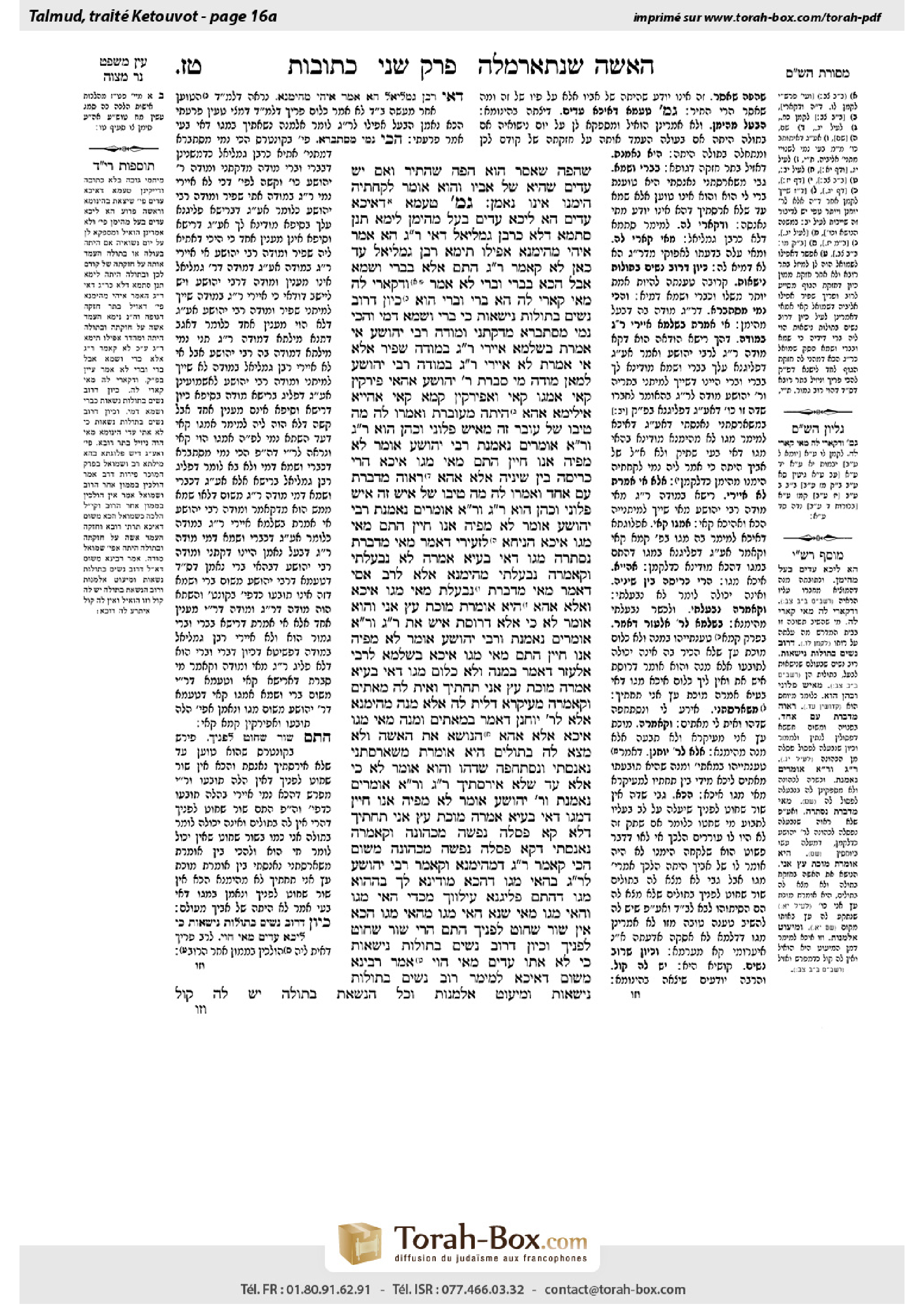
This page of Ketubot includes the Aramaic text, an English translation and an AI-generated French translation, alongside the scan above.
כתובות י״ו א · Aramaic and Hebrew text
שֶׁהַפֶּה שֶׁאָסַר — הוּא הַפֶּה שֶׁהִתִּיר. וְאִם יֵשׁ עֵדִים שֶׁהִיא שֶׁל אָבִיו, וְהוּא אוֹמֵר: ״לְקַחְתִּיהָ הֵימֶנּוּ״ — אֵינוֹ נֶאֱמָן.
גְּמָ׳ טַעְמָא דְּאִיכָּא עֵדִים, הָא לֵיכָּא עֵדִים — בַּעַל מְהֵימַן, לֵימָא תְּנַן סְתָמָא דְּלָא כְּרַבָּן גַּמְלִיאֵל? דְּאִי רַבָּן גַּמְלִיאֵל, הָא אָמַר אִיהִי מְהֵימְנָא!
אֲפִילּוּ תֵּימָא רַבָּן גַּמְלִיאֵל, עַד כָּאן לָא קָאָמַר רַבָּן גַּמְלִיאֵל הָתָם אֶלָּא בְּבָרִי וְשֶׁמָּא. אֲבָל הָכָא בְּבָרִי וּבָרִי — לָא אָמַר.
וּדְקָאָרֵי לַהּ, מַאי קָאָרֵי לַהּ? הָא בָּרִי וּבָרִי הוּא! כֵּיוָן דְּרוֹב נָשִׁים בְּתוּלוֹת נִישָּׂאוֹת, כִּי בָרִי וְשֶׁמָּא דָּמֵי.
וְהָכִי נָמֵי מִסְתַּבְּרָא מִדְּקָתָנֵי, ״וּמוֹדֶה רַבִּי יְהוֹשֻׁעַ״: אִי אָמְרַתְּ בִּשְׁלָמָא אַיְירִי רַבָּן גַּמְלִיאֵל בְּמוֹדֶה — שַׁפִּיר. אֶלָּא אִי אָמְרַתְּ לָא אַיְירִי רַבָּן גַּמְלִיאֵל בְּמוֹדֶה — רַבִּי יְהוֹשֻׁעַ לְמַאן מוֹדֵה?
מִי סָבְרַתְּ רַבִּי יְהוֹשֻׁעַ אַהַאי פִּירְקִין קָאֵי? אַמִּגּוֹ קָאֵי, וְאַפִּירְקִין קַמָּא קָאֵי.
אַהֵיָיא? אִילֵּימָא אַהָא: הָיְתָה מְעוּבֶּרֶת, וְאָמְרוּ לָהּ ״מָה טִיבוֹ שֶׁל עוּבָּר זֶה״. ״מֵאִישׁ פְּלוֹנִי וְכֹהֵן הוּא״, רַבָּן גַּמְלִיאֵל וְרַבִּי אֱלִיעֶזֶר אוֹמְרִים: נֶאֱמֶנֶת, רַבִּי יְהוֹשֻׁעַ אוֹמֵר: לֹא מִפִּיהָ אָנוּ חַיִּין — הָתָם מַאי מִגּוֹ אִיכָּא? הֲרֵי כְּרֵיסָהּ בֵּין שִׁינֶּיהָ.
אֶלָּא אַהָא: רָאוּהָ מְדַבֶּרֶת עִם אֶחָד, וְאָמְרוּ לָהּ: ״מָה טִיבוֹ שֶׁל אִישׁ זֶה״. ״אִישׁ פְּלוֹנִי וְכֹהֵן הוּא״, רַבָּן גַּמְלִיאֵל וְרַבִּי אֱלִיעֶזֶר אוֹמְרִים: נֶאֱמֶנֶת, רַבִּי יְהוֹשֻׁעַ אוֹמֵר: לֹא מִפִּיהָ אָנוּ חַיִּין. הָתָם מַאי מִגּוֹ אִיכָּא? הָנִיחָא לִזְעֵירִי דְּאָמַר: מַאי ״מְדַבֶּרֶת״ — נִסְתְּרָה, מִגּוֹ דְּאִי בָּעֲיָא אָמְרָה לֹא נִבְעַלְתִּי, וְקָאָמְרָה נִבְעַלְתִּי — מְהֵימְנָא. אֶלָּא לְרַב אַסִּי, דְּאָמַר מַאי ״מְדַבֶּרֶת״ — נִבְעֶלֶת, מַאי מִגּוֹ אִיכָּא?
וְאֶלָּא אַהָא: הִיא אוֹמֶרֶת מוּכַּת עֵץ אֲנִי, וְהוּא אוֹמֵר: לֹא כִי, אֶלָּא דְּרוּסַת אִישׁ אַתְּ. רַבָּן גַּמְלִיאֵל וְרַבִּי אֱלִיעֶזֶר אוֹמְרִים: נֶאֱמֶנֶת, וְרַבִּי יְהוֹשֻׁעַ אוֹמֵר: לֹא מִפִּיהָ אָנוּ חַיִּין — הָתָם מַאי מִגּוֹ אִיכָּא?
בִּשְׁלָמָא לְרַבִּי אֶלְעָזָר, דְּאָמַר: בְּמָנֶה וְלֹא כְּלוּם — מִגּוֹ דְּאִי בָּעֲיָא אָמְרָה: ״מוּכַּת עֵץ אֲנִי תַּחְתֶּיךָ״, וְאִית לַהּ מָאתַיִם, וְקָאָמְרָה: מֵעִיקָּרָא, דְּלֵית לַהּ אֶלָּא מָנֶה, מְהֵימְנָא. אֶלָּא לְרַבִּי יוֹחָנָן דְּאָמַר: בְּמָאתַיִם וּמָנֶה. מַאי מִגּוֹ אִיכָּא?
אֶלָּא אַהָא: הַנּוֹשֵׂא אֶת הָאִשָּׁה וְלֹא מָצָא לָהּ בְּתוּלִים, הִיא אוֹמֶרֶת: ״מִשֶּׁאֵרַסְתַּנִי נֶאֱנַסְתִּי, וְנִסְתַּחֲפָה שָׂדֵהוּ״, וְהוּא אוֹמֵר: ״לֹא כִי, אֶלָּא עַד שֶׁלֹּא אֵירַסְתִּיךְ״.
רַבָּן גַּמְלִיאֵל וְרַבִּי אֱלִיעֶזֶר אוֹמְרִים: נֶאֱמֶנֶת, וְרַבִּי יְהוֹשֻׁעַ אוֹמֵר: לֹא מִפִּיהָ אָנוּ חַיִּין. דְּמִגּוֹ דְּאִי בָּעֲיָא אָמְרָה ״מוּכַּת עֵץ אֲנִי תַּחְתֶּיךָ״, דְּלָא קָא פָסְלָה נַפְשָׁהּ מִכְּהוּנָּה. וְקָאָמְרָה: ״נֶאֱנַסְתִּי״, דְּקָא פָּסְלָה נַפְשָׁהּ מִכְּהוּנָּה, מִשּׁוּם הָכִי קָאָמַר רַבָּן גַּמְלִיאֵל דִּמְהֵימְנָא. וְקָאָמַר רַבִּי יְהוֹשֻׁעַ לְרַבָּן גַּמְלִיאֵל: בְּהַאי מִגּוֹ דְּהָכָא — מוֹדֵינָא לָךְ, בְּהָהוּא מִגּוֹ דְּהָתָם — פְּלִיגְנָא עִילָּווֹךְ.
מִכְּדִי הַאי מִגּוֹ וְהַאי מִגּוֹ, מַאי שְׁנָא הַאי מִגּוֹ מֵהַאי מִגּוֹ? הָכָא — אֵין שׁוֹר שָׁחוּט לְפָנֶיךָ. הָתָם — הֲרֵי שׁוֹר שָׁחוּט לְפָנֶיךָ.
וְכֵיוָן דְּרוֹב נָשִׁים בְּתוּלוֹת נִישָּׂאוֹת, כִּי לָא אָתוּ עֵדִים מַאי הָוֵי! אָמַר רָבִינָא: מִשּׁוּם דְּאִיכָּא לְמֵימַר רוֹב נָשִׁים בְּתוּלוֹת נִישָּׂאוֹת, וּמִיעוּט אַלְמָנוֹת, וְכׇל הַנִּשֵּׂאת בְּתוּלָה — יֵשׁ לָהּ קוֹל,
Ketubot 16a · English translation
This is so, as the mouth that prohibited, i.e., claimed that the field had belonged to the other’s father, is the mouth that permitted, i.e., claimed that he purchased the field. Even if he had not admitted that it had belonged to the other’s father, the field would have remained in his possession. Therefore, his claim is accepted. However, if there are witnesses that the field belonged to his father, and the one who has the field in his possession says: I purchased it from him, he is not deemed credible and his claim is rejected.
GEMARA: The Gemara infers: The reason that the bride’s claim is accepted is specifically due to the fact that there are witnesses that she went out of her father’s house to the wedding with a hinnuma. However, if there are no witnesses, the husband is deemed credible. Let us say that the unattributed ruling that we learned in the mishna is not in accordance with the opinion of Rabban Gamliel, as, if the ruling was according to Rabban Gamliel, didn’t he say that she is deemed credible?
The Gemara answers: Even if you will say that the ruling in the mishna is in accordance with the opinion of Rabban Gamliel, Rabban Gamliel stated his opinion only there, in a case where the claim of the bride is certain and the claim of the groom is uncertain, as the groom does not know what actually happened. However, here, in a case where the claim of the bride is certain and the claim of the groom is also certain, as he is certain that he married her as a widow, Rabban Gamliel did not say that her claim is deemed credible.
The Gemara asks: And he who asked the question, why did he ask it? The cases are clearly different, as this is a case of a certain claim and a certain claim. The Gemara answers: Since most women are married as virgins, one might have thought that the legal status in this case is like that of a case of a certain claim and an uncertain claim, as her claim is supported by a majority of cases.
And it also stands to reason that the first clause of the mishna is in accordance with the opinion of Rabban Gamliel, who concedes that without witnesses the woman’s claim is not deemed credible, despite the fact that the case is comparable to one of a certain claim and an uncertain claim, as the mishna teaches: And Rabbi Yehoshua concedes. Granted, if you say that Rabban Gamliel is speaking in the first clause of the mishna and he concedes that even though it is similar to a case of certain and uncertain, her claim is not accepted, it works out well. Rabban Gamliel concedes to Rabbi Yehoshua in the first clause of the mishna and the mishna cites a case where Rabbi Yehoshua concedes to Rabban Gamliel. However, if you say that Rabban Gamliel is not speaking in the first clause of the mishna and he does not concede, to whom does Rabbi Yehoshua concede in the latter clause?
The Gemara rejects that proof: Do you think that the statement of Rabbi Yehoshua is in reference to a mishna in this chapter? Actually, it is in reference to the principle of miggo, and it is in reference to the first chapter. Rabbi Yehoshua is saying that although he does not accept the claim supported by a miggo in the first chapter, here he accepts the claim supported by the principle: The mouth that prohibited is the mouth that permitted, which is based on the same reasoning as miggo, i.e., the fact that he could have made a more advantageous claim lends credibility to the less advantageous claim. In this case, he could have remained silent and the field would have remained in his possession. If challenged, he could have claimed that the field was his. Therefore, his less advantageous claim, that the field was not originally his but he purchased it from the father of the claimant, is accepted.
The Gemara elaborates: In reference to which case in the first chapter did Rabbi Yehoshua make his statement? If you say that it is in reference to this case (13a): If a single woman was pregnant, and people said to her: What is the nature of that fetus, and she says to them: It is from a man called so-and-so and he is a priest, Rabban Gamliel and Rabbi Eliezer say: She is deemed credible, and Rabbi Yehoshua says: It is not based on the statement emerging from her mouth that we conduct our lives. There, what miggo is there lending credibility to her claim? In that case, her belly is between her teeth, i.e., her pregnancy is conspicuous, and consequently she does not have the option of making the more advantageous claim that she did not engage in intercourse.
Rather, it is in reference to this case (13a): If people saw a woman speaking to one man, and they said to her: What is the nature of this man? And she said to them: He is a man called so-and-so and he is a priest, Rabban Gamliel and Rabbi Eliezer say: She is deemed credible, and Rabbi Yehoshua says: It is not based on the statement emerging from her mouth that we conduct our lives. Again this is challenged: There, what miggo is there? This works out well according to Ze’eiri, who said: What is the meaning of speaking mentioned in the mishna? It means that she secluded herself with a man. In this case there is a miggo. Since, if she wished to lie, she could have said: I did not engage in intercourse at all, and instead she said: I engaged in intercourse with a man of unflawed lineage. Therefore, she is deemed credible according to Rabban Gamliel. However, according to Rav Asi, who said: What is the meaning of speaking? It means that she engaged in intercourse, what miggo is there? There was no better claim available to her.
Rather, it is in reference to this case (13a), where she says: I am one whose hymen was ruptured by wood, and the groom says: No; rather, you are one who was trampled by a man. Rabban Gamliel and Rabbi Eliezer say: She is deemed credible, and Rabbi Yehoshua says: It is not on the basis of the statement emerging from her mouth that we conduct our lives. There, what miggo is there?
Granted, according to Rabbi Elazar, who said that the bride claims that she is entitled to a marriage contract of one hundred dinars, and the groom claims that she is entitled to nothing at all, as in that case, there is a miggo. Since, if she wished to lie, she could have said: I am one whose hymen was ruptured by wood under your authority after betrothal, and she would have been entitled to two hundred dinars, as she was a virgin at betrothal. And therefore, when she says that her hymen was already ruptured initially, prior to betrothal, when she is entitled to only one hundred dinars, she is deemed credible. However, according to Rabbi Yoḥanan, who said: The bride claims that she is entitled to a marriage contract of two hundred dinars; and the groom claims that that she is entitled to a marriage contract of one hundred dinars, what miggo is there? Her claim is the most advantageous claim available to her.
Rather, it is in reference to this case (12b): One who marries a woman and did not find her hymen intact, and she says: After you betrothed me, I was raped and his field was inundated, i.e., it is attributable to your own misfortune. And he says: No; rather, you were raped before I betrothed you, and my transaction was a mistaken transaction.
Rabban Gamliel and Rabbi Eliezer say: She is deemed credible, and Rabbi Yehoshua says: It is not based on the statement emerging from her mouth that we conduct our lives, as, in that case there is a miggo. Since, if she wished to lie, she could have said: I am one whose hymen was ruptured by wood under your jurisdiction after betrothal, which is a more advantageous claim, because she does not thereby disqualify herself from marrying into the priesthood. But she said: I was raped after betrothal, which is a less advantageous claim, because she disqualified herself from the priesthood. Therefore, Rabban Gamliel says that she is deemed credible. And Rabbi Yehoshua says to Rabban Gamliel: With regard to this miggo in the mishna here, I concede to you that the miggo is effective. With regard to that miggo there in the first chapter, I disagree with you.
The Gemara asks: But after all, this is a case of miggo and that is a case of miggo. In what way, in the opinion of Rabbi Yehoshua, is this miggo different from that miggo? The Gemara answers: Here, in the case of contested ownership of the field, there is no slaughtered ox before you, i.e., there is no reason to question his claim of ownership, as the field is in his possession. However, there, in the case of the woman who was found not to be a virgin, there is a slaughtered ox before you, i.e., there is reason to question her virginity, and it is only in response to that question that she makes her claim. Therefore, although it is supported by a miggo, Rabbi Yehoshua does not accept her claim.
§ The Gemara resumes discussion of the inference that it drew at the outset with regard to witnesses that the bride was a virgin. And since the Gemara established earlier that the woman’s claim is supported by the fact that most women are married as virgins, if witnesses did not come, what of it? That majority should be sufficient to establish that she married as a virgin. Ravina said: It is because there is room to say that although most women are married as virgins and a minority of women marry as widows or non-virgins, there is an additional presumption: The marriage of anyone who is married as a virgin generates publicity,
Ketubot 16a · Traduction française (IA)
Il en est ainsi, car celui qui a formulé l’affirmation qui interdisait — à savoir que le champ appartenait au père de l’autre — est aussi celui qui a formulé l’affirmation qui permettait — à savoir qu’il avait acheté le champ. Même s’il n’avait pas reconnu que le champ avait appartenu au père de l’autre, le champ serait resté en sa possession. Son affirmation est donc acceptée. En revanche, s’il y a des témoins attestant que le champ appartenait à son père, et que celui qui détient le champ dit : « Je l’ai acheté auprès de lui », on ne le croit pas et son affirmation est rejetée.
GUEMARA : La Guemara déduit que l’affirmation de la mariée est acceptée précisément parce qu’il y a des témoins attestant qu’elle a quitté la maison de son père pour se rendre au mariage avec une hinnuma. En revanche, s’il n’y a pas de témoins, on croit le mari. Faut-il donc dire que la décision anonyme de la Michna que nous avons étudiée ne suit pas l’opinion de Rabban Gamliel ? En effet, si elle suivait son opinion, n’a-t-il pas dit qu’on la croit ?
La Guemara répond : Même si l’on dit que la décision de la Michna suit l’opinion de Rabban Gamliel, celui-ci n’a exprimé son opinion que là, dans un cas où l’affirmation de la mariée est certaine et celle du marié incertaine, car ce dernier ignore ce qui s’est réellement passé. Mais ici, dans un cas où l’affirmation de la mariée est certaine et celle du marié l’est aussi, puisqu’il est certain de l’avoir épousée en tant que veuve, Rabban Gamliel n’a pas dit qu’on devait la croire.
La Guemara demande : Mais pourquoi celui qui a posé la question l’a-t-il posée ? Les cas sont clairement différents, puisqu’il s’agit ici d’une affirmation certaine opposée à une autre affirmation certaine. La Guemara répond : Puisque la plupart des femmes se marient vierges, on aurait pu penser que le statut juridique de ce cas est celui d’une affirmation certaine opposée à une affirmation incertaine, car son affirmation est étayée par la majorité des cas.
Il est également logique que la première partie de la Michna suive l’opinion de Rabban Gamliel, qui reconnaît qu’en l’absence de témoins, on ne croit pas l’affirmation de la femme, bien que le cas soit comparable à celui d’une affirmation certaine opposée à une affirmation incertaine. En effet, la Michna enseigne : « Et Rabbi Yehoshua reconnaît… » Il est cohérent de dire que Rabban Gamliel intervient dans la première partie de la Michna et reconnaît que, même si le cas ressemble à une situation où l’une des affirmations est certaine et l’autre incertaine, l’affirmation de la femme n’est pas acceptée. Rabban Gamliel reconnaît donc le point de vue de Rabbi Yehoshua dans la première partie de la Michna, et la Michna cite un cas où Rabbi Yehoshua reconnaît le point de vue de Rabban Gamliel. Mais si l’on dit que Rabban Gamliel n’intervient pas dans la première partie de la Michna et qu’il ne reconnaît pas son point de vue, à qui Rabbi Yehoshua donne-t-il raison dans la dernière partie ?
La Guemara rejette cette preuve : Penses-tu que la déclaration de Rabbi Yehoshua se rapporte à une Michna de ce chapitre ? En réalité, elle se rapporte au principe du miggo et au premier chapitre. Rabbi Yehoshua dit que, même s’il n’accepte pas dans le premier chapitre une affirmation étayée par un miggo, ici, il accepte l’affirmation fondée sur le principe selon lequel « celui qui a interdit est aussi celui qui a permis », lequel repose sur le même raisonnement que le miggo : le fait qu’une personne aurait pu avancer une affirmation plus avantageuse rend crédible celle qui l’est moins. Dans ce cas, il aurait pu garder le silence et le champ serait resté en sa possession. Si on l’avait contesté, il aurait pu prétendre que le champ lui appartenait. Son affirmation moins avantageuse — selon laquelle le champ ne lui appartenait pas à l’origine, mais qu’il l’avait acheté au père du demandeur — est donc acceptée.
À quel cas du premier chapitre Rabbi Yehoshua faisait-il référence ? Si tu dis qu’il s’agit de ce cas (13a) : une femme célibataire était enceinte, et des gens lui demandèrent : « De qui est ce fœtus ? » Elle leur répondit : « Il est de tel homme, et cet homme est prêtre. » Rabban Gamliel et Rabbi Eliezer disent : « On la croit », tandis que Rabbi Yehoshua dit : « Ce n’est pas sur la seule foi de ce qui sort de sa bouche que nous réglons notre conduite. » Or, quel miggo rend son affirmation crédible dans ce cas ? Son ventre est entre ses dents, c’est-à-dire que sa grossesse est manifeste ; par conséquent, elle n’a pas la possibilité d’avancer l’affirmation plus avantageuse selon laquelle elle n’a pas eu de rapports sexuels.
Il s’agit plutôt de ce cas (13a) : des gens ont vu une femme parler à un homme et lui ont demandé : « Qui est cet homme ? » Elle leur répondit : « C’est tel homme, et il est prêtre. » Rabban Gamliel et Rabbi Eliezer disent : « On la croit », tandis que Rabbi Yehoshua dit : « Ce n’est pas sur la seule foi de ce qui sort de sa bouche que nous réglons notre conduite. » Là encore, on objecte : quel miggo y a-t-il dans ce cas ? Cela s’accorde avec l’opinion de Ze’eiri, qui a dit : Que signifie « parler » dans la Michna ? Cela signifie qu’elle s’est isolée avec un homme. Dans ce cas, il y a un miggo : si elle avait voulu mentir, elle aurait pu dire : « Je n’ai pas eu de rapports sexuels du tout », alors qu’elle a dit : « J’ai eu des rapports avec un homme de filiation irréprochable. » Rabban Gamliel la croit donc. Mais selon Rav Asi, qui a dit que « parler » signifie qu’elle a eu des rapports sexuels, quel miggo y a-t-il ? Elle ne disposait d’aucune affirmation plus avantageuse.
Il s’agit plutôt de ce cas (13a), où elle dit : « Mon hymen a été rompu par du bois », et où le marié dit : « Non ; tu as plutôt été déflorée par un homme. » Rabban Gamliel et Rabbi Eliezer disent : « On la croit », tandis que Rabbi Yehoshua dit : « Ce n’est pas sur la seule foi de ce qui sort de sa bouche que nous réglons notre conduite. » Quel miggo y a-t-il dans ce cas ?
Cela s’accorde avec l’opinion de Rabbi Elazar, qui a dit que la mariée affirme avoir droit à une ketouba de cent dinars, tandis que le marié affirme qu’elle n’a droit à rien du tout, car il y a alors un miggo. En effet, si elle avait voulu mentir, elle aurait pu dire : « Mon hymen a été rompu par du bois, sous ton autorité, après les fiançailles », et elle aurait eu droit à deux cents dinars, puisqu’elle était vierge au moment des fiançailles. Par conséquent, lorsqu’elle dit que son hymen avait déjà été rompu auparavant, avant les fiançailles, et qu’elle n’a donc droit qu’à cent dinars, on la croit. En revanche, selon Rabbi Yoḥanan, qui a dit que la mariée affirme avoir droit à une ketouba de deux cents dinars, tandis que le marié affirme qu’elle a droit à une ketouba de cent dinars, quel miggo y a-t-il ? Son affirmation est la plus avantageuse dont elle dispose.
Il s’agit plutôt de ce cas (12b) : un homme épouse une femme et constate que son hymen n’est pas intact. Elle dit : « Après que tu m’as fiancée, j’ai été violée, et son champ a été inondé », c’est-à-dire que cela relève de ton propre malheur. Lui répond : « Non ; tu as plutôt été violée avant que je te fiance, et mon contrat a été conclu par erreur. »
Rabban Gamliel et Rabbi Eliezer disent : « On la croit », tandis que Rabbi Yehoshua dit : « Ce n’est pas sur la seule foi de ce qui sort de sa bouche que nous réglons notre conduite. » En effet, dans ce cas, il y a un miggo : si elle avait voulu mentir, elle aurait pu dire : « Mon hymen a été rompu par du bois, sous ton autorité, après les fiançailles », ce qui aurait été plus avantageux pour elle, puisqu’elle n’aurait pas été disqualifiée pour épouser un prêtre. Mais elle a dit : « J’ai été violée après les fiançailles », ce qui est moins avantageux, car elle est ainsi disqualifiée pour épouser un prêtre. Rabban Gamliel dit donc qu’on la croit. Rabbi Yehoshua dit alors à Rabban Gamliel : « Pour ce miggo de la Michna, ici, je te donne raison : le miggo est opérant. Pour cet autre miggo, là-bas, dans le premier chapitre, je ne suis pas d’accord avec toi. »
La Guemara demande : Mais après tout, il s’agit dans les deux cas d’un miggo. En quoi, selon Rabbi Yehoshua, ce miggo diffère-t-il de l’autre ? La Guemara répond : Ici, dans le cas où la propriété du champ est contestée, il n’y a pas de bœuf abattu devant toi, c’est-à-dire qu’il n’y a aucune raison de mettre en doute sa revendication de propriété, puisque le champ est en sa possession. Mais là, dans le cas de la femme dont on a constaté qu’elle n’était pas vierge, il y a un bœuf abattu devant toi, c’est-à-dire qu’il y a une raison de mettre en doute sa virginité, et ce n’est qu’en réponse à cette mise en doute qu’elle formule son affirmation. C’est pourquoi, bien que son affirmation soit étayée par un miggo, Rabbi Yehoshua ne l’accepte pas.
§ La Guemara reprend l’inférence qu’elle avait tirée au début au sujet des témoins attestant que la mariée était vierge. Puisque la Guemara a établi plus tôt que l’affirmation de la femme est étayée par le fait que la plupart des femmes se marient vierges, qu’importe qu’il n’y ait pas de témoins ? Cette majorité devrait suffire à établir qu’elle s’est mariée vierge. Ravina dit : C’est parce qu’on peut avancer que, bien que la plupart des femmes se marient vierges et qu’une minorité se marie en étant veuve ou non vierge, il existe une présomption supplémentaire : le mariage de toute femme qui se marie vierge fait grand bruit,
Traduction française générée par IA à partir de l’édition anglaise de Sefaria. Vérifie toujours un passage avec le texte source.
Text from Sefaria: William Davidson Edition - Vocalized Aramaic (CC BY NC); William Davidson Edition - English (CC BY NC).