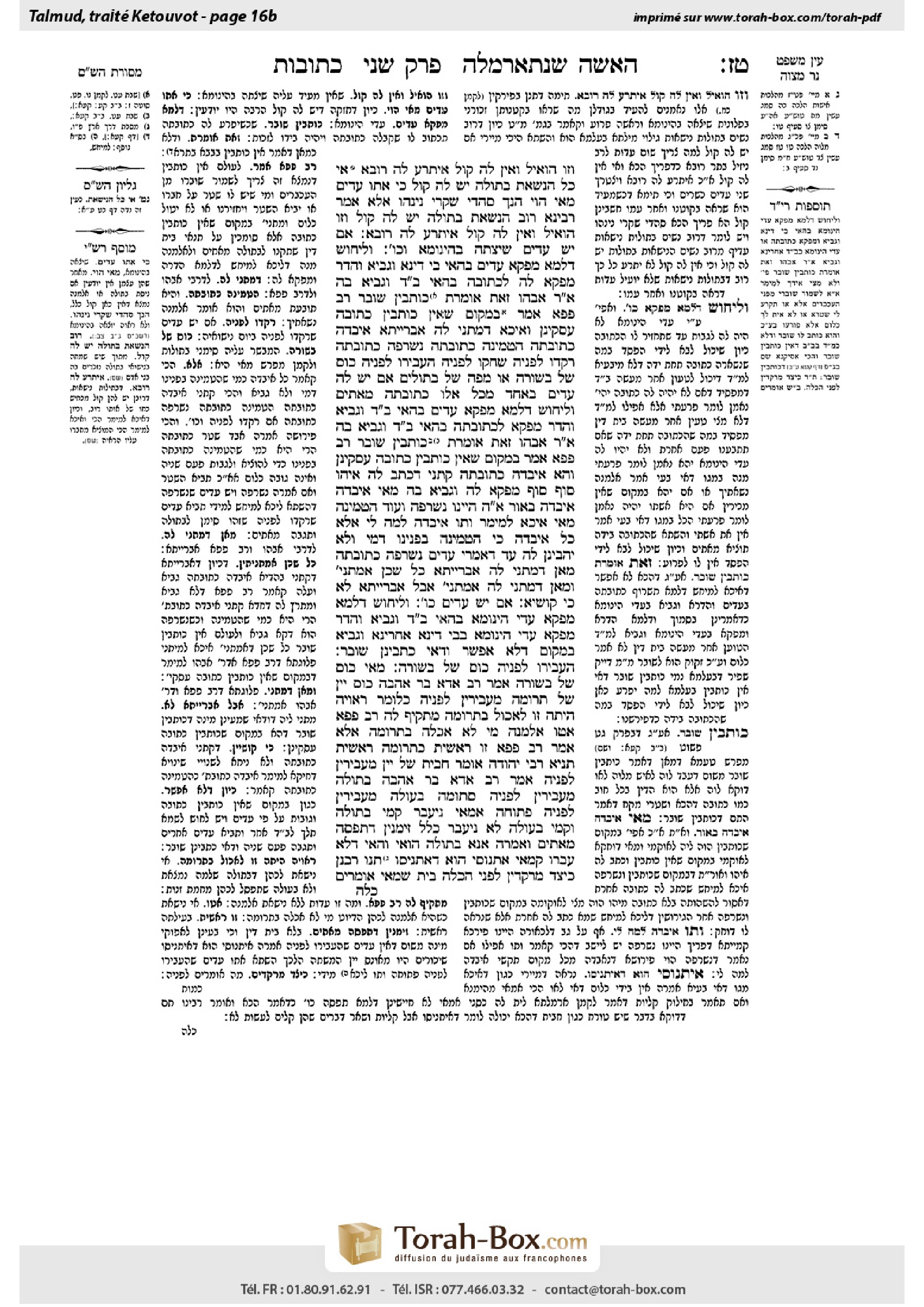
Ketubot 16b: Talmud study for Daf Yomi
Daf Yomi is the daily study of one Talmud folio. Explore 37 tractates with scans, Hebrew text, Sefaria English and AI-generated French translations where annotated.
Passage selection and English or AI-generated French translation are available where the scan has annotations. Daf Study is independent of Torah-Box and Sefaria.
Browse Ketubot · כתובות · All tractatesKetubot 16b text and translations
This page of Ketubot includes the Aramaic text, an English translation and an AI-generated French translation, alongside the scan above.
כתובות י״ו ב · Aramaic and Hebrew text
וְזוֹ, הוֹאִיל וְאֵין לָהּ קוֹל — אִיתְּרַע לֵהּ רוּבָּא.
אִי כׇּל הַנִּשֵּׂאת בְּתוּלָה יֵשׁ לָהּ קוֹל — כִּי אֲתוֹ עֵדִים, מַאי הָוֵי? הָנָךְ סָהֲדֵי שַׁקָּרֵי נִינְהוּ! אֶלָּא אָמַר רָבִינָא: רוֹב הַנִּשֵּׂאת בְּתוּלָה יֵשׁ לָהּ קוֹל, וְזוֹ הוֹאִיל וְאֵין לָהּ קוֹל — אִיתְּרַע לֵהּ רוּבָּא.
אִם יֵשׁ עֵדִים שֶׁיָּצְתָה בְּהִינוּמָא וְכוּ׳. וְלֵיחוּשׁ דִּלְמָא מַפְּקָא עֵדִים בְּהַאי בֵּי דִינָא, וְגָבְיָא, וַהֲדַר מַפְּקָא לַהּ לִכְתוּבָה בְּהַאי בֵּית דִּין, וְגָבְיָא בַּהּ? אָמַר רַבִּי אֲבָהוּ: זֹאת אוֹמֶרֶת כּוֹתְבִין שׁוֹבָר. רַב פָּפָּא אָמַר: בִּמְקוֹם שֶׁאֵין כּוֹתְבִין כְּתוּבָּה עָסְקִינַן.
וְאִיכָּא דְּמַתְנֵי לַהּ אַבָּרַיְיתָא: אִיבְּדָה כְּתוּבָּתָהּ, הִטְמִינָה כְּתוּבָּתָהּ, נִשְׂרְפָה כְּתוּבָּתָהּ, רָקְדוּ לְפָנֶיהָ, שָׂחֲקוּ לְפָנֶיהָ, הֶעֱבִירוּ לְפָנֶיהָ כּוֹס שֶׁל בְּשׂוֹרָה, אוֹ מַפָּה שֶׁל בְּתוּלִים. אִם יֵשׁ לָהּ עֵדִים בְּאֶחָד מִכׇּל אֵלּוּ — כְּתוּבָּתָהּ מָאתַיִם.
וְלֵיחוּשׁ דִּלְמָא מַפְּקָא עֵדִים בְּהַאי בֵּית דִּין וְגָבְיָא, וַהֲדַר מַפְּקָא לִכְתוּבָּתָהּ בְּהַאי בֵּית דִּין וְגָבְיָא בַּהּ! אָמַר רַבִּי אֲבָהוּ: זֹאת אוֹמֶרֶת כּוֹתְבִין שׁוֹבָר. רַב פָּפָּא אָמַר: בִּמְקוֹם שֶׁאֵין כּוֹתְבִין כְּתוּבָּה עָסְקִינַן.
וְהָא ״אִיבְּדָה כְּתוּבָּתָהּ״ קָתָנֵי! דִּכְתַב לַהּ אִיהוּ. סוֹף סוֹף מַפְּקָא לַהּ וְגָבְיָא בַּהּ! מַאי ״אִיבְּדָה״ — אִיבְּדָה בָּאוּר.
אִי הָכִי הַיְינוּ ״נִשְׂרְפָה״? וְעוֹד: הִטְמִינָה, מַאי אִיכָּא לְמֵימַר? וְתוּ: אִיבְּדָה לְמָה לִי? אֶלָּא: כֹּל אִיבְּדָה — כִּי הִטְמִינָה בְּפָנֵינוּ דָּמֵי, וְלָא יָהֲבִינַן לַהּ עַד דְּאָמְרִי עֵדִים נִשְׂרְפָה כְּתוּבָּתָהּ.
מַאן דְּמַתְנֵי לַהּ אַבָּרַיְיתָא — כׇּל שֶׁכֵּן אַמַּתְנִיתִין. וּמַאן דְּמַתְנֵי לַהּ אַמַּתְנִיתִין — אֲבָל אַבָּרַיְיתָא לָא, כִּי קוּשְׁיָא.
אִם יֵשׁ עֵדִים כּוּ׳. וְלֵיחוּשׁ דִּלְמָא מַפְּקָא עֵדֵי הִינּוּמָא בְּהַאי בֵּית דִּין וְגָבְיָא, וַהֲדַר מַפְּקָא עֵדֵי הִינּוּמָא בְּבֵי דִינָא אַחֲרִינָא וְגָבְיָא! בְּמָקוֹם דְּלָא אֶפְשָׁר וַדַּאי כָּתְבִינַן שׁוֹבָר.
הֶעֱבִירוּ לְפָנֶיהָ כּוֹס שֶׁל בְּשׂוֹרָה. מַאי ״כּוֹס שֶׁל בְּשׂוֹרָה״? אָמַר רַב אַדָּא בַּר אַהֲבָה: כּוֹס יַיִן שֶׁל תְּרוּמָה מַעֲבִירִין לְפָנֶיהָ. כְּלוֹמַר: רְאוּיָה הָיְתָה זוֹ לֶאֱכוֹל בִּתְרוּמָה. מַתְקֵיף לַהּ רַב פָּפָּא: אַטּוּ אַלְמָנָה מִי לָא אָכְלָה בִּתְרוּמָה? אֶלָּא אָמַר רַב פָּפָּא: זוֹ רֵאשִׁית, כִּתְרוּמָה רֵאשִׁית.
תַּנְיָא, רַבִּי יְהוּדָה אוֹמֵר: חָבִית שֶׁל יַיִן מַעֲבִירִין לְפָנֶיהָ. אָמַר רַב אַדָּא בַּר אַהֲבָה: בְּתוּלָה — מַעֲבִירִין לְפָנֶיהָ סְתוּמָה, בְּעוּלָה — מַעֲבִירִין לְפָנֶיהָ פְּתוּחָה. אַמַּאי? נִיעַבַּר קַמֵּי בְּתוּלָה וְקַמֵּי בְּעוּלָה לָא נִיעַבַּר כְּלָל! זִימְנִין דְּתָפְסָה מָאתַיִם, וְאָמְרָה: אֲנָא בְּתוּלָה הֲוַאי, וְהַאי דְּלָא עַבַּרוּ קַמַּאי — אִתְּנוֹסֵי הוּא דְּאִתְּנִיסוּ.
תָּנוּ רַבָּנַן: כֵּיצַד מְרַקְּדִין לִפְנֵי הַכַּלָּה? בֵּית שַׁמַּאי אוֹמְרִים:
Ketubot 16b · English translation
and with regard to this woman, because her marriage did not generate publicity, the effect of the majority is undermined.
The Gemara asks: If in fact, the marriage of anyone who is married as a virgin generates publicity, and the marriage of this woman did not generate publicity, when witnesses come, what of it? These are false witnesses, as their testimony runs counter to the presumption governing all marriages. Rather, Ravina said that it is not a universal presumption, but a majority. The marriage of most women who are married as virgins generates publicity, but for this woman, since her marriage did not generate publicity, the effect of the majority is undermined. Therefore, the testimony that she went out of her father’s house to her wedding with a hinnuma overrides the lack of publicity.
§ It was stated in the mishna: If there are witnesses that she went out of her father’s house to her wedding with a hinnuma, or with her hair uncovered, in a manner typical of virgins, payment of her marriage contract is two hundred dinars. The Gemara asks: And since she collects payment without producing her marriage contract, let us be concerned that she might produce witnesses in this court and collect payment, and then produce her marriage contract in that other court and collect with it payment a second time. Rabbi Abbahu said: This indicates that one writes a receipt indicating that the woman received payment. Were the woman to attempt to collect payment of her marriage contract a second time, her husband would produce the receipt. Rav Pappa said: We are dealing in the mishna with a place where one does not write a marriage contract. It is only in a case where there is no concern lest she produce her marriage contract that she collects payment based on the testimony of witnesses.
And there are some who teach the dispute between Rabbi Abbahu and Rav Pappa with regard to the baraita that says: In a case where a woman lost her marriage contract or concealed her marriage contract and she claims that she is unable to find it; or her marriage contract was burned, and there is no proof with regard to the sum to which she is entitled; or practices performed exclusively at the weddings of virgins were performed at her wedding, e.g., people danced before her, or played before her, or passed before her a cup of good tidings or a cloth of virginity; if she has witnesses with regard to any one of these practices, her marriage contract is two hundred dinars.
The Gemara asks: And since she collects payment without producing her marriage contract, let us be concerned that she might produce witnesses in this court and collect payment, and then produce her marriage contract in that other court and collect payment with it a second time. Rabbi Abbahu said: This indicates that one writes a receipt indicating that the woman received payment. Were the woman to attempt to collect payment of her marriage contract a second time, her husband would produce the receipt. Rav Pappa said: We are dealing in the mishna with a place where one does not write a marriage contract.
The Gemara asks: But how could Rav Pappa say that the baraita is dealing with a place where one does not write a marriage contract? Isn’t it taught in that baraita: If a woman lost her marriage contract? The Gemara answers: The baraita is referring to a case where her husband wrote her a marriage contract contrary to the local custom. The Gemara asks: If he wrote her a marriage contract, the concern remains that ultimately she will produce the marriage contract and collect payment with it a second time. The Gemara answers: What is the meaning of lost? The woman lost her marriage contract in the fire. In that case, there is no longer any concern.
The Gemara asks: If so, that is the case of: Her marriage contract was burned, listed separately in the baraita. And furthermore, what is there to say with regard to the case of concealed, where the concern that she will collect payment twice remains? And furthermore, if burned comes to explain the meaning of lost, why do I need the baraita to list the case of lost at all? It would have been sufficient for the baraita to mention the case of a burned marriage contract. Rather, the meaning of the baraita is: The legal status of any case where the woman claims that she lost her marriage contract is like that of a case where she concealed it before us, and we give her payment of her marriage contract only when the witnesses say that her marriage contract was burned. Otherwise, even if witnesses testify that the practices characteristic of the wedding of a virgin were performed at her wedding, she does not collect payment of her marriage contract.
The Gemara notes: The one who teaches this dispute between Rabbi Abbahu and Rav Pappa with regard to the baraita, all the more so would he teach it with regard to the mishna. Applying Rav Pappa’s opinion to the mishna does not necessitate the emendation and reinterpretation necessitated by its application to the baraita. However, the one who teaches this dispute with regard to the mishna would not teach it then with regard to the baraita, in accordance with the difficulty raised there, as the plain meaning of the baraita is that it is a place where one writes a marriage contract.
With regard to that same passage in the mishna: If there are witnesses that she went out of her father’s house to her wedding with a hinnuma, or with her hair uncovered, in a manner typical of virgins, payment of her marriage contract is two hundred dinars, the Gemara asks: But let us be concerned lest she first produce witnesses that she went out with a hinnuma, in this court, and collect payment, and then produce witnesses that she went out with a hinnuma, in that court, and collect payment a second time. The Gemara answers: In a place where it is not possible to guarantee that she will not collect her marriage contract more than once in any other way, certainly we write a receipt, even according to the opinion that as a rule, one does not write a receipt.
§ It is taught in that baraita: Or passed before her a cup of good tidings. The Gemara asks: What is a cup of good tidings? Rav Adda bar Ahava says: A cup of teruma wine is passed before the virgin bride, meaning that this woman would have been eligible to eat teruma had she married a priest. Rav Pappa strongly objects to this: Is that to say that a widow does not eat teruma if she marries a priest? Clearly she does. Therefore, what is the proof from teruma that she is a virgin? Rather, Rav Pappa says: The cup of teruma is passed before her to indicate that this bride is first, as she has not yet engaged in intercourse, like teruma that is the first gift separated from the produce.
It is taught in a baraita that Rabbi Yehuda says: The custom is that one passes a barrel of wine before her. Rav Adda bar Ahava said: One passes a sealed barrel of wine before a virgin, and one passes an open barrel of wine before a non-virgin. The Gemara asks: Why is that necessary? Let us pass the sealed barrel before the virgin, and before the non-virgin let us not pass a barrel at all. Why is it necessary to publicize the fact that she is a non-virgin? The Gemara explains: It is necessary, as, at times there could be a case where a non-virgin unilaterally seized two hundred dinars as payment for her marriage contract and said: I was a virgin, and the fact that they did not pass a sealed barrel before me was due to circumstances beyond their control. In order to prevent deceit of that kind, an open barrel is passed before the non-virgin, so that people will remember that she is not a virgin.
§ The Sages taught: How does one dance before the bride, i.e., what does one recite while dancing at her wedding? Beit Shammai say:
Ketubot 16b · Traduction française (IA)
Et à propos de cette femme, puisque son mariage n’a pas été connu, l’effet de la majorité est affaibli.
La Guemara demande : Si, en réalité, le mariage de toute femme épousée vierge est connu, et que le mariage de cette femme ne l’a pas été, que change la venue de témoins ? Ce sont de faux témoins, puisque leur témoignage contredit la présomption qui s’applique à tous les mariages. Ravina dit plutôt qu’il ne s’agit pas d’une présomption universelle, mais d’une majorité. Le mariage de la plupart des femmes épousées vierges est connu, mais, pour cette femme, puisque son mariage ne l’a pas été, l’effet de la majorité est affaibli. Le témoignage selon lequel elle est sortie de la maison de son père pour se rendre à son mariage avec une hinnuma l’emporte donc sur l’absence de publicité.
§ La Michna enseigne : S’il y a des témoins attestant qu’elle est sortie de la maison de son père pour se rendre à son mariage avec une hinnuma, ou les cheveux découverts, comme il est d’usage pour les vierges, le montant de sa ketouba est de deux cents dinars. La Guemara demande : Puisqu’elle perçoit le paiement sans produire sa ketouba, ne faut-il pas craindre qu’elle fasse témoigner des témoins devant ce tribunal et perçoive le paiement, puis produise sa ketouba devant cet autre tribunal et perçoive une seconde fois le paiement grâce à celle-ci ? Rabbi Abbahou dit : Cela indique qu’on rédige un reçu attestant que la femme a reçu le paiement. Si la femme tentait de percevoir une seconde fois le montant de sa ketouba, son mari produirait le reçu. Rav Pappa dit : La Michna traite d’un lieu où l’on ne rédige pas de ketouba. Ce n’est que dans un cas où l’on ne craint pas qu’elle produise sa ketouba qu’elle perçoit le paiement sur la foi du témoignage des témoins.
Certains enseignent la controverse entre Rabbi Abbahou et Rav Pappa à propos de la baraïta qui dit : Dans le cas où une femme a perdu sa ketouba ou l’a cachée et prétend ne pas parvenir à la retrouver, ou si sa ketouba a brûlé et qu’il n’existe aucune preuve quant à la somme à laquelle elle a droit, ou si, lors de son mariage, on a accompli des pratiques réservées aux mariages de vierges — par exemple, on a dansé devant elle, joué devant elle, ou fait passer devant elle une coupe de bonnes nouvelles ou un voile de virginité —, si elle a des témoins concernant l’une de ces pratiques, le montant de sa ketouba est de deux cents dinars.
La Guemara demande : Puisqu’elle perçoit le paiement sans produire sa ketouba, ne faut-il pas craindre qu’elle fasse témoigner des témoins devant ce tribunal et perçoive le paiement, puis produise sa ketouba devant cet autre tribunal et perçoive une seconde fois le paiement grâce à celle-ci ? Rabbi Abbahou dit : Cela indique qu’on rédige un reçu attestant que la femme a reçu le paiement. Si la femme tentait de percevoir une seconde fois le montant de sa ketouba, son mari produirait le reçu. Rav Pappa dit : La Michna traite d’un lieu où l’on ne rédige pas de ketouba.
La Guemara demande : Mais comment Rav Pappa peut-il dire que la baraïta traite d’un lieu où l’on ne rédige pas de ketouba ? N’est-il pas enseigné dans cette baraïta : « Si une femme a perdu sa ketouba » ? La Guemara répond : La baraïta parle d’un cas où son mari lui a rédigé une ketouba contrairement à l’usage local. La Guemara demande : S’il lui a rédigé une ketouba, on craint toujours qu’elle finisse par la produire et perçoive une seconde fois le paiement grâce à celle-ci. La Guemara répond : Que signifie « perdu » ? La femme a perdu sa ketouba dans l’incendie. Dans ce cas, il n’y a plus lieu de s’inquiéter.
La Guemara demande : Si c’est ainsi, cela correspond au cas de sa ketouba qui a brûlé, mentionné séparément dans la baraïta. Et de plus, que dire du cas où elle l’a cachée, alors que le risque qu’elle perçoive le paiement deux fois subsiste ? Et de plus, si le cas où la ketouba a brûlé vient expliquer le sens de « perdu », pourquoi la baraïta doit-elle mentionner le cas de la perte ? Il aurait suffi qu’elle mentionne le cas d’une ketouba brûlée. Le sens de la baraïta est plutôt le suivant : tout cas où la femme prétend avoir perdu sa ketouba a le même statut que celui où elle l’a cachée devant nous, et nous ne lui accordons le paiement de sa ketouba que lorsque les témoins disent que sa ketouba a brûlé. Sinon, même si des témoins attestent que les pratiques caractéristiques du mariage d’une vierge ont été accomplies lors de son mariage, elle ne perçoit pas le paiement de sa ketouba.
La Guemara note : Celui qui enseigne cette controverse entre Rabbi Abbahou et Rav Pappa à propos de la baraïta l’enseignerait à plus forte raison à propos de la Michna. Appliquer l’avis de Rav Pappa à la Michna ne nécessite pas la correction et la réinterprétation qu’exige son application à la baraïta. En revanche, celui qui enseigne cette controverse à propos de la Michna ne l’enseignerait pas à propos de la baraïta, compte tenu de la difficulté soulevée à ce sujet : le sens littéral de la baraïta est qu’il s’agit d’un lieu où l’on rédige une ketouba.
À propos du même passage de la Michna — s’il y a des témoins attestant qu’elle est sortie de la maison de son père pour se rendre à son mariage avec une hinnuma, ou les cheveux découverts, comme il est d’usage pour les vierges, le montant de sa ketouba est de deux cents dinars —, la Guemara demande : Mais ne faut-il pas craindre qu’elle produise d’abord des témoins attestant qu’elle est sortie avec une hinnuma devant ce tribunal et perçoive le paiement, puis produise des témoins attestant qu’elle est sortie avec une hinnuma devant cet autre tribunal et perçoive une seconde fois le paiement ? La Guemara répond : Dans un lieu où il est impossible de garantir autrement qu’elle ne percevra pas sa ketouba plus d’une fois, on rédige assurément un reçu, même selon l’avis voulant qu’en règle générale, on ne rédige pas de reçu.
§ Il est enseigné dans cette baraïta : « Ou fait passer devant elle une coupe de bonnes nouvelles. » La Guemara demande : Qu’est-ce qu’une coupe de bonnes nouvelles ? Rav Adda bar Ahava dit : On fait passer devant la mariée vierge une coupe de vin de terouma, ce qui signifie que cette femme aurait eu le droit de consommer de la terouma si elle avait épousé un prêtre. Rav Pappa s’y oppose vivement : Cela signifie-t-il qu’une veuve ne consomme pas de terouma si elle épouse un prêtre ? Évidemment, elle en consomme. Quelle preuve la terouma apporte-t-elle donc qu’elle est vierge ? Rav Pappa dit plutôt : On fait passer devant elle la coupe de terouma pour indiquer que cette mariée est la première, puisqu’elle n’a pas encore eu de rapports sexuels, comme la terouma, qui est le premier prélèvement séparé des produits.
Il est enseigné dans une baraïta que Rabbi Yehouda dit : L’usage est de faire passer devant elle un tonneau de vin. Rav Adda bar Ahava dit : On fait passer un tonneau de vin fermé devant une vierge, et un tonneau ouvert devant une non-vierge. La Guemara demande : Pourquoi est-ce nécessaire ? Faisons passer le tonneau fermé devant la vierge et ne faisons passer aucun tonneau devant la non-vierge. Pourquoi est-il nécessaire de faire savoir qu’elle n’est pas vierge ? La Guemara explique : C’est nécessaire, car il peut arriver qu’une non-vierge s’empare de sa propre initiative de deux cents dinars au titre du paiement de sa ketouba et dise : « J’étais vierge, et si l’on n’a pas fait passer devant moi un tonneau fermé, c’est en raison de circonstances indépendantes de leur volonté. » Pour prévenir une tromperie de ce genre, on fait passer un tonneau ouvert devant la non-vierge, afin que les gens se souviennent qu’elle n’est pas vierge.
§ Les Sages ont enseigné : Comment danse-t-on devant la mariée, c’est-à-dire, que récite-t-on en dansant à son mariage ? Beit Shammaï disent :
Traduction française générée par IA à partir de l’édition anglaise de Sefaria. Vérifie toujours un passage avec le texte source.
Text from Sefaria: William Davidson Edition - Vocalized Aramaic (CC BY NC); William Davidson Edition - English (CC BY NC).