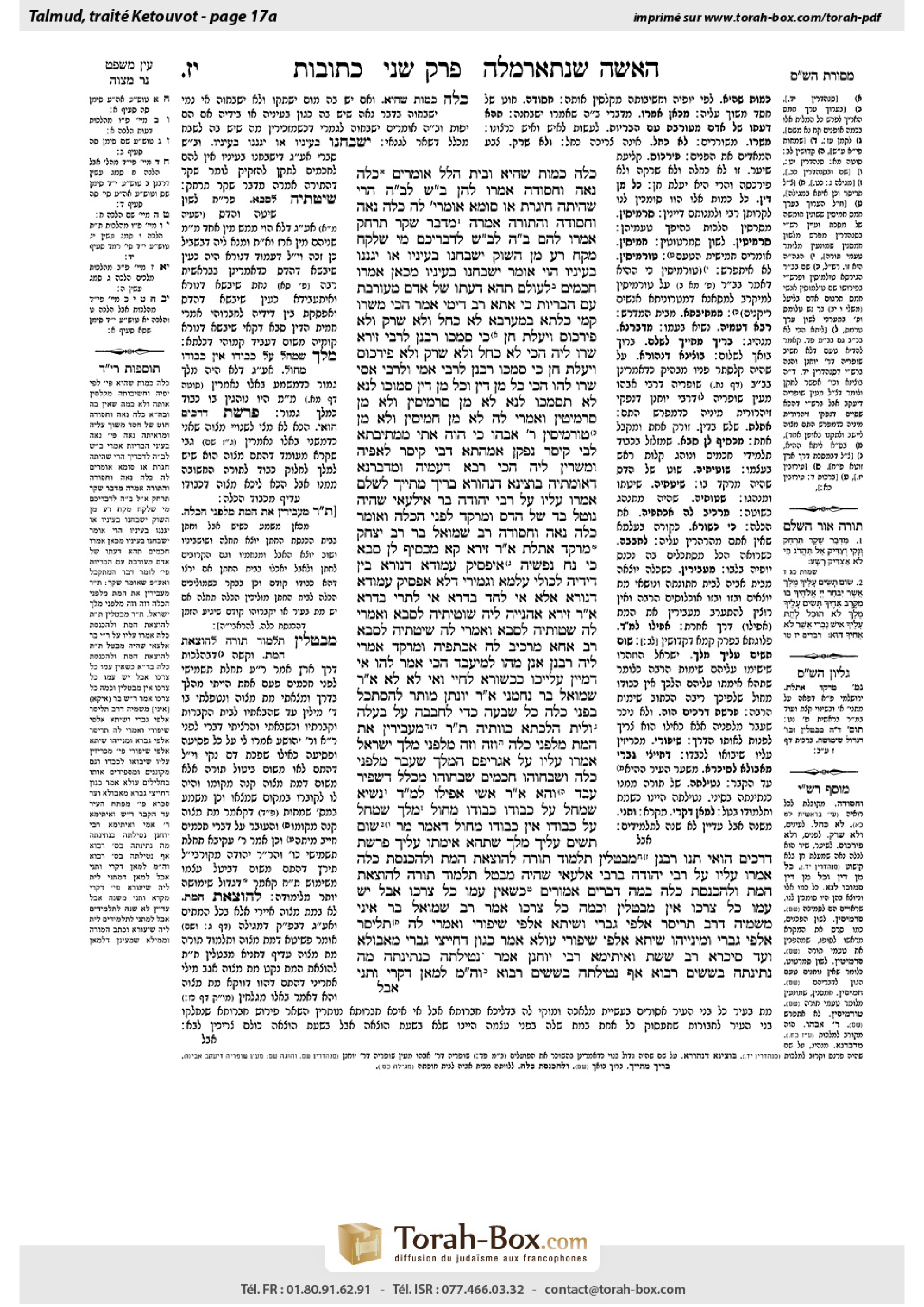
Ketubot 17a: Talmud study for Daf Yomi
Daf Yomi is the daily study of one Talmud folio. Explore 37 tractates with scans, Hebrew text, Sefaria English and AI-generated French translations where annotated.
Passage selection and English or AI-generated French translation are available where the scan has annotations. Daf Study is independent of Torah-Box and Sefaria.
Browse Ketubot · כתובות · All tractatesKetubot 17a text and translations
This page of Ketubot includes the Aramaic text, an English translation and an AI-generated French translation, alongside the scan above.
כתובות י״ז א · Aramaic and Hebrew text
כַּלָּה כְּמוֹת שֶׁהִיא. וּבֵית הִלֵּל אוֹמְרִים: ״כַּלָּה נָאָה וַחֲסוּדָה״. אָמְרוּ לָהֶן בֵּית שַׁמַּאי לְבֵית הִלֵּל: הֲרֵי שֶׁהָיְתָה חִיגֶּרֶת אוֹ סוֹמָא, אוֹמְרִים לָהּ: ״כַּלָּה נָאָה וַחֲסוּדָה״? וְהַתּוֹרָה אָמְרָה: ״מִדְּבַר שֶׁקֶר תִּרְחָק״! אָמְרוּ לָהֶם בֵּית הִלֵּל לְבֵית שַׁמַּאי: לְדִבְרֵיכֶם, מִי שֶׁלָּקַח מִקָּח רַע מִן הַשּׁוּק, יְשַׁבְּחֶנּוּ בְּעֵינָיו, אוֹ יְגַנֶּנּוּ בְּעֵינָיו? הֱוֵי אוֹמֵר: יְשַׁבְּחֶנּוּ בְּעֵינָיו. מִכָּאן אָמְרוּ חֲכָמִים: לְעוֹלָם תְּהֵא דַּעְתּוֹ שֶׁל אָדָם מְעוֹרֶבֶת עִם הַבְּרִיּוֹת.
כִּי אֲתָא רַב דִּימִי, אָמַר: הָכִי מְשָׁרוּ קַמֵּי כַּלְּתָא בְּמַעְרְבָא: ״לֹא כָּחָל וְלֹא שָׂרָק וְלֹא פִּירְכּוּס וְיַעֲלַת חֵן״. כִּי סָמְכוּ רַבָּנַן לְרַבִּי זֵירָא, שָׁרוּ לֵיהּ הָכִי: ״לָא כָּחָל וְלֹא שָׂרָק וְלֹא פִּירְכּוּס וְיַעֲלַת חֵן״.
כִּי סְמַכוּ רַבָּנַן לְרַבִּי אַמֵּי וּלְרַבִּי אַסִּי שָׁרוּ לְהוּ הָכִי: ״כֹּל מִן דֵּין וְכֹל מִן דֵּין סְמוּכוּ לַנָא, לָא תִּסְמֻכוּ לַנָא לָא מִן סַרְמִיסִין וְלָא מִן סַרְמִיטִין״, וְאָמְרִי לַהּ: ״לָא מִן חֲמִיסִין וְלָא מִן טוּרְמִיסִין״.
רַבִּי אֲבָהוּ כִּי הֲוָה אָתֵי מִמְּתִיבְתָּא לְבֵי קֵיסָר, נָפְקָן אַמְהָתָא דְּבֵי קֵיסָר לְאַפֵּיהּ וּמְשָׁרְיָן לֵיהּ הָכִי: ״רַבָּא דְעַמֵּיהּ וּמְדַבְּרָנָא דְאוּמְּתֵיהּ, בּוּצִינָא דִנְהוֹרָא, בְּרִיךְ מֵתְיָיךְ לִשְׁלָם״.
אָמְרוּ עָלָיו עַל רַבִּי יְהוּדָה בַּר אִילְעַאי שֶׁהָיָה נוֹטֵל בַּד שֶׁל הֲדַס, וּמְרַקֵּד לִפְנֵי הַכַּלָּה, וְאוֹמֵר: ״כַּלָּה נָאָה וַחֲסוּדָה״. רַב שְׁמוּאֵל בַּר רַב יִצְחָק מְרַקֵּד אַתְּלָת. אָמַר רַבִּי זֵירָא: קָא מַכְסֵיף לַן סָבָא: כִּי נָח נַפְשֵׁיהּ, אִיפְּסִיק עַמּוּדָא דְנוּרָא בֵּין דִּידֵיהּ לְכוּלֵּי עָלְמָא, וּגְמִירִי דְּלָא אִפְּסִיק עַמּוּדָא דְנוּרָא אֶלָּא אִי לְחַד בְּדָרָא, אִי לִתְרֵי בְּדָרָא.
אָמַר רַבִּי זֵירָא: אַהַנְיָיה לֵיהּ שׁוֹטִיתֵיהּ לְסָבָא. וְאָמְרִי לַהּ: שְׁטוּתֵיהּ לְסָבָא. וְאָמְרִי לַהּ: שִׁיטְתֵיהּ לְסָבָא.
רַב אַחָא מַרְכֵּיב לַהּ אַכַּתְפֵּיהּ וּמְרַקֵּד. אָמְרִי לֵיהּ רַבָּנַן: אֲנַן מַהוּ לְמִיעְבַּד הָכִי? אֲמַר לְהוּ: אִי דָּמְיָין עֲלַיְיכוּ כִּכְשׁוּרָא — לְחַיֵּי, וְאִי לָא — לָא.
אָמַר רַבִּי שְׁמוּאֵל בַּר נַחְמָנִי אָמַר רַבִּי יוֹנָתָן: מוּתָּר לְהִסְתַּכֵּל בִּפְנֵי כַלָּה כׇּל שִׁבְעָה, כְּדֵי לְחַבְּבָהּ עַל בַּעְלָהּ. וְלֵית הִלְכְתָא כְּווֹתֵיהּ.
תָּנוּ רַבָּנַן: מַעֲבִירִין אֶת הַמֵּת מִלִּפְנֵי כַלָּה. וְזֶה וָזֶה מִלִּפְנֵי מֶלֶךְ יִשְׂרָאֵל. אָמְרוּ עָלָיו עַל אַגְרִיפַּס הַמֶּלֶךְ שֶׁעָבַר מִלִּפְנֵי כַּלָּה, וְשִׁבְּחוּהוּ חֲכָמִים.
שִׁבְּחוּהוּ — מִכְּלָל דְּשַׁפִּיר עֲבַד? וְהָא אָמַר רַב אָשֵׁי: אֲפִילּוּ לְמַאן דְּאָמַר נָשִׂיא שֶׁמָּחַל עַל כְּבוֹדוֹ — כְּבוֹדוֹ מָחוּל, מֶלֶךְ שֶׁמָּחַל עַל כְּבוֹדוֹ — אֵין כְּבוֹדוֹ מָחוּל. דְּאָמַר מָר: ״שׂוֹם תָּשִׂים עָלֶיךָ מֶלֶךְ״, שֶׁתְּהֵא אֵימָתוֹ עָלֶיךָ! פָּרָשַׁת דְּרָכִים הֲוַאי.
תָּנוּ רַבָּנַן: מְבַטְּלִין תַּלְמוּד תּוֹרָה לְהוֹצָאַת הַמֵּת וּלְהַכְנָסַת כַּלָּה. אָמְרוּ עָלָיו עַל רַבִּי יְהוּדָה בְּרַבִּי אִלְעַאי שֶׁהָיָה מְבַטֵּל תַּלְמוּד תּוֹרָה לְהוֹצָאַת הַמֵּת וּלְהַכְנָסַת כַּלָּה. בַּמֶּה דְּבָרִים אֲמוּרִים — כְּשֶׁאֵין עִמּוֹ כׇּל צָרְכּוֹ. אֲבָל יֵשׁ עִמּוֹ כׇּל צָרְכּוֹ — אֵין מְבַטְּלִין.
וְכַמָּה כׇּל צָרְכּוֹ? אָמַר רַב שְׁמוּאֵל בַּר אִינִי מִשְּׁמֵיהּ דְּרַב: תְּרֵיסַר אַלְפֵי גַּבְרֵי, וְשִׁיתָּא אַלְפֵי שִׁיפּוּרֵי. וְאָמְרִי לַהּ: תְּלֵיסַר אַלְפֵי גַּבְרֵי, וּמִינַּיְיהוּ שִׁיתָּא אַלְפֵי שִׁיפּוּרֵי. עוּלָּא אָמַר: כְּגוֹן דְּחָיְיצִי גַּבְרֵי מֵאֲבוּלָּא וְעַד סִיכְרָא. רַב שֵׁשֶׁת, וְאִיתֵּימָא רַבִּי יוֹחָנָן אָמַר: נְטִילָתָהּ — כִּנְתִינָתָהּ, מָה נְתִינָתָהּ בְּשִׁשִּׁים רִבּוֹא, אַף נְטִילָתָהּ בְּשִׁשִּׁים רִבּוֹא. וְהָנֵי מִילֵּי לְמַאן דְּקָרֵי וְתָנֵי,
Ketubot 17a · English translation
One recites praise of the bride as she is, emphasizing her good qualities. And Beit Hillel say: One recites: A fair and attractive bride. Beit Shammai said to Beit Hillel: In a case where the bride was lame or blind, does one say with regard to her: A fair and attractive bride? But the Torah states: “Keep you from a false matter” (Exodus 23:7). Beit Hillel said to Beit Shammai: According to your statement, with regard to one who acquired an inferior acquisition from the market, should another praise it and enhance its value in his eyes or condemn it and diminish its value in his eyes? You must say that he should praise it and enhance its value in his eyes and refrain from causing him anguish. From here the Sages said: A person’s disposition should always be empathetic with mankind, and treat everyone courteously. In this case too, once the groom has married his bride, one praises her as being fair and attractive.
When Rav Dimi came from Eretz Yisrael to Babylonia, he said: This is what they sing before brides in the West, in Eretz Yisrael: No eye shadow, and no rouge, and no braiding of the hair, and yet she is comparable to a graceful ibex. The Gemara relates: When the Sages ordained Rabbi Zeira, this is what they metaphorically sang with regard to him in his praise: No eye shadow, and no rouge, and no braiding of the hair, and yet she is comparable to a graceful ibex.
On a related note, the Gemara relates: When the Sages ordained Rabbi Ami and Rabbi Asi, this is what they sang to them: Anyone from people of this kind and anyone from people of that kind, ordain them for us. Do not ordain for us others, neither from those who corrupt [sarmisin] halakhot, nor from those who are worthless [sarmitin]. And some say: Not from those who provide only one-fifth [ḥamisin] of the reason for a halakha, and not from those whose knowledge is incomplete [turmisin].
The Gemara relates another instance of singing the praise of the Sages: When Rabbi Abbahu would come from the academy to the house of the emperor, the maidservants of the emperor’s house would go out to greet him, and this is what they sang to him: Master of his people and leader of his nation, candle of illumination, blessed is your arrival in peace.
With regard to the mitzva of bringing joy to the bride and groom, the Gemara relates: The Sages said about Rabbi Yehuda bar Elai that he would take a myrtle branch and dance before the bride, and say: A fair and attractive bride. Rav Shmuel bar Rav Yitzḥak would base his dance on three myrtle branches that he would juggle. Rabbi Zeira said: The old man is humiliating us, as through his conduct he is demeaning the Torah and the Torah scholars. It is further related: When Rav Shmuel bar Rav Yitzḥak died, a pillar of fire demarcated between him and everyone else, and we learn through tradition that a pillar of fire demarcates only for either one person in a generation or for two people in a generation.
Rabbi Zeira said: His branch [shotitei] was effective for the old man, as it is due to this mitzva that he fulfilled so enthusiastically that he was privileged to receive this great reward. And some say that Rabbi Zeira said: His nonsense [shetutei] was effective for the old man. And some say that he said: His method [shittatei] was effective for the old man.
Rav Aḥa would place the bride on his shoulders and dance. The Sages said to him: What is the ruling? Is it permitted for us to do so as well? He said to them: If brides are comparable for you to a beam, fine, but if not, no, you may not.
Rabbi Shmuel bar Naḥmani said that Rabbi Yonatan said: It is permitted to look at the face of a bride throughout all seven days of the wedding celebration, in order to endear her to her husband, whose appreciation of her beauty will be thereby enhanced. The Gemara notes: And the halakha is not in accordance with his opinion, as it is prohibited to look at any married woman, even a bride.
§ The Sages taught: One reroutes the funeral procession for burial of a corpse to yield before the wedding procession of a bride. And both this, the funeral procession, and that, the wedding procession, yield before a king of Israel. They said about King Agrippa [Agrippas] that although he was not required to do so, he rerouted his entourage before the wedding procession of a bride, and the Sages praised him for doing so.
The Gemara asks: The Sages praised him; is that to say by inference that he did well in yielding? But didn’t Rav Ashi say: Even according to the one who said with regard to a Nasi who relinquishes the honor due him that his honor is relinquished, i.e., he may do so, with regard to a king who relinquishes the honor due him, his honor is not relinquished. As the Master said that the meaning of the verse “You shall place a king over you” (Deuteronomy 17:15) is that his awe shall be upon you. The Torah established that the subjects’ awe is an essential component of kingship and it is not the prerogative of the king to waive it. The Gemara answers: It was at a crossroads that he encountered the wedding procession, and the fact that he yielded to the bride was not obvious to onlookers. Therefore, the honor due the king was not compromised.
The Sages taught: One suspends the study of Torah to attend the removal of a corpse for burial and to attend the entry of a bride into the wedding canopy. The Sages said about Rabbi Yehuda, son of Rabbi Elai, that he would suspend the study of Torah to attend the removal of a corpse for burial and to attend the entry of a bride into the wedding canopy. In what case is this statement said? In a case where there are not enough people with him, i.e., accompanying the corpse, to satisfy all his needs, i.e., to appropriately honor him. However, if there are enough people with him to satisfy all his needs, one does not suspend Torah study.
The Gemara asks: And how many people constitute all his needs? Rav Shmuel bar Eini said in the name of Rav: Twelve thousand men and six thousand additional men each sounding a shofar to herald the approaching funeral procession. And some say: Thirteen thousand men and, among them, six thousand men sounding a shofar. Ulla said: All his needs means a crowd large enough so that the men in the funeral possession form a partition stretching from the gate of the city [abbula] until the cemetery. Rav Sheshet, and some say Rabbi Yoḥanan, said: The number of people required for taking of the Torah from the Jewish people with the death of a Torah scholar is equivalent to the number present at its giving to the Jewish people. Just as its giving took place with six hundred thousand men present at Sinai, so too, the taking of the Torah at the funeral of a Torah scholar is with six hundred thousand men. The Gemara notes: This applies only to one who read the Bible and studied mishna, i.e., one who is a student of Torah, and consequently worthy of that honor.
Ketubot 17a · Traduction française (IA)
On fait l’éloge de la mariée telle qu’elle est, en soulignant ses qualités. Beit Hillel disent : « Une mariée belle et gracieuse. » Beit Shammaï leur dit : « Si la mariée était boiteuse ou aveugle, dirait-on d’elle : “Une mariée belle et gracieuse” ? Pourtant, la Torah dit : “Tu te garderas de toute parole mensongère” (Exode 23:7). » Beit Hillel répondent à Beit Shammaï : « Selon votre raisonnement, si quelqu’un a acheté au marché un objet de qualité inférieure, faut-il qu’un autre en fasse l’éloge et en augmente la valeur à ses yeux, ou qu’il le dénigre et en diminue la valeur à ses yeux ? Il faut bien dire qu’il doit en faire l’éloge et en augmenter la valeur à ses yeux, afin de ne pas le faire souffrir. » De là, les Sages ont enseigné qu’une personne doit toujours faire preuve de bienveillance envers les gens et traiter chacun avec courtoisie. Ici aussi, une fois que le marié a épousé sa mariée, on fait son éloge en disant qu’elle est belle et gracieuse.
Lorsque Rav Dimi vint d’Eretz Israël en Babylonie, il dit : « Voici ce que l’on chante en Occident, en Eretz Israël, devant les mariées : “Pas de fard pour les yeux, pas de rouge, pas de tresses, et pourtant elle est semblable à une gracieuse gazelle.” » La Guemara rapporte que, lorsque les Sages ordonnèrent Rabbi Zeïra, voici ce que l’on chanta métaphoriquement à son sujet, en son honneur : « Pas de fard pour les yeux, pas de rouge, pas de tresses, et pourtant il est semblable à une gracieuse gazelle. »
À ce propos, la Guemara rapporte que, lorsque les Sages ordonnèrent Rabbi Ami et Rabbi Assi, voici ce qu’on leur chanta : « Des gens de cette sorte et des gens de cette autre sorte, ordonnez-les pour nous. N’en ordonnez pas d’autres, ni parmi ceux qui corrompent [sarmisin] les halakhot, ni parmi ceux qui sont sans valeur [sarmitin]. » Certains disent : « Ni parmi ceux qui ne donnent qu’un cinquième [ḥamisin] de l’explication d’une halakha, ni parmi ceux dont le savoir est incomplet [turmisin]. »
La Guemara rapporte un autre exemple de louange chantée aux Sages : lorsque Rabbi Abbahou venait de l’académie pour se rendre à la maison de l’empereur, les servantes de la maison impériale sortaient à sa rencontre et lui chantaient : « Maître de son peuple et guide de sa nation, flambeau lumineux, que ton arrivée en paix soit bénie. »
Au sujet de la mitsva de réjouir la mariée et le marié, la Guemara rapporte que les Sages disaient de Rabbi Yehouda bar Ilaï qu’il prenait une branche de myrte, dansait devant la mariée et disait : « Une mariée belle et gracieuse. » Rav Shmouel bar Rav Yitzḥak dansait en jonglant avec trois branches de myrte. Rabbi Zeïra dit : « Ce vieil homme nous humilie, car, par son comportement, il rabaisse la Torah et les érudits de la Torah. » On rapporte aussi qu’à la mort de Rav Shmouel bar Rav Yitzḥak, une colonne de feu le sépara de tous les autres. Or, nous savons par tradition qu’une colonne de feu ne marque la séparation que pour une seule personne par génération, ou pour deux personnes par génération.
Rabbi Zeïra dit : « Sa branche [shotitei] a été bénéfique à ce vieil homme », car c’est grâce à cette mitsva, qu’il accomplissait avec tant d’enthousiasme, qu’il a eu le mérite de recevoir cette grande récompense. Certains disent que Rabbi Zeïra dit : « Sa sottise [shetutei] a été bénéfique à ce vieil homme. » D’autres disent qu’il dit : « Sa méthode [shittatei] a été bénéfique à ce vieil homme. »
Rav Aḥa plaçait la mariée sur ses épaules et dansait. Les Sages lui dirent : « Quelle est la halakha ? Nous est-il permis de faire de même ? » Il leur répondit : « Si, pour vous, les mariées sont semblables à une poutre, très bien ; sinon, non, vous ne le pouvez pas. »
Rabbi Shmouel bar Naḥmani dit au nom de Rabbi Yonatan : il est permis de regarder le visage d’une mariée pendant les sept jours de la célébration du mariage, afin qu’elle devienne chère à son mari et que celui-ci apprécie davantage sa beauté. La Guemara précise que la halakha ne suit pas son avis, car il est interdit de regarder une femme mariée, même une mariée.
§ Les Sages ont enseigné : on détourne le cortège funèbre qui accompagne un défunt à son inhumation pour laisser passer le cortège nuptial d’une mariée. Et ces deux cortèges, celui des funérailles comme celui du mariage, s’effacent devant un roi d’Israël. On disait du roi Agrippa [Agrippas] que, bien qu’il n’y fût pas tenu, il détourna son cortège pour laisser passer celui d’une mariée, et les Sages le louèrent pour cela.
La Guemara demande : les Sages le louèrent ; cela implique-t-il qu’il a bien agi en s’effaçant ? Mais Rav Ashi n’a-t-il pas dit : même selon celui qui affirme, au sujet d’un Nassi qui renonce à l’honneur qui lui est dû, que cet honneur peut lui être retiré, c’est-à-dire qu’il peut y renoncer, lorsqu’il s’agit d’un roi qui renonce à l’honneur qui lui est dû, cet honneur ne peut pas lui être retiré. Car le Maître a dit que le verset « Tu établiras sur toi un roi » (Deutéronome 17:15) signifie que sa crainte doit être sur toi. La Torah a établi que la crainte des sujets est une composante essentielle de la royauté, et il n’appartient pas au roi d’y renoncer. La Guemara répond : il se trouvait à un carrefour lorsqu’il rencontra le cortège nuptial, et les spectateurs ne remarquèrent pas qu’il s’était effacé devant la mariée. L’honneur dû au roi n’a donc pas été compromis.
Les Sages ont enseigné : on interrompt l’étude de la Torah pour accompagner un défunt à son inhumation et pour accompagner une mariée lorsqu’elle entre sous la houppa. Les Sages disaient de Rabbi Yehouda, fils de Rabbi Ilaï, qu’il interrompait l’étude de la Torah pour accompagner un défunt à son inhumation et pour accompagner une mariée lorsqu’elle entrait sous la houppa. Dans quel cas cette règle s’applique-t-elle ? Lorsqu’il n’y a pas assez de personnes avec lui, c’est-à-dire pour accompagner le défunt, afin de répondre à tous ses besoins, autrement dit pour lui rendre les honneurs qui conviennent. En revanche, s’il y a assez de personnes avec lui pour répondre à tous ses besoins, on n’interrompt pas l’étude de la Torah.
La Guemara demande : combien de personnes faut-il pour répondre à tous ses besoins ? Rav Shmouel bar Eini dit au nom de Rav : douze mille hommes, auxquels s’ajoutent six mille hommes, chacun sonnant du chofar pour annoncer l’approche du cortège funèbre. Certains disent : treize mille hommes, parmi lesquels six mille sonnent du chofar. Oulla dit : répondre à tous ses besoins signifie qu’il y a une foule assez nombreuse pour que les hommes du cortège funèbre forment une haie s’étendant de la porte de la ville [abbula] jusqu’au cimetière. Rav Sheshet, et selon certains Rabbi Yoḥanan, dit : le nombre de personnes nécessaire pour accompagner la disparition de la Torah du peuple juif à la mort d’un érudit de la Torah équivaut au nombre de personnes présentes lorsqu’elle fut donnée au peuple juif. De même que sa transmission eut lieu en présence de six cent mille hommes au Sinaï, de même, lors des funérailles d’un érudit de la Torah, six cent mille hommes accompagnent la disparition de la Torah. La Guemara précise que cela ne s’applique qu’à celui qui a lu la Bible et étudié la Michna, c’est-à-dire à un étudiant de la Torah, digne de recevoir cet honneur.
Traduction française générée par IA à partir de l’édition anglaise de Sefaria. Vérifie toujours un passage avec le texte source.
Text from Sefaria: William Davidson Edition - Vocalized Aramaic (CC BY NC); William Davidson Edition - English (CC BY NC).