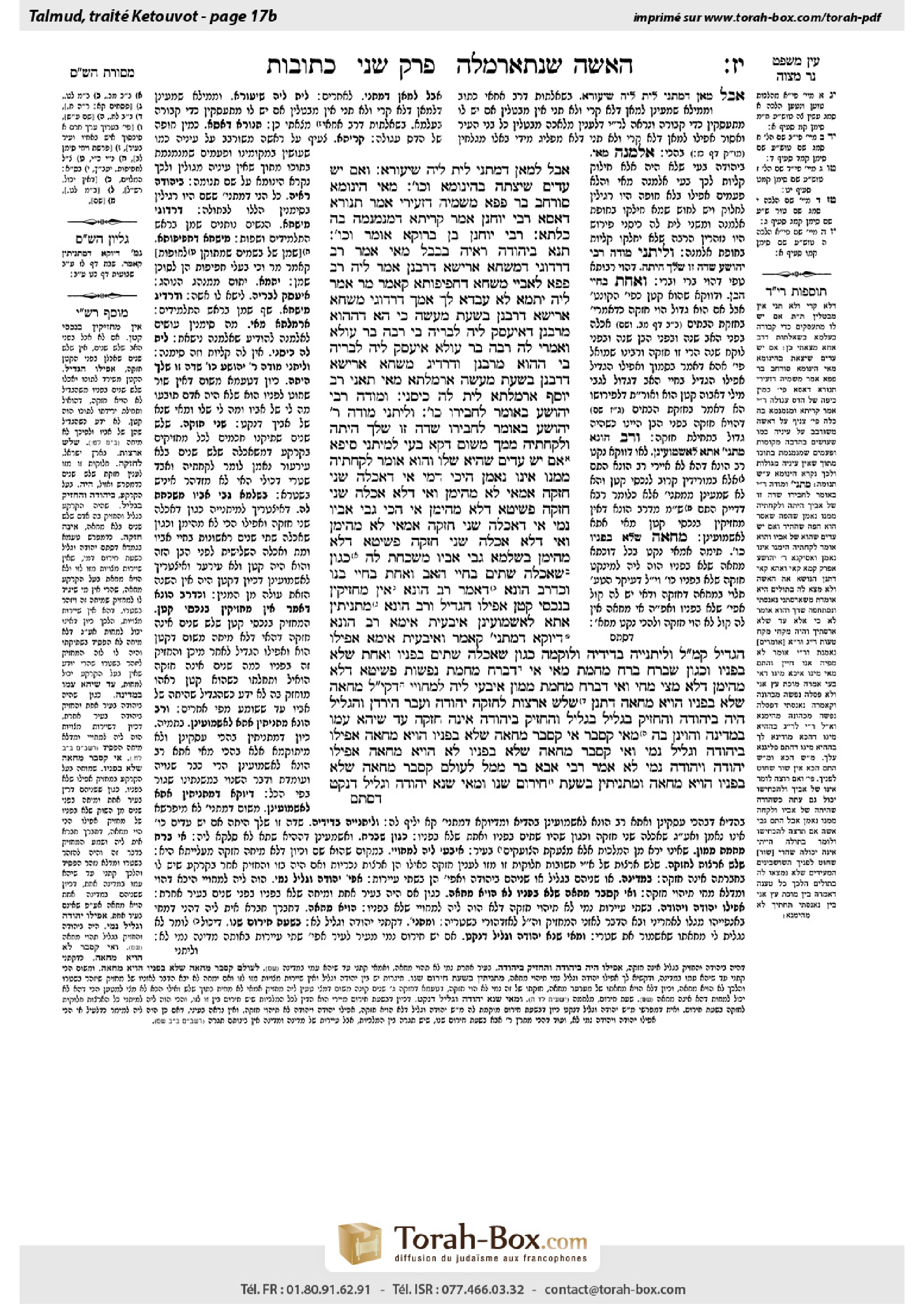
Ketubot 17b: Talmud study for Daf Yomi
Daf Yomi is the daily study of one Talmud folio. Explore 37 tractates with scans, Hebrew text, Sefaria English and AI-generated French translations where annotated.
Passage selection and English or AI-generated French translation are available where the scan has annotations. Daf Study is independent of Torah-Box and Sefaria.
Browse Ketubot · כתובות · All tractatesKetubot 17b text and translations
This page of Ketubot includes the Aramaic text, an English translation and an AI-generated French translation, alongside the scan above.
כתובות י״ז ב · Aramaic and Hebrew text
אֲבָל לְמַאן דְּמַתְנֵי, לֵית לֵיהּ שִׁיעוּרָא.
וְאִם יֵשׁ עֵדִים שֶׁיָּצְתָה בְּהִינוּמָא וְכוּ׳. מַאי הִינּוּמָא? סוּרְחַב בַּר פָּפָּא מִשְּׁמֵיהּ דִּזְעֵירִי אָמַר: תַּנּוּרָא דְאַסָּא. רַבִּי יוֹחָנָן אָמַר: קָרִיתָא דִּמְנַמְנְמָא בָּהּ כַּלְּתָא.
רַבִּי יוֹחָנָן בֶּן בְּרוֹקָא אוֹמֵר וְכוּ׳. תָּנָא בִּיהוּדָה רְאָיָה, בְּבָבֶל מַאי? אָמַר רַב: דַּרְדּוֹגֵי דְמִשְׁחָא אַרֵישָׁא דְרַבָּנַן. אֲמַר לֵיהּ רַב פָּפָּא לְאַבָּיֵי: מִשְׁחָא דַחֲפִיפוּתָא קָאָמַר מָר? אֲמַר לֵיהּ: יַתְמָא, לָא עֲבַדָא לָךְ אִמָּךְ דַּרְדּוֹגֵי מִשְׁחָא אַרֵישָׁא דְּרַבָּנַן בִּשְׁעַת מַעֲשֶׂה? כִּי הָא דְּהָהוּא מֵרַבָּנַן דְּאִיעֲסַק לֵיהּ לִבְרֵיהּ בֵּי רַבָּה בַּר עוּלָּא, וְאָמְרִי לַהּ, רַבָּה בַּר עוּלָּא אִיעֲסַק לֵיהּ לִבְרֵיהּ בֵּי הָהוּא מֵרַבָּנַן, וְדַרְדֵּיג מִשְׁחָא אַרֵישָׁא דְרַבָּנַן בִּשְׁעַת מַעֲשֶׂה.
אַרְמַלְתָּא מַאי? תָּאנֵי רַב יוֹסֵף: אַרְמַלְתָּא לֵית לַהּ כִּיסָנֵי.
וּמוֹדֶה רַבִּי יְהוֹשֻׁעַ בְּאוֹמֵר לַחֲבֵירוֹ כּוּ׳. וְלִיתְנֵי: מוֹדֶה רַבִּי יְהוֹשֻׁעַ בְּאוֹמֵר לַחֲבֵירוֹ שָׂדֶה זוֹ שֶׁלְּךָ הָיְתָה, וּלְקַחְתִּיהָ מִמְּךָ?
מִשּׁוּם דְּקָא בָעֵי לְמִיתְנֵי סֵיפָא: אִם יֵשׁ עֵדִים שֶׁהִיא שֶׁלּוֹ, וְהוּא אוֹמֵר: ״לְקַחְתִּיהָ מִמֶּנּוּ״ — אֵינוֹ נֶאֱמָן. הֵיכִי דָּמֵי?
אִי דְּאַכְלַהּ שְׁנֵי חֲזָקָה — אַמַּאי לָא מְהֵימַן?! וְאִי דְּלָא אַכְלַהּ שְׁנֵי חֲזָקָה — פְּשִׁיטָא דְּלָא מְהֵימַן!
אִי הָכִי, גַּבֵּי אָבִיו נָמֵי: אִי דְּאַכְלַהּ שְׁנֵי חֲזָקָה — אַמַּאי לָא מְהֵימַן?! וְאִי דְּלָא אַכְלַהּ שְׁנֵי חֲזָקָה — פְּשִׁיטָא דְּלָא מְהֵימַן!
בִּשְׁלָמָא גַּבֵּי אָבִיו מַשְׁכַּחַתְּ לַהּ, כְּגוֹן שֶׁאֲכָלָהּ שְׁתַּיִם בְּחַיֵּי הָאָב, וְאַחַת בְּחַיֵּי בְנוֹ, וְכִדְרַב הוּנָא. דְּאָמַר רַב הוּנָא: אֵין מַחֲזִיקִין בְּנִכְסֵי קָטָן, אֲפִילּוּ הִגְדִּיל.
וְרַב הוּנָא מַתְנִיתִין אֲתָא לְאַשְׁמוֹעִינַן? אִיבָּעֵית אֵימָא: רַב הוּנָא דִּיּוּקָא דְמַתְנִיתִין קָאָמַר. וְאִיבָּעֵית אֵימָא: אֲפִילּוּ הִגְדִּיל קָא מַשְׁמַע לַן.
וְלִיתְנְיַיהּ בְּדִידֵיהּ, וְלוֹקְמַהּ כְּגוֹן שֶׁאֲכָלָהּ שְׁתַּיִם בְּפָנָיו וְאַחַת שֶׁלֹּא בְּפָנָיו, וּכְגוֹן שֶׁבָּרַח.
בָּרַח מֵחֲמַת מַאי? אִי דְּבָרַח מֵחֲמַת נְפָשׁוֹת — פְּשִׁיטָא דְּלָא מְהֵימַן, דְּלָא מָצֵי [מְ]מַחֵי. וְאִי דְּבָרַח מֵחֲמַת מָמוֹן, אִיבְּעִי לֵיהּ לְמַחוֹיֵי. דְּקַיְימָא לַן: מֶחָאָה שֶׁלֹּא בְּפָנָיו — הָוְיָא מֶחָאָה.
דִּתְנַן, שָׁלֹשׁ אֲרָצוֹת לַחֲזָקָה: יְהוּדָה, וְעֵבֶר הַיַּרְדֵּן, וְהַגָּלִיל. הָיָה בִּיהוּדָה וְהֶחֱזִיק בַּגָּלִיל, בַּגָּלִיל וְהֶחֱזִיק בִּיהוּדָה — אֵינָהּ חֲזָקָה, עַד שֶׁיְּהֵא עִמּוֹ בִּמְדִינָה.
וְהָוֵינַן בַּהּ: מַאי קָסָבַר? אִי קָסָבַר מֶחָאָה שֶׁלֹּא בְּפָנָיו הָוְיָא מֶחָאָה — אֲפִילּוּ בִּיהוּדָה וְגָלִיל נָמֵי. וְאִי קָסָבַר מֶחָאָה שֶׁלֹּא בְּפָנָיו לָא הָוְיָא מֶחָאָה — אֲפִילּוּ יְהוּדָה וִיהוּדָה נָמֵי לָא!
אָמַר רַבִּי אַבָּא בַּר מֶמֶל: לְעוֹלָם קָסָבַר מֶחָאָה שֶׁלֹּא בְּפָנָיו הָוְיָא מֶחָאָה, וּמַתְנִיתִין בִּשְׁעַת חֵירוּם שָׁנוּ.
וּמַאי שְׁנָא יְהוּדָה וְגָלִיל דְּנָקֵט?
Ketubot 17b · English translation
However, for one who taught others, there is no measure for the number of people attending the funeral.
The mishna continues: And if there are witnesses that she went out of her father’s house to her wedding with a hinnuma her marriage contract is two hundred dinars. The Gemara asks: What is a hinnuma? Surḥav bar Pappa said in the name of Ze’eiri: It is a canopy of myrtle over the bride’s head. Rabbi Yoḥanan said: It is a veil [kerita] covering the bride’s face under which the bride dozes [menamna].
The mishna continues: Rabbi Yoḥanan ben Beroka says: Even testimony that there was distribution of roasted grain constitutes proof that she is a virgin. It was taught with regard to the mishna: In Judea, that is proof; however, what are the customs at the weddings of virgins in Babylonia? Rav said: Smearing fragrant oil on the heads of the Sages was customary. Rav Pappa, who was unfamiliar with that practice, said to Abaye: Is the Master saying oil for shampooing the hair? Calling him an orphan because he was ignorant of the custom, he said to him: Orphan, didn’t your mother perform for you smearing of oil on the heads of the Sages at the time of the performance of your wedding ceremony? As this was the case when one of the Sages who arranged for his son to marry into the family of Rabba bar Ulla attended the wedding, and some say that it was Rabba bar Ulla who arranged for his son to marry into the family of one of the Sages; and he smeared oil on the heads of the Sages at the time of the performance of the wedding ceremony.
The Gemara asks: What is the custom at the wedding of a widow? Rav Yosef taught: A widow does not have roasted grain [kisanei] distributed at her wedding.
The mishna continues: And Rabbi Yehoshua concedes in a case where one says to another: This field belonged to your father, and I purchased it from him, that he is deemed credible. The Gemara asks: And let the mishna teach: Rabbi Yehoshua concedes in a case where one says to another: This field belonged to you, and I purchased it from you.
The Gemara answers: Although Rabbi Yehoshua concedes that his claim is accepted even in that latter case, he addressed the case where the field originally belonged to the father due to the fact that the tanna wanted to teach in the latter clause that if there are witnesses that it was the father’s field, and he says: I purchased it from him, he is not deemed credible. That is the halakha only with regard to a field that belonged to the father, and not to the claimant himself. Were it referring to a field that he purchased from the claimant, what are the circumstances?
If it is a case where the one in possession of the field consumed its produce for the three years necessary to establish presumptive ownership, why is his claim that he purchased the field not deemed credible? After three years of unchallenged possession, the purchaser’s claim is sufficient to establish ownership without documentation. And if he did not consume its produce for the three years necessary to establish presumptive ownership, it is obvious that his claim is not deemed credible. Since the distinction between a case where witnesses are present and a case where there are no witnesses present does not apply when the field in question was the property of the claimant, the tanna cited a case where the field belonged to the father.
The Gemara asks: If so, the same difficulty may be raised with regard to a field belonging to the claimant’s father as well: If the one in possession of the field consumed its produce for the three years necessary to establish presumptive ownership, why is his claim that he purchased the field not deemed credible? And if he did not consume its produce for the three years necessary to establish presumptive ownership, it is obvious that his claim is not deemed credible. The latter clause is no more applicable to the father’s field than it is to the claimant’s field. Why did the tanna prefer to cite a case where the field belonged to the claimant’s father?
The Gemara answers: Granted, with regard to the case where the field belonged to his father, a circumstance can be found where there is uncertainty with regard to the presumptive ownership of the field, where the one in possession of the field consumed its produce for two of the three years necessary to establish presumptive ownership during the lifetime of the father and one year during the lifetime of the son after the death of his father. And this is in accordance with the opinion of Rav Huna, as Rav Huna said: One cannot establish presumptive ownership of the property of a minor, even after he reached majority. This is because the minor is unaware of the property owned by his father; the fact that he did not challenge the claim of the one in possession of the field proves nothing. Therefore, only two of the three years necessary to establish presumptive ownership have passed.
The Gemara asks: And since the mishna can be explained only in the case delineated by Rav Huna, did Rav Huna come to teach us a mishna? There is no need for an amora to teach matters that appear in a mishna, as the content of mishnayot is known by all. The Gemara answers: If you wish, say that Rav Huna is stating the inference from the mishna, as the circumstances are not written explicitly in the mishna. And if you wish, say instead that he is teaching us that even if during the year after the father died his son was no longer a minor, one may not establish presumptive ownership of the property of a minor, even after he reached majority. From the mishna, one could learn only a case where during the third year the son was still a minor.
The Gemara asks: And let the tanna teach the halakha in a case where the one in possession of the field says that he purchased the field from the claimant himself. And let him establish the mishna in a case where the one in possession of the field consumed its produce in the presence of the claimant, who was the original owner of the field, for two of the three years necessary to establish presumptive ownership, and consumed its produce not in his presence for one year. And that scenario is in a case where the claimant fled and therefore, the fact that he did not challenge the claim of the one in possession of the field proves nothing.
The Gemara asks: That scenario is referring to one who fled due to what reason? If it is that he fled due to the fact that his life was in jeopardy, it is obvious that the one claiming presumptive ownership is not deemed credible, since the owner of the field is unable to protest, as he fears for his life. And if he fled due to money that he owes, and that is why he does not return to protest the possessor’s occupation of the field, he ought to protest from afar, as we maintain that a protest lodged not in the presence of the one using the field is a legitimate protest. He could have lodged in a court in his place of exile his protest against the illegal occupation of his field.
This is as we learned in a mishna (Bava Batra 38a): There are three independent lands in Eretz Yisrael with regard to establishing presumptive ownership: Judea, Transjordan, and the Galilee. If the original owner of the field was in Judea and another occupied his field in the Galilee, or if he was in the Galilee and another occupied his field in Judea, that does not establish presumptive ownership, until the one occupying the field will be with the original owner in the same country.
And we discussed that mishna: What does this tanna hold? If he holds that a protest lodged not in the presence of the one using the field is a legitimate protest, then even in the case where one is in Judea and one is in the Galilee the protest should also be legitimate. And if he holds that a protest lodged not in the presence of the one using the field is not a legitimate protest, then even in the case where one is in Judea and the other one is in Judea as well, the protest should also not be legitimate.
Rabbi Abba bar Memel said: Actually the tanna holds that a protest lodged not in the presence of the one using the field is a legitimate protest, and the Sages taught this mishna with regard to a crisis period, when travel is perilous and information cannot be transmitted from Judea to the Galilee. Therefore, although no protest was received from the original owner, the occupier does not establish presumptive ownership of the field, because the lack of protest can be attributed to the perilous situation.
The Gemara asked: And if it is due only to the exigent circumstances that the protest is ineffective, what is different about Judea and the Galilee that the tanna cited specifically these two lands? Ostensibly, even within one of the three lands, if travel and communications are restricted, the same halakha would apply.
Ketubot 17b · Traduction française (IA)
Cependant, pour celui qui a enseigné à d’autres, le nombre de personnes assistant à ses funérailles n’est pas limité.
La Michna poursuit : Et s’il y a des témoins attestant qu’elle est sortie de la maison de son père pour se rendre à son mariage avec une hinnuma, sa ketouba est de deux cents dinars. La Guemara demande : Qu’est-ce qu’une hinnuma ? Surḥav bar Pappa a dit au nom de Ze’eiri : C’est un dais de myrte placé au-dessus de la tête de la mariée. Rabbi Yoḥanan a dit : C’est un voile [kerita] qui couvre le visage de la mariée et sous lequel celle-ci somnole [menamna].
La Michna poursuit : Rabbi Yoḥanan ben Beroka dit : Même le témoignage attestant que des céréales grillées ont été distribuées constitue une preuve qu’elle est vierge. À propos de la Michna, il a été enseigné : En Judée, cela constitue une preuve ; mais quelles sont les coutumes lors des mariages de vierges en Babylonie ? Rav a dit : On avait coutume d’enduire d’huile parfumée la tête des Sages. Rav Pappa, qui ignorait cette pratique, dit à Abaye : « Le Maître parle-t-il d’huile pour se laver les cheveux ? » Le traitant d’orphelin parce qu’il ignorait cette coutume, il lui dit : « Orphelin, ta mère n’a-t-elle donc pas fait enduire d’huile la tête des Sages lors de la célébration de ton mariage ? » En effet, cela se produisit lorsqu’un des Sages, qui avait arrangé le mariage de son fils avec une membre de la famille de Rabba bar Ulla, assista aux noces ; et certains disent que c’est Rabba bar Ulla qui avait arrangé le mariage de son fils avec une membre de la famille d’un des Sages. Il enduisit d’huile la tête des Sages lors de la célébration du mariage.
La Guemara demande : Quelle est la coutume lors du mariage d’une veuve ? Rav Yosef enseignait : On ne distribue pas de céréales grillées [kisanei] lors du mariage d’une veuve.
La Michna poursuit : Et Rabbi Yehoshua reconnaît que, dans le cas où quelqu’un dit à un autre : « Ce champ appartenait à ton père, et je le lui ai acheté », il est tenu pour digne de foi. La Guemara demande : Pourquoi la Michna n’enseigne-t-elle pas que Rabbi Yehoshua reconnaît que, dans le cas où quelqu’un dit à un autre : « Ce champ t’appartenait, et je te l’ai acheté » ?
La Guemara répond : Bien que Rabbi Yehoshua reconnaisse que sa revendication est acceptée même dans ce dernier cas, il a formulé le cas où le champ appartenait à l’origine au père, car le tanna voulait enseigner, dans la dernière clause, que s’il y a des témoins attestant que le champ appartenait au père et que l’homme dit : « Je le lui ai acheté », il n’est pas tenu pour digne de foi. Cette halakha ne concerne qu’un champ qui appartenait au père, et non au revendicateur lui-même. Si le cas portait sur un champ qu’il avait acheté au revendicateur, quelles seraient les circonstances ?
Si celui qui possède le champ en a consommé les fruits pendant les trois années nécessaires pour établir une présomption de propriété, pourquoi ne serait-il pas tenu pour digne de foi lorsqu’il affirme avoir acheté le champ ? Après trois années de possession incontestée, l’affirmation de l’acquéreur suffit à établir sa propriété sans document. Et s’il n’en a pas consommé les fruits pendant les trois années nécessaires pour établir une présomption de propriété, il est évident qu’il n’est pas tenu pour digne de foi. Puisque la distinction entre un cas où des témoins sont présents et un cas où ils ne le sont pas ne s’applique pas lorsque le champ en question appartenait au revendicateur, le tanna a cité le cas d’un champ qui appartenait au père.
La Guemara demande : Si tel est le cas, la même difficulté se pose aussi à propos d’un champ appartenant au père du revendicateur : si celui qui possède le champ en a consommé les fruits pendant les trois années nécessaires pour établir une présomption de propriété, pourquoi ne serait-il pas tenu pour digne de foi lorsqu’il affirme avoir acheté le champ ? Et s’il n’en a pas consommé les fruits pendant ces trois années, il est évident qu’il n’est pas tenu pour digne de foi. La dernière clause ne s’applique pas davantage au champ du père qu’à celui du revendicateur. Pourquoi le tanna a-t-il préféré citer le cas d’un champ appartenant au père du revendicateur ?
La Guemara répond : Certes, dans le cas d’un champ qui appartenait à son père, on peut envisager une situation où la présomption de propriété du champ est incertaine : celui qui possède le champ en a consommé les fruits pendant deux des trois années nécessaires pour établir cette présomption du vivant du père, puis pendant une année du vivant du fils, après la mort de son père. Cela correspond à l’opinion de Rav Huna, car Rav Huna a dit : On ne peut pas établir une présomption de propriété sur les biens d’un mineur, même après qu’il a atteint la majorité. En effet, le mineur ignore quels biens appartenaient à son père ; le fait qu’il n’ait pas contesté la revendication de celui qui possède le champ ne prouve rien. Par conséquent, seules deux des trois années nécessaires pour établir une présomption de propriété se sont écoulées.
La Guemara demande : Puisque la Michna ne peut s’expliquer que dans le cas défini par Rav Huna, Rav Huna est-il venu nous enseigner une Michna ? Il n’est pas nécessaire qu’un amora enseigne ce qui figure dans une Michna, puisque le contenu des Michnayot est connu de tous. La Guemara répond : Si tu veux, dis que Rav Huna énonce l’inférence tirée de la Michna, car les circonstances n’y sont pas formulées explicitement. Et si tu veux, dis plutôt qu’il nous enseigne que, même si, durant l’année qui suit la mort du père, son fils n’est plus mineur, on ne peut pas établir une présomption de propriété sur les biens d’un mineur, même après qu’il a atteint la majorité. De la Michna, on pourrait seulement déduire le cas où, durant la troisième année, le fils était encore mineur.
La Guemara demande : Pourquoi le tanna n’enseigne-t-il pas la halakha dans le cas où celui qui possède le champ affirme l’avoir acheté au revendicateur lui-même ? Qu’il situe la Michna dans le cas où celui qui possède le champ en a consommé les fruits en présence du revendicateur, qui était le propriétaire initial du champ, pendant deux des trois années nécessaires pour établir une présomption de propriété, puis en a consommé les fruits en son absence pendant une année. Il s’agirait alors d’un cas où le revendicateur s’est enfui ; le fait qu’il n’ait pas contesté la revendication de celui qui possède le champ ne prouve donc rien.
La Guemara demande : Pour quelle raison s’est-il enfui dans ce cas ? S’il s’est enfui parce que sa vie était en danger, il est évident que celui qui revendique la présomption de propriété n’est pas tenu pour digne de foi, puisque le propriétaire du champ ne peut pas protester, car il craint pour sa vie. Et s’il s’est enfui à cause de dettes, raison pour laquelle il ne revient pas protester contre l’occupation de son champ, il aurait dû protester depuis le lieu où il se trouve, car nous considérons qu’une protestation formulée en l’absence de celui qui utilise le champ est valable. Il aurait pu déposer, devant un tribunal de son lieu d’exil, une protestation contre l’occupation illégale de son champ.
C’est ce que nous avons appris dans une Michna (Bava Batra 38a) : Il y a trois régions distinctes en Eretz Israël en ce qui concerne l’établissement d’une présomption de propriété : la Judée, la Transjordanie et la Galilée. Si le propriétaire initial du champ se trouve en Judée et qu’un autre occupe son champ en Galilée, ou s’il se trouve en Galilée et qu’un autre occupe son champ en Judée, cela n’établit pas de présomption de propriété tant que celui qui occupe le champ ne se trouve pas dans la même région que le propriétaire initial.
Et nous avons examiné cette Michna : Quelle est l’opinion de ce tanna ? S’il considère qu’une protestation formulée en l’absence de celui qui utilise le champ est valable, alors, même si l’un se trouve en Judée et l’autre en Galilée, la protestation devrait également être valable. Et s’il considère qu’une protestation formulée en l’absence de celui qui utilise le champ n’est pas valable, alors, même si l’un se trouve en Judée et l’autre également en Judée, la protestation ne devrait pas être valable.
Rabbi Abba bar Memel a dit : En réalité, le tanna considère qu’une protestation formulée en l’absence de celui qui utilise le champ est valable, et les Sages ont enseigné cette Michna à propos d’une période de crise, où les voyages sont dangereux et où les informations ne peuvent pas être transmises de Judée en Galilée. Par conséquent, même si aucune protestation n’a été reçue du propriétaire initial, l’occupant n’établit pas de présomption de propriété sur le champ, car l’absence de protestation peut être attribuée à la situation dangereuse.
La Guemara demande : Si seule la situation exceptionnelle rend la protestation inefficace, en quoi la Judée et la Galilée se distinguent-elles, au point que le tanna ait précisément cité ces deux régions ? À première vue, même à l’intérieur de l’une des trois régions, la même halakha s’appliquerait si les déplacements et les communications étaient entravés.
Traduction française générée par IA à partir de l’édition anglaise de Sefaria. Vérifie toujours un passage avec le texte source.
Text from Sefaria: William Davidson Edition - Vocalized Aramaic (CC BY NC); William Davidson Edition - English (CC BY NC).