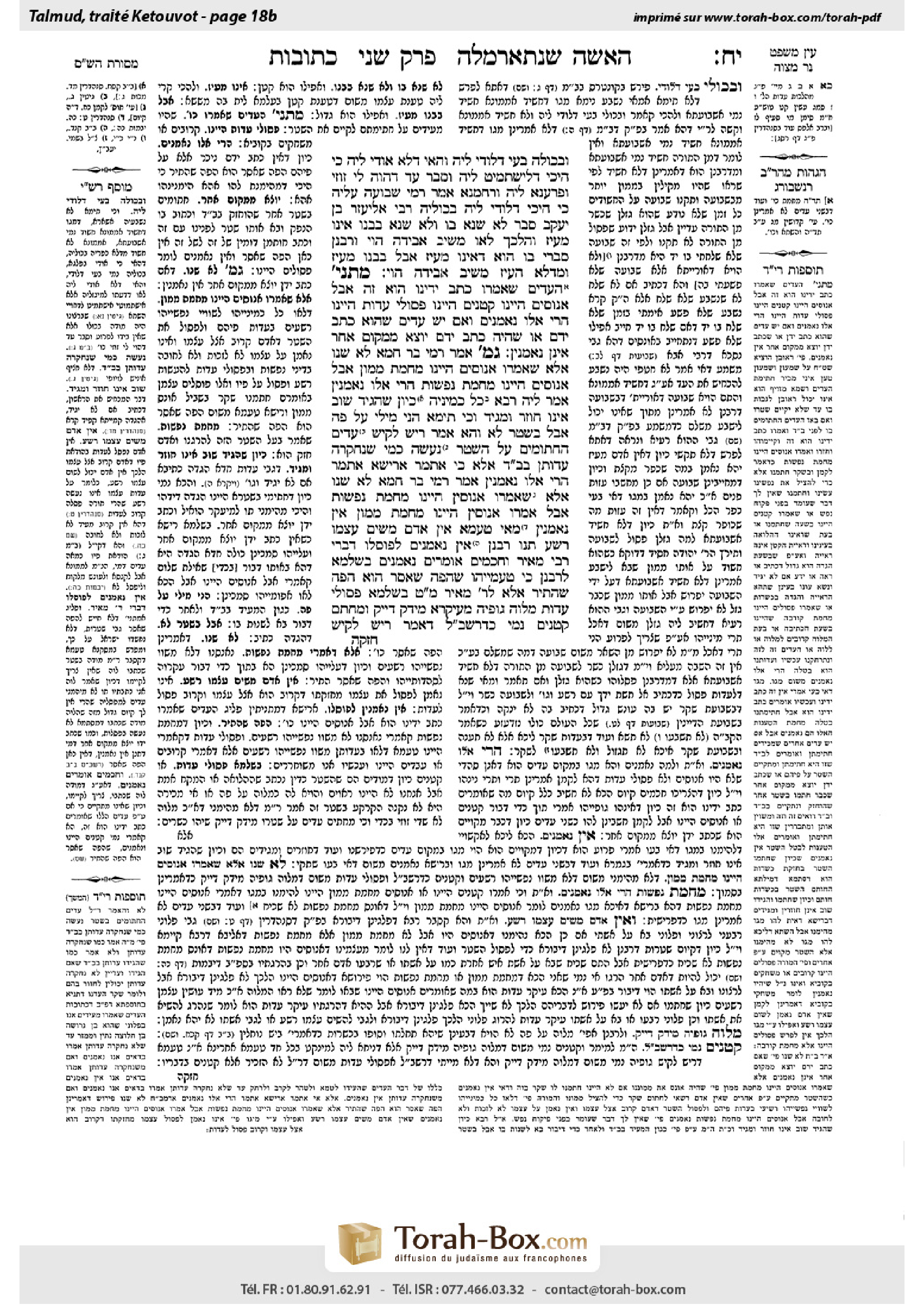
Ketubot 18b: Talmud study for Daf Yomi
Daf Yomi is the daily study of one Talmud folio. Explore 37 tractates with scans, Hebrew text, Sefaria English and AI-generated French translations where annotated.
Passage selection and English or AI-generated French translation are available where the scan has annotations. Daf Study is independent of Torah-Box and Sefaria.
Browse Ketubot · כתובות · All tractatesKetubot 18b text and translations
This page of Ketubot includes the Aramaic text, an English translation and an AI-generated French translation, alongside the scan above.
כתובות י״ח ב · Aramaic and Hebrew text
וּבְכוּלַּהּ בָּעֵי דְּלוֹדֵי לֵיהּ. וְהַאי דְּלָא אוֹדִי לֵיהּ — כִּי הֵיכִי דְּלִישְׁתְּמִיט לֵיהּ, וְסָבַר: עַד דְּהָוֵה לִי זוּזֵי וּפָרַעְנָא לֵיהּ. וְרַחֲמָנָא אָמַר: רְמִי שְׁבוּעָה עֲלֵיהּ, כִּי הֵיכִי דְּלוֹדֵי לֵיהּ בְּכוּלֵּיהּ.
רַבִּי אֱלִיעֶזֶר בֶּן יַעֲקֹב סָבַר: לָא שְׁנָא בּוֹ וְלָא שְׁנָא בִּבְנוֹ, אֵינוֹ מֵעִיז, וְהִלְכָּךְ לָאו מֵשִׁיב אֲבֵידָה הָוֵי. וְרַבָּנַן סָבְרִי: בּוֹ הוּא דְּאֵינוֹ מֵעִיז, אֲבָל בִּבְנוֹ — מֵעִיז. וּמִדְּלֹא הֵעִיז — מֵשִׁיב אֲבֵידָה הָוֵי.
מַתְנִי׳ הָעֵדִים שֶׁאָמְרוּ: כְּתַב יָדֵינוּ הוּא זֶה, אֲבָל אֲנוּסִים הָיִינוּ, קְטַנִּים הָיִינוּ, פְּסוּלֵי עֵדוּת הָיִינוּ — הֲרֵי אֵלּוּ נֶאֱמָנִים. וְאִם יֵשׁ עֵדִים שֶׁהוּא כְּתַב יָדָם, אוֹ שֶׁהָיָה כְּתַב יָדָם יוֹצֵא מִמָּקוֹם אַחֵר — אֵינָן נֶאֱמָנִין.
גְּמָ׳ אָמַר רָמֵי בַּר חָמָא: לֹא שָׁנוּ אֶלָּא שֶׁאָמְרוּ ״אֲנוּסִים הָיִינוּ מֵחֲמַת מָמוֹן״. אֲבָל ״אֲנוּסִים הָיִינוּ מֵחֲמַת נְפָשׁוֹת״ — הֲרֵי אֵלּוּ נֶאֱמָנִין.
אֲמַר לֵיהּ רָבָא: כֹּל כְּמִינֵּיהּ?! כֵּיוָן שֶׁהִגִּיד — שׁוּב אֵינוֹ חוֹזֵר וּמַגִּיד. וְכִי תֵּימָא: הָנֵי מִילֵּי עַל פֶּה, אֲבָל בִּשְׁטָר — לָא, וְהָא אָמַר רֵישׁ לָקִישׁ: עֵדִים הַחֲתוּמִים עַל הַשְּׁטָר — נַעֲשָׂה כְּמִי שֶׁנֶּחְקְרָה עֵדוּתָן בְּבֵית דִּין!
אֶלָּא, כִּי אִתְּמַר — אַרֵישָׁא אִתְּמַר: הֲרֵי אֵלּוּ נֶאֱמָנִין, אָמַר רָמֵי בַּר חָמָא: לֹא שָׁנוּ אֶלָּא שֶׁאָמְרוּ: אֲנוּסִין הָיִינוּ מֵחֲמַת נְפָשׁוֹת, אֲבָל אָמְרוּ: אֲנוּסִין הָיִינוּ מֵחֲמַת מָמוֹן — אֵין נֶאֱמָנִין. מַאי טַעְמָא: אֵין אָדָם מֵשִׂים עַצְמוֹ רָשָׁע.
תָּנוּ רַבָּנַן: אֵין נֶאֱמָנִים לְפוֹסְלוֹ, דִּבְרֵי רַבִּי מֵאִיר. וַחֲכָמִים אוֹמְרִים: נֶאֱמָנִים. בִּשְׁלָמָא לְרַבָּנַן כִּי טַעְמַיְיהוּ, שֶׁהַפֶּה שֶׁאָסַר הוּא הַפֶּה שֶׁהִתִּיר. אֶלָּא לְרַבִּי מֵאִיר, מַאי טַעְמָא? בִּשְׁלָמָא פְּסוּלֵי עֵדוּת, מַלְוֶה גּוּפֵיהּ מֵעִיקָּרָא מִידָּק דָּיֵיק וּמַחְתֵּם. קְטַנִּים נָמֵי, כִּדְרַבִּי שִׁמְעוֹן בֶּן לָקִישׁ. דְּאָמַר רֵישׁ לָקִישׁ:
Ketubot 18b · English translation
And, as a result, he would have liked to admit to him that he owes him the entire loan. And the reason that he did not admit to him that he owes him the entire loan is so that he may temporarily avoid paying him. And he rationalizes doing so, saying to himself: I am avoiding him only until the time that I have money, and then I will repay him. Due to the concern that the partial admission is motivated by that rationalization and the claim of the lender is true, the Merciful One says: Impose an oath upon him so that he will admit that he owes him the entire loan.
Rabbi Eliezer ben Ya’akov maintains: It is no different with regard to the creditor himself, and it is no different with regard to his son. The debtor would not be so insolent as to deny the debt. And therefore, he is not considered as one returning a lost article on his own initiative. Rather, he is considered as one who partially admits his debt in response to a claim, and is therefore required to take an oath. However, the Rabbis maintain: In the presence of the creditor one would not be insolent, but in the presence of his son, who did not lend him the money, he would be insolent and deny the claim entirely. Since he had the option of completely denying the loan and opted to admit to part of the claim, he is considered as one returning a lost article and his claim is accepted without an oath.
MISHNA: With regard to the witnesses who said in their testimony to ratify their signatures in a document: We signed the document and this is our handwriting; however, we were compelled to sign, or we were minors when we signed, or we were disqualified witnesses, e.g., we are relatives of one of the parties, they are deemed credible. Since the document is ratified on the basis of their testimony, it is likewise invalidated on the basis of their testimony. However, if there are other witnesses who testify that it is their handwriting, or if their handwriting emerges on a document from another place, enabling confirmation of their signatures by comparing the two documents, then the witnesses who signed the document are not deemed credible. The document is not invalidated based on their testimony, because ratification of the document is not dependent on their testimony, as their signatures can be authenticated independently.
GEMARA: With regard to the latter clause in the mishna, in which it is stated that if there is independent corroboration of the signatures of the witnesses the document is not invalidated based on their testimony, Rami bar Ḥama says: The Sages taught this halakha only in a case where they said: We were compelled to sign the document due to a monetary threat. Their testimony incriminates them, as they testified falsely for money, and the principle is: The testimony of one who incriminates himself is not accepted. However, if the witnesses said: We were compelled to sign the document due to a threat to our lives, they are deemed credible, as that testimony is not self-incriminating, since in that case it is permitted to testify falsely.
Rava said to Rami bar Ḥama: Is it within their power to retract their testimony? There is a principle: Once a witness stated his testimony in court, he cannot again state testimony that contradicts his previous testimony. And if you say that this principle applies specifically to oral testimony, but with regard to testimony in a document, no, the principle does not apply and one may retract that testimony, didn’t Reish Lakish say: The legal status of witnesses who are signatories on the document becomes like those whose testimony was cross-examined in court. Therefore, just as one may not retract oral testimony, neither may he retract written testimony.
Rather, when the statement of Rami bar Ḥama is stated, it is stated with regard to the first clause of the mishna, that if there is no independent corroboration of their signatures they are deemed credible. Rami bar Ḥama said: The Sages taught this halakha only in a case where the witnesses said: We were compelled to sign the document due to a threat to our lives, as in that case they do not incriminate themselves. However, if the witnesses said: We were compelled to sign the document due to a monetary threat, they are not deemed credible. What is the reason that they are not deemed credible? It is based on the principle: One does not render himself wicked, and self-incriminating testimony is not accepted.
§ The Sages taught: Witnesses who testify to invalidate their signatures on a document are not deemed credible to invalidate the document; this is the statement of Rabbi Meir. And the Rabbis say: They are deemed credible. The Gemara asks: Granted, according to the Rabbis, their opinion corresponds to their reasoning stated previously: The mouth that prohibited it, i.e., ratified the document, is the mouth that permitted it, i.e., invalidated the promissory note. However, according to Rabbi Meir, what is the reason that their testimony to invalidate the document is not accepted? Granted, their testimony that they were disqualified witnesses is not accepted, as the lender himself initially ascertains that the witnesses are fit to testify and only then signs them on the document. Similarly, according to Rabbi Meir, their testimony that they were minors is also not accepted, in accordance with the statement of Rabbi Shimon ben Lakish, as Reish Lakish said:
Ketubot 18b · Traduction française (IA)
Et, par conséquent, il aurait voulu reconnaître devant lui qu’il lui devait la totalité du prêt. S’il ne lui a pas reconnu devoir la totalité du prêt, c’est afin de pouvoir différer temporairement le paiement. Il se justifie en se disant : « Je ne fais que me dérober à lui jusqu’à ce que j’aie de l’argent, et alors je le rembourserai. » Parce qu’il est à craindre que cette reconnaissance partielle soit motivée par cette justification et que la réclamation du prêteur soit fondée, le Miséricordieux dit : « Impose-lui un serment, afin qu’il reconnaisse devoir la totalité du prêt. »
Rabbi Eliezer ben Ya’akov soutient que cela ne fait aucune différence qu’il s’agisse du créancier lui-même ou de son fils. Le débiteur n’aurait pas l’insolence de nier la dette. Il n’est donc pas considéré comme quelqu’un qui restitue spontanément un objet perdu. Il est plutôt considéré comme quelqu’un qui reconnaît partiellement sa dette en réponse à une réclamation et doit donc prêter serment. Les Rabbins, toutefois, soutiennent qu’en présence du créancier, on n’aurait pas l’insolence de nier la dette, mais qu’en présence de son fils, qui ne lui a pas prêté l’argent, on aurait cette insolence et on nierait entièrement la réclamation. Puisqu’il aurait pu nier complètement le prêt et qu’il a choisi de reconnaître une partie de la réclamation, il est considéré comme quelqu’un qui restitue un objet perdu, et sa déclaration est acceptée sans serment.
MICHNA : Au sujet des témoins qui déclarent, en déposant pour faire authentifier leurs signatures sur un document : « Nous avons signé le document et voici notre écriture ; toutefois, nous avons été contraints de signer », ou « Nous étions mineurs lorsque nous avons signé », ou « Nous étions des témoins inaptes », par exemple parce que nous sommes parents de l’une des parties, ils sont jugés dignes de foi. Puisque le document est authentifié sur la base de leur témoignage, il est également invalidé sur la base de leur témoignage. Cependant, s’il existe d’autres témoins qui attestent que l’écriture est la leur, ou si leur écriture figure sur un document provenant d’ailleurs, ce qui permet de confirmer leurs signatures en comparant les deux documents, les témoins qui ont signé le document ne sont pas jugés dignes de foi. Le document n’est pas invalidé sur la base de leur témoignage, car son authentification ne dépend pas de leur témoignage : leurs signatures peuvent être authentifiées indépendamment.
GUEMARA : À propos de la dernière partie de la Michna, où il est dit que, si les signatures des témoins sont corroborées indépendamment, le document n’est pas invalidé sur la base de leur témoignage, Rami bar Ḥama dit : Les Sages n’ont enseigné cette halakha que dans le cas où les témoins ont dit : « Nous avons été contraints de signer le document sous la menace d’un préjudice financier. » Leur témoignage les incrimine, puisqu’ils ont témoigné faussement pour de l’argent, et le principe est le suivant : le témoignage de quelqu’un qui s’incrimine lui-même n’est pas accepté. Cependant, si les témoins ont dit : « Nous avons été contraints de signer le document sous la menace de mort », ils sont jugés dignes de foi, car ce témoignage ne les incrimine pas eux-mêmes, puisqu’en pareil cas, il est permis de témoigner faussement.
Rava dit à Rami bar Ḥama : « Est-il en leur pouvoir de revenir sur leur témoignage ? » Il existe un principe : dès qu’un témoin a déposé au tribunal, il ne peut plus présenter un témoignage qui contredise son témoignage précédent. Et si tu dis que ce principe ne s’applique qu’au témoignage oral, mais que, s’agissant d’un témoignage écrit dans un document, il ne s’applique pas et qu’il est possible de revenir sur ce témoignage, Reish Lakish n’a-t-il pas dit : le statut juridique des témoins qui ont signé un document est celui de témoins dont le témoignage a été soumis à un contre-interrogatoire au tribunal ? Par conséquent, de même qu’on ne peut pas revenir sur un témoignage oral, on ne peut pas non plus revenir sur un témoignage écrit.
En réalité, la déclaration de Rami bar Ḥama s’applique à la première partie de la Michna : s’il n’existe pas de corroboration indépendante de leurs signatures, les témoins sont jugés dignes de foi. Rami bar Ḥama dit : Les Sages n’ont enseigné cette halakha que dans le cas où les témoins ont dit : « Nous avons été contraints de signer le document sous la menace de mort », car, dans ce cas, ils ne s’incriminent pas eux-mêmes. En revanche, si les témoins ont dit : « Nous avons été contraints de signer le document sous la menace d’un préjudice financier », ils ne sont pas jugés dignes de foi. Pourquoi ne sont-ils pas jugés dignes de foi ? En vertu du principe suivant : une personne ne se rend pas elle-même coupable, et un témoignage qui l’incrimine n’est pas accepté.
§ Les Sages ont enseigné : Les témoins qui témoignent pour invalider leurs signatures sur un document ne sont pas jugés dignes de foi pour invalider le document ; telle est l’opinion de Rabbi Meir. Les Rabbins disent : ils sont jugés dignes de foi. La Guemara demande : Selon les Rabbins, leur opinion correspond bien au raisonnement énoncé précédemment : la même bouche qui l’a interdit, c’est-à-dire qui a authentifié le document, est celle qui l’a permis, c’est-à-dire qui a invalidé la reconnaissance de dette. Cependant, selon Rabbi Meir, pourquoi leur témoignage visant à invalider le document n’est-il pas accepté ? Il est logique que leur témoignage disant qu’ils étaient des témoins inaptes ne soit pas accepté, puisque le prêteur vérifie d’abord que les témoins sont aptes à déposer et ne les fait signer sur le document qu’ensuite. De même, selon Rabbi Meir, leur témoignage disant qu’ils étaient mineurs n’est pas non plus accepté, conformément à la déclaration de Rabbi Shimon ben Lakish, car Reish Lakish a dit :
Traduction française générée par IA à partir de l’édition anglaise de Sefaria. Vérifie toujours un passage avec le texte source.
Text from Sefaria: William Davidson Edition - Vocalized Aramaic (CC BY NC); William Davidson Edition - English (CC BY NC).