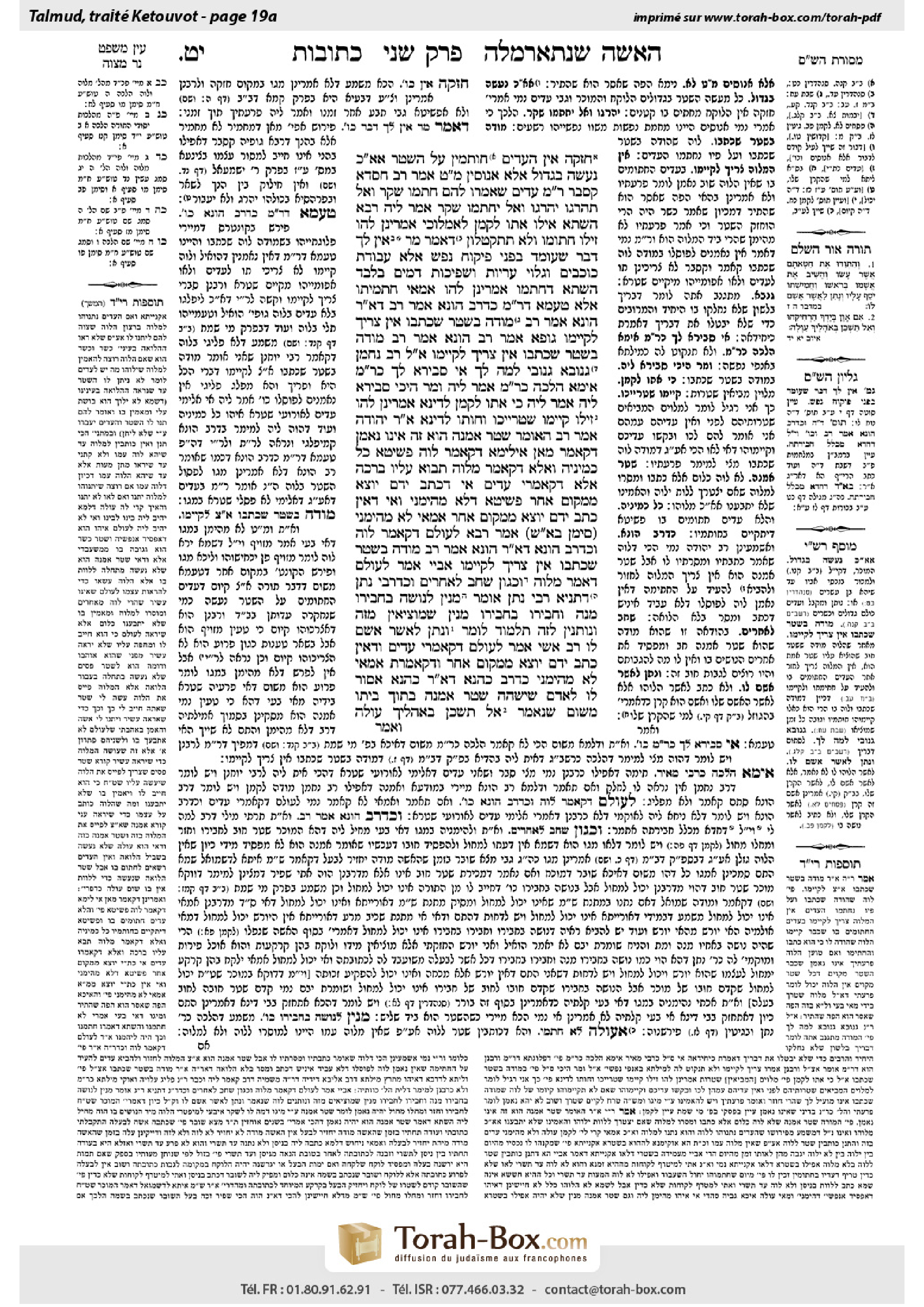
Ketubot 19a: Talmud study for Daf Yomi
Daf Yomi is the daily study of one Talmud folio. Explore 37 tractates with scans, Hebrew text, Sefaria English and AI-generated French translations where annotated.
Passage selection and English or AI-generated French translation are available where the scan has annotations. Daf Study is independent of Torah-Box and Sefaria.
Browse Ketubot · כתובות · All tractatesKetubot 19a text and translations
This page of Ketubot includes the Aramaic text, an English translation and an AI-generated French translation, alongside the scan above.
כתובות י״ט א · Aramaic and Hebrew text
חֲזָקָה אֵין הָעֵדִים חוֹתְמִין עַל הַשְּׁטָר אֶלָּא אִם כֵּן נַעֲשָׂה בְּגָדוֹל. אֶלָּא אֲנוּסִין, מַאי טַעְמָא?
אָמַר רַב חִסְדָּא, קָסָבַר רַבִּי מֵאִיר: עֵדִים שֶׁאָמְרוּ לָהֶם ״חִתְמוּ שֶׁקֶר וְאַל תֵּהָרְגוּ״ — יֵהָרְגוּ וְאַל יַחְתְּמוּ שֶׁקֶר.
אֲמַר לֵיהּ רָבָא: הַשְׁתָּא אִילּוּ אָתוּ לְקַמַּן לְאִמְּלוֹכֵי, אָמְרִינַן לְהוּ: זִילוּ חֲתוּמוּ וְלָא תִּתְקַטְּלוּן, דְּאָמַר מָר: אֵין לְךָ דָּבָר שֶׁעוֹמֵד בִּפְנֵי פִּיקּוּחַ נֶפֶשׁ אֶלָּא עֲבוֹדָה זָרָה, וְגִלּוּי עֲרָיוֹת, וּשְׁפִיכוּת דָּמִים בִּלְבָד. הַשְׁתָּא דַּחֲתַמוּ, אָמְרִינַן לְהוּ: אַמַּאי חָתְמִיתוּ?
אֶלָּא: טַעְמָא דְּרַבִּי מֵאִיר כִּדְרַב הוּנָא אָמַר רַב. דְּאָמַר רַב הוּנָא אָמַר רַב: מוֹדֶה בִּשְׁטָר שֶׁכְּתָבוֹ — אֵין צָרִיךְ לְקַיְּימוֹ.
גּוּפָא. אָמַר רַב הוּנָא אָמַר רַב: מוֹדֶה בִּשְׁטָר שֶׁכְּתָבוֹ — אֵין צָרִיךְ לְקַיְּימוֹ. אֲמַר לֵיהּ רַב נַחְמָן: גַּנּוֹבָא גַּנּוֹבֵי לְמָה לָךְ. אִי סְבִירָא לָךְ כְּרַבִּי מֵאִיר, אֵימָא הֲלָכָה כְּרַבִּי מֵאִיר.
אֲמַר לֵיהּ: וּמָר הֵיכִי סְבִירָא לֵיהּ? אֲמַר לֵיהּ: כִּי אָתוּ לְקַמַּן לְדִינָא, אָמְרִינַן לְהוּ: ״זִילוּ קַיִּימוּ שְׁטָרַיְיכוּ וְחוּתוּ לְדִינָא״.
אָמַר רַב יְהוּדָה אָמַר רַב: הָאוֹמֵר ״שְׁטַר אֲמָנָה הוּא זֶה״ — אֵינוֹ נֶאֱמָן.
דְּקָאָמַר מַאן? אִילֵימָא דְּקָאָמַר לֹוֶה — פְּשִׁיטָא, כָּל כְּמִינֵּיהּ?! וְאֶלָּא דְּקָאָמַר מַלְוֶה — תָּבוֹא עָלָיו בְּרָכָה. אֶלָּא דְּקָאָמְרִי עֵדִים. אִי דִּכְתַב יָדָם יוֹצֵא מִמָּקוֹם אַחֵר — פְּשִׁיטָא דְּלָא מְהֵימְנִי. וְאִי דְּאֵין כְּתַב יָדָם יוֹצֵא מִמָּקוֹם אַחֵר — אַמַּאי לָא מְהֵימְנִי?
(סִימָן בָּאֵ״שׁ) אָמַר רָבָא: לְעוֹלָם דְּקָאָמַר לֹוֶה, וְכִדְרַב הוּנָא. דְּאָמַר רַב הוּנָא אָמַר רַב: מוֹדֶה בִּשְׁטָר שֶׁכְּתָבוֹ — אֵין צָרִיךְ לְקַיְּימוֹ.
אַבָּיֵי אָמַר: לְעוֹלָם דְּאָמַר מַלְוֶה, וּכְגוֹן שֶׁחָב לַאֲחֵרִים, וְכִדְרַבִּי נָתָן.
דְּתַנְיָא, רַבִּי נָתָן אוֹמֵר: מִנַּיִן לַנּוֹשֶׁה בַּחֲבֵירוֹ מָנֶה, וַחֲבֵירוֹ בַּחֲבֵירוֹ — מִנַּיִן שֶׁמּוֹצִיאִין מִזֶּה וְנוֹתְנִין לָזֶה — תַּלְמוּד לוֹמַר: ״וְנָתַן לַאֲשֶׁר אָשַׁם לוֹ״.
רַב אָשֵׁי אָמַר: לְעוֹלָם דְּקָאָמְרִי עֵדִים. וּדְאֵין כְּתַב יָדָם יוֹצֵא מִמָּקוֹם אַחֵר. וּדְקָאָמְרַתְּ אַמַּאי לָא מְהֵימְנִי — כִּדְרַב כָּהֲנָא. דְּאָמַר רַב כָּהֲנָא: אָסוּר לוֹ לָאָדָם שֶׁיְּשַׁהֶה שְׁטַר אֲמָנָה בְּתוֹךְ בֵּיתוֹ, מִשּׁוּם שֶׁנֶּאֱמַר: ״אַל תַּשְׁכֵּן בְּאֹהָלֶיךָ עַוְלָה״.
Ketubot 19a · English translation
There is a presumption that witnesses sign on the document only if the transaction was made when both parties to the transaction are adults. A corollary of that presumption is that each party would sign only adult witnesses to the document. However, if their testimony was that they were compelled to sign the document, what is the reason that Rabbi Meir rules that their testimony is not accepted?
Rav Ḥisda said that Rabbi Meir maintains: Witnesses that others said to them: Sign a document containing a falsehood and you will not be killed, should allow themselves to be killed and they should not sign a document containing a falsehood. Therefore, even when they testify that they were compelled to sign the document due to a threat to their lives, they are incriminating themselves.
Rava said to him: Now, if the witnesses came before us to consult with the Sages, we say to them: Go sign the document and you should not be killed, as the Master said: You have no matter that stands before saving a life, other than idol worship, forbidden sexual relations, and murder. Now that they signed, do we say to them: Why did you sign? Only in those three cases, when faced with a choice between violating the prohibition and being killed, must one be killed rather than violate the prohibition. Signing a false document does not fall into that category. Why then, according to Rabbi Meir, is their testimony that they were compelled to sign the document not accepted?
Rather, the reason for the opinion of Rabbi Meir is in accordance with the statement that Rav Huna said that Rav said, as Rav Huna said that Rav said: In the case of a borrower who admits with regard to a document that he wrote it, the lender need not ratify the document in court. Once the borrower admits that he wrote the document, he cannot then claim that it is forged or that the debt was repaid. Similarly, once the witnesses testify that they signed the document, it is a credible document that they cannot then invalidate (Tosafot).
§ With regard to the matter itself, Rav Huna said that Rav said: In the case of a borrower who admits with regard to a document that he wrote it, the lender need not ratify the document in court. Rav Naḥman said to Rav Huna: Why do you need to conceal the reason for your opinion like a thief? If you hold in accordance with the opinion of Rabbi Meir, say: The halakha is in accordance with the opinion of Rabbi Meir. Do not state your opinion in a manner that obscures its connection to a tannaitic dispute.
Rav Huna said to him: And what does the Master hold in a case where the borrower admits that he wrote the document? Rav Naḥman said to him: When lenders come before us for judgment, we say to them: Go and ratify your documents and descend and stand before us for judgment. If a lender relies solely on the confession of the borrower, the borrower could claim that although he wrote the document, he then repaid the loan. However, if the document was ratified by the court based on the testimony of the witnesses who signed it, the borrower’s claim that he repaid the loan is not accepted.
§ Rav Yehuda said that Rav said: One who says with regard to a document: This is a document of trust, is not deemed credible. If one claims that the document is a valid document but that no loan actually took place, and instead the borrower trusted the lender and gave him the document in order to borrow money in the future, or as security, he is not deemed credible.
The Gemara asks: In the case to which Rav’s statement is referring, who is saying that the document was a document of trust? If you say that it is the borrower who is saying so, it is obvious that he is not deemed credible. Is it within the power of the borrower to establish that the document is not genuine? But rather, say it is the lender who is saying that it is a document of trust. In that case, not only is he deemed credible, but let a blessing come upon him for admitting that a debt may not be collected with this document. Rather, say it is the witnesses who are saying that it is a document of trust. If so, the question arises: If it is a case where their handwriting emerges from another place, it is obvious that they are not deemed credible, as the document is ratified. And if it is a case where their handwriting does not emerge from another place, and the witnesses themselves testify that it is their signatures on the document, but that it was a document of trust, why are they not deemed credible? This is a clear case of: The mouth that prohibited is the mouth that permitted.
The Gemara provides a mnemonic for the names of the amora’im who seek to explain Rav’s statement and resolve the problem: Beit, the second letter in the name of Rava; alef, the first letter in Abaye; and shin, the second letter in the name of Rav Ashi. Rava said: Actually, it is the borrower who is saying it, and it can be explained in accordance with the statement of Rav Huna, as Rav Huna said that Rav said: In the case of a borrower who admits with regard to a document that he wrote it, the lender need not ratify the document in court. In this case, the borrower admits that he wrote the document and had witnesses sign the document. Rav Yehuda teaches the novel halakha that although the borrower later contends that it was a document of trust, once he admits that he wrote the document, that contention is not accepted.
Abaye said: Actually, it is the lender who said it, and it is in a case where he causes loss to others by invalidating the document and relinquishing his debt. If the lender owes money to others and lacks funds to repay his debt, then his invalidation of the document creates a situation where his creditor is unable to collect the debt. This is in accordance with the opinion of Rabbi Natan.
As it is taught in a baraita that Rabbi Natan says: From where is it derived that in a case where a creditor seeks to collect a debt of one hundred dinars from another, and the other person seeks to collect a debt from another, from where is it derived that one takes money from this second debtor and gives it to the first creditor without the money passing through the debtor of the first, who is the creditor of the third? It is derived as the verse states: “And he shall give to the one to whom he is guilty” (Numbers 5:7). One pays the person to whom the money is owed, even if he did not borrow the money directly from him. When the debtor of the first who is the creditor of the third invalidates the document, he causes a loss to his own creditor.
Rav Ashi said: Actually, it is the witnesses who are saying it, and it is a case where their handwriting does not emerge from another place. And with regard to that which you are saying: Why are they not deemed credible, it is in accordance with the opinion of Rav Kahana, as Rav Kahana said: It is prohibited for a person to keep a document of trust in his house, as it is stated: “And let not injustice dwell in your tents” (Job 11:14). This false document is likely to engender injustice when the lender seeks to collect payment with it.
Ketubot 19a · Traduction française (IA)
On présume que les témoins ne signent un document que si la transaction a été conclue alors que les deux parties étaient majeures. Il en découle que chacune des parties ne ferait signer le document qu’à des témoins majeurs. Toutefois, s’ils témoignent avoir été contraints de signer le document, pourquoi Rabbi Meïr décide-t-il que leur témoignage n’est pas accepté ?
Rav Ḥisda dit que Rabbi Meïr soutient ceci : si des gens disent à des témoins : « Signez un document contenant un mensonge, et vous ne serez pas tués », les témoins doivent se laisser tuer plutôt que de signer un document contenant un mensonge. Par conséquent, même lorsqu’ils témoignent avoir été contraints de signer le document sous la menace de mort, ils s’incriminent eux-mêmes.
Rava lui dit : « Or, si les témoins étaient venus nous consulter, nous leur aurions dit : “Allez signer le document et ne vous faites pas tuer”, car le Maître a dit : “Rien ne prime le sauvetage d’une vie, à l’exception de l’idolâtrie, des relations sexuelles interdites et du meurtre.” À présent qu’ils ont signé, leur disons-nous : “Pourquoi avez-vous signé ?” Ce n’est que dans ces trois cas, lorsqu’on doit choisir entre transgresser l’interdit et être tué, qu’on doit se laisser tuer plutôt que de transgresser l’interdit. Signer un document mensonger ne relève pas de cette catégorie. Pourquoi donc, selon Rabbi Meïr, leur témoignage selon lequel ils ont été contraints de signer le document n’est-il pas accepté ? »
La raison de l’opinion de Rabbi Meïr repose plutôt sur ce que Rav Houna a dit au nom de Rav, car Rav Houna a dit au nom de Rav : dans le cas d’un emprunteur qui reconnaît avoir rédigé un document, le prêteur n’a pas besoin de faire authentifier le document au tribunal. Dès lors que l’emprunteur reconnaît l’avoir rédigé, il ne peut ensuite prétendre qu’il est falsifié ou que la dette a été remboursée. De même, dès lors que les témoins attestent avoir signé le document, celui-ci fait foi et ils ne peuvent ensuite l’invalider (Tossafot).
§ À propos de cette question même, Rav Houna a dit au nom de Rav : dans le cas d’un emprunteur qui reconnaît avoir rédigé un document, le prêteur n’a pas besoin de le faire authentifier au tribunal. Rav Naḥman dit à Rav Houna : « Pourquoi dissimules-tu la raison de ton opinion comme un voleur ? Si tu es de l’avis de Rabbi Meïr, dis : “La halakha est conforme à l’opinion de Rabbi Meïr.” N’énonce pas ton opinion d’une manière qui masque son lien avec une controverse tannaïtique. »
Rav Houna lui dit : « Et quelle est ton opinion dans le cas où l’emprunteur reconnaît avoir rédigé le document ? » Rav Naḥman lui répondit : « Lorsque des prêteurs viennent nous demander justice, nous leur disons : “Allez faire authentifier vos documents, puis revenez vous présenter devant nous pour être jugés.” Si un prêteur se fie uniquement aux aveux de l’emprunteur, celui-ci pourrait prétendre que, bien qu’il ait rédigé le document, il a ensuite remboursé le prêt. En revanche, si le document a été authentifié par le tribunal sur la foi du témoignage des témoins qui l’ont signé, l’emprunteur ne peut faire valoir sa prétention selon laquelle il a remboursé le prêt. »
§ Rav Yehouda a dit au nom de Rav : celui qui dit au sujet d’un document : « C’est un document de confiance », n’est pas jugé digne de foi. S’il prétend que le document est valide, mais qu’aucun prêt n’a réellement eu lieu et que l’emprunteur a plutôt confié le document au prêteur afin d’emprunter de l’argent ultérieurement, ou à titre de garantie, il n’est pas jugé digne de foi.
La Guemara demande : dans le cas auquel se rapporte la déclaration de Rav, qui affirme que le document était un document de confiance ? Si tu dis que c’est l’emprunteur qui le dit, il est évident qu’il n’est pas jugé digne de foi. Est-il en son pouvoir d’établir que le document n’est pas authentique ? Mais alors, disons que c’est le prêteur qui affirme qu’il s’agit d’un document de confiance. Dans ce cas, non seulement est-il jugé digne de foi, mais qu’une bénédiction lui soit accordée pour avoir reconnu que cette créance ne peut être recouvrée au moyen de ce document. Disons plutôt que ce sont les témoins qui affirment qu’il s’agit d’un document de confiance. Dès lors, la question se pose : si leur écriture a été identifiée ailleurs, il est évident qu’ils ne sont pas jugés dignes de foi, puisque le document est authentifié. Et si leur écriture n’a pas été identifiée ailleurs, et que les témoins eux-mêmes attestent que les signatures sur le document sont les leurs, mais qu’il s’agissait d’un document de confiance, pourquoi ne sont-ils pas jugés dignes de foi ? C’est un cas manifeste où « la bouche qui a interdit est la bouche qui a permis ».
La Guemara fournit un moyen mnémotechnique pour les noms des amoraïm qui cherchent à expliquer la déclaration de Rav et à résoudre le problème : beit, la deuxième lettre du nom de Rava ; alef, la première lettre d’Abayé ; et shin, la deuxième lettre du nom de Rav Ashi. Rava dit : en réalité, c’est l’emprunteur qui l’affirme, et cela s’explique conformément à ce que Rav Houna a dit au nom de Rav : dans le cas d’un emprunteur qui reconnaît avoir rédigé un document, le prêteur n’a pas besoin de le faire authentifier au tribunal. Dans ce cas, l’emprunteur reconnaît avoir rédigé le document et avoir fait signer celui-ci par des témoins. Rav Yehouda enseigne cette halakha novatrice : même si l’emprunteur prétend par la suite qu’il s’agissait d’un document de confiance, cette prétention n’est pas acceptée dès lors qu’il reconnaît avoir rédigé le document.
Abayé dit : en réalité, c’est le prêteur qui l’a dit, et il s’agit d’un cas où il cause un préjudice à autrui en invalidant le document et en abandonnant sa créance. Si le prêteur doit de l’argent à d’autres et n’a pas les moyens de rembourser sa dette, l’invalidation du document empêche son créancier de recouvrer la dette. Cela est conforme à l’opinion de Rabbi Natan.
En effet, il est enseigné dans une baraïta que Rabbi Natan dit : d’où déduit-on que, lorsqu’un créancier cherche à recouvrer une dette de cent dinars auprès d’une personne, et que cette personne cherche elle-même à recouvrer une dette auprès d’une autre, on prend de l’argent à ce second débiteur et on le donne au premier créancier sans que l’argent passe par le débiteur du premier, qui est le créancier du troisième ? Cela se déduit du verset : « Il donnera à celui envers qui il est coupable » (Nombres 5:7). On paie celui à qui l’argent est dû, même si l’on ne lui a pas emprunté directement. Lorsque le débiteur du premier, qui est le créancier du troisième, invalide le document, il porte préjudice à son propre créancier.
Rav Ashi dit : en réalité, ce sont les témoins qui l’affirment, et il s’agit d’un cas où leur écriture n’a pas été identifiée ailleurs. Quant à ta question : pourquoi ne sont-ils pas jugés dignes de foi ? La réponse est conforme à l’opinion de Rav Kahana, car Rav Kahana a dit : il est interdit de conserver chez soi un document de confiance, ainsi qu’il est écrit : « Que l’injustice ne séjourne pas dans tes tentes » (Job 11:14). Ce faux document est susceptible de provoquer une injustice lorsque le prêteur cherche à en obtenir le paiement.
Traduction française générée par IA à partir de l’édition anglaise de Sefaria. Vérifie toujours un passage avec le texte source.
Text from Sefaria: William Davidson Edition - Vocalized Aramaic (CC BY NC); William Davidson Edition - English (CC BY NC).